Too Scared

Old Testament: Zephaniah 1-3

Poetry: Psalm 140

*New Testament: Matthew 26

I am writing today’s devotion for those that consider themselves strong in their faith.  I’m talking about those of you out there that know there is nothing anyone can do to mess with your salvation.  You are going to stay faithful to the end no matter what may happen.  You just know you would never turn your back on God.  If Peter were around today, I am sure he would say he was in this group, but he surprisingly was not able to keep his word in the past.

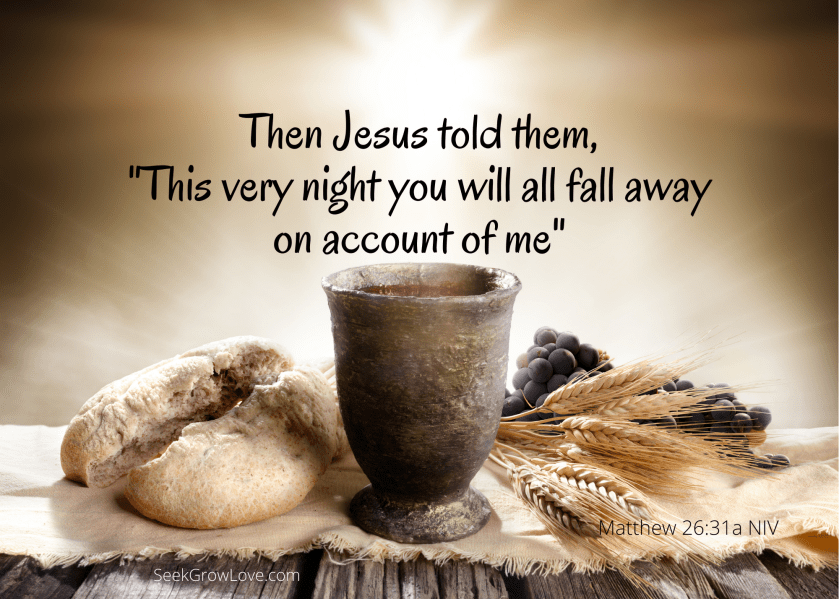
In Matthew 26, Jesus was explaining to the disciples at the last supper that they were all going to fall away on account of him.  Peter spoke up and said that even if everyone else falls away, he never would.  I am sure Peter believed that with his whole heart, but then Jesus described how Peter was going to deny him three times that very night.  At that point, Peter did not politely agree with Jesus; instead, he doubled down on the fact that even if he had to die with him, he would never disown him.  The rest of the disciples then said the same.  So what happened?

Jesus was arrested after Judas betrayed him with a kiss.  A large crowd came to arrest him, and all the disciples deserted him and fled.  That didn’t take long.  They were too scared to stay with Jesus even though they said they would never do that just a few hours earlier.  Peter followed Jesus at a distance, but we know he was confronted three times that night and disowned Jesus all three times.  Why?  Because he was too scared.  He was tipped off it was going to happen that way so he could have been prepared to deal with it, but his fear made him act differently.

Would you be strong enough if you were in the same situation as Peter?  I hope so, but how strong is your faith now?  Does fear ever get in the way of you doing something that should be done?  Have you invited your neighbor to church yet or are you too scared?  Maybe just haven’t gotten around to doing that yet, wink wink.  Are you willing to stick up for some kid at school that is being picked on or are you scared what people might think about you?  Is there a ministry at church you might be good at, but you are too scared to give it a try?  Is there a family member, co-worker, or friend that needs to hear about Christ?  If fear is holding you back in any of these situations, join the Peter club.

I honestly think if you had enough guts to deal with any of these situations, it would probably turn out well, or at the very least, not that bad.  You may get rejected or have people ridicule you, but you may also save a life for eternity.  I am always surprised what risks people will take to save a life for a handful of years now (running into burning buildings, etc.), but they are unwilling to put themselves out there when trying to save lives for an eternity.

Do you know who was really scared to do something he knew needed to happen?  Jesus.  He prayed three times for God to come up with a plan different than him having to die for everyone’s sins.  He was so scared that he said in verse 38 that his soul was overwhelmed with sorrow to the point of death.  He absolutely did not want to do what he was supposed to do.  But in those same prayers, he said he would follow his Father’s will, not his own.  Did the situation turn out to be easy and he was just over-thinking it?  Nope.  He had to go through a terribly painful death.  He was definitely scared, but he wasn’t too scared to do the right thing.

So those of you with the strong faith, Jesus gave you the example to follow.  Is there someone you need to talk to?  Make it happen even if you are scared.  Is there a ministry waiting for you?  Volunteer for that even if it makes you sweat.  Jesus saved a bunch of lives by facing his fear and acting.  Hopefully, you can help save some lives too.

Reflection Questions:

Is there something you should be doing for God that you have put off?  Do you make excuses so you don’t have to admit you are too scared?  Or maybe just try not to think about it?

It’s easy to put things off until later.  Is there anyone in your life that you waited to talk to, but now it is too late because they are gone (died, moved to a different state, got a new job at a different company, etc.)?  If so, how does that make you feel now?

-Rick McClain

Home Alone

Old Testament: Habakkuk 1-3

*Poetry: Psalm 139

New Testament: Matthew 25

Christmas is approaching, and today’s reading of Psalms 139 reminded me of the movie Home Alone.  I suspect most of you are familiar with the family who went on vacation and didn’t realize until they arrived at their vacation destination that they had left their very young son home alone.  This seems like a bit of a stretch; did they not consider why they had a leftover plane ticket?  Anyways, it was a fun movie and I know that probably all parents have forgotten about their kids when they were supposed to be responsible for them many times.  This is how crayon drawings happen on walls, unexpected haircuts happen, etc.  However, today we read that we are never alone, not for a second, literally.

God is always with us, whether you like it or not, ALL the time.  From your very beginning in your mother’s womb to this very minute, He has been with you the whole way.  He doesn’t ever sleep, and He isn’t just in the next room over in case you need some help; He is staring at you all day and night long.  I doubt He even blinks.  That is intense!  But that shows how invested He is in your life.  Moreover, He knows more about you than you know about yourself.  Give that a minute to sink in.  I know myself really well because I can hear all the thoughts in my mind, but He knows me more.  He knows my thoughts before I think them.  Whoa!

He is totally inside my head, but He still gives me the freedom to live the life I want, even when it is something He dislikes.  He allows me to go the wrong direction, but you’ve probably heard Him like I have, saying “don’t do that, that’s a bad idea.”  Can you imagine how He feels when we ignore Him and do what makes us feel good instead?  On the other hand, can you imagine how He feels when we listen to Him in those moments and do the right thing?

Let’s put ourselves in God’s shoes for a minute.  I know, basically impossible, but let’s try anyways.  Let’s imagine that you were as brilliant as God, and you used your talents to create a new girl or boy.  You also loved your new creation more than can be comprehended and you wanted to spend all your time with your new person every minute of every day for their whole life.  Does it seem creepy to love someone so much that you never want to leave them alone?  Maybe, but it also shows the incredible degree of love you have for them.

Now let’s look at some potential scenarios and see how you feel about them.  You love this person immensely and spend all day with them, but in the first scenario, they don’t ever even acknowledge you are there.  I would be devastated and extremely hurt.  How rude!  In the next scenario, they know you are there, but they rarely pay attention to you.  They could go hours or even days not saying a word to you.  Why are they ignoring me?  Do they not like me that much?  In the last scenario, they understand what you did for them and that you are there for them.  They stay in contact with you all throughout every day.  They appreciate what you do for them, and they love you as best as their human hearts allow.  That sounds like a great relationship that both people would feel great about.

God cares about you so much that He is always with you.  He nudges you along the way to keep you on the right path, but He lets you make the decisions in your life.  He invests so much in you because He loves you immensely and wants to have a personal relationship with you.  It is an understatement to say we are fortunate to have someone so knowledgeable, powerful, and loving on our side and so involved in our lives.

Reflection Questions:

Do you realize how important you are to God?  Have you thanked Him for that lately?

There is a lot to be upset and anxious about in today’s world.  Does it make it easier when you stop to consider that God is with you to the end through all the difficult times?

How long do you typically ignore that there is someone (God) with you each day?  Do you acknowledge Him throughout the day, or do you get to the end of the day, and say, “Oh, Hi God, I forgot you were there.  Sorry I didn’t have time to talk today”?

-Rick McClain

This World Stresses Me Out

Old Testament: Nahum 1-3

Poetry: Psalm 138

New Testament: Matthew 24

Wars, diseases, crime, hate, famines, earthquakes, hurricanes, and a bunch of other bad stuff can really stress you out these days.  It really seems to have gotten worse lately.  I am 58 and a half years old, so I was growing up in the 70’s when nuclear weapons became a big topic of the day.  Many Christians I knew were saying that we were in the end times then.  In fact, I remember one person predicted that Christ may be returning in 1982.  Clearly, that wasn’t a very good prediction and it taught me not to make predictions about such things, but I do think events are a lot more aligned now with scripture and the end times could be starting now or soon.  Matthew 24 talks about the end times when things are going to get bad, really bad, but it also gives those who can persevere a lot of hope.

I am not going to review all the signs of the end times mentioned in Matthew 24 here; you can read those yourself.  However, my quick summary that I already mentioned is that it will be bad, really bad.  Jesus warned us in verse 6 that we will hear of wars and rumors of wars, but he also said that we should not be alarmed because these things need to happen before the end comes.  He went on to describe a lot of other disturbing events that will take place.  He was warning us of what is going to happen so we can stay chill during that time.  Unfortunately, he also told us that many would turn away from the faith at that time.  If we didn’t have this warning, I do think it would be difficult to keep our faith when we see the whole world crumbling before our eyes.  But c’mon, if you say you have faith now when you know these bad times are coming, it is not much faith if you abandon it when you see exactly what you already knew was going to happen.  It should increase your faith when you start to see events that were written about 2,000 years ago actually occurring.  That’s impressive.  Moreover, we already know how this story ends, and it is amazingly positive for those who keep their faith to the end.

It is true that some will lose their faith because they just can’t handle all the bad things that are going to happen, but Jesus has another warning for a different group of people.  He talks about a group of people that aren’t ready for his return.  They are people that even believe in Jesus, but they start thinking that he has been gone a long time, so they have more time before they need to get their lives in order.  They think they can live for themselves a bit longer before they need to repent and start living for God.  There are two major problems with that thinking.  First, your life could end today, and you will have missed your chance to be saved.  Second, only God knows when Christ is going to return, and it is going to surprise many people.  Jesus told a story about a master of a servant who will come on a day when he does not expect him and at an hour he is not aware of.  There will be people that put off the decision to live for God because they think they have more time, but instead will find themselves in the place where there will be weeping and gnashing of teeth.  It will be too late the same way it was too late for all the people in Noah’s time who didn’t believe Noah until it started raining.

This has all been explained to us in scripture so you really shouldn’t be surprised when it happens.  It was explained to us beforehand so we can stay calm and know that once this happens, we will see the Son of Man coming on the clouds of heaven, with power and great glory.

Reflection Questions:

Does this world stress you out or do you realize that God is in control, and everything is going to turn out great in the end for His people?

Are you glad Jesus warned us of the bad things that are going to happen or would you rather have not known and be surprised when it happens?  Do you think it would be easier to keep your faith in the end if you knew what was going to happen or if you were in the dark?

-Rick McClain

Inside vs. Outside

Old Testament: Micah 5-7

Poetry: Psalm 137

New Testament: Matthew 23

We are all concerned with how we look to others on the outside, and that is a good thing.  The outside is all the stuff people can see about us.  It is how we physically look, the things we own, the words we say, our actions, our reputation, etc.  It might sound a bit vain to be concerned about what others think about us, but it is ok to want to be accepted by others and you will have more influence with others if they like you and respect you.  The inside is all our thoughts and desires, and others cannot hear our thoughts or know if we are being honest about our desires.  We can hide our true thoughts and desires from those around us, although nothing is hidden from God.  Which is more important?  The way others see us on the outside or what we are thinking on the inside?

I think they are both important and we should be concerned about both.  But what happens if we concentrate on only one or the other?  In Matthew 23, Jesus talks about a group of people that were only concerned about the outside.  The Pharisees and teachers of the law were overly concerned about what other people thought of them.  They made their phylacteries (boxes containing scripture verses worn on their forehead and arm) wide and the tassels on their garments long for people to see.  They loved places of honor at banquets and the most important seats in the synagogues.  They loved to be greeted with respect and to be called ‘Rabbi’ by others.  They gave a tenth to God’s work, but they neglected justice, mercy, and faithfulness.  They appeared to be righteous on the outside, but they were full of hypocrisy and wickedness on the inside.  Jesus detested the way they lived because it was not honest, and they only did it to impress others.  They were arrogant hypocrites, and that’s not a good look on the inside or outside.

Similarly, if we are ultra concerned about how our bodies look, the clothes we wear, the car we drive, the house we live in, etc., we are concentrating on the wrong things because we are trying too hard to impress others so we can feel good about ourselves.  That is also not a good look reputation-wise because we are lacking humility.  On the other hand, please brush your teeth, take a shower, and take care of your house and yard enough so others won’t think you don’t care.

So, what happens if you only concentrate on the inside?  I love what Matthew 23:25-26 had to say about this.  Jesus was ripping on the Pharisees and teachers of the law again by saying they clean the outside of the cup and dish, but inside they are full of greed and self-indulgence.  He goes on to tell them to first clean the inside of the cup and dish, and then the outside will also be clean.  That is brilliant!  If you concentrate on your thoughts and desires on the inside that others can’t see, it will affect how you look on the outside to others.  In other words, focus on the inside and the outside will take care of itself.

If you love God and love others on the inside, your words and actions will look beautiful to others because of your love for them and because you are not putting yourself first.  Verse 12 says, “For those who exalt themselves will be humbled, and those who humble themselves will be exalted.”  It is important to look good on the outside and inside, but you need to focus on getting the inside right, not the outside.  The better you look on the inside, the better you will look on the outside as well.  You will be a truly humble and loving person, rather than an arrogant hypocrite.

Reflection Questions:

Should we be concerned about what others think about us?  Why or why not?

What are some practical steps we can take to “work on our insides”?

-Rick McClain

His Love Endures Forever

Old Testament: Micah 3 & 4

Poetry: Psalm 136

New Testament: Matthew 22

If you are like me, it is troubling to watch what is happening today over in Israel.  Many lives have been lost in the Israeli Hamas war.  I feel bad for the innocent people who have lost their lives.  Moreover, I am confused about what I want to happen.  Of course, peace is the ultimate goal, but does blood have to be shed to reach that goal?

I wouldn’t necessarily pick such a grim and complex topic for a daily devotion, but I couldn’t help but think about what is happening today when I was reading today’s chapters in Micah, Psalms, and Matthew.  The topics were not all warm and fuzzy, in fact, they were quite violent at times.  I’m not sure what I read helped me frame my view of the war today, but I got a glimpse into the mind of God.  I still have more questions than answers, but I feel I am more prepared to understand why the events will unfold the way they will.

Let’s start with Micah.  When I heard what was happening in Israel, my first thought was that Israel was God’s chosen people and you really don’t want to mess with them if you value your own life.  I already know who wins in the end, and it is Israel.  But then I thought about all the times Israel turned their backs to God and bad things happened to them.  In Micah 3:9-12, it talks about the rulers of Israel who despised justice, distorted what was right, built Zion with bloodshed, and built Jerusalem with wickedness.  They thought that the Lord was among them so no disasters would come upon them.  Instead, because of them, Jerusalem became a heap of rubble.  Does this describe the leaders of Israel today?  Is it possible they are trying again to build up Jerusalem with wickedness and bloodshed?  Are they going against what God wants to happen when innocent people are killed?

Would God, the most loving being there is, be ok with so many people dying in a war?  Strangely enough, the answer to that came in Psalms 136.  The second part of all 26 verses says, “His love endures forever.”  It is a whole chapter that talks about many ways that God loved his people.  It starts out nice enough when it talks about how good He is and how He created great wonders for us, but it gets a bit weird later.  It talks about His love enduring forever because He struck down the firstborn of Egypt, swept Pharoah and his army into the Red Sea, struck down great kings, and killed mighty kings.  It is strange to read a verse that says, “to Him who struck down the firstborn of Egypt, His love endures forever.”  I don’t usually consider killing children as a sign of His love enduring forever.  However, it was a sign of His love because he did it to help His chosen people.  He loved the Israelites so much, that He was willing to kill others that were against them.  Is it possible Hamas is being killed because of God’s love for the Israeli’s?

The chapters from Micah and Psalms are sufficient in framing the discussion, but I was surprised to see that even Matthew had a little bit to say about the subject.  The parable of the wedding feast includes the king who was so enraged, he sent his armies to destroy the murderers and set their city on fire.  And the chapter ends with Jesus quoting David who said, “Sit at my right hand, until I put your enemies beneath your feet.”  These two examples in Matthew were not necessarily referring directly to the issue we are talking about today, but I thought it was interesting that God did not rule out violence to solve some of the problems talked about in Matthew.

I already mentioned I don’t have complete clarity about this war today, but in my position, I think that is fine.  I am not the one deciding how much death and destruction will occur and I really don’t think either side would listen to me anyways if I had an opinion.  I care about what is happening, but I am just not directly involved.  I am ok watching what is happening, and I think it will become clear with time how God wants this to play out.  My prayer is for peace, but I will be patient to see how that peace comes about.  Perhaps true peace won’t even occur until a time that Micah talked about in chapter 4 – when Jesus returns.  I will also pray for that day to come soon.

Reflection Questions:

Do you think God is an active participant in this war or is He just watching what is happening?

What is your prayer for this war?

-Rick McClain

Popularity – and Rejection

Old Testament: Micah 1 & 2

Poetry: Psalm 135

New Testament: Matthew 21

As we come to the Christmas season, reading about these last days of Jesus puts a different light on the passage. 

At the beginning of the chapter, we see Jesus riding into Jerusalem on a donkey as the king he was prophesied to be.  This lines up with what was expected from his birth!  And yet, as we continue to read though the last parable in the chapter, we see that rejection starting to come.

In the parable of the tenants, we see a landowner who planted a vineyard, took care to put in safety precautions, then rented it out when he moved.  He sends his servants back first to collect the harvest.

The result?  One is beaten, another killed, and a third stoned.  He sends more servants, and they continue to treat them in the same way.

Finally, the landowner decides to sends his son, certain that he will be respected.  Instead, the tenants kill the son in an effort to steal his inheritance. 

Jesus explains that those who behave in this way – those that reject God’s servants, and ultimately his son – will have the kingdom taken away from them and given to someone else who will produce fruit.

Those who are reading these devotions are probably Christians.  But do we have times in our lives where we reject God’s son all the same?  Probably not an outright rejection or denial, but we might push him to the side of our lives or we might not be willing to speak of the gospel in front of others which is another way of denying him.

As we get closer to Christmas, let’s remember the amazing miracle of Jesus’ birth through the ultimate proof that he was the Messiah by his resurrection and focus on sharing the good news rather than denying his name.

~Stephanie Fletcher

A short bio about me: I live in Minnesota with my husband and our two kids – 5 & almost 3.  We may be a little crazy, but a couple of years ago, we bought a home with my parents – it is like two regular sized homes stacked on top of each other, and we all live there together.  For a short while, my sister, her husband, and their baby lived there too.  We live there with our dog, Indiana (a compromise from Han Solo or Ford based on my liking of Harrison Ford), and a pet fish – Mickey Rainbow Mermaid Fish (name courtesy of my daughter as technically, it’s her pet).

Reflection Questions

  1. What can you learn from Jesus in how he handled popularity? And, from how he handled rejection? 
  2. How have your actions or words (or lack thereof) been a denial of Jesus Christ?
  3. How can you do better? 
  4. What fruit is the landowner looking for? 

Your Compassion

Old Testament: Jonah 3 & 4

Poetry: Psalm 134

New Testament: Matthew 20

I do not care for the ending of Jonah.  It is such a cliffhanger to me.  I love to read stories.  And when I read stories, my judgment on the quality is if it makes my stomach clench throughout.  Even a book I have re-read 5 times can have that same effect on me.  I know I’m involved with the characters when that happens.  And Jonah is a pretty good story.  But if the ending of this book was in the ending of another book I have read, I would be quite upset.  I want to know what happened!

So post-preaching to the Ninevites, Jonah has a bad attitude.  He starts out in a good mood, sitting down to wait for the smiting of his enemies.  But as time goes on and it doesn’t happen, he gets grumpy.  To the point of comedy in my opinion.

Do we see that in our own lives?  Maybe not the waiting for the smiting of enemies (or maybe for some readers, that is true), but just for the fulfillment of what we want?  Maybe you have something in your mind of how things should go, and you are happily waiting to see that happen.  But when it doesn’t, you get angry, grumpy, and over-dramatic.  Do we stop to think that maybe what we want isn’t always the best way?

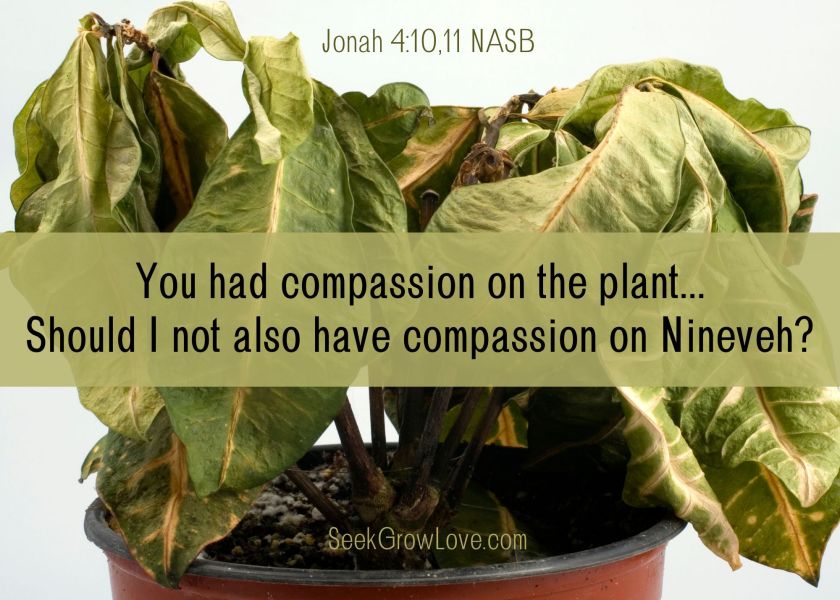
God’s response to Jonah in the last chapter is powerful to me.  He says to Jonah, “I made them, who are you to decide they need to die?  You care more about a plant that you didn’t even plant than these living, breathing people that I designed.” (not actually a quote from Scripture – my paraphrase).

Do you ever care more about what you want to have happen than the people God designed?  Again, it might not be that you are waiting for them to die.  But maybe you are more upset that your order at a restaurant was messed up than the fact that the person taking your order was having a really bad day and made a mistake.  Maybe you want so much to be proven that you are the most right about something at school or work or church that you are alienating people that you could be having an impact on?

When you are focused on yourself and what you want, remember that other people matter too. The fact that someone managed to show up for work might be a huge victory for them, even if your order got messed up.  Taking the time to care about people more than your own selfish, petty desires, not only can improve someone else’s life, but your own too.

~Stephanie Fletcher

Reflection Questions

  1. How would your rate Jonah’s compassion? God’s compassion? Your compassion?
  2. When do you find yourself more focused on what you want than on what others need and how you can serve them?
  3. What do you learn from Jonah in the book of Jonah? What do you learn about God in the book of Jonah?

Reluctant Obedience

Old Testament: Jonah 1 & 2

Poetry: Psalm 133

New Testament: Matthew 19

The book of Jonah fascinates me.  I think the main reason is that my understanding of it has changed so much since I first heard the story as a child.  And honestly, even now when I read it, my opinion of Jonah is still changing as I keep changing.

In children’s’ classes, the story of Jonah is typically used as an example of obedience to God.  He didn’t listen at first, but then he was swallowed by a large fish and changed his mind and went and did what God told him to do.  So that was my opinion of Jonah growing up for the most part – great example of obedience.

I know I had read through the whole book, but I must have glossed over the ending.  As a parent, I understand why most classes do stop at Jonah’s obedience to God in going to Nineveh.  My kids need good examples.  They don’t really need more ideas of bad behavior or attitudes – they can come up with plenty on their own.

When I got a little older and continued to read through this story, it finally struck me – yes, Jonah did obey God’s direction to go to Nineveh, but 1) that was after he had been swallowed by a giant fish, lived, and was spit back out, and 2)his behavior is like a child telling a sibling they were sorry for hitting them because they were told by their parents to do that.  Not because they really felt sorry and wanted to, but because they were made to.  His obedience didn’t really seem to come from the heart.

And we see that as the book continues.  He did what God asked.  He told the Ninevites that they were doing bad things and that God was going to destroy their city.  And this changed their lives!  They turned from their evil ways – at least for a time; we do know they went back to evil – but Jonah didn’t care about that.  He only wanted to see the destruction that he preached.

While this isn’t the example I want to present to my children, I get it.  Jonah speaks to me as an adult as a reminder that I can’t just do the “right” thing.  I have to do it with the right heart.  It reminds me of 1 Corinthians 13 which lists all these things that one could do that are good, but says “but if I have not love, I am nothing.”  We can do all the right things.  By the book.  But if we do them without love, does it really matter? 

The Ninevites were saved for a time by Jonah’s preaching.  His reluctant obedience made a difference for their lives.  But did it make a difference in Jonah’s own life?  I think God can use our reluctant obedience to still make a breakthrough to others, to serve them.  But when we do things without love, we miss out on the best God has for us – the joy and blessings of serving.

More on Jonah tomorrow.

~Stephanie Fletcher

Reflection Questions

  1. When have you obeyed – but reluctantly and with a wrong heart? In your case was that better than not obeying at all? How might have things been different if you had obeyed – done the right thing – with a right heart?
  2. Re-read Jonah’s prayer in Jonah 2. What do you learn from Jonah in this prayer?

Refocus

Old Testament: Obadiah

Poetry: Psalm 132

New Testament: Matthew 18

Who is the greatest?  The GOAT (is that still a thing)?  This is what the disciples come to Jesus asking at the beginning of Matthew 18.

Jesus doesn’t answer them directly, per usual.  Their question isn’t even worth answering.  It doesn’t matter who is the greatest.  That comes with the wrong focus.  Instead Jesus tells them:

And he said: “Truly I tell you, unless you change and become like little children, you will never enter the kingdom of heaven. Therefore, whoever takes the lowly position of this child is the greatest in the kingdom of heaven. 

Your position is not important.  Rather, not viewing yourself as the greatest will put yourself in a better, more humble position.

There are several parables in this chapter, and I think you could probably tie them all to humility in some way, but I want to look at the last section.  It starts with:

21 Then Peter came to Jesus and asked, “Lord, how many times shall I forgive my brother or sister who sins against me? Up to seven times?”

22 Jesus answered, “I tell you, not seven times, but seventy-seven times.[g]

That is going to require humility.  When someone sins against us, we probably feel we are in the right to be angry or to hold a grudge.  After all, they sinned against me.  But Jesus’ instructions don’t allow for this kind of pride.  Instead, we are to go on forgiving our fellow Christians time and time again, swallowing our pride, pushing it aside, for the sake of forgiveness.

We might think this is unfair, but through the parable Jesus tells of the unmerciful servant, we can see that God forgives us so much!  For us to accept God’s forgiveness for our own sins, but to hold another’s sins against them is prideful.  It is saying that you deserve forgiveness more than them, or that your sins weren’t as great.

Instead, Jesus wants us to humble ourselves, to admit that we are just as low, or even lower, than others and offer the grace to others that we have been given.

Humility is a topic that has come up often in my discussions and readings the last few months.  It is hard – it is against our human nature.  But I really believe it is one of the most important things for us to focus on.  And likely, it isn’t a one-time thing.  We need to constantly be reminded and refocus on humility to make sure that pridefulness doesn’t seep into our lives, because pride does come naturally.  But humility is key.  It is key to forgiveness, to serving others, to spreading the gospel.  Your message will be better received if it comes from a place of humility rather than pride.

~Stephanie Fletcher

Reflection Questions

  1. What does pride look like? What does humility look like? Why do you think Jesus teaches humility? Which type of person do you prefer to be around? 
  2. When and how does pridefulness seep into your life? What has helped you remember and practice humility?

The Search for Knowledge?

Old Testament: Amos 7-9

Poetry: Psalm 131

New Testament: Matthew 17

Our Psalm reading starts today with this verse:

My heart is not proud, Lord,
    my eyes are not haughty;
I do not concern myself with great matters
    or things too wonderful for me.

When reading through this, I had two thoughts on this first verse from different perspectives.

  1. Do we sometimes try to understand things that we just really can’t understand?  There are some people who want to know the answer to everything.  And searching for knowledge isn’t inherently bad.  But does it become so much of a priority that it is leading you toward pride?
  2. On the other hand, do we let this become an excuse to just say “well, I guess we can’t know” and give up on the pursuit of truth and knowledge?

I think there probably has to be a balance between these two things.  When I don’t know the answer to something (that I believe to be unanswerable – not like a math problem that has a clear answer), it just doesn’t bug me.  I know other people who just have to know and they spend so much time searching and studying and still not finding answers which frustrates them.  But I do let that be an excuse at times to not search for an answer and give up on something that I could know more about.

The passage goes on to say, “But I have stilled and quieted my soul […] O Israel, put your hope in the LORD both now and forevermore.”

That’s the key.  Our hope shouldn’t be found in knowledge.  Our hope should be in the LORD.  We should be at peace with the things that are above our understanding.  But I also think we should try to know the LORD as best as we can with our human minds.  In John 17:3, it says, “Now this is eternal life: that they know you, the only true God, and Jesus Christ, whom you have sent.”  Eternal life is to know God and His Son Jesus.  And we can’t know Him if we don’t spend time pursuing Him even if we can’t have all the answers.

So we should be doing what we can to know and understand God, but also let go of our desire to have the answer to everything, humble ourselves, and live in peace knowing that God’s ways are greater than our own.

~Stephanie Fletcher

Reflection Questions

  1. Is there some information you are content not knowing? Like what?
  2. Have you ever found yourself struggling with pride because of what you do know? How can you practice humility instead?
  3. What do you think God wants us to know about Him and His Son?
  4. Do you ever misplace your hope and put it in yourself and all you know and can do – instead of in God? What is the remedy?