Share Jesus – at all costs

Acts 4-6

            Earlier this year, in June, I experienced a first.  Let me walk you through the moment.  I was preaching at the North Hills Church of God in Springfield, Ohio, as I do every Sunday.  At this point in time, our church chose to worship outside because there were a lot of unknowns of the Coronavirus.  There were very strict rules in place to help prohibit the spread of the virus.  During my message, a police officer slowly pulled through our long driveway and checked what was taking place.  For a split second, I thought that I was maybe going to get in trouble for hosting a large group gathering.  I thought I could get in trouble for preaching to a group of people.  It was the first time in my life that I ever wondered whether or not I would get in trouble with preaching God’s Word.

            To say that we have it pretty easy in the United States is quite the understatement.  I praise God that we have the freedom to share God’s Word with others without even having the fear of being persecuted.  I have spent all of maybe 5 seconds in my life thinking that I could get in trouble/persecuted for sharing God’s word.  If I had to guess, I would say that most people reading this would have a similar experience to myself.  There are people today who do not have this luxury, and this was especially true in the book of Acts

            In Acts chapter 4, our heroes, Peter and John, were sharing God’s Word with others.  When they did this, they were arrested and presented before the Jewish council.  The council questioned Peter and John, and the council commanded them to no longer share the good news about Jesus and remain silent.

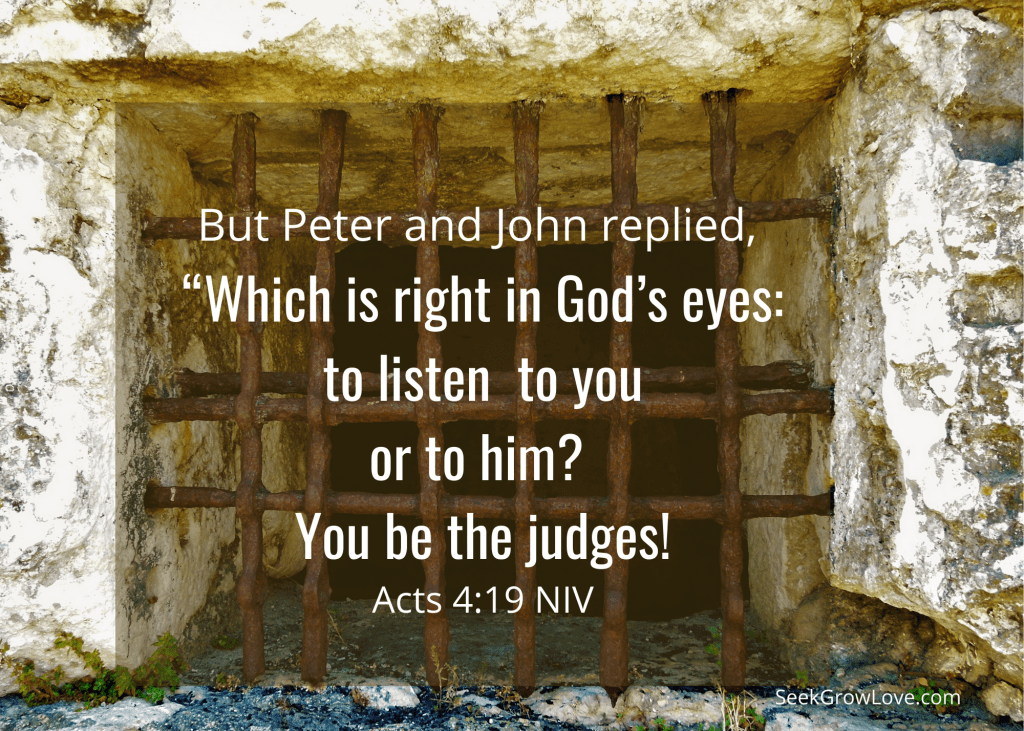
            I absolutely love Peter and John’s reply to this command to remain silent: “Whether it is right in the sight of God to listen to you rather than to God, you must judge, for we cannot but speak of what we have seen and heard,” (Acts 4:19,20).  Burn baby to you, council!  Peter and John made it obvious to the council, that they must listen to the voice of God over the voice of men.  They had to preach the good news of Jesus, for that is what God wanted them to do, not the council.  Peter and John did not care what the consequences would be for preaching about Jesus.

            Peter and John were eventually released after receiving more threats from the council.  Word got out of what had taken place to Peter and John.  The Christ followers responded by praying to God for boldness.  The early Christ followers did not succumb to the external pressures of the world.  Rather, they prayed to God and came together as one to share this radical message of the Messiah.

            These Jesus followers gave their all to further spread this message.  They were even willing to contribute all of their possessions to spread the knowledge of Jesus the Messiah, and that is literally what they did.  They pooled all of their possessions together for the good of the gospel message (outside of a few greedy people *cough* Ananias and Sapphira *cough*).

            My oh my!  Imagine what good we could accomplish today if we had the same mindset of the Jesus followers in Acts.  These people had no cares in the world what would happen to them for sharing the gospel message, even though the threat was very real and evident.  All they did was pray for more boldness, and it didn’t stop with just their voices either.  They were willing to give all of their possessions to help spread this gospel message.

            What great examples these early Jesus followers provide for us today.  In comparison, today, we seem to be a whole lot more reserved in our approach to spread this gospel message.  Maybe we should take a note from the early church and take some more extreme measures in our life to spread the gospel message.  If we do, God can work so many wonderful wonders in and through us. 

            Be bold and give it all to God!

-Kyle McClain

Today’s Bible passage can be read or listened to at BibleGateway here – Acts 4-6

Tomorrow we continue the exciting, inspiring historical account of the early church with Acts 7-8. Come read along!

Be A Witness

Acts 1-3

If you have been following along with the SeekGrowLove devotions for the past 1.5 months, we have been able to take a look at the life and ministry of Jesus through the four gospels.  What a crazy, action-packed time during Jesus’ ministry on earth.  Today, we transition into the book of Acts, and we get to see how Jesus’ disciples will respond to these couple crazy years with Jesus.  As we near the end of 2020, we are all too familiar of what it looks like to live through some crazy events.  As we read through the book of Acts, we can take some notes of how Peter, Paul, and others responded to the crazy events revolving around Jesus.

Before Jesus ever ascended to heaven (yep, not even Jesus went to heaven right after his death), he spent 40 days preaching about the Kingdom of God.  Right before Jesus’ ascension, he told his disciples to, “Witness in Jerusalem and in all Judea and Samaria, and to the end of the earth,” (Acts 1:8). 

The order of locations that Jesus provides is important.  He starts off with Jerusalem; Jerusalem was basically the home base for the Jews and early Christians.  They first needed to witness to their home base of Jerusalem.  Then, they needed to witness in Judea and Samaria; that consists of the land surrounding the city of Jerusalem.  After they have witnessed to the surrounding area, then they had a calling to witness to the ends of the earth.  The book of Acts follows this exact blueprint, which I find to be so fascinating.  Chapters 1-7 are all witnessing in Jerusalem.  Chapters 8-9 consists of them witnessing in Judea and Samaria.  Then, chapters 10-28 cover the disciples, Paul, and others witnessing to the ends of the earth: Caesarea, Antioch, Asia Minor, Greece, and Rome.

We can learn a lot from this blueprint that Jesus provided for his disciples.  We have a calling to witness to those right around us, whether that be your family, friends, coworkers, etc.  Studies show that the most effective mode of evangelism is relational evangelism.  We are best able to spread the news to people we have a relationship with.  Are you using your relationships with nonbelievers, as an instrument to spread the gospel message of the Kingdom?  When you have spread the gospel message to those around you, are you helping that message be spread throughout the ends of the earth?  We have better capabilities now than ever to spread the gospel message to the ends of the earth.  Let’s take advantage of those capabilities.

We can’t go through Acts 1-3 and not mention Peter’s killer sermon in chapter 2.  It is truly one of my favorite sermons ever recorded.  Peter absolutely brings it to the Jews.  You can feel his passion for his Lord and Savior in this message, and he shares this passion with the Jews, the same people who had him crucified (as Peter so gracefully informs them)!  If you want to see someone who is on fire for God and his son, Jesus, then look no further than Peter’s message here in Acts chapter 2.  I hope and pray that we can reflect this passion in our lives today.

I look forward to covering the first half of Acts with you all.  It’s my prayer that we can all learn from the wonderful examples of Peter, Paul, and others throughout this wonderful book.  Witness to those around you, and then help spread that message to the ends of the earth!

-Kyle McClain

Today’s Bible reading passage can be read or listened to at BibleGateway here – Acts 1-3.

Tomorrow we continue this exciting book, with Acts 4-6. Now’s a great time to jump on board and finish 2020 strong with a daily reading of God’s Word as we watch to see how the world responds to the life, teaching, death and resurrection of God’s Son, Jesus. Let’s get ready for his return!

All the Scriptures Point to Christ

Luke 24 & John 20-21

The closing sections of Luke and John’s gospel are rife with personal encounters and dialogues with the risen Jesus. These interactions with Jesus and Peter, the two men on the Emmaus road, the women at the tomb, and the various other interactions show the personality and humanity of Jesus. Jesus shows his sense of humor on the Emmaus road, he eats a meal with his disciples, and restores and forgives Peter.

In the midst of these interactions Jesus, as he always does, teaches. I’d like to draw our focus to what Jesus tells the two men on the Emmaus road in Luke 24.27. Luke writes, “Then beginning with Moses and with all the prophets, he explained to them the things concerning himself in all the scriptures”. This verse is pregnant with meaning and significance! This verse states very clearly that Jesus is the centerpiece of scripture. All roads in the Bible lead to Jesus Christ. Notice that the verse says, “Starting with Moses and the prophets.”. Moses represents the writings of the Pentateuch and the prophets represent all the major and minor prophets. Starting from those two places Jesus taught the men that the entirety of the Old Testament points toward to himself. 

This teaches us that the whole of the Bible is beneficial and needed for believers. A whole Bible makes a whole Christian. For Jesus, the disciples, Paul, and the early church the Old Testament was their Bible. The New Testament is built off of the foundation of the Old Testament. Not only do we learn about Jesus in the gospels and the New Testament but in light of the New Testament we see Jesus in the Old Testament. That’s why I love and encourage Bible reading plans that take you through the whole of scripture. Jesus is the crowning Jewel of scripture. From Genesis to Lamentations to Obadiah a road to Christ can be found. Now I would warn against over reading Jesus into texts but this is where interpreting correctly is important.

The take away is Jesus can be found in all the scriptures, therefore, let us read the whole of scripture and learn of Jesus. 

-Jacob Rohrer

Today’s Bible reading passages can be read or listened to at BibleGateway here – Luke 24 and John 20-21

Tomorrow we begin the exciting book of Acts to see what happens after Jesus’ resurrection – Acts 1-3

The Promise of Jesus’ Presence

Matthew 28 & Mark 16

Praise God that Jesus was raised from the dead and lives forevermore! Today we close out the gospel of Matthew and Mark with reading about Jesus’ resurrection from the dead. I want to focus in on the last phrase of Matthew 28 and the closing phrase of the gospel where Jesus says, “Lo, I am with you always, even to the end of the age” (Matthew 28:20 NASB)

Just a few lines earlier Jesus declared that all authority in heaven and on earth has been given to him and then charges his disciples to make disciples. Concluding his final words he promises them he will always be with them and never leave them. Not only did Jesus promise to always be with his original disciples but he promises to always be with all who follow him. What a comforting truth especially during this season of life all of us are living. Life in general is tough but living as a Christian, a true follower of Jesus, can be even tougher at times. Take heart and remember that you are never alone. The resurrected all-powerful living Christ abides with his people! 

-Jacob Rohrer

Today’s Bible passages can be read or listened to at BibleGateway here – Matthew 28 & Mark 16

Tomorrow we will finish the other two gospel accounts – Luke 24 and John 20-21 as we continue on our chronological Bible reading plan through 2020.

A Kingdom Not of this World

Luke 23 & John 18-19

At the time this devotion is being written the election for the president of the United States will take place in five days. As American Christians the realities of democracy, patriotism, and freedom run deep in our veins. The way Jesus describes his kingdom to Pilate in John 18 is something not only each American Christian needs to be reminded of but each Christian wherever they live needs to be reminded of. As Christians our primary citizenship is not the country we currently reside in, it is the kingdom of God. 

Jesus says to Pilate in John 18.36, “My kingdom is not of this world”. “Not of this world” means, not of this present world system. The kingdom Jesus presides over operates in a totally different realm than the kingdoms of this present evil age do. And because we belong to God this means we are citizens of a different kingdom (Phil. 3.20). We are citizens of the kingdom of God first then citizens of our natural country second. 

While all of us are saturated with the current country and culture we live in, we should remember, our citizenship is with the kingdom of God primarily and we are to live out the kingdom life in whatever context we live in. As followers of Christ our lives are to be lived against the grain of the current ways of life, just like how Jesus said his servants wouldn’t fight over him because they belonged to a kingdom that was not of this world

-Jacob Rohrer

Today’s Bible passages can be read at BibleGateway here – Luke 23 & John 18-19

Tomorrow we will read Matthew 28 and Mark 16.

What Does Jesus’ Death Mean?

Matthew 27 & Mark 15

Why is this devotion being written? Why are you reading this devotion? Why have you experienced supernatural life change in the name of Jesus? It’s all because of what we read in today’s section of Matthew and Mark, the crucifixion of our Lord Jesus Christ. The gospel accounts give us a point of view perspective of the final moments of the Messiah’s life. Why did Jesus die? According to Jesus it’s because it was the purpose of his life (Mk. 10.33-34), Judas betrayed him, and the Jewish leadership sought out his execution. 

But when we leave the gospels and enter Acts, the epistles, and the apocalypse (Revelation) new light is shed upon old truths about what happened at the cross of Christ. The rest of the New Testament, if you will, tills the soil of what we read in the gospels to reveal truths and realities bound in the death of Jesus. The cross is like a diamond when held up to the light. Depending on which way you hold the diamond the light will refract differently and reveal different aspects of the diamond. The cross is a multi-dimensional event with a number of faith-building, worship-inducing, Christ-glorifying truths and realities for the believer to soak up in the scriptures and to be consumed by the love of Jesus and the Father. 

This morning we will look at three meanings of the cross:

1. Jesus died to demonstrate the righteousness of God (Romans 3.25)

According to Paul in Romans 3.25 Jesus’ death demonstrated or put on display the righteousness of God. What is the righteousness of God? The righteousness of God is God’s own holy, perfect, blameless, and just character and being. Sin is a capital offense against God. Because he is holy, just, and good he cannot allow sin and rebellion to go unpunished. If he did this, he would then be unjust and not good. When Jesus died his blood covered every past, present, and future sin. Jesus’ death satisfied the wrath of God. When we look at the cross it tells us not only how much God loves us, it also shows us how much God hates sin and the penalty for sin. The death of Jesus demonstrates God’s perfect judgement and character. The cross says God will not let sin go unpunished. 

2. Jesus died to disarm the powers of Satan and darkness (Col.2.13-15)

When Jesus’ blood was shed the power that satan and darkness had over humanity was relinquished. The biggest weapon Satan and spiritual darkness can have against you is your own sin and from that, guilt, shame, and other consequences of sin. But when Jesus’ blood was shed the power and slavery that sin held over humanity was broken. The blood cancelled out our certificate of debt (list and penalty of sins) therefore, the power Satan once had was taken away. This is similar to Jesus’ teaching in Mark 3.22-27. The way Jesus conquered victoriously over the power of satan and spiritual darkness is through his death. Paul says in I Corinthians 2, that had the “the rulers of this age” (spiritual powers of darkness) had known what would have happened after Jesus died they “would not have crucified the Lord of Glory”. The death of Jesus breaks the yoke of slavery and oppression over our lives, we are rescued from the power of satan. 

3. Jesus died to provide us an example to follow in our own Christian walks (I Pet. 2.21)

Jesus, though he was tried and executed unjustly, still endured the cross to save his sheep (John 10). He surrendered his privileges and his rights and humbled himself for the eternal benefit of others. Likewise, we as Christians should consider the plight of Jesus and imitate him. When we are treated unjustly and unfairly we should not return evil with evil but instead love. When we suffer for doing the right thing we ought to entrust ourselves to God as Jesus did to his Father. 

When you read Matthew 27 and Mark 15 these three realities among others are present when Jesus breathed his last on the cross.

-Jacob Rohrer

Today’s Bible reading passages can be read or listened to at BibleGateway here –Matthew 27 & Mark 15

Tomorrow’s reading will be Luke 23 and John 18-19.

Jesus’ Final Teachings

John 14-17

The contents of John 14 to 17 are Jesus’ final words to his disciples (except Judas) and his prayer to his Father moments before he is handed over. The one dominating overarching theme in these four chapters is the absolute unchallenged supremacy, beauty, and glory of our Lord Jesus Christ. Jesus states the following:

“I am the way, the truth, and the life; no one comes to the Father but through me” 

– John 14.6

“If you ask me anything in my name, I will do it” – John 14.14

“Peace I leave with you; my peace I give to you; not as the world gives do I give to you. Do not let your heart be troubled, nor let it be fearful” – John 14.27

“Just as the Father has loved me, I have also loved you; abide in my love” – John 15.9

“These things I have spoken to you, so that in me you may have peace. In the world you have tribulation but take heart I have overcome the world” – John 16.33

“…these things I speak in the world so that they may have my joy made full in themselves” – John 17.13

What Jesus prays for in chapter 17 is what he taught and instructed in chapter 14 to 16. Jesus prayed for each believer to have unity with him, to be filled with his joy, to be sanctified in the truth. The life we have in Jesus is so beautiful and precious. Jesus Christ is the living water. Let us drink from him deeply and without reservation. Let us be always dependent and in communion with Jesus. Abiding and communing with Christ is the key to realizing the fullness of joy, peace, and love. In addition, we see the work of the Father, the work of the son, and the work of the spirit active in lives of those whom God has saved. The Father has chosen us, the son has died for us and bought our salvation, and the spirit makes us alive.

To God be the glory in the name of Jesus Christ by the power of the Holy Spirit!

-Jacob Rohrer

Today’s Bible passage can be read or listened to at BibleGateway here – John 14-17

Make sure you come back tomorrow when we will read Matthew 27 & Mark 15. We are getting to the end of the gospels.

Love Like Jesus

Luke 22 & John 13

John 13 is the only chapter in the four gospels that record Jesus washing his disciples’ feet. In John 13.34 Jesus teaches “A new commandment I give to you, that you love one another, even as I have loved you, that you also love another”. What is the newness of this commandment Jesus gives his disciples and to us? I believe it is the phrase “even as I have loved you”. The way believers are to love each other is no longer patterned after how we would want to be loved (Lev.19.18) but there is a new way to love each other. The new pattern of love is Jesus himself. 

What does it mean to love other Christians like Jesus? This is a very tall order! Where do we start?! I believe the washing of the disciples feet provides a framework for what Jesus had in mind when he said love each other as I have loved you. 

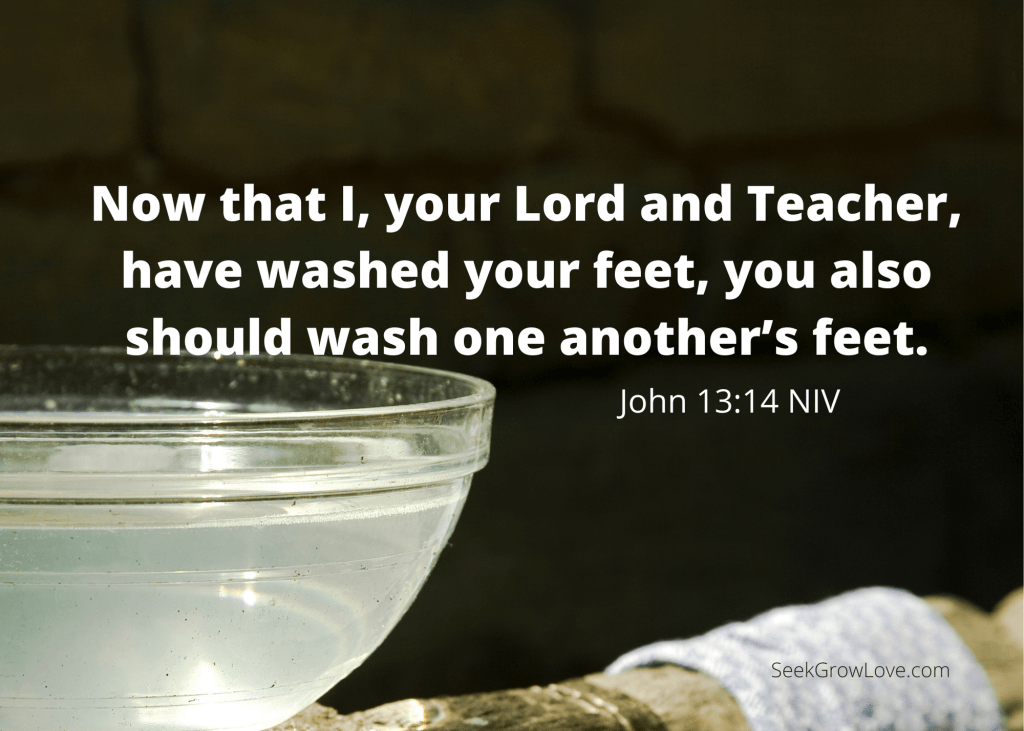
There are two lessons/principles we can learn from Jesus in this account that we can emulate in our lives towards other believers. The first one can be read in John 13.4-5,12-15. Jesus illustrates humility. Jesus as Lord and teacher took the position of a common house servant when he got on his hands and knees and girded himself with a towel to wash feet. If anyone’s feet should have been washed it was Jesus yet the holy selfless Lord and teacher put aside his rightful privileges to serve his students. Jesus humbled himself. Likewise we as Christians are called to humble ourselves before each other and seek out the interest of others before ourself (Eph. 4.2, 5.21, Phil. 2.3-5). 

The second lesson we can learn form Jesus is that to love each other involves humbling ourselves before each other and serving one another in practical ways. The act of washing feet in antiquity served a very practical purpose. Most people wore open-toed shoes or sandals and people walked everywhere. The result was people’s feet would easily become dirty, rough, and caked with filth. No one would want to track the dirt through someone’s home so either the homeowner or a servant would wash the guests feet as they came in. It was practical for the guest and the homeowner. 

What is involved in loving other Christians as Jesus loved us? Looking at the real life illustration of Jesus washing his students’ feet, we learn to love one another involves humbling ourselves before others and serving them in practical ways. 

-Jacob Rohrer

Today’s Bible passages can be read or listened to at BibleGateway here – Luke 22 & John 13

Tomorrow we will read John 14-17.

The Most Needed Ministry

Matthew 26 & Mark 14

In the closing moments of Jesus’ life after the last supper he took his three closest disciples and prayed. Jesus was a man of prayer and it is fitting that in the final moments before he is handed over he prays to his Father. I cannot emphasize enough the importance of prayer. Many of us are guilty of not praying as we ought to. Look at the degree to which Jesus expected his three closest disciples to pray. In Matthew 26.36-41 and Mark 14.32-38 he asks them to remain and watch while Jesus went off and prayed. Watch and pray are synonymous words. To watch is to pray and to pray is to watch. 

When Jesus comes back the first time he questions Peter, James, and John and says, ”You couldn’t keep watch for an hour?” Jesus expected his disciples to pray for a whole hour! Many of us can only last a few minutes let alone an hour. If prayer was important to Jesus and his ministry and his relationship with God CERTAINLY it must be a priority for us. I would venture to say prayer is one of the most neglected and undervalued ministries. Jesus never believed prayer was expendable, neither should we. 

Do you want to grow with God? Do you want to grow in spirituality? Do you want deeper intimacy in your relationship with God and other believers? Do you want to combat spiritual darkness? Do you want to see people saved? Pray. Pray. Pray. 

If we will give ourselves over to the ministry of prayer and intercession God will grow and mature us. Prayer is too valuable to discard, it’s too precious to pass over, and it’s too powerful to be ignored.

Lord Jesus stir in our hearts a desire and hunger for prayer! Raise up men and women who will pray! Amen!

-Jacob Rohrer

Today’s Bible passages can be read or listened to at BibleGateway here – Matthew 26 & Mark 14

Tomorrow we will read Luke 22 & John 13.

Test Yourself!

Matthew 25

Today as we look at Matthew 25 we should take notice that though we are starting a new chapter the context surrounding this chapter is the same as that of chapter 24. Matthew 24 and 25 are a single unit of thought. This can be seen in verse 1 with the word “then” (the NIV says “at that time”) indicating what Jesus was speaking about in chapter 24 is continuing into chapter 25. The focus of the chapter is about the end of this age when Jesus returns and the judgement that he will enact. 

There are three pictures of judgement in chapter 25. The first two are parables (the parable of the ten virgins and the parable of the talents) and the last one is a description of the judgement scene. 

In the first parable there are ten virgins who wait for the bridegroom. The bridegroom delays in appearing and all fall asleep but suddenly the bridegroom appears but only five are ready for the bridegroom while the other five are not ready and they are denied entrance into the wedding feast. The virgins denied entrance are then told by the bridegroom he never knew them. 

The second parable is about a master and his slaves. The master gives each slave a talent (an amount of money) and went on a journey. When the master returns only two of the three slaves honored the master with what they were given. The third slave squandered his talent and is rebuked by the master and the slave is thrown out into the outer darkness.

The third picture of judgement involves Jesus separating goats from sheep among the nations. The sheep and goats represent those who belong to Jesus and those who do not. The sheep (believers) are rewarded with the kingdom and the goats (non-believers) are cast into hell with satan and his demons. 

What are we to make of this chapter? What does Jesus want us to learn from these three pictures of judgement? I believe it is this.

There is a judgement coming and not everyone who calls themself a Christian will enter into life. The reality is, not everyone who calls themself a Christian is a true believer. In all three teachings there is one group of people who are then divided into those who are accepted and those who are rejected. Many people comprise the Church but not everyone who attends church is a true believer. The judgement of Christ sorts out the self-deceived from the real believers. Jesus himself teaches this earlier in Matthew 13.24-30, 36-43 in the parable of the tares. And he also teaches this in Matthew 7.21-22. 

Who are you? Are you deceived or a true believer in Christ? The five virgins were accepted into the feast because they were ready and prepared. The 2 slaves were honored by the master because they were faithful with what the master had given them. And the sheep entered the kingdom because they loved and served other Christians in need. 

A true believer will have evidence of salvation in their life. A true believer bears the fruit of the spirit, they grow in holiness, they grow in their disdain for sin, they hunger for the scriptures, they serve other Christians and people. A real believer matures and grows in Christ.

Paul tells the Corinthians in II Cor. 13.5 to test themselves against the scriptures to see if they are in the faith. Compare yourself to scripture and to the words of Jesus. Have you really received salvation from God? In addition to this, talk with mature believers closest to you about this serious matter if you question your salvation.

-Jacob Rohrer

Today’s Bible passage can be read or listened to at BibleGateway here – Matthew 25

Tomorrow we will read Matthew 26 and Mark 14.