Truth Matters

1 Samuel   5-6 & John 18

I was a teenager when the movie Raiders of the Lost Ark first hit the theatres.  It instantly became one of my all-time favorite movies.  I love the Indiana Jones character and this particular adventure, searching for the Ark of the Covenant, was especially cool to me because it drew from Biblical themes.  The Ark of the Covenant was a real thing containing real power.  What would happen if it was found and fell into the wrong hands, like the Nazi’s?  It was a great story.  It got pretty intense toward the end when they tried to open the Ark.  Spoiler alert: it doesn’t end well for the Nazi’s.

The Nazi’s in the story should have spent less time plotting the genocide of the Jews and global domination and more time reading their Bibles, because the story of the Ark in 1 Samuel 5-6 should have discouraged them from having anything to do with the Ark. (I know, Raiders of the Lost Ark is fiction- but what happens to the Philistines in today’s reading is True).

One thing we know from reading the Bible is that God doesn’t like to share His glory with idols.  God is the one True God and He alone created everything, gives life, sends rain to produce crops and blesses people with fertility.  God takes it very personally when people build statues for other “so called” gods and give them credit for sending rain or helping babies to be born.

I find the story of the Philistines stealing the Ark of the Covenant and bringing it in the temple of their “god”  Dagon humorous.  Dagon was the main god of the Philistines and they offered sacrifices to Dagon so that they could have fertility- their cattle, and their wives.  They wanted lots of cattle to feed their bellies, and they wanted lots of sons to grow up and serve in the army to fight their enemies.  So they prayed and offered sacrifices to Dagon so that Dagon would make their cows and their wives fertile.

We might excuse the ignorance of the Philistines because maybe they didn’t know any better, maybe no one told them the Truth about the True God.  But God made it quite clear to His chosen people, Israel, that they were to worship and serve God alone.  But they were often tempted to worship other gods.  Several stories in the Old Testament show how God was superior and defeated other “so called” gods.  Elijah called down fire from heaven and defeated the prophets of Baal.  Samson’s last act after he had been captured and blinded was to push down the pillars of the temple to Dagon and kill a bunch of the Philistines.    And here, when the Ark of the Covenant is brought into another temple of Dagon,  The statue of Dagon falls down the first time, then falls down again breaking the idol  into pieces.  The Philistines of that town are afraid so they send the Ark to another town.  There, everybody gets tumors and they end up in a panic.  Everywhere the stolen Ark is taken trouble comes to the Philistines, so finally they bring the Ark back to Israel along with a guilt offering (golden tumors and rats, what a thoughtful gift).

The Philistines had trouble discerning fact from fiction- the true God, YHWH, the God of Israel, vs. Dagon, a statue that was quite brittle when it fell to the ground.

Truth matters.  In today’s reading in John 18, after Jesus is arrested and brought to trial, he appears before Pilate, who is the highest representative of the Roman Empire in the region who ultimately decides all capital cases, who lives and who dies.

Pilate is a politician caught between his boss, Caesar, who has tasked him to keep the Jewish people in line and the Jewish people who can turn on him and cause trouble.  He has to carefully consider the political implications of what he’s being asked to do.  Like many politicians and people in charge, he is more of a pragmatist than anything else.  What is going to work out to my best interests here?  He asks Jesus some questions and Jesus gives an answer that he finds quaint.  Jesus answered: “The reason I was born and came into the world is to testify to the truth. Everyone on the side of truth listens to me.” 

Truth?  How naïve.  You might imagine the amusement (or scorn) in Pilate’s response when  he asks Jesus: “What is Truth?” 

If the idea of truth was a quaint notion to a first century Roman politician, it’s become reviled and scorned by 20th and 21st century intellectuals.  We live in a time of Postmodernism.  Absolute truth has been replaced by relativism.  Truth is whatever the people who have the power to control government, the news, the arts and higher education say it is.  Truth is what Facebook, or Twitter, or Google’s “fact checkers” say it is. 

Whether you and I like it or not we are in the midst of a culture war.  It’s the same one that’s been going on since the serpent tempted Eve to question God.  It’s the same one that was going on in the temple of Dagon when the stolen Ark  was brought in, it’s the same one that was going on when the Jewish leaders lied about Jesus and brought him to Rome to be condemned and executed, it’s the one that was going on when Pilate asked, “What is truth?”  It’s going on today in a society where the things we’ve always believed about God and virtue,  right and wrong, and pretty obvious things like basic human biology, are all being questioned and redefined.  Gender isn’t about biology it is a social construct.  If you start introducing facts or science or Truth, you will receive as much scorn as Jesus received from Pilate.  But it is a culture war and Jesus told Pilate  that there are two sides: one side is false and the other is true.  Jesus said that if you are on the side of Truth you listen to Jesus.  Pilate chose his side, and so he did what was politically correct and had Jesus crucified to appease the Jewish people.  The question you and I must ask ourselves is whose side am I on?  Am I on the side of Truth, that listens to the words of Jesus?  Pick a side.

-Jeff Fletcher

Today’s Bible reading can be read or listened to at BibleGateway here 1 Samuel 5-6 and John 18

Your Servant is Listening

1 Samuel 3-4 and John 17

When was the last time you were purposefully silent?  No headphones on with iTunes or Netflix playing in your ears?  No talking with someone else, just you in silence?

One respected Christian writer says: “Silence is a kind of substance in which we are able to experience eternity. It is a substance that enters into our souls and if we don’t have it, our souls become impoverished.”- Dallas Willard, Dmin. Lecture, Fuller Seminary 2012

We are constantly surrounded by noise, aren’t we?  In actual fact, I think most of us like it that way.  Having noise going on makes us feel less… alone.  Of course, we don’t like too much noise all the time.  We can also relate to The Grinch:

“For tomorrow, I know, all those Who girls and boys, will wake bright and early, they’ll rush for their toys, and then… Oh the noise! Oh the noisenoisenoisenoise! There’s one thing I hate: oh the noisenoisenoisenoise!”- The Grinch in How the Grinch Stole Christmas, Dr. Seuss.  

            We want enough noise to distract us but not so much noise as to irritate us.

My iPhone 12 now tells me when I’m being exposed to too much noise.  Yesterday, I was mowing my grass and decided that I would listen to a book on my iPhone’s  Audible program ( ironically the book I was listening to was about the spiritual disciplines including… silence) while I mowed with my headphones on.  In order to hear it over the loud noise of my lawnmower I had to have the volume turned up to full.  My iPhone didn’t like that and told me I needed to turn it down. (iPhones tell us when and how to do almost everything- when to wake up, how to get where we want to go, when it’s time get up and move around, and turn down that music- iPhones are now our nagging parent I guess).

I have eleven children, most are now adults, but when they were all small, noise was simply a fact in our house.  If I wanted quiet I had to go someplace else.  During that time I went to a monastery and spent several days in a silent retreat.  There was no noise. None.  We were not to speak to other people, not even a hello when you passed them in the hall, no chit chat at the dinner table.  Just 5 days of silence.  A strange thing happened to me during that time of silence.  For the first time in my life I really heard God speak to me.  Why did I hear God speak to me that week?  Because I had turned off all of the other noise, and I was really listening for God’s voice.

Can you really hear God’s voice?  A lot of people doubt that this is even possible because they’ve never experienced it.

            “The fact that we do not hear does not mean that God is not speaking to us… We know that messages from radio and television programs are passing through our bodies and brains at all hours of the day: messages that an appropriately tuned receiver could pluck from the very air we breathe… We are not attuned to God’s voice. We have not been taught how to hear it sounding out in nature — for as we read in Psalm 19, ‘The heavens announce the glory of God” — or in special communication directed by God to the individual.” (Dallas Willard- Hearing God p. 68-69)

            In today’s reading, young Samuel had to be taught how to listen for God’s voice.  As we saw yesterday Samuel’s mother, Hannah, gave him to God in gratitude for God giving him to her.  Samuel was brought to the House of God where he was being trained by Eli, the priest, to be a servant of God.   It’s interesting to notice that it says that at that time the word of the Lord was rare (3:1).  Apparently God wasn’t doing much talking, or, maybe the people weren’t doing much listening, you decide.

The priests at that time not only served in the temple they also slept in the temple. Picture the scene:  Samuel is in bed, it’s quiet, and everyone is trying to go to sleep.  Samuel hears a voice speaking in the silence.  Samuel assumes it’s Eli calling for him so he comes to Eli’s bed.  Eli says “It wasn’t me, go back to bed”.  It happens a second time, Samuel gets up and goes to Eli who again says “It’s not me, go back to bed.”  It happens a third time and Samuel again runs to Eli, who by now realizes that the boy isn’t trying to stall going to bed but someone really is calling him, and it must be the LORD.  So Eli trains Samuel in how to listen for God’s word.  Say, “Speak LORD, for your servant is listening.”  Samuel does as he is told, and God speaks and Samuel responds, “Speak LORD, your servant is listening”, and then God tells Samuel what is about to happen.  God is about to punish Eli and his family for their sin.

At breakfast the next morning Eli asks Samuel what God said and warns him to tell the truth.  Samuel delivers the bad news to Eli and the priest accepts this as being a true word from the LORD.  As the story unfolds, God backs up His word.  The Philistines defeat Israel in battle, they take possession of the Ark of the Covenant, where’s God’s glory resides, and Eli’s two wicked sons are killed.  When the report is given to Eli he falls out of his chair and breaks his neck and dies.  From then on God keeps speaking to Samuel.  Why?  Because his servant was listening. 

Samuel was faithful and took the words God gave them and shared them with the people.  Jesus did the same thing.  He listened for the voice of his father and he faithfully shared them with his people.  In John 17 Jesus says: “I gave them the words you gave me and they accepted them.” (John 17:8)  The words that Jesus spoke were the words that came from his Father.  Jesus spent much of the first 30 years of his life studying the scriptures and committing them to memory.  He began his ministry by spending 40 days in the wilderness in solitude and silence.  His daily habit was to rise up early while it was still dark and pray- you can be sure that his prayers weren’t simply him telling God what he wanted, but included much careful listening.

The word of God was rare in the days of Samuel, was it because God wasn’t speaking, or was it because no one was listening for God’s voice until Samuel?

If it feels to you like the word of God is rare today ask yourself, is it because God isn’t speaking, or is it because we aren’t listening?  Try this… turn off the noise, find a place to be silent and place yourself before God and say, “Speak LORD, your servant is listening”.  God may speak to you through His written word, the Bible, or through His creation, or through a dream, or maybe even a still, small voice.  But you won’t hear God if you don’t shut off the noise and listen for Him.

-Jeff Fletcher

Today’s Bible reading passages can be read or listened to at BibleGateway here – 1 Samuel 3-4 and John 17

Swim Against the Current

Don’t Go with the Flow

1 Samuel 1-2 and John 16

            To be a follower of Jesus means a life of swimming against the current.  What does it mean to swim against the current?  Think of a salmon.  It is born in a river, follows the current out to the ocean when it is young and grows stronger and then with valiant effort it swims against the current up the river back to the spawning ground where it multiplies by laying or fertilizing eggs.

            Followers of Jesus spend their lives swimming against the current in order to be fruitful and multiply by sharing the gospel and making more disciples.  Disciples have to resist the forces of nature that want to carry us the opposite direction (along with the rest of the world) and resist the predators (for salmon it’s bears and fishermen- for Christians it’s the evil one and sinful temptations of the world.)

            Because we are swimming against the current of society we often find ourselves doing the opposite of what everyone else is doing.  Today’s story of Hannah gives a good illustration of one who was swimming against the current of her day.  As you read the story it’s important to remember that parts of the Bible are descriptive and parts of the Bible are prescriptive.  It’s like when you go to the doctor with a health issue.  The descriptive part comes when you tell the doctor what’s going on…. where does it hurt, and when the doctor runs test to evaluate what is causing  your symptoms.  The prescriptive part is when the doctor tells you his recommendation of the best way to treat the problem.  Take a pill, do an exercise, cut something out etc…  In the story of Hannah one of the descriptive parts is that the man Elkanah has 2 wives- Hannah and Peninnah.  The Bible is describing what was commonly practiced at that time- multiple wives.  It is not prescribing polygamy, having many wives, as a good or right practice.  It would be a mistake to read this story as giving sanction for the practice of polygamy today.  Note that there are prescriptive passages in the Bible that clearly state that marriage should be between 1 man and 1 woman.  It’s important to clear this up because many errors come when we confuse a descriptive passage in the Bible for a prescriptive one.

            One can also note here why polygamy is not a good idea from a relational standpoint.  One wife was fertile and able to have children and one was not.  The fertile wife Peninnah bullied Hannah because of her infertility and this caused poor Hannah a lot of emotional pain. (Note in other descriptive passages in the Bible where polygamy is practiced it always includes jealousy and strife so we should learn the importance of monogamy by observing all the bad that comes when it is not rightly practiced).

            Israel was a pretty immoral place at this time.  This comes at the end of the period of Judges, if you recall Sunday’s devotion it was a time of lawlessness when “everyone did what was right in their own eyes.”  They carried over even in the realm of the sacred.  The high priest, who at this time in Israel’s history lived in the town of Shiloh, had 2 sons who were thugs.  They bullied people into giving them the best parts of the sacrifices, the parts that were supposed to go to God.  They were also sexually deviant and used their power as priests in Israel to force young women to have sex with them.  Meanwhile, their Father, Eli the high priest allowed his sons to carry on their immoral thuggery with no correction or consequences.  They were pretty much all going with the flow, following the stream of everyone doing what was right in their own eyes like the rest of society.

            Elkanah was going with the flow with his multiple wives, Peninnah was going with the flow by using her blessing and fertility as a weapon against her rival wife, Hannah.  They were pretty much all flowing strongly away from God’s will and ways.

            By contrast to all those going with the flow, swimming against the stream’s current like a good salmon, was Hannah.  She came to Shiloh, she fervently prayed to God for help.  She promised God that if He gave her a son she would give him back in service to God.  She prayed with such emotion that Eli the priest thought she was drunk (she wasn’t, she was just passionately mourning her infertility and the abuse she was receiving while seeking God’s grace and mercy- people who are swimming against the stream are often mistaken for being drunk or crazy, think about the Apostles on the day of Pentecost, or Jesus, whose own family thought that he had lost his mind).

            The high priest, Eli, came to Hannah and asked God to grant her the request.  God was listening and “He remembered her.”  Hannah gave birth to a little boy, she named Samuel, and as she promised, when he was old enough she gave him back to God.  Samuel would grow up to be a priest and serve God in worship.

            Hannah’s prayer in chapter two is a beautiful song of thanksgiving to God.  From one who was swimming against the currents of her time, when everyone else was laughing, she was weeping.  But now, God has heard her cries and pleading and God has visited her with blessing and turned her tears into songs of praise.

            Jesus takes this same theme in some of his final words found in John 16.  For three years Jesus has been teaching his disciples how to follow him.  They are to take up their crosses daily.  Jesus teaches them to take the narrow path that leads to life instead of the wide path that ends in destruction.  Jesus teaches them how to be good salmon, swimming against the current of society on the way to judgment.  Jesus warns them that they will be going through some painful times in the days ahead.  While everyone else is celebrating his rejection, condemnation and crucifixion, they will be mourning.  But Jesus also promises that afterwards, their sadness will be turned to joy:

“Very truly I tell you, you will weep and mourn while the world rejoices. You will grieve, but your grief will turn to joy.  A woman giving birth to a child has pain because her time has come; but when her baby is born she forgets the anguish because of her joy that a child is born into the world.  So with you: Now is your time of grief, but I will see you again and you will rejoice, and no one will take away your joy.” – John 16:20-22

                Friend, being a salmon can be tough.  It requires a lot of effort.  As Dallas Willard once correctly pointed out,   salvation is free and cannot be earned, the gospel is opposed to earning, but it is NOT opposed to effort.  It takes a lot of hard work to be a salmon and a disciple. Swimming against the current, when everything is working together to try to pull you in one direction can be painful and exhausting.  Like Hannah and like the disciples of Jesus, when everyone else is celebrating, you could find yourself crying.  But take heart and keep swimming against the stream, because one day your sadness will turn to joy, and no one can take that away from you.  Following Jesus is the way that leads to life, true life, everlasting life and joy.    

-Jeff Fletcher

Today’s Bible reading passage can be read or listened to at BibleGateway here – 1 Samuel 1-2 and John 16

All You Need is Love

Ruth 3-4 and John 15

            “All you need is love.”  That song, written by John Lennon and sung by the Beatles in June 1967 (during the so-called “summer of love”)   was broadcast live and seen by over 400 million viewers in 25 countries at the time.  It was a kind of sappy, feel good, hippie anthem/anti-war protest song (this was during the height of the war in Viet Nam).

            The late 60’s was a time of radical change in America.  Young men were coming back from Viet Nam in body bags and people were burning their draft cards.  Desegregation was making strides through Dr. King’s call to non-violent protest and some progress was being made, until Dr. King was assassinated in Memphis in 1968 and peaceful protest turned to violent mobs.  As the 60’s gave way to the 70’s and 80’s many of the hippies grew up and became yuppies trading their free love,  pot and “make love, not war” peace signs for cocaine and dollar signs on Wall Street.

            Now we’re in 2021 and the BLM movement tells us that racism is still alive and well.  All that love that John Lennon said  was all we needed seems to be in short supply these days.

            Ruth is an interesting kind of love story that we need to study today.  It shows that true love makes sacrifices and takes risks for the benefit of others.  After Ruth’s husband dies and her father-in-law dies Ruth is encouraged to go back to her people and find another husband, but she loves her mother-in-law enough to sacrifice doing what is most convenient for her.  She goes to a foreign land where she lives a very marginal existence of grabbing the scraps of life.  She is a foreign woman without a husband living far from her family.  It was a perilous existence full of danger and risk, yet she does it out of love for Naomi.

            There are lots of interesting details to the story that no doubt get lost in 3000 years of cultural distance. Kinsmen redeemer is a foreign concept in our society.  In ancient Israel there were two things that mattered most- having an heir and having land that belongs to the family and stays in the family for generations.  When a man died without leaving behind a male child to continue the family name and inherit the land and care for the women in their old age it was up to the next available unmarried male relative to marry the widow and their child would actually be the heir of the son who died.  Many men didn’t like this set up and refused to participate in it.  It was a sacrificial act for a man to take on that responsibility for his dead relatives family and legacy.

            Boaz was a man of great character.  In many ways he could have taken advantage of Ruth’s helplessness and dependency and used her to his advantage.  He did not, instead, he looked out for her and her mother-in-law by making sure they received more than enough food.  He didn’t take advantage of her sexually, instead, he did what was right and at personal cost he took over the role of the kinsmen redeemer and made Ruth his wife and took care of Ruth’s mother-in-law, Naomi.  He acted in a very loving way toward Ruth and Naomi.  Ruth acted in a very loving way toward Naomi.  Naomi was protected and cared for.  Ruth was protected and cared for.  She and Boaz were blessed with a son.  That son, Obed was the grandfather to David who later became the King of Israel, and they were ancestors of Jesus.

            “All you need is Love.” There’s a lot of love in the story of Ruth. Love really is important, it’s foundational to everything.  But love must be rightly understood.  It’s more than what we typically think of as love – warm feelings, romantic notions and sappy songs are not what love is about.  Love is about commitment and sacrifice, it’s about doing what is hard in order to benefit the person you love.  Love is a willingness to take the less easy route.  Love is doing the right thing even when it would be easier and less complicated to do the wrong thing.

            Jesus takes up this theme of love in John 15.  He was about to go to the cross and suffer and die.  He is giving a message to his friends and disciples to sustain them through the difficult hours and days ahead.  The foundational message he gives them is love: “12 My command is this: Love each other as I have loved you. 13 Greater love has no one than this: to lay down one’s life for one’s friends. “

            Jesus teaches about love and exhorts them to love and then he shows them what love looks like by sacrificing himself as an offering for the sins of the world, his friends the disciples, and for us as well.  This love that Jesus demonstrates is a reflection of God’s love for us that is shown in giving his son, Jesus that we might have eternal life (see John 3:16).

            “All you need is love?”  Yes, if we mean the kind of love modeled by Ruth and Boaz which ultimately led to Jesus.  “All you need is love?”  Yes, if we mean the kind of love modeled by Jesus who gave his life for our sins and by God who gave His only begotten son for our salvation.  Love is not just peace signs and romantic songs- it’s commitment and sacrifice and placing the needs of others ahead of our wants and desires.  Who and how can you and I love today?

-Jeff Fletcher

Today’s Bible reading passages can be read or listened to at BibleGateway here – Ruth 3-4 and John 15

Without a King

Judges 19-21 and John 13

If you’ve not yet read today’s scriptures, especially Judges 19-21 you should read them now.  Right now!  Go ahead, I’ll wait patiently while you read this very disturbing story. (Be sure to read it in an easy to read version like the NIV or ESV and not KJV so you don’t get lost).  Did you read it?  How did you feel while reading it?  Disgusted?  Angry? Sick to your stomach?  To be honest I felt all of those things and I feel all of those things whenever I read it.  It is like watching a Netflix docuseries about horrible rapes and murders, only it gets much worse because it goes from rape and murder to all out warfare…a virtual bloodbath.  Made worse by the fact that these are cousins fighting each other.

How sick is it to see a bunch of thugs demanding to gang rape a houseguest?  How sick is it that a young woman is given to the sex-crazed angry mob who end up raping her and murdering her and leaving her body on the front door? How truly bizarre that the husband then cuts up her dead body and sends it all over the country?  How crazy is it that this results in war with thousands of cousins killing each other?  And how truly bizarre that the war is resolved by encouraging a bunch of warriors to kidnap virgins and drag them home and force them to be their wives?  You couldn’t make up this kind of sick, twisted, debauched behavior… and yet here it is in the Bible?  What on earth is going on?

Two verses stand out- the first verse and the last verse.  It begins with Judges 19:1: “In those days Israel had no king.”   The last verse is Judges 21:25 “In those days Israel had no king; everyone did as they saw fit.”   Those two verses essentially explain all of the chaos, vile and disgusting behavior that goes on throughout the story.  Human beings do not survive very well in situations of complete anarchy.  In school you may have read the book The Lord of the Flies.  It’s about a group of young boys during WWII in England who are taken away from the country for their own safety to protect them from the war.  Their plane crashes on an Island and the boys  survive with no adult supervision.  What happens when you have a bunch of schoolboys together with no adult supervision?  Absolute chaos.  What happens when you have a country where there is no leadership, no law and order?  Absolute chaos.  That is what was going on in Israel at the time of our story in Judges.  “Everyone did as they saw fit.”  That’s a recipe for lawlessness.

Those of you living in the United States have gotten a little taste of this during the past year.  In places where demonstrations and protests turned into riots, in places where all law and order broke down, and for a few minutes at the US Capitol on January 6, 2021 we saw examples of what happens when “everyone did as they saw fit.”

After God brought His people out of slavery in Egypt, one of the first things that he did to help form them as a community was give them 10 commandments for how they were to live.  He also gave them instructions for how to worship, what foods to eat and not eat, and instructions for how to respond to infectious diseases and how to properly dispose of human excrement and dead bodies.  He gave them rules about who you could and could not have sex with: you can have sex with your husband or wife of the opposite sex.  You cannot have sex with your sister, your mother, your aunt, your neighbor’s wife, people of your own gender or your animals.  God did His best as Israel’s king to create order and stability within their communities so that they could be healthy, have strong families and communities and live long and prosperous lives as His chosen people. 

Some people followed God’s instructions for their lives and prospered.  Others rejected God as King and His instructions.  By the time we get to Judges 19-21 we arrive at a place of near anarchy where “everyone did as they saw fit.”  And that is how we get the story of the tribe of Benjamin trying to gang rape a cousin, murdering his wife, the man cutting her to pieces and it leading to a civil war that ends only after a bunch of virgins are sex-trafficked (abducted and taken by force to be wives).  That’s how lawlessness worked then, and that’s how it still works today and if you don’t believe me just watch a Netflix documentary (or the news every day on tv.)

Jesus shows us a better way in John 13.  Jesus is God’s choice to be Israel’s king.  He is worthy to be king because he is both humble and loving and also obedient to His father and His God.  Jesus shows his humble love by kneeling down and washing the feet of the people over whom he will serve as King.  Jesus the king loves his servants enough to wash their dirty feet, and to die for them.  That is a king we can follow.  That is a king we can love.  That is a king who will one day restore order and bring a final end to lawlessness and chaos and make all things right.  This is a King whose words and example and life we can follow.

-Jeff Fletcher

Today’s Bible passages can be read or listened to at BibleGateway here Judges 19-21 and John 13

Everything or Nothing: A tale of two women

John 12

In Judges 17 we meet Micah’s mother. She promises a certain amount of money to God but holds back most (17:3). She built an altar and disgraces herself by not giving everything to God. Fast forward to the New Testament where we meet a woman who meets Jesus and takes her most treasured possession, her perfume, and pours it on Jesus’ feet. The comparison is stark. On one hand, you have Micah’s mother who holds back and on the other hand, you have a woman who lavishly gives everything at Jesus’s feet.

We all have things that we value and take great care to keep. At the beginning of John 12, we see the thing Mary considered precious — a bottle of expensive perfume. This perfume was not just a fragrance to Mary. It was worth nearly a year’s wages. Mary wasn’t just saving this perfume for a special day. This bottle was her financial security.

“Then Mary took about a pint of pure nard, an expensive perfume; she poured it on Jesus’ feet and wiped his feet with her hair. And the house was filled with the fragrance of the perfume” (John 12:3).

In an act of love, Mary poured her perfume onto Jesus’ feet. She knelt to the ground and washed His feet, ignoring the opinions of others. Mary gave radically. She gave not knowing if she would be able to live through the day but trusting Jesus anyway. She gave with such extravagance that the disciples told her she had given too much.

To put Mary’s situation in today’s terms, it would be like going to church next Sunday, feeling called to give, and tithing your entire year’s salary! Yet, this is the same way God gave to us. He gave His best when He gave us Jesus. God not only calls us to radical faith, but He also calls us to radical giving.

What woman are you like? Are you giving everything to the Lord? Ask yourself how you can be more extravagant in your giving. What’s holding you back from pouring your security out at Jesus’ feet? How do these verses show us that we can trust Him with what’s most precious to us?

Is there anything in your life you have not given to God?

-Andy Cisneros

Today’s Bible reading passages can be read or listened to at BibleGateway here – Judges 17-18 and John 12

How, Who, What?

John 10

How can we live a full life? We all want our lives to be fulfilled. We all want to know that answer, don’t we? Well, we can’t answer how until we focus on the more important question: What or who is the source of abundant life?

Jesus compares Himself to a good shepherd who feeds and cares for His sheep. Tired of Jesus’ metaphors, religious leaders corner Jesus at the temple and ask Him directly: Are you the Christ?

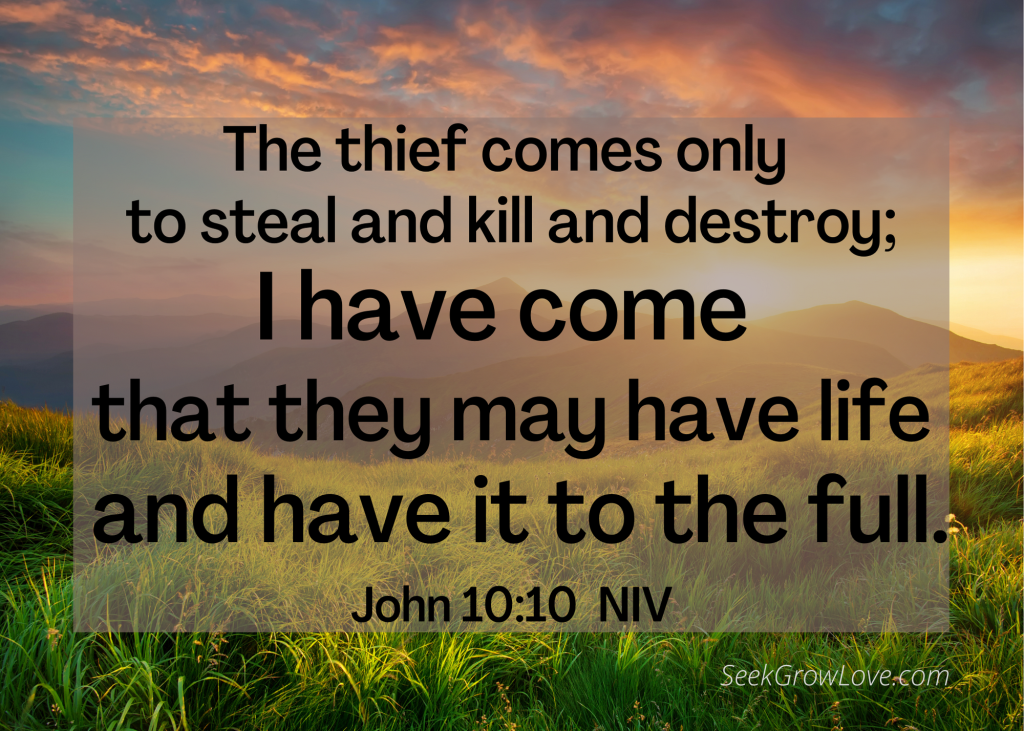
Jesus says in John 10:10, “The thief comes only to steal and kill and destroy; I have come that they may have life and have it to the full.” What is Jesus saying here? Chasing anything other than Jesus will steal what God has blessed you with, kill your dreams, and destroy your purpose in life. Only Jesus can restore the blessings that have been stolen, bring life to dreams that have died, and give our lives purpose. Possessions come and go, as does the enjoyment they bring. The only way to experience joy that never leaves is to have something that cannot fail. An abundant life comes from Jesus, who never fails.

“I am the gate; whoever enters through me will be saved. They will come in and go out and find pasture” (John 10:9).

When a reporter asked John D. Rockefeller how much money was enough to make him happy, the millionaire replied, “Just one dollar more.” Nothing on Earth is ever going to satisfy us. But if you ask anyone who has made Jesus the Lord of their life, they will tell you that they are blessed beyond anything they could have ever asked or imagined. A life apart from Jesus will always leave you lacking, but a life centered on Jesus is full of abundance.

• What do you strive for in life? Is what you strive for different from what Jesus strived for?

• What are some common traps that keep us from living the life Jesus wants for us?

-Andy Cisneros

Today’s Bible reading can be read or listened to at BibleGateway here – Judges 13-14 and John 10

The Blind See

John 9

Jesus meets a blind man and heals him with a combination of dirt, spit, and the Holy Spirit. When the man’s neighbors learn about his healing, religious leaders come to Jesus looking for answers.

Can you imagine living blind? Your view of the world would be only what people told you.

If you were blind, wouldn’t you be willing to try just about anything to be healed? Can’t you see yourself thinking, “Cover my eyes with a fresh mud pie made out of spit? Good plan!” Because that’s exactly what Jesus did. After covering the man’s eyes with mud Jesus told him to go wash his face. Instantly, his dark world became light.

“While I am in the world, I am the light of the world.” John 9:5

Religious leaders overlooked the healing miracle because they wanted to ensure it happened according to their regulations. Was this the same man who had been blind, the beggar? If so, who had healed him? Didn’t Jesus know He wasn’t supposed to heal people on the Sabbath? Their interrogation ended abruptly with the former blind man proclaiming, “I was blind, but now I see!” John 9:25

Everyone who accepts Jesus as Lord and Savior has a before and after story. If you’ve gone from darkness to light, your story has been written so the works of God might be displayed in you. Your story is just as miraculous as the one in John 9. You were blind, and now you see. Now walk in sight.

-Andy Cisneros

Today’s Bible reading passages can be read or listened to at BibleGateway here – Judges 11-12 and John 9

Compare and Contrast

Judges 9-10 and John 8

The people wanted Gideon as king. He declined but Gideon named his son Abimelech (Judges 8:31), literally “my father is king.” So while Gideon had refused the crown (8:23), he had also subtlely claimed it by having a son whose name was “my father is king.” This Abimelech, no doubt exalted by the experience, further exalts himself and betrays his father’s legacy at the insistence of the people of Shechem (9:1-6), killing seventy brothers on one stone (9:5). One brother, Jotham, is not killed, and Jotham curses Abimelech and the leaders of Shechem for their betrayal (9:7-21). 

Abimelech only reigns three years (9:22), and God causes “bad blood” to grow up between him and the leaders of Shechem (9:23-25). They find another leader to betray Abimelech now, Gaal son of Ebed (9:26). Zebul, the ruler of the city, hears of the plot, warns Abimelech, and Abimelech sets an ambush (9:30-45) and ends up burning to death 1,000 men and women of Shechem shut in a tower (9:46-49). 

He tries the same thing again at Thebez (9:50-52), but now aware of his tactic, a woman drops a millstone on his head, mortally wounding him (9:53), so he calls his armor bearer to kill him so that people would not say he was killed by a woman (9:54).

Fast forward to the beginning of John 8 and you have a woman caught in adultery. The scribes and Pharisees bring this woman to Jesus and ask him what they should do. He says anyone who is without sins let him cast the first stone. All of them dropped their stone and walk away. Leaves only Jesus left with the woman. He says go and sin no more.

There is a lot of similarities in these stories. The principle that I took out of both is that stones wound! Silly I know but true. Arrogance hurts too. There is a lot of arrogance in both of these stories. Arrogance tends to start when we think we have more power than someone else. Do you feel you have more power than someone today? How do you use that power? That influence. We all struggle with that desire to be above someone. To want to control someone. But the one person that could control us, overpower us, bring us low – chose to die for us instead. What does that tell us? How can you give up some of your power this week? How can you be a servant to someone else? It takes losing some power, control and it takes time. But Jesus calls us to that. Are you up to the challenge?

-Andy Cisneros

Today’s Bible reading passages can be read or listened to at BibleGateway here – Judges 9-10 and John 8

What will it take for you to believe?

John 7

In John chapter 7 you find an interesting story about Jesus’ brothers who question his authority. Jesus’ brothers try to get Jesus to go up to Jerusalem, so that the miraculous works that he had been doing ( 2:1–11; 4:46–54; 5:2–12; 6:4–14, 19, 21) would be more visible: “No man works in secret if he seeks to be known openly. If you do these things, show yourself to the world.” His brothers are very excited that Jesus can do such wonders as heal the sick and turn water into wine and feed 5,000 people; so they want him to get on with the business of showing himself to the world. In one sense Jesus’ brothers have a lot of confidence in Jesus: they really believe he can do miracles. They have seen him. Verse 5, then, is a shock: John says that the reason they urged Jesus on in his miraculous demonstration of power was “because even his brothers did not believe in him.” You can believe Jesus is a great miracle worker and yet still lack the faith Jesus wanted. His miracle-working is insufficient for saving faith.

Are we sometimes like Jesus’ brothers? Taking bits and pieces of Jesus but not fully believing everything he has done. Maybe believing he is a great teacher, but not accepting him as our savior. Maybe we believe that he did those miracles all those years ago, but he could never do a miracle for you today. What will it take for you to believe? Read John chapter 7 and Judges chapters 7&8 and try to find the principles for true belief. The goal is to have saving faith and believing fully in Jesus Christ in everything.  Jesus says in John chapter 7:37-38, “If anyone is thirsty, let him come to me and drink. The one who believes in me, as the Scriptures said, will have streams of living water flow from deep within him.”

Do you believe this? Make it your prayer today.

-Andy Cisneros

Today’s Bible reading passages can be read or listened to at BibleGateway here – Judges 7-8 and John 7