Conflict

Acts 25

Conflict within the church weakens community, and ultimately destroys the credibility of the church. In the eyes of the Romans, Paul’s arrest was just another Jewish squabble that needed to be controlled and contained. Arguments in the church make the world look down on us, instead of how God intended the church to be; a light to unbelievers, pointing others to God. Certainly God can still bring good out of conflict but the purpose of the church is to be Christ’s hands and feet doing God’s work.

It is hard to be doing God’s work while you are fighting with your brothers and sisters in Christ. Paul was following God’s direction for his life by going to Jerusalem where he knew he would be imprisoned by the Jewish leaders. From the time Jesus called him on the road to Damascus Paul had been obeying God’s instruction to preach the gospel to the Gentiles. Paul and the Jewish leaders had a lot in common. They both believed in God, and followed all the Jewish teachings and traditions. The difference between Paul and the Jewish leaders is that the Jewish leaders were not listening to God like Paul was and it was creating conflict that affected everyone within the church, the Jewish leaders, and the Romans and Gentiles.

-Makayla Railton

Today’s Bible reading passages can be read or listened to at BibleGateway here – 1 Kings 7-8 and Acts 25

The Money Trail

Acts 19

There is a saying with some truth to it that if you want to know about a matter – ‘follow the money’. This means if you look at the funding sources of a matter then you get a picture of who is pushing what (aka agenda) and who has financial gain or interest or conflict of interest in the matter. This is not a new concept, but rather, an old one. It is even present in Biblical times. The incident with Demetrius in Acts 19 is the perfect example.

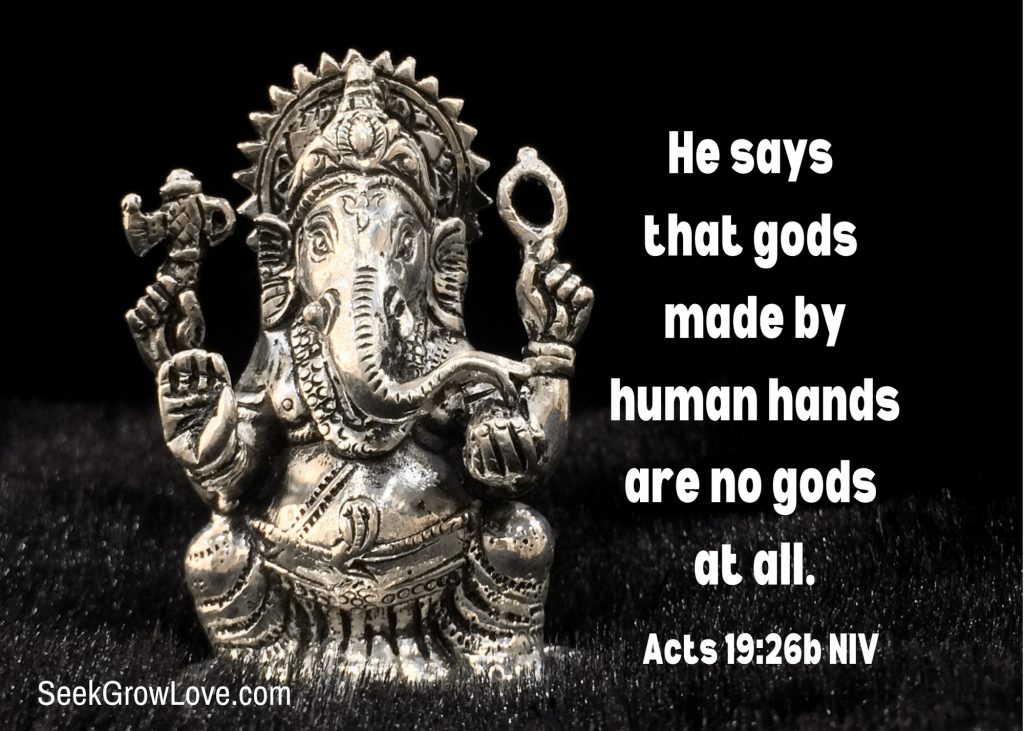
Demetrius is a silversmith idol maker and has a good business going making a lot of money in Ephesus. He is afraid that the message that Paul is sharing that there is only one true God and that Jesus Christ is His son will plummet his sales in idols of Diana. Ephesus was known for its worship of the goddess Diana and the god Zeus. So he incited his fellow idol makers towards anger and malice towards Paul and the disciples in Ephesus. This snowballed into a riot where half the people didn’t even know what the issue was and just joined in rioting just because. (Sound familiar?) The authorities of the city knew that Paul and the disciples had done nothing wrong and had not stirred up this great rioting mob by anything they had done so they refused to bring them to court to try them. Ultimately Paul and the disciples decided to leave town and go somewhere else where they could share the gospel.

All of this is due to Demetrius and his fellow silversmiths being concerned that they would lose their livelihoods making shrines that they made a great profit from selling to the people. They were not interested in hearing or considering the truth – they were only concerned with the almighty dollar as we might say today. It is sad that the truth of the gospel couldn’t be openly shared in Ephesus because of a handful of greedy men. Does this happen today? In our time? You bet. The names and the livelihoods may be different but the situation still rears its ugly head. So …if you want to know about a matter ‘follow the money’ and you will find out a lot. More importantly follow Jesus and gain discernment about situations that arise. One will never go wrong when truly following Jesus.

-Pastor Merry Peterson

Today’s Bible reading passages can be read or listened to at BibleGateway here – 2 Samuel 19-20 and Acts 19

Going with the Gospel

Around the World or Across the Street

Acts 18

It is interesting how some people basically stay in one place all their lives and others seem to travel about quite frequently. No one can accuse the apostle Paul of being a homebody! In Acts 18 we notice that Paul travels quite extensively staying in one place for a little while, and then traveling to another place. Sometimes the places he traveled to received the gospel message with readiness and welcomed him, and at other times he received more hostile treatment. Everywhere he went he shared the gospel message. About the first thing he would do each place he went was to go to the synagogue and teach there about Jesus being the promised Messiah and way to salvation.

Among his travels he met Priscilla and Aquila and they were strengthened in the faith. So much so that later when Paul travelled on to a new location without them they were able to teach another man named Apollos more clearly about the gospel. It seems whether near to home or far away these early Christians were ready and willing to share the message with whoever would listen and believe. They were truly ready to give an answer in season for the hope they held within them.

We should be ready and willing just as they were to give an answer for the hope that we hold within us. Whether God gives us the opportunity to travel from place to place, or whether He asks us to be the light within our own community. Our willingness should always be present, just as it was with the early Christians, to share the hope we have in Christ.

-Pastor Merry Peterson

Today’s Bible reading passages can be read or listened to at BibleGateway here – 2 Samuel 17-18 and Acts 18

God Focused Response

Acts 16

There are so many things that I find interesting in Acts 16. Paul has a vision of a man from Macedonia asking for him to come share the gospel with him. When they get to Macedonia to the region of Philippi they meet a woman who comes to belief along with her whole household. But what unfolds next is really fascinating. Paul and Silas get into a situation and end up being severely beaten and thrown into the inner holding rooms of the prison. But what I want us to notice is their reaction – they aren’t crying, they aren’t in there feeling sorry for themselves or busy being angry or muttering threats – they are Praying and Singing Hymns to God! What a contrary reaction to what everyone would expect!

If we were in that situation, sore, and bleeding, in a dark, inner, dingy room with criminals around us would we be that confident and flat out bold? We would more likely be in there feeling sorry for ourselves, scared out of our wits, and wanting desperately to call our lawyer or mom or anybody that could help us get out of there! But Paul & Silas’ response was God focused. By praying and singing hymns to God they were communicating with the one who has all power and authority to change and alter any and every situation. Who needs a lawyer when you have God on your side? God used the situation to open the hearts of the Philippian jailer and his household to hear and accept the gospel message. Paul and Silas were also released to go free from the prison where they were being held. When Paul and Silas exhibited the right response to their unfair situation God turned their situation around for His glory.

If we were to be bold and confident in the Lord and say within ourselves as the Psalmist did in Psalm 121:2 “My help comes from the LORD, who made heaven and earth.” And keep an attitude of worship, praise, and open communication with God in our trials; maybe we would stand in the same place of victory as Paul and Silas did. One of the biggest challenges that we face in our Christian walk is keeping the right attitudes when things don’t go our way or get difficult for us. I hope we are inspired by the actions of Paul and Silas and remember to communicate with the author of life and outcomes when we face our next difficult situation.

-Pastor Merry Peterson

Today’s Bible reading passages can be read or listened to at BibleGateway here – 2 Samuel 13-14 and Acts 16

Prayer for Peace – and More

2 Samuel 3-4 and Acts 11

“The war between the house of Saul and the house of David lasted a long time.” (2 Samuel 3:1). So begins today’s Old Testament reading. The “young” country of Israel was experiencing great turmoil as some remained loyal to Saul’s remaining relatives, and a growing number were excitedly backing the champion David. The commander of Saul’s army, Abner, becomes angered by an accusation made by Saul’s son and heir, Ish-Bosheth. Abner vows to help bring all Israel under David’s kingship. But the army commander under David, Joab, has a lasting feud with Abner, still distrusts him and kills him for revenge. David mourns and instructs Israel to do the same. When 2 thugs kill Ish-Bosheth they expect to be warmly received by David as they have helped clear the way to David’s legitimate rule. Instead, similar to his reaction to the Amelekite who announced the death of Saul, David orders the death of the two murderers. David sought for peace within the young nation and an end to the hostility, bloodshed, revenge, and distrust. He tried to show a better way.

Today there remains great tension and hostility in the land of Israel, and this week it has bubbled again to the surface with the worst outbreak since 2014. Last night after reading the Bible passages for today I read one more email before bed – it happened to be a request for prayer from an organization called Jewish Voice whose goal is to bring salvation to the Jews, that they may believe in Jesus as God’s Promised Messiah. I will include a few quotes from their email…

“Terror groups Hamas and Islamic Jihad have fired more than 1,700 rockets and mortars at major Israeli cities and Israel has responded with more than 700 airstrikes on terrorist targets…

To make matters worse, unexpected riots and clashes between Arab Israelis and Jewish Israelis have broken out in multiple cities across Israel…

Please join me in fervent prayer for Israel and the Jewish people. Pray supernatural peace for Israelis who have been under continual fire for four days and may have to endure more. Pray safety for the IDF personnel as they battle terrorist forces and wisdom of Israel’s military leaders to know the right course of action. Pray for an end to the violence both between Israel and Gaza, and reconciliation between Arab and Jewish Israelis. Finally, let’s pray that these times of trouble would lead the Jewish people to recognize Yeshua (Jesus) as their Messiah.”

As David wrote more than 3,000 years ago – “Pray for the peace of Jerusalem…Pray for the sake of the house of the Lord our God.” Psalm 122:6,9 NIV

In Acts 10 we saw God remove the barrier between Jew and Gentile. Now both could believe in Jesus and be saved. Jews and Gentiles could now remove the hostility between themselves and become brothers and sisters in the family of God! It was unheard of! And it was such an amazing event that Peter explains it all again in Acts 11. The Christians needed to know – the world needed to know. Jews and Gentiles don’t need to live in hatred to one another. Together, they can both be saved. But without the Jesus glue…it falls apart.

Paul would expand upon the prayer of David. “Brothers and sisters, my heart’s desire and prayer to God for the Israelites is that they may be saved.” (Romans 10:1 NIV). Just peace is not enough. But with Jesus comes salvation which brings brotherly peace even amongst Jews and Gentiles.

And, here we are today – needing the prayers of David and Paul just as much. For the nation of Israel, and for our neighbor across the street. We pray for brotherhood created by the blood of Jesus. We pray for peace. We pray for salvation for us, our families and churches and also salvation for those different from us. We pray for an end to hostility and take steps to love others. We also know that as followers of Jesus we will face many enemies and we pray for wisdom and strength in confronting them. We pray and long for the day when Jesus returns and a lasting peace will reign in New Jerusalem as God’s Kingdom is set up on earth.

-Marcia Railton

Today’s Bible reading passages can be read or listened to at BibleGateway here – 2 Samuel 3-4 and Acts 11

The Early Church : The Passion of The Church

Acts 3

The early church was a special time in history. Jesus has just been raised. He has gone up, bodily, into heaven, and has poured out his Spirit upon those who follow him. (Rom. 8:9) In our day discussions about doctrines and divisions about drivel develop daily. 


BUT in the EARLY CHURCH, they were passionately pleading for the Pierced. They didn’t argue and debate about the number of angels that can dance on the head of a pin (to be fair, no-one has ever really debated that question). We can get so distracted from what was the early church’s singular focus : giving everyone and anyone the message of Jesus, and changing their world with the power of Jesus.


In chapter three, a man who had been begging for years is healed. This is the first of many, many miracles recorded in the book of Acts. The disciples were passionately sharing the message and gift of Jesus with everyone! They tell their fellow Israelites that God healed this man because of his servant Jesus. They tell the Sanhedrin and high priest about Jesus. They count it as a joy when they are persecuted and beaten for Jesus. They know their reward in heaven is great, because the righteous are persecuted by the wicked (Matt. 5:12).


In our lives, are we passionate about the message and work of Jesus then and now? If you aren’t don’t try to be passionate!


Instead, remember your sins, your mistakes, your failures. Remember that for even the smallest, you were separated from God. You were condemned to destruction, because that is the fate of those without God. And remember that God loved you enough to give you Jesus to redeem you. Jesus loved you enough to die in your place. They love you SO MUCH they love you just as you are, and they love you TOO MUCH to let you stay there, and want to make your life better, freer, holier, more and more wonderful. 


The early church was passionate because they knew the truth of Christ. We will be passionate when we remember it. 

-Jake Ballard

Today’s Bible reading passages can be read or listened to at BibleGateway here – 1 Samuel 17-18 and Acts 3

The Early Church : The Mission of the Church


Acts 1

On Sunday, we discovered the message of the early church. This message is two pronged. It is the message from Jesus and the message about Jesus, it is the Kingdom and the King. The message of the church is the message of Jesus himself, “The Kingdom of God has come near! Repent and believe the good news!” The Kingdom of God, the rule and reign of God, is breaking out among his people, and will one day be over the whole earth. The way we enter that kingdom now, and are given the resurrection to eternal life in the Kingdom in the future, is through the King, Jesus the Messiah, who died to take away our sins and make us righteous. If we believe in this good news, we can be saved. That is the message of the church, both the early church and today. 


But just what was the mission of the church? We know now what they said, but what did they do? Jesus tells us in Acts 1:8. After being empowered by God’s Spirit they would “… be [Jesus’] witnesses in Jerusalem, and in all Judea and Samaria, and to the ends of the earth.” That’s seems pretty big. What does it mean? In this case, a witness was one who would tell of the truth of what they had heard and seen. They were to go tell others about the Messiah. Even more than that, they were called to live in accordance with that message as a witness to the Messiah Jesus. And they were to go to Jerusalem, Judea, Samaria and the ends of the Earth. 


My friends, this is our mission still today, at least in principle. Have you experienced the love of God? Tell others. Have you experienced the forgiveness of God? Show others. Have you found the people of God? Invite others to join! That is what it means to be a witness, to tell, show, invite others to experience what you have. If you are still searching for this love, forgiveness or people, keep searching. But they are there, and I am inviting you in to a God who has changed me. This starts in our own local area. Jerusalem was where the church already was. We need to give the message to our neighbors before we worry about the rest of the world. Does everyone you know know you love Jesus? They should! Once they do, it spreads out to our broader locations. Our state, country, even our enemies. And then, we take it with us to Africa, Asia, South America. But sadly, America is a mission field. We don’t need to go halfway around the world to find large populations who don’t know God. Sometimes, it’s fifteen minutes from our house! 


Ask God to lead you in your mission. Be a witness for Jesus today, to your neighbors, your family, your friends. And maybe someday, even today, he will use you to reach the “ends of the Earth!”

-Jacob Ballard

Today’s Bible reading passages can be read or listened to at BibleGateway here – 1 Samuel 13-14 and Acts 1

The Early Church : The Fate of the Apostles

John 21

In John 21, Jesus has a number of more appearances to the disciples. After the disciples go fishing, Jesus shows up on a beach, and feeds them. Jesus takes the time to “restore” Peter. After asking him three times if Peter loved him, and hearing Peter’s three replies, he says in 18-19


“Truly, truly, I say to you, when you were younger, you used to gird yourself and walk wherever you wished; but when you grow old, you will stretch out your hands and someone else will gird you, and bring you where you do not wish to go.” Now this He said, signifying by what kind of death he would glorify God. And when He had spoken this, He said to him, “Follow Me!”


Very often, when we first start following Jesus, we may think “Well, now life will be good!” We may hear preachers say “just pray and believe” and then life will go really well. And Scripture itself says that “And we know that God causes all things to work together for good to those who love God, to those who are called according to His purpose.” (Rom. 8:28) But we need to be careful before thinking this means we won’t have troubles, pains, and even death in spite of, or even CAUSED BY, following Jesus. Jesus himself warned his followers that they would have trouble (See John 16:33; “you will have trouble”). And the early church, especially the lives of the disciples, prove that we will have trouble. 


Most of our knowledge of the apostles come from church tradition; we don’t know the following, but it is generally accepted. Simon Peter, Andrew, Philip, Simon the Zealot, and Matthias were all crucified by Rome. James the son of Zebedee and James the son of Alpheus were both killed in Jerusalem by the ruling authorities. Matthew, Thomas, Thaddeus/Jude and Bartholomew/Nathanel were all killed while speaking of their faith. Paul, the thirteenth apostle “to the gentiles” was beheaded after a long time in prison. Only John, as Jesus prophesied, died of old age. 


I don’t bring this up to scare you or to make you depressed. I want you to know that a bunch of hillbilly fisherman from the backwoods of a small nation oppressed by an Empire changed the world. The truth of Christianity is proved in these men. They gained no power, no prestige, no wealth, no control by dedicating their lives to the gospel message. They truly believed, to the point of death, that a man named Jesus lived, taught, died, and was raised again. They didn’t go out conquering with armies. They gave their lives so others may find life. They lived knowing that God would work everything out for the good of those who love him; because they were called according to his purpose, they would be raised according to his son. 


That is the kind of passion and dedication I want to have for Jesus. I am asking myself “if Jesus sent me to speak his name, would I go? Would I be willing to die to make sure that others could find life?” I want my answer to be yes. 


How about you? How would you answer that question? Jesus is turning to you and saying “Follow me!

-Jacob Ballard

Today’s Bible reading passages can be read or listened to at BibleGateway here – 1 Samuel 11-12 and John 21

The Early Church : The Message

John 20


I love the book of John, and I am so glad I get to lead us in this week, because John 20 is one of my favorite chapters. 


This week we are discussing the early church. We will be ending John and moving into Acts. While Luke shows us the crucifixion, resurrection, and later the coming of the Spirit at Pentecost as the beginning of the church, John shows us the beginning of the church here in chapter 20. 


In the opening verses, Jesus is RISEN! Jesus, in John, clearly laid down his life of his own accord, and clearly takes it up again. There is no doubt in the mind of Jesus or the author about what he was doing. Jesus was saving humanity! Jesus was giving the final sign that he is the Messiah, and 8th sign, signifying that he is creating something new. The disciples sprint to see the empty tomb but go away. Mary stays. Jesus sends her to let them know that his words were true, he had been raised, just as he said. He sends her out.


This sending of Mary is mirrored in what Jesus does to the apostles is verse 19. They are sitting in fear, but Jesus shows up and gives them his peace. Then in verse 22-23 we get a weird picture. Jesus breathes on his disciples, post-CoViD, masks, and social distancing, we may feel like Jesus was in their personal space. But he says, “Receive the spirit”. The Holy Spirit, the power, presence, and promise of God to those who would believe in the Messiah, is the very breath of Jesus. What John is showing is that this powerful spirit that shows up in Acts and shakes the city and changes the world, is the breath of Christ. He gives his disciples spirit for power, for forgiveness, for judgement. This is John showing us the birth of the church. 


However, the verses I want us to really see are the last three of the chapter. “Doubting” Thomas gets an unfair, if earned, nickname. Yes he doubted. But no one has ever brushed off a crucifixion before. No one gets executed and wakes up a couple days later. Jesus is the exception to the rule. But when Jesus shows up, Thomas believes, declaring “My Lord and My God.” Jesus recognizes the belief of Thomas and says “Because you have seen me, you believe. Blessed are those who did not see, and yet believed.”


My brothers and sisters, that is you. Jesus spoke of how YOU are blessed for having faith without sight. Jesus knows that it is a difficult thing to believe, to be the church. But, like Mary, like Peter, like Thomas, like John, we are called, in faith, to tell others the message of the early church, the message that is still true today. “These things (the book of John) are written so that you may believe that Jesus is the Christ, the Son of God and that by believing you may have life in His name.” (John 20:31) If you believe, have faith without sight, that Jesus is the Christ, as John has been showing, as Peter and Paul declared, as Jesus himself testified to for 40 days on earth, then YOU have life in his name. That is the message of the early church, it is the message of the medieval church, it is the message of the contemporary church, and it will be the message of the church until the end of the age. Jesus is the Christ, the Son of God, and we have life in his name. 


Let us, his breath-filled, Spirit-empowered followers, be his witnesses to the world. 

-Jake Ballard

Today’s Bible reading passages can be read or listened to at Bible Gateway here 1 Samuel 9-10 and John 20

Allegiance to the King

1 Samuel 7-8 and John 19

            When I was a kid in public school back in the dark ages, we used to begin each school day by standing at our desks, placing our hand over our heart, facing the United States flag and pledging our allegiance to that flag.  We did it day after day, year after year.  I never thought much about it, it was just something you did.  In music classes we sang “God bless America, land that I love…”  Then in 6th grade we had a new kid in the class named John.  I didn’t like John very much- as an early bloomer I had actually been the tallest kid in the class for the previous couple of years (with the exception of Linda, a freakishly tall girl).  But among the boys I was the tallest which was a great help on the basketball court where I ruled during recess and after school.  But tall, lanky John was a good 2-3 inches taller than me.  Fortunately, his height did not translate into coordination and he wasn’t any good at basketball, so I still ruled supreme there, but it was still annoying that my height domination had been superceded.  (Fun fact, I stopped growing after 6th grade, so while I was a massively tall presence on the basketball court at 5’10” in sixth grade, by the time I hit 9th grade, still 5’10” I was too short, not quick enough and didn’t have a good enough outside jump shot so I didn’t bother to try out for the high school team.  Post-up skills don’t go very well with being NOT the tallest kid on the team). 

But I digress, back to lanky, uncoordinated taller John who wore clothes that looked outdated and never seemed to comb his hair, and was just a weird kid.  What really set this weird kid, John, apart was that when the rest of us stood by our desks to pledge allegiance to the flag every morning, John didn’t stand.  What is with this strange outlier among us?  Eventually, I discovered the reason for this.  John said he didn’t stand for the pledge of allegiance because he was a Jehovah’s Witness and it was against his religion.  His parent also didn’t vote, and they didn’t celebrate their birthdays or Christmas.  I was quite relieved that I wasn’t a Jehovah’s Witness.  I got to celebrate my birthday and Christmas, I didn’t have to be the odd-ball sitting during the pledge,  and my parents got to vote for Richard Nixon as President.  (that didn’t age well, now, did it?).

It was at that time that I first became aware that for some religious people there was a connection between their religious faith, how they worshipped God on Sunday, and other parts of their life like politics.  It’s been nearly 50 years since I learned that Jehovah’s Witnesses like John didn’t pledge allegiance to the flag, but I still remember that day I learned it.

What do we mean by allegiance?  Webster’s dictionary defines allegiance as:

“the obligation of a feudal vassal to his liege lord, the fidelity owed by a subject or citizen to a sovereign or government. Devotion or loyalty to a person, group, or cause. allegiance to a political party. Synonyms:adhesionattachmentcommitmentconstancydedicationdevotednessdevotionfaithfaithfulnessfastnessfealtyfidelityloyaltypietysteadfastnesstroth.”

That’s a lot to unpack but for our purposes look at some of those synonyms like commitment, devotion, faith etc… those are all clearly religious words.  For many people their flag represents their nation, their family, their people, their way of life, all that matters to them.  Particularly those who serve in the military often have a ferocious loyalty and allegiance.  The Marine Core motto is Semper Fi, Latin for Always Faithful.

What does any of this have to do with today’s readings?  In his books Salvation by Allegiance Alone and Gospel Allegiance, Matthew Bates makes the case that the Greek word “pistis”, which is often translated “faith” into most English translations of the Bible should more accurately be translated “allegiance.”  Salvation, then is transformed from simply faith in Jesus Christ to Allegiance to Jesus as Christ, or more precisely, Allegiance to Jesus as God’s anointed King.  What does it look like to place your allegiance in Jesus as God’s anointed King over the whole earth? 

In today’s readings in 1 Samuel and John’s Gospel the concept of king and allegiance come to the forefront of both narratives.  During the time of Samuel Israel transitioned from being led by various judges: Gideon, Deborah, Samson and others to a place where they demanded to be led by a king.  Their stated reason for wanting a king was interesting as they wanted “to be like all of the other nations.”  Think of the teenager who makes a request to a parent and when rebuked comes back with “but all the other kids are doing it.”   Samuel took the people’s request for a king as a personal rejection of his leadership, but God pointed out that HE had been their king since they left Egypt and that this constituted a rejection of Him, not Samuel.  God told Samuel to go ahead and give the people what they wanted, a king, along with a word of warning- kings require those in their kingdom to show them a high level of Allegiance, and if you get a narcissistic, proud man as king you will regret it as he will use his power to enrich and empower himself still more.  “Yeah, but we still want to be like everybody else.”

So begins the next phase of Israel’s history in the time of the kings and in coming weeks you will read about those king’s like Saul, David, Solomon and many others.  You will see how even the bravest and godliest, like David and the wisest, like Solomon, misused their power and privilege and eventually the kingdom split, then was taken into captivity and constantly battled the empires and kingdoms around them.  Having a sinful king was no better than a judge.  How much better it would have been if they had simply given their full allegiance to God as their king.

In the Gospel of John Israel gets a do over.  God has given them His own son, Jesus, the sinless human representative of God to be their king.  After Jesus is arrested and brought before Pilate to be judged and sentenced Pilate looks to persuade the Jewish people to change their minds about Jesus.  “Here is your king,” Pilate said to the Jews. But they shouted, “Take him away! Take him away! Crucify him!” “Shall I crucify your king?” Pilate asked. “We have no king but Caesar” the chief priests answered. Finally Pilate handed him over to them to be crucified.”

In the account in Samuel, Israel rejects God as their king so that they can be like everybody else.  He gives them that choice.  In the Gospel of John, a thousand years after they rejected God as king, God’s son, Jesus,  is presented to them as their king, and once again they decisively reject God’s anointed King. Instead, they demanded that he be crucified.  They declared their allegiance that day to Caesar, I guess because they wanted to be like everybody else.  Not much changed in 1000 years in Israel.

2000 years and half a world a way we still have the same choice.  To whom will we give our allegiance?  Will we give our allegiance to the principalities and powers of this age.  Will we give our loyalty to trying to be like everybody else, going along with the crowd, whatever direction the crowd decides we should be going?  Or will we give our allegiance to God’s anointed king, Jesus?

            If you are a Christian living in this world you are a resident alien living in exile.  Your body may be in Ohio or Indiana or Virginia or India, but your citizenship is in Heaven because that’s where your King is currently living.  One day King Jesus will return from heaven to earth and reign right here on earth during the renewal of all things (See 1 Corinthians 15:20-24).  But for now, you and I are living in exile and while  living in exile we should strive to be respectful and law abiding in areas that don’t conflict with our primary allegiance to King Jesus (See Romans 13).  You can be a good citizen in many ways, but never forget that if you are a follower of Jesus, your allegiance is to him first and foremost, not to your country, or your family, or your friends, or your culture or fashion or whatever seeks to define you.  Your allegiance must be to Jesus.

            Can you be a Christian and still pledge allegiance to the US flag?  My childhood classmate John thought, “No, you can’t” and Christians may not always agree on these kinds of questions, but there should be no doubt in your mind as to whom your ultimate allegiance is due, Jesus Christ the King, and God our Father.

-Jeff Fletcher

Today’s Bible reading passages can be read or listened to at BibleGateway here – 1 Samuel 7-8 and John 19.