Dear Church in Ephesus – and You

OLD TESTAMENT: Jeremiah 27 – 29

POETRY: Psalm 119:25-32

NEW TESTAMENT: Revelation 2:1-7

Rev. 2:1-7 – Letter to Ephesus

Hello all!  Although the other material is just as wonderful, we will be taking a focused look on the Revelation passages, exploring the Letters to the Churches.  Let’s dive in!

Each letter has a general pattern of a greeting and introduction, praise for their behavior, a warning or correction, plus a reminder of what is to come (hint, it’s the Kingdom!)

For some context, the church in Ephesus was visited and established by Paul back in Acts 18 & 19. We know from these passages that the silversmith Demetrius, and his shrines or idols to the goddess Artemis, were popular opposers of the message of Jesus the Messiah.  From the book of Ephesians, we know that Paul believed the Ephesians loved all of God’s people, but still needed guidance on how to daily live out the Christian walk.  Knowing this can impact how we read the letter John transcribed to them in Revelation 2, and how we can take that message and apply it to our own churches and lives.

After greeting the church in Ephesus, through John, Jesus writes to the church of Ephesus and commends them on their hard work, perseverance, and holding fast to doctrinal truths diligently (v.2-3).  But their correction is that they have forsaken the love they had at first (v.4).  Some people debate the exact meaning this has, but personally, when paired with the information we have from Paul’s writing, I believe this means they have lost the love they had for God’s people. 

Back in Paul’s time, they were a church in the middle of a dark, secular, perverse community.  Yet, they were growing and evangelizing in a way that was drawing people away from worshiping other gods, and bringing them to repentance.  Clearly they were doing something right at this time to be so appealing to people in such a community, so much so that those trying to make a profit off of sinful practices started a riot!  And THAT is what I believe they lost.  

This church seems to have swung the pendulum to the side of practicing truth without love.  While we can only speculate, I do think this likely looked like church leaders who were so focused on ensuring their church stood out from the worldly crowds, they lost the compassion for those outside of their own doors.  They lost the zeal and vigor for spreading the gospel, and became too heavily focused on trying to maintain the doctrinal ‘purity’ they had built.  

Notice how Jesus doesn’t say in these verses they should stop holding fast to those important practices, but rather they should do them in combination with what they did at first, loving others in their community so well that they were attracted to the church.  In fact, right after this reminder, he even says that he appreciates that they hate the same detestable practices he does!  Jesus was never saying to disregard the importance of true and accurate teaching of the Gospel message.  But he was challenging a church who had been a beacon of light to their community, to remember how they felt in those early days when they received the Holy Spirit, and go back to the same energy and passion for the people they were surrounded by.

Well-established churches or believers, especially those who hold tightly to doctrinal truths, must be on guard for this same loss of love in their own communities and hearts.  Not compromising on the biblical truths they hold, but never losing sight of the greatest commandment, to LOVE one another.  We all may have a bit more Ephesus in us than we think… which isn’t always a bad thing, but is something we must be cognizant of to make sure we are still remembering the love we must show, in order to have the opportunity to experience the “paradise of God” (v.7).

Reflection Questions:

  • Consider yourself and your church, have you lost your first love?  If you have, what steps can you take to revitalize that passion?  
  • Think of someone you care about deeply.  Have you shared the truth of Jesus Christ with them in a loving way?  If not, how can you start that conversation?
  • Reread Psalms 119:29-32 from today’s reading.  Clearly we see throughout all Scripture the importance of holding fast to God’s commands, just like the church in Ephesus.  Are you truly “setting your heart” on God’s laws as in these Psalms verses?

-Sarah (Blanchard) Johnson

Contemplation – Take it to Heart

OLD TESTAMENT: Jeremiah 24-26

POETRY: Psalm 119:17-24

NEW TESTAMENT: Revelation 1

Revelation is a tricky book. I will admit that I struggle with it, as I’m sure others do. When meditating on this passage I actually sat down and tried to put myself in John’s place. He is receiving one intense vision, full of important messages, all of which he might not fully comprehend in his time. 

This devotion is less of a devotion today and more of an invitation to join me in a practice of contemplation. 

John introduces himself and tells the reader what he is writing and why he’s writing it. And the first part of this great message is actually a collection of letters to the seven great churches of the time. 

Now these letters are laid out in chapters 2 and 3. However, I’m not actually going into those so I feel like I’m within my realm of Revelation 1 for this little exercise! 

Join me, if you will, in constructing a letter to yourself and/or your church, written by Christ. This can be either written or mental. This devotion will primarily be reflection questions to give you some things to contemplate. 

Reflection: 

Take a few minutes with each of these questions to pray and evaluate: 

Christ, seated at God’s side, knows your deeds. In looking at your current habits and practices, what does he lift up? What is he pleased with? Pray over these things and ask God to continue to help you to grow. Thank him for allowing you the circumstances that allow you to minister and please him. Thank him for the blessings he has given you. 

What about in your church body? What does your church do well in God’s eyes? Pray over your church family now, thanking God for individuals that serve alongside you in the church body. Thank God for the blessings he has given your church family. 

Now, what practices in your life are not pleasing? What do you struggle to turn away from? How would Christ address those? How would he advise you to take action? Pray over these, and ask for strength and guidance in those areas. Pray for mercy and forgiveness. 

Are there practices within your home church that Christ would not be pleased with? Are there attitudes that need changing? Does your own attitude need adjustment? How would Jesus address your church in this regard? How would he encourage you to correct these behaviors and thoughts? Pray now over your church family. Pray for forgiveness and mercy. Pray that God will show you a way in which you can help be a positive force of change in your church body. 

Dear father, I’m so thankful for my fellow believers in churches all over the world. I pray that we would be pleasing to you. I pray that we are able to seek out what we are doing wrong and right ourselves. Please show us the way and also show us great mercy. Thank you for the sacrifice that was made so that we could one day see Christ’s return and see your kingdom established forever here on a perfect earth. Grant us all guidance and strength until we see that great day. In your son’s name I pray, Amen.    – Jenn Haynes

Shepherd the Flock & Be Watchful

OLD TESTAMENT: 2 Chronicles 35 & 36

POETRY: Psalm 115 (all week)

NEW TESTAMENT: 1 Peter 5

What is the best way to lead others in the church? What is the best way to follow church leadership?

At the end of 1 Peter, Peter gives some exhortations to leaders in the church and then to the general assembly. His exhortation to leadership, while brief, is powerfully meaningful:

1 Peter 5:2-3 (ESV)

2 shepherd the flock of God that is among you, exercising oversight, not under compulsion, but willingly, as God would have you; not for shameful gain, but eagerly;

3 not domineering over those in your charge, but being examples to the flock.

Leaders in the church are commanded to shepherd the flock not by abusing authority but by being examples. Peter is repeating what Jesus taught him years before (see Matthew 20:25-28). Jesus served others in love, showing everyone how to live a godly life. He did not collect taxes, lead an army, start a big corporation, or run for President (or Caesar, not that it was a democracy!), but even if he held a prominent worldly position, he would not have led through fear or domination.

How many times has this gone wrong in the history of the Christian church? How often are leaders tempted to lead this way? As a pastor, knowing how common this problem is leads me to greater personal reflection and humility. My job is to serve willingly and eagerly and to be a good example to the people in our congregation. That sounds simple and straightforward, but the other way is tempting. Leaders, we must keep the servant’s towel wrapped around our waist at all times!

Peter goes on to admonish the whole assembly to be humble, to cast anxieties to God, and to be watchful. Each of these dispositions is important. First, humility is a foundational Christian attribute. It’s like the key to the door of growth. Humility says, “I don’t know everything yet. I can still learn more.” Everyone in the church should be humble before God and before the Scriptures. There is always more to learn. There is always more to live.

Second, we are to cast our anxieties to God. This world is full of trouble and brokenness. All of us experience anxiety from time to time. We must remember that God cares about every aspect of our lives. What a crazy thing to believe, but it is true — the Creator of the Universe wants a relationship with you! God cares for you!

Finally, we are to be watchful. There are influences of darkness in the world around us (see: anxieties above). The powers of darkness, led by the adversary/devil, have built systems to damage our faith and lead us into temptation. Just as our Lord Jesus taught, we seek God instead. He will deliver us from evil, and the promise is, that as we resist, the devil will flee (see also James 4:7).

-Will Barlow

Reflection Questions:

  1. (Leaders) How do you stay humble and focused on serving the people around you?
  • (Non-leaders) What can you do if you are concerned about your leaders and how they are behaving?
  • Are there things in your life that need more watchfulness or resisting the powers of darkness? What can you do to strengthen your resolve in those categories?

Set an Example

Old Testament: 2 Chronicles 21

Poetry: Psalm 100

New Testament: 1 Timothy 4

My name is Philip Kirkpatrick.  I’m 17, live in Minnesota, and attend Pine Grove Bible Church.  Some of you may have met me before and some of you may have no idea who I am.  I share this for two reasons, the first is to give those who don’t know me a little bit of background on who’s writing, and the second is because it relates to what I’m writing about.  As I was reading 1 Timothy 4, one of the verses stuck out to me.  That is verse 12,  the NIV version states:

‘Don’t let anyone look down on you because you are young, but set an example for the believers in speech, in conduct, in love, in faith and in purity.’

Considering my age and youthfulness, this verse stuck out to me.  Reading it over, it seems pretty straightforward to me.  I’m going to break this up into two parts.  The first part simply states that just because of someone’s young age, it doesn’t mean they should be looked down on.  Looking back now, I can think of times that I surprised my parents by having an answer they didn’t expect me to get, or knowing a big word and casually dropping it in the middle of a sentence.  Even today I find myself surprised at times by those younger than me when they find answers I didn’t expect or know things that I don’t.  Something to keep in mind here is that just because someone is young doesn’t mean that person doesn’t have good ideas. 

This also plays into something called a logical fallacy.  A logical fallacy is an illogical argument in its simplest form.  In this case, it’s an Ad Hominem fallacy.  This logical fallacy can be used to state that someone who may typically not have good ideas, someone young and inexperienced in this case, can’t come up with good ideas. The Ad Hominem Fallacy in other words; it is an attack against the person, not the argument or idea they are proposing.  So in the case of someone young, it’s saying you can’t dismiss it simply due to age.

The second part of this verse here tells us that we should set an example for others in 5 ways: speech, conduct, love, faith, and purity.  I’m not going to dig into all those and explain them all.  Overall it can be defined by how we act.  We should act in a manner befitting a Christian.   

To the younger: set an example to the older on how to act. 

To the older: set an example to the younger on how to act. 

And to all, don’t look down on someone because of their age, listen, and consider what they have to say. 

-Philip Kirkpatrick

Reflection Questions

  1. When have you taken notice of a good example set by someone young? Have you ever been guilty of looking down on someone just because of their age?
  2. Consider each of the ways we are to set an example for believers: in speech, in conduct, in love, in faith and in purity. Think of times when you set an example in each of these areas. Are you strongest in one of those areas? Which ones could you work on more this week?

Furthering the Gospel Message

Old Testament: 2 Kings 23

Poetry: Psalm 88

New Testament: Philippians 1

I sat down several times to work on this devotion today. Every time I distracted myself. I struggle, often, to stay on task, as I’m sure many people do. There are just so many different things I can focus on! I stopped again just now and distracted myself by recounting all the things I did this morning rather than write this. 

Back to the topic at hand: Staying On Topic. The first chapter of Philippians (one of my FAVORITE books) is full of love and encouragement toward people that desperately need it. And Paul (who is imprisoned) gets right to the point: Their focus should be on spreading the gospel message. 

Verses 1- 14: Paul loves these people. Carrying on in ministry is not a job one accomplishes alone. We draw on each other for strength and encouragement. He loves his brothers and sisters in Christ and prays over them. 

Stop for a moment and pray over your brothers and sisters in Christ. Pray blessings over them, particularly the ones who might feel discouraged. Who can you reach out to encourage today as Paul is doing here? 

Paul says his imprisonment is to be celebrated because he has been able to spread the message of Jesus Christ. In this he acknowledges that in all of our circumstances and trials, we are to use our lives as a testimony.

Ask yourself what trials or difficult circumstances you are experiencing at present. How can you use this as a testimony to others? How are you displaying Christ? How can you do it better? 

Verses 15-26: Paul cuts to the heart of the matter, and asks that his friends ignore motives for just a moment. Who can judge the heart but God, after all? Their focus, and ours, should be on one important mission: that the gospel of Jesus Christ be spread. Nothing. Else. Matters. 

Yes, the present life is difficult. Yes there are people out there trying to create harm, trying to make circumstances worse for Paul. But we must keep our focus on spreading the gospel. And any time the Good News is shared in ANY way, we are to rejoice!  

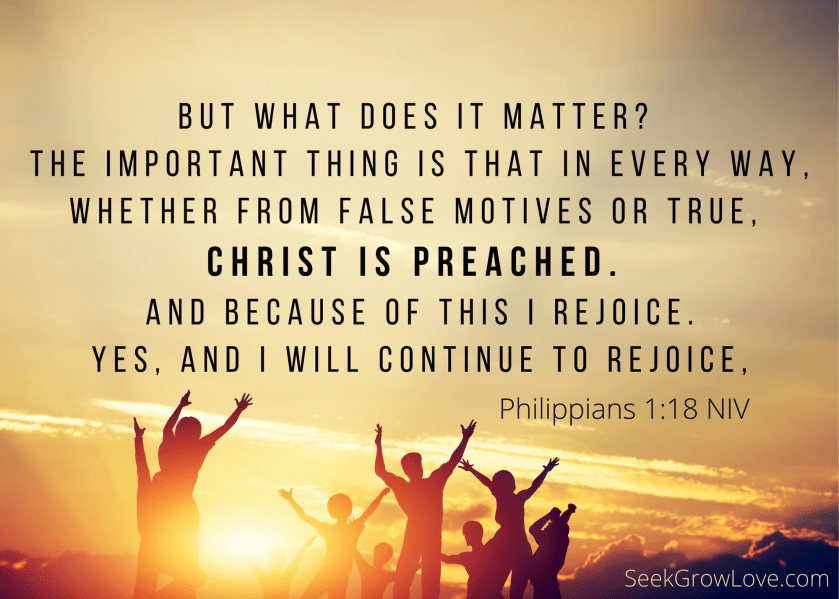
“In every way, whether from false motives or true, Christ is preached. And because of this I rejoice.” 

Do you get sidetracked, sometimes, worrying about the motives of others? I know I do. I’m frequently suspicious. And I must force myself to ask, as Paul does, “What does it matter?” So long as the gospel message is preached, I should rejoice. 

Verses 27-30: Paul encourages the Philippian church to stay on track. No matter what happens, be concerned first that the gospel is preached in your words and in your actions. Don’t be distracted by those who oppose you or by those who may have false intentions. Live a life that glorifies Christ and spreads the message of the kingdom.

Are you distracted by the negative voices and actions in your life? Have you lost focus? The gospel of Christ is first!  Are you conducting yourself “in a manner worthy of the gospel of Christ”? What adjustments do you need to make in your life to be a better representative of the kingdom? 

As your sister in Christ, I’m praying over you now that you find encouragement in whatever your situation is. I pray that you are able to defend and confirm the gospel in your actions and your words. I pray that you find support in your fellow believers to continue on in your important task of spreading Christ Jesus to others, and that you do so without distraction! Let’s continue to advance the gospel together. I love you!

-Jenn Haynes

Reflection Questions

  1. See above – lots of great questions in Jenn’s devotion

Wounds from a Friend

Old Testament: 2 Kings 9 & 10

Poetry: Proverbs 27

New Testament: Luke 10:1-24

The Proverbs are, in many cases, fairly self explanatory. Don’t be lazy, don’t be a wicked ruler, don’t be foolish but be wise, be a righteous ruler, be diligent in your work. Each Proverb has it’s own meaning but they go along those lines. But some are not so self explanatory. They are counterintuitive.

A short example is found in 28:27. If you want to be prosperous and blessed, to never be in want, then we give our money to the poor. The world, our own sinful heads, and many economists believe that the way to grow our wealth and not be in want is to hoard our money. But that’s not the way God works. It is only in generosity and giving that we will be blessed. This comes from the fact that God will bless and many times he blesses us through the care of others in our time of struggle and hardship.

Also, 27:5-6 doesn’t seem to be true in the moment. I don’t like to be rebuked. I don’t like it when a friend calls me out on the garbage way I am acting. But the Proverb teaches us that we should delight when a friend rebukes us because their correction comes from a place of love and they want our life to be one of wisdom and righteousness. This is especially true for  our brothers and sisters in our local church. Many times, we may feel judged by the people of our church, but more often than not, they are wanting the BEST for us. The “wounds” they give are better than any kisses of those who tell us we have nothing wrong with us. There could be people who act like a friend and hurt you in terrible ways, but here we mean TRUE friendship, TRUE companionship, TRUE love from a brother or sister in Christ. That true love is shown in forgiveness and compassion, especially in our moments of weakness and humility. Many times, when we are sinning and are fearing the rebuke of those people, we hide our sin away, like 28:13 says. But counterintuitively, by hiding our sins, we only hurt ourselves more when they are brought to light in some other way. We need to confess our sins and turn away from them. When we do, compassion and forgiveness are waiting for us from the people of God and from God himself.

Jake Ballard

(originally posted for SeekGrowLove June 17, 2020)

Reflection Questions

  1. What other proverbs have you run across that seem counterintuitive and the opposite of how the world thinks or operates? How is God’s wisdom better than the world’s?
  2. Can you think of a time a true friend gave you correction or a rebuke? Can you think of a time you, as a true friend, gave correction or rebuke? What is the value of correcting a friend? What problems can develop if we don’t correct in love, or if we don’t accept the correction given in true love?

Unity

Old Testament: 2 Samuel 20-21

Poetry: Proverbs 6

New Testament: Ephesians 4

After the attacks on September 11, 2001, President George W. Bush spoke to the emergency workers in Ground Zero through a megaphone, finding a response that resonated with the entire country and even more, the world, “I can hear you. The rest of the world hears you. And the people who knocked down these buildings will hear all of it soon.” A historical 92% of the country approved of the job he was doing, bringing together a country that was fraying at the seams in the previous election cycle. It is hard to imagine something similar happening today; no matter who is the president-elect in November, half of the country will be instantly dissatisfied with the results.  These are typical terms we accept in our government, but also this “majority rules” culture has historically found its way into boardrooms and even churches. Let me quickly lower the tension by stating that today’s devotion is not about politics or presidents.  It does not upend or chastise any church form of government. Its sole purpose is to examine the expectation of unity laid out for the church body, as it might be equally unimaginable. 

This spirit of unity was on the mind of Jesus before being arrested in the garden of Gethsemane. He prays for his disciples and all believers when he leaves us the following words, “Holy Father, protect them by the power of your name, the name you gave me, so that they may be one as we are one. (John 17:11b)” Jesus knew his departure to the cross would scatter His apostles, create infighting, and feed doubt. Fortunately, with the exception of Judas, each of them found their way back to a unified front. Having seen Jesus Christ raised to life, they each waited for the Holy Spirit at Pentecost.  They each dedicated their lives to sharing the Good News of the Kingdom of God. They each shared in martyrdom or exile for the sake of Christ.

In the same manner, I have seen churches unite during revival, when facing tragedy, or during persecution from the outside. It is easy for the dross to fall away when the metal is hot, but what about when the metal starts to cool? What does unity look like in maintenance mode? Within the day-to-day routine of uniting relationships, mulling through ministries, and discerning what is best for a body of believers? In Ephesians 4, Paul describes this as “walk[ing] in a manner worthy of the calling, with all humility and gentleness, with patience, bearing with one another in love, eager to maintain the unity of the Spirit in the bond of peace.”

While there could be a devotion on each of the elements of this verse, let’s quickly unpack the key points given to Ephesus. First, walking implies that it is not a quick process, but instead requires some dedication to go the distance (Eph 2:10). Next, humility is the acknowledgement that self-reflection should be the first step in the process, making adjustments and amendments when necessary (Matt 7:3-5; Phil 2:3), and gentleness is the grace that is extended to my brother and sisters during this same process, as imperfect people try to discern the will of God (Col 4:6). Additionally, we are required to commit to patience and love, easily spoken but in reality, conflict makes us more unbearable to one another (Col 3:12-14; Matt 18:15-20). In the body of believers, this is similar to taking the last rep of weight training, it burns the most, but it is the one that produces the result. Finally, eagerness to maintain unity means we stay focused on what unites us (Rom 14:19), defending against the six things the Lord hates (Prov. 6:16-19), and keep our mission far away from doctrinal nuances or extra-biblical preferences.

Unity takes far more work than building a majority.  It isn’t a compromise or consensus because there are no losers. We grow as one together. We move towards one another as we move towards our Heavenly Father. Today, let us be extra mindful in our prayer time to dwell on the topic of unity and ask God to reveal our vision and repair divisions that may exist.  May we live out the prayer of Jesus and the petitions of Paul to become one like our God and His Son, Jesus Christ.

-Aaron Winner

Reflection Questions

  1. Where and when have you experienced or seen the beauty of a united church body?
  2. Dedication, humility, gentleness/grace, patience, love, focused on what unites. How can you exhibit these qualities today? How can you use them to increase the unity of your church? What can happen when just one is missing?

“I’ll be there for you”

Old Testament: 1 Samuel 19 & 20

Poetry: Psalm 68

New Testament: Galatians 1

David was successful.

A consummate warrior (1 Sam. 18:7), 

a decisive leader (1 Sam. 30:21-25),

handsome enough to make the ladies swoon (1 Sam. 18:20, 25:39-42). 

But is that what makes a man successful? 

Strong arms, incisive wit, a good frame?

David would never say that those things made him great. I’m not even speaking of the most obvious reason he was successful; clearly that is because he honored the Lord his God, he worshipped God and was a man after God’s heart. The power, wisdom, and beauty of the Lord far outstrip anything David had “naturally”. 

Beyond worship, David did not live his life *alone*. It is very Western and American to think of a successful man or woman and assume they succeeded on their own, against all odds, versus the world, pulling themselves up by their own bootstraps. But the world doesn’t work this way. 

Success doesn’t work this way. 

Faith doesn’t work this way. 

David was surrounded by people he admired and who admired him, men who believed in his cause and who would follow him. 1 Chronicles 11 is a list of David’s valiant warriors, his mighty men, thirty guys whose names are immortalized as warriors who went to battle with David as his greatest compatriots. 

In our reading today, what we see is the love David had for Jonathan and that Jonathan had for David. In chapter 18, Jonathan loved David as he loved himself, and gave him gifts to prove his love. The entirety of chapter 20 consists in David knowing Saul wants to kill him but wanting proof from Jonathan, and Jonathan learning that his father was murderously insane. Jonathan and David weep when they know they are going to be separated so that David is not killed by Saul in a jealous rage. They weep knowing that they may never meet again in this life. 

Jonathan is the example of the proverb:  “A friend loves at all times, and a brother is born for adversity.” (Prov. 17:17)

David, to be the man God wanted him to be, needed people, especially peers he respected, to push him and to support him. David needed Jonathan. 

Jesus chose to surround himself with guys he trusted, even if they were super frustrating (“you little-faiths” is somewhere between an insult and a term of endearment). Jesus loved his disciples. He didn’t start the church as a solo act. Moreover, the disciples needed each other! Jesus didn’t just teach one disciple or 2, but had twelve close disciples/apostles and seventy-two who he sent out to teach in pairs. (Luke 10:1ff)

This message is intended for everyone (boys and girls, men and women), but I want to speak directly to the guys for a second: Fellas, you need someone to support and who supports you, a real friend. It doesn’t need to look like the loving, hugging, (kissing? gross) friendship of David and Jonathan. But in our culture, men are marked by loneliness and without real connections to other guys. Young guys especially are socially disconnected, which leads to pessimistic views about the future. In trying to find communities, we naturally turn to the internet, which can connect us superficially with people who think like us, but also is a place ripe for shallow “personal relationships,” unrealistic para-social relationships, and a possibility for bad actors to try and warp pain and loneliness into anger and resentment. 

In other words, we need to go outside, touch grass, and make some real friends. Go to church and talk to people. 

David needed it.

Jesus modeled it. 

The Disciples lived it. 

May you find your Jonathans and Davids soon. 

-Jake Ballard

Reflection Questions

  1. You’ve got a friend in me?: Do you have friends outside of digital spaces? Online friends are nice, but as embodied creatures, the digital cannot substitute for the reality of physical friends who are in the same room, space, worship gathering, concert hall, wherever you and your friends gather. How can you bring your digital friends together in physical spaces? How can you eliminate the nagging, lazy voice of “just stay home tonight” when your friends want to gather together? 
  2. Jesus’s Besties: Jesus, because he is the empowered son of God, could have theoretically, maybe gone through life without friends. However, his life shows us why he wouldn’t want to! Friends were necessary for his movement, and friends gave him joy. Five hundred gathered together after his death, the seventy two were sent by him, and the twelve knew him for three years or more. But closer than that were Jesus’s besties; Peter, James, and John. John himself was probably the disciple whom Jesus loved. More than many friends, do you have deep friendships? Is there anyone you would trust to hear your secrets, with whom you could share doubts, or to whom you could confess? These deep friendships are not quick choices or made overnight, but having them is essential for the kind of success Jesus wants for his disciples.

A Team Effort

Old Testament: Judges 1-3

Poetry: Psalm 52

New Testament: 1 Corinthians 12

            I love baseball. (If you don’t, don’t leave just yet, please). Baseball is a team sport.  This was put on display for me recently.  I was watching a Washington Nationals game this weekend and the commentators brought in a retired pitcher who used to play for the Nationals in their 2019 World Series winning season.  During the playoffs that year, Anibal Sanchez came very close to pitching a no-hitter.  It was broken up in the 8th inning by a Cardinals batter.  When asked about it Sanchez said he wouldn’t have come close to having a no-hitter without his teammates making great plays.  He said no pitcher should ever get sole credit for a no-hitter.  It’s impossible without your teammates making plays.   Sanchez wasn’t just being humble, he was 100% right.  It takes a catcher to catch the pitch, fielders to make plays and throw the ball to first, outfielders to run and catch fly balls.  Without good teammates, you can’t pitch a no-hitter.  When a no-hitter does happen, or even rarer a perfect game, the pitcher gets the accolades and they stick a microphone in his face after the game, but it was a team effort.

            The same is true for the Church.  That’s what Paul was trying to get at in 1 Corinthians 12.  There are a few people that are “up front” during a worship service.  The worship leader, the soloist, the scripture reader, and the pastor all have visible roles and they are important.  But they aren’t the only important people.  Many important people are working behind the scenes in nearly invisible ways.  The person running the sound system is important.  The pianist, guitar player, and other musicians are important.  The person who makes the coffee before Sunday School is important.  The people who set up tables for Church dinners are important.  The people who teach children’s church are important.  The people who clean the bathrooms, take out the trash, and vacuum the floors are important.  The people who buy toilet paper are important, very important.  If those people don’t do their jobs what have you got?  A mess.  Also important are the people who type the bulletin and change the slides with the worship song lyrics, and the people who make sure that the heat is turned on or the a/c is turned on.  All of these people are important.  So are the people who faithfully place their financial contributions in the offering, and the people who count and collect those offerings, and the people who write checks so that the pastor can feed their family and the lights stay on.  Even in smaller churches, it takes a lot of people to share their gifts and talents.

            Apparently, in the Church at Corinth, there was a lot of jealousy and rivalry going on between Christians.  It was causing division in the Church.  The Apostle Paul wrote this letter to correct some of those problems.  He wanted them to understand that Churches need to maintain unity to be healthy and carry out the mission that God has given us to do.  Everyone in the church is not gifted in the same way.  Some people love to be up front serving in visible ways.  Some people are not gifted to speak or lead worship, but they have other gifts.  I have a special needs sister, Christine, who wants to help and has claimed her gifts by handing out the church bulletins.  She grabs a stack and goes to each person in Sunday School and gives them a bulletin.  She wants to help by sharing her gifts.  She also loves to sing very loudly in worship and her exuberance is infectious.  (And she likes to say “amen” when her brother the preacher says that he’s winding up the sermon).

            Read through all of the Apostle Paul’s letters in the New Testament and see how much Paul depended on others to help him carry out his ministry.  Often when he wrote letters to encourage and teach Churches he was in jail for preaching the Gospel of Jesus, which was a threat to both the religious leaders and the Roman Empire.  Paul depended on people to take the letters he wrote from prison and deliver them to the Churches.  He also depended on people to bring him food, an extra blanket, his books and letters, and medicine.  He had poor eyesight so he depended on a secretary to write down his words. He also longed for fellowship with other followers of Jesus.  Paul was the face of much of the teaching and spread of the Church in the first century, but it took a team to support him.

            What are some ways that you are serving in your Church?  You can’t start too early.  Our church has a 7-year-old help take up the offering some Sundays. As you read through 1 Corinthians 12, try not to get too bogged down thinking about the theological issues that continue to divide Christians today (are the spiritual gifts Paul mentions for now or did they stop after the first century?)  It’s amazing how this chapter that Paul wrote to help a church not be divided has caused many Christians to disagree and divide.  If God decides to give you the gift of miracles or healing, who am I to tell you that God did away with those gifts 1900 years ago?  (if you do have the gifts of miracle or healing, please come visit me, I could use it.)

            Remember, there is no “ I” in “Team”.  And there is no I in Church.  It’s all about how we use the gifts God has given each of us to serve.

Pastor Jeff Fletcher

Reflection Questions

  1.  What similarities do you see between sports teams or work teams and the team work needed to carry out the work of Jesus and the Church?
  2. Are you currently using any of your gifts to help carry out the mission of the Church?
  3. Are you willing to test your gifts and potentially experience some failures and disappointments as you seek to carry out the mission of Jesus Christ and the Church?  What will you try and risk next?

Giving Responsibility

xr:d:DAF9U4VOudE:10,j:1267056673937771116,t:24022012

Old Testament: Leviticus 4 & 5

Poetry: Psalm 37

New Testament: Acts 6

Today, we’re going to take a break from Psalms 37 and focus on our passage in Acts. Though a short chapter, two very important events take place in chapter 6. To set the stage, here’s a quick mini review of Acts so far.

Acts 1 – Jesus leaves the apostles and Matthias is chosen to replace Judas of Iscariot.
Acts 2- Holy Spirit comes, pentecost.
Acts 3 – Peter heals a beggar and preaches in the temple.

Acts 4 – Leading priests and elders get mad. Peter, John, and believers began to worry about oppression but pray for courage and continue preaching. Believers begin to unite in one heart and mind, caring for each other by acting as generous givers.

Acts 5 – Ananias and Sapphira lie about being generous givers and are struck dead. The apostles heal many people. More officials get mad at apostles and arrest them. An angel of the Lord sets them free and they continue preaching.

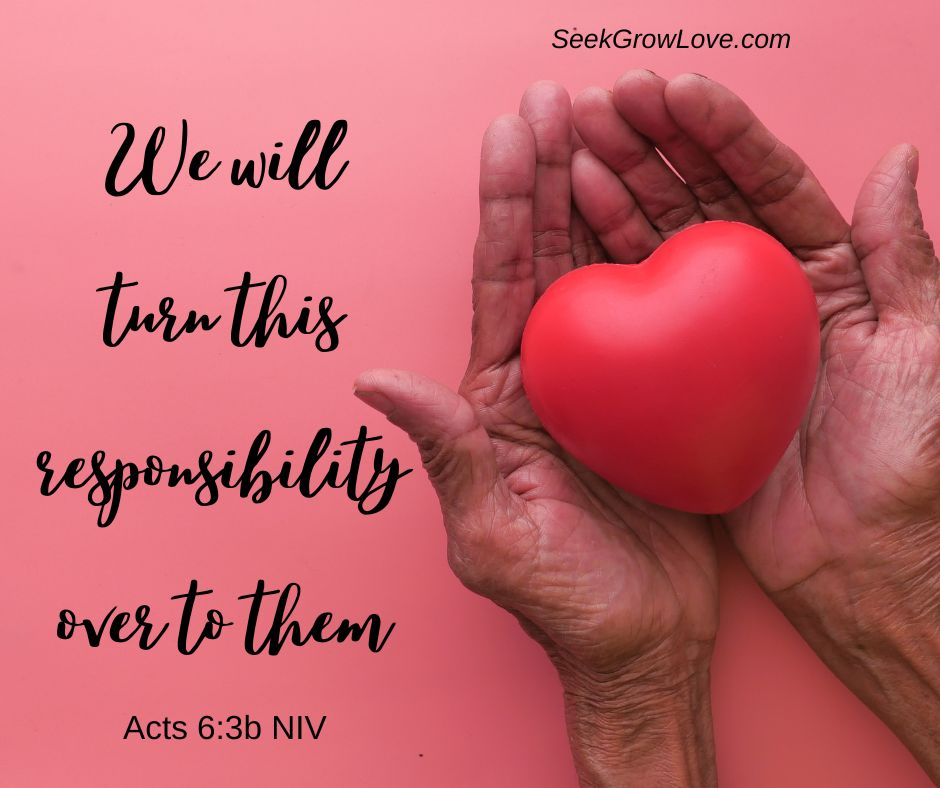
In Acts 6 we see the church has grown and the apostles feel overwhelmed with responsibility. So, like all great leaders, the apostles delegate. Seven men are chosen to be in charge of caring for widows, food distribution, and other administrative duties. This enables the apostles, those who had lived with Jesus and witnessed his resurrection, to continue their preaching and teaching.

I love this story because it shows how all people are useful within the church. Not everyone is meant to be a preacher. Not everyone has a surplus of money to donate to the church. Not one role is more important than the other. This is where we start to see the church operating as a body.

As a little girl I was always in awe of my Aunt Christy. I got to really see her at work when she took over directing Minnesota State Youth Camp. My first camp job was making sure my cousin, her toddler son, “stayed out of the lake” as his parents put it. During that time of babysitting my cousin, I saw a lot of the behind the scenes work Christy did. I was impressed. There is a lot more that goes into running a camp than one might think. I told her how she was so good at her job and she laughed in humility. Then she told me something I’ve never forgotten. She said the secret to being a good leader is finding the things other people are good at and putting them in charge of those things. In Acts 6 that is exactly what happens for the early church.

Sometimes I think we are too harsh on ourselves. We compare ourselves to others and guilt ourselves for not serving like them. The thing is we all have different roles to play. We need not feel bad about our role. It takes all sorts of people to run a church efficiently. We are given this example in Acts 6.

The second important event in Acts 6 is Stephen’s arrest. His arrest leads to his death in Acts 7. This is significant as it is the first recorded execution of someone preaching the Gospel in Jesus’ name. Present at Stephen’s execution is the first time we see the man Saul who would later become Paul the Apostle. Before he is stoned to death, Stephen delivers a beautiful sermon. One line in particular stood out to me but we will look at that tomorrow. For now, I encourage you to find ways to serve within your church community, using your unique God-given gifts.

-Emilee Ross

Reflection Questions

  1. What God-given gifts have you been given?
  2. How can you use those to serve within your church community?
  3. Is there a job you have been doing for the church that might be good to share with someone else?
  4. What benefits are there to giving responsibilities to others?