The Day of the LORD – Past & Future

Joel 1-3

Devotion by Sherry Alcumbrack (South Carolina)

When we have something important to tell someone and we want to make sure they understand, we will repeat it many times. In the small book of Joel, “the day of the Lord” is mentioned five times, so we know that this is its central theme. That lets us know that what he is telling us is important to understand, he wants to make sure we get it.

There are two “Days of the Lord” mentioned. One is a past event, Israel had been ravaged by locusts: gnawing locusts, swarming locusts, creeping locusts, and stripping locusts. This was a judgement against Israel and the sins against God that they committed. In Chapter 1:14 to gain repentance Joel suggests that they: “consecrate a fast, proclaim a solemn assembly, gather the elders and all inhabitants of Israel to the house of the Lord, and cry out to the Lord.” He understood their need for repentance.  Chapter 2: 12-13 says “’Yet even now,’ declares the Lord, ‘Return to Me with all your heart, And with fasting, weeping, and mourning; and tear your heart and not merely your garments.’ Now return to the Lord your God, For He is gracious and compassionate, slow to anger, abounding in mercy and relenting of catastrophe.” He tells us that we have to do more than tearing our clothes (an outward sign), we need to change our hearts, if we do that, God will forgive us.

It even says that he will make up for the years that the locusts have taken and that his spirit will be poured out on all mankind. That verse is very important to all of us. Chapter 2:28 says “It will come about after this that I will pour out My Spirit on all mankind; And your sons and your daughters will prophesy, your old men will have dreams, your young men will see visions.” This is no longer just to the Israelites, he is talking to all of us about a future “day of the Lord.” The people of Israel had to go to the temple to receive forgiveness of their sins with an animal sacrifice. God made a new way when he gave us Jesus as our sacrificial lamb, so now we can repent and be baptized and our sins are forgiven. We look forward to the future “day of the Lord”, when Jesus will return to the earth, and will usher in the Kingdom of God. What a glorious Day that will be!

Reflection Questions

  1. Why is repentance – and how we do it – important to God? What gets in the way of our true repentance?
  2. Contrast the mood in the beginning of Joel to the mood at the end. What makes the difference?

A People for God

1 Kings 8 & 2 Chronicles 5

God’s covenant with His people is a continued theme throughout the Bible. It is confirmed with some of the greatest Old Testament leaders, such as Abraham, Moses, and David. Generations have been taught about God and all He has done for them. Though they have some faults, they have remained faithful to God as His people. The completion of the temple by Solomon further signifies a desire to worship God and be His people. After years of planning and construction the temple is finally used for its intended purpose and the glory of God fills the temple. In dedication, Solomon offers a prayer and addresses the people of Israel regarding the relationship between God and the people.

His prayer is a powerful plea for the LORD to remember His people and be their God. He begins by praising God and thanking Him for keeping His promises. Solomon prays that God will remain with them and hear their prayers. More importantly, he urges God to forgive them when they mess up. Solomon was wise enough to know that even if they tried their best they would sin and require God’s forgiveness. This applies to a variety of situations Solomon covers in his prayer, such as drought, famine, plague, war, and captivity. He argues that they have been God’s people for years and that He should continue to remember them for God’s glory. 

Then Solomon turns to the Israelites with him and requests that they keep their side of the covenant. Speaking to the people, Solomon says, “may your hearts be fully committed to the LORD our God, to live by His decrees and obey His commands” (1 Kings 8:61). God has fulfilled his agreement of the covenant in the past, so it is up to the Israelites to follow the covenant they agreed to. They must remain faithful to God to enjoy the benefits of being God’s people and having a hope for the future. There are many false gods that can be worshiped, but Solomon’s desire is that the LORD who brought their ancestors out of Egypt remains their God. 

That is easy to agree to in good times, but history has proven that is not always the case. There are numerous examples of the Israelites turning away from God for a period of time. Although Solomon’s reign was successful for the Israelites, they would not enjoy the same prosperity and unity for long. Solomon prayed that God be with them in all situations and advised the people to remain faithful to God. No matter what happens, wisdom suggests making a conscious decision to develop a relationship with God and be a people for Him.

-Josiah Railton

Reflection Questions

  1. What do you find in Solomon’s Dedication Prayer that would be wise to add into our prayers today?
  2. When did you last make a conscious decision to develop a relationship with God and be a person for Him? How is it going?
  3. Solomon was wise to know we would and will all need forgiveness. When have you veered off the fully committed and living by his decrees path? Have you experienced His forgiveness? What did that look like?

Reconciliation

2 Samuel 13-15

Have you ever been in a conflict where you feel extremely wronged in a situation? Everyone is like yes and amen. The story of our lives. Haha. Now secretly, to a really close friend you may be able to admit that you also did some wrong stuff, too; but there ain’t no way that anyone else is finding out about that. In fact, to all your friends you portray yourself as something resembling Jesus in the situation. I hope that you aren’t so disillusioned that you actually believe this has never happened to you. We really enjoy this social feedback loop.

There are other situations that come up in life where you have a single incident and then everything spirals out of control and that one incident ends up messing up everything in that relationship. I have totally had one of those.

It seems that there is nothing new under the sun because that is exactly what has happened with Absalom and David. The worst and most ridiculous thing about this story is that the catalyst to this relational tension didn’t even involve them. As you’ve read, this caused years of tension and problems and separation between father and son.

I am not going to speculate on whether David was right in not sentencing Amnon to death after rapping Tamar or whether Absalom should have killed his brother. There comes a certain point at which what has happened in life has happened. There is nothing you can do to change it and now you just need to live your life with the future in mind. In most of these cases keeping the tension and the bad blood in the relationship isn’t profitable to our own spiritual health and doesn’t promote godliness.

The section of today’s reading that I would like to discuss is 2 Samuel 13.37-39 and 2 Samuel 14.21-24, 28.  After Absalom killed Amnon, in worry and anxiety he fled to Geshur. It says that David mourned for his son in 2 Samuel 13.37. I am not sure which son he was mourning for but I believe that given the context of the paragraph and the verses around it the verse is telling us that David mourned for Absalom. This is also supported by v.39 where David says he longed to go out to Absalom. So why didn’t he?

David didn’t go out to seek his son Absalom, even though, he wanted to. He left him out in Geshur for 3 years. In fact, it wasn’t even David’s prompting that brought him back. Joab had to step in as mediator and be the counselor in this situation for Absalom to return. I think the responsibility falls on David to take the initiative to mend the relationship with his son instead of just leaving the situation in the wind. David essentially stuck his head in the sand and ignored the problem. Ultimately, this just caused problems between David and Absalom later on.

Finally, after Joab’s prompting David brings Absalom back to Jerusalem but tells Joab that Absalom can’t enter his presence. Absalom spends 2 years in Jerusalem before any action is taken in this relationship and the initiative once again wasn’t taken by David. It took Absalom saying it would have been better if I hadn’t left Geshur than to live like this and I would rather just have David do to me what seems right to him. Absalom hit the point where he would rather die if he had any guilt in him than live with this relational separation.

Surveying this whole situation, we see problems on both sides but I think the judgement ultimately lies with David. He took none of the initiative to repair this relationship. There is a real danger to leaving things unsaid that should have been said. I believe David’s longing to see his son at Geshur should have moved him to take action and confront the problems in relationship instead of just waiting. David longed for his son but out of pride or anger or stubbornness didn’t take the initiative to reconcile with Absalom.

When you consider the intensity of distress Absalom must have felt at the tension and loss of relationship that he would be willing to die if he had any guilt it is obvious that this weighed heavily on him. The two men’s reconciliation is sweet but was so long overdue that I think irreversible damage was done to the relationship given what happens in Chapter 15.

So, what can we draw from this? Firstly, to not let our conflicts go on forever. Secondly, when it is on your heart to apologize or you are longing for someone who you are in conflict with, it may be God working on your heart to repair the relationship. Thirdly, get a mediator or a counselor involved if needed. Don’t wait until someone else feels like something needs to be done. Fourthly, you are responsible for taking the initiative to reconcile or apologize for what you have done. Fifthly, don’t be afraid to let someone have the ability to go second. In this final scene where Absalom goes to his father, his father embraced him and kissed him. I have a feeling that David had longed for this moment. I can remember a moment in my relationship with my wife where we were in conflict and I had my defenses up to keep myself from over apologizing or taking too much of the blame. I remember so vividly her apologizing first and immediately all the weight was lifted, my defenses dropped, and I was no longer looking out for myself but I was looking for the good of the relationship. It gave me the freedom to really say the things I wanted to say when, at first, I may have even been hostile.

Finally, our relationships will only be as good as our communication in them. Remember it is wise to address conflicts as soon as possible. Do not leave things unsaid or problems unaddressed. They don’t just go away.

Daniel Wall

(originally posted May 14, 2020 for SeekGrowLove)

Reflection Questions

  1. How do you typically deal with conflict with someone close to you? What are the advantages and disadvantages to this approach? What would be better?
  2. What is the best response to our own sin? What is the best response to someone else’s sin?
  3. What was Joab’s role? How did he do it? Do you think God was pleased with Joab?
  4. Is there a situation where you might be able to help work towards reconciliation? (first in your own life, and then perhaps in someone else’s)

A Psalm of Repentance

Psalm 32, 51, 86, 122

Create in me a clean heart, O God, and renew a right spirit within me. Psalm 51:10 ESV

Yesterday, we looked at the narrative and the outcome of David’s tryst with Bathsheba. We see David essentially commit murder to cover up his affair, and we see the prophet Nathan come and confront David about the evil that he has perpetrated.

David could have been dismissive. He could have just shrugged off Nathan’s confrontation and said, “This is where my heart led me.” He could have said, “God wants me to be happy.” But he does not deflect. Despite his error, David still desires to do what God desires of him. He wants to be right before God, and when the clarity and gravity of his treachery sink in, he shows contrition. Not combativeness. Not excuses. Contrition.

David knows that what he has done is wrong, and he knows that he is not capable of fixing himself and reorienting his life and priorities alone. He cannot wash himself clean of his sin, but God can forgive him and cleanse him of the sin that has come forth from him.

David sees what would later be written: God does not desire sacrifice, but repentance. Not a cheap get me out of this mess offering, but a recognition of the sin done and the brokenness of recognizing the gravity of the separation from God that sin causes. God accepts sacrifices, but he accepts these sacrifices from a clear conscience; he doesn’t desire sacrifices from a guilty one.

-JJ Fletcher

Reflection Questions

  1. Why do we struggle to see the gravity of our sin?
  2. How can we truly show contrition, not just be sad that we’ve had our sin found out?
  3. What can we learn from Psalm 51, a psalm of repentance?

Wrong Place, Wrong Time

2 Samuel 11-12
1 Chronicles 20

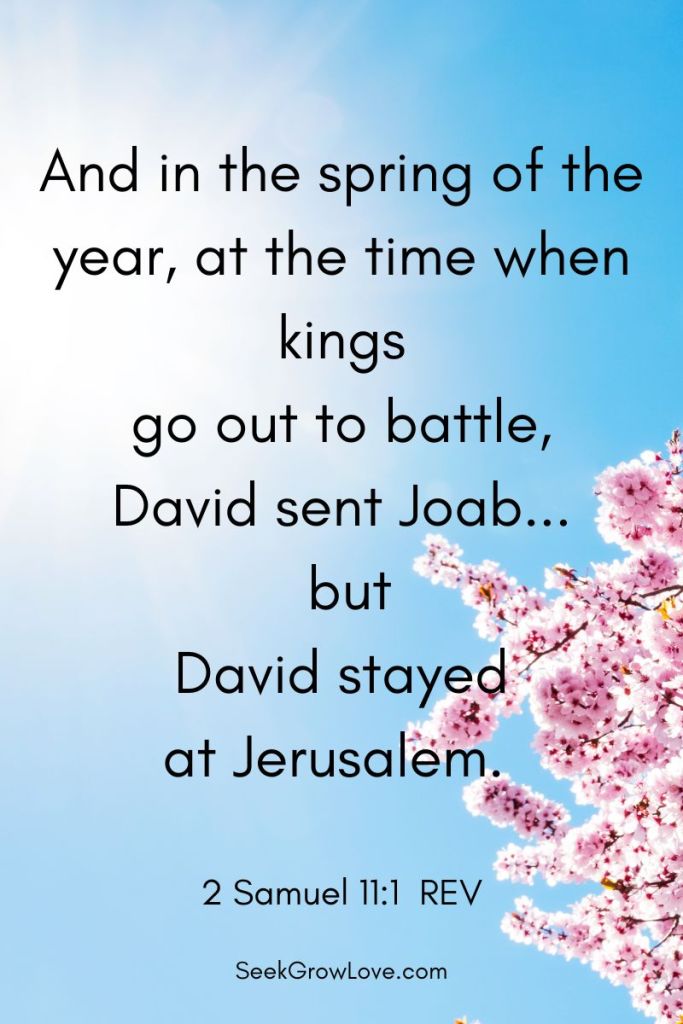
And in the spring of the year, at the time when kings go out to battle, David sent Joab, and his servants with him, and all Israel, and they laid waste the children of Ammon and besieged Rabbah, but David stayed at Jerusalem. – 2 Samuel 11:1 (REV)

                  In today’s reading, we see two realities. Both happened, but at different times and represent different things. In 2nd Samuel, we see David, king of Israel. Where do we see David? At home. Sitting on his keister and not doing what a king would normally be doing: overseeing his generals as they go out to battle.

                  David is not where he is supposed to be. He should be meeting with his generals. He should be motivating his armies. He should be praying and fasting and seeking out God’s direction for the safety and prosperity of Israel, but he’s back in Jerusalem. Twiddling his thumbs? Playing his harp? We don’t know what he was doing at all hours of the day when he held up in his palace.  We do, however, know what he was doing on one specific evening.

                  David is out walking on the roof, where he shouldn’t be, and he sees Bathsheba bathing. David does not turn away from seeing the nakedness of this woman whom he is not married to. He stares. He dwells. He obsesses. She’s beautiful. He needs to meet her. To be with her.

                  David ends up having her come into his home, and he has sex with her and gets her pregnant. We may have seen this story happen in the lives of some people we know, but this is high profile. This is a problem. A bunch of people are going to know what has happened, and this is going to be hard to explain to Bathsheba’s husband, Uriah, who is out at war, where he is supposed to be: fighting for the armies of the people of Yahweh. While the king is out preying upon the wife of his soldier.

                  David finds himself in a sticky situation, so he sends for Uriah and does his best to get Uriah to go have sex with his wife and cover his… keister. Uriah, however, cannot fathom such a thing while his comrades are off fighting a war. He refuses to even go visit his wife. This poses a major problem. People are going to know that Bathsheba is expecting, and they are going to know that Uriah hasn’t been with her in months, maybe longer. David tries multiple times, but no dice. Uriah is a man of honor and conviction, and that is not going to fly in this situation. David needs an out. David essentially puts out a hit job on Uriah. David cannot control his urges, so a good man dies.

The story unfolds. Uriah is dead. David marries his baby mama, and then the baby dies. Nathan the prophet comes to confront David and gets David worked up with a parable. David wants vengeance for the perpetrator in the story, but then the tables are turned when David is revealed to be the bad guy in the tale. David grieves, David repents, but the baby does not survive. It’s rough.

In 1 Chronicles 20, we see that it is the time when kings go out to war. And David goes out to war. And his armies thrive. He gets an awesome new crown. God blesses the armies of a king who acts in good faith. David is more than capable of doing the right thing, but even a man after God’s own heart can allow himself to fall off the rails.

Here’s the rub: Sometimes we get complacent. Sometimes we get lazy. Sometimes we do things, go places, consume content that we know we shouldn’t, but we’ve allowed ourselves to be in the wrong place at the wrong time, and we fall victim to the allure of the temptations of sin around us.

We’ve all allowed ourselves to be in bad situations that we could have avoided. Sometimes we may come out on top, but given enough opportunities to sin in the situations we create, we are bound to fall. We play with fire… and you know the cliché, but it’s true, we get burned.

-JJ Fletcher

Reflection Questions

  1. Can you recall some times you allowed yourself to be in a place you shouldn’t have been? What was the outcome? How could you have avoided putting yourself in that situation? What did you learn from it?
  2. What do you think of Nathan’s tactics of getting David to see the gravity of the wickedness that he had perpetrated?
  3. What does the story of David and Bathsheba teach us about grace, repentance, and forgiveness?
  4. If David can be forgiven for this travesty, who can you forgive that may have done much less harm in the way that they have wronged you?
  5. How does the contrast of 2 Samuel 11-12 and 1 Chronicles 20 sit with you? Does it give you any insight or change the way you perceive David’s sin?

If You Want His Blessings…

Obey!

Leviticus 26-27

We have finally come to the end of Leviticus and I hope that you’ve gained an appreciation for this “skipped-over” book: there is much we can learn about our God and how to serve Him within these pages, even if some of the specific details are different now under the new covenant with Jesus. One thing that will never change about our heavenly Father is something described in chapter 26: He blesses obedience and punishes disobedience.

Like most kids, I disobeyed my parents often when I was younger. If I was told not to do something, that’s immediately where my mind gravitated towards, even if there was the threat of punishment. I was also stubborn (and still am sometimes), and continued my disobedience even if the punishment was dealt out, until the punishment grew to a severity that wasn’t worth it anymore. A time-out from television didn’t mean much to me: neither did the extra chores that I was given. However, when those things didn’t work out and I was grounded from seeing my friends, I began to shape up and ask for forgiveness. My parents weren’t thrilled about punishing me, like most parents: they just needed to do something to get my attention and create an obedient spirit within me (probably the hardest job of a parent).

God as our heavenly Father is much the same way, and it is shown in Leviticus 26: He will punish the disobedience of His children until they shape up and realize the error of their ways. In this chapter, He gives the Israelite nation FIVE chances to change their ways and start listening to Him again, with increasing punishments: they unfortunately proved to be very stubborn and continued their disobedience until their nation was completely driven away from the Promised Land (which did happen). Although God warned them ahead of time, and gave them multiple chances to change, they kept acting out and disobeying until God had to go to extreme measures to get their attention.

However, despite all the disobedience and the punishments in this chapter, God says that if they will confess their sins and repent of their ways, He will forgive them (just like a good parent). He promises to bring them back to the Promised Land, restore the covenant that He made with their forefathers, love them again, and even dwell with them again: all they have to do is repent and start obeying Him again, because He knows what’s best for them.

We would do well to remember this lesson above all else: God blesses obedience, not disobedience. Far too often Christians have chosen to disobey God’s instructions and immediately expect His forgiveness because Jesus died for us. However, we cannot miss the most important part of receiving forgiveness: repentance.

It is not those who are well who need a physician, but those who are sick. I have not come to call the righteous but sinners to repentance.” – Luke 5:31-32 NASB1995

Do you want to live a good life full of blessings? Then obey God’s instructions.

Have you disobeyed God’s instructions and are suffering for it? Ask for forgiveness and repent.

God is willing to work with us and forgive our sins, but we must do something about it. Like a good Father, He is expecting obedience and a change of heart. We cannot simply “skate by” in our Christian walk, expecting forgiveness when we have no change in our lives. We have to obey Him if we want His blessings.

-Talon Paul

Reflection Questions

  1. How is God similar to your parents? How is God different from your parents?
  2. What blessings does He give that make you want to obey Him? What punishments does He give that make you want to not disobey Him? If you want to obey God how do you learn what His instructions are?
  3. What have you learned from Leviticus?

Clean Before the Lord

Leviticus 14-16

Whenever we watch a movie or read a book, we are anticipating “the moment” in the story where everything comes to a climax and all the puzzle pieces finally come together: chapter 16 of Leviticus is that climax within this book. In this chapter, God gives a special ceremony for the Israelite people, later called Yom Kippur (the Day of Atonement). At this special ceremony, the sins of ALL the people were forgiven and forgotten: at this special annual celebration, every person in God’s family gets a fresh start.

Once a year, the high priest would offer a sin offering for himself, his family, and all the people of Israel within the tabernacle. Since atonement and forgiveness are only possible through blood (Leviticus 17:11), the high priest offers this sacrifice on behalf of all the people to cover all their past yearly sins. He also presents a “scapegoat” before the people, a goat that would bear the sins of all the people and be led out into the wilderness, representing their sins being carried away and forgotten forever. Meanwhile, the people were expected to “deny themselves” in humility before God, repenting and mourning over the ways that they had offended their God throughout the year (and likely fasted from food and water).

What a wonderful and merciful act that God blessed His people with! This was the most important day of the year for every Israelite: the day that they could walk into a new year, cleansed and forgiven of every past mistake they’d made. God didn’t have to provide this ceremony: He only allowed it because He loves His people and understands that we are only dust.

As far as the east is from the west, so far has He removed our transgressions from us. Just as a father has compassion on his children, so the LORD has compassion on those who fear Him. For He Himself knows our frame; He is mindful that we are but dust.” – Psalm 103:12-14 NASB1995

Unfortunately, under the Old Covenant, only the high priest was able to bring about this forgiveness and atonement: only he could offer the sacrifice needed to cover over the sins of the people. There hasn’t been a tabernacle, a Temple, or a priesthood for Israel since 70 AD… based on the standards of Leviticus, it is impossible for the people to have their sins forgiven before God. That is, unless God provided a better way, which He did.

We find out in the book of Hebrews that Jesus Christ has taken the role of our new High Priest, and also as the sacrifice we need to take away our sins: not only just for the year, but forever.

Every priest stands daily ministering and offering time after time the same sacrifices, which can never take away sins; but Jesus, having offered one sacrifice for sins for all time, sat down at the right hand of God, waiting for that time onward until his enemies be made a footstool for his feet. For by one offering he has perfected for all time those who are sanctified.” – Hebrews 10:11-14 NASB1995

We all have regrets and understand that we haven’t lived perfectly: what if you knew that tomorrow all those deeply regretful moments would be washed away, never to be remembered again? Would that change the way you lived before God today? Under the New Covenant, we have the opportunity to live completely free from the guilt and pain that comes from regretful sin, because Jesus died in our place: this is an opportunity available to you, not just once a year, but every single day.

We all have the choice to live differently today than we did yesterday, because Jesus has removed all our sins from the past. What will you choose to do?

-Talon Paul

Reflection Questions

  1. What similarities and differences do you see between Aaron as high priest and Jesus as high priest?
  2. What regrets, guilt, and shame have you experienced? Are you living with them today? Do you need to? What are the New Covenant’s steps to accepting God’s free gift of forgiveness? What will you choose to do?
  3. Did living under the Day of Atonement mean they could do whatever they wanted because once a year all the sins would be forgiven? Does living under the sacrifice of Jesus mean we can do whatever we want because we have forgiveness of sins every day of the year?

Trying it Their Own Way

Leviticus 8-10

Leviticus is usually the most difficult book for people to read through, specifically because so many of the rituals from the ancient time of the Israelites don’t apply anymore. Many Christians when they come to this book in their Bible reading plans enter “skimming mode”, and brush over most of the content. However, we may be surprised at just how important this book really is when it comes to experiencing the presence of God. In order to understand how significant Leviticus really is, we need to look at the end of Exodus to grasp the story.

Then the cloud covered the tent of meeting, and the glory of the LORD filled the tabernacle. Moses was not able to enter the tent of meeting because the cloud had settled on it, and the glory of the LORD filled the tabernacle.” – Exodus 40:34-35 NASB1995

The story up to this point has been God desiring to be with His people, but when His glory finally does come to earth in the tabernacle, even Moses isn’t able to experience it fully… Leviticus is the answer to the problem. Through the rituals and the laws that Leviticus spells out for the Israelites, they are able to fully experience God’s presence. What is really cool about this book is that it worked: when we come to the following book of Numbers, Moses is finally able to enter into the tabernacle and see God’s glory.

Then the LORD spoke to Moses in the wilderness of Sinai, in the tent of meeting, on the first of the second month…” – Numbers 1:1 NASB1995

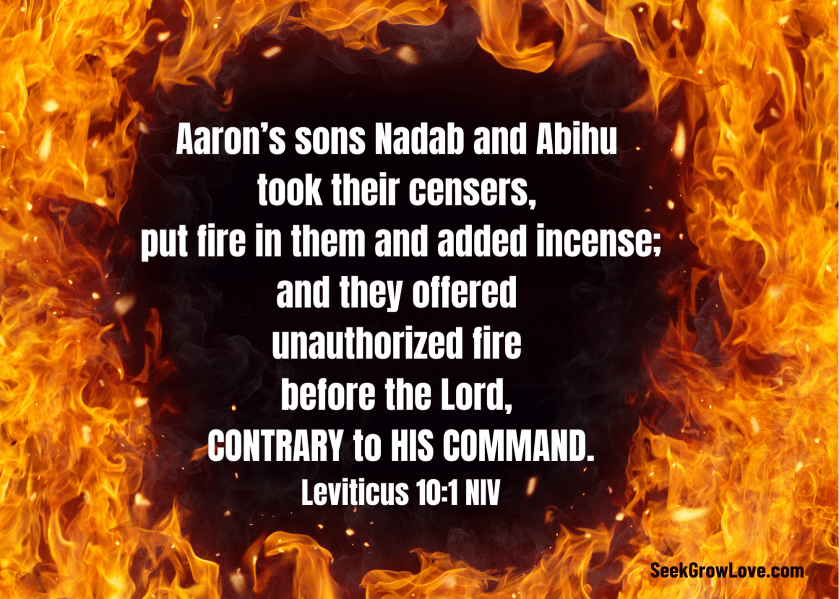
Moving forward, I hope that you will have a renewed appreciation for this often misunderstood and skipped-over book, especially as we discuss our chapters today. Through the first seven chapters, God has been telling Moses and his brother Aaron about all the very specific details they need to follow in order to bring forgiveness of sins into the Israelites’ lives. When we come to chapter eight today, they begin to put these instructions into practice: however, not everyone follows the clear instructions from God and suffers for it. Aaron’s sons, Nadab and Abihu, didn’t follow the proper procedure for worshiping before God, choosing to offer “strange fire” (10:1) onto the altar. Because they didn’t follow God’s instructions, they were struck dead and stand as an example for everyone that will worship afterwards.

We learn that God takes worship SERIOUSLY: to “worship” Him in an unworthy manner will not be tolerated. He told Moses and Aaron, “By those who come near Me I will be treated as holy, and before all the people I will be honored.” (10:3) He is a good God and Father who tells us exactly what we need to do, but will punish those who choose to “try it their own way”, especially those in positions of religious authority. No matter what, when we come to worship before our God and before our Savior, Jesus, we need to treat it as a serious matter, and seek to bring them total glory. True worship goes far beyond what type of music is played (hymns or contemporary), what order of service our church has “always used”, and beyond how we “feel” after the service: true worship is about God and Jesus being honored and exalted. If you don’t have that as your primary focus, nothing else matters. 

-Talon Paul

Reflection Questions

  1. Give some examples of how the world “tries it their own way” instead of following God’s instructions. When have you “tried it your own way” instead of following God’s instructions?
  2. We aren’t told what Nadab and Abihu might have been thinking as they were experimenting with their ‘strange fire’. Whar are some possibilities?
  3. Instant death is not always the consequence for acting contrary to God’s commands. What are some other consequences you have seen or experienced for acting contrary to God’s instructions?
  4. Why do you think God places such great importance on worship, and worship done right? How do we come into His presence today?

Just for the Guilty in any Matter…

Leviticus 5-7

Confession – yesterday we talked about Christ’s sacrifice replacing the Old Testament offerings. In those sacrifices, it was just that, a sacrifice – the people had to give something that they could have enjoyed because of their sin.

Even though there was a loss, the people had no clear way to alleviate the weight of guilt and find forgiveness in their lives. God has provided another way to help with that – Confession.

Confession is something that is hard to do. Many lie, deny and push blame on others just to avoid confessing. It is something that God asks of us not for his benefit but for ours. I remember being told often as a kid the only way to fix a problem  is to realize there is one. And that is what confession is.

Further, confession gives a proper view on sin, God and ourselves.

The punishment for sin is death – we need a proper view of sin. I have often heard of people talk about their sin as “Not that big of a deal.” Sin is just that, SIN. If it is wrong, we shouldn’t do it. Sin that is not confessed and not repented of leads to missing out on the Kingdom.

God cannot be in the presence of sin – we need a proper view of God. Our God is a holy God. He expects purity not just in our actions but also in our hearts. (Matt. 5:8 says the pure heart will see God.)

We cannot do it on our own – we need a proper view of ourselves. We often try to fix our problems on our own. Sin is not something we can fix on our own or earn enough to repay the debt. We need a savior and Christ is willing to step in on our behalf.

A couple tips on confession:

Confess immediately – when you know you have done something wrong do not push it off. It is easy to push it off.

Confess specifically – I hear a lot of prayer that vaguely ask for all sins to be forgiven. Make it personal and specific.

Confess honestly – Take it serious and do not make promises you know you will not keep.

Confess to someone else – this is something I push in the church. For some reason people are afraid of letting others know about their sin. Most will acknowledge they are a sinner but would never discuss their struggles for fear of other’s judgement. Find someone you trust and create an open discussion and ask for accountability.

John Wincapaw

(Originally posted February 14, 2020)

Reflection Questions

  1. What are you guilty of? What have you tried (lie, deny, blame, etc…) to avoid correctly addressing the problem?
  2. How does not confessing hurt you? What are the benefits of confession?
  3. What has God been waiting to hear from you? Talk to Him today.
  4. Do you have an accountability partner? If not, who do you know who would make a good accountability partner?

The Big Reveal

Genesis 45-47

Next to the greatest story ever told, the story of Joseph is by far my favorite Bible story. There are so many valuable lessons one can learn from reading it. Some lessons that stand out to me are the sovereignty of God, the importance of trusting God even in the midst of tragedy and suffering, and the beauty and power of forgiveness. 

I have often asked myself if I would have had Joseph’s attitude in the midst of a seemingly unending chain of absolutely horrific events. In spite of the terrible hand that he continued to be dealt, we don’t see him being consumed by anger, self-pity or a quest for vengeance. There’s something very powerful about Joseph’s unwavering faith in God that inspires me. He seems to possess a quiet assurance that everything is ultimately going to be okay. 

In this 45th chapter of Genesis, we see Joseph revealing his true identity to his brothers. We know he had risen to a very prominent position of power as second in command of Egypt. The stage could have been set for him to get the “perfect revenge” against his brothers. We read in verse 5 right after Joseph reveals his identity to his brother: “And now, do not be distressed and do not be angry with yourselves for selling me here, because it was to save lives that God sent me ahead of you.” I find it especially poignant that not only does Joseph not want to exact revenge in this situation, he actually chooses to comfort his brothers in this moment rather than “giving them what for.” We know from earlier scriptures that Joseph was clearly hurt by their previous actions, but he wants to spare them the hurt of being angry with themselves or beating themselves up because of their actions. He points them to an understanding of God’s sovereignty and that they were players in God’s plan. 

How differently that 45th chapter of Genesis could have played out if Joseph had been bent on vengeance. Instead, we see the true beauty and power of forgiveness and a reminder that God is in control even in the midst of our darkest hours. 

If we choose to be consumed with anger or self-pity, we miss the important lessons God is trying to teach us. We read in Romans 8:28, “And we know that in all things God works for the good of those who love him, who have been called according to his purpose.” Perhaps the answer in those dark times is to focus on loving God even more deeply and purposely than ever before.

-Kristy Cisneros

Questions for Reflection and Discussion


1) When you encounter hardships and tragedies, does your attitude reflect one of unwavering faith in God? If not, how can you further nurture and strengthen that faith so that it is at the ready when life’s storms come your way?

2) What action can help us love God more deeply and purposely than ever before?

3) What other lessons can you learn from the story of Joseph?

(originally posted for SeekGrowLove on February 6, 2020)