At the beginning of Acts 3, we find two disciples (Peter and John) endowed with the Holy Spirit perform a miracle. John and Peter told a lame man (Acts 3:2-8), who had been unable to walk since birth, to get up and walk…and the man did! Unused and weak legs were instantly transformed, and the man was healed. Not only was he able to walk, but his gratefulness could not be contained, and he leaped into the air and praised the LORD. That is why most miracles are performed so that God will get the glory.
Soon, however, the word of the supernatural occurrence got around. According to what Peter said, the crowd gave the two men credit for the healing. Instantly Peter corrected their error, “… When Peter saw this, he said to them: “Fellow Israelites, why does this surprise you? Why do you stare at us as if by our own power or godliness we had made this man walk?”
God is still in the miracle performing business. While we no longer have apostles with us today (those who physically walked with and were taught by Christ) we do have followers of Christ. Righteous men and women who believe God works miracles even today. When God does the impossible, it is always He that should be honored, never a man. The person used to do God’s will is simply that, one that God used.
Unfortunately, the Healer and the Changer of the impossible often gets forgotten. God seldom gets the glory for doing the incredible. People pray for healing or a bad situation to change. It is changed, but God does not get the credit. Others believe that a certain “man of God” can change the situation. The preacher’s prayers are honored, and the man is sometimes revered as being responsible. Often little credit is given to God. The man, medicine, or objects are just the vehicles God uses. God is the only one that can change anything.
“When in doubt, give God the glory.”
-Andy Cisneros
Questions for Reflection and Discussion
Does God do miracles today? How do you know?
Do we still pray to Him expecting to be heard? Has God answered prayer in your life? As little as the answer to a prayer or request may be, it still is a miracle. Did you thank God for answering your request?
Jesus has just finished his impressive Sermon on the Mount and many are following him. They hear something different in his teaching and are drawn to him. Now, it’s time for them to see something different! Jesus is not all talk. He shows them the love and power of God which God gave to His Son to put into action to make believers, to convince the people that the Messiah was in their midst. Jesus is incredible to watch. He conquers disease, isolation, paralysis, suffering, fevers, demon possession, storms and the elements. He teaches a better way (add love) and he demonstrates what that looks like, with a healthy dose of God’s power.
Jesus is not scared of the leper who has been ostracized, feared and shunned because of the painful sores on his body and this contagious disease. Rather, he stops, listens, reaches out his hand, touches him, and heals him with compassion and power.
Likewise, he heals the Roman centurion’s servant (without even touching or seeing him) because of the faith of the centurion. He heals Peter’s mother-in-law of a fever and she responds by serving him. He heals the sick and demon-possessed and in a mighty way he calms the storm and amazes his disciples.
Those are all great accounts of awesome acts, but today I want to look a little deeper at the last events of Matthew 8 – the healing of two demon-possessed men in the region of the Gadarenes. It is certainly not because I have a wealth of information to share with you about demon-possession. It is indeed one of those Bible topics I know is in there, but still have a lot of questions about. It might be easier to try to ignore it and read right over it – but then I would be missing a chunk of Jesus’ life and power and I don’t want to do that. And I can’t help but feel that if I understand this a little more…there could be something useful for me to learn and put into action myself today.
So, what do we learn about these specific demons from this passage?
They are powerful and violent and have control over people even in a physical manner.
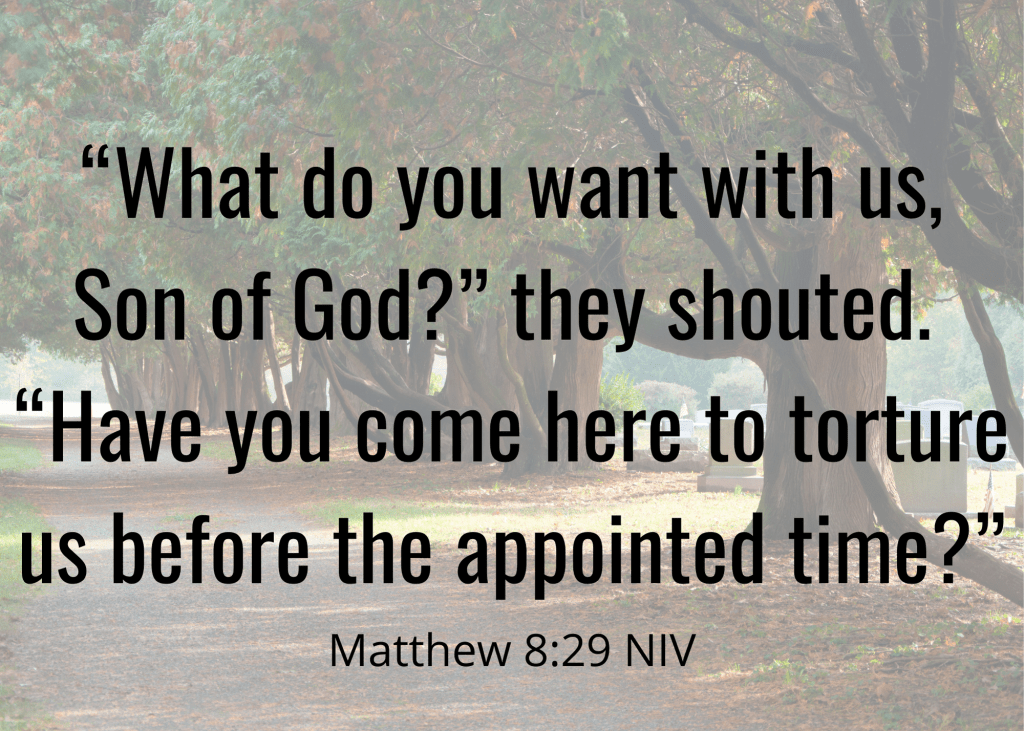
They are smart in spiritual matters. They recognize Jesus as the Son of God! They know that there will be a time coming when Jesus will do battle against them and torture them. (Matthew 8:29)
Despite all the power these demons have displayed over people, and the fear they have instilled in others, they are now in Jesus’ presence (since he was bold enough to go where others wouldn’t). And in Jesus’ presence they are begging him. They realize the Son of God, Jesus, has power over them. They have more than met their match.
And then there are the townspeople’s reaction to Jesus! They hear that Jesus has freed these two men from the demons that controlled them and terrorized their roadways. And they learn that Jesus had sent the demons (as per their request) into a herd of pigs which then rushed down the steep bank and drowned in the water. And their response is to plead with Jesus to leave town, leave them alone. They had grown accustomed to the demon possessed men. It might not be pleasant, but it was what they knew. They were used to their violent ways and were practiced at trying to avoid personal injury; maybe some demons weren’t too bad to have around. After all, the townspeople were still able to raise their pigs and have a decent way of life.
Until Jesus came around. He freed the men and sent the demons packing, but the pigs were lost. The people feared what they did not know. And, they were likely a bit upset about their material loss.
Help me to not grow comfortable in the presence of evil. Help me never be more attached to my material goods than to what is right. Help me to see clearly evil for what it is. And help me see clearly the power of God for what it is. Help me to see the power God has given Jesus over spiritual darkness and demons – then, now and in the future. Help me always choose good over evil, whatever the cost.
-Marcia Railton
Questions for Reflection and Discussion
1 – What’s the worst storm you have ever been in? How would you react (both that day, and the following month) if Jesus had appeared in the middle of it and calmed the storm with his words? How did the disciples react? Why do you think Jesus calmed this storm but not all storms?
2 – Did reading this chapter make you think of any questions you have for God? Talk to Him about them.
3 – Jesus wasn’t afraid to help the outcasts, touch the lepers, and go where others wouldn’t dare. If Jesus were in your town today where do you think we would find him?
The Old Testament prophets who spoke for God, including Jeremiah, were entrusted with preaching a lot of doom and gloom. Because God’s children had strayed from his commands, judgment would be coming and the people needed to know. I loved Jeff Fletcher’s illustration in his devotion yesterday of a doctor who could be charged with malpractice if he knew the sick condition of a patient’s insides and knew how to fix it and what changes the patient would need to make in order to cure the potentially deadly ailment, and said nothing. This would be like the Christian who sees the broken sinful world and pretends everything is okay. Don’t withhold the cure.
Jeremiah paints a very vivid picture of a world that is not okay. Chapter 9 opens with the prophet mourning the sinfulness of God’s people. He would love nothing more than to pack up and go to a desert retreat where he could get away from and forget this crowd of unfaithful people. Can you relate? But, rather than abandoning the people in their sin, Jeremiah continues passionately speaking truth for God, over and over, even though his words often seem to fall on deaf ears. He still must speak and write and hold out the cure to these wayward people.
God has had it, too. He aptly describes the situation this way:
“It is not by truth that they triumph in the land. They go from one sin to another; they do not acknowledge me,” declares the LORD. (Jeremiah 9:3b NIV)
and again, “They have taught their tongues to lie; they weary themselves with sining. You live in the midst of deception; in their deceit they refuse to acknowledge me,” declares the LORD. (Jeremiah 9:6 NIV)
It sounds to me like God and Jeremiah are describing the sad state of affairs in 2021. So many lies and deceptions abound when attempting to justify and explain and even celebrate sin and sinful lifestyles that fester and grow when individuals and nations and societies have turned their backs on God.
It is as though God is left without a choice. “What else can I do because of the sin of my people?” (Jeremiah 9:7 NIV) “‘Should I not punish them for this?’ declares the LORD. ‘Should I not avenge myself on such a nation as this?’ ” (Jeremiah 9:9 NIV). God had drawn up the rules long ago with blessings promised to those who followed and curses to those who stubbornly disobeyed. Many chances had been given. Prophets had been sent to remind the people of the deadly disease and of the cure – repentance, turning away from sin and turning back to God. But these were a very stubborn people who took delight in continuing in their sin and lies and more sin and more lies.
God had given mercy. God had given reminders. God had given prophets. God had stretched out the cure. But, to no avail. So, God says – it is time. It is time to teach your daughters how to wail – death and destruction is coming. (Jeremiah 9:20,21).
Towards the end of chapter 9 an interesting section seems almost out of place…
This is what the Lord says:
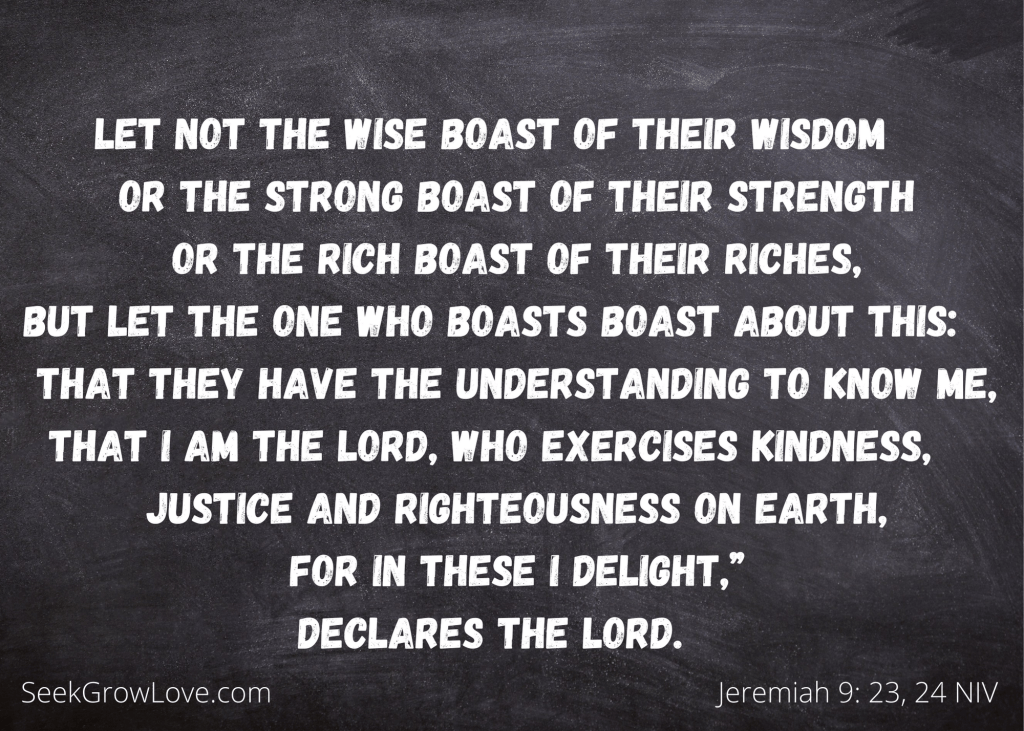
“Let not the wise boast of their wisdom or the strong boast of their strength or the rich boast of their riches, 24 but let the one who boasts boast about this: that they have the understanding to know me, that I am the Lord, who exercises kindness, justice and righteousness on earth, for in these I delight,” declares the Lord. (Jeremiah 9:23-24 NIV)
Perhaps it was written more for us who would be reading Jeremiah centuries later, to remind us of the choice we have. And, the great opportunity we have to boast about our God, our Creator, Our YHWH. He created the cure. His Son is the cure that was not yet available in Jeremiah’s day. Sin is the same and comes with the same consequences – death. People today need to know about the cure. They don’t need to hear you bragging about your dinner, your kids, your car, your job, your grades, your house, your ______ (on social media or at the checkout line). They need to know about the LORD our God who exercises kindness AND justice and always righteousness. The Psalms passages today have some great examples of boasting about our God while holding out the cure. How can you hold out the cure today to a nation and world that is unknowingly in the stages of the deadly disease of disobedience?
-Marcia Railton
Today’s Bible reading passages can be read or listened to at BibleGateway.com here – Jeremiah 9-10 and Psalms 99-101
Our God is a God of restoration. There will ultimately be a full restoration, but full restoration can only happen when the world is once again the beautiful, perfect place God created it to be, when His Kingdom is established on earth. Partial restoration, however, has been happening ever since the beginning of time. We read about restoration countless times in the Bible, and if you look, you can see it in our lives today, too. God constantly restores what has been lost to His people, whether it be a physical ability, such as sight, or movement, or a spiritual restoration, such as that of faith, or even the restoration of life.
Today, we read in 2 Kings chapter 8 about a Shunammite woman who lost everything she had during a 7 year famine, but because of her faith in God and willingness to obey, it was restored to her. Now this woman was not new to witnessing God’s ability to restore what was lost. In chapter 4 of 2 Kings, we read about how Elisha rewarded the Shunammite woman’s kindness with fertility, and she bore a son. Sadly, the son later died, but she had faith in God’s power, so she sought out Elisha. Elisha came, and the son was brought back to life; he was restored.
It is clear that this woman had remarkable faith. Perhaps this is why Elisha warned her about the famine that would come on the land for 7 long years, and advised her to leave. So without question, she and her household left their home and stayed in the land of the Philistines for 7 years, until the famine was over. When they returned, she had to appeal to the king to get back her home and all her land. The crazy thing is, right as she was coming to appeal to the king, Elisha’s servant, Gehazi, (who in chapter 5 was cursed with leprosy, and left Elisha… so it can be assumed that these chapters are not necessarily in chronological order) was telling him the unbelievable story of the miracle Elisha performed in the resurrection of the son of the Shunammite woman. The woman, who just happened to show up during this particular story time, also gave an account of what happened, and the King was so impressed that he instantly granted her the land and all that she left 7 years ago.
This story speaks volumes of God’s perfect timing, and adds to the common theme we see throughout the Bible of God’s willingness to restore what has been lost to those who are faithful. Look closely at the different ways in which God restores things in your life, and let it remind you to live everyday for the ultimate restoration that’s coming.
-Isabella Osborn
Today’s Bible reading devotions can be read or listened to at BibleGateway here – 2 Kings 7-8 and Proverbs 8
As ignorant, stuck-up, entitled humans, we often think we know what we need. We have this nice little idea of what will make our lives better, and we go to God expecting Him to grant us our wishes. But the thing is, we don’t know what we need; we don’t know how God works or what He plans to accomplish through us, or how He even uses our situation for His glory.
In 2 Kings 5, we read about one particular ignorant human who went to Elisha hoping to be healed of his leprosy, despite being a gentile and enemy of Israel. Now this man, Naaman, wasn’t mistaken in thinking he would receive the help he needed, but what he thought he needed and what God knew he needed were two separate things. When Elisha told Naaman to wash 7 times in the river Jordan, he became angry and almost turned around to head home, because this wasn’t the grand solution he expected to hear. Fortunately, however, his servants reminded him what was at stake, and what he should be willing to try for the sake of healing his leprosy. So Naaman, I imagine quite reluctantly, went down to the river and followed Elisha’s instructions. And what do you know – he was healed!
After experiencing this miraculous restoration of health, Naaman knew who the one true God was (and is), and came back a changed man. Even in the few paragraphs we read about Naaman, we can see a drastic difference in his overall attitude and behavior. God changed his heart. If Naaman wasn’t lucky enough to have those servants around, he would’ve missed out on everything he gained in his short encounter with Elisha. Because of his own pride and desires, he was prepared to walk away from the only chance he would ever get at healing his fatal disease, and finding a relationship with his Creator.
Naaman’s story can serve as a reminder to let go of our self-conceived ideas of what is best for us, and instead trust God to handle every situation His way. God’s way is always the best way, whether or not we are capable of understanding it. He has a plan for all His children, and this plan has already been set in motion. He answers our prayers in ways we could never imagine, and sometimes in ways we can’t even see. We have to trust that our loving, heavenly Father knows what’s truly best for us, and that everything He does is part of the ultimate plan He has for us to live together with Him in His eternal Kingdom.
God knows what you need, all you have to do is trust Him.
–Isabella Osborn
Today’s Bible reading passages can be read or listened to at BibleGateway here – 2 Kings 5-6 and Proverbs 7
Have there been times in your life where you’ve been taken somewhere you didn’t expect? Last spring, I was taking a drive when I became lost on some of the backroads. I was filled with uncertainty about my location and starting to get anxious about finding my way back. As I found myself where I didn’t expect to be, a lost lamb appeared on the road. It was nearly hit by oncoming traffic as it frantically sprinted down the pavement. The cream and brown spotted lamb was panting from exhaustion. It was scared and confused. Because I was at this unexpected intersection, I was able to get the lamb off the road and put it in my truck. After searching for its farm and calling the sheriff, eventually it was reunited with its home. Sometimes it is the places that we don’t see coming, where we prove to be the most useful.
In Acts 28 we learn about Paul’s experiences on the island where he and the rest of the people on his ship came to be shipwrecked. As we read yesterday, Paul’s journey was quite wild. But God had delivered them safely to this Island called Malta. When Paul left for Rome, he probably never expected to make a pit stop, let alone be shipwrecked at this place. Yet, this was where he was taken, and it was not without purpose.
On this island, in the middle of the Mediterranean, Paul was able to interact with the people. These inhabitants of Malta saw something different about Paul as they had witnessed him being delivered from the sea and from a snake bite. And then Paul was able to pray for and heal their sick. An island that might not have been a priority for people of that time to take the gospel to had nonetheless witnessed it through Paul’s unexpected stay there.
So, although this time and stay in Malta had been unexpected, it proved useful and it exposed others to the One True God. So, while you may at times find yourself in an unexpected place, do not be discouraged. Sometimes it is the most unexpected places in our lives that God uses us for an unexpected purpose.
-Hannah Deane
Today’s Bible reading passages can be read or listened to at BibleGateway here – 1 Kings 13-14 and Acts 28
Jesus – how well do we really know him? It is easy to look at passages like today’s and quickly dismiss them as familiar. Oh, yeah, this is where he talks about the parables of the Kingdom of God for awhile, drives out a bunch of demons (whatever those are), calms the storm and heals some people. He was a pretty cool guy.
Indeed, but if we look at these stories more closely can we learn anything that we might not have caught back in our preschool Sunday School days when we may have first heard these amazing and true stories of the Son of God. I enjoyed reading the Wiersbe NT Bible Commentary that pointed out in these chapters of Mark we see that, “God’s servant, Jesus Christ, is the Master of every situation and the Conqueror of every enemy.” (p101). We see him provide victory over danger (the storm), demons, disease and even death! In a world that still has some very real issues with fear, anxiety and worry (and maybe even demons?) – we would do well to take a closer look at this man Jesus – as well as how people responded to him when they were face-to-face with this one-of-a-kind conquering hero servant.
To help me look at Jesus more deeply, I made a chart of what Jesus DID in these passages – his actions and how he responded to various people (and demons). And, then, as I am also interested in how I ought to respond to Jesus – I included how a broad range of people reacted to Jesus, his teachings and what they personally experienced.
My Jesus column included things like:
Jesus saw – both the crowd and then also individual needs
He touched – Peter’s mother-in-law and Jairus’ daughter
He taught – to the crowd in parables and with further explanations for his followers
He slept – in the boat, through the storm (even though we also know some nights he stayed up praying all night)
He spoke – and the demons obeyed
He went with Jairus
He knew power had gone out from him
He ignored what others said (regarding the girl being dead or asleep)
I love the presence of this man. Not shaken by a storm or by a legion of demons (in the Roman army a legion was a group of 6,000 men) or by sickness or even by the science of death or by those who would argue or laugh at him. He knew what they didn’t. He knew he was the Son of God and God would use him to display God’s greatness and power and compassion and wisdom.
And some people (and demons) of his day would see this – and react in different ways. So, on my chart of how others responded to Jesus I included things like:
Peter’s healed mother-in-law – Got up and began to wait on him
Those who heard of Jesus – Brought demon-possessed and sick to Jesus
Teacher of the law – Vowed to follow Jesus
Disciples – Followed him; amazed at Jesus; still terrified – even AFTER the winds and waves obeyed Jesus; questioned who Jesus was (needed to know!)
Demons – Begged Jesus; recognized Jesus as the Son of the Most High God; and had no choice but to obey him
Those who saw the changed life of the formerly possessed man – Scared of Jesus; pleaded with Jesus to leave the area
The man formerly possessed by “Legion” – Begged Jesus to let him go with Jesus – but followed Jesus’ direction to stay and tell others of what Jesus had done for him
Jairus (synagogue ruler with a very ill 12 year old daughter) – Fell at Jesus’ feet; pleaded earnestly for his sick daughter
Poor, sick, desperate woman who had been bleeding for 12 years and spent all she had on doctors who only made her worse – Found Jesus; secretly touched his clothes, confident this would heal her; when healed and Jesus questioned – she fell at his feet, trembling with fear, told him the whole truth
Mourners – Laughed at Jesus
Jairus’ 12 Year Old Daughter – Raised from the dead and walked around
Even though these events happened 2,000 years ago, there are still those who laugh at Jesus, and those who don’t understand and ask him to leave. I pray our eyes are opened and we spend more and more time, “completely astonished” at what he has done. May we turn to Jesus again and again when we are hurt, scared, fearful, spiritually unhealthy, haunted by demons, and in need of wisdom and hope. May we bring our friends and family to him for healing. May we be active and vocal in serving him and telling of what he has done. And, like the disciples who watched him calm the storm, may we remain a bit terrified at what he can and will do. His reign is not over, in many ways it has not even truly begun. The best is yet to come.
Obviously we can’t take just one passage (of which we still have only brushed the surface) and say we know all there is to know about Jesus. There is still so much more. The things we have already read, like how he told the healed paralyzed man to, “Go and sin no more.” and the stern warnings he had for the ‘holier than thou’ Pharisees. As well as all the exciting things we have yet to read in the coming months and days – washing the feet of his disciples, his prayer for those who will believe, the agony of his crucifixion, the victory of his resurrection, the mystery of his ascension and the completely astonishing coming return of Jesus. Now is the time to get to know him and share him. The best is yet to come!
Tomorrow we will read Matthew 9 & 10. Come follow along as we learn more and more about Jesus and how we can respond to him, on our Bible reading plan…
Matthew 8:1-13 & Luke 7- Jesus heals a man with Leprosy
Before we get into today’s story, we need to understand the Old Testament law dealing with leprosy. Leviticus 13:1-46 talks in great detail about leprosy. There, we find that leprosy is a skin disease that is more than skin deep, it’s highly infectious, it defiles a person, anyone with leprosy must cover their mouth (this sounds like a mask), be separated from other people (social distance), live outside the town (this sounds like isolation), wear torn clothes, and cry out, “Unclean! Unclean!”
In Matthew 8, we find the story of a man with leprosy. Instead of staying away, we’re told, “A man with leprosy came and knelt before him [Jesus] and said, “Lord, if you are willing, you can make me clean.” I believe this man had great faith. He knew Jesus could heal him, he just didn’t know if Jesus would be willing to. And he violated the law so he could get close enough to Jesus to find out.
Matthew 8:3 says, “Jesus reached out his hand and touched the man. “I am willing,” he said, “Be clean!” Immediately he was cured of his leprosy.” I find this very moving. Jesus demonstrated how much he cared for this man by not just healing him – which was astounding enough. Jesus also touched him. By touching the man, Jesus would have become defiled – made unclean himself. And remember, since no-one could touch a leaper, who knows how long it had been since this man had someone actually touch him. I can’t imagine what that touch meant to the man.
Matthew 8:4 goes on to say that Jesus told the man, “See that you don’t tell anyone…” We find this same story in Mark, and we’re told in Mark 1:45, “Instead, he went out and began to talk freely, spreading the news. As a result, Jesus could no longer enter a town openly but stayed outside in lonely places. Yet the people still came to him from everywhere.”
In this story, I see that leprosy compares well with sin. Sin runs more than skin deep, it is highly infectious, it defiles a person, and whether we admit it or not, it makes us unclean, and separates us from God. When Jesus went to the cross, he took our sin on himself, causing him to be defiled. But he demonstrated his obedience to God and his love for us by doing this anyway. But Jesus’ sacrifice means nothing for us unless we each have faith in Jesus, come submit before him, and ask to be healed (forgiven). Are you willing to get close enough to Jesus to find out what he can do for you?
Finally, at the end of the story, the man disobeyed Jesus’ direct command to him to tell no one. Jesus commanded us to tell everyone. How are you doing with that?
–Steve Mattison
Today’s Bible passage can be read or listened to at BibleGateway here – Matthew 8:1-13, Luke 7
In Jerusalem there was a pool, called Bethesda, where blind, lame, and paralyzed people would gather. My Bible has a footnote that says John 5:4 isn’t in the most reliable manuscripts. John 5:4 says “From time to time an angel of the Lord would come down and stir up the waters. The first one into the pool after each such disturbance would be cured of whatever disease he had.” If this verse isn’t legitimate, the rest of the story doesn’t make sense, so I’ll assume it is valid.
Anyway, there was a man there who had been an invalid for 38 years. Jesus asked him if he wanted to get well. This seems like a strange question to ask someone who was an invalid. But who knows, maybe he was making a good income begging, and wanted to stay in his condition.
Instead of saying, “Yes!”, the man started making excuses – he replied that he didn’t have anyone to help him into the pool when the water was stirred, so he never got into the water first.
Jesus then told him, “Get up! Pick up your mat and walk.” At once the man was cured; he picked up his mat and walked.
This is a curious miracle. The man didn’t ask Jesus to heal him. The man didn’t have faith that Jesus could heal him – when asked, he didn’t even know who had healed him. Also, there were many sick people there, and Jesus only healed this one man. First, I do have to acknowledge this is a tremendous example of grace. But I do have to wonder, why did Jesus heal this man?
If we keep reading the story, we find that instead of being happy for the man that had just been healed, the religious leaders criticized him for carrying his mat on the Sabbath. He told them he was just doing what he was told by the man who had healed him. When asked who that was, he didn’t know.
Later, Jesus found him again and told him to stop sinning or something worse would happen to him. (We can assume Jesus meant the final judgement, but we’re not told.) After this, the man went back to the religious leaders to tell them Jesus had healed him – on the Sabbath.
Now, I think we are finally at the point of understanding why Jesus healed this man. I wonder if Jesus wanted to shake up the understanding of the religious leaders of his day, and this was a good way to get their attention. He told them, “My father is always at his work to this very day, and I, too, am working.” Notice that Jesus said “My father” instead of “our father”.
The Jews recognized that Jesus was telling them that He is the son of God. In this chapter, He also called himself the “Son of Man”, which they would have recognized as a messianic reference from Daniel 7:13l. They were furious that not only was Jesus breaking the Sabbath, he was claiming that He was (is) the son of God. And they made the mental leap to say that if Jesus was claiming to be the Son of God, he was claiming to be equal with God.
They studied the scriptures regularly, and thought they would “earn” eternal life because of that. Jesus pointed out, “These are the Scriptures that testify about me, yet you refuse to come to me to have life.”
The religious leaders of Jesus’ day couldn’t accept what He was telling them. Instead, they just wanted to kill Him. What about you? Do you acknowledge that Jesus is the Son of God who will one day judge the living and the dead? To paraphrase James 2:19, the demons acknowledge this too – and shudder.
If you do acknowledge Jesus, what are you going to do about it? I would encourage you to take a cue from the man who was cured, and obey what Jesus said. No, don’t pick up your bed and walk – instead read your Bible to understand all Jesus taught about, and obey all of that. Finally, we should all take to heart Jesus’ warning to the man, “Stop sinning or something worse may happen to you.”
Because, as we’re reminded in John 5:28-29, “… for a time is coming when all who are in their graves will hear his voice and come out — those who have done good will rise to live, and those who have done evil will rise to be condemned.”
–Steve Mattison
Today’s Bible passage can be read or listened to at BibleGateway here – John 5
Tomorrow we read Matthew 12:1-21, Mark 3, and Luke 6 as we continue in our Bible reading plan.
In Mark 2, we find the story of Jesus healing a paralized man. Jesus was becoming more well known, and more popular. He was inside a house, and some men brought their friend to Jesus so Jesus could heal him. But because such a big crowd had gathered, there wasn’t room to bring him to Jesus, not even outside the door. So the friends took the man onto the roof, dug through the roof, and let him down in front of Jesus.
I have to admire these friends. They were very concerned about their friend, and wanted to see him healed. They believed Jesus could and would heal him, if they could just get him to Jesus. They didn’t just “pray about it”, they stepped out on faith and did something about it. They dug through the roof, and let their friend get close to Jesus – and Jesus rewarded their efforts.
Mark 2:5 tells us, “When Jesus saw their faith, he said to the paralytic, “Son, your sins are forgiven.” Jesus obviously saw that the man was crippled, but Jesus saw what wouldn’t have been nearly as obvious to us. The man’s biggest problem was his sin – so Jesus healed him of that first. This is the greatest miracle Jesus performed (and still performs).
The teachers of the law said that Jesus was blaspheming, believing only God can forgive sin. I’m guessing they were thinking, “it’s easy to tell someone their sins are forgiven, since you can’t prove they are really forgiven.” Jesus then told them, “But that you may know that the Son of Man has authority on earth to forgive sins…” He said to the paralytic, “I tell you, get up, take up your mat, and go home.” So the man got up, took his mat, and walked out.
I love this story, not only because I love reading about all Jesus’ miracles, but specifically because this is the only story I can think of where someone is healed because of the faith of his friends. We’re not told, maybe the paralized man asked to be taken to Jesus. But any way about it, Jesus saw the faith of the friends, forgave the man’s sins, and ultimately healed him.
This story puts me to shame. I invite you to ask yourself some questions…
Am I this concerned about my friends?
Am I willing to be uncomfortable – maybe even make a scene – to bring someone to Jesus?
Am I willing to not just “pray for” someone, but actually “do something” for someone?
Would Jesus see my faith and forgive and even heal someone I care deeply about?
Finally, do I need Jesus’ ultimate miracle for myself – to have him forgive me of my sins? This miracle meets the greatest need. It costs the most. It brings the greatest blessing. It has the longest lasting results. And Jesus is still doing it daily.
–Steve Mattison
Today’s Bible passage can be read or listened to at BibleGateway here – Mark 2
Tomorrow we read John 5 as we continue on our 2020 Bible reading plan.







 Seek Grow Love