Accomplished athletes, musicians and artists alike are often asked what it means to be “in the zone”. In psychology circles, being “in the zone” is referred to a state of flow – when an individual is completely absorbed in doing a challenging, yet doable, task. They are somehow able to shut out all of the external noise and distraction to focus on the very present moment to do one thing.
Performers and entertainers are not the only ones who are able to find their flow. Scientists and mathematicians; emergency responders; and everyday average Joes like you and me are able to concentrate so intently on a task that time just seems to slip away and we find ourselves doing something extraordinary.
As I meditated on Lamentations chapters three through five, I couldn’t help but be bombarded with how devastated the author was over losing their home, being held in captivity, and witnessing depravity all around him.
And yet, right in the middle of all those laments, there are these verses that stand out, that give hope and encouragement.
Yet this I call to mind and therefore I have hope:
Because of the LORD’s great love we are not consumed,
for his compassions never fail.
They are new every morning; great is your faithfulness.
I say to myself, “The LORD is my portion; therefore
I will wait for him.”
The LORD is good to those whose hope is in him;
it is good to wait quietly for the salvation of the LORD.
Lamentations 3:21-26
How is it that the author, in the midst of all the calamity, is able to break out these words of great expectation?
Maybe, the author was just for a moment, able to quiet his thoughts and instead of focusing on the turmoil he and the other captives were facing, meditated on God’s character. As he penned these words, he found himself in a state of flow of sorts.
Whenever we find ourselves in difficult situations, it is so easy to concentrate on all that is wrong; all that pains us; all that is overwhelming.
But what if, instead, we were able to quiet our minds, to completely block out all of the negativity, and just simply rest in the quietness of God’s character: his love, his compassion, his grace and mercy, his forgiveness, his holiness, his faithfulness.
This is the space where we are able to renew our hope, to find the strength to dig deep and do the hard things, to press on through the challenge having complete confidence that God is ultimately on our side; that He is bigger, greater, higher than anyone or anything that we may be facing.
If you are in the middle of a difficult circumstance, you may be tempted to lament all day long to anyone who is willing to listen. Instead, I urge you to refocus your thoughts and “set your minds on things above, not on earthly things”. (Colossians 3:2) Find yourself in God’s flow zone. Here you will experience the peace that passes all understanding.
-Bethany Ligon
Today’s Bible reading passages can be read or listened to at BibleGateway.com here – Lamentations 3-5 and 1 Peter 1
We begin a new book of the Bible today—James. James is one of my favorite Bible books. I participated in Bible quizzing on James as a teenager in IL, and coached Bible quizzers on James in IN and MN. More than half of the verses of this first chapter of James are underlined in my Bible.
James’ writing style differs from the author of Hebrews. He is blunt and forthright in his writing.
The author of James was most likely the son of Joseph and Mary, which made him the half-brother of Jesus. Interestingly, James and other family members did not initially accept the teaching of Jesus.
In Mark’s account of Jesus, we find these verses.
“He came home, and the crowd gathered again, to such an extent that they could not even eat a meal. And when His own people heard about this, they came out to take custody of Him; for they were saying, ‘He has lost His senses.’” Mark 3:20-21
The book of John tells us “For not even His brothers believed in Him.” John 7:5
However, after Jesus had risen from the dead, (“then He appeared to James, then to all the apostles” I Cor 15:7), James’ life was transformed. He became an important leader of the church in Jerusalem and the surrounding early churches.
The first verse of James ties in with his widespread influence to the churches. He addresses his letter “to the twelve tribes which are dispersed abroad.” This audience was actually Jewish Christians, many of whom had been forced to leave their homeland due to persecution. They were new in their faith and needed instruction and encouragement that was straight forward and easily understood.
Think about the opportunities and choices available today for people who want to be a “do-it-yourselfer.” Whether it is home building or remodeling, cooking, gardening, crafting, “you name it,” there is a book, a manual, a TV program, a YouTube video, or a website that can help you out. (DIY network, HGTV, Craftsy, are a few that come to mind.) Paul A. Cedar calls the letter of James a “how -to-do-it manual for the Christian life.” James offers solid, practical instruction for Jesus’ followers.
“Consider it all joy, my brothers and sisters, when you encounter various trials,knowing that the testing of your faith produces endurance. And let endurance have its perfect result, so that you may be perfect and complete, lacking in nothing.”
Verse 2 tells us to be joyful when we face trials. It seems like a difficult thing to do, but remember, the Christians who first received this letter had experienced extreme trials to the point they had fled their homes to survive.
Paul writes in I Corinthians 10:13, “No temptation has overtaken you except something common to mankind; and God is faithful, so He will not allow you to be tempted beyond what you are able, but with the temptation will provide the way of escape also, so that you will be able to endure it.”
This is the joy we should have when trials confront us. And, as verse 3 says, “the testing of your faith produces endurance.” When we experience trials, our faith grows in the Lord, as we work towards our “perfect self” in God’s Kingdom. (verse 4)
James’ brother Jesus, our Savior, often told parables, or simple stories to help his audience understand his teaching. I find it interesting that James, like his brother, uses several illustrations in his letter to further explain his instructions to his readers.
If you lack wisdom, ask God for it, but don’t doubt you will receive it. One who doubts “is like the surf of the sea driven and tossed by the wind. Let not that man expect that he will receive anything from the Lord, being a double-minded man, unstable in all his ways.” (verses 5-8)
Blunt and to the point! No commentary by me needed!
Story/illustration #2–Verses 9-12
“Now the brother or sister of humble circumstances is to glory in his high position; but the rich person is to glory in his humiliation, because like flowering grass he will pass away. For the sun rises with its scorching heat and withers the grass; and its flower falls off and the beauty of its appearance is destroyed; so also the rich person, in the midst of his pursuits, will die out. Blessed is a man who perseveres under trial; for once he has been approved, he will receive the crown of life which the Lord has promised to those who love Him.”
A Christian with limited means for livelihood “glories” in his coming inheritance in God’s Kingdom. A rich man/Christian should glory in the fact that his wealth is temporary, only of this world. Verse 11 gives us a visualization of the fleetingness of this life—hot sun, scorching wind, dead grass and flowers. (This picture reminds me of the drought areas around the US this past summer.) Both men are equal in their future reward, a “crown of life,” IF they “persevere under trial.”
James continues with straightforward, sensible instruction.
“No one is to say when he is tempted, ‘I am being tempted by God’; for God cannot be tempted by evil, and He Himself does not tempt anyone.But each one is tempted when he is carried away and enticed by his own lust. Then when lust has conceived, it gives birth to sin; and sin, when it has run its course, brings forth death. Do not be deceived, my beloved brothers and sisters. Every good thing given and every perfect gift is from above, coming down from the Father of lights, with whom there is no variation or shifting shadow.”
God, the Father of Lights, loves us, and is a generous giver. His greatest gift was His Son Jesus and the plan of salvation, but He has also given us the beautiful natural world to delight in and discover its wonders each day. God has given us our families, friends, jobs, food, homes. How blessed we are. And His care, His protection, His love never changes—“with whom there is no variation or shifting shadow.” This phrase reminds me of one of my favorite verses, Malachi 3:6a. “For I, the Lord, do not change.”
James continues with his direct approach in verse 19. He tells his readers to be “quick to hear, slow to speak, and slow to anger.” Why? Verse 20 says, “For the anger of man does not achieve the righteousness of God.” (Insert drum rimshot here!) Obviously!
Quick, Slow, Slow. In other words, 30 seconds to think and respond during a contentious conversation. Even Thomas Jefferson had this sage advice. “When angry, count to 10 before you speak. If very angry, a hundred.”
Verses 21-25 bring us another story/illustration to make James’ point, if we still don’t get it! The guidance is repeated with action words this time to begin the illustration.
“Put aside filthiness and the remains of wickedness.”
“Receive the word”
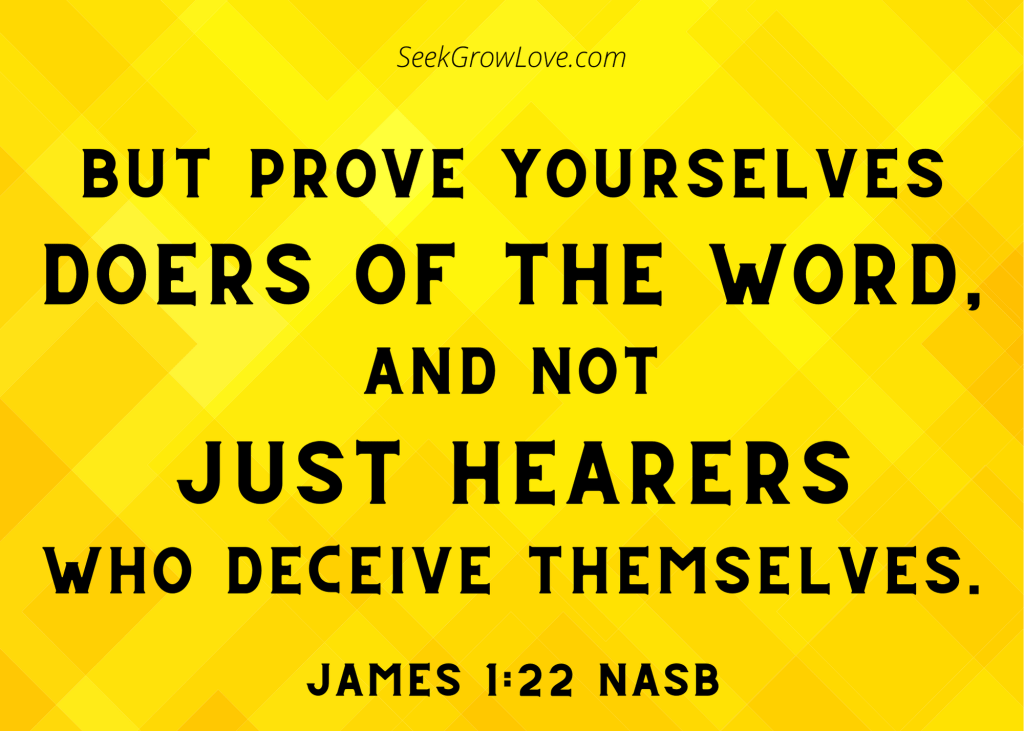
“Proveyourselves doers, (not merely hearers, who delude themselves.)”
Don’t hold back, James!
Here comes the explanation/story. “For if anyone is a hearer of the word and not a doer, he is like a man who looks at his natural face in a mirror; for once he has looked at himself and gone away, he has immediately forgotten what kind of person he was. But one who has looked intently at the perfect law, the law of freedom, and has continued in it, not having become a forgetful hearer but an active doer, this person will be blessed in what he does.” (verses 23-25)
A man looks at himself in a mirror, walks away, and immediately forgets what he looks like. This man is like a person that listens to God’s Word, hears what “the preacher says,” and then leaves church on Sunday and lives his life the rest of the week not connected to God.
However, one who not only looks into God’s Word, (the perfect law of liberty) abides in it, and follows through with appropriate actions, is truly blessed in his life. Paul said it this way, “For all the law is fulfilled in one word, even in this: ‘You shall love your neighbor as yourself’” Galatians 5:4. Where do you start?
James gives us an example in the last verse of James 1, verse 27. “Pure and undefiled religion in the sight of our God and Father is this: to visit orphans and widows in their distress, and to keep oneself unstained by the world.”
Simple love in action. The Bible is our guidebook/how-to manual. We can’t just read it and not follow through. James 1 is direct instruction for the do-it-yourself generation.
-Paula Kirkpatrick
Today’s Bible reading passages can be read or listened to at BibleGateway.com here – Jeremiah 45-46 and James 1
Following God and obeying His will does not mean that we will have a life free of problems as we can see from so many of the stories in the Bible. It does mean that God is with us as we go through the hard times. Sometimes life is harder for us when we tell others what God wants them to hear. As we read Jeremiah 33 & 34, we see that this is true for Jeremiah. Jeremiah is still imprisoned by King Zedekiah and Jeremiah is still obeying and trusting in God and telling them what God has told him to say. In Jeremiah 33:2-3a it says “This is what the Lord says, He who made the earth, the Lord who formed it to create it, He whose name is the Lord: ‘Call to Me and I will answer you,‘” Isn’t it amazing that the God who created the universe wants us to call out to Him, and it’s equally amazing that He WILL answer. We all have hard times that we go through, but we can call out to our Father and He will walk with us through the hard times. But He wants us (and the Israelites & Judeans) to know that there is a bright future when all the hardships will be over and we will live in joy and peace.
It says in Jeremiah 33:11b “Give thanks to the Lord of armies, for the Lord is good, for His mercy is everlasting,” God is a good God and His mercies are everlasting, and He has a great future in store for His children. God reminds them that a day is coming when His word will be fulfilled. In Jeremiah 33:14-16 we have a prophecy about Jesus and it says; “Behold, days are coming,’ declares the Lord, ‘when I will fulfill the good word which I have spoken concerning the house of Israel and the house of Judah. In those days and at that time I will make a righteous Branch of David sprout; and He shall execute justice and righteousness on the earth. In those days Judah will be saved and Jerusalem will live in safety; and this is the name by which it will be called: the Lord is our righteousness.’”
In Chapter 34 God tells Jeremiah to tell King Zedekiah that Babylon will come in and take over and he will meet King Nebuchadnezzar face to face, but he says that the king would not die by the sword but that he would die in peace. As we learn in the rest of the chapter that is exactly what happened.
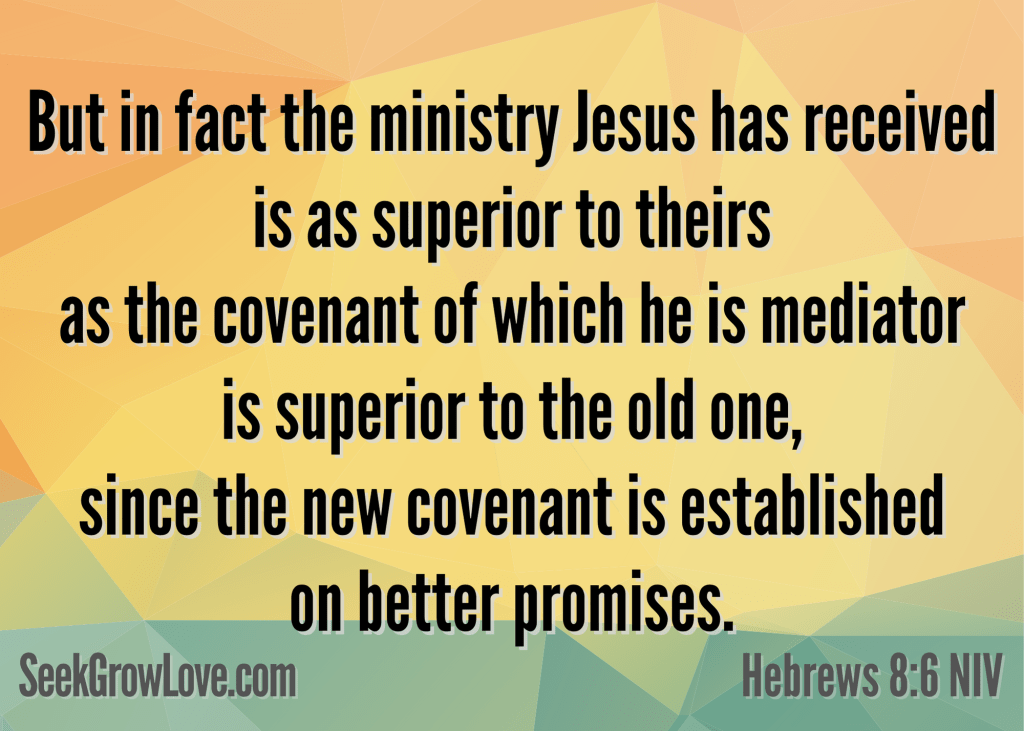
We have all seen commercials about something that is “New and Improved,” which means that something was not as good as it should have been or there would be no need for improvement. Hebrews 8 is all about a new covenant that has been established through Jesus, our sacrificial lamb, and now our high priest. The reason there had to be a new covenant was because the first one was not faultless, but the new covenant is. Hebrews 8:1 “Now the main point in what has been said is this: we have such a high priest, who has taken His seat at the right hand of the throne of the Majesty in the heavens, without fault.” Jesus was the perfect sacrificial lamb, without fault or blemish. We have read some of these verses already because they were taken from Jeremiah 31:33. Anytime a verse is used in both the Old and New Testament, we should pay attention to what it says. Hebrews 8:10-11. “For this is the covenant which I will make with the house of Israel after those days, declares the Lord: I will put My laws into their minds, And write them on their hearts. And I will be their God, and they shall be My people. And they will not teach, each one his fellow citizen, and each one his brother, saying, ‘Know the Lord,’ for they will all know Me, from the least to the greatest of them.” God is constantly working in our lives because He is a God of love, He loves His children, and He wants to be our God, and for us to be His people.
-Sherry Alcumbrack
Today’s Bible reading passages can be read or listened to at BibleGateway.com here – Jeremiah 33-34 and Hebrews 8
In Chapter 25 & 26 of Jeremiah, he continues prophesying to the people of Judah about what is going to happen to them. It sounds to me like he is getting a little irritated with them. Have you ever heard “If I’ve told you once, I’ve told you a thousand times” from your parents? He says that he has been talking to them for 23 years but they will not listen to him. Not only has he been talking to them but God has sent prophets to them for years and they refuse to listen. He is telling them that they have a choice to make. He says in Chapter 25:5&6 “Turn now, each of you, from your evil ways and your evil practices, and you can stay in the land the Lord gave to you and your ancestors for ever and ever. Do not follow other gods to serve and worship them; do not arouse my anger with what your hands have made. Then I will not harm you.” God has always given us a choice, which is to choose good or evil, the choice is ours. But he is hoping that we choose to turn from evil and do good, and if we do, he will always forgive us. But on the flip side, he says, if the children of Judah refuse to listen they will go through hard times and captivity that will last for years.
The prophet Jeremiah could have lied to the Judean people like the other prophets during that time and told them what they wanted to hear, and his life would have gone easier (perhaps for a time), but he did the hard thing and he obeyed God and told them what God wanted them to hear. The people did not like what they heard and they wanted to kill Jeremiah. He put his trust in God knowing that he might be killed. He trusted God with his life and trusted that what God purposed in his life would happen. He says in 26:14-15 “But as for me, behold, I am in your hands; do with me as is good and right in your sight. Only know for certain that if you put me to death, you will bring innocent blood on yourselves, and on this city and its inhabitants; for truly the Lord has sent me to you to speak all these words so that you hear them.” He knows what Paul tells us in Acts 5:29b “We must obey God rather than men.”
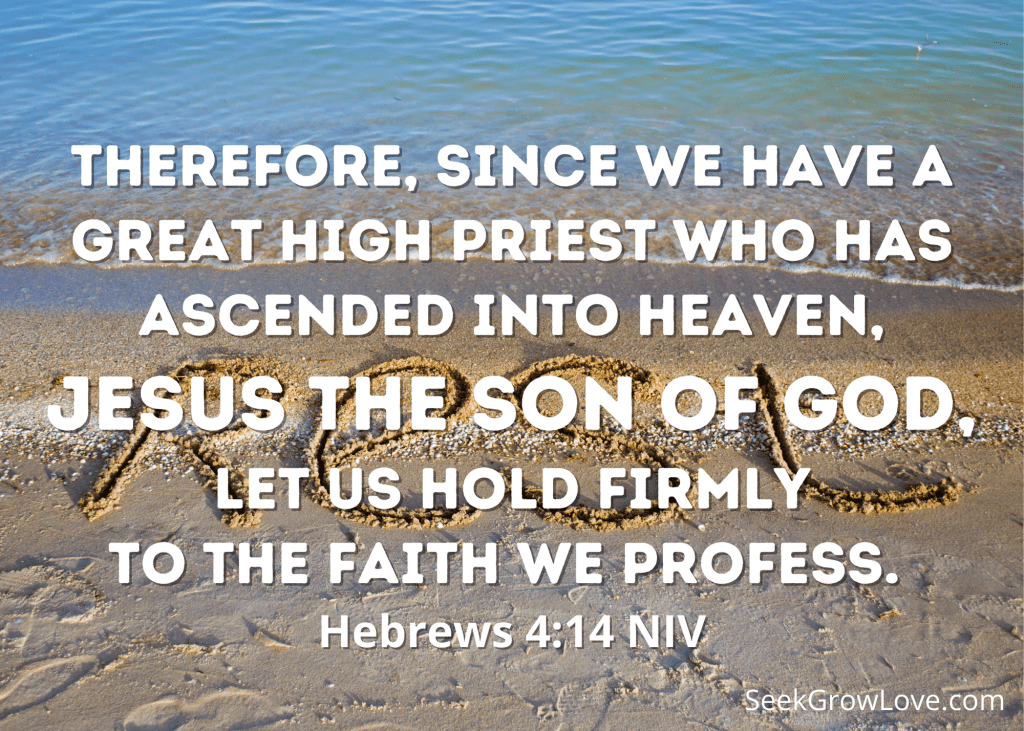
Hebrews 4 seems to go hand in hand with the chapters in Jeremiah. The Israelites before them, and then the children of Judah were not able to enter into God’s rest because of their disobedience. We are invited to live our lives in such a way that we will be allowed to live in God’s rest. The children of Judah needed prophets and priests to help them to have a relationship with God, but we do not have to go to the synagogue to have our sins forgiven or go to the town square to listen to the prophets. It says in Hebrews in verses 14-16 “Therefore, since we have a great high priest who has passed through the heavens, Jesus the Son of God, let’s hold firmly to our confession. For we do not have a high priest who cannot sympathize with our weaknesses, but one who has been tempted in all things just as we are, yet without sin. Therefore let’s approach the throne of grace with confidence, so that we may receive mercy and find grace for help at the time of our need.” God’s rest is a life that is filled with the knowledge that God is in control and we will trust Him no matter what hardships we may go through. If we would like to enter into God’s rest, all we have to do is accept the salvation that God has provided to us through Jesus and we are free to enter into God’s rest for eternity.
-Sherry Alcumbrack
Today’s Bible reading passages can be read or listened to at BibleGateway.com here – Jeremiah 25-26 and Hebrews 4
Over the last week we have focused on Philippians, and especially the theme of joy. Joy is a state of happiness and contentment in the midst of any and every circumstance because of our response to the gospel and our connection to God through Christ. When we live like Christ, we experience deep levels of joy. Joy is found also in overcoming those who try to turn us away from the gospel message, and those tendencies within ourselves. Finally, we are reminded, even commanded, to rejoice in the Lord always. Joy is available to us in every situation, not just good ones, but in suffering and pain, because of who we are and whose we are. (We are brothers of Christ, which makes God our Father!) We are able to have joy at all times; what great news!
In the Christian tradition there have been some documents that have really helped Christians explain their faith or aspects of their faith well. The Confessions of St. Augustine, The Institutes of the Christian Religion, The Chronicles of Narnia. Even if we don’t agree with everything in these works, they have made quite an impact on the Christian faith. (Especially the Chronicles of Narnia.) One other document is the Westminster Shorter Catechism, a document used to teach the Christian faith that has been around from the 1640s. The first question it asks and answers is :
What is the chief end of man?
Man’s chief end is to glorify God, and enjoy him forever.
To explain, this is saying “the greatest goal of every person is to give God glory and praise, and to be in joyous relationship with him forever.” It’s not scripture exactly, but that sounds about right to me. The last state of the believer is joy with God.
In Revelation Chapter 19, there are three times that a great multitude exalts God and praises his name for casting down wickedness in the world. Revelation 19:6-8 say. “6 Then I heard what seemed to be the voice of a great multitude, like the roar of many waters and like the sound of mighty peals of thunder, crying out, “Hallelujah! For the Lord our God the Almighty reigns.7 Let us rejoice and exult and give him the glory, for the marriage of the Lamb has come, and his Bride has made herself ready; 8 it was granted her to clothe herself with fine linen, bright and pure…” In this picture of the great multitude, which are those who have been saved by the Messiah, they are saying that what they will do is to exalt and glorify God, but also to REJOICE in him. They are finding joy in God.
That is the final state of those who have followed Jesus. When we think of the eternal life of the saved, it is not just living for a really long time, it is a fulfilled, joy, content life. It is life to the fullest. Yes, it will last forever but it will not be dull, boring and monochromatic, and it won’t be sorrow, struggle filled, and just like this life.
We will feast with Jesus at his wedding to his bride, the Church. (Rev. 19:9) We will be exalted to live and reign with Christ, whatever that looks like. (Rev. 20:6) My favorite promise is that we will look into the face of God, and he will wipe away our tears. (Rev. 21:4) That is what it means to enjoy God forever. We will have EVERY REASON to find joy, because “God will dwell with us, and we will be God’s people, and God himself will be with us as our God.” (Rev. 21:3, in the first person)
My brothers and sisters may Jesus be your savior and lord so you may feast and rejoice at his wedding supper.
May you be raised again so that death will have no power over you.
May your tears be wiped away, and may you enjoy God forever.
“Rejoice in the Lord, always” and forevermore!
-Jake Ballard
——————————
Jake Ballard is pastor at Timberland Bible Church. If you’d like to hear more from him, you can find Timberland on Facebook (https://www.facebook.com/TimberlandBibleChurch/ ) and on Instagram (https://instagram.com/timberlandbiblechurch?igshid=t52xoq9esc7e). The church streams the Worship Gathering every Sunday at 10:30. Besides studying and teaching God’s word, he is raising three beautiful children with the love of his life, plays Dungeons and Dragons and is really excited about going to a Renaissance Fair this Fall. If you’d like to reach out to talk Bible, talk faith, or talk about your favorite D&D monster, look Jacob Ballard up on Facebook (https://www.facebook.com/jacob.ballard.336 )or email him at jakea.ballard@yahoo.com. God bless you all!
Read or listen to today’s Bible reading plan passages at BibleGateway.com here – Isaiah 17-18 and Colossians 2
I love etymology, or the study of the origin of words. How do words come to mean what we say they mean? It’s a fascinating subject for a nerd like me. And words sometimes, or maybe often, don’t mean what they sound like. One word that is used commonly in North America, and especially in my experience, in the South, is “doohickey”. For those unfamiliar, when someone says “hand me the doohickey”, they are saying “give me the item to which I am gesturing that you should see I obviously need.” Context, as they say, is key. You need to be in the moment to know what they mean, and you need to be paying attention to understand how you should behave, e.g. giving them the tool, instrument, or whatever they are asking for.
When reading Scripture, we see that certain ways of being, believing, and living are better than others. These better ways should be the standard for those who are redeemed by God. However, we need to always remember that the words we read in scripture weren’t written down by some guy last week in USA-English, but were written down 2000 years ago by men (and women?) who were writing in a different time to a different context and translated to our language today. We CAN understand a lot about scripture; it is clear there is only one God, not 100, and that Jesus is his Son and our Savior. However, studying helps us understand ideas, concepts, and words more clearly. The more clearly we understand Scripture, the better we can live it out and the better our lives will be by living it out.
Today, we are looking at the word “joy”. If we can understand how joy is used in the New Testament, that should shed some light on how joy is used in Philippians.
First, joy (in Greek : charas) is the reaction of those who hear the gospel of the Kingdom of God and the name of Jesus. When Jesus is born, the angels proclaimed it was good news of great joy (Luke 2:10). When the magi find the home of Jesus, they are overwhelmed with joy. (Matt. 2:10) As Jesus is raised, the disciples respond in joy. (Matt. 28:8)
Next, joy is the response of the early church in Acts. The disciples not only receive the Holy Spirit but also joy! (13:52) The people had joy due to miracles being performed. (8:8) Joy came upon all the believers when Gentiles came to the truth of faith in Christ. (15:3)
Finally, Paul has his own way of speaking about joy. Paul looks to those he leads as those who bring him joy. Paul calls the Thessalonians his “glory and joy” because of their steadfastness in faith and proof that God is working through him. (1 Thess. 2:19-20) Paul sees his sufferings and persecutions as a cause for joy because of the work it may do for the message of Christ (Col. 1:24). Finally, over and over, Paul tell his readers that joy is the reality of Kingdom living, a gift of God, a gift God gives through connection to His Holy Spirit. (Rom 14:17, Gal 5:22-23, 1 Thess. 1:6)
That’s a lot of verses to meditate on through today or tonight, but a bunch of verses does not a definition make. So we need to say what joy seems to be in the New Testament.
Here is an example definition. I would encourage you, as you study the verses above, and others, to write your own definition, but this may be a helpful definition for you as we walk in joy this week.
Joy is the state of happiness and contentment as we hear the gospel message and respond in faith. In that response, we are given God’s Holy Spirit, that will allow us to ground our joy in the truth that God is our loving Father and we are his saved children. Then we are able to see the difficult and painful circumstances of life as opportunities for God’s glory rather than as cause for us to lose our happiness. Joy is, therefore, not an emotion like happiness and sadness, but a way of living in response to the work of God and Jesus where we are continually hopeful and peaceful in every situation.
May you, my brothers and sisters, find THAT joy today. May it fill your hearts and minds, and may it pour from the spirit of God into your spirit.
-Jake Ballard
Read or listen to today’s Bible reading passages at BibleGateway.com here – Isaiah 9-10 and Philippians 2
I’m not gonna lie to you : it’s been a bit rough. Since March of 2020 until now, we have seen a pandemic that caused suffering and panic across the globe, racial and political division across the US, an even greater erosion of trust in our institutions of power, particularly of the media, and financial and political instability the world over, as well as claims from some that some or all of these issues don’t even exist!
We need to know how to respond to these situations. The Bible doesn’t have a “read this passage in case of global pandemic and division” section, but there are multiple places that describe the appropriate attitude to take in the midst of suffering.
In the book of Philippians, we see Paul in the midst of suffering. In 1:12-13, we learn of Paul’s predicament. He is imprisoned, probably in Rome or Ephesus. (You can read more about Paul’s imprisonment for the Gospel in Acts 25-28.) He seems to believe that he may be going to his death, though he would love to both visit the Philippians again, and to go on to Spain. He wants to continue to do God’s will, but he recognizes that death may be a better alternative, as he would finally rest and have peace in Christ. (1:21)
“To die is gain” is a strange statement from the same man who said “the last enemy to be destroyed is death.” (1 Cor. 15:26) Is death a gain or an enemy? As we said before, Paul is suffering. Being in prison isn’t a cakewalk. But he is not only experiencing suffering for the sake of Christ, but telling the Philippians they will suffer for the sake of Christ as well. (1:29-30) If all this is true, then what should our response be? Gloom? Doom? Wailing and mourning?
ABSOLUTELY NOT! The letter of Philippians is drenched in a word : Joy, or rejoice. This is the theme that pervades the thought of Paul in Philippians, using the word 16 times and talking about joy throughout the letter. He says that he offers his prayers with joy because of the Philippians and what they have done for him (1:4). Paul rejoices over the fact that Christ is preached and that the Philippians will bear Paul up in their prayers. (1:18-19)
How can Paul have joy in the midst of suffering? What is the joy that Paul talks about? Answering these questions and more like them is the goal of this week. Over the next few days we will be walking with joy. Tomorrow we will see how joy is used in the rest of the New Testament to know what Paul means by joy. Then we will see the joy of being like Christ and the joy of overcoming sin. We will discuss what it means to rejoice always. Finally, we will look to the end of the age and try and rejoice in the joy that we will experience forever.
Today, my brothers and sisters, may you begin to be excited about the joy that Christ brings. May you taste the joy on this beautiful day, and may it carry you through this week.
-Jake Ballard
Read or listen to today’s Bible reading plan passages at BibleGateway here – Isaiah 7-8 and Philippians 1
I’m intrigued by tardigrades. They are eight-legged microscopic animals that look almost like bears when they move, earning them the alternate name water bears. They can be found anywhere on earth, surviving the most extreme temperatures and pressures. Apparently it is no big deal for them to have no air, water, or food for a while. They can dehydrate in a water shortage and sit dormant for decades until more water comes along, and then rehydrate and continue their life as if nothing happened. They can even survive exposure to outer space unshielded from dangerous radiation. They have a resilience of almost mythical proportions.
Consider Behemoth (Job 40:15-24). He seems pretty solid. He makes me think of an elephant, hippo, or in the Harry Potter universe, an erumpent. Who knows what he is anyway? All I know is that I’d rather not cross paths with one. The most a tardigrade could do to me is crawl on me, and I wouldn’t notice it. Encountering a black bear could be scary, but they’d likely run away, especially if we are in a group. They don’t want to run into you any more than you want to run into them. But Behemoth doesn’t care. He’d trample you.
“Even if the river is turbulent, it is not frightened; it is confident though Jordan rushes against its mouth. Can one take it with hooks or pierce its nose with a snare?” (Job 40: 23-24)
Like the tardigrade, Behemoth is resilient. You or I would be swept away by the current, but not Behemoth. He makes his way through the turbulent Jordan and doesn’t lose his confidence. He knows the struggle is real, and the waters may even slow him down, but this is not the end of Behemoth. Not even close.
We’re of “small account” just like Job (40:4). We all have our struggles, our raging Jordans, that we are trying to make our way through. During the process, it’s fair to want to know why we have to struggle and suffer, and where all of it comes from. Is it from a broken world paying forward the hurt? Is it the natural consequence of our poor decisions? Does it come from God, like the author of Psalm 88 might suggest? Is it from evil forces trying to discourage us? Is it just general suffering we’re guaranteed to experience? Is it some combination of all of them?
But do you think Behemoth or the tardigrade worry about why they suffer? Probably not. They just try to get through it. Maybe while you are suffering, the “why” questions aren’t going to be the most important thing. You may only have the energy or capacity to react to the crisis and pick up the pieces later. Figuring out the deeper questions might be something you only worry about on the other side of suffering.
The ability to think about suffering is both a blessing and curse. If you think about your situation and realize that you are at least partly responsible for your suffering or the suffering of others, you have the ability to learn from your mistakes and avoid making them again. In that way, being able to avoid unnecessary suffering is a blessing. But it can seem like a curse to keep thinking about the purpose of your suffering when it comes from something completely beyond your control. This is the carousel of painful thoughts Job was on.
In that situation, it is fair to want to challenge God, like Job did. Where is his supposed justice? Go ahead and challenge God and have the wrestling match (Gen 32). He can handle it. Just be prepared to be challenged back. Be prepared for the possibility of injury. Be prepared to grow and receive a new name. Be prepared to be more resilient, more Behemoth or tardigrade-like.
To quote someone who voluntarily took on suffering for our benefit and was resilient through death itself: “I have said this to you, so that in me you may have peace. In the world you face persecution. But take courage; I have conquered the world!” (John 16:33)
-Jay Laurent
Read or listen to today’s Bible reading passages at BibleGateway here – Job 39-40 and Psalm 87-88
There is an idea called the “retribution principle” that you can find woven into much of scripture. If you think that being good and righteous means that you will be rewarded, and that being wicked means you will be punished, you think that the retribution principle is true on some level. It seems to make sense as a general rule. What goes around comes around; you reap what you sow.
For most of the book of Job, we’ve been immersed in a debate between Job and his friends about whether this principle holds up. Job’s friends insist that Job must have done something wrong to bring on this suffering. Job insists he’s righteous and that his suffering makes no sense, bringing God’s justice into question. Elihu shows up, defending God’s majesty and justice, and condemning Job for being too self-righteous.
Sometimes Job’s friends seem like they have a grasp on the truth, but other times what they say seems misguided, and in the times left over, we just aren’t sure what to think. They all have worthwhile things to say, but at the core are still flawed humans. When reading anything in Job, we have to use some discernment to decide if what is being said is really true. After all, in the last chapter of the book, Job’s friends are criticized by God for not speaking of him what is right.
At this point we have read a large chunk of Job, yet we are not sure who to believe or how to make sense of all the things that are being said. Suddenly in chapter 38, God rejoins the conversation from a whirlwind, signaling that this should be the dramatic moment when all our questions are answered.
We get no answers. In fact, God says he is going to ask the questions now.
If Job is man enough to challenge God, then he’d better be man enough to be challenged back. He’d better brace himself like a warrior. Job, were you there when I put down the foundation of the earth and gave the chaotic waters their boundaries? Do you have intimate knowledge of how all of creation works? Have you explored the highest highs and the deepest and darkest chasms? Do you have control over light, rain, snow, lightning, stars, or animals? Where does wisdom come from?
What would you say back? Really, what could you say back?
Does this frustrate you? It frustrates me. We call out to God in our deepest despair and questions but then feel like we just have more questions. It is not any fun to be humbled and put in our place. It’s disheartening to follow God and still go through hard times; we think it isn’t supposed to work that way. It’s natural to ask why we even bother serving God when we can’t seem to find the benefits, and yet the troubles have no trouble finding us. This all hurls us back to the question posed in Job chapter 1: If all the benefits were stripped away, would Job still serve God? Would you?
Through the story, the author of Job is asking us to question the retribution principle. Apparently, being good doesn’t mean you’ll expect only good things in your life. And being bad doesn’t mean getting a lump of coal. Reality is just more complex than that. It rains on the righteous as well as the wicked, and even in a desert land where nobody lives.
I’ll close with prayers of hope from the other part of our reading today:
“Let me hear what God the LORD will speak, for he will speak peace to his people, to his faithful, to those who turn to him in their hearts. Surely his salvation is at hand for those who fear him, that his glory may dwell in our land.” (Psalm 85:8-9)
“But you, O Lord, are a God merciful and gracious, slow to anger and abounding in steadfast love and faithfulness.” (Psalm 86:15)
-Jay Laurent
Some of you may know Jay as the really tall bass player in the FUEL worship band. We welcome his deep thoughts on God’s Scriptures this week.
Today’s Bible reading passages can be read or listened to at BibleGateway here – Job 37-38 and Psalm 85-86
It’s no secret that life can be difficult, and we are always tempted to do things to our liking and understanding. Everyone has their own image set out in front of them, of what THEY think their life should look like. But God has a different image of our lives. Sure, it may be close to our perfect life, but God’s will and our will hold different opportunities, even if they are similar.
Psalms 81-82 are called, The Call to Obedience, and a Plea for Righteous Judgement. (NLT)
Psalms 81:6-12
“I relieved his shoulder from the burden; His hands were freed from carrying the basket. You called out in distress, and I rescued you; I answered you from the thundercloud. I tested you at the Waters of Meribah.
Listen my people and I will admonish you. Israel, if you would only listen to me! There must not be a strange god among you; you must not bow down to a foreign god. I am the Lord your God, who brought you up from the land of Egypt. Open your mouth wide, and I will fill it.
“But my people did not listen to my voice; Israel did not obey me. So, I gave them over to their stubborn hearts to follow their own plans.
The people of Israel back in this time had chosen with their own free will to go against God’s commands and do what they desired at the time. This led to their pain and suffering that God would again bring them through as a lesson of his love and power. The truth is that his plan is all knowing, created with love and perfection. He knows every part of us from the hairs on our head to the tiny wrinkles of our skin. He knows who we are meant to be, even before we are born, but he lets us choose our own path.
The purpose of this devotional is not to tell you that every path is going to be easy. The purpose is to show you that life is going to be hard, there are going to be valleys of trial and consequence, there will be mistakes. All those things are why free will exists. God gives us free will because he wants us to learn from our past and push for what he knows we are capable of. Because “People make choices and those choices have consequences, and if knowing my will were part of every human decision how would anything happen?” (From the movie, An Interview with God) This quote, and scripture are pointing out that to really reach our full potential we must go through rights and wrongs. We must make the decisions without knowing the result because those choices will bring us to our full potential.
God says, “I gave them over to their STUBBORN HEARTS to follow THEIR OWN PLANS.” Our Father wants us to choose his way for us in our lives, but he will not force us to. This also does not mean he doesn’t care when we choose our own way. This simply means that he is going to watch and let you learn from your mistakes. He is going to let you fall because then he can pick you up and you will learn from the mistakes after. Learning from our mistakes are some of the greatest parts of our journey. They are the things that make us who we are, and who God intended us to be.
-Hannah Eldred
Today’s Bible reading passages can be read or listened to at BibleGateway here – Job 33-34 and Psalm 81-82