God’s Wisdom

James 1-2

Devotion by Juliet Taylor (Tennessee)

How do you want to be known? James calls himself, “a slave to God and to the Lord Jesus the Christ.” Though we’re no longer slaves, but friends of Christ, it is a great grand opening to talking about how to be perfect, which is in doing the will of God until the end of our lives (because we’ve become people who really want to)!

James is writing to the 12 tribes dispersed abroad, so in other words, he’s writing to Jewish Christians in various lands. I’m not sure what persecution was going on at the time of James’s writing, but we have seen in other books of the Bible that spreading the Gospel put a target on Christians. James gives his brethren what they need to endure whatever happens to them to the end of their lives. He gives them God’s wisdom.

James encourages his brethren to consider various trials with joy, as a testing of their faith, as it produces endurance, which results in perfection. These words point my thoughts to Jesus in the garden. What was about to happen to him was happening because others hated him for what he spoke and did, and they wanted his influence to stop. They were jealous.

Jesus was in agony thinking about the cross and thinking about the disciples and early Christians who were about to be scattered for his sake, that James may be writing to now. He endured the cross by thinking about what would be accomplished because of this final trial.

This is how you endure hardships for the Lord; you think about all of the people you will influence by following Jesus’s example so that they too can desire to love like Jesus and be saved. This perspective can bring you joy. Changing your mind to have this perspective during various trials is wisdom from God.

But if we lack wisdom about what to do, especially during hardships, all we need do is ask and God will be generous to teach us his ways. But we must ask in faith, without doubting.

We shouldn’t doubt that he’ll give us wisdom about what to do when we ask because he’s proven that he’s a good God and father, who teaches us his ways for our own good. A good father won’t give his children something that’s going to harm them when they ask for something they desire, right (Luke 11:11-13)? Of course not. He’s going to give them what they need (though it may not always seem like it, such as in the case of Jesus going to the cross).

If you doubt that God is going to give you wisdom for your own good, and instead will give you wisdom that will harm you or make your situation worse (e.g., Massah & Meribah), you’re showing him that you don’t trust him. You’re like the surf of the sea, driven and tossed by the wind. You’re not going to get anything from him if you don’t trust him.  

James goes on to teach the dispersed brethren a bit of wisdom that we can all heed. I think it is the wisdom of God that’s of utmost importance for us to follow as his disciples. We’re not given a set of laws we must follow in the New Covenant, but we are given wisdom. Let’s desire it like Solomon did and do it like Jesus did:  

A poor man knows that God is his provider. He can glory in his humility (glory in that he seeks God’s wisdom for his survival). But a rich man that does not rely on God for his means and pursues what he wants for his own personal gain can glory in his humiliation. He’s not going to make it to the Kingdom of God without seeking the father’s wisdom about his provisions (or his abundance).

Know that this life comes with trials. Trust in God’s wisdom to get through it and let it shape you into the kingdom citizen God wants you to be, so that you won’t be a person that desires harm to come to anyone, rather, you’ll be a person who loves like his son. In the end, your crown of life will be waiting.

Understand that when temptation comes, it didn’t come from God. It came because our world has been shaped by people who didn’t always choose God’s will. It came because there is a devil lurking about, persuading people to choose to eat of the tree that’s choosing their own wisdom about what’s good and evil, and then they do evil, which affects everyone. It came because we ourselves don’t always choose God’s will. Our own lust breeds sin that will always lead to death. But choosing God’s wisdom about what we should do to overcome our lust (our own will) approves us as one who wants God as our judge when we do what God says is good.

Every good and perfect gift given comes down from the father above (meaning, it was given by God, and it was his will). It was his will that he brought us forth by the word of truth (his wisdom about creating us new in Christ), that we would be a kind of first fruits among his creation. So be the first fruits you were meant to be, as lights to the world like his son.

You already know God’s word, so put away what remains of filthiness in your life that will prevent you from seeking God’s wisdom and doing his will. Be quick to hear from God, slow to speak, and slow to anger so that you will be a person prepared to receive the word implanted, which is his wisdom about what you should do to save your soul (and your neighbor’s soul).

If you hear the word of God (God’s wisdom about what you should do) but then fail to do it, you’re like someone who looks at himself in a mirror (hearing the word only), but then walks away, forgetting what he looks like. I equate this with going to church, getting filled with the Holy Spirit to do God’s will, then forgetting that you are a child of God throughout the week, and that you were meant to shine for others to see through your works. We need to actually do what we hear. That’s the word implanted. It’s continually being filled by the holy spirit so that we can walk by it (action).

Instead of looking at yourself in the mirror, look intently at the perfect law of liberty, to love as Jesus loved, so that you won’t be an effectual hearer only of the word, but a doer. Notice in this example that there’s no walking away, in contrast to the mirror. You look intently at it so that you won’t walk away and forget. Your eyes are continually fixed upon the law that says to do something, for loves sake, to save others, just like Jesus did.

Bridle your tongue to let God’s wisdom about what you should do prevail and guide you (by being quick to hear when you ask, slow to speak so that you’re sure you’re speaking God’s will and not your own, and slow to anger – God’s will about what you should do isn’t going to be to tell you to get angry, for the most part, because anger does not bring about the righteousness of God). Your own tongue can deceive you into thinking that you’re doing God’s will, but it’s just lip service if you’re not doing what God says to do.

Pure and undefiled religion is in the doing of God’s will continually, instead of our own (which is sinning). Doing God’s will will keep us unstained by the world. For Jesus, pure and undefiled religion was laying down his life for us. For us, it may be to love orphans and widows in their distress by visiting them and giving them what they need. It can be loving anyone in distress by visiting them to help them, especially the brethren.   

Don’t just do good for those who society favors. If you do, you’ve chosen to be the judge of who’s deserving of God’s royal treatment, rather than relying on his wisdom about it. God favors those who favor him, who are generally the poor, because they’re humble (they rely on God for his wisdom instead of the rich, who generally rely on their wealth).

If you show partiality by way of how you treat the poor compared to the rich, then you’ve dishonored the poor. And for what? The favor you show to the rich goes to people who oppress you. They are those who have no problem dragging you into court when an issue arises, and will there blaspheme your name to win a case against you.

If you are fulfilling the royal law from scripture (Lev 19:18), “You shall love your neighbor as yourself,” you are doing well, because that’s God’s will (and in so doing, you fulfill all the Law of Moses and the prophets (Mat. 7:12; 22:40 with the Shema)).

If you show partiality however, that is sin. It is sin because you’re using your own wisdom/being the judge of who’s deserving of God’s royal treatment (who gets your love and who doesn’t?). It is better to be merciful to the poor than to judge them unworthy of your mercy by way of how you treat them.

And if you sin in this way, you are guilty of sin and are convicted as a violator of the Law (of Moses, I think; but also of the law of liberty). Not showing partiality is a moral law we should still “follow” under the law of liberty because we want all people to enter the kingdom of God. Treating the poor as well as we treat the rich just may show them the love of Christ, planting a seed of faith/trust that will bring them to the kingdom.

Jesus explained how to do this with some of the laws from the Law of Moses in his Sermon on the Mount. Here it looks like James is doing it with the law against showing partiality. The wisdom from God then, is the same wisdom from God under the New Covenant regarding how to fulfill this commandment. It’s in loving your neighbor as yourself – not just the rich and influential.  

Under the New Covenant, we are to speak and act as those who are to be judged by the law of liberty, serving all with God’s royal treatment (treat them how you’d want to be treated because you are motivated by love to get them into the kingdom).

If you committed the sin of showing partiality under the Old Covenant, you would have to repent by making a sacrifice to cover the sin. Under the New Covenant, you need to repent to your high priest Jesus (a much easier yoke), and stop showing partiality because you realize that you want the poor to know the love of Jesus and enter the Kingdom of God as much as you want to. If you don’t show them mercy, God will not show mercy to you on the day of judgment.

You can’t rightly say you have faith without works that are evident of your faith. Your works are how you treat people based on whose will you decide to follow. If someone says he has faith but no works, it is like telling the cold and hungry person who asked you for food to, “Go in peace, be warmed and be filled,” without actually giving him anything. This is worthless if you don’t give him what he needs when you are able.

Belief that something is true is not enough for justification’s sake. Take the belief that God is one for example. The demons believe this to be true, but shudder. They know the truth, but their actions reveal that they follow their own will and oppose the preaching of faith in Jesus. They shudder because they know they are guilty before a powerful God and will face destruction soon.

Abraham (a Jew) had faith, and so did Rahab (a Gentile). They believed that God was able to fulfill his promises to them for their good (or that God’s people would fulfill their promise because of who their God was in Rahab’s case), and so they acted based on their belief. They are included in the promises of God because of this. Likewise, let’s prove that we have faith by our works, which are acts of love, proving that we are becoming a person like Jesus, who chooses to do God’s will for the good of all; for loves sake.

QUESTIONS

1. Do you think that the sins of others in times past have affected your walk with God? If so, how can you change that so that you will affect others with the good you do?

2. Do you think the Royal law is the same as the law of liberty/freedom?

3. If we are guilty of a sin (like showing partiality) under the law of liberty/freedom, how does our high priest Jesus differ in how our sin is handled from the high priest under the Old Covenant?

Joy in the City

Nehemiah 11-12 and Psalm 126

(saving Nehemiah 13 for tomorrow)

Devotion by Telva Elwell (SC)

The wall and the gates of Jerusalem had been rebuilt. (Nehemiah 6:15) Leadership and positions of service had been filled. Israelites were moving in to occupy the city of Jerusalem. (Nehemiah 11) The stage was set for a celebration!

It was time!

The dedication of the wall of Jerusalem attracted people to come to Jerusalem to be present for the dedication of the wall of the city.  What a huge crowd that came that day!  The Levites came to celebrate the dedication with gladness, thanksgiving, and singing.  Cymbals, harps, and lyres were played in great celebration.  In addition, singers came from the areas around Jerusalem, and other surrounding areas.  The singers had even built for themselves villages around Jerusalem.  The priests and Levites purified themselves and the people.  All the celebrants were spiritually prepared and excited!  Let the celebration begin! (12:27-30)

Nehemiah then brought the singers and musicians up onto the wall.  What excitement must have stirred through the crowd when they mounted that wall that many thought impossible to rebuild!  The city must have exploded with songs of praise and thanksgiving as Nehemiah instructed one half of the singers to sing songs of praise, accompanied by the blast of trumpets and other instruments created by David, the man of God.   He sent them to march south on the top of the wall, along with Ezra the scribe.  As they marched, they sang loudly with whole hearts overflowing with praise.  Likewise, the second choir was sent to march north on top of the wall, along with Nehemiah.  They sang and worshiped and praised the great God who had done mighty works in Jerusalem.  The two choirs then met at the house of God where they gave thanks and presented sacrifices to their great God. They rejoiced! “For God had made them rejoice with great joy. And the joy of Jerusalem was heard far away.” (v. 43)

One of the Songs of Ascent was probably song.  Psalms 126, one of those songs, has such meaningful words for such an occasion as this:

“When the Lord turned again the captivity of Zion, we were like them that dream. Then was our mouth filled with laughter, and our tongue with singing; then said they among the heathen, The Lord hath done great things for them.  The Lord hath done great things for us; whereof we are glad.  Turn again our captivity, O Lord, as the streams in the south.  They that sow in tears shall reap in joy.  He that goeth forth and weepeth, bearing precious seed, shall doubtless come again with rejoicing, bringing his sheaves with him.”

Yes, the joy of Jerusalem was heard far away, but how that joy must have stung for some.

Throughout the celebration of praise and thanksgiving to God, this message was being seen and heard by those outside the congregation of the Israelites.  There were a few familiar faces and names of people among the foreigners who probably wanted to hide in embarrassment.  And it was all because of the completion of the work at Jerusalem on the 25th day of Elle (6:15).  “All the nations around us were afraid and fell greatly in their own esteem, for they perceived that this work had been accomplished with the help of our God” (6:16).  Even their enemies and naysayers believed that what they were hearing with their ears and seeing with their eyes, was indeed proof positive that God was with Jerusalem and that He had caused the wall and gates of the city of Jerusalem to be restored! (Ps. 126:2)

Flash back several weeks earlier when word spread throughout the region that the wall was being rebuilt. Sanballat and Tobiah were up to their mischief trying to discourage and hinder the work of the Jews in rebuilding the wall.  They teased; can these feeble old Jewish men even build these walls themselves?  Will they sacrifice? They knew it would take more than a few prayers to rebuild the wall.  Could they even finish it?  They laughed at the materials they were using, calling the stones rubbish, because they were broken and burnt.  They jeered, “How could anyone build anything out of trash?” (4:2) And yet, they built it!  There it stood on this great day of dedication after its completion. So, with God even feeble old men can accomplish great things!  Yes, they were able to finish the wall with God’s help!  Even burnt stone dug from the rubble could become a strong wall!  Sanballat and Tobiah probably heard the praise, the trumpet blasts, the loud songs of worship that day and cringed. But what may have been worse was seeing the wall standing strong, and the people standing strong and thankful upon that wall—that very wall that Tobiah declared would fall in a heap if even one fox went up on to the wall. (4:3). This was just what Nehemiah prayed to God to do…to “turn their taunt on their own heads” (4:4). What a testimony to God and the power of prayer!   Now a multitude of people stood upon the wall and sang out praises to the One true God for the whole world to hear!

What are you doing to make sure that your wall stays strong, and that songs of praise to the One true God can be heard in your part of the world?

Reflection Questions

  1. What is praise?  How important is expressing praise in your prayers to God?  What things do you praise God for?  Is there a relationship between expressing praise to God and feeling joy in your life?
  2. What is the difference between praise and thanks?  Or are they the same thing? Do you share your thanksgiving and praise with others?
  3. What did Paul mean when he said, “In all things give thanks?  (1 Thess. 5:18) Does giving thanks remove fear and worry from your life? How do you incorporate giving thanks in your life when you feel overtaken and undone by loss or grief?

Let the Nations be Glad

Psalm 65-67, 69-70

So many of the psalms focus on directly worshipping and declaring the goodness of God, which is good, but this psalm takes that knowledge of God and comes in with a missional view: Let God be known and praised by all the people. All the nations. Not just Israel, his covenant people, but by everyone.

The psalmist recognizes the goodness of God and what he has done for his people. In light of this fact, they want the goodness of God to be experienced by all people and for there to be abounding joy for all.

God provides sustenance for all people, the earth yields its produce. It does so because God designed it that way, so may the nations recognize that Yahweh created life and sustains it through his order.

Verse 4 talks about the nations being judged with equity. Equity here is the Hebrew word mishor, which literally means levelness or uprightness. God will not play favorites with his judgment, he will judge with prejudice, but he will judge fairly and give the same outcomes to the faithful of all tongues and tribes. In the same way, destruction comes from rejecting God, regardless of the background of the individual.

We can look at this through the lens of Jesus, but even without a clear picture, the psalmist saw a future where there was no Jew nor Greek, nor slave nor free, but a world where all could bask in and enjoy the glory of God and worship him in spirit and in truth.

Let the nations be glad.

-JJ Fletcher

Reflection Questions

  1. Where does your joy come from?
  2. Do you view your role as a believer to be missional? To bring others into a saving relationship with Jesus and his Father?
  3. Do you have trouble with being equitable in your sharing? Can it be difficult to share with people from different backgrounds?
  4. If you find great hope and strength in the gospel, shouldn’t you share it? Why are we worried about “offending people” with the gospel?

Joy of Every Longing Heart

Job 1-5

Students may feel time stands still, waiting the release of a school day, but where reality is truly suspended is at a school dance.  I am no scientist, but I believe Albert Einstein must have been chaperoning teenagers when he discovered the theory of relativity.  It isn’t just one thing that makes it feel like you are locked into an eternal session on “Cotton-Eye Joe” on a Friday afternoon, but the combination of the shouting,  the music, the shouting, the running, the shouting, the smells, and the shouting, create a enormous sense of anticipation and longing for escape.

Today in our chronological study, we end up in a completely different book. Job is thought to historically settle in and around the time of Abraham, but there is room for debate. Personally, I like the fade to black, and the entry into another storyline.  Multiple narratives, whether in our texts or as we edify one another today, demonstrate that God is working to bring all things to one conclusion or resolution, which indeed is our great joy as we consider his uniting Kingdom.

Conversely, the vast majority of Job’s story is within the walls of great suffering, where time seemingly stands still; the playlist is that of devastating loss. Job’s health, his wealth, and his family are stripped from him.  He slowly and surely unpacks the persistence of physical and emotional pain, reminding us of the sovereignty of God: it is His prerogative to give and to take away.

Nonetheless, Job continues to seek joy and restoration with God, though time stands still in agonizing sorrow.  Leaning, reclining, and collapsing on God are the only available avenues to move forward through the most intense trials and longest of sufferings.  David says in Psalm 16:11: “You make known to me the path of life; in your presence there is fullness of joy; at your right hand are pleasures forevermore.” We long for security, satisfaction, and meaning, but the answer to these needs  do not come from momentary allowances. We can only attain this through God, who freely gives this and more through Jesus Christ.

Through His  life, death, and resurrection, we have abounding grace.  Through trials of every kind we can receive joy and develop perseverance because we know that our narrative is only one of many, tied to a single storyline about our Savior.  Though at times it feels like we will never move again, seeking God, we will be inspired to join in the conga-line with those before us who have died longing and waiting for their joy made complete.

Revelation 21:4 reminds us that eventually the noise and the music will stop, and we can finally go home  – “He will wipe away every tear from their eyes, and death shall be no more, neither shall there be mourning, nor crying, nor pain anymore, for the former things have passed away.”  Blessed be the name of the Lord! What great joy there is in eternity, to sustain us through the most taxing times where we feel the ticking of every second.  We will be in the presence of God. We will be made perfect and whole.  We will be reunited. Oh come, thou long expected Jesus.

-Aaron Winner

Reflection Questions

  1. What has God given to you? What has He taken away? Why and how can you praise Him for both? What “negative” things has He also taken away for you?
  2. Who or what else also shares responsibility for the suffering Job endures?
  3. Who do you know who has suffered much and continues to praise the name of the Lord?
  4. How can joy and perseverance grow in the face of trials, tears and suffering?

Have you downloaded and printed the 2025 SGL Chronological Reading Plan

or just one month at a time – here’s January…

Joy to the World!

OLD TESTAMENT: Nehemiah 8

POETRY: Psalm 148

NEW TESTAMENT: John 19:38-42

Joy to the World! The Lord is come. Merry Christmas!

I never really considered Nehemiah as a Christmas devotional, but today’s reading actually fits in quite nicely! We read today about the Israelites finally being reintroduced to the Scriptures after completing the wall. They had forgotten who they were, and as the Torah was read to them, they cried – perhaps they were sad that they had not known this all of their lives? The Levites asked them to stop mourning and instead go celebrate by eating and drinking together. “Do not grieve, for the joy of the Lord is your strength!” (Neh. 8:10). 

As the people heard and understood more of the scriptures, they learned about the Feasts: God-ordained parties that had long been ignored or forgotten! Realizing that they were near the appointed time to celebrate the Feast of Tabernacles (also known as Sukkot or Feast of Booths) and eager to reconnect with their roots and their God, they quickly gathered branches to create temporary shelters. The booths/sukkahs that they created to remember their ancestors’ wilderness wanderings following their escape from Egyptian slavery were also a tangible reminder of their recent history living in a tumbledown city, which caused a renewed appreciation for their newly rebuilt Jerusalem. I can only imagine the overwhelming feeling of God’s faithfulness they experienced! The restoration of the wall led to a restoration of the Jewish people and their faith. 

A few months ago on a pleasant autumn evening, my family huddled with hearty bowls of soup under a makeshift tent (ok, so it was really just old bedsheets haphazardly pinned to the clothesline in the shape of an A by my Littles, but it’s the thought that counts!) in our backyard while we retold the story of Moses leading his people out of slavery only to wander in the desert and sleep in sukkahs – temporary dwellings – for 40 years until they were ready to enter the Promised Land. This God-ordained fall Feast of Tabernacles, which has been celebrated for centuries among the Jewish people, is a rich way to remember God’s faithfulness in the past (providing literal and metaphorical shelter for his people until they entered their Promised Land) and His promised hope for the future (the Kingdom). Through burps, unrelated laughter, and all the other chaos that occurs when doing almost anything with a small mob of children, we briefly discussed the parallels between Moses awaiting the Promised Land and Jesus awaiting the Kingdom through my best novice attempt to honor some of the traditional celebrations. (I encourage you to look more into the feasts and celebrate them, even at a basic level, with your family and friends!). 

Through my studies of this feast, I learned that Jesus was likely born around the time of Sukkot, which could be another reason why (in addition to the census) the area near Jerusalem was so full with travelers. As the Jewish nation celebrated their humble past, our Savior and King was born nearby in a humble dwelling, ushering in a new beginning. As many of us celebrate CHRISTmas today, we thank God for the gift of His son, Jesus. Merry CHRISTmas! 

Notes about the other passages:

In Psalm 148, the writer begs everyone and everything, large and small, to praise the LORD! The people of Jerusalem were definitely praising God for the completion of the wall and the restoration of their faith. 

John 19:38-42: Jesus was born around the time of the Feast of Tabernacles, but he died just before Passover, another important feast in which the Jewish people celebrate God’s provision when He led them out of slavery in Egypt. 

-Rachel Cain

Reflection:

  • Consider ways to renew your relationship with God and Jesus, such as celebrating the feasts, to help revive your joy and faith. 
  • During what times in your life has the joy of the LORD sustained you with supernatural strength? 

This is a music video of one of my favorite songs about JOY. How will you let God’s true joy be your strength in spite of whatever you’re facing

Serving – with Joy

Old Testament: 2 Chronicles 3-4

Poetry: Psalm 92

(or repeat 91 one more day – they are both great Psalms – or read them both!)

New Testament: 1 Thessalonians 2

            Yesterday, we looked at being imitators of Christ and allowing our faith to reflect positively in the lives of others. Remember the verses about the fruits of the spirit from the devotional yesterday? Those are the start of reflecting our faith positively in the lives of those around us. Paul said in 1 Thessalonians 2:6-7, “nor did we seek glory from men, either from you or from others, even though as apostles of Christ we might have asserted our authority. But we proved to be gentle among you, as a nursing mother tenderly cares for her own children.”  Paul is explaining how they shared the gospel with the people of Thessalonica. He shared with great gentleness and care. In the following verse he talks about having a fond affection for the people. As an imitator of Christ, Paul shared the gospel in love, gentleness, and care. Both Paul and Christ cared for the people they ministered to. They didn’t command authority over them, they walked alongside those they taught. 

            Jesus said in Matthew 20:28, “just as the Son of Man did not come to be served, but to serve, and to give his life a ransom for many.” He is explaining to his disciples that his role was to serve the people and to give his entire life to them. Jesus many times flipped the worldview of being the best and greatest to showing that humility and service was above all most important. Paul recognized this about Christ and imitated this selfless and humble lifestyle. 

            Think of the person who has had the largest impact on your spiritual walk. Is this person controlling, authoritative, and pushy? OR does this person show how much they care for you as an individual and show you through grace and mercy the life and death of Jesus? I know for me it is the latter of the two. My parents were always my strongest examples of what a life following Christ should look like. They loved the people within their church even when it was hard. They went out of their way to help whenever there was a need. They never forgot to say I love you to everyone they cared about. Having a deep care and love towards people will help them trust you and it will allow them to see God’s faithful and never failing love. 

            Psalm 92:1-2 says, “It is good to give thanks to the LORD and to sing praises to Your name, O Most High; to declare Your lovingkindness in the morning and your faithfulness by night.”  Growing up with siblings, it was a lot easier to find things to be mad at them about than to be thankful for them about. A sibling cleaned the bathroom but moved your brush so instead of focusing on the good they did, you yell at them about touching your stuff. Does that show your sibling you care about them and are thankful for what they do, or does that say something opposite? 

Right about now you might be wondering why I pulled the two verses from Psalm 92. Let me explain. When we focus on the negatives in life, it makes it hard to find anything positive and that will reflect in how we speak and act around others. This doesn’t serve as a good example and it definitely won’t show that we greatly care for those around us. Instead, we should have an attitude of praise. Psalm 92 is a psalm full of praise and it reflects on the good God has done. If we thank God for His lovingkindness in the morning and praise Him for His faithfulness at night, our attitudes will slowly shift from one of negativity to one of positivity. When we look for God’s goodness throughout our day, we likely will look for the goodness in those around us as well. In order to selflessly serve like Christ and to impact people like Paul with his gentleness and care, we should have a heart overflowing with praise to help focus on all the good that is in our lives. 

Recently, the movie Inside Out 2 came out. If you have had the chance to watch it or the first film, we see the huge role Joy plays in the lives of people. In the second film, Joy wonders if growing up means being less joyful. The world isn’t a joyful place and it will push us towards locking our Joy deep within ourselves. In the film, it made Riley hurt her friends and not connect well with the people around her. Joy is a needed emotion that will help us find the good in life. 

-Makenna Landry

Discussion Questions:

1: What are ways you can show people you care deeply for them?

2: Why is caring deeply for people important?

3: Are you letting Joy be your main focus or are other negative emotions clouding your view of those around you?

Life is Uncertain

Old Testament: 1 Chronicles 21 & 22

Poetry: Ecclesiastes 11

New Testament: Colossians 2

Life is uncertain. That seems to be the theme that Solomon focuses on in this chapter. His first statement seems quite enigmatic, “Cast your bread on the waters; for you may find it after many days.” “Casting one’s bread on the waters” may be a metaphor for maritime trade, and what one might “find after many days” could refer to the revenue that comes back to the person after the goods are sold. The numerical proverb in verse 2 could suggest the wisdom in diversification of cargo on different ships, so that if something happened to one ship, the entire shipment won’t be lost. The reasoning for this is that a person cannot know “what evil may happen on the earth,” referring to unforeseen disasters and circumstances in the future.

Another imagery that is used is that of clouds that are full of rain (v. 3). The imagery is meant to depict the randomness of life and the unpredictability of events. The implicit idea that the imagery represents is the uncertainty of disasters or bad things that will negatively impact one’s life. We have no control over where a cloud will drop its rain. We know that clouds bring moisture, but the definitiveness of when and where that will take place is outside the ability of a person to know. We are simply subject to the randomness of weather patterns. Now, ultimately we know that weather is not truly random, but it is impossible for us to know all the factors that play into the weather and the behavior of clouds.

A modern expression that captures this same idea is: “That’s the way the cookie crumbles.” No one can predict how it is going to happen. But when it does, then that is how it happens.

Next an agricultural illustration is used describing farmers and how the inevitable randomness can cause one to be paralyzed by the inability to know the future. If a farmer tries to predict when the wind will be favorable for planting, they will never sow their seed because the wind might change at any moment. In addition, the farmer who stares at the clouds in order to predict when it will be dry to harvest will never gather the crops because it might rain before the harvest can be completed.

As one scholar summarizes the point of v. 4, “…one cannot use the possibility of misfortune as an excuse for inactivity. Someone who is forever afraid of storms will never get around to working his field. The Teacher in effect says, ‘Just face the fact that things may go wrong, but get out there and do your work anyway.’” (Duane A. Garrett, Proverbs, Ecclesiastes, Song of Songs, [Vol. 14, The New American Commentary], 338)

We humans are vastly ignorant about the inner workings of life and of God. In this verse, Solomon is stressing that fact but using the developing fetus in a womb as a clear example of something we know nothing about. One of the great mysteries of human existence is how life comes together in a fetus as it forms in the womb. We have no idea how “spirit” (i.e., life) enters the bones of a baby.

This example of human ignorance is being used to make the point that even though we don’t understand how many things in life really work, we should not let a lack of knowledge paralyze us into inactivity.

Thus, while trying to figure out what is going to come in the future is not profitable, we should still act wisely and take reasonable chances in life, unlike the skeptic and fearful who will not move forward in life even if the opportunity is there.

This illustration is compared then to the “work of God” in the world. Solomon describes God as the one who “makes everything.” The reference is to the operations of creation (e.g., gestation). God causes the sun to rise and the rain to fall, just as he gives life to the fetus and causes it to grow in the womb. And so, in the same way that we don’t understand how certain things happen, like a pregnant woman who is trusting God that the baby will develop as God designed, so also all future plans must likewise be put in the hands of God. We ultimately cannot control success or failure. We must simply do our best and trust God with the rest (i.e., the outcome).

In light of the general ignorance about life and the work of God, Solomon encourages the reader to work hard in the face of uncertainty, even if we don’t understand what is going to happen. He instructs farmers to “sow your seed,” meaning go out and plant the crops, and “do not withhold your hand,” meaning don’t refrain from working. Finish the job!

We have no idea whether something will turn out good or bad. We have to wait and see. Maybe one thing will work, and another will fail, or perhaps both will work, or both will fail. But one thing we can be sure of, if we don’t do anything, then nothing will ever happen.

“Light is sweet” appears as a mismatched metaphor. How can “light” be tasted. Here “light” is likely a metonymy of association referring to the perception of light by the senses of one who is alive. Thus, it refers figuratively to “life” and represents a living person (cf. Job 3:20; 33:30; Ps 56:14). This is the opposite of “darkness” which represents “death.” And “sweet” is a metaphor of taste referring to a pleasurable experience, not actual tasting with one’s mouth. This figuratively represents something that is good and delightful. Furthermore, “to see the sun” refers to being alive and able to work and do something “under the sun.” The idea is that being alive is “good” and something to be enjoyed.

Verse 8 provides the reader with encouragement to rejoice in life no matter what age a person might be. But that rejoicing is to be accompanied by an awareness that life is filled with “darkness” and that everything that happens cannot be explained or give ultimate meaning to life. Sometimes bad things happen, and no explanation can be offered to explain them. Thus, attempting to know the reason why everything happens is not possible, and therefore, it is “pointless.”

Solomon is advancing the premise that joy should accompany a person throughout their life, but life is not solely one of bliss and ease, it is also filled with hardship, pain, and various evils. And this is why he returns to the idea of “joy,” and now in more forceful terms, he flat out instructs the reader to “Rejoice!” The instruction is not meant exclusively to be directed or applied exclusively to young people. What is meant by the expression is for “joy” to become a set pattern early on in one’s life.

The phrase “let your heart cheer you…walk in the ways of your heart…in the sight of your eyes” uses the terms “heart” and “eyes” as organs of desire, and they refer to one’s inner yearnings and inclinations. The exhortation is not to follow whatever impulses one has regardless if they are immoral or reckless. Rather, one is to pursue desires and the joy they bring into life with the awareness of God’s impending judgment over everything you do.

Lastly, with God’s judgment in mind, a person should not allow the frustrations of life to incumber their pursuit of joy. We must not let the enigma of life and the unexplainable and uncontrollable realities weigh down our rejoicing in life. On the other hand, a person must not let their desires draw them into evil either. Pursuing one’s desires often can lead to wickedness and sin. Thus, one must be diligent about avoiding temptations that arise from the desires in our flesh. So, despite the human condition, we are to overcome the troubles that the “pointlessness” in life brings and focus on the joy that we can experience in the midst of it.

-Jerry Wierwille

Reflection Questions

  1. Have you ever used the possibility of misfortune as an excuse for your inactivity? If so, what might Solomon say to you?
  2. “Pursuing one’s desires often can lead to wickedness and sin.” How have you seen this in your own life? What desires? What wickedness and sin? How can you protect against this? Should some desires be changed? How? Should you go about pursuing some desires in different ways?
  3. Even with the unknowns and the difficulties in life, how can you still pursue and show joy?

Prayer and Thanksgiving

Theme Week – Thanks: Philippians 4

Old Testament: Ezekiel 45 & 46

Poetry: Psalm 111

Some laws we have make very little sense. 

In Los Angeles, you can’t use silly string on Halloween. 

In the UK, you can’t “handle salmon in a suspicious manner.”

In Barbados, you can’t wear camouflage. (Sorry, hunting fans!)

However, once you know the context, these laws begin to make sense. 

In LA, it cost the city nearly $200,000 to clean up the silly string every year from just Halloween. 

In the UK, they were trying to stop illegal salmon fishing, and it’s a crime to take fish that you suspect to have been illegally fished. 

In Barbados, the government has decided that the Defense Force are the only people who can wear camouflage (like a uniform) and wearing camo might be seen as an attempt to impersonate an officer. 

In Philippians 4, Paul gives a couple commands that, on the surface, seems to make very little sense. 

“Rejoice in the Lord always; again I will say, rejoice!” (4:4)

And 

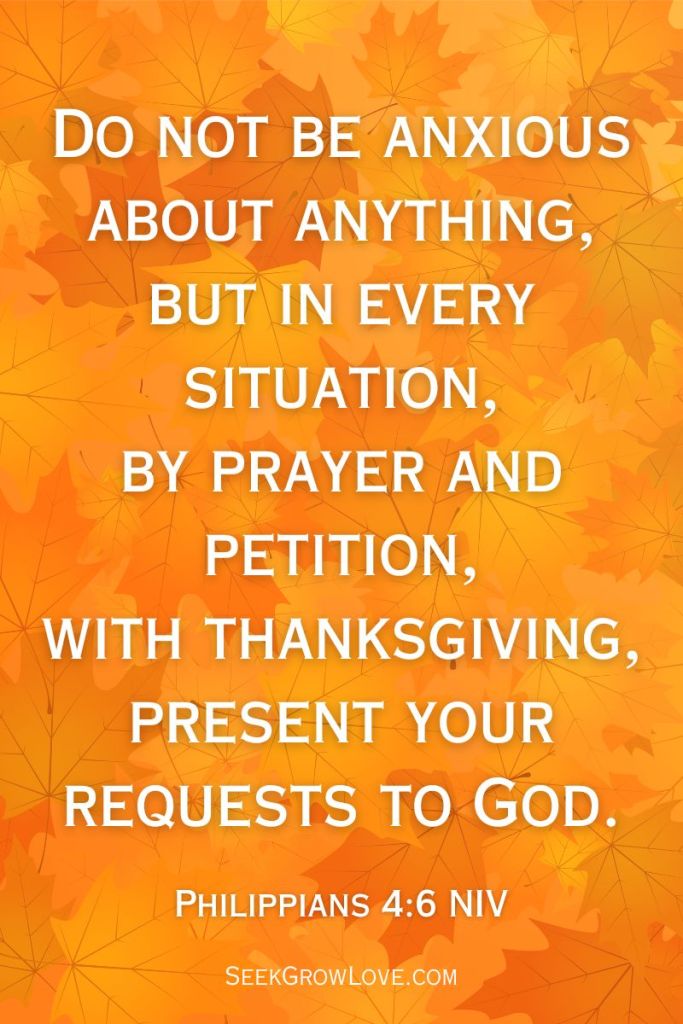
“Do not be anxious about anything.” (4:6)

It’s almost like Paul doesn’t know what it is like to be human! We can’t control our emotions. I don’t choose when to be happy, or when to be anxious. Nor does anyone else, though we try ; over 12% of the US population over age twelve take antidepressants and 6% of the population is on anti-anxiety medication. What a strange command that makes very little sense. 

Until we add context. 

To “rejoice” is not “feel happy” but “find joy in”. Joy is not the ephemeral, fleeting happiness that comes and goes based on what happens to us moment by moment, but the unshakeable reality that God’s desire for us is to be blessed by him forever. Will we have pain, heartache, grief and mourning in this world? Yes, because it is fallen. However, we don’t rejoice because of those things, but in the midst of those things, we are commanded and encouraged to find our joy in God. God’s grace, his gifts, and his promises will always outweigh our pain in the grand scheme of the universe. One day, all will be made new, and the old things will pass away and only the new and eternal will remain. 

Similarly, God does not expect us to overcome our worries and cares for the future through sheer willpower ; instead he says “do not be anxious about anything, but in everything by prayer and supplication with thanksgiving let your requests be made known to God.” The command is more than not being anxious, but about being in relationship with the one who overcomes our anxiety, and who overcomes our depression. 

I hope this week, as you have been spending 5, 10, or 15 minutes thanking God for the good things in your life, that you begin to recognize that God appreciates your thanksgiving, but also cares about your prayers and supplications. He hears it all and he is always working for your sanctification, your salvation, and your life to be abundant. He is working to bring joy in your life, joy found in what Christ has and will do in you, and to meet your needs so you will not need to be anxious. 

APPlication & Reflection

Today, instead of having questions to answer, take the time to 

Pray to God. 

Give him thanks.  

Let him know all that is on your heart that makes joy seem so far away, and all that is on your mind that makes anxiety close at hand. 

As you do, may “the peace of God, which surpasses all understanding, … guard your hearts and your minds in Christ Jesus.” (4:7)

-Jake Ballard

From Suffering Servants to Shouts of Joy

Old Testament Reading: Isaiah 53-54

Poetry Reading: Psalm 85

New Testament Reading: Mark 16

Today’s Old Testament reading of Isaiah 53 actually starts mid-way in the last of four “Servant Songs” from the book of Isaiah. If you didn’t read Isaiah 52 already, you might want to back up to Isaiah 52:13 since that is often considered the start of this poem.

Recently, I learned a new word at a Bible class I was attending when the teacher mentioned the variations of “pericopes” Bible publishers use. For some reason the word entertained me enough to laugh, and while I couldn’t remember the word writing this and had to look it up and laughed again saying it to myself, it just means the heading at the top of the divisions of scripture.  In my Bible, the pericope for Isaiah 53 is called The Suffering Servant, giving a good clue that this is a rather serious subject.

I have been enjoying a Christian historical fiction book recently set during the time of Jesus as a Jewish family is piecing together scriptures and promises as they are hearing what is going on near their “out of town relatives in Nazareth”. I have been struck by how much of Isaiah they knew and were waiting to see fulfilled and come clear, and how much what we know of our Messiah today is woven together throughout scripture. It brings such credibility and contextual understanding to have the Old with the New Testament and Isaiah 53 is certainly one of those linking passages. From what I can see, it is directly quoted at least eight times in the New Testament in a variety of writings including Matthew, Luke, John, Romans, Acts, and I Peter. Beyond these, we also see more New Testament references to the chapter’s concept referenced indirectly.

If you are doing the New Testament readings this week wrapping up Mark as well, you will certainly see the parallel to this concept that a blameless Messiah suffered torture and humiliation as an intercessor for the sins of all. It was prophesied about hundreds of years before Jesus came into existence in the womb of Mary, and it came true, bringing credibility to the well-preserved and passed down Hebrew scriptures. We have a mediator between God and us. We don’t have to sacrifice animals, recite chants, or come up with meaningless ways to “pay back” for our sins. We can’t fix the problem. But the son of God did:

He poured out His blife unto death,

And was counted with wrongdoers;

Yet He Himself bore the sin of many,

And interceded for the wrongdoers.”

 New American Standard Bible (La Habra, CA: The Lockman Foundation, 2020), Is 53:12.

Isaiah 54 starts with shouts for joy and continues on with an encouraging message that supersedes whatever brings shame, sorrow, and feelings of abandonment. While the main character in chapter 53 was the Servant, in this chapter we are reunited with a female character mentioned earlier in Isaiah. Earlier in Isaiah this woman was abandoned by her husband and then later reunited with him. (Side note: I know someone who had this happen in real life just like Israel did!) This woman seems to be a personified “Zion”, sometimes representing the city of Jerusalem, sometimes the nation of Israel, sometimes the descendants of Abraham. Whatever the case in chapter 54….she’s getting good news! While she’s felt abandoned and forsaken for a time, she is given a lot of beautiful promises. She doesn’t need to fear weapons, enemies, or past mistakes. She is promised everlasting comfort, compassion, peace, and some pretty cool gems (like maybe the ones in the New Jerusalem?!). I couldn’t even pick a favorite verse to pull out, but here’s one I liked and I’m sure you’ll find other words of encouragement in this chapter.

“For the mountains may be removed and the hills may shake,

But My favor will not be removed from you,

Nor will My covenant of peace be shaken,”

 New American Standard Bible (La Habra, CA: The Lockman Foundation, 2020), Is 54:10.

-Jennifer Hall

Reflection Questions:

1. How does learning the Old Testament scriptures impact your understanding of the New Testament?

2. What message in the Suffering Servant poem might you need to be reminded of today?

3. What words of encouragement do you see in Isaiah 53 and 54 for yourself? Or for someone else you know?

Light. Will. Come.

Old Testament: Job Intro – found below

Poetry: Psalm 30

New Testament: John 10

Sometimes things are just hard. Life is not going our way. We’re feeling burdened, overwhelmed, or just plain sad. When we are stuck in the middle of these times, it can bring relief just to see the possibility of a light at the end of our dark tunnel. We don’t even have to see the light yet. Just knowing that it’s coming can lighten our load and bring a deep breath of hope.

I was talking with a friend recently who is feeling a lot of stress at work. My friend is doing her own job as well as another person’s job. When we talked, she told me that her company had posted the other person’s job and should be hiring to fill it soon. Even though her workload hadn’t changed, in that moment she felt a subtle lifting of her burden. The relief wasn’t there yet, but just knowing that it was coming gave her hope, and a boost to continue on until the relief actually showed up and she could go back to just doing her own job.

Weeping may last for the night, but joy comes with the morning. Psalm 30:5b

Have you ever experienced insomnia? How about being up all night with a sick child (or sick self)? We’ve all been in those situations where we wish with every fiber of our being that morning would just arrive. And it does. Every single time.

Although some nights may be long and dark, joy will come again. The darkness may even get worse but God will meet you in your darkness and the light will come.

Life is not free of struggle or pain– not even for the most faithful servant of God. But in our pain and confusion, God is always with us, working for our good.

Isaiah 43:2 reminds us of that: “When you pass through the waters, I will be with you; and through the rivers, they shall not overwhelm you; when you walk through fire you shall not be burned, and the flame shall not consume you.”

It would be nice, wouldn’t it, if God promised that he’d take away all of our burdens? Snap his fingers and make everything sunshine and rainbows. The reasons why he doesn’t are probably many and accurate.

What he does promise us, though, is that not only will he be with us in the dark times (and as someone who is still afraid of the dark, that is no small gift) but he promises us that light will come. Let me say that again for those who need to let that sink in…

Light. Will. Come.

But even more than THAT, God doesn’t simply promise to give us peace at the end of the long, dark night. He offers dancing. Dancing!

You turned my wailing into dancing; you removed my sackcloth and clothed me with joy, that my heart may sing your praises and not be silent. LORD my God, I will praise you forever. Psalm 30:11

Thanks, God. Thanks for being so kind to a dummy like me who, even though I know the morning always comes, still doubts…still fears in the darkness. And yes, thank you for asking, you may have this dance.

-Susan Landry

Reflection Questions

  1. Read Psalm 30 looking for how God is described and what He is doing/has done. Now re-read it and find how the Psalmist is responding. What image of God do you have after reading Psalm 30? What is your response?
  2. What is the darkest night/hardest struggle you have encountered so far? Are you still in it right now or have you already experienced some light/joy/and perhaps even dancing? How did you see God during the dark mourning – and also in the light morning?
  3. Who do you know who is stuck in a dark night right now and could benefit from hearing that the light is coming? How can you use God’s promises, His Word, and perhaps even this devotion to be an encouragement to this person? What/who can you also be praying for?
  4. After reading the Job Introduction below, how does it apply to today’s devotion?

Job Introduction

The Book of Job is about a righteous man named Job who remained faithful to God despite God allowing Satan to take everything from him except his life.  We don’t know who wrote this book, or even exactly when it took place.  Given Job’s age (he lived 140 years after the events recorded in the book), it’s likely Job lived around the time of Abraham, or possibly earlier.

In the first two chapters, we get a glimpse of one reason bad things happen to godly people – Job seemed to be a pawn in a cosmic battle to test Job’s integrity.  

Job had 3 “friends” who came to comfort him, but they were really more torment.  They consistently accused Job of hidden sins – otherwise, God wouldn’t be punishing him they said.  But Job consistently maintained his innocence.

Despite Job’s intense suffering, he maintained his belief in the resurrection, as is recorded in Job 19:25-27, “I know that my Redeemer lives, and that in the end he will stand upon the earth.  And after my skin has been destroyed, yet in my flesh I will see God; I myself will see him, with my own eyes – I, and not another.  How my heart yearns within me!”  (This is one of my favorite passages in the Bible.)

In the end, God Himself confronted Job, and eventually blessed Job with twice as many possessions at the end of his life as he had before his downfall – including 10 more children.

This is a good example to show us that we don’t need to understand why bad things are happening, we must just remain faithful, no matter what.  Job also shows us that we can be honest with God when we are suffering and when we don’t understand why things are happening.

Finally, no matter what happens to you, may you, with Job, be able to say, “I know that my Redeemer lives, and that in the end he will stand upon the earth.  And after my skin has been destroyed, yet in my flesh I will see God; I myself will see him, with my own eyes – I, and not another.  How my heart yearns within me!”

-Steve Mattison