As I read through the first half of this Psalm, one thing that stuck out to me was the repetition of the thought of loving God’s law/commands/decrees or desiring to love them.
When we think about laws, we don’t usually think about loving them. We follow the laws so we don’t get punished. Some laws, we understand and agree that they are good, so it makes sense to follow them, and some, we don’t and the only reason to follow them is to not get in trouble (like prohibiting nursing homes from playing Bingo more than two times per week or not crossing state lines with a duck on your head).
The concept of loving laws makes much more sense when you consider a loving God that created them. Though we may not understand all of them, we can know that God put them into place for the good of people.
Though the requirements of the law were fulfilled in Christ and there wasn’t an expectation for the Gentiles to follow the law, we can still look at the law and see valuable guidance like washing your hands. You can see how the instructions on dealing with dead bodies or blood would have made sense, especially before more medical advances were made. And whatever doesn’t make sense to you at this time, if you believe that God is good and loving, you can trust that the laws were made with a reason.
When we look at the direction given by Jesus that went above and beyond the call of the law, we can also believe that he gave those directives because he loves people too and wants us to as well.
When we want to do good because it is good rather than because of a fear of punishment (or a promise of reward), we can live our lives differently than the world around us.
God, teach us to love your ways, to truly believe that your ways are good and trustworthy.
~Stephanie Fletcher
Reflection Questions
What are your favorite 3 verses in Psalm 119:1-88? Why did you choose each one?
What is the benefit of having good laws? What laws help your home, school or work environment run more smoothly?
Do you trust that God’s laws are good? Pick one of God’s good laws that God might want you to love more. What would that look like?
As David gets ready to die in 1 Kings 2, the beginning verses as he speaks to Solomon stuck out to me.
2 “I am about to go the way of all the earth,” he said. “So be strong, act like a man, 3 and observe what the Lord your God requires: Walk in obedience to him, and keep his decrees and commands, his laws and regulations, as written in the Law of Moses. Do this so that you may prosper in all you do and wherever you go 4 and that the Lord may keep his promise to me: ‘If your descendants watch how they live, and if they walk faithfully before me with all their heart and soul, you will never fail to have a successor on the throne of Israel.’”
“So be strong, act like a man” – what does that look like? I think this statement connects with the next one. To be strong and act like a man is to observe what the Lord your God requires which is to walk in obedience to him and keep his decrees. Doing those things takes strength because it opposes the way of the world.
I am not a man, but I am raising a young one, and this is what I desire for him. I want him to be strong, that is, to stand firm in faith and not give in to pressures from this world, but to instead walk in obedience to God. I want him to be strong as in to stand up for those who can’t, to defend and protect the weak.
Our culture puts definitions on what it wants men to be like, and that changes throughout time (for example, I read recently that pink used to be a very masculine color in the past), but those things don’t really matter. How they follow God matters. How they care for others matters.
As you continue reading in 1 Kings 2, you see poor examples of men in Adonijah, in Abiathar, in Joab, in Shimei as they tried to usurp the leader God put in place or followed the wrong people or refused to listen. These aren’t poor examples of men in a cultural sense, they are poor examples of men in the sense that they were not walking in obedience to God. They were not being strong/faithful to what they were told, but instead were led astray, or were trying to lead others astray. If we can raise up men who follow God and care for others, we raise up men who are like Jesus and that is the strength that I hope to see.
~Stephanie Fletcher
Reflection Questions
How is God’s definition of what it takes to be a man different from what the world currently says men should be?
While it is not discussed in this text specifically, what do you think God would say to women about how they should act?
Man or woman, how have you showed strength in opposing the way of the world? Is there an area where God would like to see more strength in you – more doing what God requires?
What good examples have you had of men or women who were strong in the Lord?
Integrity is a part of your character that you can’t develop overnight- it involves a lifetime of good, honest, and moral decision-making. In Psalm 101, we read words written by David telling us how he desires to live with integrity in both his personal life and in his rule. Though none of us are likely to ever be kings, we can still apply a lot of this wisdom to our own lives, but you should probably leave the destruction of the wicked to others.
So, how can we walk with integrity like David? First, we see that he will “ponder the way that is blameless.” It’s a good practice to consider what it means to live in a way that glorifies God. Ponder your life and seek to be blameless in the way you live and make changes that you need to make.
Then, “I will not set anything worthless before my eyes.” What are you focusing on? What gets most of your attention throughout the day? Do me a favor and take a moment to check your Screen Time Report on your phone. Now, answer honestly- how many of the things you set before your eyes are worthless? Replace these worthless things with things that will improve your life, your mental health, and your relationship with God.
We also see that David is actively avoiding “perverse hearts,” “those who slander their neighbors,” “those with a haughty look and arrogant heart,” and those who “practice deceit.” Take a look at the people you allow to influence you, the people in your inner circle. Are they fostering your growth or hindering it? Surround yourself with people who will offer you godly advice and support. Build a community around you that will carry you when you can’t carry yourself.
-Hope Fletcher
Reflection Questions
What do you see as the importance of pondering the way that is blameless? What in your life this month has brought glory to God? What has not?
What is worthless? What is not? “What are you focusing on? What gets most of your attention throughout the day?”
“Take a look at the people you allow to influence you, the people in your inner circle. Are they fostering your growth or hindering it?” Who could you intentionally spend more time with in order to work towards your own godly growth? Set up some time together with this person/these people and pray about your time together.
Today’s reading, found in 1 Samuel chapters 18 through 20, highlights how far Saul has fallen from his successes of chapter 14. (Remember from chapter 15, that Saul had deliberately disobeyed a direct command from God, and things have been going from bad to worse for him since.)
In 18:10-11, we read, “The very next day a tormenting spirit from God overwhelmed Saul, and he began to rave in his house like a madman. David was playing the harp, as he did each day. But Saul had a spear in his hand, and he suddenly hurled it at David, intending to pin him to the wall. But David escaped him twice.”
Once Saul decided to abandon God, God not only abandoned Saul, God tormented Saul. This should be a lesson to us – never disobey God – there are always negative consequences.
Saul became jealous of David, after David had killed Goliath, because the women of Israel sang this song, “Saul has killed his thousands, and David his ten thousands.” As a result of his jealousy, Saul tried to kill David with his spear in 18:11 and again in 19:10. Saul also tried to kill David by having the Philistines kill him in 18:17, 21, 25. In 19:1, Saul urged his servants and his son Jonathan to assassinate David. In 19:15, Saul ordered his men to bring David (and his bed) to Saul to be killed, when Saul thought David was sick in bed. In 19:20, 21 and 22 Saul unsuccessfully sent troops to get David three times.
In 20:30, Saul boiled with rage at his own son, Jonathan, who was friends with David, and in 20:33, Saul hurled his spear at Jonathan, intending to kill him.
So much for Saul, what about David?
If you were David, how would you react? What would you do?
Remember that Samuel had anointed David in chapter 16, and declared that David would be the next king over Israel. So what did David do? He wrote some songs about this. Let’s see what he said in those songs…
David wrote Psalm 59 when Saul sent his soldiers to watch David’s house in order to kill him. This psalm starts out, “Rescue me from my enemies, O God. Protect me from those who have come to destroy me. Rescue me from these criminals; save me from these murderers. They have set an ambush for me…”. This makes sense. David was in trouble, so he cried out to God for help. David continues in verse 9, “You are my strength; I wait for you to rescue me, for you, O God, are my fortress.”
Then an astounding thing happens. David starts praising God – in advance of God’s rescuing him. Psalm 59 ends with, “But as for me, I will sing about your power. Each morning, I will sing with joy about your unfailing love. For you have been my refuge, a place of safety when I am in distress. O my strength, to you I sing praises, for you, O God, are my refuge, the God who shows me unfailing love.”
David, the man after God’s own heart was actually praising God when he was literally afraid for his life. This shows his great faith that God will indeed rescue him. Maybe this is one of the reasons he was called a “man after God’s own heart.”
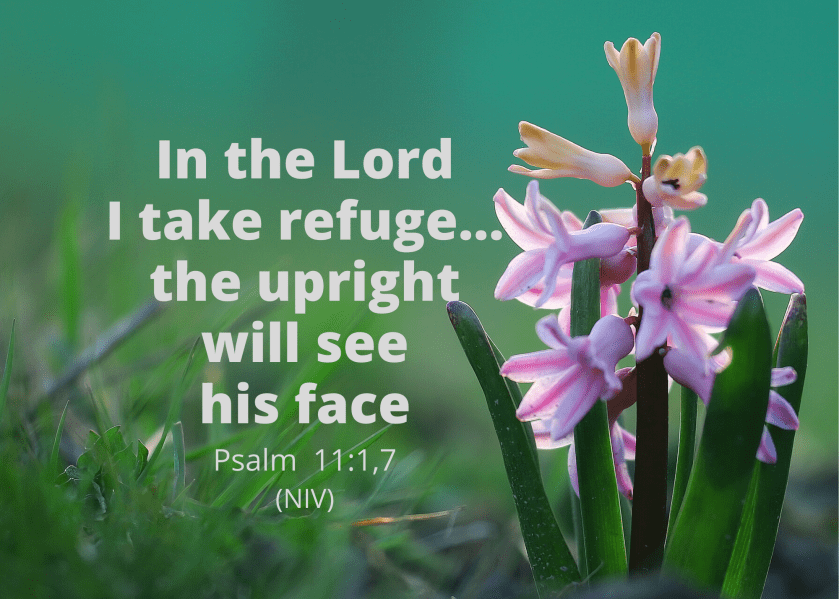
Psalm 11, the other chapter from today’s reading also shows David’s faith through difficulty. It starts out, “I trust in the Lord for protection…”, and ends with “For the righteous Lord loves justice. The virtuous will see his face.”
I believe David’s response is a good example for us. When times are tough, it’s natural to cry out to God for help. We need to move on from just asking for help, and follow David’s example to also have faith and praise God, even before the answer comes. And in the process, we, too, may become people after God’s own heart.
–Steve Mattison
(originally posted April 12, 2020 for SeekGrowLove.com)
Reflection Questions
Compare and contrast Saul and David based upon what we know from 1 Samuel.
What do you see in your own life that is similar to Saul? And David?
What does it look like to show faith in God during the difficulty?
What difficulty (big or small) have you recently found yourself in, in which you can practice giving God praise even before the answer comes?
Being raised as a pastor’s kid, I probably took for granted the accessibility of all things church related. Being a Christian was something that was easily practiced because of the environment I was constantly in. I asked Jesus to come into my heart when I was 5 years old. I was baptized the summer before my eighth grade. But it wasn’t until I went off to college that I really realized that my faith was my own responsibility. If I was going to have Christian friends, I needed to find them on my own. If I was going to attend a mid-week Bible study, I needed to find it on my own. If I was going to attend a Sunday morning service, I needed to find it on my own. Mom and Dad weren’t there to guide and direct me. If I wanted to continue to build up my faith, it was now up to me.
As we read through King Saul’s life, we see that he was hand selected and groomed to take on the role of leading Israel – everything was handed to him. And as a result, he never really owned the responsibility of the position he was put in. He never connected the dots of being the leader of God’s people and having a relationship with God himself.
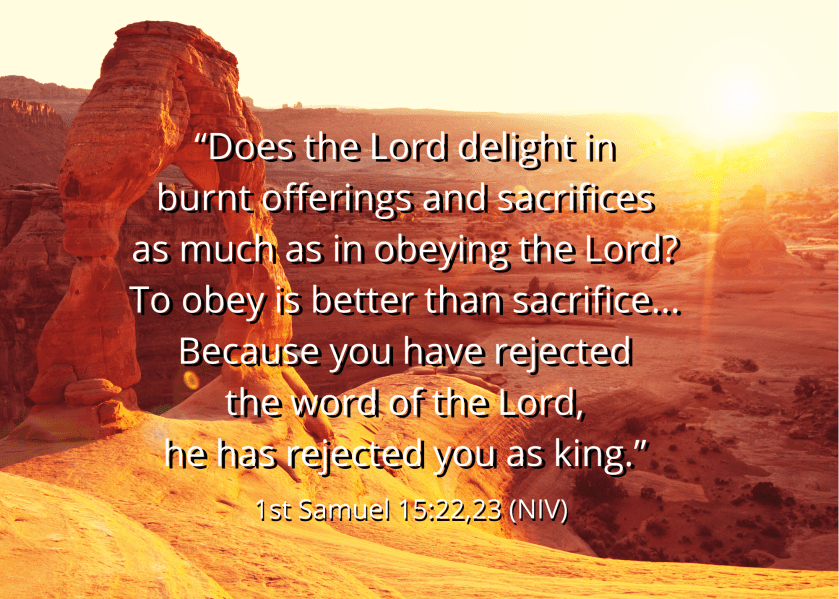
This is particularly evident in 1 Samuel 15. Saul has carried out God’s instructions of taking up arms against the Amalekites. Once Israel wins the battle, they were supposed to destroy everything: man, woman, child, cattle, sheep, camels and donkeys. Nothing was to be spared. But…that’s not what Saul did. He kept the best of the spoils. He claims that he was going to use the prime plunder as a sacrifice.
Here’s how I know that Saul didn’t own his relationship with God: in verses 21 and 30 of chapter 15, Saul refers to the LORD as Samuel’s God.
“…the best of what was devoted to God, in order to sacrifice them to the LORD your God at Gilgal.” (v 21)
“…come back with me, so that I may worship the LORD your God.” (v 30)
Saul didn’t understand his disobedience because he hadn’t bothered to grow a relationship with the One who made him king of Israel.
More than anything God desires to have a relationship with us. He wants us to seek Him more than any other person or pursue any other passion. When we grow our relationship with Him, we come to know the things that please Him as well as the things that displease Him. As we grow our relationship with God, our hearts swell with love for Him, His word, and His people. And when our hearts are full of love, obedience comes naturally.
Bethany Ligon
(originally posted for SeekGrowLove April 11, 2020)
Reflection Questions
Why is obeying Him important to God?
Have you ever felt like God is just someone else’s God?
The decisions of our family members affect us. Growing up, I attended a public school where many teachers and staff knew my dad. Whether it was because he was working as a substitute, looking for a teaching position, or something else, they knew him and often told me something along the lines of, “You better be on your best behavior because I know your dad.” I’m sure my older brother heard this many times, and I’m not sure about my younger siblings. Regardless of that detail, my younger brother has been called by my older brother’s name before (maybe because of their similar competitive spirit or fast mile times in P.E.). Yet, my siblings and I know very well that if something bad were to happen at school, somehow or someway it would find its way back to our parents (even if it had to be via carrier pigeon). My siblings and I did/do very well at staying out of trouble, but we weren’t/aren’t perfect (and I’ll spare you from those details).
When my older brother signed up for the morning choir, it changed my school life and routine. I didn’t want to ride the bus, and I couldn’t drive, so the best option was to get up earlier and ride with my brother (and wait until the rest of my friends arrived). At that time, I disliked my brother’s decision very much. However, this eventually led me to become interested in morning choir, learn all the musical parts I could, somehow end up singing in the choir for the last two years of high school and being involved in two musicals/plays. After looking back at my older brother’s decision, I am grateful for it (even though I lost some sleep here or there). Our actions can dissipate and impact the lives of those around us (for better or for worse), and in today’s reading Eli’s actions are no different.
My parents taught us that our decisions and indecisiveness have consequences. As Laurie Buchanan said, “Whatever we are not changing, we are choosing.” Eli made a few poor decisions that resulted in the downfall of his family before God. We might think that Eli was innocent when we read 1 Samuel Chapter 2, but 1 Samuel Chapter 3 tells us the reality of his situation. He didn’t do anything about his son’s sins nor restrained them from sinning (3:13). He needed to hear from God, a friend, or his wife something along the lines of Proverbs 13:24 which states, “Whoever spares the rod hates his son, but he who loves him is diligent to discipline him.” Or, perhaps he knew this concept and simply continued his daily practices disregarding this information (though I think this is more unlikely). Whatever the case may be, Samuel (Hannah and Elkanah’s son) was dedicated to the LORD (1:28) and grew in stature and favor with the LORD and people (2:26). He was the result of his parents’ good decision(s) and didn’t follow in the ways Eli and his sons acted. His parents understood Proverbs 22:6 which states, “Train up a child in the way he should go; even when he is old he will not depart from it,” likely before it was written. It is important to know the words of God, obey them, and be an example to those around us (even when we think others aren’t looking or paying attention).
-Jeffrey Seiders
REFLECTION Q’s
Eli knew the words of the LORD and yet acted disobediently. Are there times when you’ve acted disobediently even though you knew what God’s word says? What happened as a result of your disobedience? How can you get “back on track?”
Eli’s sons acted as if their father wouldn’t correct them. How have you acted in a way that you thought God and/or your parents wouldn’t correct you? What are the consequences of your actions? In what ways can God teach you through your consequences?
Samuel grew in favor with the LORD and with people. How can you change your actions and mindset to grow in favor with the LORD and bring people closer to Him?
But the Israelites broke faith in regard to the devoted things: Achan son of Carmi son of Zabdi son of Zerah, of the tribe of Judah, took some of the devoted things; and the anger of the LORD burned against the Israelites. Joshua 7:1 (NRSV)
As God promised, He led the Israelites to victory over Jericho. It is to be ransacked and destroyed, and there are to be none left alive, aside from Rahab and her family. There were specific items (gold, silver, etc.) that were taken from the rubble that were to be set aside and placed in the treasury of the house of the Lord.
After this great blessing of victory, one would assume that everyone would honor the directives of God and be obedient to him, but alas, we’ve been here before. Despite God proving himself time and time again to be a God of his word, both in blessing and in punishment, this knucklehead named Achan decides to take a heap of these goods for himself, and he buries them underneath his tent.
The stuff is hidden, there was so much of it, no one is going to know. The only one that this affects is him, and he’s going to keep it a secret. Maybe, eventually, it will just seem like this is some of the swag that was received from the Egyptians as they sent their ancestors out of Egypt. I don’t know what exactly was going through Achan’s mind, but I’m sure we’ve all been there, deceiving ourselves, justifying the stupid decisions that we have made to disobey or to take something that we have no business possessing.
As I sit here, I am reminded of an instance where one of my brothers took something that did not belong to him. This would have been sometime in the mid to late 90s and I’m a little fuzzy on some of the peripheral details. But we get home after a trip to the grocery store (Bohning’s in Ponchatoula, LA, I believe), and we discover that my brother has in his possession a whistle pop. After further investigation, it is discovered that he has many of them; in fact, he has a FULL BOX of whistle pops. At some point while we were standing in the check-out line, he grabbed the box off the candy shelf and shoved it under his shirt or down his pants. Now, I’m assuming that my mom took him back to Bohning’s to return it, as had happened when other contraband candy items had “shown up” in our house.
Now, a 5-year-old is not going to get arrested for petty theft and is probably going to get some sort of punishment for their misbehavior, but that action did not just affect him. There is embarrassment when a parent brings their child in to cop to a misdeed, apologize, and return the uneaten contraband. The stakes are low in this situation, but the principle is there: sin and error do not just affect the perpetrator.
Israel is feeling a kind of high as their God has just handed their enemies to them, and they are going to press forward into the land. They go make military advances on Ai, but they are driven back; they do not experience deliverance against their enemies; they are driven back and several dozen of their comrades fall to the enemy.
How? Why? Why would God deliver them a fortress and then allow them to fall to a less powerful fortification?
Because sin doesn’t happen in a vacuum. Sin affects everything. You don’t have to sin against someone for them to be affected; there are plenty of indirect effects of sin. We don’t have to go into a laundry list of sins, but different sins can cause us to behave and think in certain ways that harm others. Sin can lead to anger. Sin can lead to spousal abuse or neglect. Sin can lead to broken relationships. Sin can lead to more and more sins being perpetrated. Sin can break hearts. Sin can put a wedge between a person and God, and I’m not talking about the person that sinned.
Achan’s sin caused God to be furious, and he withheld his blessing and protection from Israel. Achan’s misappropriation of riches, which had nothing to do with the battle against the people at Ai, led to the loss of a battle. The sin affected all of Israel. In this case, Achan lost his life because of his sin.
So, if there is unrepentant sin in our homes, in our churches, in our relationships, and our individual hiding places, we can expect that it is going to affect others in one way or another. Sin cannot be reconciled with good. Jesus died to free you from sin, not to free you to sin. Yes, sin is crouching at our door; your enemy, the devil, is on the prowl like a lion to devour you with temptation that leads to sin (1 Peter 5:8). But when we sin, we are not to try to justify it or explain it away. I’ve cited it already this week, but here it is again:
“If we confess our sins, he is faithful and just and will forgive us our sins and purify us from all unrighteousness”1 John 1:9 (NIV)
Achan confessed his sin, but the damage had been done. He waited till he had been found out and others had suffered extreme loss due to his actions.
When we fall short, it is best to confess quickly before it becomes a bigger mess in our lives and the lives of those we love (or don’t even know).
-JJ Fletcher
Reflection Questions:
Why is it so easy to overlook God’s commands?
Is it difficult to read about the punishment for sin that is described in scripture? Does it lead you to a greater appreciation for the New Covenant in Christ’s blood?
What thoughts did you have on Achan’s sin as you read through today’s reading in Joshua 5-8?
Why is it easy to be blind to the way that our sin affects others?
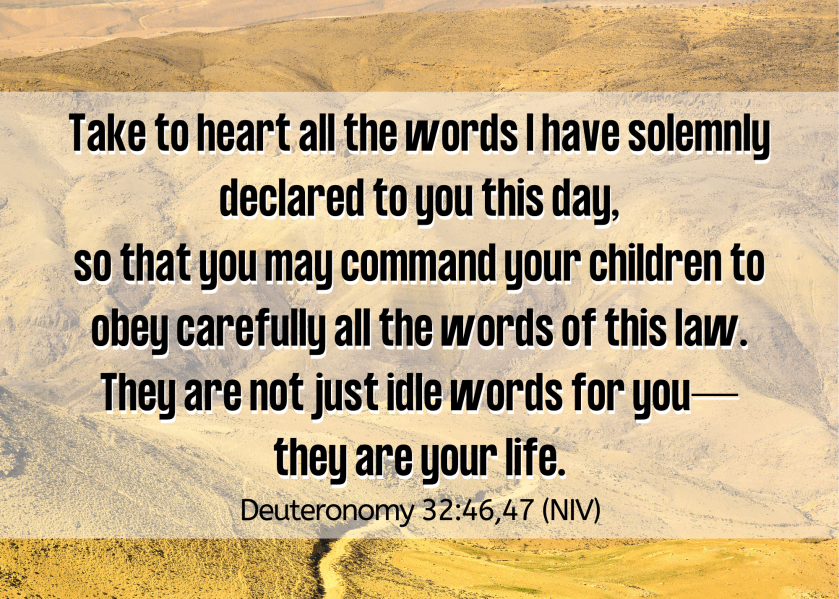
When Moses had finished reciting all these words to all Israel, he said to them: “Take to heart all the words that I am giving in witness against you today; give them as a command to your children, so that they may diligently observe all the words of this law”. Deuteronomy 32:45-46 (NRSV)
I’m a music lover. My memory of “contemporary” music goes back about 30 years. 1995-1996 is when I first remember getting into music on the radio. It’s not just the music of my era… I grew up listening to the classic rock format as well as ‘90s rock and pop. If I were to anonymously give you a top 20 list of my favorite albums or songs (which I’d probably never be able to narrow down), you might be left scratching your head, wondering who this person is and when they were born. Powerful is the art of song and music. I love music for the notation, the way that notes and chords are put together to create melody and harmony, even dissonance, but also for the lyrics… The way that someone can convey emotion or conviction in a way that hits hard, that makes you think and feel.
Great songs come in many forms. There is much to be gleaned from a simple lyric – Jesus loves me, this I know, for the Bible tells me so; and there is much to contemplate from an imaginative and thoughtfully written gem that paints an image in the mind: “Could we with ink the ocean fill, and were the skies of parchment made; were every stalk on earth a quill, and everyone a scribe by trade; to write the love of God above would drain the ocean dry; nor could the scroll contain the whole, though stretched from sky to sky”.
The Beatles were a smash with their early simplistic songs, but also with more thought-provoking tunes toward the end of their run. Leonard Cohen’s “Hallelujah” (Jeff Buckley did it better) is one of the most gut-wrenching (in a good way) songs that I can think of. It carries the listener through peaks and valleys of emotion as it describes tensions in the human experience of love. Perhaps I have digressed too much, but I can get distracted when I get into the minutiae of music.
In Deuteronomy 32, we have recorded a song that Moses recited to the Israelites shortly before he went up to Mount Nebo to get a distant view of the promised land and then die. In this song, we see a variety of things addressed. Moses glorifies Yahweh, his God, but takes the people on a journey to envision their future failure and rejection of God’s ways that they are on a path toward. Challenges, encouragement, and perspective.
While Moses covers some pretty negative territory regarding the Israelites in his words, he also gives assurance that Yahweh is a God of mercy and redemption and that his people will be cleansed. Despite impending failure, there is forgiveness and mercy on the docket, and there will ultimately be protection for the people of God against their adversaries.
I find it a little curious that Moses addresses the people in song, diverging from the status quo of God’s revelation to his people up to this point, but song can be a powerful way to commit things to memory. In contrast to the ten commandments and the subsequent revelation of the full law, this presentation perhaps was remembered and recited in a way that was engaging and complementary.
-JJ Fletcher
Reflection Questions:
How has music impacted your relationship with God and Jesus?
Do you find it easier to remember lyrics and scripture put to song than simply memorizing bible verses?
How do we balance the desire that we might have for catchy and relatable tunes with the directive to glorify and worship God with music?
What impact do you think Moses’s addressing the people in this manner had on them? (might be helpful to look back at Deuteronomy 31:19-22)
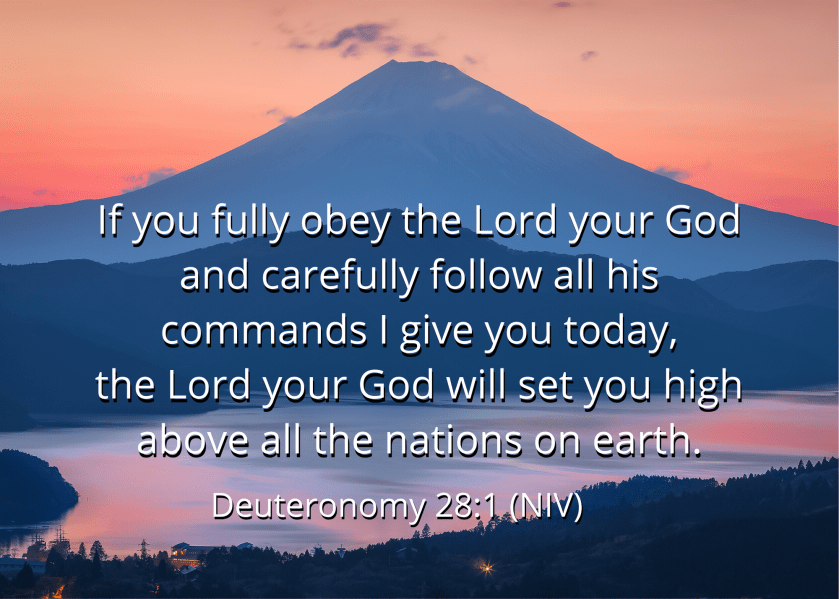
“And if you faithfully obey the voice of the LORD your God, being careful to do all his commandments that I command you today, the LORD your God will set you high above all the nations of the earth… But if you will not obey the voice of the LORD your God or be careful to do all his commandments and his statutes that I command you today, then all these curses shall come upon you and overtake you.Deuteronomy 28:1;15 (ESV)
Motivating my four children, ages 4 to 12, requires different strategies. My 12-year-old is motivated by rewards, i.e., if you do all your chores and then some extra work, you can have an extra 30 minutes playing the Switch. Consequences, however, don’t seem to faze her quite as much. The other 3 children are less cut and dry and require a more measured approach with rewards and consequences; however, one great challenge is follow-through. As busy parents with hundreds of things to do each day and limited energy reserves, it can be difficult to be consistent and follow through on our threats and promises.
God is not inconsistent. God is merciful, but he follows through on his promises. In Deuteronomy 28:1, he promises a blessing in return for obedience, but in Deuteronomy 28:15, he promises punishment for disobedience. It’s the same as a carrot and stick. Something tasty to motivate or something that brings pain to correct course. We see through Israel’s history that even though God followed through on his promises of blessing, he still had to break out the stick to use on a hard-headed people.
Over the past couple of weeks, I have been preaching from Romans 7-8. In Romans 7, Paul writes about not understanding his actions. Paul knows what is right, he knows what God desires of him, and he wants to be obedient, but there’s a problem. Despite the faith in and knowledge of God’s ways, Paul succumbs to human desire and does the things he does not want to do, i.e., the things of the flesh. Can you believe it? Paul, the apostle, was a “slave” to sin in the flesh! Is that hard to believe? Paul is human like us, and despite what we know is right, we often don’t do the right thing. Why, why, why? Because sin is ingrained in the flesh.
There are debates on something called original sin, which is not something we’ll get into here, but it is clear we learn how to sin from an early age. We are naturally selfish as children; we need to be self-focused to survive, but as we mature, we should become less self-focused and more focused on the big picture. In the Christian view, we should be imitating Jesus, who humbled himself (Philippians 2). Jesus was a model of selflessness and submission to God’s will. Jesus did not want to die, yet he was obedient to the point of death so that many could be ransomed from the death that comes from sin; he saw the big picture. Though we can see the big picture, we often fall short of the kind of selflessness that Jesus modeled.
Unlike the Israelites under the old covenant, we have Jesus in clear view. We are not holding out hope for a future savior but rather holding onto the promise that the blood of Jesus has covered our sins past, present, and future. While we are called to obedience, God does not hold our salvation in limbo every time we mess up. We are faced with the present consequences of our mishaps with sin, but we have constant forgiveness through the blood of Christ Jesus. “If we confess our sins, he is faithful and just and will forgive us our sins and purify us from all unrighteousness”1 John 1:9 (NIV). We don’t have to go through the carrot and stick metaphor as partakers of the New Covenant in Christ’s blood. We must strive to be obedient, but fess up when we miss the mark, and move forward in each new day as we are redeemed by the blood of the lamb.
-J.J. Fletcher
Reflection Questions:
Why do you think it is so hard to balance the desires of the flesh with the knowledge of the living God and some pretty clear instructions on his will for us?
Is it easy to become discouraged when we fall short? What are some obstacles to confidence in our faith walk?
Does a tendency toward legalism sometimes impede our ability to deal with flaws in ourselves and others?
Is there a place for carrot-and-stick dynamics in church life and discipline?
What would Paul think about the way that some modern churches deal with reconciling the desires of the flesh with faithfulness to the gospel?
We all know the Israelites had their share of ups and downs, more often than not due to their own iffy decision making. This is where God makes it indisputably clear that He’s not cool with that. He never has been, and though they made a narrow escape from His righteous wrath once, they have to make a change. Moses reminds them of the abundance of evidence they have of God’s provision. They have no reason to doubt His guidance, or His love. They need only obey the very simple, very clear instructions laid out before them, and they will thrive in the Promised Land. Moses is really leaving no room for misunderstanding; if they remember what the LORD has done for them and follow His commandments, blessings will flow. If not, destruction awaits them. (Deut 8:6-20)
It is also made abundantly clear that any blessings they have previously received were by no means owed to them, that the great nations God delivered into their hands were not because of their own righteousness, but rather because of the rival nations’ wickedness. God had a covenant to keep with the Israelites, and He chose to blot out some evil along the way.
It is not because of your righteousness or the uprightness of your heart that you are going in to take possession of their land, but it is because of the wickedness of these nations that the Lord your God is driving them out from before you, and in order to confirm the oath which the Lord swore to your fathers, to Abraham, Isaac, and Jacob. – Deut 9:5
Chapter 10 expresses that God desperately wants the wholehearted devotion of His people. No other being is worthy of our praise. We cannot divide our allegiance between God and the things of this world that compete for our loyalty; Yahweh’s unmatchable greatness demands our reverence.
You shall fear the Lord your God; you shall serve Him, and cling to Him, and you shall swear by His name. He is your glory and He is your God, who has done these great and awesome things for you which your eyes have seen. – Deut 10:20
Just as the Israelites had to be repeatedly reminded of God’s provision and grace, it is of such importance that we remind ourselves (and each other) on a regular basis that even though we haven’t (and can never) earn such a reward, we serve a God who has endlessly displayed His immense love for us and His perfect plan for us. It is not by our own righteousness that we are saved, but we are saved nonetheless. And furthermore, we are loved beyond all comprehension. Who else is worthy of our praise? Who else is worthy of our life-long commitment? Even in today’s world, there are so many things competing for our attention and fealty. We must make the same decision the Israelites were faced with in today’s reading, the daily decision to choose God over all else. Although we don’t deserve His love, He is the only thing that deserves ours.
-Isabella Osborn
Reflection Questions:
How has God provided for you in ways that you may have overlooked or taken for granted? Take a moment to reflect on His faithfulness in your life.
In what areas of your life are you tempted to divide your loyalty between God and the things of this world? How can you realign your heart to give Him your full devotion?
If our blessings are not earned, but given by God’s grace, how should that shape your perspective on gratitude, humility, and obedience in your daily walk with Him?







 Seek Grow Love