I have a confession to make. I really don’t like conflict and because of that I don’t always confront situations or people as I should or as is necessary. Now thankfully the Lord is growing me in this area because the reality is confrontation and conflict is necessary. Actually the New Testament teaches that there is a time and place for believers to hold each other accountable with regard to sin. Many Christians and churches struggle with this. It’s uncomfortable, awkward, and scary yet our Lord himself exemplified this in today’s chapter of Matthew 23 (read Matt. 18.15).
Seven times in Matthew 23 Jesus says “woe to you” with reference to the Pharisees. “Woe” is a prophetic denunciation that the prophets in the Old Testament used to warn people that their behavior was not pleasing to God and if they didn’t correct their actions God’s punishment and judgement would come.
The crime of the Pharisees was that they were so caught up in religious activities that it compromised true obedience God really desired. Jesus loves and forgives but he will not tolerate empty obedience and religious service. He will not be sweet to that which God hates and opposes. Likewise as followers of Jesus we must strive to become like him in all respects including standing up for the truth even when that means calling out sin and that which God hates.
This must be done with great wisdom and care and love. I’ll include passages that speak to this theme. I’d encourage you to read them and get exposed to this New Testament teaching. We as Christians have a duty to lovingly hold other believers accountable with regard to sin.
Passages for further study:
.Matt. 16.21-23
.Matt. 18.15-20
.I Cor. 5.1-5
.Gal. 2.11-14
.Gal. 6.1
.Eph. 5.11-14
.I Tim. 5.20
.Tit. 3.10-11
.Jam. 4.17
Jacob Rohrer
Today’s Bible passages can be read or listened to at Bible Gateway here – Matthew 23 and Luke 20-21.
Well, that was the question the Pharisees and teachers of the law asked Jesus: Why don’t your disciples wash their hands before they eat? Good question, most of us would agree it’s a good thing to wash your hands before you eat, and when you return from the marketplace, and several other times of the day. This Jewish delegation (comparable to today’s church leaders) were very curious about Jesus and his followers. They had traveled all the way from Jerusalem to Galilee (approximately 70 miles over rough terrain, most likely walking for 2 or more days) to check out this Jesus. They had heard about his many miracles and teachings, and had probably been around long enough to witness some as well. They were watching him closely to decide what they were going to do with this man. And then they saw a problem they could attack: Jesus’ disciples didn’t wash before they ate. It is interesting that Matthew says “your disciples”, Mark says, “some of your disciples”, but it does not say that Jesus didn’t wash – so it doesn’t appear the Pharisees could personally attack Jesus for his own uncleanliness – but what of his disciples? They asked Jesus, “Why do your disciples break the tradition of the elders? They don’t wash their hands before they eat!” (Matthew 15:2 – even with exclamation!)
Jesus quickly flipped the question around – “And why do you break the command of God for the sake of your tradition? (Matthew 15:3). And then he gave an example of how they enticed people to break God’s law which said to honor their parents. It appears they were encouraging people to give large showy gifts to God even when it meant they no longer had the means to provide for their aging parents. Jesus shows how the Pharisees had majored in the most minor issues (like pointing out someone’s dirty hands) and left the most important things neglected.
I think of my daycare children and all the potty-training and hand-washing I have taught over the years. I can certainly attest that hand-washing is very important. However, supremely more important is that child’s love for God and others. Imagine a child who is a beast all day long. Fighting with the other children, biting, ripping toys out of their playmates’ hands, yelling at authority, and screaming during lunch time prayer. But, they washed their hands very well before coming to the table. When I give a report to the parents at the end of the day how foolish it would be for me to congratulate them on a child who follows well the rules of man and has clean hands to eat.
Likewise, at the end of the day, we will stand before Judge Jesus. Some will expect to be commended. They did a really great job of following the laws of the land or the traditions of the church, they loved their family, excelled in their business and other man-made expectations. They always washed their hands before they ate. They were good people.
But, that is not what will matter. Jesus will be rewarding those who truly love God and love people – not just in their words but in their actions and sacrifices and daily priorities. Did they keep God’s law first, even when society said they should follow man’s law instead? Did they accept God’s son as the only way to salvation, even when the world said there are many different roads to salvation? Did they carry their cross, even when the world mocked and pointed fingers and threw accusations?
Beware of following the wisdom of this world and the traditions of men. It won’t get you where you want to be in the end. Instead, consider carefully God’s way, every time, and walk in it. In what areas of your life would God have you turn your back on the traditions of men and human rules and expectations to instead dive deeper and deeper into His way – love God, love others, accept Jesus, prepare for the Kingdom.
-Marcia Railton
Today’s Bible reading can be read or listened to at BibleGateway here – Matthew 15 and Mark 7
Tomorrow we will read Matthew 16, Mark 8, and Luke 9:18-27 as we continue reading God’s Word.
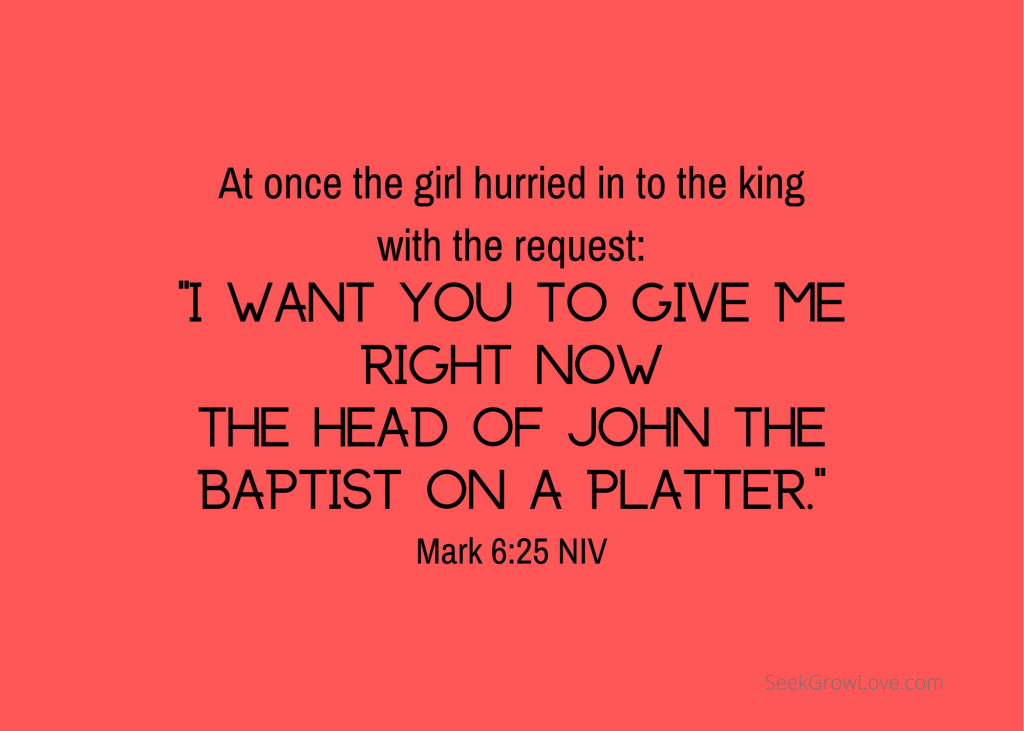
Each day’s new reading through the gospels brings more “favorites” from the life and teachings of Jesus. So it is with today’s – too many great stories to choose what to write about. Since we will be reading John’s account of the feeding of the 5,000 and Walking on the Water tomorrow, we will focus today on Herod, his wife (and former sister-in-law) Herodias, her dancing daughter and the head of John the Baptist.
It is a difficult story to stomach. So much evil. Perhaps we have gotten used to questionable leaders and too much violence, and the familiarity of this short passage on Herod and John the Baptist can make it quick to read and pass over. But imagine knowing these people, living amongst them, and hearing of these events for the first time. Imagine sitting down to your morning cup of coffee, opening the newspaper and reading of the events that transpired just last night.
Of course you would have known King Herod was having his birthday party last night – everyone could hear the sounds from his palace. And, yes, the newspaper calls him King Herod, since that is what he loves to be called, even though everyone knows his dad had been the last King Herod (yes, the one responsible for killing all the baby boys of Bethlehem about 30 years ago). In reality, now Herod Antipas was just a “tetrach”, ruling over just one quarter of his father’s territory, all the while being watched over by the real Roman authorities.
Herod had divorced his wife in order to marry his half-brother’s wife, Herodias. The only trouble was this prophet of God known as John the Baptist had been speaking out against this marriage, saying it was unlawful. Unlawful for who? Who’s law was it anyway? God’s? Herod wasn’t one to try to follow all those outdated laws – it was so much easier to just make new laws instead (similar to today’s society which is very good at ignoring God’s law and replacing it with their own).
His wife, Herodias, was not one to stand idly by while a prophet pointed out the sins of her family. Something had to be done. Herod (prompted by his wife) had John arrested, bound and put in prison. But, that wasn’t enough. While Matthew records that Herod wanted to kill John, Mark has a slightly different interpretation of Herod and perhaps digs a little deeper into his motives, relationships and thoughts. Mark says that it was Herodias who, “nursed a grudge against John and wanted to kill him. But she was not able to, because Herod feared John and protected him, knowing him to be a righteous and holy man. When Herod heard John, he was greatly puzzled; yet he liked to listen to him.” (Mark 6:19-20) which I am sure made his wife even more livid.
So, we come to the night of Herod’s birthday party and the entertainment for the evening – Herod’s dancing step-daughter (unnamed in the gospels, but Jewish historian Josephus records her name to be Salome). We aren’t told the details (thankfully), but we can guess that this was not a 5 year old girl performing her latest ballet or tap recital pieces for her father’s dinner guests. Whatever the dance included, it seems likely she was being exploited by her mother and ogled (or worse) by her step-father and all his male guests. These men liked her dance so much Herod thought it fitting to offer this dancing wonder anything she wanted (up to half his kingdom).
That’s a lot for a girl to think on – so she goes running out to get her mother’s advice. Herodias is prepared for this moment and she has no trouble involving her “innocent” daughter in getting what she has been waiting for – the death of John the Baptist, in the most gruesome way she could imagine – his head on a platter for her daughter.
Herod is in conflicted agony but sees no way out. The execution is ordered and completed. The head is delivered.
Can you imagine the varying emotions of each and every participant and those who will hear of these events.
What are John’s last thoughts?
Does Salome have nightmares? What does she become?
What do Jesus – and his 12 Disciples feel? If this is what comes of the one who prepares the way of the Messiah, what is the future of the Messiah – of his followers?
Herod will be mentioned just once more in the gospels – when Jesus is arrested, bound and brought before Herod on trial. Jesus remains silent – but quite likely he is remembering Herod and John as well as looking into his future.
Some days it just looks like evil triumphs.
But God is still at work. This is not where the story ends.
Herod will go to war and suffer defeat at the hands of the angry father of his first wife, whom he had divorced to marry Herodias. Later, Herod and Herodias will be sent into exile, where it is recorded Herod dies.
But, that’s not really the end, either.
A resurrection day is coming. A day when John the Baptist will rise from the dead. Can you imagine the reunion he will have with Jesus? I want to see that!
And, a judgment day is coming. Herod and Herodias will appear before the judge. At that time there is only one law that will matter – God’s. And, only one way to salvation – to accept the Lord Jesus Christ.
Some days it looks like evil triumphs – but that’s not how it ends!
Do you know who I would love to see debate in a globally televised event? Jesus and the Pharisees. Sure, Jesus could take on the whole crew of them. For people who had so much in common, they sure were polar opposites.
What did Jesus and the Pharisees have in common? They were from the same family. They could trace their ancestry back to Abraham. They were Jews born at the same time in history. Both Jesus and the Pharisees knew well and deeply appreciated the Old Testament scriptures. They both knew the importance of the coming Messiah the Jews anticipated. They both spoke of how to please God and urged people to follow the way they laid out in order to be saved in the life to come. They had so much in common. Imagine what they could have done together for God’s work – if only the Pharisees hadn’t been so pharisaical.
The Pharisees loved the law of Moses so much (as well as the additions they added to the Law to make themselves look even more saintly) that they were blinded to the true Messiah in front of them. In the end they were much more interested in making themselves look good (and pointing out others’ shortcomings) than in doing what God actually desired – and that is a dangerous place to be.
In today’s reading we come across a few topics that would surely come up in our much anticipated debate between the Pharisees and Jesus.
The Pharisees felt threatened by Jesus’ growing popularity and his displays of God’s power. But, rather than accepting him for who he was showing himself to be – they preferred creating lies and rumors for something they didn’t fully understand. So, when the crowd was amazed at Jesus’ healing of a demon possessed man, the Pharisees tried to explain it away by saying Jesus must be working with Beelzebub, the prince of demons (Matthew 12:24 & Luke 11:15). I don’t think I would take that very well, but Jesus calmly rebuttals that if indeed Satan were working at driving out Satan, his house wouldn’t be standing for long. He goes on to say that from evil you can expect evil, but from good you can expect good – for what is stored up in a man overflows for all to see and hear. And, he reminds them that there is a day coming when all will be judged for “every careless word they have spoken.” (Matthew 12:36)
But, they fail to realize the wisdom and truth and warnings Jesus spoke. So, the debate topics continue. They notice Jesus didn’t wash his hands before he ate (this definitely sounds like a debate topic that could be used today against a political opponent – times never change). Jesus counters with a truth stinger – the Pharisees spend so much time making sure they look good on the outside, but they neglect the more important work of cleaning up their own greed and wickedness on the inside. They are so busy harping on the itty-bitty showing-off, do-good outside acts (like tithing on the produce from their herb garden) and expecting praise for their goodness – but they completely overlook the weighty matters of justice and God’s love. In trying to make themselves look holy, they have neglected to care for others. And Jesus was telling them that is a dangerous place to be. Judgment will also be coming for today’s Pharisees.
Thankfully, there is another option. Jesus laid it out. Be his family – accept who Jesus is – do the will and work of his Father in heaven – not your own selfish agenda, or what will make you look good in the eyes of today’s twisted Pharisees who try to tell us how to be godly but have totally missed the boat themselves. Draw closer to Jesus than you ever have been before so you can tell the difference between the truth that he offers and the lies of the Pharisees. Your life depends on it – as well as the lives of those who are watching you.
There will be a time coming when the whole world will see and know who is the clear winner of this debate.
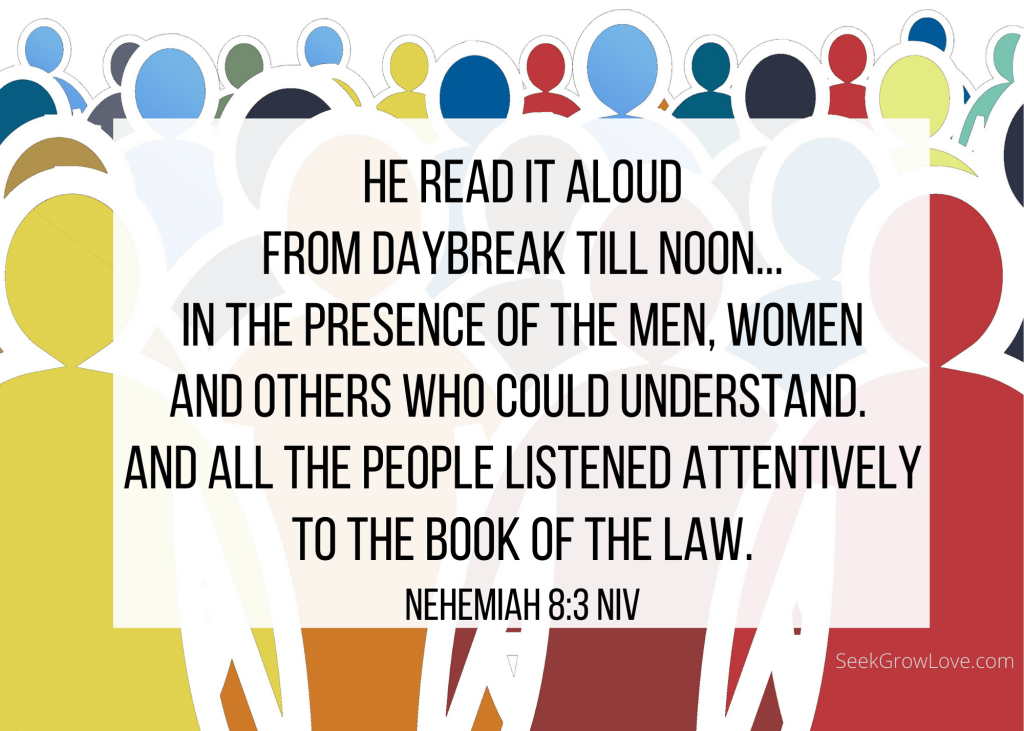
Now that the wall of Jerusalem was completed the people gathered together at the Water Gate to have Ezra read from the Book of the Law of Moses on the first day of the seventh month (which was actually last weekend on the Jewish calendar and the Feast of Trumpets. It’s not really the Jewish New Year, that was adapted from a later time in exile. The first month of the Jewish year is Passover). It states NINE times that “all the people” are included in the events happening in chapter 8. The priests even helped the people to understand the readings, (8:8) and the people responded with WEEPING (8:9). Nehemiah encouraged them to go and “eat fat and drink sweet” for this day is holy to the Lord. They weren’t to be sad, for “the joy of the LORD is your strength.” (8:10) They knew the words were declared to them.
The second day they gathered again to hear the Law and learned that in the seventh month they were to dwell in booths for a week. They were to go to the mountains and gather olive branches, myrtle, palm, and leafy branches to make a booth. The other day on my fast walk in the neighborhood I plucked various leafy bushes to add to the pop-up booth card I’m making to send to our grandson next week. 😊 I’m going to also include some fruit snacks he can enjoy by his “booth” as a celebration of the end of the harvest season. In Israel today, where we lived for many years, they still make and “dwell” in booths during this weeklong holiday. They’re on rooftops, balconies, and yards. They’re decorated with paper chains, lights, and pictures. Our kids liked to sleep in them some nights with their friends. The people in Nehemiah’s time hadn’t celebrated the Feast of Booths/Tabernacles since the time of Joshua, so it was a time of “great gladness” (8:17), and still is to this day. Although, this year might be different as they’re on a full lockdown in Israel during these holiday times because of Covid.
They continued to read the Book of the Law for a ¼ of the day and for another ¼ of the day they confessed their sins and worshipped the LORD their God. (9:3) Some of the Levites stood up and recalled God’s work through Moses, Egypt, Wilderness, and how He brought them into a good land. However, they “cast His Law behind their backs and killed prophets sent to them.” (9:26) So God “gave them saviors” when they cried out for help and many times delivered them. (9:27) “For many years You had patience with them and testified against them by Your Spirit in Your prophets, yet they would not listen.” (9:30)
“Now therefore, our God, the great, the mighty, and awesome God, who keeps covenants and mercy… (9:32) You are just in all that has befallen us.” (9:33) How patient God was and is with His people. It says not the kings, princes, priests, or fathers have kept God’s Law.( 9:34) How important it was for all the people to gather together and recall God’s work over time and their own lack of commitment, and thus to refocus their love and service for the LORD their God for the future. Now that the wall of Jerusalem had been rebuilt, they needed God’s protection over them. Instead of blaming God for failures, it’s good they acknowledged they were wrong and refocus on Him as they move forward. We too, can learn from their example in our lives today.
Stephanie Schlegel
Today’s Bible passage can be read or listened to at BibleGateway here – Nehemiah 8-10
Tomorrow we will finish the book of Nehemiah and read Psalm 126 as we continue seeing God’s faithfulness in our
I love the man Nehemiah! I love his passion, his prayers and his “get ‘er done” action. At the start of our story he holds the position of royal cupbearer to King Artaxerxes, so we can assume he is no slacker but is quite driven, reliable and trustworthy. He has spent his whole life in Babylon/Persia, and done very well in this “foreign” environment. But kudos to those who raised and influenced him, for his Jewish heart was still steadfast in serving the God of Abraham, Isaac and Jacob and his ancestors.
It had been 90 years since the first group of Jewish exiles had returned to Jerusalem. And just 13 years ago Artaxerxes had allowed Ezra to return to rebuild the temple. Nehemiah learns some have just come from Judah and he asks them how his “homeland” is doing. And what he hears breaks his heart. It is natural to be heartbroken at bad news. But for a lot of people the heartbreak is soon replaced with other feelings – perhaps relief that it didn’t happen to you, perhaps just busy-ness with other daily activities. But Nehemiah mourned, fasted and prayed (with confession) for several days when he heard that the people of Judah were still in distress and the walls of Jerusalem were still torn down. Just as this was breaking God’s heart, Nehemiah allowed his heart to be broken, too. And as he prays and fasts he listens for God’s answer, and just like Esther he too uses the position God has placed him in to be a part of the solution. If you find yourself mourning what God mourns, and you don’t know what to do…follow Nehemiah’s example with prayer and fasting and watch for God’s plan to develop – and then do it!
I won’t retell the rest of the story that Nehemiah tells so well – but make sure you catch some of the neat details that we would do well to remember when we seek to do God’s work.
Nehemiah was scared to death going before the king – this was not an easy thing to do, and it could even cost him his life – but doing God’s work is always worth it.
Even as the king was asking Nehemiah what he wanted, Nehemiah was praying away! He knew he wasn’t doing this on his own – and he would continue to give God the credit for the king’s generosity and for the work that would be done.
Nehemiah didn’t try to build the wall on his own. There was something for everyone to do – and Nehemiah got them going. The city officials, the temple servants, the families, the daughters, even the goldsmiths and the perfumers were out there working. Certainly most of them would never have said their spiritual gift was rebuilding walls – but Nehemiah provided the leadership, the need was presented to them and, most of them, were ready to roll up their sleeves and get to work. What job is God calling you to do with your brothers and sisters?
I would have loved to see Baruch the son of Zabbai complete his section of the wall – Nehemiah reports he “zealously” did his work. This wasn’t a half-hearted effort for him. Will you be known as one who zealously does the work of the Lord?
The world didn’t stop to applaud God’s construction team – in fact, God’s people faced much opposition, ridicule, anger, threats and violence from many sides. It would have been easy to give in to their fears and give up. But instead, they responded FIRST with prayer and then they kept at it – with one hand to do the work and one hand to carry the weapon to defend themselves if needed. They meant business. They looked after one another and once again commited themselves to finishing the job God gave them.
Nehemiah also stood up for those who had been taken advantage of and he corrected those who had performed acts of injustice for their own selfish gain.
The world could sure use more leaders like Nehemiah. How will you step up? There is much broken in our world today. What is breaking your heart and God’s? Begin with prayer and fasting. And then continue with prayer as you attack God’s work with wisdom and action even in the face of opposition. His work is always worth it.
-Marcia Railton
Today’s Bible passage can be read or listened to at BibleGateway here – Nehemiah 1-5
Tomorrow we will read the next two chapters in Nehemiah’s story as we continue on our journey through the
Ezekiel 18 describes three generations of men in a family, the first generation is righteous and follows God, the second generation is evil and does everything that God detests, and the third generation is Godly just like the grandpa. According to the thinking of the Jews of that time each person inherits God’s blessings from their parents, so the evil man would be blessed by God and live a happy and fruitful life because of the righteousness of his father, while the son of the evil man will have a miserable and cursed life because of the evil of his father. God is going to make it very clear to them that their thinking is fundamentally faulty, because obviously a person who goes around robbing the poor, sleeping with his friends’ wives, and worshiping false gods is going to have a miserable life. He won’t have friends, and will never be trusted, no matter how great his father was. How is that a blessed life?
The opposite is also true, if the evil man has a son and that man lives a Godly life and helps the poor, and gives money to the needy, and keeps all of God’s laws he will have a full and blessed life. People might remember how horrible his father is, but his own actions will speak for themselves, and God will also see his actions and bless him.
This is summed up perfectly in Ezekiel 18:30-32.
“30 “Therefore, you Israelites, I will judge each of you according to your own ways, declares the Sovereign Lord. Repent! Turn away from all your offenses; then sin will not be your downfall. 31 Rid yourselves of all the offenses you have committed, and get a new heart and a new spirit. Why will you die, people of Israel? 32 For I take no pleasure in the death of anyone, declares the Sovereign Lord. Repent and live!”
This verse is a great blessing, but also a warning. It is a blessing if you or your family has a past that is full of sin and brokenness and you want to break the cycle, repent and live! It doesn’t matter what your parents did, good or bad, God will judge you for your own actions. This makes it very important to make our faith our own, because even though my Mom had and Dad has faith that can move mountains, that does not make me a Christian by default, I still have to work hard at it and build my own faith up. Just like how knowledge will never transfer from your textbook to your brain when you use the textbook as a pillow, righteousness will not transfer from your parents to you when you sit next to them at church, you have to open the book and read for yourself.
Chris and Katie-Beth Mattison
Today’s Bible reading passage can be read or listened to at BibleGateway, here – Ezekiel 18-19
According to chapter 1, God called Ezekiel on July 31, 593 BC (using our calendar). Jerusalem didn’t fall to Nebuchadnezzar until 586 BC. This means that the first 7 years of Ezekiel’s prophesying in Babylon overlapped the last 7 years of Jeremiah’s prophesying in Jerusalem.
In addition to foretelling Jerusalem’s destruction for her sin, Ezekiel adds another recurring theme – “then they will know that I am the Lord.” This phrase occurs 70 times in the book of Ezekiel, so it must be important. Ezekiel 6: 9b-10 is an example, “They will loathe themselves for the evil they have done and for all their detestable practices. And they will know that I am the Lord; I did not threaten in vain to bring this calamity on them.”
7:3-4 says, “The end is now upon you and I will unleash my anger against you. I will judge you according to your conduct and repay you for all your detestable practices. I will not look on you with pity or spare you; I will surely repay you for your conduct and the detestable practices among you. Then you will know that I am the Lord.”
And God pointed out through Ezekiel that He wouldn’t listen to their prayers, because of their sin. We see an example of this in 8:18, “Therefore I will deal with them in anger; I will not look on them with pity or spare them. Although they shout in my ears, I will not listen to them.”
As we read this, we may think, “They were sure idiots for not turning back to God.” But I wonder what truths might apply to us today?
Some of their sins were: idolatry, greed, arrogance, and lack of mercy – and these infuriated God. If we were compared with the ancient Israelites, how would we as a nation measure up? How would I as an individual measure up?
You may want to ask yourself a few questions:
Is God more important to me than anything and everything else? (If the answer is no, that sounds like idolatry). And to make sure we understand what it means to put God first, is He obvious in every area of life – including areas as diverse as finances, conversation, entertainment, and charity?
Am I merciful? If you answer yes, how are you demonstrating that? For example, how are you helping resolve the racial tensions that seem to be tearing our nation apart right now? How are you helping those less fortunate than yourself?
Am I greedy? If the answer is no, where and how are you giving your time and money to God’s work – and to others?
If I’m honest, I see that I may not be much more righteous than the ancient Israelites. And we as a nation don’t measure up well at all.
Romans 15:4 reminds us, “For everything that was written in the past was written to teach us, so that through the endurance taught in the Scriptures and the encouragement they provide we might have hope.”
If these things were written to teach us, will we learn? What will it take for us to know that God is the Lord? Will we humble ourselves, confess our sins, repent, and turn to God wholeheartedly?
2 Corinthians 6:2 reminds us, “I tell you, now is the time of God’s favor, now is the day of salvation.”
Hebrews 3:15 says, “Today, if you hear his voice, do not harden your hearts as you did in the rebellion.”
What will you do?
Steve Mattison
Today’s Bible reading passage can be read or listened to here Ezekiel 5-8
The second half of the book of Lamentations is even more depressing than the first half. Jeremiah was overwhelmed with grief because he had seen horrible things. Here are two vivid examples. Lamentations 4:4 says, “Because of thirst the infant’s tongue sticks to the roof of its mouth; the children beg for bread, but no one gives it to them.” And Lamentations 4:10 says, “With their own hands compassionate women have cooked their own children, who became their food when my people were destroyed.”
These are disturbing images. But Jeremiah reminds us why these troubles came on “God’s people”. Lamentations 3:39-40 says, “Why should any living man complain when punished for his sins? Let us examine our ways and test them, and let us return to the Lord.”
I’ve heard a quote that goes something like this, “You should learn from other’s mistakes, because you can’t live long enough to make them all yourself.” In this case, we should learn from Judah’s mistakes so we can live long enough to make other mistakes.
The Bible tells us repeatedly that we have a choice. We can follow God and receive a blessing, or fight against God and receive a curse. I love the way Moses put it in Deuteronomy 30:15-16, “See, I set before you today life and prosperity, death and destruction. For I command you today to love the Lord your God, to walk in obedience to him, and to keep his commands, decrees and laws; then you will live and increase, and the Lord your God will bless you in the land you are entering to possess.”
When we read passages like those in Lamentations, we need to think about why they were included in scripture, and how they may apply to us today. I think one reason these are there is to serve as a warning to those who follow – and in our case, for us.
God isn’t a vengeful God, just waiting for people to step out of line so he can slap them; He’s a loving God who wants a relationship with each of us. But God can’t leave the guilty unpunished.
Ezekiel 33:11 says, “Say to them, ‘As surely as I live, declares the Sovereign Lord, I take no pleasure in the death of the wicked, but rather that they turn from their ways and live. Turn! Turn from your evil ways! Why will you die, people of Israel?’”
God warned his people, Israel, repeatedly to return to Him, but they ignored Him and paid the price. He warns us today through His word – the Bible. How will you respond?
Today we remember that God is not just the God of the Jews – but the God of the world – all the nations. And as God has watched the sins of these nations – so will He exact discipline on these nations. Jeremiah writes what God tells him to write regarding the coming destruction that God will oversee and orchestrate against Israel’s neighbors.
Jeremiah uses vivid imagery to describe these events:
“The sword will devour till it is satisfied, till it has quenched its thirst with blood.” (Jeremiah 46:10 NIV)
“Moab is disgraced for she is shattered.” (Jeremiah 48:20 NIV)
His descriptions show not only how scary and total the destruction will be – but also what a sad state of affairs these societies had become. The most powerful passage that got my attention was in the message against the Philistines, “Terrified fathers run madly, without a backward glance at their helpless children.” (Jeremiah 47:3b NLT). Where have the strong, brave protectors and defenders of their families gone?
We would do well to pay special attention to the passages that point to the reasons for this judgment. All of these neighbors are being punished for their mistreatment of God’s chosen people, as well as for their own sins. “Since you trust in your deeds and riches, you too will be taken captive…We have heard of Moab’s pride – her overweening pride and conceit, her pride and arrogance and the haughtiness of her heart…In Moab I will put an end to those who make offerings on the high places and burn incense to their gods…Moab will be destroyed as a nation because she defied the LORD” (Jeremiah 48:7, 29, 35, 42 NIV). How many similarities do you have to Moab – just one of the countries that would feel the burn of God’s discipline? How do you treat God and His people? Is your pride in check? Where do you put your trust – in your job, your finances, your teachers, your doctors, yourself – or in God? Do you offer your best and first time, talents and resources to God or to selfish pursuits and false gods?
After 46 verses of judgment against Moab, the final verse of chapter 48 says, “Yet, I will restore the fortunes of Moab in days to come.” Hope and restoration is coming – at least for those judged worthy. Amongst the condemnation of these chapters, Jeremiah includes a beautiful word from God for Israel as well,
“But do not be afraid, Jacob, my servant; do not be dismayed, Israel. For I will bring you home again from distant lands, and your children will return from their exile. Israel[f] will return to a life of peace and quiet, and no one will terrorize them. 28 Do not be afraid, Jacob, my servant, for I am with you,” says the Lord. “I will completely destroy the nations to which I have exiled you, but I will not completely destroy you. I will discipline you, but with justice; I cannot let you go unpunished.” (Jeremiah 46: 27-28 NLT)
God sees and will not let the guilty go unpunished. But His deepest desire is to find and reward faithfulness in His children so He can live with them in peace. God still judges in His love today – as a wise and caring parent. There will yet be a time of unequaled punishment for those who appeared to get away with evil with a proud heart, relying on themselves and turning their backs on God. This is discipline with justice. And, then, there will be restoration and peace. Come Lord Jesus Come – may He find us faithful.
Marcia Railton
Today’s Bible reading can be read or listened to at Jeremiah 46-48.