2 Corinthians 4 teaches us that we have the ability to endure hardship. We are able to endure hardships because we have God’s help. As Christians we have to remember that since God has the ability to raise the dead, he also has the ability to give us the strength to handle hard situations or remove us from those situations altogether. 2 Corinthians 4:7 states:
“But we have this treasure in jars of clay to show that this all-surpassing power is from God and not from us.”
Paul refers to the power that can save us as “treasure in jars of clay”. This treasure cannot be found from worldly things. There is no amount of podcasts or self-help books that will save you the way only God’s power can save us. Paul goes on to remind us that even when we feel the pressure of our problems, we are not broken.
“We are hard pressed on every side, but not crushed; perplexed, but not in despair; persecuted, but not abandoned; struck down, but not destroyed.” (2 Corinthians 4:8-9).
2 Corinthians 4 leaves us with an important reminder. The problems we have to deal with now are only temporary and it is an opportunity for God to work within us. If we remain faithful, we will one day live eternally without worldly troubles.
“For our light and momentary troubles are achieving for us an eternal glory that far outweighs them all. So we fix our eyes not on what is seen, but on what is unseen, since what is seen is temporary, but what is unseen is eternal” (2 Corinthians 4:17-18)
-Brooke Cisneros
Reflection Questions
What have you done that could only be done with God’s power? Are you using God’s power to the fullest?
When have you felt “hard pressed…but not crushed; perplexed, but not in despair; persecuted, but not abandoned; struck down, but not destroyed”? What makes the difference and gives you hope even in difficult situations?
What temporary or “light and momentary” troubles has God already seen you through?
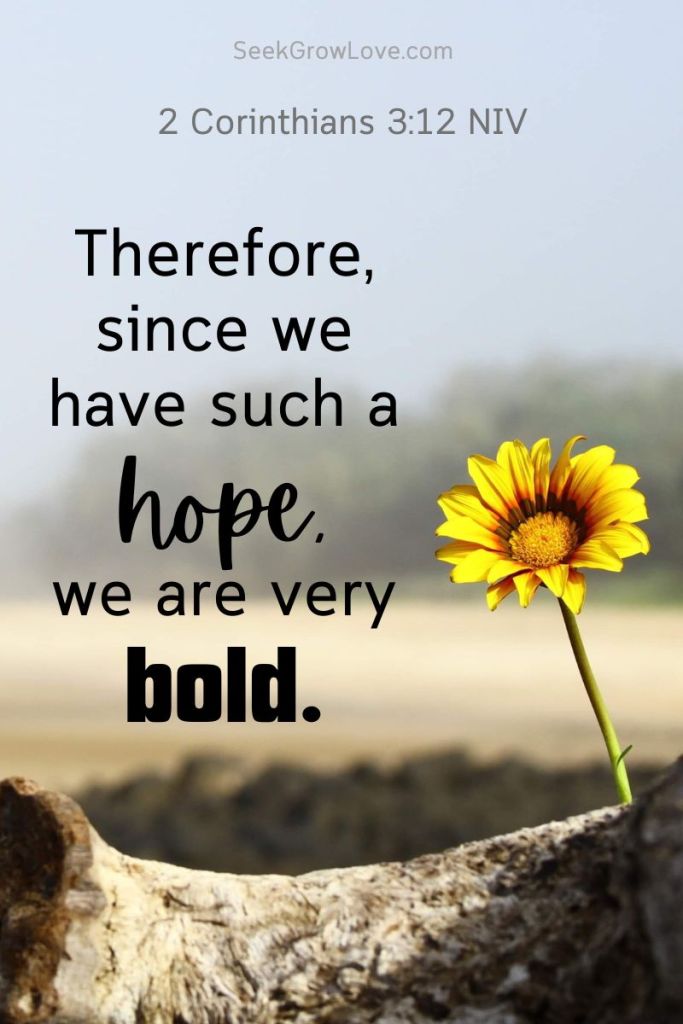
A major theme in 2 Corinthians 3 is boldness. 2 Corinthians 3:12 states:
“Therefore, since we have such a hope, we are very bold.”
In this verse we also see the word hope. Hope is different in the Bible than it is in the English language. Hope as an English word often conveys doubt, but almost always in the New Testament the word hope is the Greek elpis/elpizo. There is no doubt attached to this word. This means that when we see the word hope in the Bible, we know it means confidence and security.
So, if there is no doubt in this type of hope, let me ask you a question. What would change in your demeanor if you knew… I mean really knew that the hope you have is assured? If you already knew you won the game or aced the test, you would be bold and confident in what you are trying to do. Biblical hope is a reality, not just a feeling. It’s a sure foundation that we can build our lives on.
Kirk Cameron once asked the question, if you had the cure for cancer would you keep it to yourself, or would you share it? If you knew you could save someone’s life you would be more bold. As Christians we have the opportunity to save people by being bold with our faith. We are called to give an answer to anyone that would ask.
“But in your hearts revere Christ as Lord. Always be prepared to give an answer to everyone who asks you to give the reason for the hope that you have. But do this with gentleness and respect” (1 Peter 3:15).
When was the last time you were bold enough to share your faith?
-Brooke Cisneros
Reflection Questions
What would change in your demeanor if you knew… I mean really knew that the hope you have is assured? How would you explain your hope – and how it is different from a hope with doubt?
When was the last time you were bold enough to share your faith?
How can you boldly share your faith today? Will you?
In 2 Corinthians 2 Paul teaches us how we should forgive as Christians. Paul expresses the idea that the people who grieved him should not be met with revenge, but instead with reconciliation.
“Now instead, you ought to forgive and comfort him, so that he will not be overwhelmed by excessive sorrow. I urge you, therefore, to reaffirm your love for him.”
Unfortunately, some Christians today have a false definition of forgiveness. We have all heard the saying “I can forgive, but I can’t forget”. When you forgive someone, you don’t keep track of their wrongdoings. This is a way we show love as Christians. 1 Corinthians 13:4-5 states:
“Love is patient, love is kind. It does not envy, it does not boast, it is not proud. It does not dishonor others, it is not self-seeking, it is not easily angered, it keeps no record of wrongs”
Why is Paul so willing to practice forgiveness? It’s because he has been forgiven by God through Jesus. When we feel it’s “too hard” to forgive someone we have to remember how often we are forgiven ourselves.
Forgiveness needs to become part of our new nature. As image bearers of God, we need to become forgiving like God is. We need to recognize that forgiveness is part of God’s nature (Exodus 34:6-7), just as many people in the Bible recognized that God’s nature was forgiving (Numbers 14:17-19). If God is forgiveness we need to be forgiving. Forgiveness was the mission of Jesus Christ, let that be our mission as well.
-Brooke Cisneros
Reflection Questions
When have you forgiven someone else? How did that make you feel?
What is the problem with unforgiveness? What is the connection between unforgiveness and being “outwitted by Satan”? (see verse 11)
Explain how God has forgiven. Have you accepted His forgiveness through accepting His Son? If so, how can you pass forgiveness on to others? If not, why not?
One major theme in Psalms 62 is slander. According to Merriam-Webster slander is “the utterance of false charges or misrepresentations which defame and damage another’s reputation.” In this Psalm, David is being slandered by his enemies. He shares in Psalms 62:3-4 about the way he is being slandered:
“How long will you assault me?
Would all of you throw me down—
this leaning wall, this tottering fence?
Surely they intend to topple me
from my lofty place;
they take delight in lies.
With their mouths they bless,
but in their hearts they curse.”
Have you ever been the victim of slander, or even slandered someone else? Slander is a form of gossip. In my personal opinion, slander is one of the biggest issues we have in the church today. Slander is gossip personified—it’s deliberately telling information with the intent of harming someone else. Slander is not only an Old Testament issue, it’s talked about throughout the Bible. In Romans 1:28-32, Paul lists the traits of someone who is not close to God and slander is included within the list.
“They have become filled with every kind of wickedness, evil, greed and depravity. They are full of envy, murder, strife, deceit, and malice. They are gossips, slanderers, God-haters, insolent, arrogant and boastful; they invent ways of doing evil; they disobey their parents;” (Romans 1:29-30)
We need to find ways to move away from these things. Colossians 3:7-8 states:
“You used to walk in these ways, in the life you once lived.But now you must also rid yourselves of all such things as these: anger, rage, malice, slander, and filthy language from your lips.”
The only way we can move away from slander is with a new heart. Psalms 62 is a poem of instruction on trust. We need to trust that God will deal with our enemies, so we don’t need to take revenge. The Psalm tells us that we should trust in God, but if we trust in men or our negative emotions, we are depending on that which is lighter than breath. We must remember what is said in Psalms 62:12:
“You reward everyone according to what they have done.”
If we are slandering, God will not reward us but judge us.
-Brooke Cisneros
Reflection Questions
How much do you value and appreciate the truth from others? Do you hold yourself to the same standard when it comes to gossip, lies and slander?
How does trusting in God relate to your feelings and expectations, words and actions toward anyone you might consider your enemy?
Have you ever been in a situation where you have come to God in desperation, feeling depressed, angry, or scared? In Psalm 61 David is crying out to God in a time of need. Many people believe David wrote this about when his son temporarily pushed him from the throne. Sometimes we view asking God for help as weakness but it is evident in the Bible that it’s not. Throughout the Bible we see people crying out to God. Jesus cried out to God and we read in Hebrews 5:7,
“During the days of Jesus’ life on earth, he offered up prayers and petitions with fervent cries and tears to the one who could save him from death, and he was heard because of his reverent submission.”
There are three main takeaways from Psalms 61:
1. We need to cry out to God when we are hurting, which is expressed in the first two verses which reads
“Hear my cry, O God;
listen to my prayer.
From the ends of the earth I call to you, I call as my heart grows faint; lead me to the rock that is higher than I.”
2. We need to have confidence and faith that God will answer our cries, which is expressed in verses 5-7 which reads
“For you, God, have heard my vows;
you have given me the heritage of those who fear your name.
Increase the days of the king’s life, his years for many generations.
May he be enthroned in God’s presence forever; appoint your love and faithfulness to protect him.”
3. We need to have a commitment and loyalty to God which is expressed in verse 8 which reads
“Then I will ever sing in praise of your name
and fulfill my vows day after day.”
-Brooke Cisneros
Reflection Questions
When have you cried out to God when you were feeling scared, angry, depressed or in desperation?
What does it mean to you that God is the Rock higher than you? How do you approach Him in prayer?
Do you have confidence in Him? Are you committed to Him?
1 Corinthians 15 is a chapter all about resurrection. In 1 Corinthians 15 there were people within the church who don’t believe in the resurrection and feel like it’s not an important belief of being a Christian.
Unfortunately, this is still a belief held by some people today. There are people in the world that teach that the death and resurrection of Christ never really happened, instead it’s just a made up story. Some people even try to water down the gospel and come up with scenarios that are more “plausible” than Jesus dying and being resurrected. This is an incredibly dangerous thought process as the validity of the resurrection gives us purpose as Christians.
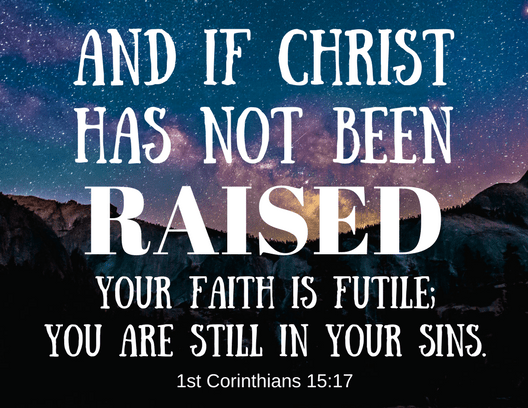
In 1 Corinthians 15:3-8, Paul reminds those that don’t believe in the resurrection that there is evidence it happened. There were hundreds of eyewitnesses that saw Jesus alive after being publicly executed by the Romans. Paul then goes on to explain that without the resurrection we are all lost. In 1 Corinthians 15:17-18 Paul says
“And if Christ has not been raised, your faith is futile; you are still in your sins.Then those also who have fallen asleep in Christ are lost.”
Paul is essentially saying that without the resurrection our faith is pointless. We are unable to be saved and our loved ones are unable to be raised from the dead. Paul then goes on to remind us that the resurrection is real! The resurrection of Jesus reminds us of what’s really important in our lives, to glorify God during our lives on Earth.
-Brooke Cisneros
Reflection Questions
Why does it matter if you believe in the resurrection of Jesus Christ or not?
Do you believe in the resurrection of Jesus Christ?
How can you put into action verses 57 & 58, Paul’s concluding words on the resurrection and the difference it should make in our lives?
In this devotion I want to delve into a chapter in Psalms. What we see is David sharing a dark time in his life, one of the things that makes it difficult is people turning on him. One of the hardest things in life is having people you trust betray you. Jesus dealt with this same thing when Judas betrayed him.
Have you ever had to deal with a betrayal? What did you do in that instance? Many people unfortunately want to take revenge. Others spin into a depression, but David gives us strong advice on how to handle adversity. He tells us to allow God to protect us and keep us strong. He likens God to a strong tower that we can take refuge in. In Psalm 59 David is in his house surrounded by Saul’s soldiers who were sent to kill him.
The Psalm is both a prayer and a praise for God’s saving help. Psalms 59 is an important chapter because it reminds us of God’s unfailing love. David was hunted by people whose love had turned into jealousy which drove them to try to kill him. David had trusted friends and the king who he considered a mentor who all turned against him.
As humans, relationships are so important and necessary. We all hope and strive for dependable, long-lasting relationships but that’s not always the case. We all have dealt with broken relationships. Maybe it was the loss of a friendship, a break up, a church split, or family estrangement. At some point everyone deals with finding out that someone was not a trustworthy, dependable person like you thought. This is the hard side of human relationships. Humans are far from perfect, people will disappoint you and you will disappoint others. Regardless of the state of your relationships in this world, God’s relationship to you is unchanging and unfailing.
-Brooke Cisneros
Reflection Questions
Have you ever felt betrayed? What was your response?
When have you turned to God for strength when human relationships disappointed you? What did you find in Him?
What do you appreciate about God’s unchanging and unfailing character? How will you praise Him for this?
When we began this week on Sunday we read about Spiritual gifts in chapter 12. We saw that there is no “I” in “team” and that everyone in the church has gifts and needs to be using their gifts to help the church grow and carry out its mission.
There is one key transitional sentence at the end of chapter 12 leading into chapter 13: “And I will show you a still more excellent way.” The more excellent way is the way of love. From Monday to Friday, we have looked at love, not as an abstract idea but as a concrete set of actions. Love is made up of behaviors that are patterned after God. When we love we show people who God is and what God does.
Today, we look at how Paul closes out this “Love chapter” in verses 8-13:
Love never ends. As for prophecies, they will pass away; as for tongues, they will cease; as for knowledge, it will pass away. For we know in part and we prophesy in part, but when the perfect comes, the partial will pass away. When I was a child, I spoke like a child, I thought like a child, I reasoned like a child. When I became a man, I gave up childish ways. For now we see in a mirror dimly, but then face to face. Now I know in part; then I shall know fully, even as I have been fully known.
So now faith, hope, and love abide, these three; but the greatest of these is love.
Here as Paul brings this section to completion he brings home the point. It’s important to be gifted, to use your gifts and talents to serve in the Church and to serve God in the world, but as important as those gifts are, they are not the ultimate or final good, they are penultimate or next to last good. To speak a prophetic word to exhort a congregation is important, to exercise the gift of speaking to the world in ways that are understood by people of different languages is valuable, and knowledge is a necessary good to a flourishing life and church, but all of these are penultimate good, not ultimate. They will give way to the eternal, but love will outlast everything. At the end of all things love for God is love.
I’m getting older and I have some serious health challenges which remind me that I am a mortal person. Unless Jesus Christ returns very soon I will one day join those who have gone to “sleep in the dust of the earth” (Daniel 12:2) awaiting the resurrection. As I get closer to my personal end, I am more aware of that which is truly most important in life. It’s not my accomplishments, it’s not how much money I’ve earned, at the end of the day what matters most is “Did I love?” Jesus summed up the entire teaching of God with 2 things: “Love God and Love others”. Paul is adding more depth and clarity to what love looks like and what we all should aspire to be. Every morning we should ask, “God, how can I love well today?” And at the end of the day ask “God, how well did I love today?”
Reflection Questions
When you hear the words “Love never ends” what comes to your mind?
Why do you think Paul says that being loving is even more important than being gifted?
When will you start to begin your days asking “God, how can I love well today?” And at the end of the day ask “God, how well did I love today?”
Love bears all things, believes all things, hopes all things, endures all things.
Through this week of reading through 1 Corinthians 13 Paul is giving us concrete examples of what It means to love. He’s building this message into a kind of crescendo. Like a great symphony or chorale masterwork, the various themes of the story build on themselves. Here he is moving toward the peak of this love song with 4 things that love does: love bears, love believes, love hopes and love endures. That would be a lot. But he adds “all things.”
I could take time and give you a detailed exegesis of what each of these words means in the original Greek and how they are used in Corinthians and throughout Paul’s writings and the Bible as a way to arrive at their precise meanings, but I’m not going to do that. Instead, I’m going to tell you a story.
I grew up in a loving family. My father was a pastor and also a school teacher. My mom was a pastor’s wife and drove a school bus and took care of our family, keeping us fed every day precisely at 6 p.m., our clothes washed and our house neat. I felt loved and supported along with my 2 older sisters Cheryl and Debbie. I was the baby, younger than my two older siblings by 7 and 10 years. My parents were in their early 40’s, our family was settled and my oldest sister had already left the nest and gotten married. I was an active boy, a happy ‘tween who played baseball and basketball and hadn’t started noticing girls yet at eleven, but life was sweet. We went to Church every Sunday and learned about God and his love for us.
Then the world changed. My Mom found out that she was going to have another baby. Surprise! Jeff, you’re not going to be the youngest child anymore, you get to be a big brother. I couldn’t wait, after years of being the only boy, the little brother who had to listen to his older sisters who both loved me but could also be a bit bossy. Sometimes it felt like I had a Dad and 3 Moms telling me what to do. Now I would have a little brother to boss around and to show how to hit a baseball and shoot a free throw. I even had a name picked out for my little brother, Scott. I don’t know why I picked that name, but that was the name I picked for my little brother.
As it turned out, “Scott” was born a little girl, whom my parents named Christine Noelle (she was born right after Christmas so she got a very Christmasy-sounding name). Before I got to meet my little sister (I got over the fact that she was not my little brother Scott) my parents shared that she was a special child. She was born with some differences in her little body that made her look different from other babies that I had known and she would not be able to do all the things that other children did in the way that they did them. The name for my sister’s condition was called Down’s Syndrome. I didn’t fully understand what that meant, but I was glad when my parents got to bring her home and we all loved her very much.
For the next 50 years my Father and Mother, and after my father died my mother alone, provided love and care for Christine. She received cutting-edge health care. She had multiple surgeries to repair things that normally didn’t function well in children with Down’s Syndrome that would help extend her life. She started getting therapy and schooling and grew to be a happy and loving young woman.
I found out many years later, as an adult, that when she was born her doctor advised my parents to have her institutionalized. He said she would never live with a good quality of life and would be a burden to them. It would be best for them, for the family, and everyone else to let her be put away. I am so glad that my parents did not listen to the advice of their physician but to the love of God in their hearts.
My mother, who is now 90 has spent the last 50 years loving my sister Christine. Christine has spent the last 50 years loving my mom. My mom has spent 50 years bearing, believing, hoping, and enduring many trials and challenges while caring for my sister. She has been for me, a model of what Paul talks about when he describes what true love is all about.
At 90, my Mom has come to recognize her limits, she will not be around forever to care for Christine, but even now she is acting in love to help prepare my sister to live a good and flourishing life after my Mom is no longer here.
I could tell many other stories about love that I have seen and experienced in my life.
When we love in selfless ways we bear God’s image to the world.
Pastor Jeff Fletcher
Reflection Questions
Think of a person in your life who modeled a selfless love for others. What does their life teach you about God’s love?
Why does Paul connect bearing, believing, hoping and enduring all things with concrete examples of love?
What is something you can do today to show selfless love for another?
Usually, when we watch a movie we are introduced to a hero or heroic group to root for. We want the “good guy” to win and the “bad guy” to lose. We need to see Batman defeat the Joker or 007 to defeat the agents of SPECTRE.
Occasionally, though, the filmmaker sneaks one by us and we find ourselves rooting for the anti-hero. The show Breaking Bad did an outstanding job of getting us to root for Walter White who morphed from being an ordinary hard-working science teacher husband and dad to Heisenberg, the drug kingpin of the southwest who poisoned people with his methamphetamine creation.
I recently saw someone post on Reddit that he realized later in life that the movie Top Gun had us rooting for Maverick instead of Ice Man when clearly Ice Man was the far better pilot and person. “Iceman was the only pilot that: actually obeyed the rules, was a skilled flier, never killed anybody in the entire movie and correctly identified all of Maverick’s faults.” Yet we were all rooting for Maverick.
To that, I will simply add that I can’t imagine why anyone would ever root for the evil New York Yankees, Dallas Cowboys, or Alabama Crimson Tide. (I’ll stop before I make some more lifelong enemies).
The spirit of this age is constantly working to pull people away from finding joy in truth. The Bible contains an epic story about our hero, a loving God who creates a place where everything is good and populates it with people in his divine image to care for the earth, who are opposed by those he created. But God loves this creation so much that he will stop at nothing to find ways to rescue and restore that which is lost and broken and corrupt.
We are currently living amidst the ongoing battle against that which is true and right. People are daily undermining what is good and just and loving and claiming that that which is evil and corrupt is good, and that which is good and holy is evil.
For Paul, true love does not root for the villain or the anti-hero. True love does not rejoice that evil is victorious. True love finds its joy in the truth that is consistent with God and God’s love.
Jesus predicted that before the end of this age, there would be a decrease in love. In Matthew 24:12 Jesus says: “And because lawlessness will be increased, the love of many will grow cold.” When people reject what is true and right, when people reject the ways that God lays before us to keep a rightly ordered society, it will result in a loss of love. Lovelessness is the natural outgrowth of lawlessness.
Jesus said “I am the way, the truth and the life.” (John 14:6). If you want to have true life, you have to follow the path of Jesus, the path of truth. Paul says essentially, you can’t find love if you reject God’s truth. You can’t truly love God and love people if you don’t love God’s truth.
Today, ask yourself, “Are there things in my life that I know are the opposite of God’s truth?” If you answer “yes”, you must be willing to reorient your life to pursue God’s truth and rejoice in God’s truth to practice true love.
Pastor Jeff Fletcher
Reflection Questions
Why do you think increased lawlessness results in failure to love the truth?
Why is society becoming more enamored with anti-heroes who are opposed to truth?