There is so much uncertainty in life. So many things to handle. It can make your heart race. That’s why we need to find our refuge in God. In Psalm 17, David begins by asking God to hear his cries. He has also confirmed that what he is asking for is right. He says, “Hear, O LORD, my righteous plea; listen to my cry” (Psalm 17:1). This teaches us to move towards God’s presence and guidance in confidence. He is our ultimate protector and source of peace. How can we know that what we are asking for is right, and that He will listen? I think David answers these questions all through Psalm 17. Let’s take some time in the next couple days to see what David says to do to find refuge in God.
1.Have Faith that God Knows What He is Doing
David recognizes God’s justice, trusting that God will judge rightly. “Let my vindication come from Your presence; may Your eyes see what is right”-Psalm 17:2. This verse encourages us to trust in God’s righteous judgment instead of seeking revenge or justice on our own. God sees all and will act justly in His time.
2. Show Your Heart to God
Sometimes we hide from God. Nothing is secret from Him. David speaks of his commitment to living a life of integrity, saying, “You have tested my heart; You have visited me in the night”-Psalm 17:3. This is a call for us to pursue a blameless life, striving to align our actions with God’s will. When we do this, we are an open book to what God wants to do in our life.
3. Watch and Listen to What You Say
David highlights the importance of guarding our speech: “I have resolved that my mouth will not sin”-Psalm 17:3. This lesson is a reminder to be mindful of our words, ensuring they are edifying and truthful in all areas of our lives. Sometimes we are so hard on others. Sometimes we are mean to ourselves. Our speech should reflect the love and truth of Christ, building others and ourselves up rather than tearing down.
4. Guard Your Paths
Have you expressed your commitment to following God’s ways: “My steps have held to Your paths; my feet have not slipped”-Psalm 17:5. This encourages us to walk confidently in God’s paths. Always relying on His Word and Spirit as our guide. By doing so, we can navigate life’s challenges with confidence and assurance.
5. Confidently Ask
David’s relationship with God is marked by confidence in prayer: “I call on You, O God, for You will answer me”-Psalm 17:6. This verse shows us how to approach God with boldness, knowing that He hears and answers our prayers. Our confidence in prayer is rooted in our faith in His promises and His unfailing love. Do you have confidence in God? Do you come to Him in right standing? In humble obedience?
Tomorrow we will continue in Psalms 17
Reflection Questions
Is God your refuge? If so, what do you already do to find refuge in God? If not, do you want Him to be your refuge?
Which of these steps speaks loudest to you as something you need to do more and more?
Do you have confidence in God? Do you come to Him in right standing? In humble obedience?
Prayer
This morning let’s pray that you can RELAX, knowing that God wants you to succeed. That He loves you. Father, please give us a quiet confidence to be able to rest in the knowledge that you are a good God. My prayer is that our hearts are open to you. That you see us and we see you. Amen
There are a number of cautionary tales in the bible. Whenever I see a few specific characters, I mentally always add “The cautionary tale of….” and that character’s name to remind me that while every single one of us has a purpose, sometimes that purpose is just to be an example to others of what not to do. The cautionary tale of Queen Vashti is one of my favorites (See the book of Esther), about privilege and responsibility. Today’s reading is one of those, “The cautionary tale of Nadab and Abihu”, and it’s always intrigued me as well, primarily because I’ve always wondered what “strange fire” was.
First, a little background. Aaron and his descendants were designated (by God, see Leviticus 8 for details on their ordaining) to be the priests of Israel, the men who would stand before God and offer propitiation for the sins of the nation. Aaron had 4 sons by his wife Elisheba (Ex 6:23), and Nadab and Abihu were the two oldest. Aaron was the “High Priest”, and had some specific duties that only he was supposed to carry out, and his sons were all priests. All of his descendants are priests as well, but it should be noted that Nadab and Abihu did not have any children so their younger brothers stepped up to fill their role after the events in today’s reading (Eleazar and Ithamar, as noted in Num 4:4 and later in Lev 10).
Keep in mind also that these newly appointed priests were just freshly put in the position, back in Lev 8. We then have to go back a chapter from today’s reading to get the pattern of what a normal ritual should look like, going back and reading from Lev 9:1-23 for the particulars, and culminating in Lev 9:24 when “Then fire came out from before Yahweh and consumed the portions of fat on the altar. And all the people saw it and shouted out and fell on their faces.” (LSB) . I think I’d fall on my face too, it’s a pretty amazing scene. It’s also pretty important to note that Aaron as the high priest was the one who was supposed to offer the sacrifices for the nation, as noted in Lev 9:6-10 and Ex 30:7-8.
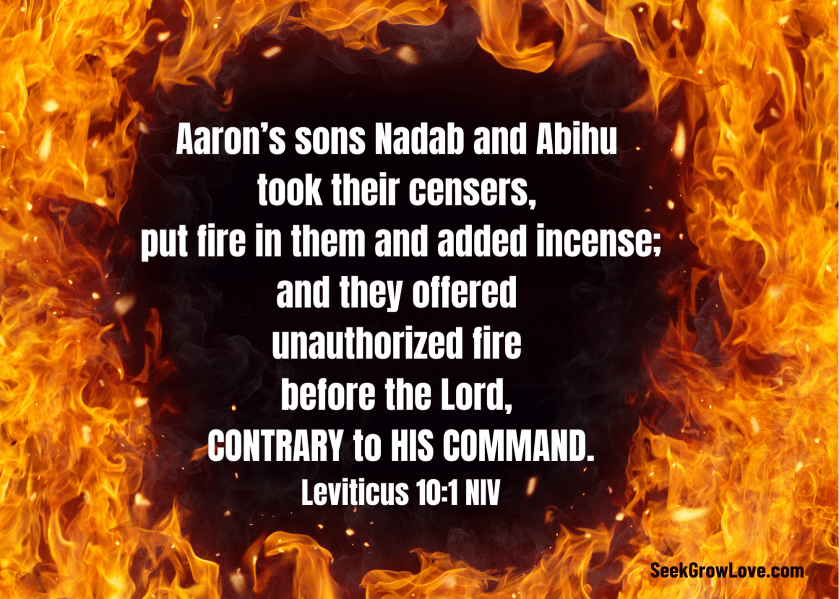
So, seemingly immediately after the miraculous fire coming out from before Yahweh and all of the people falling on their face, enter Nadab and Abihu, who “took their respective firepans and put fire in them. Then they placed incense on it and offered strange fire before Yahweh, which He had not commanded.” (Lev 10:1, LSB).. Then, as before, “fire came out from before Yahweh” but instead of burning up the offering, it burned up Nadab and Abihu.
So what is strange fire? I’ve honestly always wondered. Carefully dissecting today’s reading, there were probably a couple factors in their unfortunate demise. First off, it was presumptuous of Nadab and Abihu to offer the incense before God, since that was the job of the High Priest. Secondly, they used their own fire on the incense (Lev 10:1) instead of the “fire which came forth from Yahweh”. The word that we translate as “strange” fire could also be equally accurately translated as “profane” fire, by the way. This seems like a pretty cavalier attitude from a couple guys who just spent an entire week (Lev 8) preparing spiritually to enter the priesthood. Then Moses says to Aaron “It is what Yahweh spoke, saying, by those who come near Me I will be treated as holy, and before all the people I will be glorified.” (Lev 10:3, LSB).
While this was a bit presumptuous on Nadab and Abihu’s part, read on in Lev 10:8-11: “Yahweh then spoke…saying, “do not drink wine or strong drink…when you come into the tent of meeting, so that you will not die…so as to separate between the holy and the profane…” (LSB). It doesn’t seem likely that this was a random statement given the circumstances, but more likely a bit of preventative education from God for future priests. This seems to indicate that maybe they were impaired with alcohol as well, which might help to explain the (extremely poor) decision to offer “strange fire” on their own. There was more than one thing going on, it looks like.
What’s strangest to me in this story is that just prior to these events, both Nadab and Abihu were present with the 70 elders when God appeared to them in Ex 24:3-8. These are men that should have had an extremely healthy respect for the most high God. These are men that should have known with every fiber of their being that the Lord God Almighty is Qodesh (Holy, Set Apart, Seperated), and had seen with their own eyes the awesome and fearful power of the living God. These are men that were likely in line to be High Priests themselves, but because they did not separate in their minds and actions between the holy and the profane, the clean and the unclean, they died in a fire. They should have known better.
When we approach our God, we need to make sure that we are not offering strange fire. We should be sober (1 Pet 1:13) and focused. We need to separate in our mind between the clean and the unclean, the holy and the profane, before we approach the altar. We need to purify ourselves. Consider for a moment a tiny ant, and your relationship with it comparatively. Our role before our Creator is infinitesmally smaller than that, comparatively. When we pray, when we seek God, we need to understand that this is the most important and critical moment in our existence, every time, and not a casual conversation: we are approaching the Lord God Almighty, the Creator of heaven and earth, the master of all life who sustains us with His breath (Job 34:14-15) and we should tremble. Approaching the Lord God Most High is not something that is to be taken casually or lightly, but with awe and reverence.
Since God has sent us his Christ, we no longer need to make ritual sacrifices, the sacrifice has been made once and for all. The sacrifices that we need to make, the sacrifices that our God desires from us are righteousness (which can also be translated as “equity”), and obedience (1 Sam 15:22). We need to reflect the amazing and awesome character of our God, and love Him with our whole heart, as well as loving the rest of His creation as much as we do ourselves (Mark 12:29-31), just like He has loved us. Jer 29:13 says “You will seek me and find me when you search for me with all your heart.” (LSB). If you go seeking inappropriately and offering strange fire, be very aware that instead of finding God, God might find you. Don’t become a cautionary tale.
REFLECTION QUESTIONS
Lots of times when we pray, we basically just present God with our “to do” list. Do you pause for a few moments and consider the level of interaction between a single tiny human and the omnipotent Creator of all things in the universe before you pray? Every time?
When you open your Bible to read it, do you pause for a few moments to wonder at the amazing grace and love of the Lord God most high who has given you His words as a guide, tiny human?
Do you seek fully to know your God with the attitude of an unworthy servant seeking their hardest to please their master? All the time, or just on church days?
Consider for just a moment, every day, what am amazing God we have. It should melt your heart. He sent His own son as a sin offering, to cut a covenant with us. What are you going to do to show God how much you love Him back, today?
PRAYER
Father God, my Master and my Creator, forgive me, heal me, and teach me. I am an unworthy servant. You are wonderful and beautiful, and greater than all. Help me to be a servant who pleases his master. I was not worth the price You paid for me, have mercy on me Lord God. Help me to love as You love. Grant me your spirit, and teach me wisdom so that I can please you. Thank you heavenly Father, in Jesus’ name, Amen.
In terms of emotions, today’s readings take us from one extreme to the other. In Exodus we see hope of a promised land, covenants renewed, broken things repaired, and the brightness of God’s glory radiating. I can almost feel the summer on my skin reading these chapters, and I hear the message of God’s mercy and hope. In Matthew, we read of the coming kingdom available for everyone (regardless of when in life one joined the kingdom work!), we see miraculous healing, humility, and service to others. And then there is Psalm 6.
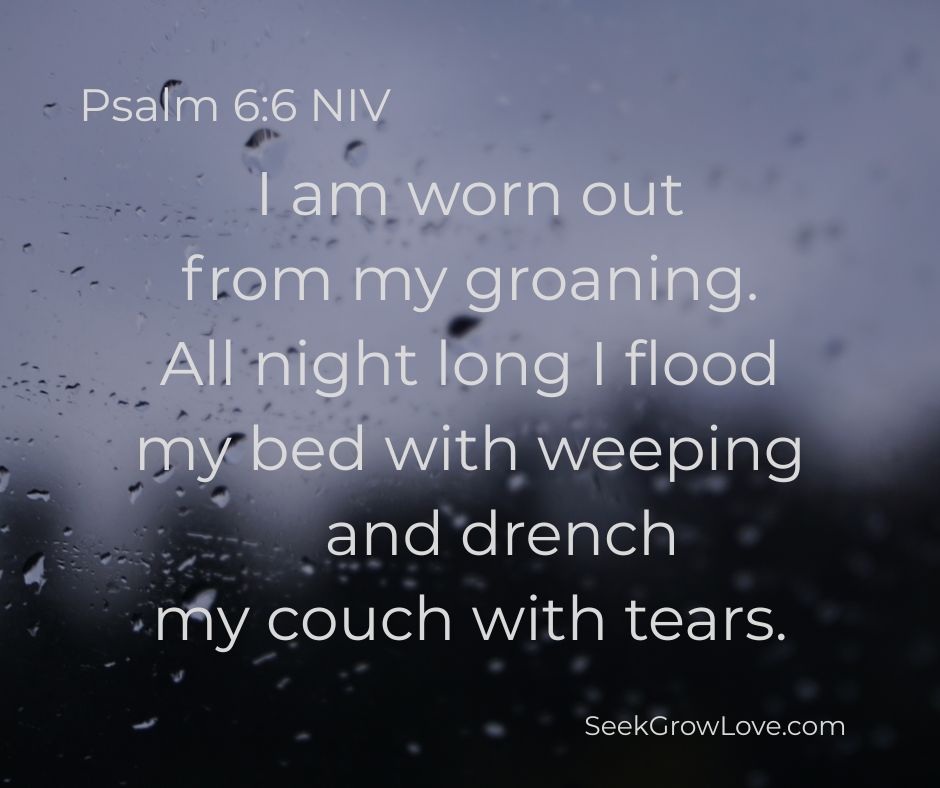
I distinctly remember as a child on the way to church noticing a few verses of Psalm 6 while I was looking at my Bible in the back seat of the our family’s monstrous (and memorable!) Oldsmobile. I also remember that my seat was duct taped at the corner for practical reasons that only duct tape can fix, and because of this, sometimes tape got stuck to my tights on the way to church. Tights. Ick. The thing that surprised me as a kid still catches me by surprise as an adult. David drenched his couch with crying! I’m not surprised David cried. Who doesn’t? I was actually more surprised he had a couch! But, it is clear reading Psalm 6, men-after-God’s-own-heart also sometimes feel troubled, anguished, full of grief, guilty, broken, sick, wasted, and all the rest. Having a relationship with God does not mean we are protected from heartache and distress. But, it does mean that no matter where we are, who we are, what we’ve done, or what has happened to us, we have someone hearing our tears who sees the big picture, who knows His eternal tomorrow, and who is merciful and constant.
Psalm 6 is the first of what are considered the “psalms of penitence”, and we see David starting this psalm with reference to rebuke and discipline indicating he knew that some of his pain and sufferings were connected to sin. Guilt is a powerful emotion and many of our other emotional challenges can build upon it when we haven’t released it to God. David is a stellar example in so many ways, and I am grateful that one of those ways is demonstrating what to do after making mistakes. Big mistakes. I love that we know more of David’s thoughts and not just his historical story. The psalms are very relatable because of their expression of emotion, and there are reasons that words from them are swarming in worship songs, requested at funerals, hospital rooms, and times of emotional need.
At work, I get to talk about emotions a lot with my patients. “Spot the Emotion” is a cute little guy I like for all ages, and he hangs out in various ways in our clinic in books, art work, worksheets, and my most recent favorite is a stuffed Spot! “Emotional regulation” has become one of the most highly requested goals of parents who bring kids to see us in OT, and the pediatric world is buzzing with the reality that we are in a “mental health crisis” in this country, youth for sure. The idea of emotional regulation is a bit of a buzzword and means different things to different people, but what stood out to me in this psalm is that David, through God, had emotional regulation skills. It doesn’t mean he was cool, calm, and collected all the time. He had meltdowns. It is okay and normal to have feelings that are troubled in this world. But, in those moments David believed God was there. I loved that in verse eight he tells us that the LORD has heard the sound of his weeping. In verse nine he confidently tells us that he believes his crying was heard, his prayers were accepted, and the LORD was there. Before we sob it out, while we are drenching the couch, and after we have taken a deep breath and are starting to get up again, the LORD is with us. We are never alone. We are always understood by Him. And if there is one emotional regulation tool I would give to any person in this world, it would be what David had. A relationship with the one true God, a knowledge of His words, and the forgiveness and healing that brings. If I could give a second thing to everyone in this world, it would be a support system of those who love and know God. It is okay to ask for help, and it is okay to be a helper who asks for help.
There is a day coming where the need for emotional regulation tools will be as absent as the sun. A day with no tears, no pain, no sin. Until then, the LORD hears us, knows us, and wants us to cry to Him, laugh with Him, and talk to Him.
Reflection Questions:
How do you feel about being able to cry to God anywhere or anytime about anything?
How did you relate to David’s psalm?
As we wait for the kingdom to come, we need each other. Who can help hold you up in Godly wisdom as you deal with big emotions? Who in your life might need some encouragement and help right now?
Prayer:
Dear One True God – Thank you for being near, hearing prayers, and seeing tears. Thank you for David’s example and heart. Help me to seek You and find You, even in the midst of my toughest days, and also never forget You on the easier days when my couch is dry.
In our Ex 15: 1-20 reading today, we find the Israelites flushed with joy (and probably a bit surprised and amazed) at their very recent miraculous escape from Pharoah’s army through the Red Sea. The song that Moses and the Israelites sang, which is beautiful, highlights their joyous wonder and details the miraculous hand of God in their redemption. Then they walked for 3 days to the well of Marah (Ex 15:22-27) and began a pattern which would repeat pretty regularly throughout the book: complaining and whining. Kind of like us, right? How many times in your life has God done something miraculous and then within days or weeks you’ve completely forgotten about it and moved on with your life? It sounds painfully familiar because at heart most of us are exactly the same. God will do something utterly and completely miraculous, and we celebrate it and praise Him, and then forget about it and are looking for our next blessing. Why are we like that? How can we act differently? (There are some practical answers towards the end, if you want to skip down)
So after God once again miraculously cared for them by giving them water to drink, predictably, the sons of Israel once more started grumbling (Ex 16:2). God then began to provide for His people, and did so for 40 years (Ex 16:35) from this point, until they came to the promised land. In the morning he gave them manna, a miraculous bread from heaven, and in the evening he gave them meat (in the form of quail) (Ex 16:13-14). During these 40 years of provision, the Israelites where physically and spiritually trained in the concept and keeping of the Sabbath (Ex 16:22-29). There is a neat description of the texture and taste of manna in Ex 16:31.
I have 2 very large dogs (Bo and Luke): they’re very sweet, very large, and very pushy. I’ve had them now for about 7 years, they’re good boys (mostly). I bring them up only to make a point. Every day I’ve had them, I have fed them the exact same dog food, in the exact same portions, twice a day. Do you know how they react? They LOVE it. Every single time, it’s like they just won the lottery, like they got the family pass to Disneyland and it’s Christmas morning, they are SO excited. Bo does standing jumps up in the air about 4′ high from the moment I go to the back to get the food until the moment I put it down for them, and Luke wags his entire backside so hard that he’ll knock you over if you get in the way (I have this on video, it happens daily). They are SO happy and just excited and grateful to get that same exact dog food, in that same exact bowl, at the same time daily. Then when they are done, they come lick my face happily (and for a bit longer than I’m usually comfortable with) while wagging their whole bodies to let me know how much they appreciated the food.
So what about you? When God gives you your daily provision, every day, do you show Him how grateful you are? Do you do standing jumps 4′ in the air and wag your whole bottom? Do you then go and lick God’s face repeatedly in thanks (figuratively, of course)? Think about it. Most of us would be more along the lines of the ancient Israelites “Ugh, manna and quail AGAIN??!“, while completely overlooking the fact that we have been provided for. Our creator, the God of Abraham, Isaac, Jacob, and you gives us blessings every day. I urge you, as I urge myself; jump for joy, wag your tail, kiss the hand of the Almighty who has given us such abundant blessings undeservedly.
PRACTICAL STEPS
Pray when you wake up. Gush. Get on your hands and knees and thank God that you woke up today, that He has seen fit to grant you another day of life.
Look at your blessings, consider how ALL of them come from the hand of God (Ps 24:1)
Look at the sky in the morning, and praise God that He’s given us, His children, such a beautiful playground to live in.
Breathe in, Breathe out. That is the breath of life that God put inside you, thank Him for it.
Love the people you meet, God created them too, they are your brother/sister and it pleases Him when you acknowledge this.
When you struggle, thank God for refining you and strengthening your spirit. Ask for his help if you are failing.
When you eat anything, thank God.
When you bathe, thank God for the cleansing water. Ask Him to cleanse your heart as well.
When you go to bed, thank God for the day He gave you, and you’re still alive. Ask for forgiveness if you’ve failed in any way to please Him, and then wake up in the morning and do better.
Glorify God at all times, in everything you do, in every thought you have, in every action you take. Diminish your “self” and enlarge God’s spirit within you.
I’ve went on a bit long about our OT reading this morning, but I would be absolutely remiss if I didn’t point out a couple things in our Matt 15 reading. When the pharisees confront Jesus about some legalistic violations, Jesus calls them out (Matt 15:3) and points out the difference between honoring God with your heart and just “going through the motions”. It’s important to note that the traditions of men are not necessarily the commandments of God, we need to honor God and love him in our hearts. If we’re not doing any of the things we do daily as rituals out of pure love for God, then we too are missing the whole point.
I have a friend who believes firmly (and I don’t disagree) that “unconditional love towards the Father” is in itself perfect religion lived properly. I humbly suggest that some of the daily rituals suggested above may help us to refocus our attention and gratitude to where it belongs. May God bless you and lead you, and touch your heart with His spirit.
Reflection Questions:
Do you (figuratively) wag your tail and lick the hand that fed you, every time you get food? Why or why not?
God physically and spiritually trained his children the Israelites to keep the sabbath every week for 40 years. Do you think it was important to him?
Should we keep the Sabbath nowadays? No cheating by repeating whatever you were told by someone else: look it up in scripture, use your own words to answer, and show your work.
Prayer:
Father God, THANK YOU! You have provided for my every need, every day, and given me far beyond what was needed. I have not deserved it, I have not earned it, but you have been a gracious and loving God to me anyway. Lord God please forgive me, help me to love you with that same fierce love that you have loved me with since I was born, and teach me the depths of your awesome love. Thank you for life, and breath, and all things. Please guide me and be with me, in Jesus’ name, Amen.
As Jesus continues his journey toward Jerusalem, he encounters people from all walks of life—outcasts, disciples, religious leaders, and ordinary men and women. In Luke 17:11–18:14, there are various stories and teachings involving miracles and parables where Jesus calls people to deeper trust, genuine gratitude, and humble prayer.
Trust and Thankfulness
This section of Scripture opens with Jesus traveling along the border between Samaria and Galilee. Ten men with serious skin diseases (traditionally translated as “lepers”), who were shunned by society and desperately wanted mercy, call out to him from a distance, saying, “Jesus, Master, have mercy on us” (Luke 17:13). Jesus responds not with an immediate healing, but with a command: “Go and show yourselves to the priests.” As they obeyed, they were cleansed. But while all ten were physically healed, one man (the Samaritan) displayed gratitude which brought him a deeper wholeness—spiritual as well as physical. Jesus tells him, “Your trust has made you whole” (Luke 17:19). The passage reveals that faith and thankfulness are both vital to experiencing the fullness of God’s blessing.
One helpful insight here is that trust often requires action before we see results. The lepers had to begin their journey to the priests while still unhealed. Their obedience was an expression of trust, and as they went, God’s power healed them. Trust, even as small as a mustard seed, has the power to move what seems immovable (cf. Luke 17:6).
Reflect: Where is God inviting you to trust him more, even before you see the outcome? How might cultivating a heart of gratitude open the door to God’s work in your life?
Persistence in Prayer
Jesus then tells the parable of The Persistent Widow (Luke 18:1-8), encouraging his followers to “always pray, and not become discouraged.” The widow’s relentless pursuit of justice before an indifferent judge is contrasted with God’s attentive care for his people. If even an unjust judge can be moved by persistence, how much more will God respond to the cries of his beloved children when they persistently come to Him in prayer?
The parable is about the necessity of persistent prayer and unwavering hope, even when answers seem delayed. Jesus asks, “When the Son of Man comes, will he find trust on the earth?” (Luke 18:8). Our perseverance in prayer is an act of trust and also a testimony to our trust in God’s character.
Reflect: In what prayers do you need to be more persistent? What discouragements in your life can you bring honestly before God, trusting that he hears and cares?
Humility Before God
Finally, Jesus tells the parable of The Pharisee And The Tax Collector (Luke 18:9–14). The Pharisee stands confidently, listing his religious achievements and looking down on others. The tax collector, by contrast, stands at a distance, unable even to lift his eyes, but nonetheless, he prays: “God, be merciful to me, a sinner.” Jesus declares that it is the humble tax collector who goes home “righteous,” not the devout Pharisee. The reason Jesus gives is that “everyone who exalts himself will be humbled, but whoever humbles himself will be exalted.”
This parable reveals that one must be humble when coming before God. Humility, openness, and a childlike posture are essential for receiving the kingdom of God (Luke 18:17). Our standing before God is not based on our prowess, devoutness, or accomplishments, but on our honest need for his mercy, because there is nothing we can do to deserve it.
Reflect: In what ways do you find yourself comparing your spiritual life to others? How can you approach God with greater humility and openness in your heart?
Encouragement
As you read these stories and teachings of Jesus, may you be inspired to trust in God more deeply, return thanks for His goodness and blessing, persist in prayer, and humble yourself before Him.
Jerry works on the REV Bible (revbible.com) as the chair of the REV Translation Committee and the lead NT translator. He also has a podcast on the Book of Proverbs called “Words of Wisdom” (stfi.org/podcasts/words-of-wisdom-podcast) that people can find on Spotify, Apple, Pandora, etc.
Imagine this absurd scenario. . . “Daddy, can I have some fish?” “No son, but instead here is a plate of snakes”. . . . “Daddy, can I have some bread?” “No daughter, but instead here is a plate of scorpions”. Jesus used this extreme example to illustrate the goodness of God. He points out that if parents, imperfect as they are, would never offer snakes or scorpions to their children, imagine what would be provided from God, a perfect Father who takes delight in providing for his children. The phrase, “how much more” is used to engage our imagination about how a loving Father provides for His people if only he is asked.
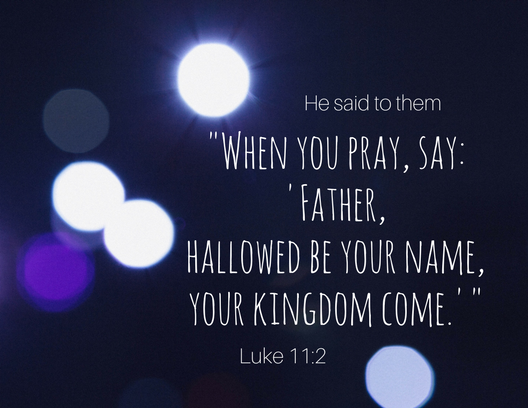
Luke 11 puts an intense focus on the importance of prayer in the life of a Christian. He begins with Jesus providing what we know as The Lord’s Prayer as a suggested guide for how to pray but then segues quickly into why we pray and how it works in the lives of believers. He gives an illustration of going to a friend in the middle of the night and pounding on the door requesting bread to share with another. While the friend will initially say, “Go away”, he will eventually give in due to the persistence of the request and repeated (and I’m sure annoying) knocking. The message is clear. . .ask for what you need and be persistent in your prayers.
Jesus used three verbs to help in our approach to praying. . . Ask, Seek and Knock. These three verbs involve three different senses. Asking is verbal—becoming aware of what you need and verbalizing it to God. Seeking is cognitive—determining priorities and focusing the mind on what is being asked in order to go deeper and be more engaged with the request. Finally, knocking implies using intentional actions and behaviors toward the request. The use of these verbs in the Greek are “present imperatives” which suggest continuous and persistent prayers. In other words, keep asking, keep seeking, keep knocking with these commands being followed by promises from a loving Father. If you ask, you receive, if you seek you will find and if you knock, the door will be opened. It is discovering that prayer is more than just making requests; it is about building a relationship with a loving Father who only wants to give good gifts to his children. It is discovering that God is not reluctant, but responsive. By this ongoing relationship with Him through persistent prayer, we deepen our relationship with Him and experience his faithfulness.
Questions for reflection:
When have you experienced the faithfulness of God in answering prayers?
How does the phrase “how much more” impact your approach to praying?
How has your relationship with God deepened because of your prayer life?
How might using those present imperative verbs of asking, seeking and knocking impact your prayers?
How does viewing God as Father change the way you approach him in prayer?
How does persistence in praying change your relationship with God?
The wall and the gates of Jerusalem had been rebuilt. (Nehemiah 6:15) Leadership and positions of service had been filled. Israelites were moving in to occupy the city of Jerusalem. (Nehemiah 11) The stage was set for a celebration!
It was time!
The dedication of the wall of Jerusalem attracted people to come to Jerusalem to be present for the dedication of the wall of the city. What a huge crowd that came that day! The Levites came to celebrate the dedication with gladness, thanksgiving, and singing. Cymbals, harps, and lyres were played in great celebration. In addition, singers came from the areas around Jerusalem, and other surrounding areas. The singers had even built for themselves villages around Jerusalem. The priests and Levites purified themselves and the people. All the celebrants were spiritually prepared and excited! Let the celebration begin! (12:27-30)
Nehemiah then brought the singers and musicians up onto the wall. What excitement must have stirred through the crowd when they mounted that wall that many thought impossible to rebuild! The city must have exploded with songs of praise and thanksgiving as Nehemiah instructed one half of the singers to sing songs of praise, accompanied by the blast of trumpets and other instruments created by David, the man of God. He sent them to march south on the top of the wall, along with Ezra the scribe. As they marched, they sang loudly with whole hearts overflowing with praise. Likewise, the second choir was sent to march north on top of the wall, along with Nehemiah. They sang and worshiped and praised the great God who had done mighty works in Jerusalem. The two choirs then met at the house of God where they gave thanks and presented sacrifices to their great God. They rejoiced! “For God had made them rejoice with great joy. And the joy of Jerusalem was heard far away.” (v. 43)
One of the Songs of Ascent was probably song. Psalms 126, one of those songs, has such meaningful words for such an occasion as this:
“When the Lord turned again the captivity of Zion, we were like them that dream. Then was our mouth filled with laughter, and our tongue with singing; then said they among the heathen, The Lord hath done great things for them. The Lord hath done great things for us; whereof we are glad. Turn again our captivity, O Lord, as the streams in the south. They that sow in tears shall reap in joy. He that goeth forth and weepeth, bearing precious seed, shall doubtless come again with rejoicing, bringing his sheaves with him.”
Yes, the joy of Jerusalem was heard far away, but how that joy must have stung for some.
Throughout the celebration of praise and thanksgiving to God, this message was being seen and heard by those outside the congregation of the Israelites. There were a few familiar faces and names of people among the foreigners who probably wanted to hide in embarrassment. And it was all because of the completion of the work at Jerusalem on the 25th day of Elle (6:15). “All the nations around us were afraid and fell greatly in their own esteem, for they perceived that this work had been accomplished with the help of our God” (6:16). Even their enemies and naysayers believed that what they were hearing with their ears and seeing with their eyes, was indeed proof positive that God was with Jerusalem and that He had caused the wall and gates of the city of Jerusalem to be restored! (Ps. 126:2)
Flash back several weeks earlier when word spread throughout the region that the wall was being rebuilt. Sanballat and Tobiah were up to their mischief trying to discourage and hinder the work of the Jews in rebuilding the wall. They teased; can these feeble old Jewish men even build these walls themselves? Will they sacrifice? They knew it would take more than a few prayers to rebuild the wall. Could they even finish it? They laughed at the materials they were using, calling the stones rubbish, because they were broken and burnt. They jeered, “How could anyone build anything out of trash?” (4:2) And yet, they built it! There it stood on this great day of dedication after its completion. So, with God even feeble old men can accomplish great things! Yes, they were able to finish the wall with God’s help! Even burnt stone dug from the rubble could become a strong wall! Sanballat and Tobiah probably heard the praise, the trumpet blasts, the loud songs of worship that day and cringed. But what may have been worse was seeing the wall standing strong, and the people standing strong and thankful upon that wall—that very wall that Tobiah declared would fall in a heap if even one fox went up on to the wall. (4:3). This was just what Nehemiah prayed to God to do…to “turn their taunt on their own heads” (4:4). What a testimony to God and the power of prayer! Now a multitude of people stood upon the wall and sang out praises to the One true God for the whole world to hear!
What are you doing to make sure that your wall stays strong, and that songs of praise to the One true God can be heard in your part of the world?
Reflection Questions
What is praise? How important is expressing praise in your prayers to God? What things do you praise God for? Is there a relationship between expressing praise to God and feeling joy in your life?
What is the difference between praise and thanks? Or are they the same thing? Do you share your thanksgiving and praise with others?
What did Paul mean when he said, “In all things give thanks? (1 Thess. 5:18) Does giving thanks remove fear and worry from your life? How do you incorporate giving thanks in your life when you feel overtaken and undone by loss or grief?
This chapter, Nehemiah 9, contains the longest prayer in the Bible. No, prayer is not a contest, but sometimes it takes a lot of words to get things off your chest. Other times it only takes a few words to speak your heart to God. When Jesus hung on the cross, he only needed 10 words— “Father, forgive them for they know not what they do.” But in Nehemiah’s day in Jerusalem, it took a lot of words to get everything out so that God’s people could express their forgiveness and experience restoration.
And so, they prayed.
Sometimes we need to express our heart in different ways. In Nehemiah 9 it is written that the people expressed their sin, their shame, and their remorse in many ways. They fasted; they wore sackcloth and ashes. They threw handfuls of dirt on their heads; they separated themselves from others; they confessed their sins along with the sins of their ancestors. They even signed a binding contract promising obedience to God. All of these things were important, but it was what they expressed from their hearts that was probably the most meaningful. Often those feelings are expressed without words, but with tears. Peter remembered Jesus’ prophesy, “Before the rooster crows, you will deny me three times,” and after his third denial, Peter “went out and wept bitterly” (Matt 26:75). (See also Rom. 8:26). Tears speak a language our tongues cannot. Nehemiah understood.
When Nehemiah received the report from his brother, Hanani, that the Jewish remnant was in “great trouble and disgrace” and that “the wall of Jerusalem is broken down and its gates have been burned with fire…he sat down and wept…” (1:3.4)
And then he prayed:
“I confess the sins we Israelites, including myself and my father’s family have committed against You. We have acted very wickedly toward You. We have not obeyed the commands, decrees and laws You gave your servant Moses.” (1:6,7)
As I read this prayer, I noticed that these people acknowledged failing their God six times, by disobeying and betraying Him.
“Our fathers acted presumptuously and stiffened their neck and did not obey your commandments. (9:16)
“They had made for themselves a golden calf and said, “This is your God…” (9:18)
“They were disobedient and rebelled against You and cast your law behind their back and killed your prophets…and they committed great blasphemes.” (9:26)
“They did evil again before You.” (9:28)
“Yet they acted presumptuously and did not obey your commandments but sinned against your commandments.” (9:29)
“Even in their own kingdom, and amid your great goodness that You gave them, and in the large and rich land that You set before them, they did not serve You or turn from their wicked works.” (9:35)
And six times they came crawling back, probably wrapped in their sackcloth and covered with dirt and grime. Each time they acknowledged the goodness and greatness of God!
“But You are a God ready to forgive, gracious and merciful, slow to anger and abounding in steadfast love, and did not forsake them.” (v17)
“You in your great mercies did not forsake them in the wilderness.” (v19)
“Forty years You sustained them in the wilderness, and they lacked nothing.” (v21)
“According to your great mercies You gave them saviors who saved them from the hand of their enemies.” (v27)
“Many times, You delivered them according to your mercies.” (v28)
“Nevertheless, in your great mercies You did not make an end of them or forsake them, for You are a gracious and merciful God.” (v31)
He did not forsake them.
But when will He despair of their sins and wickedness? When will God decide He has had enough? When will He turn His back on His people? When will He turn His back on ME? When will He stop listening to MY prayers of confession? Never. Because that is who He is! He is “a forgiving God, slow to anger and abounding in love.” (9:17) “Nevertheless, in your great mercies You did not make an end of them or forsake them for You are a gracious and merciful God.” (9:31).
“For He will never leave you or forsake you,” (Duet.31:8) NEVER. So, every time that you mess up and dishonor God, pray. Because God forgives.
Every time.
Reflection Questions:
The people choose to fast when they prayed. Have you ever fasted when you prayed? Did it ever change the experience for you? If you have, what kind of occasions do you think are appropriate for fasting and praying?
Why do you think the Jews acknowledged God’s greatness and mercy in their prayer of forgiveness?
Remember Judas’ sin of betrayal of Jesus and later his suicide? Did he show signs of regret? If so, was that the same as confession? Do you think the outcome would have been different if he had confessed, as the Jews did, and then acknowledged the mercies of God? Or was he just too depraved? Did he feel he was beyond being forgiven? Was he too ashamed? Have you ever felt that way?
When someone says, “Ask me if I care”, it is generally said in a sarcastic manner, leading us to believe that this individual does not care. “Why would I care about that?” (That situation does not affect me.) “What’s the point?” (Nothing is going to change.) “I have better things to be concerned about.” (My life is more important.) “My life is good, so why should I worry about someone else’s troubles?” (Let everyone take care of their own business.) I bet every one of us has said or thought these things at least once in our lives. I know I have, and sadly, I felt justified in feeling that way.
It was probably an ordinary day in the life of Nehemiah, if there was such a thing for Nehemiah. After all, he was the cupbearer for a powerful king. He stood in his presence every day, making sure his needs were all taken care of. It was a cushy job with a lot of perks and great benefits. Lucky Nehemiah, right? But along comes his dear brother, Hanani, to visit Nehemiah. It was good to see him, I am sure, but Nehemiah’s life was about to be upended in an unexpected way! Perhaps foolishly Nehemiah inquired about the Jews (his people) who had survived the exile and the condition of the city of Jerusalem, expecting good news or maybe a simple answer like, “Oh, things could be better” with a shrug of the shoulders. End of discussion. Instead, what he heard was, “The remnant there in the province who had survived the exile is in great trouble and shame. The wall of Jerusalem is broken down, and its gates are destroyed by fire.” (1:3). Was this Nehemiah’s problem? After all, it had happened a while ago and now Nehemiah had a great position with the King and lived 800 or more miles away from all of that. Kind of like, out of sight, out of mind. How easily, and perhaps justifiably, Nehemiah could have wished them the best and continued living his happy life. Who would have blamed him? We would have done the same. Right? Deep inside, Nehemiah might be thinking, “Why would I care about that?”
Instead, however, as soon as Nehemiah heard their words, he “sat down and wept and mourned for days and continued fasting and praying before the God of Heaven.” (vs 4) It is hard to deny the fact that Nehemiah was filled with sorrow and empathy. But does he really care? How far will this caring take him? What can he really do anyway, being that he is working for a powerful king in Persia many miles away from Jerusalem?
Nehemiah could not let it go. He had to do something. This is where it got tricky for Nehemiah. He could not just say, “I can’t do anything to help.” He could not just say, “My work in the palace is more important.” He had to do something. So, he went to the King to get his permission to take a leave of absence and to go to Jerusalem. That was the tricky part because the King had every right to refuse his request. Through the work of the Lord, however, the King granted him permission. Then, because he was ill-prepared to rebuild the wall of the city, he would have to figure out how to accomplish that, and how to lead the band of survivors in that task. Nehemiah was willing to leave the safety and comfort of the palace for living in a ruined city. He did so, without excuses as to why he could not build the wall and gates of Jerusalem, and he did it in 52 days because of his faith in the God of Heaven! He did it because he cared.
It is safe to say that we will never be faced with such a monumental task. Such a task comes seldom, and only to a man like Nehemiah. But we are faced with important tasks, nonetheless. People are hurting, they have needs, they need a gentle hand, a listening ear, they need someone to pray for them and with them, or maybe your church has a Sunday School class without a teacher.
We are not Nehemiah, but we can be like him.
We can care.
Reflection Questions
1. Are there times when it is okay to genuinely not care? Are caring and doing inseparable? Are there times when it is okay not to help? Does that mean you don’t care?
2. What are your first thoughts when you are asked to help with something important? Do you first think about all the reasons that would make you unable to help? Are all those reasons real or just excuses? Or do you first consider the ways/solutions that would make you able to help? Is prayer part of your process?
3. How would have things turned out if Nehemiah had decided he really didn’t care or simply did not want to help?
The final chapters of Daniel give us a peek into the future. It also gives us a look at how things exist in the spiritual realm. In Daniel chapter 10, Daniel was given a great vision about the future – a future filled with great conflict. The vision was so terrible that Daniel refused to eat (choice foods) or bathe (“use lotions”) for a full three weeks! As Daniel pondered the meaning of the vision, God was already at work “behind the scenes” (within the spiritual realms).
After a few weeks of giving his whole devotion and confusion to God, Daniel gazed across the Tigris River and saw a man clothed in linen, with a fine belt of gold around his waist (Daniel 10:4-5). Daniel quickly realized this was no ordinary man – this was a man who looked like beryl (a green gemstone) with a face like lightning. His eyes were like flames and his arms and legs beamed like bronze. His voice was very loud (Dan. 10:5-6). Daniel, recognizing this man as an angel sent from God was overcome with fear and fainted! How would you react if you saw an actual angel?
The angel was not there to frighten Daniel, but to encourage him. The angel touched Daniel and woke him up with gentle words of encouragement and affirmation. The angel informed Daniel that he had been sent to him by God – and a reminder that God greatly loved him. God was pleased that Daniel was a man who devoted his heart to understanding. He was a man who humbled himself before God (Daniel 12:11-12). As a result, God sent this angel to give Daniel a special message – and a gift of encouragement.
Many times we pray to God and wonder if He will answer us. Sometimes, we can feel so small that we wonder if God even hears our prayers. Daniel must have felt that way as he struggled for three weeks without choice food and wine. Where was God? Would God give him understanding of the terrible vision? We often struggle when it seems that God has not heard or answered our prayers.
But the angel allowed us to take a “sneak peak behind the scenes”. From the moment Daniel began to pray – on the very first day of prayer – God had heard him and sent out the angel on this important mission to meet with Daniel. Why the delay? The Angel explains that as he went forth from God, he was attacked and battled with the “prince of the kingdom of Persia” (Dan. 10:13). This spiritual battle between the angel and demonic wickedness lasted for 21 days and was only broken by the appearance of the arch-angel Michael (Daniel 10:12-14). What a battle!
In the book of Ephesians, Paul encourages us to “be strong in the Lord and in the strength of His might” and to equip ourselves with the full armor of God (Ephesians 6:10-11). By preparing for spiritual “battle” we have the advantage to defeat wickedness. Paul explains that “we do not wrestle against flesh and blood, but against the rulers, against the authorities…” (like the prince over Persia who fought against the angel) “…against the cosmic powers over this present darkness, against the spiritual forces of evil in the heavenly places” (Ephesians 6:12).
Believe it or not, there actually is an unseen, spiritual world. It is the heavenly world of our God and all spiritual forces – good and evil. Just like Daniel, we often seek God for comfort, guidance, and an answer to our prayers. Sometimes, we need to keep praying. And keep hanging in there – because the battle can be long. Through our faithfulness and endurance, God can ultimately demonstrate His grace and truth. Put on the full armor and stand firm!
Questions for Discussion:
Why do you think God allowed the angel to be detained by the spirit over Persia?
We cannot see the spiritual realm, but we are impacted by what goes on there. How can our full armor of God make an impact in the “heavenly places”?