Have you ever been in a situation where you have come to God in desperation, feeling depressed, angry, or scared? In Psalm 61 David is crying out to God in a time of need. Many people believe David wrote this about when his son temporarily pushed him from the throne. Sometimes we view asking God for help as weakness but it is evident in the Bible that it’s not. Throughout the Bible we see people crying out to God. Jesus cried out to God and we read in Hebrews 5:7,
“During the days of Jesus’ life on earth, he offered up prayers and petitions with fervent cries and tears to the one who could save him from death, and he was heard because of his reverent submission.”
There are three main takeaways from Psalms 61:
1. We need to cry out to God when we are hurting, which is expressed in the first two verses which reads
“Hear my cry, O God;
listen to my prayer.
From the ends of the earth I call to you, I call as my heart grows faint; lead me to the rock that is higher than I.”
2. We need to have confidence and faith that God will answer our cries, which is expressed in verses 5-7 which reads
“For you, God, have heard my vows;
you have given me the heritage of those who fear your name.
Increase the days of the king’s life, his years for many generations.
May he be enthroned in God’s presence forever; appoint your love and faithfulness to protect him.”
3. We need to have a commitment and loyalty to God which is expressed in verse 8 which reads
“Then I will ever sing in praise of your name
and fulfill my vows day after day.”
-Brooke Cisneros
Reflection Questions
When have you cried out to God when you were feeling scared, angry, depressed or in desperation?
What does it mean to you that God is the Rock higher than you? How do you approach Him in prayer?
Do you have confidence in Him? Are you committed to Him?
In this devotion I want to delve into a chapter in Psalms. What we see is David sharing a dark time in his life, one of the things that makes it difficult is people turning on him. One of the hardest things in life is having people you trust betray you. Jesus dealt with this same thing when Judas betrayed him.
Have you ever had to deal with a betrayal? What did you do in that instance? Many people unfortunately want to take revenge. Others spin into a depression, but David gives us strong advice on how to handle adversity. He tells us to allow God to protect us and keep us strong. He likens God to a strong tower that we can take refuge in. In Psalm 59 David is in his house surrounded by Saul’s soldiers who were sent to kill him.
The Psalm is both a prayer and a praise for God’s saving help. Psalms 59 is an important chapter because it reminds us of God’s unfailing love. David was hunted by people whose love had turned into jealousy which drove them to try to kill him. David had trusted friends and the king who he considered a mentor who all turned against him.
As humans, relationships are so important and necessary. We all hope and strive for dependable, long-lasting relationships but that’s not always the case. We all have dealt with broken relationships. Maybe it was the loss of a friendship, a break up, a church split, or family estrangement. At some point everyone deals with finding out that someone was not a trustworthy, dependable person like you thought. This is the hard side of human relationships. Humans are far from perfect, people will disappoint you and you will disappoint others. Regardless of the state of your relationships in this world, God’s relationship to you is unchanging and unfailing.
-Brooke Cisneros
Reflection Questions
Have you ever felt betrayed? What was your response?
When have you turned to God for strength when human relationships disappointed you? What did you find in Him?
What do you appreciate about God’s unchanging and unfailing character? How will you praise Him for this?
For the rest of this week, we are going to be looking each day at small sections of one chapter in the Bible- 1 Corinthians 13. When I was a kid I was taught that 1 Corinthians 15 is the Resurrection chapter, Hebrews 11 is the Hope chapter, and 1 Corinthians 13 is the Love chapter. If you’ve ever been to a wedding ceremony there is a good chance that you’ve heard all or at least a portion of this read as part of the ceremony. Today we will look at verses 1-3:
If I speak in the tongues of men and of angels, but have not love, I am a noisy gong or a clanging cymbal. And if I have prophetic powers, and understand all mysteries and all knowledge, and if I have all faith, so as to remove mountains, but have not love, I am nothing. If I give away all I have, and if I deliver up my body to be burned, but have not love, I gain nothing.
This is such a timely reading for me to consider. For the past 3 years, I’ve been working toward receiving my Doctorate of Ministry from Vanderbilt Divinity School in Nashville. It’s been a lot of hard work. For my project I read hundreds of articles and books, conducted interviews, presented ideas to colleagues, tested ideas on various groups, and wrote, edited, re-wrote, and re-edited until I had a project to present to my committee. Then after my committee read it, we met and I had to defend my project thesis orally. Finally, on April 9 I passed. On May 10 I’ll graduate and receive my official title D.Min, Doctor of Ministry in Integrative Mental Health Chaplaincy. The afternoon I passed my wife Karen said “Hello, Dr. Fletcher.” I said, “That’s the only time you’re ever going to call me that, right?” She said, “Absolutely, I hope you enjoyed it.”
So, I’ve been feeling relieved, accomplished, grateful, and good about having achieved this milestone in my academic and professional career.
But God had a lot more to teach me. And Brother Paul put his finger on it. In 1 Corinthians 13:1-3 Paul is saying a lifetime of accomplishments, being a gifted speaker, full of knowledge, or being spiritually gifted with miraculous powers, in the absence of concrete acts of love, is just a bunch of noise. You can get all the degrees and accolades and knowledge, but if you don’t put love into practice, it’s a bunch of noise and worthless.
It reminds me of a story I once heard: There was a child psychologist who was famous and had written many best-selling books on parenting and how to raise children. Recently, he had spent many hours constructing a new driveway at his home. Just after he smoothed the surface of the freshly poured concrete, his neighbors’ small children chased a ball across the driveway, leaving deep footprints. The man yelled after them with a torrent of angry words. His shocked neighbor heard these words and said to him, “You’re a psychologist who’s supposed to love children.” The fuming man shouted, “I love children in the abstract, not in the concrete!”
Paul is saying in I Corinthians 13:1-3 that love in the abstract is worthless.
A few days later, God showed me what love in the concrete looks like. I shared the following story on my Facebook page recently. It resonated with a lot of people because it’s been shared hundreds of times and I’ve heard more responses to it than anything else I’ve ever posted on social media. It illustrates to me what Love in the Concrete looks like:
I met Jesus yesterday. Face to face.
He’s a cashier at a grocery store in Front Royal, Virginia.
I was on my way home from work after a busy Monday visiting sick patients at the hospital, supporting families as their loved ones face the end of life, helping people struggling with addiction and staff cope with the challenges of being full-time caregivers. I’m a chaplain and a pastor, that’s what I do all day. It’s what I’ve trained to do, studied, practiced.
But then, yesterday, out of the blue, with no warning I met Jesus working the register at a grocery store.
First, I saw him patiently help the customer ahead of me. The one who only had 3 items in her cart, was very confused trying to figure out how much she could spend because she needed to have enough left over. He was gentle and patient with her. He couldn’t be more than his late teens, maybe early 20s, but he was attentive and caring. No eye rolls or looks of frustration, just caring for this confused and frustrated woman. (I was the one who was frustrated at how long it was taking).
Then it was finally my turn to check out. He was a thin young man, wearing a cross made of horseshoe nails and wire. He smiled and asked gently, “May I pray for you?”
That was unexpected and caught me completely off guard. I said, “Yes, please.” I was so moved that this young man would take the time to notice me and ask if he could pray for me. This was more than a transactional relationship for him. He was there to do more than simply earn his paycheck and go home. He saw me as more than an object, a thing to help pay his bills, he saw me as a person, a human being made in the image of God, who has a life outside of this 5-minute transaction and has needs that can be helped by God’s intervention. I was deeply moved.
But he wasn’t finished.
“What would you like me to pray for?” What should I say? How specific should I be? Should I say, “I’m currently under treatment for 2 types of advanced cancer and trying my best to keep going?” Should I tell him about my concerns about family members that I love, my desire to help my Church grow, and all the needs of the people I visit and staff I serve in the hospital?
There wasn’t time to go into all of that, so I simply said “My health.”
He stopped and said, “So you are having health problems. I’ll pray for that.”
By then the tears were starting to well up in me and I hurriedly helped him bag my groceries so I could get out of there before I started ugly crying in the grocery store check-out line.
But he wasn’t done yet.
“What’s your name?” That about finished me off. He wasn’t just making conversation or using spiritual cliches like “I’ll pray for you” as well-intentioned people often do, but sometimes forget to actually do. I knew that he really meant it. He was and is praying for me, Jeff, who has health needs. And based on what I saw, he’s already pretty close to God. So I have a feeling God will listen attentively to his prayers.
As I sat in my car afterward waiting for the tears to subside, I had the overwhelming sense that I had just spent time with Jesus.
I met Jesus yesterday.
He works as a cashier at a grocery store in Front Royal, Virginia.
Since I shared this on Facebook I’ve had dozens of people who live locally write to me or tell me in the hospital that this same young man has left others equally in tears when he prayed for them and they, too, equally felt touched by Jesus.
This young man probably doesn’t have a doctorate in spiritual care, but you don’t need one of those to show people concrete love in the name of Jesus. Go and be Jesus wherever you are today.
Pastor Jeff Fletcher
Reflection Questions
Name a time when you were surprised by God’s love revealed to you in unexpected places.
How would you describe the difference between abstract love and concrete love?
The young man showed Jesus’ love while checking people out at the grocery store. Where can you show the love of Jesus today?
Ahh….Psalm 51. There are few Psalms I can remember off hand what they are about. I usually can recall that Psalm 119 is the really long one kinda smack dab in the middle of the Bible that talks about the word of God. Psalm 100 is my Mom’s favorite that she still has memorized and can recite on turbo speed which is an uplifting one full of gratitude. And then there is Psalm 51. It isn’t super long and it isn’t super cheerful, but it is authentic, transparent, and full of repentance. A psalm of confession at a time in David’s life that is so significant even our Bibles tell us what David had just been caught doing before writing this.
I don’t know about you, but I know I wouldn’t particularly want people thousands of years from now reading about my sins or finding prayers I wrote on my darkest days. But, I am so grateful that God allowed that from the man after God’s own heart, a beautiful poet and gifted communicator whose contrite and sincere words are available for us today to encourage, convict, and restore.
In Psalm 51 verse 7, hyssop caught my eye because right now I have it growing in my yard again, transitioning back to a vibrant green after the long winter of blah. For my purposes today, I like that it is a perennial with pretty foliage and purple flowers that also have some herbal benefits. But, in the Bible it is referenced as a cleansing and purifying plant, one used for cleansing lepers, ceremonial cleansings, and what the Israelites were instructed to use as a paintbrush of sorts for smearing the sacrificed lamb’s blood on the doorposts in Exodus 12. How beautiful a psalm and image to read on the first day of Passover. How wonderful to know that since David’s time, through his line, we received a Messiah through whom we can be cleansed and made right to God. It is encouraging to know that God always knew we needed this Messiah, and that Jesus was part of God’s plan from the beginning. The relationship with God we have through Jesus and the hope of the gospel he preached in the coming kingdom, a time of no more mistakes and tears, provides a source of joy today.
Purge me with hyssop, and I shall be clean;
wash me, and I shall be whiter than snow.
Let me hear joy and gladness;
let the bones that you have broken rejoice.
Hide your face from my sins,
and blot out all my iniquities
Someone else must think Psalm 51 is a noteworthy one we can relate to because like it or not. . . here we come. . . .6 days in a row!
-Jennifer Hall
Questions:
1. What do you like about Psalms and the books of poetry in scripture?
2. How do you relate to the words in Psalm 51?
3. Consider what you need to ask God to cleanse you of today, and rejoice in the mercy and great compassion David reminds us are abounding in Him when we turn to him in repentance.
My inner science nerd was more excited than a kid in a free candy store last week as I donned my (un)fashionable cardboard glasses in preparation for a once-in-a-lifetime event: for the first time in over 200 years, my Midwest residence would be within the path of totality for a total solar eclipse – an alignment promised to not reoccur in this area for three quarters of a century. Seven years ago, we watched a partial eclipse (around 90% totality) from our home, which was very… underwhelming. However, after learning that there is a vast difference between even 99 and 100% totality, I bought into the hype and prepared for amazement. We hosted a watch party on our church property and our friends even flew in from Alaska to experience it with us! The weather was abnormally lovely for April. As the coverage increased, we detected a cool wind breaking through the warm air, and then street lights began to light up. Then, the millisecond that it reached total coverage, a wave of deep twilight blanketed the field and an evening chill washed over us; I could instantly sense the distinct change in my peripheral vision from behind the safety of my glasses. For about 3 minutes, we eschewed our disposable spectacles as we stared into the void of the sun, soaking in the uniqueness of a mid-afternoon that felt like a near-midnight. We were awed by the surreal experience and applauded the workmanship of our Creator! And then, as suddenly as it had been hidden, the sun again commenced its glorious shine, changing the temporary night back into day.
Our reading in Joshua today tells of another rare astronomical event – “the sun stopped in the middle of the sky and delayed going down about a full day” while Joshua fought the Amorites. There are many theories about what actually went down on the day the sun didn’t, from an annular eclipse (which even secular scientists agree did occur in Canaan around that time) to a variation in rotation speed and everything in between (you can start your rabbit hole dive here), but what is most important is that God did something very miraculous to help Joshua win the battle. God was on Joshua’s side, and he took “astronomical” measures to help Joshua do what God had called him to do. Joshua and his men put forth the effort as wise and persistent soldiers, but they called on God for a miracle to help them win the battle – and He did, in an awesome display of His power. “There has never been a day like it before or since, a day when the LORD listened to a man. Surely the LORD was fighting for Israel!” (Joshua 10:14, NIV)
God fought for His people, and God fights for us. God is on our side, and He loves to show up in mighty ways. BUT… God usually expects us to be actively involved as well. Joshua had to go out and fight the battle – many of them, actually – and God showed up, often miraculously. This is a good reminder for our own lives. God has given us gifts and abilities, and He wants us to be engaged and active in this life. (For example, we don’t really have a legitimate reason to complain about not having a job if we’ve never submitted any applications, right?) Sometimes the best and only thing we can do is pray and let God work, but often, we will pray while we fight right there on the battlefield, trusting in God’s supernatural provision. He still performs miracles!
In whatever battles you will face, remember that God is with you and still works in miraculous ways. Keep your eyes open to see His handwork in your life!
-Rachel Cain
Reflection:
– Watch for God moments in your day and thank him for them. It might be something as small as a daffodil field to bring a smile to your face as you drive to work, or as large as seeing God’s might during a solar eclipse. Either way, praise Him in all those moments!
– How can you depend on God more to fight your battles? How might God be calling you to be more engaged in the battles yourself?
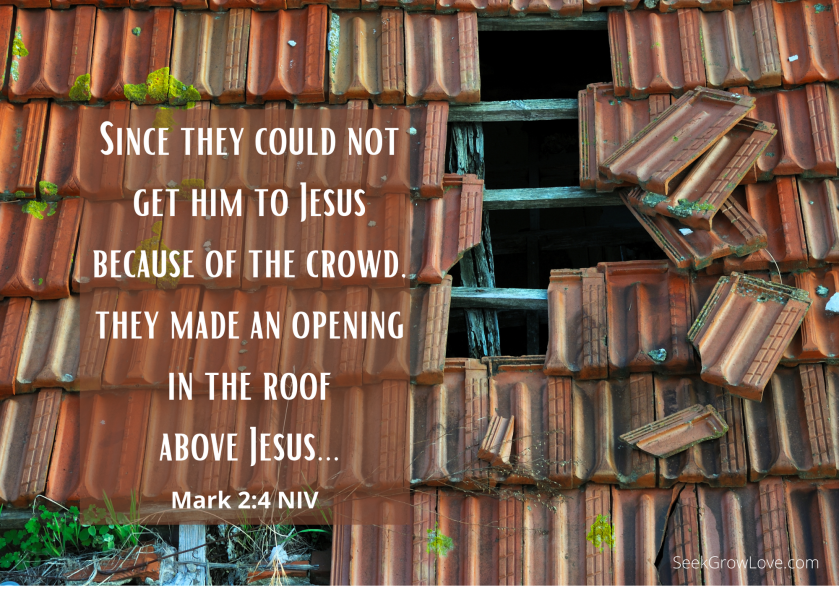
In Mark 2, we find the story of Jesus healing a paralyzed man. Jesus was becoming more well known, and more popular. He was inside a house, and some men brought their friend to Jesus so Jesus could heal him. But because such a big crowd had gathered, there wasn’t room to bring him to Jesus, not even outside the door. So the friends took the man onto the roof, dug through the roof, and let him down in front of Jesus.
I have to admire these friends. They were very concerned about their friend, and wanted to see him healed. They believed Jesus could and would heal him, if they could just get him to Jesus. They didn’t just “pray about it”, they stepped out on faith and did something about it. They dug through the roof, and let their friend get close to Jesus – and Jesus rewarded their efforts.
Mark 2:5 tells us, “When Jesus saw their faith, he said to the paralytic, “Son, your sins are forgiven.” Jesus obviously saw that the man was crippled, but Jesus saw what wouldn’t have been nearly as obvious to us. The man’s biggest problem was his sin – so Jesus healed him of that first. This is the greatest miracle Jesus performed (and still performs).
The teachers of the law said that Jesus was blaspheming, believing only God can forgive sin. I’m guessing they were thinking, “it’s easy to tell someone their sins are forgiven, since you can’t prove they are really forgiven.” Jesus then told them, “But that you may know that the Son of Man has authority on earth to forgive sins…” He said to the paralytic, “I tell you, get up, take up your mat, and go home.” So the man got up, took his mat, and walked out.
I love this story, not only because I love reading about all of Jesus’ miracles, but specifically because this is the only story I can think of where someone is healed because of the faith of his friends. We’re not told, maybe the paralyzed man asked to be taken to Jesus. But any way about it, Jesus saw the faith of the friends, forgave the man’s sins, and ultimately healed him.
This story puts me to shame. I invite you to ask yourself some questions…
Am I this concerned about my friends?
Am I willing to be uncomfortable – maybe even make a scene – to bring someone to Jesus?
Am I willing to not just “pray for” someone, but actually “do something” for someone?
Would Jesus see my faith and forgive and even heal someone I care deeply about?
Finally, do I need Jesus’ ultimate miracle for myself – to have him forgive me of my sins? This miracle meets the greatest need. It costs the most. It brings the greatest blessing. It has the longest lasting results. And Jesus is still doing it daily.
–Steve Mattison
(Originally posted for SeekGrowLove on October 6, 2020)
Ok, we know that things are not going to go well when we read, Now the people complained about their hardships in the hearing of the Lord, … (Numbers 11:1)
Why would they do that? The Israelites grumbled, argued and complained, but this never works out for them. Honestly, if we look at our own lives, are we guilty of this too? Do we show God that we are thankful for our life and the provisions that He gives us? If I may quote Madame Blueberry: “A thankful heart is a happy heart.” But, the Israelites are not thankful, and they are not happy. In Numbers 11, they complained about their hardships in the hearing of the Lord, and when he heard them his anger was aroused. Then fire from the Lord burned among them and consumed some of the outskirts of the camp.
So, surely they adopted a new way of doing things, a new way to react to the situations that arose. Nope.
“The rabble with them began to crave other food, and again the Israelites started wailing and said, “If only we had meat to eat! We remember the fish we ate in Egypt at no cost—also the cucumbers, melons, leeks, onions and garlic. But now we have lost our appetite; we never see anything but this manna!” (verses 4-6)
Wow. Yep that slavery, that was the good life. Sure, they lived lives of servitude, but they had cucumbers.
Unfortunately, this complaining spread until Moses heard the people of every family wailing at the entrance to their tents. The LORD became angry and Moses was troubled. This is where I think we can learn from the way Moses responds. He asked the LORD. He is troubled because he is in a situation that is impossible for him to handle alone. He just has an honest conversation with the LORD. We see him react in the same way that he did in chapter 9 when he is asked a question about the Passover feast. He told the people to wait until he found out what the LORD commanded concerning them. I think that is how all of us should handle hardships. We should talk with God about what ever is troubling us. If we are in a continual conversation with the LORD, we bring him our praises and requests continually too.
Moses told Him that he could not carry all those people by himself; the burden was too heavy. The LORD had a solution for him. The LORD would take some of the power of the Spirit that was on Moses and put it on seventy of Israel’s elders. They shared the burden of the people so Moses did not have to carry it alone. As far as the request for meat, the quail arrived when the LORD said it would. Even Moses did not know how God could do it, but again he talks with God about it. I wonder how things would have gone for the Israelites if they had humbly thanked God for their manna and asked for meat. The LORD could even have thrown in cucumbers if He wanted to. From today’s reading lets be encouraged to pray continually sharing our hardships and praises with God.
-Rebecca Dauksas
(first posted for SeekGrowLove on September 3, 2016)
Reflection Questions
When hardships hit do you spend more time complaining or praying?
If you were a pastor/youth leader or spiritual counselor for the Israelites what issues or problems would you address with them? Which of these problems do you have as well? What could they – and what can you – do to work towards fixing these problems?
What do you learn about the Lord God in Numbers 11?
I love that right after Luke wrote about Cornelius and Peter’s God-orchestrated visit (in yesterday’s reading of Acts 10) he spends the bulk of the next chapter telling all the events again. This time Peter is explaining his actions to the circumcised believers in Jerusalem who were criticizing him for going into the home of an uncircumcised man and and even eating with them. This story is obviously near and dear to the writer’s heart. In Luke’s gospel and his sequel book of Acts how many times did Luke write of the events of the birth of Jesus? Once. How many times did Luke recount the events of Jesus’ death and resurrection? Once. But Luke, the Gentile doctor, perhaps the only Gentile writer of the New Testament (depending on who wrote Hebrews), takes the opportunity to tell this story twice.
For this story – this true factual account complete with times and locations – opened up a new way for Jews and Gentiles. This story had the power to change ministry, to change lives, to save lives – a lot of lives. Now God’s overwhelming love, forgiveness, salvation through the blood of his Son – the Jewish Messiah – and the newly poured out gifts of the Spirit were not just for the circumcised Jews who believed but for anyone in the whole world who would listen and accept and do what is right. God in His mercy and grace can and will and has cleaned up what was thought could never be clean. This is BIG NEWS worthy of retelling.
Did you catch what Luke reports the Gentile named Cornelius was doing when God’s angel appeared to him with a message, that when followed, had the potential to change his life and the lives of his family and the lives of all Gentiles to come? If you aren’t sure, check out Acts 10:30. Did you catch what Luke reports the Jew named Peter was doing when he received the vision (3 times, because once wasn’t enough) that would completely change the brand new life of the early church and Christian movement? If you aren’t sure, it’s recorded in Acts 11:5. I don’t think it is mere coincidence that both of these devout men were praying AT THE TIME when God gave them directions that would change their world.
“Draw near to God and He will draw near to you” (James 4:8).
What might have happened if Cornelius and Peter had been too busy to pray? I don’t doubt that God’s amazing plan would have proceeded, but perhaps through the actions of someone else. What would have happened if either of these men had not followed the directions given to them when they prayed? What if they had just come to God in prayer to quickly deliver their most recent “God Please Do” list and then get on with their day as they had planned? What if Peter had continued with his, “Surely not, Lord” protests because the directions he was receiving weren’t what he expected?
Might there be times we have missed out on God’s life-altering blessings and messages because we didn’t take the time to pray to draw near to God? Are there times when we steal Peter’s line and tell the Almighty, “Surely not, Lord”? Are there people and situations we doubt God can clean? Have you ever tried to stand in God’s way? Are there times we haven’t followed the Lord’s direction because it doesn’t line up with what we were expecting? Maybe we need to hear this story again?
-Marcia Railton
Reflection Questions
What does this account in Acts 10 and 11 mean to you? What do you find amazing about it?
Is your prayer time drawing near to God, not just turning in your most recent “God please do” list? When you pray are you ready to really receive direction from God?
Have you tried telling God, “Surely not, Lord”? Have you tried to stand in His way? Do you more often stand in His way or follow His way?
Sunday I said I love a good underdog story. It just so happens I also love a good battle story – and the Bible does not disappoint. There are many great battle stories in God’s word, including one in today’s reading in Exodus 17 of young Joshua (this is the first time he is mentioned in Scripture) battling the Amalekite army that attacked the Israelites.
My favorite kind of story though are the faith stories. How did God come through and save the day – again? What was needed and how did God deliver? Who was praying, where, and who witnessed the answer to prayer? And, how did they praise God for the answers sent? And – once again – the Bible does not disappoint.
In fact, the battle story of Joshua vs. the Amalekites is also a great faith story. For while we have Joshua leading his very first battle with an army he put together in a day, we also have Moses holding the staff of God on the top of a hill overlooking the battle below. The action on the battlefield is just part of the story. It is the intercession on the hill which is pivotal in the outcome below. ”As long as Moses held up his hands, the Israelites were wining, but whenever he lowered his hands the Amalekites were winning.” (Exodus 17:11) 80 year old Moses wasn’t on the battlefield but he was so important in the events of the day!
The trouble is – fatigue and weariness set in and his arms were getting heavier and heavier. He couldn’t hold up his arms any longer. He couldn’t do it alone. Intercession for the army below was not a one man job. Luckily, Aaron and Hur were on hand, saw the need, and stepped up. They provided a stone for Moses to sit on and with Aaron on one side and Hur on the other, they propped up Moses’ weary arms so that his hands remained outstretched toward heaven.
And at the end of the day (and it did take all day) the Israelites beat back the Amalekites. And it wasn’t just because of the Joshua and his soldiers. And it wasn’t just because of the steadfast intercession of Moses, Aaron and Hur. It was a direct result of all of those AND mostly due to a mighty God who gave the victory. Moses realized this and he gave the glory to God as he built an altar to God and called it, “The LORD is my Banner.”
Does your prayer matter? Yes! There is great power in prayer and too often we take it much too lightly. We might mumble off a few sentences about, “Dear God please be with _____ and help her with ______ today.” But, when was the last time we let prayer and intercession order the events of our day, inconvenience us, or even cause a bit of pain?
What could be changed if we take more seriously the job of lifting our hands to the throne of God? Realizing that prayer is not a one man job, who can we involve in praying with us? If you are currently on the battlefield, who can you ask to lift up hands in prayer for you and the victory you are fighting for? And how will you give the glory to God for sending answers and showing his goodness, power and love.
I am thankful these stories have been written down to for us to learn and remember. And, I love that God told Moses to write the events of that day long ago down for Joshua to remember. How often do we forget how God displayed His goodness and power in our own lives and through the intercession of others? What great faith stories have you witnessed – perhaps as the warrior on the battlefield or perhaps as the intercessor on the hill? Will you write it down?
-Marcia Railton
Reflection & APPLICATION
It is not recorded what specific words Moses may have been praying aloud or silently. In fact the word pray is not included in this passage. Do you think we might focus a bit too much on what words we say in prayer when God is more interested in our heart and arms uplifted to him (not just physically, but spiritually lifting needs to him with a devoted heart)?
There were a lot of questions in the devotion to contemplate. Which ones do you want to spend more time on?
This has been on my mind for awhile now – so today is the perfect day to ask for your help! I would love to compile a collection of written faith stories from warriors and intercessors who have seen the One True God provide the victory – in both big and small ways: the keys were found, the prodigal son returned, the need was met in unexpected ways. Do you have a story you would write down to be shared? If so, please reach out to me so I can read and share your story! You can leave a comment below or find me on facebook or email me at grow16br@gmail.com.
Remember how we recently read in Matthew 5 to SHINE – “before men, that they may see your good deeds and praise your Father in heaven.” (Matt 5:16). And, then we get to Matthew 6 which begins, “Be careful not to do your ‘acts of righteousness’ before men, to be seen by them. If you do, you will have no reward from your Father in heaven.” (Matt 6:1). One says do your good deeds before men while the other specifically says don’t do your acts of righteousness before men. Is there a contradiction there? I want to follow Jesus, I do – but sometimes…I am not exactly sure what it should look like. But, over and over again I find I am the one that needs to grow in my understanding and action. So, let’s dig a little deeper and see what we’ve got here.
In our SeekGrowLove Bible reading plan last year we focused on looking at what we can learn about God or what He reveals about Himself every time we read His words. I learned a lot. I had a great year journaling and marking in my Bible margin little asterisks when I read descriptions of God, what He’s like and what He likes, what He is doing and will do. In the gospels it is extra fun to find all the descriptions of God given to us by one who knows Him so well – His Son Jesus. I have found it can be very valuable to read God’s word not as a checklist of do’s and don’ts but as a search for more and more about our Heavenly Father.
These first 18 verses in Matthew 6 on giving, praying and fasting seems at first to be primarily a lot of direction on what we should be doing – and sometimes what we should not be doing. But, upon looking closer – there are quite a few asterisks in my margins. God, specifically called ‘Your Father’, shows up, again and again. Twice He is referred to as unseen – perhaps in contrast to the Pharisees and religious leaders who enjoyed making themselves very well seen, and perhaps just as a reminder we all need – God is here – don’t be fooled at just concerning yourself with what you can see with your eyes. He is unseen and very real.
In each of the three sections on giving, prayer and fasting Jesus states, “your Father, who sees what is done in secret, will reward you.” So, even though He is unseen, He sees. There are no secrets we can keep from God. He sees it all. And when He sees what He likes – giving in secret to the needy, one-on-one prayer with Him, and fasting in secret – he will reward us. He is real, He sees and He rewards, when we do it right.
So, what is the wrong way to give, pray and fast? They all seem like good deeds to do – should we shine while doing them? Jesus answers that question – give, pray and fast, but don’t do them, “before men to be seen by them.” When we are putting on a holy show to let others know how good we are – that is when God says, “I got nothing for you – you already received your praise from men. You weren’t really looking for My praise anyways. You wanted to look better than the rest. Your pride was lifting yourself up. You weren’t pointing people to a Me. You were just plain showing off and trying to create a name for yourself.” (This was also what the Tower of Babel folks got in trouble for in our Old Testament reading of Genesis 11 today – trying to make a name for themselves).
So, it becomes another heart issue where motive and manner is extremely important. What is your motivation to give, pray or fast? Do you have selfish reasons and are motivated by looking good? Do you do it in a manner to get the most attention and eyes on you? Just remember, God sees, too, and He ain’t happy. Those acts of righteousness were supposed to come from a pure and sincere heart seeking ways to thank, honor and draw closer to your Father in heaven. But you took that sacred interchange between yourself and Him and cheapened it by broadcasting it before men.
But what about those good deeds that we ARE supposed to do before men SO THAT God is praised? It seems the “good deeds” category is different and perhaps broader than the “acts of righteousness” we just discussed. While the acts of righteousness were things we do for and with God (and most appropriately in secret), the good deeds are what we can do for and with others. Motive is still really important. No one (least of all, your Father) wants to see your good deeds that are only done to bring praise to yourself. How do we do good deeds that others will see, and when they do see, they will praise our Father in heaven? Perhaps (like always) the best answer and example is seen in Jesus. As we read through the rest of Matthew let’s look for what he does in secret with and for His Father and what he does before men to bring praise to His Father. What are his acts of righteousness and what are his good deeds? Can we tell what his audience and motives are in each?
-Marcia Railton
Reflection Questions
How are you doing with your acts of righteousness? Do you think God sees and is pleased? What motivates your acts of righteousness – where is your heart? What would you like to do better – for Him?
In Matthew 6:8 what do we learn about your Father? How is this reassuring to you? How can knowing this affect your prayers? What do you learn from Jesus’ model prayer in verses 9-13?
In Matthew 6:14 & 15 what do we learn about your Father and forgiveness? Why is this so important? Is there someone you need to forgive today?