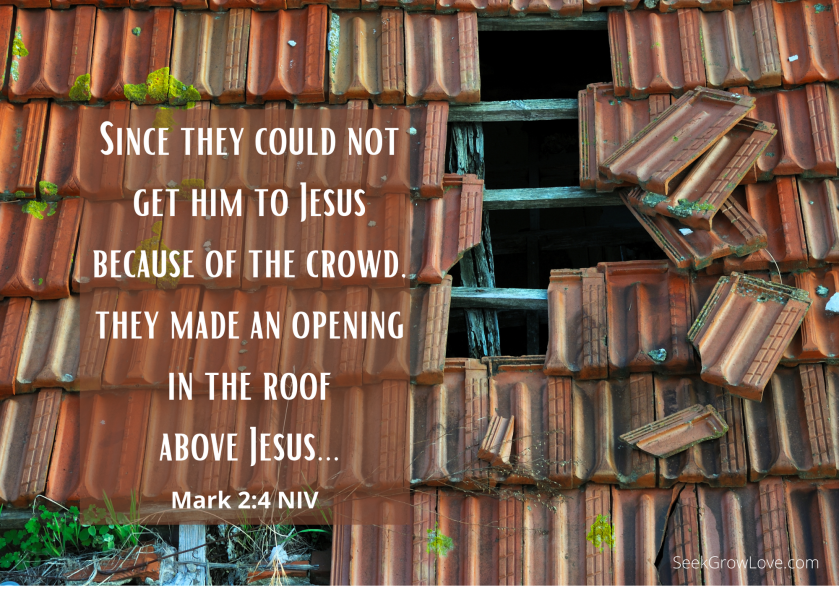
In Mark 2, we find the story of Jesus healing a paralyzed man. Jesus was becoming more well known, and more popular. He was inside a house, and some men brought their friend to Jesus so Jesus could heal him. But because such a big crowd had gathered, there wasn’t room to bring him to Jesus, not even outside the door. So the friends took the man onto the roof, dug through the roof, and let him down in front of Jesus.
I have to admire these friends. They were very concerned about their friend, and wanted to see him healed. They believed Jesus could and would heal him, if they could just get him to Jesus. They didn’t just “pray about it”, they stepped out on faith and did something about it. They dug through the roof, and let their friend get close to Jesus – and Jesus rewarded their efforts.
Mark 2:5 tells us, “When Jesus saw their faith, he said to the paralytic, “Son, your sins are forgiven.” Jesus obviously saw that the man was crippled, but Jesus saw what wouldn’t have been nearly as obvious to us. The man’s biggest problem was his sin – so Jesus healed him of that first. This is the greatest miracle Jesus performed (and still performs).
The teachers of the law said that Jesus was blaspheming, believing only God can forgive sin. I’m guessing they were thinking, “it’s easy to tell someone their sins are forgiven, since you can’t prove they are really forgiven.” Jesus then told them, “But that you may know that the Son of Man has authority on earth to forgive sins…” He said to the paralytic, “I tell you, get up, take up your mat, and go home.” So the man got up, took his mat, and walked out.
I love this story, not only because I love reading about all of Jesus’ miracles, but specifically because this is the only story I can think of where someone is healed because of the faith of his friends. We’re not told, maybe the paralyzed man asked to be taken to Jesus. But any way about it, Jesus saw the faith of the friends, forgave the man’s sins, and ultimately healed him.
This story puts me to shame. I invite you to ask yourself some questions…
Am I this concerned about my friends?
Am I willing to be uncomfortable – maybe even make a scene – to bring someone to Jesus?
Am I willing to not just “pray for” someone, but actually “do something” for someone?
Would Jesus see my faith and forgive and even heal someone I care deeply about?
Finally, do I need Jesus’ ultimate miracle for myself – to have him forgive me of my sins? This miracle meets the greatest need. It costs the most. It brings the greatest blessing. It has the longest lasting results. And Jesus is still doing it daily.
–Steve Mattison
(Originally posted for SeekGrowLove on October 6, 2020)
Ok, we know that things are not going to go well when we read, Now the people complained about their hardships in the hearing of the Lord, … (Numbers 11:1)
Why would they do that? The Israelites grumbled, argued and complained, but this never works out for them. Honestly, if we look at our own lives, are we guilty of this too? Do we show God that we are thankful for our life and the provisions that He gives us? If I may quote Madame Blueberry: “A thankful heart is a happy heart.” But, the Israelites are not thankful, and they are not happy. In Numbers 11, they complained about their hardships in the hearing of the Lord, and when he heard them his anger was aroused. Then fire from the Lord burned among them and consumed some of the outskirts of the camp.
So, surely they adopted a new way of doing things, a new way to react to the situations that arose. Nope.
“The rabble with them began to crave other food, and again the Israelites started wailing and said, “If only we had meat to eat! We remember the fish we ate in Egypt at no cost—also the cucumbers, melons, leeks, onions and garlic. But now we have lost our appetite; we never see anything but this manna!” (verses 4-6)
Wow. Yep that slavery, that was the good life. Sure, they lived lives of servitude, but they had cucumbers.
Unfortunately, this complaining spread until Moses heard the people of every family wailing at the entrance to their tents. The LORD became angry and Moses was troubled. This is where I think we can learn from the way Moses responds. He asked the LORD. He is troubled because he is in a situation that is impossible for him to handle alone. He just has an honest conversation with the LORD. We see him react in the same way that he did in chapter 9 when he is asked a question about the Passover feast. He told the people to wait until he found out what the LORD commanded concerning them. I think that is how all of us should handle hardships. We should talk with God about what ever is troubling us. If we are in a continual conversation with the LORD, we bring him our praises and requests continually too.
Moses told Him that he could not carry all those people by himself; the burden was too heavy. The LORD had a solution for him. The LORD would take some of the power of the Spirit that was on Moses and put it on seventy of Israel’s elders. They shared the burden of the people so Moses did not have to carry it alone. As far as the request for meat, the quail arrived when the LORD said it would. Even Moses did not know how God could do it, but again he talks with God about it. I wonder how things would have gone for the Israelites if they had humbly thanked God for their manna and asked for meat. The LORD could even have thrown in cucumbers if He wanted to. From today’s reading lets be encouraged to pray continually sharing our hardships and praises with God.
-Rebecca Dauksas
(first posted for SeekGrowLove on September 3, 2016)
Reflection Questions
When hardships hit do you spend more time complaining or praying?
If you were a pastor/youth leader or spiritual counselor for the Israelites what issues or problems would you address with them? Which of these problems do you have as well? What could they – and what can you – do to work towards fixing these problems?
What do you learn about the Lord God in Numbers 11?
I love that right after Luke wrote about Cornelius and Peter’s God-orchestrated visit (in yesterday’s reading of Acts 10) he spends the bulk of the next chapter telling all the events again. This time Peter is explaining his actions to the circumcised believers in Jerusalem who were criticizing him for going into the home of an uncircumcised man and and even eating with them. This story is obviously near and dear to the writer’s heart. In Luke’s gospel and his sequel book of Acts how many times did Luke write of the events of the birth of Jesus? Once. How many times did Luke recount the events of Jesus’ death and resurrection? Once. But Luke, the Gentile doctor, perhaps the only Gentile writer of the New Testament (depending on who wrote Hebrews), takes the opportunity to tell this story twice.
For this story – this true factual account complete with times and locations – opened up a new way for Jews and Gentiles. This story had the power to change ministry, to change lives, to save lives – a lot of lives. Now God’s overwhelming love, forgiveness, salvation through the blood of his Son – the Jewish Messiah – and the newly poured out gifts of the Spirit were not just for the circumcised Jews who believed but for anyone in the whole world who would listen and accept and do what is right. God in His mercy and grace can and will and has cleaned up what was thought could never be clean. This is BIG NEWS worthy of retelling.
Did you catch what Luke reports the Gentile named Cornelius was doing when God’s angel appeared to him with a message, that when followed, had the potential to change his life and the lives of his family and the lives of all Gentiles to come? If you aren’t sure, check out Acts 10:30. Did you catch what Luke reports the Jew named Peter was doing when he received the vision (3 times, because once wasn’t enough) that would completely change the brand new life of the early church and Christian movement? If you aren’t sure, it’s recorded in Acts 11:5. I don’t think it is mere coincidence that both of these devout men were praying AT THE TIME when God gave them directions that would change their world.
“Draw near to God and He will draw near to you” (James 4:8).
What might have happened if Cornelius and Peter had been too busy to pray? I don’t doubt that God’s amazing plan would have proceeded, but perhaps through the actions of someone else. What would have happened if either of these men had not followed the directions given to them when they prayed? What if they had just come to God in prayer to quickly deliver their most recent “God Please Do” list and then get on with their day as they had planned? What if Peter had continued with his, “Surely not, Lord” protests because the directions he was receiving weren’t what he expected?
Might there be times we have missed out on God’s life-altering blessings and messages because we didn’t take the time to pray to draw near to God? Are there times when we steal Peter’s line and tell the Almighty, “Surely not, Lord”? Are there people and situations we doubt God can clean? Have you ever tried to stand in God’s way? Are there times we haven’t followed the Lord’s direction because it doesn’t line up with what we were expecting? Maybe we need to hear this story again?
-Marcia Railton
Reflection Questions
What does this account in Acts 10 and 11 mean to you? What do you find amazing about it?
Is your prayer time drawing near to God, not just turning in your most recent “God please do” list? When you pray are you ready to really receive direction from God?
Have you tried telling God, “Surely not, Lord”? Have you tried to stand in His way? Do you more often stand in His way or follow His way?
Sunday I said I love a good underdog story. It just so happens I also love a good battle story – and the Bible does not disappoint. There are many great battle stories in God’s word, including one in today’s reading in Exodus 17 of young Joshua (this is the first time he is mentioned in Scripture) battling the Amalekite army that attacked the Israelites.
My favorite kind of story though are the faith stories. How did God come through and save the day – again? What was needed and how did God deliver? Who was praying, where, and who witnessed the answer to prayer? And, how did they praise God for the answers sent? And – once again – the Bible does not disappoint.
In fact, the battle story of Joshua vs. the Amalekites is also a great faith story. For while we have Joshua leading his very first battle with an army he put together in a day, we also have Moses holding the staff of God on the top of a hill overlooking the battle below. The action on the battlefield is just part of the story. It is the intercession on the hill which is pivotal in the outcome below. ”As long as Moses held up his hands, the Israelites were wining, but whenever he lowered his hands the Amalekites were winning.” (Exodus 17:11) 80 year old Moses wasn’t on the battlefield but he was so important in the events of the day!
The trouble is – fatigue and weariness set in and his arms were getting heavier and heavier. He couldn’t hold up his arms any longer. He couldn’t do it alone. Intercession for the army below was not a one man job. Luckily, Aaron and Hur were on hand, saw the need, and stepped up. They provided a stone for Moses to sit on and with Aaron on one side and Hur on the other, they propped up Moses’ weary arms so that his hands remained outstretched toward heaven.
And at the end of the day (and it did take all day) the Israelites beat back the Amalekites. And it wasn’t just because of the Joshua and his soldiers. And it wasn’t just because of the steadfast intercession of Moses, Aaron and Hur. It was a direct result of all of those AND mostly due to a mighty God who gave the victory. Moses realized this and he gave the glory to God as he built an altar to God and called it, “The LORD is my Banner.”
Does your prayer matter? Yes! There is great power in prayer and too often we take it much too lightly. We might mumble off a few sentences about, “Dear God please be with _____ and help her with ______ today.” But, when was the last time we let prayer and intercession order the events of our day, inconvenience us, or even cause a bit of pain?
What could be changed if we take more seriously the job of lifting our hands to the throne of God? Realizing that prayer is not a one man job, who can we involve in praying with us? If you are currently on the battlefield, who can you ask to lift up hands in prayer for you and the victory you are fighting for? And how will you give the glory to God for sending answers and showing his goodness, power and love.
I am thankful these stories have been written down to for us to learn and remember. And, I love that God told Moses to write the events of that day long ago down for Joshua to remember. How often do we forget how God displayed His goodness and power in our own lives and through the intercession of others? What great faith stories have you witnessed – perhaps as the warrior on the battlefield or perhaps as the intercessor on the hill? Will you write it down?
-Marcia Railton
Reflection & APPLICATION
It is not recorded what specific words Moses may have been praying aloud or silently. In fact the word pray is not included in this passage. Do you think we might focus a bit too much on what words we say in prayer when God is more interested in our heart and arms uplifted to him (not just physically, but spiritually lifting needs to him with a devoted heart)?
There were a lot of questions in the devotion to contemplate. Which ones do you want to spend more time on?
This has been on my mind for awhile now – so today is the perfect day to ask for your help! I would love to compile a collection of written faith stories from warriors and intercessors who have seen the One True God provide the victory – in both big and small ways: the keys were found, the prodigal son returned, the need was met in unexpected ways. Do you have a story you would write down to be shared? If so, please reach out to me so I can read and share your story! You can leave a comment below or find me on facebook or email me at grow16br@gmail.com.
Remember how we recently read in Matthew 5 to SHINE – “before men, that they may see your good deeds and praise your Father in heaven.” (Matt 5:16). And, then we get to Matthew 6 which begins, “Be careful not to do your ‘acts of righteousness’ before men, to be seen by them. If you do, you will have no reward from your Father in heaven.” (Matt 6:1). One says do your good deeds before men while the other specifically says don’t do your acts of righteousness before men. Is there a contradiction there? I want to follow Jesus, I do – but sometimes…I am not exactly sure what it should look like. But, over and over again I find I am the one that needs to grow in my understanding and action. So, let’s dig a little deeper and see what we’ve got here.
In our SeekGrowLove Bible reading plan last year we focused on looking at what we can learn about God or what He reveals about Himself every time we read His words. I learned a lot. I had a great year journaling and marking in my Bible margin little asterisks when I read descriptions of God, what He’s like and what He likes, what He is doing and will do. In the gospels it is extra fun to find all the descriptions of God given to us by one who knows Him so well – His Son Jesus. I have found it can be very valuable to read God’s word not as a checklist of do’s and don’ts but as a search for more and more about our Heavenly Father.
These first 18 verses in Matthew 6 on giving, praying and fasting seems at first to be primarily a lot of direction on what we should be doing – and sometimes what we should not be doing. But, upon looking closer – there are quite a few asterisks in my margins. God, specifically called ‘Your Father’, shows up, again and again. Twice He is referred to as unseen – perhaps in contrast to the Pharisees and religious leaders who enjoyed making themselves very well seen, and perhaps just as a reminder we all need – God is here – don’t be fooled at just concerning yourself with what you can see with your eyes. He is unseen and very real.
In each of the three sections on giving, prayer and fasting Jesus states, “your Father, who sees what is done in secret, will reward you.” So, even though He is unseen, He sees. There are no secrets we can keep from God. He sees it all. And when He sees what He likes – giving in secret to the needy, one-on-one prayer with Him, and fasting in secret – he will reward us. He is real, He sees and He rewards, when we do it right.
So, what is the wrong way to give, pray and fast? They all seem like good deeds to do – should we shine while doing them? Jesus answers that question – give, pray and fast, but don’t do them, “before men to be seen by them.” When we are putting on a holy show to let others know how good we are – that is when God says, “I got nothing for you – you already received your praise from men. You weren’t really looking for My praise anyways. You wanted to look better than the rest. Your pride was lifting yourself up. You weren’t pointing people to a Me. You were just plain showing off and trying to create a name for yourself.” (This was also what the Tower of Babel folks got in trouble for in our Old Testament reading of Genesis 11 today – trying to make a name for themselves).
So, it becomes another heart issue where motive and manner is extremely important. What is your motivation to give, pray or fast? Do you have selfish reasons and are motivated by looking good? Do you do it in a manner to get the most attention and eyes on you? Just remember, God sees, too, and He ain’t happy. Those acts of righteousness were supposed to come from a pure and sincere heart seeking ways to thank, honor and draw closer to your Father in heaven. But you took that sacred interchange between yourself and Him and cheapened it by broadcasting it before men.
But what about those good deeds that we ARE supposed to do before men SO THAT God is praised? It seems the “good deeds” category is different and perhaps broader than the “acts of righteousness” we just discussed. While the acts of righteousness were things we do for and with God (and most appropriately in secret), the good deeds are what we can do for and with others. Motive is still really important. No one (least of all, your Father) wants to see your good deeds that are only done to bring praise to yourself. How do we do good deeds that others will see, and when they do see, they will praise our Father in heaven? Perhaps (like always) the best answer and example is seen in Jesus. As we read through the rest of Matthew let’s look for what he does in secret with and for His Father and what he does before men to bring praise to His Father. What are his acts of righteousness and what are his good deeds? Can we tell what his audience and motives are in each?
-Marcia Railton
Reflection Questions
How are you doing with your acts of righteousness? Do you think God sees and is pleased? What motivates your acts of righteousness – where is your heart? What would you like to do better – for Him?
In Matthew 6:8 what do we learn about your Father? How is this reassuring to you? How can knowing this affect your prayers? What do you learn from Jesus’ model prayer in verses 9-13?
In Matthew 6:14 & 15 what do we learn about your Father and forgiveness? Why is this so important? Is there someone you need to forgive today?
In Los Angeles, you can’t use silly string on Halloween.
In the UK, you can’t “handle salmon in a suspicious manner.”
In Barbados, you can’t wear camouflage. (Sorry, hunting fans!)
However, once you know the context, these laws begin to make sense.
In LA, it cost the city nearly $200,000 to clean up the silly string every year from just Halloween.
In the UK, they were trying to stop illegal salmon fishing, and it’s a crime to take fish that you suspect to have been illegally fished.
In Barbados, the government has decided that the Defense Force are the only people who can wear camouflage (like a uniform) and wearing camo might be seen as an attempt to impersonate an officer.
In Philippians 4, Paul gives a couple commands that, on the surface, seems to make very little sense.
“Rejoice in the Lord always; again I will say, rejoice!” (4:4)
And
“Do not be anxious about anything.” (4:6)
It’s almost like Paul doesn’t know what it is like to be human! We can’t control our emotions. I don’t choose when to be happy, or when to be anxious. Nor does anyone else, though we try ; over 12% of the US population over age twelve take antidepressants and 6% of the population is on anti-anxiety medication. What a strange command that makes very little sense.
Until we add context.
To “rejoice” is not “feel happy” but “find joy in”. Joy is not the ephemeral, fleeting happiness that comes and goes based on what happens to us moment by moment, but the unshakeable reality that God’s desire for us is to be blessed by him forever. Will we have pain, heartache, grief and mourning in this world? Yes, because it is fallen. However, we don’t rejoice because of those things, but in the midst of those things, we are commanded and encouraged to find our joy in God. God’s grace, his gifts, and his promises will always outweigh our pain in the grand scheme of the universe. One day, all will be made new, and the old things will pass away and only the new and eternal will remain.
Similarly, God does not expect us to overcome our worries and cares for the future through sheer willpower ; instead he says “do not be anxious about anything, but in everything by prayer and supplication with thanksgiving let your requests be made known to God.” The command is more than not being anxious, but about being in relationship with the one who overcomes our anxiety, and who overcomes our depression.
I hope this week, as you have been spending 5, 10, or 15 minutes thanking God for the good things in your life, that you begin to recognize that God appreciates your thanksgiving, but also cares about your prayers and supplications. He hears it all and he is always working for your sanctification, your salvation, and your life to be abundant. He is working to bring joy in your life, joy found in what Christ has and will do in you, and to meet your needs so you will not need to be anxious.
APPlication & Reflection
Today, instead of having questions to answer, take the time to
Pray to God.
Give him thanks.
Let him know all that is on your heart that makes joy seem so far away, and all that is on your mind that makes anxiety close at hand.
As you do, may “the peace of God, which surpasses all understanding, … guard your hearts and your minds in Christ Jesus.” (4:7)
It is easy to get to the end of our rope, to find that our cup is empty. In moments like these we became frustrated at best. Our weakness makes our goals out of our grasp. Thankfully, we have someone on our side that can give us strength in our struggle and can fill our cup once more so we are not only capable, but we are ready to meet whatever challenge He has set before us. So the question is, how can we access this power? Here are some scriptures to remind us to stop looking into ourselves but seek the strength of the Lord.
Cry out to the Ever-Present God: We serve a God that is in every place at every moment. That means when his children cry out, He will answer them and can come quickly to their aid. He welcomes our prayers, and our conversations with Him give us strength because we are reminded exactly who we are connected to.
“Where can I go from your Spirit? Where can I flee from your presence?If I go up to the heavens, you are there if I make my bed in the depths, you are there.If I rise on the wings of the dawn if I settle on the far side of the sea, even there your hand will guide me, your right hand will hold me fast.” Psalm 139:7-10
“Lord, do not forsake me; do not be far from me, my God. Come quickly to help me, my Lord and my Savior.” – Psalm 38:21-22
Embracing Jesus as Our Advocate: In our trials and tribulations, we can find strength knowing that Jesus Christ is at the right hand of God, and He understands our struggles. By petitioning in His name, He is mediating for us. Because of this connection, we can speak directly to our Heavenly Father, and furthermore, access the power of His Holy Spirit, which has the power to comfort, heal, and protect those who are washed in the blood of the Lamb.
“Even now my witness is in heaven; my advocate is on high. My intercessor is my friend as my eyes pour out tears to God on behalf of a man he pleads with God as one pleads for a friend.” – Job 16:19-22
“Therefore [Jesus] is able to save completely those who come to God through him, because he always lives to intercede for them.” – Hebrews 7:25
Surrendering to God’s Will: When we submit to the will of God, we are emulating Christ our Savior. Jesus submitted to the will of God every step of the way leading up to His death. God calls us all to be martyrs, not that we all give our lives on a cross, but that we all sacrifice our wills and intentions for Him. God may call us to do a hard thing, but He also gives us the strength to accomplish it when we submit to His will. His alone is sovereign and He alone can empower us to endure.
“Jesus commanded Peter, “Put your sword away! Shall I not drink the cup the Father has given me?” – John 18:11
-Aaron Winner
Reflection Questions
Of the three steps Aaron shared: Cry Out to the Ever Present God, Embrace Jesus as Our Advocate and Surrender to God’s Will, which comes hardest for you?
What would it look like for you to do each of these steps in whatever situation you find yourself in this week? What is the benefit to each of these steps?
Have you even been introduced to someone as God’s fellow worker? It has a nice ring to it, doesn’t it? Paul described Timothy as, “our brother and God’s fellow worker in spreading the gospel of Christ, to strengthen and encourage you (the Thessalonians) in your faith” (1 Thessalonians 3:2). Could you be described as God’s fellow worker?
I am impressed in this chapter (1 Thessalonians 3) with Paul’s obvious heart for his fellow workers (there was a reason they were called brothers even though they had no blood relations) and his heart for the church – some of whom he had not known long and had only spent a short time with. And yet, with the good news Timothy brought of the Thessalonians’ strong faith and love Paul says, “For now we really live, since you are standing firm in the Lord” (1 Thess 3:8). You can hear his heart filled with joy. For now we really live!
Paul had been concerned that when he and his fellow workers moved on to carry the gospel message to other towns the tempter might be successful in tempting the young Thessalonian church away from true faith in God and love for Him and one another. It is a very real and powerful threat that is still active and alive today. It is why the armor of God is so important. Thankfully, the Thessalonians were standing strong.
Another way that Paul shows his heart is through his prayers – night and day – most earnestly – remembering the Thessalonians, praying they might see each other again, and praying that their faith would be strengthened even more. This is an important reminder to keep praying for our brothers and sisters in the church – even if they appear to be doing alright and don’t have any known health problems (often the most common needs on the church prayer list). The tempter is always looking for little cracks in the armor. Prayer is huge. Keep at it. Night and day. Most earnestly. Remember your extended church family in your prayers. Pray for their faith to be strong and growing – with any gaps filled in to present a stronger front against the tempter.
Healthy faith displays action and love. Pray also that love will be increased – love for each other (the church) and also for “everyone else” (vs. 12) including those outside who need to know God and His Son Jesus. Increasing love. Love is a beautiful thing – but increasing love is even so much better. Don’t be content being a loving person – strive and pray to have increasing love. Be a parent, a spouse, a neighbor, a boss, a co-worker, a missionary, one of God’s fellow workers with increasing love. Pray for increasing love for yourself, each other and everyone else.
AND – of course we have to end this devotion as Paul ends every chapter in 1 Thessalonians – REMEMBER – Jesus is coming back!! So live your life preparing for that day! As Paul says so well – “May he strengthen your hearts so that you will be blameless and holy in the presence of our God and Father when our Lord Jesus comes with all his holy ones.” This is my prayer for you – my fellow SeekGrowLove reader. Blameless and holy, I hope to see you there. Come, Lord Jesus, come!
-Marcia Railton
Reflection Questions
Wh0 has been God’s fellow workers with you? What have they done for you and for God? Do they know how much you appreciate them?
How is your faith and love doing – if someone were sent to give Paul a report on you and your church’s faith and love what would Paul hear back? Would he rejoice that you are standing firm? Where can your faith grow, filling in the gaps? How can your love increase?
Pray the prayers of Paul in 1 Thessalonians 3 (for faith filled in, increasing love and blameless/holy people ready to stand/bow before God when Jesus returns) for yourself, and your church family and extended church family. Use specific names God brings to mind. Repeat night and day – most earnestly.
The story of Hannah is touching and interesting how it was the LORD that closed her womb (1 Samuel 1:5) like the other matriarchs. And her husband suggests that isn’t he better than 10 sons? (1:8) She was desperate for a child and yet willing to make a vow to the LORD that if He’d give her one, she’d give him back to serve the LORD! So the LORD remembered her and gave her Samuel. (1:19) The thrill she must have felt and knowing the LORD did it. She worshipped the LORD and prayed, “My heart rejoices in the LORD… because I rejoice in Your salvation.
No one is holy like the LORD, for there is none besides You, …
For the LORD is the God of knowledge.” (2:1-3)
Then she ends her prayer with the hope of the messiah, which is the first time mentioned in the Bible. “The LORD will judge the ends of the earth. He will give strength to His king, and exalt the horn of His anointed. (messiah)” (2:10)
Sometimes we want something so badly and yet need to be ready to give it up, like Hannah did with the very child she wanted. Furthermore, “the LORD visited Hannah, so that she conceived and bore three sons and two daughters.” (2:21) The LORD blessed her with five more children! “And the child Samuel grew in stature, and in favor both with the LORD and men.” (2:26) Sounds familiar with another special messiah in the NT, right?!
“Yes, if you cry out for discernment, and lift up your voice for understanding,
If you seek her as silver, and search for her as for hidden treasures;
Then you will understand the fear of the LORD, and find the knowledge of God.
For the LORD gives wisdom; from His mouth come knowledge and understanding.” (Proverbs 2:2-6)
Jesus spoke of being betrayed by “parents, brothers, relatives, and friends; and they will put some of you to death. And you will be hated by all for my name’s sake. … By your patience possess your souls.” (Luke 21:16-19) We will go through hard times and not be well received by everyone. We can expect it since we’ve been warned ahead of time. “Then they will see the Son of Man coming in a cloud with power and great glory.” (21:27) “Watch therefore, and pray always that you may be counted worthy to escape all these things that will come to pass, and to stand before the Son of Man.” (21:36) Watch and pray and then prayer can burst forth like it did with Hannah in her desperation and in her exaltation!
-Stephanie Schlegel
Reflection Questions
Is there something in your life you desire pretty desperately, like Hannah? And yet, are you willing to give it back to God if He does give it to you?!
What is a difficulty in your life right now that you need to pray about? Sometimes we let a certain matter consume our thoughts and yet we haven’t prayed much about it! Take the time to commit the matter to prayer today!
Today we begin reading the book of Ruth, which is both enjoyable and easy to read; a book without heavy theology to parse. The importance of the book is made plain at its end (for a preview, look to Ruth 4:17), in that it identifies a certain history of the family of the later King David. In that sense, it serves the Old Testament purpose of remembrance. In this case, it establishes a back story for the royal family (which ultimately leads to Jesus himself), but it also shows the providential role of God in that family. Like the passages in the Book of Judges, an important purpose of the text is to remind Israel how God established a relationship with the nation and then provides, cares for, and protects the nation.
Chapter 1 of Ruth provides the context for the remainder of the book: a family’s migration to Moab, and Naomi’s return to Bethlehem with the unexpected companion, Ruth. Chapter 2 is where the action of this story is established, with Ruth going to glean in Boaz’s fields and the repeated acts of kindness that he shows to her. We must also recognize the extent of his kindness as well: Boaz is obligated to leave some of his unharvested crops for the poor (see Leviticus 23:22), but he goes above and beyond this in his instructions to his servants to purposely leave grains for Ruth. She must have been confused, perhaps embarrassed by the kindness of Boaz, but it all leads to Naomi recognizing Boaz:
“The man is our relative, he is one of our closest relatives.” (Ruth 2:20 NASB)
Unfortunately, the depth of the term “closest relative” is not adequately captured in translation. The Hebrew term means “kinsman redeemer” – a family member that satisfies an obligation or vengeance of another in the extended family. Specific examples are the man that, following the Torah, marries his brother’s widow to preserve land inheritance, but also one who redeems a family member from slavery. This usage takes us to a second purpose of the Old Testament: prefiguring. Boaz, as a “kinsman redeemer” for the family of Naomi, prefigures Jesus as the one that redeems his family: Israel and (as we now know) Gentiles grafted in.
One aspect of Ruth that I greatly enjoy is the ordinariness of the spiritual expression of its characters. Without being ostentatious, the characters of the book recognize the providential role of God repeatedly and reflect it back to others to further recognize God’s role in their daily lives. Consider the statement of Ruth and Orpah in 1:8,9:
“May the LORD deal kindly with you as you have dealt with the dead and with me. May the LORD grant that you may find rest, each in the house of her husband.”
It is not enough for Naomi to wish her daughters-in-law success in their presumed departure; she specifically calls on God to give them that success in their new lives.
Then consider the dialogue between Boaz and his servants in 2:4:
Boaz to his servants: “May the LORD be with you.”
Servants’ response: “May the LORD bless you.”
I think the implication is that Boaz and his servants lived lives suffused in the presumption that God would be with them in every action, in every step along every path. Think about it further: Boaz and his servants were not going to war or going on a trip; they were simply going to the fields for the ordinary work of the day. Yet, he begins the day with a blessing on his servants.
In today’s culture, we increasingly compartmentalize our lives, even our spiritual lives. We work for some hours of the day, we take care of our daily obligations, and, hopefully, we set aside time to relax. More than likely prayer is a “carved out” time and time reading scripture may have to be scheduled. The alternative is to suffuse the entire day with the recognition that God is with us at every moment, and that prayer can and should be spontaneous and simple – ordinary. That we can take any moment to request God’s blessing on another.
This reminds me of an experience from childhood that might be odd to some. One summer, sometime in my teenage years, I had taken my youngest sister on a bike ride to the post office ostensibly for an errand, but mostly to be outside. At the post office, we encountered two nuns in the waiting area. (This was not out of the ordinary, there was a very active convent in my hometown.) One of the nuns leaned down, laid her hand on my sister’s head, and spoke a very simple blessing on her. Then she went back to her business, without skipping a beat. For that woman, living a life devoted to serving others in the name of God, speaking a blessing on a young child was utterly ordinary – she simply wanted to express God’s love to a child.
One of the messages of the Book of Ruth is that God is present in all parts of our lives. We can endeavor to purposefully include our appreciation for God for who He is and to share His love for all people in every moment of our day.
-Dan Siderius
Dan Siderius is a member of the Fair Oaks Community Church of God in Virginia. He lives in central Maryland with his wife and daughter and works as a research scientist for a government laboratory. Apart from work and parenting, he enjoys studying history, gardening, and all varieties of cooking.
Reflection Questions
How can you break your spiritual life out of its compartment this week and mix it with your ordinary every day life? What are the benefits to doing so?
How and to whom can you share remembrances of God providing, caring for and protecting? How can you seek to more regularly and often request God’s blessings on others?
In what ways are Boaz and Jesus similar? In what ways are they different?
What do we learn of God, and His Son Jesus, in our Bible readings today?







 Seek Grow Love