Consider the Great Love

OLD TESTAMENT: Isaiah 48-50

*POETRY: Psalm 107

NEW TESTAMENT: James 3:13-18

My family has a book at home called 52 Bible Words Every Kid Should Know by Carrie Mars, and this last week, we read about the word “Psalm.”

One thing that I appreciate about reading things like this with my children or putting together lessons for young kids (teaching preschool is my favorite), is just stopping to examine simply defined truths.  When I personally go to classes, or small group, I do feel I gain things from those – a deeper understanding of things, an opportunity for discussion to hear other viewpoints, etc., but sometimes I miss the simple wonder like I had mentioned earlier this week.

When I am working on kid lessons or readings, they aren’t filled with the in-depth explanations or discussions, they are just boiled down, trying to give kids a foundation to grow from, and circling back to those things as an adult often touches me in a simple way.

In reading this book last week, it talked about how the Psalms show us how we can share all of our feelings with God.  We feel lots of things at different times, and there are psalms that fit so many different feelings.  We don’t have to just bring our good feelings before God – we can bring absolutely everything to Him.  It ends with a simple prayer “God, I’m so glad I can tell You anything.  I praise You for being so wonderful!”  God is wonderful for so many things, and us being able to bring anything before Him is just one of those things.

So let’s look a little at this specific Psalm – the first verse is one that repeats in other psalms (and repeats slightly altered throughout this one), and is a popular (if somewhat older) song:

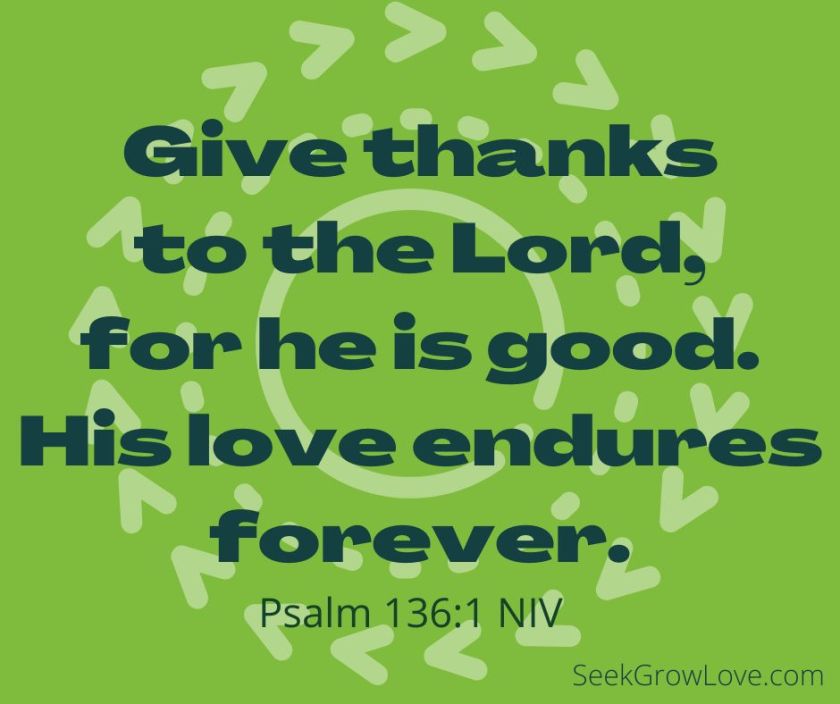
“Give thanks to the LORD, for he is good; his love endures forever.”

It is simple; it is basic.  But God is good!  And He isn’t good the way we might call someone a “good” person.  He is really, truly, and fully good, and one of the most amazing things is that He loves us and that love will last forever.  This isn’t a revolutionary concept if you have been a Christian for a while, but it is a simple truth that can astound you when you stop to think about that.

If you were going to teach that to a child, you would break it down, emphasize how God’s good far surpasses ours, and emphasize how amazing His love is – get them excited about it!  As adults, I find we have heard those things so many times that we often gloss over them, but stop and think.  The great, amazing, good God of the universe loves you, and that love is perfect, and lasts forever.

When I truly stop and think about that, it just blows my mind.  And thinking about that makes it so easy to give thanks to the LORD for who He is.

The psalm ends with this verse:

“Whoever is wise, let him heed these things and consider the great love of the LORD.”

So this is my suggestion to you – slow down, view it through the simplicity of a child’s eyes, and consider the great love of the LORD.

~Stephanie Fletcher

Reflection Questions

  1. What feelings will you bring before God today? Are there some feelings you have that you typically don’t bring to Him?
  2. Make a list of what God does in Psalm 107. In this psalm how do we see God displaying His love? Which ones apply to you? How else could you describe what God has done for you? How will you give thanks to God for His love and mercy?
  3. How many times does this Psalm tell us that the thankful redeemed tell others about God’s love and what He has done?
  4. How would you describe God’s love and mercy to a child you know? How would you describe His love to an adult? What and how can you share at church about God’s love? Outside of church, who and how can you tell about God’s love?

Questions, Questions, Questions

Old Testament: Joel 1

Poetry: Psalm 103

New Testament: 2 Timothy 1

Some days do you feel like you have more questions than answers? Me, too. But, that’s okay. Because, actually, every educator knows that when we can ask and eventually start to answer some really good questions on our own we learn a lot more than if we just read someone else’s answers. So, today, I have NO answers for you. But instead, here’s a whole devotion full of some reflection questions to get us thinking more about Psalm 103, a beautiful psalm of David. In our Bible reading plan we are going to spend today and the next four days reading and re-reading Psalm 103 so today we will just include questions for the first 5 verses but go ahead and read the whole Psalm over and over this week.

So, let’s open up our Bibles and start to look at Psalm 103 verse by verse. Besides thinking about these questions below – what other great questions can you think of?

VERSE 1 – How many times is the word “praise” repeated in this Psalm? What is praise? What does it look like to praise God with “all my inmost being”? How deep does your praise go, or is it more often somewhat shallow? What would be needed to praise the Lord with your inmost being – and do it more regularly? What makes God’s name holy? Do you treat it in a holy manner?

VERSE 2 – What are at least ten (feel free to list more) of the “benefits” God has given you personally? Which ones do you often take for granted? How can we work at not forgetting them – or the God who gave them? What happens when people DO forget what God has done and given to them? What is the relationship between praising and thanking and remembering?

VERSE 3 – Have you asked for and accepted God’s forgiveness for ALL of your sins? How does asking for God’s forgiveness look different now compared to what it looked like when David wrote these words? Why does God want to forgive you of all of your sins? What would it be like to serve a god who loved but never forgave? What diseases (perhaps some physical and some not) has God healed?

VERSE 4 – What does the word “redeem” mean? What pit does God redeem you from? King David says that God “crowns you with love and compassion”. What does it mean to you to be crowned by God – with His unfailing love and compassion? How does it feel? Why do you think He does it? What would it be like to serve a god who forgave but never loved? How would you explain this verse to a kindergartener?

VERSE 5 – What desires have you had that God has already satisfied with good things – perhaps in the way you were imagining, perhaps in another way? What can we learn from David in a similar (but slightly expanded passage) about the desires of our heart – Psalm 37:3-5? What desires are you still waiting for God to satisfy? What do you do while you wait (see Psalm 37)? Might that change what you desire? What might King David be thinking of/imagining/feeling/experiencing when he writes about God satisfying desires, “so that your youth is renewed like the eagle’s”? It might depend on what your actual age is, but have you ever felt like God’s blessings were knocking years off your life, renewing you, or just plain, helping you soar? Where would you be without God’s goodness and generosity in your life? How do His blessings renew you?

What can we learn about God in His Word? What can we learn about our relationship with Him?

Thank you for trying something new with us today. Enjoy your time in Psalm 103! Is there someone you can start a conversation with today by asking them a question about Psalm 103?

-Marcia Railton

Will You Stand Firm or Topple?

Old Testament: 2 Chronicles 13-14

Poetry: Psalm 95

New Testament: 2 Thessalonians 2

            Psalm 95 encourages praise and worship to the LORD with joy and thanksgiving. When I was in upper elementary school, I was challenged to make note of three things I was thankful for every day. I gave the same challenge to those who attended Family Camp at the end of my sermon Sunday night. I challenge you today to find at least three things you are thankful for and lift them up to the LORD in praise. 

            In 2 Chronicles 13 and 14, you read about the reign of Abijah and Asa, kings of Judah. Unlike King Rehoboam who did evil in the eyes of the LORD, these two both pointed the people back to God, but in different ways. Abijah focused on the fact that the Levites were still faithfully serving and teaching in the temple. He recognized the faults of the king of Israel for having false priests who were not faithful to the LORD most high. King Abijah recognized who God was and the implications that had on the people of Judah. King Asa went farther than King Abijah by removing anything that was meant for idol worship. He also commanded the people to seek God and follow His law. Under both these kings, the nation of Judah was prosperous and had great success when defending their land. They recognized and encouraged truth among the nation. 

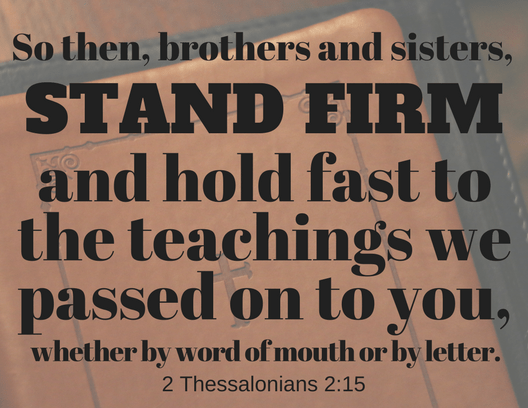
            2 Thessalonians 2 warns against a man of lawlessness who will say he is higher than God as well as encourage lawlessness and wickedness. This man is not like the kings you read about in 2 Chronicles. He will lead people away from God instead of towards God. Paul writes in verse 15 “So then, brethren, stand firm and hold to the traditions which you were taught, whether by word of mouth or by letter from us.” The way to combat this lawlessness is to stand firm in what you have been taught. Abijah stood firm in what he had been taught about God being with the people of Judah. Asa stood firm in what he had been taught by pointing people back to following God’s commands. Both successfully and literally fought off those who were against God. 

            This is going to look different within your own life. Instead of fighting a nation, you are fighting on an individual level. 1 Peter 5:8-9 says “Be alert and of sober mind. Your enemy the devil prowls around like a roaring lion looking for someone to devour. Resist him, standing firm in the faith, because you know that the family of believers throughout the world is undergoing the same kind of sufferings” (NIV). Temptation will come your way. Lawlessness approaches. Luckily, the Bible warns against that happening so you can be prepared to stand firm in your faith just like Abijah and Asa. One way you can be prepared to stand firm is doing what I challenged you to do at the beginning of this devotional. Finding the good in life that you can praise God for doing. Recognizing His presence and work within your life helps combat against the negativity of the world.

            Judy Hopps, from the movie Zootopia, is a good example of how your mentality can help you stand firm or be swayed. Judy is a small bunny whose childhood dream was to become a cop. She worked her hardest to pass from the police academy. She continued to work towards her strong desire to do good even when everyone around her didn’t think she could do it. When she ended up as a meter maid, she still tried to keep a positive attitude about her situation to stand firm in her convictions of doing good as a police officer. If you’ve seen in the movie she doesn’t always have that attitude and when she doesn’t, it doesn’t go well for her. Her joy and determination were completely gone so she ended up giving up. Judy lost her strong stance and fell. 

            The same can be true within our own lives. Not only should we know and understand the scripture in order to be firmly rooted in truth, we must also be firmly rooted in thanksgiving and praise. Recognizing God’s work in your life will help you stand firm. Having both knowledge and an attitude of thanksgiving, your foundation will be deeply rooted and ready for whatever comes. Like Paul warned against, a lawless one will come. He will spread lies and try to topple believers. You must stand firm in your faith like the good kings of 2 Chronicles. Knowing what is within the Word will help you stand firm, but having a heart of praise will keep you close to God and your attitude in a positive place. 

-Makenna Landry

Reflection:

1 – What are three things you can praise God for today?

2 – How has thankfulness helped you stand firm when the world seems bleak?

3 – What stood out to you the most in the lives of King Abijah and King Asa? 

He Answered Me

Old Testament: Jonah 2

Poetry: Proverbs 31

New Testament: Luke 11:14-54

What do you find in every one of the four chapters of Jonah?

Not a great fish – but prayers.

And, chapter 2 is just about all a prayer from the prophet Jonah to his great big God – while he waits, inside the belly of a fish sent by God.

What might you pray if you ever were to find yourself in such a predicament, or an equally stuck and potentially stinky one? What predicaments have you found yourself in that shared some characteristics, even though there were several differences, too? What did you pray for in those instances? I am guessing my prayer would include a whole lot of “Get me outta here, God!” If there is one type of prayer that most of us seem to have mastered, perhaps it is the prayer for deliverance. Lord, deliver us from sickness, from unemployment, from stress and anxiety, from dysfunctional families, from bad grades, from disgrace, and yes, from evil, and the list goes on. Turns out there are a lot of places we do not want to be – including inside the belly of a great fish.

But I find the prophet who was trying to run away from God in chapter 1 has a lot to teach me about prayer in Jonah chapter 2.

I am guessing that given 3 whole days and nights Jonah had the perfect opportunity to say a lot of things to God. He might have very well included some prayers for deliverance. But, that is not what is recorded in the 8 verse prayer of Jonah 2. Jonah sees and recognizes and gives God thanks for taking care of him, thus far. He sees the belly of the great fish not as a trap but as one more step of God’s merciful path toward salvation. And he thanks God. It could have been so much worse. He would have been at the bottom of the ocean, lifeless. But God has sent salvation. (Maybe that was the name of the fish?) He delivered from the deep. He provided a spiritual time-out for Jonah. He helped Jonah put his life and his death into perspective to see again God’s greatness and the privilege we have to follow Him, to fulfill our vows to Him, even into the scary land of the Ninevites (but more on that tomorrow.)

-Marcia Railton

Reflection Questions

  1. What conversations could you have with God for three days and three nights if you removed all distractions around you except those that could be found inside the deep dark belly of a great fish? How could you create and take advantage of a spiritual time-out to meet with God for an extended time?
  2. In the midst of your big fish, or when you felt you were sinking, what have you/can you thank God for?
  3. When did you need a reminder that “Salvation is from the Lord.” How did Jonah know that to be true? How do you?

Thankful for Their Legacy

OT: Joshua 3

Poetry: Psalm 45

NT: Romans 16

Last Friday marked one year since my father lost his battle with a terrible neurodegenerative illness. My sisters and I had helplessly watched him decline for over a decade, advocating intensely during that time to help him get the complex care he desperately needed while grieving the slow waning of our once-healthy father. Then, three days after Easter, our dad succumbed to his illness and was finally able to rest from this broken world. 

We sisters all shared a lot of our fond memories of our dad at his memorial service: his love for the color yellow, his affinity for hiking in nature, his proclivity to play practical jokes on unsuspecting coworkers and family members, his devotion to his daughters. As I remembered his life, I also considered what I would want written in my epitaph. What do I want people to say about me at my memorial service? What kind of legacy do I hope to leave? While considering my own funeral might sound a bit morbid, it is important to remember that we are mortal, our actions in this lifetime can have consequences (for the good or the bad), and we need to be focused on our mission for Christ. 

Perhaps, like me, you tend to skip over chapters like Romans 16, in which Paul is just thanking and saying hello to some random people with difficult-to-pronounce names, much like we might skip over the Acknowledgements section of a book. However, I encourage you to read it again, focusing on how all of these people were important to Paul and his work in some way. They all left a legacy, built a foundation for the early church. Paul didn’t complete his great missionary journeys alone; there were countless people supporting him in various ways the whole time. Some of the people were mentioned elsewhere in scripture; some of the others we have never heard of before, but they were all instrumental in the ministry work that Paul was doing, so he wanted to thank them publicly. (This is a good reminder to me that we need each other for help and encouragement, and we should offer gratitude to those people who have made a difference in our lives, especially those who encourage us in the ministry.) This chapter is a testament to the devotion of the early believers who helped spread the message of Jesus so we can all be believers today! And even though these are just names to us now, they were real people doing real work for the Kingdom, and their names are still being read thousands of years later. What a great legacy!

As followers of Jesus, we also have a hope beyond the grave. This life is not all that there is! We have a hope for resurrection and eternal life in the Kingdom with God and Jesus, and we are called to share that hope with others during our lives. Take another peek at the poetry reading for today. The explanation under the heading of Psalm 45 states that it was a wedding song, but many scholars also believe that it actually has some parallels to our Messiah and the hope of the coming Kingdom, the wedding feast of the Lamb (Jesus) with his Bride (the Church). What comparisons do you notice between the poem and the coming Kingdom? 

So, let’s keep living with an eternal perspective, focusing on the work God has called us to do, leaving a legacy for Him by contributing to the work of His Church. 

-Rachel Cain

Reflection questions:

-Who has been an encouragement and support to you as you seek out and pursue the work God has for you? How can you thank them?

-What do you hope is written in your epitaph? (What kind of legacy do you want to leave?)  What can you do this week to further develop or strengthen your legacy?

Handling Hardship

Numbers 11:23 NIV for SGL

Old Testament: Numbers 11

Poetry: Job 10

New Testament: Acts 24

Ok, we know that things are not going to go well when we read, Now the people complained about their hardships in the hearing of the Lord, … (Numbers 11:1)

Why would they do that? The Israelites grumbled, argued and complained, but this never works out for them. Honestly, if we look at our own lives, are we guilty of this too?  Do we show God that we are thankful for our life and the provisions that He gives us?  If I may quote Madame Blueberry: “A thankful heart is a happy heart.”  But, the Israelites are not thankful, and they are not happy.  In Numbers 11, they complained about their hardships in the hearing of the Lord, and when he heard them his anger was aroused. Then fire from the Lord burned among them and consumed some of the outskirts of the camp.

So, surely they adopted a new way of doing things, a new way to react to the situations that arose. Nope.

“The rabble with them began to crave other food, and again the Israelites started wailing and said, “If only we had meat to eat!  We remember the fish we ate in Egypt at no cost—also the cucumbers, melons, leeks, onions and garlic. But now we have lost our appetite; we never see anything but this manna!” (verses 4-6)

Wow. Yep that slavery, that was the good life. Sure, they lived lives of servitude, but they had cucumbers.

Unfortunately, this complaining spread until Moses heard the people of every family wailing at the entrance to their tents. The LORD became angry and Moses was troubled. This is where I think we can learn from the way Moses responds.  He asked the LORD.  He is troubled because he is in a situation that is impossible for him to handle alone.  He just has an honest conversation with the LORD. We see him react in the same way that he did in chapter 9 when he is asked a question about the Passover feast.  He told the people to wait until he found out what the LORD commanded concerning them. I think that is how all of us should handle hardships.  We should talk with God about what ever is troubling us. If we are in a continual conversation with the LORD, we bring him our praises and requests continually too.

Moses told Him that he could not carry all those people by himself; the burden was too heavy. The LORD had a solution for him. The LORD would take some of the power of the Spirit that was on Moses and put it on seventy of Israel’s elders.  They shared the burden of the people so Moses did not have to carry it alone. As far as the request for meat, the quail arrived when the LORD said it would.  Even Moses did not know how God could do it, but again he talks with God about it. I wonder how things would have gone for the Israelites if they had humbly thanked God for their manna and asked for meat.  The LORD could even have thrown in cucumbers if He wanted to.  From today’s reading lets be encouraged to pray continually sharing our hardships and praises with God.

-Rebecca Dauksas

(first posted for SeekGrowLove on September 3, 2016)

Reflection Questions

  1. When hardships hit do you spend more time complaining or praying?
  2. If you were a pastor/youth leader or spiritual counselor for the Israelites what issues or problems would you address with them? Which of these problems do you have as well? What could they – and what can you – do to work towards fixing these problems?
  3. What do you learn about the Lord God in Numbers 11?

Still Giving Thanks

Old Testament: Daniel 9,10

Poetry: Psalm 118*

New Testament: Matthew 4

In our homeschool history lessons, my children and I have been learning about much of the world exploration that happened following the Reformation. Prior to this time period, two entire continents – North and South America – were largely unknown to the charted world. When there was religious persecution in England, the Puritans, who believed they should be able to worship God in their own way rather than under the thumb of the Church of England, decided to venture to the New World, where they could be truly free. Explorers had already paved the way for their travels; some colonies survived, but some did not. These Pilgrims were supposed to arrive at an existing Virginian village, but because a fierce storm blew The Mayflower off course, they ended up in Massachusetts instead. Their journey was wrought with difficulties, but they were careful to make note of God’s provision along the way, such as providing a kind Native American named Squanto who knew English (as a result of his own hardship of being sold into slavery in England for a time) and taught them how to grow food and survive the winter. Though half of the Pilgrims died that first year, they joined with their new Native American family after the first fall harvest to give thanks to God for his blessings. 

Psalm 118 begins and ends with praise; what a great reminder of how we should start and finish each day! It continues on to tell of difficulties and challenges, but immediately shares how YHWH God showed up each time, a reminder of His faithfulness and provision. 

Last week, many of us gathered to thank God for our blessings, remember the historical first Thanksgiving, and express gratitude for our religious freedom. Thanksgiving is perhaps my favorite holiday; it’s often a simple gathering with a mighty feast of both food and gratitude. My favorite part of the day is participating in the Cain family prayer song. Before we dig into our meal, thirty or more of us – original Cains, their spouses and families and extended families, and many friends – hold hands and sing “Give Thanks with a Grateful Heart” in a variety of harmonies. This sends shivers through my body as it reverberates through the large room that was once a church sanctuary and in which there have been countless prayers offered and innumerable songs sung. I always think of the bookend verses of Psalm 118 (verses 1 and 29, NIV) on Thanksgiving, but it is wise to remember at the beginning and end of every day of the year: “Give thanks to the LORD, for he is good! His faithful love endures forever.” 

Reflection:

-Commit to memory the first and final verses of Psalm 118. Then practice saying them as you wake up for the day and as you tuck yourself back into bed at night.

-Gratitude is an attitude! How can you cultivate more gratitude? 

Rachel Cain

Remembering & Responding

*Old Testament: Daniel 5,6

Poetry: Psalm 116

New Testament: Matthew 2

Last Thursday, my fellow Americans and I demonstrated our gratitude for life’s blessings by stuffing our faces with stuffing, turkey, mashed potatoes, corn, and pie. Thanksgiving Day is a special time to remember not only our national heritage which includes the original Thanksgiving celebration of religious freedom and God’s providence of 400ish years ago, but also to reminisce about our own individual blessings. Sometimes we get so caught up with the ins and outs of life that we fail to remember how far we have come, the blessings that we have, the answered prayers and faithful love of our Father in Heaven. As we’ll see, we are not the first people in history to be so flaky and forgetful. 

In Daniel 5, we see King Nebby’s son, Belshazzar, ruling the kingdom. While drinking with his nobles out of goblets stolen from the Holy Temple, he notices a hand – just a hand – writing words on the wall. Flushed with terror, he promises a reward to whomever can interpret the cryptic message. Daniel, famous for having “power from the gods,” was summoned. Though his true interpretation of the text signified the imminent death and defeat of the current king, he was given a position of power, as promised. 


Daniel remained a leader for the new king, Darius. Because YHWH had blessed Daniel with wisdom and leadership qualities, it was widely assumed among the king’s men that Daniel would soon be given even more power than they had. Consumed with jealousy, they had to find a way to get rid of Daniel, but they could find no fault in him. 

…Except, there was that one thing: Daniel still prayed three times a day to the One True God. Maybe, if they could just get the king to sign a decree that everyone pray only to him, they could trap Daniel and get rid of him for good! 

Approaching the king with flattery to kindle the flame of his pride, the king’s leaders – minus Daniel, of course – recommended that the king enact a 30-day irrevocable law that people could pray only to King Darius. (Finally, a sure-fire way to trap their nemesis, Daniel!) The king signed the law, and the men immediately spied on Daniel. 

It didn’t take much spying, though. The men knew that Daniel always prayed at the window facing Jerusalem, and just as they suspected, his knowledge of the new law did not alter his commitment to this spiritual discipline and his allegiance to the True King. 

Giddy with pride at the simple success of their scheme, the men came back to the king, reminded him of the law, and tattled about Daniel’s offense. Darius, who considered Daniel a friend, was replete with regret. Aware that even he could not change his law, the king ordered Daniel thrust into the den of hungry lions, but offered one last hopeful prayer: “May your God, whom you serve continually, rescue you!” (6:16, NIV).  

Cue the children’s picture Bibles to show cute, cuddling lions purring on Daniel’s lap; maybe Daniel rubbed their bellies (a favorite pastime of my late cat, Maximus) or perhaps the lions just basked calmly in the ray of sunshine, as cats tend to do for the majority of their lives. However, that was not the case. The Bible states that an angel held shut the mouths of lions. Perhaps the angel was even wrestling with the powerful big kitties all night long to keep them from eating Daniel!  

Darius couldn’t sleep at all that night. As soon as dawn broke through, he scurried to the den to find out if Daniel’s God had miraculously saved his friend. The king was overjoyed when he heard Daniel’s voice and found him unharmed! Indignant at their trickery, Darius ordered the accusers to be thrown into the den, along with their families, who were mauled by lions before they even reached the bottom of the cell. Through this miracle, King Darius recognized YHWH as the One True God and decreed that his kingdom would follow YHWH, the God of Daniel. 

As a lover of all cats large and small, this story has always been a favorite of mine. I also noticed that the kings – and other characters – in the Bible have been as wishy-washy as a cat (“Pet me! Now stop or I’ll attack you! I’m hungry again! No, I want beef chunks in gravy, not beef pate!”) in the way they continue to forget or reject YHWH and then turn from their ways when they witness His power. Do they not remember? Did they learn nothing from the kings before them? Surely these events about hangry lions not eating a captive meal and three men (and an angel) walking around in a blazing furnace went down in history as turning points in their culture! It reminds me of the ridiculous cycle of the Israelites wandering in desert who would turn from the One True God, then come running back to Him when He allowed bad things to happen, then promised to always follow Him, and then forgot and worshiped other gods, and then He let their enemies attack them, and on and on and on… I feel no pity for the Israelites because they just keep on forgetting their One True God, but then I realize: how fickle am I sometimes, too. I am human; you are human; we all fail. We all forget to remember the faithfulness of our Father. We cease seeking Him when we need Him most. We, too, are like the amnesiac Israelites and the arrogant kings of the Old Testament. 

Thankfully, our reading from Psalms reminds us that “the LORD is gracious and righteous; our God is full of compassion…” (116:5, NIV). So as we depart today, let us not dwell on our offenses, but, with gratitude, ponder the question posed a few verses later (vs 12):  “What shall I return to the LORD for all His goodness to me?”

Reflection & Application: 

– Make a list of how you have seen the goodness of God, those recorded in the scriptures and in your own life, and pray about how He wants you to serve as a result of his faithfulness and grace, to share His love and joy with others. 

-Write out answered prayers and/or things for which you are grateful. Post it where you can see it. 

-Thank our Father in Heaven for His forgiveness and kindness when we forget and stray. How can you offer His grace to someone in your life today?

Rachel Cain

The Final Thanksgiving

Theme Week – Thanks: Revelation 11

Old Testament: Daniel 1 & 2

Poetry: Psalm 114

Revelation is one of my favorite books in the Bible. It’s weird. It’s full of metaphor and symbolism. There is warfare, warriors, and a dragon defeated by a King upon a horse. 

But you just read all this! 

I want to end our week on thanks with the words of Revelation 11. 

At the end, when the kingdom comes at the sounding of the last trumpet, the voices in heaven say “The kingdom of the world has become the kingdom of our Lord and of his Christ, and he shall reign forever and ever.” There is no wait, no delay, no other kingdoms. Every kingdom good or bad, across all of time and around the world, will now be the righteous, holy, eternal kingdom of God. 

Of course the elders fall on their faces and worship God with thanks! Notice what they call the Lord God Almighty, “who is and who was”. No longer is the the one who is coming; he is HERE! He has taken power, he is going to reign. There will be judgment, yes, but it is also time for the saints, the prophets, and the God-fearers from every time and place to be rewarded. 

My friends, you who desire to seek God through his word, grow through the word you read, and love God, his Christ, and your brothers and sisters because of what you read, you are in this promise. Today, I ask that you thank God not for what he has done or even what he is doing, but what he will do. In Revelation 11, we get to see a glimpse of the joy of those who love God because the God of all joy has arrived to be with his people. 

Give thanks that God in the ages past created a good world, with great care, empowering humanity to carry his image. 

Give thanks that God gives faith, hope, and love through Jesus Christ and salvation in his name, and that God takes the the brokenness and pain of life and turns it into something beautiful. 

Give thanks that God will rule over the world, that God will destroy all wickedness, death, destruction, and pain, and that God will allow only righteousness, life, flourishing and joy to remain. 

Give thanks to God today!

Reflection Questions

  1. How long did you spend in prayerful thanksgiving this week? Did you keep track of everything for which you gave thanks? How many different items did you think of?
  2. How many of the things for which you gave thanks were about what God has done in the past? What God is doing now? What about what God is going to do in the future?

-Jake Ballard

Jake Ballard is pastor at Timberland Bible Church. If you’d like to hear more from him, you can find Timberland on Facebook (https://www.facebook.com/TimberlandBibleChurch/ ) and on Instagram (https://instagram.com/timberlandbiblechurch?igshid=t52xoq9esc7e). The church streams the Worship Gathering every Sunday at 10:30. Besides studying and teaching God’s word, he is raising three beautiful children with the love of his life, is a big nerd who likes fantasy (Pendragon), sci-fi (Star Wars) , and board games (Dungeons and Dragons). If you’d like to reach out to talk Bible, talk faith, or talk about your favorite nerdy things, look Jacob Ballard up on Facebook (https://www.facebook.com/jacob.ballard.336 ) or email him at  jakea.ballard@yahoo.com
God bless you all!

Christ Jesus and Thanksgiving

Theme Week – Thanks: 1 Timothy 1

Old Testament: Daniel Introduction found below

Poetry: Psalm 113

Thanksgiving is a cultural institution; something like 85% of Americans typically partake in the holiday, and in 2022 we spent $1.27billion on Turkeys. Just. Turkeys. 

But when we celebrate thanksgiving, that means we give thanks *to someone*. It *might* be possible to just have a thankful attitude generally, but that’s not thanksgiving. Thanksgiving is giving thanks. And when 85% of Americans celebrate and only 81% believe in God, our culture tends to treat thanksgiving as a time to give thanks to our loved ones, or to be thankful generally. 

As Christians, however, we give thanks to someone. Or someones?

During this week, most of our focus and attention was given to giving thanks to God. 

Giving thanks because it is our duty to the God who gives us all things. 

Giving thanks because it allows our eyes to be open and our minds to be holy toward God.

Giving thanks for our generous blessings during our every time of prayer and to give thanks in every circumstance. 

But when we give thanks, there are times that our thanks should spill out to God’s Son as well. 

In 1 Timothy, Paul says, “I thank him who has given me strength, Christ Jesus our Lord.” (1:12) When we look to Jesus, he sends the Spirit in Acts, he provides wisdom to his people, he provides the Revelation to John. Our Lord Jesus Christ is STILL the empowering, teaching, revealing King of God’s Kingdom. Christ appointed Paul to service (1:12). It is the grace of Jesus, our Lord, that overflowed onto Paul. (1:14) The one who looked upon those who were crucifying him and said “Father, forgive them” is the one who looks upon us, the blasphemer, the persecutors, the insolent opponents to his grace, and still forgives, still gives grace so that faith and love overflow. 

Today give thanks to God, of course. But think about the mercy, grace, love, forgiveness and sacrifice of Jesus, and thank him for his grace. His intercession on your behalf in heaven will be honored when we recognize what he has done for us. 

-Jake Ballard

Reflection and Application

  1. Accurate Thanksgiving : When you give thanks to God and Jesus, it is helpful to distinguish the way they bless you individually. While Jesus empowers Paul and calls him to service, he ends this section in 1 Timothy with “to the King of the ages, immortal, invisible, the only God, be honor and glory forever and ever. Amen.” That is CLEARLY not speaking about Christ, but about his Father, God. Today, for what can you thank God? (Maybe, creation) For what can you thank Jesus? (Maybe, his sacrifice.)
  2. Giving thanks for forgiveness : Christ Jesus came into the world to save sinners, of whom I am the foremost. My friends, we should all say this in unison with Paul. We should see our sin as the most grievous, as the worst. We should consider ourselves as the chief of sinners. Even then, God is saving you through Jesus. Take the time to consider that salvation and give God and his Son thanks today. 

Daniel Introduction

The book of Daniel was written by the prophet Daniel (whose name means “God is my judge”) while in exile in Babylon from 605 BC until 536 BC.  Daniel was among the group of “Israelites from the royal family and the nobility – young men without any physical defect, handsome, showing aptitude for every kind of learning, well informed, quick to understand, and qualified to serve in the king’s palace”.

The Book of Daniel is a fascinating and exciting mix of history (chapters 1-6) and prophecy (chapters 7-12).  Chapter 1 starts by giving Daniel’s example of how to live a Godly life while surrounded by evil influences.  Chapter 3 is Shadrach, Meshach, and Abednego’s example of Godliness despite persecution.  

Daniel contains some well known stories, including:

Chapter 3 – the fiery furnace

Chapter 5 – the writing on the wall

Chapter 6 – Daniel in the lion’s den

Daniel chapters 7-12 are prophetic, prophesying about the rise of world powers after Babylon, including: Medo Persia, Greece, …, and eventually prophesying about the Great Tribulation, and ultimately the resurrection of the dead and the Kingdom of God. 

The book of Daniel highlights the fact that God is in charge.  2:21 says, “He [God] changes times and seasons; he sets up kings and deposes them.”  4:34-35 says, “…His [God’s] dominion is an eternal dominion; his kingdom endures from generation to generation.  All the peoples of the earth are regarded as nothing.  He does as he pleases with the powers of heaven and the peoples of the earth.  No one can hold back his hand or say to him: ‘What have you done?’“

It’s important to remember that in the end, God wins.  This will be particularly important as persecution arises, as we see in 11:33-35, “Those who are wise will instruct many, though for a time they will fall by the sword or be burned or captured or plundered.  When they fall, they will receive a little help, and many who are not sincere will join them.  Some of the wise will stumble, so that they may be refined, purified and made spotless until the time of the end, for it will still come at the appointed time.”

-Steve Mattison