We’ve all heard the saying, “it’s the thought that counts.” Intentions matter. That’s what Jesus is getting at in today’s scripture reading in Mark 7.
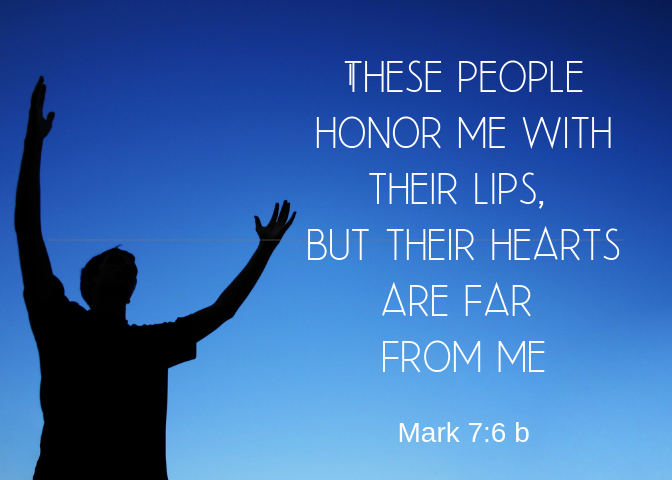
Jesus tells the Pharisees actions without heart mean nothing. He quotes Isaiah 29:11 saying, “These people honor me with their lips, but their hearts are far from me” (NLT). It got me thinking about how easy it can be to practice routine spiritual disciplines without our hearts being fully present. The spiritual disciplines I’m referring to include tithing, regular church attendance, praying before meals, communion, prayer, worship, and reading of scripture. These are the things that easily become mundane for the longtime practicing Christian. It’s important to find ways to mix things up once in a while. We can easily get stuck hamster wheeling through the motions without taking the time to really consider what it is we’re doing. Taking a break from your normal routine can reignite your passion. When we feel like we’re going on autopilot, switching things up, practicing our spiritual disciplines in different ways, helps us refocus on the task and approach it with a renewed attitude.
I understand not everyone’s mind works like this, so I’ve created a list of suggestions. This week I encourage you to choose one discipline to switch up. See if the task means more to you. If you get more out of the experience. Or, perhaps you’ll learn just how much you enjoyed doing it your way, which will hopefully renew your heartfelt intentions. The goal of this challenge is to bring yourself back to the heart of why we do what we do, by pausing and re-evaluating your intentions.
Tithing
Write your check at a different time than normal. If you’re always doing your check right before the plate is passed, try preparing it at home first. If you always come with your check prepared, try writing it during the worship service. I personally really enjoy tithing during services. To me, there’s something intimate about listening to the worship music, getting on my phone and checking my pay stubs, doing quick math on the back of a bulletin, then placing my check in the offering box.
Include your children in tithing. This may be by encouraging them to put their own money in the plate, or giving them something to put in the offering. I still remember the feeling of importance I got as a little girl whenever I dumped my change into the offering. It felt good to give to God and made me feel part of something bigger than myself, even if all I contributed were pennies.
Church Attendance
Go to service at a different time if your church offers multiple services.
Sit somewhere else during the service.
Praying Before Meals
If you typically pray silently, pray aloud.
If your family is the fold hands type – try holding hands to pray.
Put your hands in a different position.
Start your prayer off with thanking Him for one specific blessing you experienced since your last meal.
Have your family take turns saying the prayer.
Communion
If you know it’s communion Sunday, sit somewhere else during the service so you are taking communion in a new environment.
Prayer
Pray aloud.
Pray at a different time in the day.
Put your hands in a different position.
Start a prayer journal. Or just simply write down your prayers.
Create a prayer chart with a white board.
Pray when you are bored or waiting. This is how we learn to pray without ceasing and be in constant conversation with God.
Take yourself to a quiet place and pray on your knees.
End your prayer time with a worship song.
Pray with your children.
Pray with your spouse.
Pray in public. Without being the annoying guy in Luke 18:9-14. For example, you could end your coffee date with your friend by praying for her right there in the shop, quietly in the corner taking a private moment together.
Worship
If your church is a standing and singing church, sit down during a song, bowing your head in prayer.
Don’t sing. Listen to the words.
Do sing! Even if you are no good and you think no one wants to hear your voice – God does.
Do a mini worship session in the car on the way to work. Turn on the local Christian radio, or play some of your favorite worship music.
Take a Sunday off from leading worship if you’re part of the worship team. Sometimes it can be nice to simply be a part of the service instead of leading it. This also may give the opportunity for others in your church to step up and serve.
Reading of Scripture
Sit someplace else in your house for your quiet time.
Take a break from what you are currently reading. It’s okay to flip to a different part of the Bible, or a different devotional book. Doing it just for the sake of doing it and saying you completed something is exactly what Jesus was accusing the Pharisees of doing.
Questions:
Which challenge are you going to choose?
Give yourself a heart check. Are there areas of your faith that have become mundane?
Prayer –
based on the lyrics “The Motions” by Mathew West
Dear God,
I don’t want to go through the motions. I don’t want to go one more day without your all consuming passion inside of me. Let your love make me whole.
Our reading in Leviticus lists the six festivals the LORD commanded the Jews to follow and observe. I thought it would be fun to take a deep dive into each. For each festival, I searched additional scriptures where it was mentioned. I also investigated how it is celebrated in today’s modern world.
Passover and Festival of Unleavened Bread
This is perhaps the most commonly known Jewish holiday. In our passage today, the festival is said to last seven days, the first and last days marked with a “holy assembly” and “no work.” This festival commemorates when the tenth plague passed over the Israelites in Egypt. This final plague ultimately led to their deliverance from Egyptian slavery. In scripture, Passover is seen as a time of rededication, purification, remembrance, and celebration. It is during this celebration the Last Supper takes place, and from this the Christian practice of communion. The reverence and sincerity in which passover is handled in the Old Testament is a reminder to us Christians of the mindset we should have when taking communion. The passover is still celebrated by Jews, today. Jewish families gather in their homes for a special meal called the Seder. During this, the story of the Israelites exodus from Egypt is read. Special food is served at this meal to symbolize aspects of the Jewish faith.
Celebration of First Harvest
This celebration is marked by bringing sacrificial grain offerings from the first fruits of the crop to be presented to the LORD. It is also referred to as the Feasts of Firstfruits and is tied into the Festival of Harvest, yet still as a separate day of celebration, according to the text. I found it much more difficult to find information of this day alone as it is so closely related to the Festival of Harvest. From what I can tell, this day is no longer celebrated on its own. Yet, God made a distinction here, in Leviticus. I think part of that purpose is to show how God desires our worship and honor. God wanted a separate day set aside just for the first fruits of a crop. This was so he could be acknowledged as creator and giver of life. One way that we as Christians can continue this theme of gratitude for provisions is to pray before our meals.
Festival of Harvest
The Festival of Harvest, or Festival of Weeks, was later referred to as Pentecost and is known today as Shavout. It is to take place fifty days after the Celebration of the First Harvest. According to our text in Levitus, this festival was marked by various offerings of “pleasing aroma to the LORD” and a day or holy assembly in which no work was to be done. In Deuteronomy 16:9-12 it is described as a time of great celebration. The focus of the holiday in today’s age is no longer agricultural but instead serves as a time to celebrate the giving of the Torah. It is a sacred time in Jewish culture. It is observed with traditional foods, decoration of synagogues, and confirmation services. I think it’s incredibly special how practicing Jews set aside a time to remember and give thanks for their scriptures. How often do we as Christians pause and give thanks for our own Scriptures? When was the last time you honestly thanked God for the Bible? Perhaps we Christians could learn something from the modern day celebration of Shavout.
Festival of Trumpets
The Festival of Trumpets is a day for holy assembly and no work. Specific offerings are to be presented. These are described in more detail in Numbers 29:1-9. During this celebration there is to be a blast of trumpets. I imagine this was the biblical version of setting off fireworks. This festival later became known as Rosh Hashanah, the Jewish New Year. It is celebrated by traditional foods, such as sweet breads to signify the hopes of a sweet new year. The specific readings during services focus on God’s sovereignty, past deeds, and anticipation of the future. The instructions in Leviticus for this festival are unique as it shows music as an example of worshipful offering. This is something each of us are capable of doing. God wants to hear our praise in song and deed.
Day of Atonement
The Day of Atonement is the second most well-known Jewish holiday. It is known today as Yom Kippur. Leviticus 16 goes into further detail of the requirements for the Day of Atonement. It is a day of holy assembly, fasting, and offerings of purification made by the High Priest. Jesus is our High Priest and his sacrifice on the cross is symbolic of the offerings made on the Day of Atonement. It is considered one of the holiest days in Jewish culture. Today, it is marked by a time of fasting and confession. The Day of Atonement shows that God is in the business of reconciliation. He provides a path of redemption for all people. The Day of Atonement was a physical reminder of God’s covenant grace with his people. Jesus has allowed that same covenant of grace to extend to all people who come to Christ.
Festival of Shelters
The Festival of Shelters is also referred to as Festival of Booths or Festival of Tabernacles. It is an eight day celebration. Days one and eight are characterized by holy assembly days and days of rest. On each day of the festival, specific offerings are to be made, detailed in Number 29:12-40. Deuteronomy 16:13-17 reveals it is to be a time of great joy and celebration, reflecting upon the good harvest. Our text, Leviticus 23, instructs families to build tiny huts from branches to live in during the week of the Festival. This is to represent their time living in shelters after being delivered from Egypt. Today, this holiday is known as Sukkot. Interestingly enough, it is still widely celebrated in a similar fashion with families gathering in small temporary huts called sukkahs. This festival reminds us of the importance of pausing to thank God for all our many blessings. It is meant to be a joyous celebration, where we are to rejoice in God’s goodness. We should have this attitude of praise daily, but it is also good to set aside time dedicated just for thankfulness.
Questions:
What do you do to prepare yourself for communion?
Do you pray before every meal? Why or why not?
Do you think Christians take scripture for granted? How can we remember to treat God’s word with holiness?
Do you sing along during worship at church? Why or why not? Do you think you should start?
In what ways is Jesus our High Priest?
Can you think of a U.S holiday similar to the Festival of Shelters? Even though Thanksgiving is a long ways away, how will you plan to make this year’s celebration a holy time?
PRAYER:
Dear Lord God, You are so worthy of our worship. Help me daily, and in special ways and times, honor and celebrate You, Your scriptures (yes, including Leviticus), Your precious Son – the perfect High Priest we need, , the good gifts that You give, the good God that You are. Thank you for life and redemption, for your perfect plans through the ages, for music, prayer, communion, church, feasts, fasting and holidays. Help me to prepare well for the celebration that will surpass them all, when Your Son returns to earth to set up Your Kingdom for eternity.
In our Ex 15: 1-20 reading today, we find the Israelites flushed with joy (and probably a bit surprised and amazed) at their very recent miraculous escape from Pharoah’s army through the Red Sea. The song that Moses and the Israelites sang, which is beautiful, highlights their joyous wonder and details the miraculous hand of God in their redemption. Then they walked for 3 days to the well of Marah (Ex 15:22-27) and began a pattern which would repeat pretty regularly throughout the book: complaining and whining. Kind of like us, right? How many times in your life has God done something miraculous and then within days or weeks you’ve completely forgotten about it and moved on with your life? It sounds painfully familiar because at heart most of us are exactly the same. God will do something utterly and completely miraculous, and we celebrate it and praise Him, and then forget about it and are looking for our next blessing. Why are we like that? How can we act differently? (There are some practical answers towards the end, if you want to skip down)
So after God once again miraculously cared for them by giving them water to drink, predictably, the sons of Israel once more started grumbling (Ex 16:2). God then began to provide for His people, and did so for 40 years (Ex 16:35) from this point, until they came to the promised land. In the morning he gave them manna, a miraculous bread from heaven, and in the evening he gave them meat (in the form of quail) (Ex 16:13-14). During these 40 years of provision, the Israelites where physically and spiritually trained in the concept and keeping of the Sabbath (Ex 16:22-29). There is a neat description of the texture and taste of manna in Ex 16:31.
I have 2 very large dogs (Bo and Luke): they’re very sweet, very large, and very pushy. I’ve had them now for about 7 years, they’re good boys (mostly). I bring them up only to make a point. Every day I’ve had them, I have fed them the exact same dog food, in the exact same portions, twice a day. Do you know how they react? They LOVE it. Every single time, it’s like they just won the lottery, like they got the family pass to Disneyland and it’s Christmas morning, they are SO excited. Bo does standing jumps up in the air about 4′ high from the moment I go to the back to get the food until the moment I put it down for them, and Luke wags his entire backside so hard that he’ll knock you over if you get in the way (I have this on video, it happens daily). They are SO happy and just excited and grateful to get that same exact dog food, in that same exact bowl, at the same time daily. Then when they are done, they come lick my face happily (and for a bit longer than I’m usually comfortable with) while wagging their whole bodies to let me know how much they appreciated the food.
So what about you? When God gives you your daily provision, every day, do you show Him how grateful you are? Do you do standing jumps 4′ in the air and wag your whole bottom? Do you then go and lick God’s face repeatedly in thanks (figuratively, of course)? Think about it. Most of us would be more along the lines of the ancient Israelites “Ugh, manna and quail AGAIN??!“, while completely overlooking the fact that we have been provided for. Our creator, the God of Abraham, Isaac, Jacob, and you gives us blessings every day. I urge you, as I urge myself; jump for joy, wag your tail, kiss the hand of the Almighty who has given us such abundant blessings undeservedly.
PRACTICAL STEPS
Pray when you wake up. Gush. Get on your hands and knees and thank God that you woke up today, that He has seen fit to grant you another day of life.
Look at your blessings, consider how ALL of them come from the hand of God (Ps 24:1)
Look at the sky in the morning, and praise God that He’s given us, His children, such a beautiful playground to live in.
Breathe in, Breathe out. That is the breath of life that God put inside you, thank Him for it.
Love the people you meet, God created them too, they are your brother/sister and it pleases Him when you acknowledge this.
When you struggle, thank God for refining you and strengthening your spirit. Ask for his help if you are failing.
When you eat anything, thank God.
When you bathe, thank God for the cleansing water. Ask Him to cleanse your heart as well.
When you go to bed, thank God for the day He gave you, and you’re still alive. Ask for forgiveness if you’ve failed in any way to please Him, and then wake up in the morning and do better.
Glorify God at all times, in everything you do, in every thought you have, in every action you take. Diminish your “self” and enlarge God’s spirit within you.
I’ve went on a bit long about our OT reading this morning, but I would be absolutely remiss if I didn’t point out a couple things in our Matt 15 reading. When the pharisees confront Jesus about some legalistic violations, Jesus calls them out (Matt 15:3) and points out the difference between honoring God with your heart and just “going through the motions”. It’s important to note that the traditions of men are not necessarily the commandments of God, we need to honor God and love him in our hearts. If we’re not doing any of the things we do daily as rituals out of pure love for God, then we too are missing the whole point.
I have a friend who believes firmly (and I don’t disagree) that “unconditional love towards the Father” is in itself perfect religion lived properly. I humbly suggest that some of the daily rituals suggested above may help us to refocus our attention and gratitude to where it belongs. May God bless you and lead you, and touch your heart with His spirit.
Reflection Questions:
Do you (figuratively) wag your tail and lick the hand that fed you, every time you get food? Why or why not?
God physically and spiritually trained his children the Israelites to keep the sabbath every week for 40 years. Do you think it was important to him?
Should we keep the Sabbath nowadays? No cheating by repeating whatever you were told by someone else: look it up in scripture, use your own words to answer, and show your work.
Prayer:
Father God, THANK YOU! You have provided for my every need, every day, and given me far beyond what was needed. I have not deserved it, I have not earned it, but you have been a gracious and loving God to me anyway. Lord God please forgive me, help me to love you with that same fierce love that you have loved me with since I was born, and teach me the depths of your awesome love. Thank you for life, and breath, and all things. Please guide me and be with me, in Jesus’ name, Amen.
Our reading today includes so much powerful material and wisdom. The reading from the Psalms is from Psalm 1 and tells us how to live and worship our God in 6 easy verses. Just do these things and your life is on path and blessed by God. How is it that God distills such great truth so many times into passages that give us such pure direction in a short section. This should be a familiar section of scripture to many and be a comfort and help in our lives. I have it here quoted in the KJV because of the familiarity of the section wording, and also that it does a good job of showing us the poetic nature of the Psalm.
Psalms 1(KKJV) Blessed is the man that walketh not in the counsel of the ungodly, nor standeth in the way of sinners, nor sitteth in the seat of the scornful. 2 But his delight is in the law of the LORD; and in his law doth he meditate day and night. 3 And he shall be like a tree planted by the rivers of water, that bringeth forth his fruit in his season; his leaf also shall not wither; and whatsoever he doeth shall prosper. 4 The ungodly are not so: but are like the chaff which the wind driveth away. 5 Therefore the ungodly shall not stand in the judgment, nor sinners in the congregation of the righteous. 6 For the LORD knoweth the way of the righteous: but the way of the ungodly shall perish.
The Old Testament was memorized by the Hebrews and many of them knew the whole of the scrolls by heart. The poetic nature of the original writing helped them to remember the passages. Some of the easiest passages to memorize are those that are poetic in their structure for us in English. The Psalms were also written to be sung which is an even more powerful way that helps us remember scripture. Think about small songs that you may have sung as a child. For me many taught me were verses from the Bible and etched those verses in my memory.
How about you? What puts the words of the Word into your memory?
Do you meditate on the Word of God every day?
What is a good way to bring it to mind for you?
When we read the section of Matthew 15 this morning Jesus cuts right to the chase with the people there and then puts us on the right track of understanding and action. The argument he has with scribes and Pharisees is over the disciples hand washing rituals before a meal. It wasn’t for sanitary purposes that these rules were developed but were regulations made up to control people’s lives by ritual.
Matthew 15:1-9(NLT) Some Pharisees and teachers of religious law now arrived from Jerusalem to see Jesus. They asked him, 2 “Why do your disciples disobey our age-old tradition? For they ignore our tradition of ceremonial hand washing before they eat.” 3 Jesus replied, “And why do you, by your traditions, violate the direct commandments of God? 4 For instance, God says, ‘Honor your father and mother,’ and ‘Anyone who speaks disrespectfully of father or mother must be put to death.’ 5 But you say it is all right for people to say to their parents, ‘Sorry, I can’t help you. For I have vowed to give to God what I would have given to you.’ 6 In this way, you say they don’t need to honor their parents. And so you cancel the word of God for the sake of your own tradition. 7 You hypocrites! Isaiah was right when he prophesied about you, for he wrote,
8 ‘These people honor me with their lips, but their hearts are far from me. 9 Their worship is a farce, for they teach man-made ideas as commands from God.’”
This passage is from Isaiah 29 and Jesus knowing the scriptures draws on a section where God judges the standard for our actions and faith.
Isaiah 29:13(NKJV) Therefore the Lord said: “Inasmuch as these people draw near with their mouths And honor Me with their lips, But have removed their hearts far from Me, And their fear toward Me is taught by the commandment of men,
Then God tells us in this section of Ezekial another prophecy about Jesus:
Ezekiel 33:30-33(NKJV) As for you, son of man, the children of your people are talking about you beside the walls and in the doors of the houses; and they speak to one another, everyone saying to his brother, ‘Please come and hear what the word is that comes from the LORD.’ 31 So they come to you as people do, they sit before you as My people, and they hear your words, but they do not do them; for with their mouth they show much love, but their hearts pursue their own gain. 32 Indeed you are to them as a very lovely song of one who has a pleasant voice and can play well on an instrument; for they hear your words, but they do not do them. 33 And when this comes to pass—surely it will come—then they will know that a prophet has been among them.”
I am aways astounded by God’s anticipation of all that Jesus does in his life here on earth and in his ministry. These words of God’s true wisdom that Jesus speaks are ignored then and ignored today by all that don’t believe his words. When we hear God’s Word with our ears but don’t hear with our hearts then we are far from the God that made us and created His life in us.
Isaiah 29:15-16(NLT) What sorrow awaits those who try to hide their plans from the LORD, who do their evil deeds in the dark! “The LORD can’t see us,” they say. “He doesn’t know what’s going on!” 16 How foolish can you be? He is the Potter, and he is certainly greater than you, the clay! Should the created thing say of the one who made it, “He didn’t make me”? Does a jar ever say, “The potter who made me is stupid”?
How can we change our hearts and actions today?
What will put this Word into our hearts and minds?
Our lives are determined by what we truly believe in our hearts and not by what we do and Jesus shows us this again in Matthew 15.
Matthew 15:15-20(NLT)Then Peter said to Jesus, “Explain to us the parable that says people aren’t defiled by what they eat.” 16 “Don’t you understand yet?” Jesus asked. 17 “Anything you eat passes through the stomach and then goes into the sewer. 18 But the words you speak come from the heart—that’s what defiles you. 19 For from the heart come evil thoughts, murder, adultery, all sexual immorality, theft, lying, and slander. 20 These are what defile you. Eating with unwashed hands will never defile you.”
REFLECTION QUESTIONS:
See questions in bold above
PRAYER:
Father, please open our hearts to hear your Words and believe them. Give strength to us to do the actions You ask us to do. Give us works of righteousness to do to show others your greatness and deliverance. Let us not be defiled by our unrighteous thoughts but changed to become like Your Son in every way. In Jesus name we pray this day.
I am pleased today to share words from Jeffrey Fletcher, a pastor, chaplain, husband, father and regular writer for SeekGrowLove and Church of God publications. We mourn the death of Pastor Jeff, we look forward to celebrating with him at the resurrection, and we are thankful that his Godly words of wisdom and his example of faith live on for us today. The following is part of an article titled True Abrahamic Faith which was published in the July-Sept 2025 edition of The Restitution Herald (Vol 114 No 3).
If we say we have the faith of Abraham, shouldn’t we understand what that really means? The fact of the matter is … when we study the life of Abraham, we find very little spoken about what he actually believed in a structured, systematic way. Abraham left behind no creed or statement of belief about God. So to understand what faith meant to Abraham, we have to look at what he did by way of response to God.
First, we see in Genesis 12 that Abraham took his wife, his nephew, and his servants, left Haran, and went down to the land of Canaan, where he pitched his tent and built an altar to the LORD who had appeared to him. From this, we discover three things about the faith of Abraham:
1. He had a personal relationship with God – Abraham believed that God was a personal God.
Abraham was not an atheist, who doesn’t believe in God.
He wasn’t an agnostic, who won’t say one way or another if there’s a God.
He wasn’t a deist, who believes that God is a kind of higher power who simply wound up the universe at the beginning and then pretty much left us on our own to do as we please.
He wasn’t an animist, who believes that an immaterial force called nature — Mother nature, Gaia, etc. — inhabits the universe and occupies all living things (had he believed that, he never would have killed an animal and offered up a sacrifice at the altar). If you want to know more about animism, just watch the Disney film Pocahontas, which reflects a prevalent 90s animistic belief that things like trees have spirits.
He was not a pantheist, who believes in and worships all gods. This popular belief holds that all religious truth is equally valid. All gods are equally valid and can justly be worshipped – whether they be called Buddha, Lord Krishna, or YHWH.
Abraham believed in God and God alone as the true God. Not a higher power, which is a kind of politically correct term for God among many 12-step groups. Yes, God is a higher power, but He is more than pure power, energy, or even impersonal spirit. God is a personal being with whom we can enter into a real, personal relationship.
We know these things about Abraham not because of what he said to others about God, but because of the way he responded to God.
2. He made worship a priority – notice that wherever Abraham settled, he built an altar. He came to Shechem; he built an altar to worship God. He went to Bethel; he built an altar to worship God. Later, he moved to Hebron; again he built an altar to God. Everywhere he settled, he built an altar to God. Worship was a priority to him. And remember too – this was not because of some religious law or empty ritual Abraham was following. The laws of Moses, which prescribed the type and frequency of offerings to God, were not given until over 400 years after the time of Abraham. Abraham selected animals from his flocks as a way of recognizing that everything he had was from God and really belonged to God. Abraham was willing to offer up his best as an act of worship to God.
This priority of worship was demonstrated when Abraham, after being victorious in battle against the confederacy of kings from Sodom and Gomorrah, as an act of worship, brought to Melchizedek, a priest of God, a tenth of the spoils of war. The very first tithe in the Bible does not come as a result of an ecclesiastical law, but as an offering of worship and display of faith on the part of Abraham. Abrahamic faith makes worship a priority and demonstrates it through sacrificial giving and tithing.
3. He believed God – he packed up his tents and moved based on a promise that God had given him. He believed God and demonstrated that belief by his actions. Had Abraham stayed in Haran, would he have had true faith? What if he had said to everyone in Haran, “Listen, I believe in God, I believe God keeps His promises, I believe that God will give me the land of Canaan and make a great nation out of me” and then never packed up his tents, never loaded up his camels and donkeys, never tightened his sandals, never pulled out his walking stick and never journeyed south to Canaan? Would that have been true faith?
You see, so much of what passes for “faith” these days isn’t really faith at all. Part of the problem is that faith in the English language is a noun.
Listen to the Dictionary – faith (fEth) n.
1. Confident belief in the truth, value, or trustworthiness of a person, an idea, or a thing.
2. Belief that does not rest on logical proof or ma-terial evidence.
3. Loyalty to a person or thing; allegiance.
4. The theological virtue is defined as secure belief in God and a trusting acceptance of God’s will.
5. The body of dogma of a religion.
6. A set of principles or beliefs.
A noun is a person, place, or thing, whereas a verb is an action. English is one of the only languages that has the word “faith” as a noun. In other languages, it is a verb. Why is that significant? Because Abrahamic Faith is a verb. Abrahamic Faith requires action. There’s no room for couch potatoes in Abrahamic Faith. Abrahamic Faith is not a spectator sport.
One of the problems with American religion today is illustrated by the weekly football game, where we have 22 exhausted men who desperately need some rest being observed by thousands of spectators sitting around eating junk food and drinking beer, who desperately need some exercise.
Abraham set down his beer, put down the remote control, packed up his stuff, and began a journey that would last for the rest of his life. He didn’t know how many stops, how many detours, how many frustrations, how many dis-appointments, how many battles, how much pain there would be on the journey. But then again, none of us on this journey of faith knows what we will encounter along the way. We travel out on faith, trusting that the God who has called us to the promised land will never abandon us on that journey, and that the land that awaits us is truly a good land.
The complete article can be found here, starting on page 7. THE RESTITUTION HERALD is owned and published by the Church of God General Conference, a nonprofit Christian corporation located at 2020 Avalon Parkway, Suite 400, McDonough, GA 30253, which is also the site of Atlanta Bible College.
Reflection Questions:
What is involved in having a personal relationship with God? How is that the same or different from what you have seen in religion today? Do you have a personal relationship with God? It is healthy to continually look for ways to improve relationships. How can you improve your relationship with God?
How do you worship? How might God want to see you worship, in addition to what you typically do now? What happens when we don’t make worship a priority? Would God say that you make worship a priority?
Do you generally think of faith as a noun or a verb? Who have you seen live out their faith? What have done or currently do to demonstrate your faith? What might God be asking you to do next?
Prayer
Dear Heavenly Father, we praise you because you are a real, personal God who desires a relationship with your creation. We thank you for the examples of faithful fathers, for the men and women recorded in your Word, as well as the ones who have lived since then, who though not perfect, go beyond talking about faith to demonstrate a living, breathing, moving, active faith in you. Help me to have a faith that gets me off the couch and even beyond my comfort zone. Show me, Father, how you want me to live out my faith next. May my worship of you be pleasing to you and a priority in my life. I pray these things in Your Son’s name. Amen.
Devotion by Aaron Winner (originally posted for SGL on Dec 28, 2020)
There is much to take in with today’s reading as John describes the throne room of heaven and the events that unfold, marking the Kingdom of God being set into motion. There are angels, horsemen, and elders, each executing and exacting the will of God. If you are a bit overwhelmed by today’s reading, you are not alone. John, who spent more time with Jesus than most, is still awestruck by the worship of God happening before him, and he is doing his best to describe heavenly things for which there is no earthly vocabulary (something important to keep in mind as we examine the remainder of this book and prophecy). With a resounding question, John’s attention is drawn to the hand of God:
“And I saw a mighty angel proclaiming in a loud voice, “Who is worthy to break the seals and open the scroll?” But no one in heaven or on earth or under the earth could open the scroll or even look inside it. I wept and wept because no one was found who was worthy to open the scroll or look inside.” Rev 5:2-4
John weeps, for the content of the scroll could very well never be known. Salvation’s plan locked inside this scroll with no one on heaven or earth who is worthy of removing the seven seals that keep it shut. This is seemingly the end of the road. Without a Savior, life on earth has no redemption. This is most definitely worth a weep, knowing that for some, their story stops here. They have put everything in what they alone can achieve, yet they are like every other creature in heaven and on earth. Without the hope delivered in the next verses, all that would remain is remorse and regret (Luke 13:27,28).
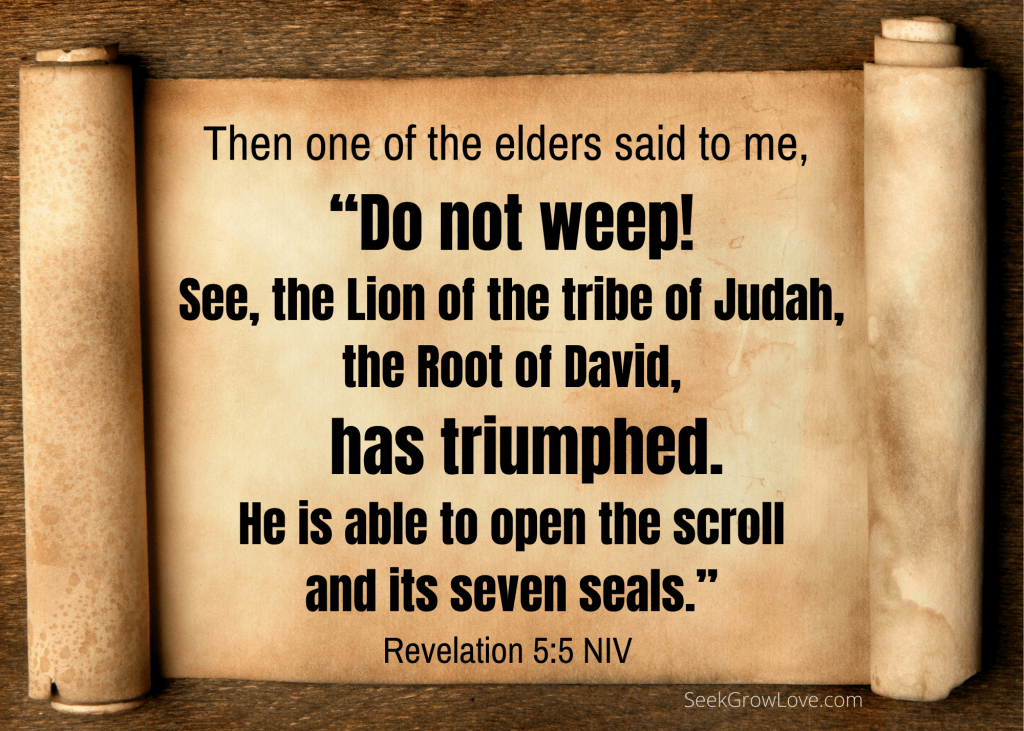
Then one of the elders said to me, “Do not weep! See, the Lion of the tribe of Judah, the Root of David, has triumphed. He is able to open the scroll and its seven seals.” Rev 5:5
Salvation is a gift of God, paid for by the blood of Jesus Christ (Eph 2:8,9). In the moments when we are overcome with great grief, sense the defeating drift of sin, are lost or lonely, feel pressed or persecuted, let Jesus Christ step forward. Do not reach deeper into empty stores, pour out of a broken vessel, or pick up the shattered pieces; let him do what we cannot. We need only lift our heads – to pray, to seek, to take heart – as we listen to the words of the elder that Jesus Christ, the Lamb of God, has triumphed. He will step forward and unfurl a new banner, renewing and restoring the purpose of our life. He alone is worthy to open the scroll, yet we are indeed the beneficiaries of the prize of his propitiation.
And they sang a new song, saying: “You are worthy to take the scroll and to open its seals,because you were slain, and with your blood you purchased for God persons from every tribe and language and people and nation.” Rev 5:9
Reflection Questions
What do you find especially memorable, powerful or awe-inspiring in John’s description of God’s heavenly throne room in Revelation 4? How is God described? What is he praised for?
What makes Jesus worthy and able to do what no one else could or can do? What has he triumphed over? What will he triumph over? How is Jesus described? What is he praised for?
What is the problem if no one could be found to open the scroll? When was the last time you really considered or even wept over the fate of those without salvation? You can not unseal the scroll. But you can introduce the one who can and will to those who do not know the Savior.
Isaiah 14:24 says: The Lord Almighty has sworn, “Surely, as I have planned, so it will be, and as I have purposed, so it will happen.”
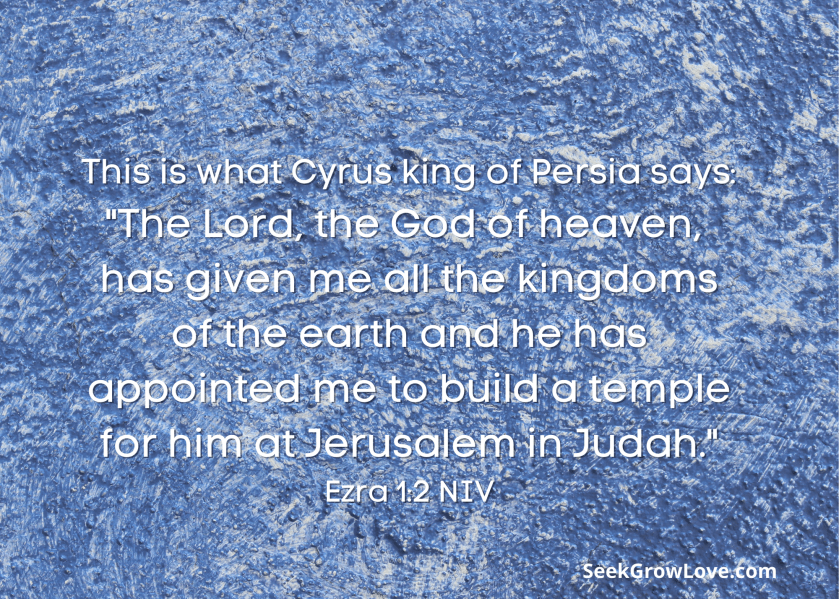
In the first chapter of Ezra it says that God stirred the heart of King Cyrus to fulfill a prophecy of Jeremiah that they would be exiled for seventy years and after this time they would be allowed to return to Jerusalem. See Jeremiah 25:11-12, 29:10.
In Isaiah 44-45, it names King Cyrus over a century before he was born. It is amazing to see how God chooses to work, here he is using a pagan king to fulfill his prophesies. King Cyrus sent out a proclamation that “the Lord, the God of heaven” had appointed him to rebuild His house in Jerusalem. Ezra Chapter 1 v.3 says “Whoever there is among you of all His people, may his God be with him! Go up to Jerusalem which is in Judah and rebuild the house of the Lord, the God of Israel; He is the God who is in Jerusalem.”
Then, he told all the survivors to support them with silver, gold, or other valuables. Everyone had a part in the rebuilding of the temple even if they were not actually doing the building. We all have a part in ministry, it may be supporting those that are doing the work, but that is an important and much needed part of any ministry. King Cyrus also brought back the vessels from the first temple that Nebuchadnezzar had taken and restored them to their rightful place.
These people had been taken into captivity when Babylon had taken over, now they are given a chance to return and chapter 2 lists the people and the families that they represent who came back. In 2:68-69a “Some of the heads of fathers’ households, when they arrived at the house of the Lord which is in Jerusalem, offered willingly for the house of God to erect it on its site. According to their ability they gave to the treasury…” The identity of the Jewish people as the people of God was tied up in the temple, where the presence of the Lord dwelt. The Jewish people were devastated by the destruction of the first temple in 586 BC. They were filled with despair and a loss of hope. With the chance to rebuild the temple, the people gained some of their hope back. Their national pride began to come back. In the seventh month after the return, the Levites built an altar to God so that they could offer burnt offerings on it. This was important to them to show obedience to the Law of Moses. It was also an important act of worship to God. They were terrified of the people around them, and they wanted the protection of God to surround them. They reinstated the offerings and the festivals even before the foundation for the temple had been laid, because they wanted to restore their worship to God. The people were excited to build the temple again, to have a place where God would dwell, and where they could go to worship Him.
When the foundation was laid, it says in chap 3 v. 10b-11a “they praised the Lord according to the directions of King David of Israel.” “And they sang, praising and giving thanks to the Lord, saying, ’God He is good, for His lovingkindness is upon Israel forever.” They shouted and wept in celebration and it says it was heard far away.
Just as God used people in the Old and New Testament to carry out his purposes, he also uses us for His purpose. Ephesians 2:10 “For we are His workmanship, created in Christ Jesus for good works, which God prepared beforehand so that we would walk in them.” Also, Philippians 2:13 “For it is God who is at work in you, both to desire and to work for His good pleasure.” God is working with us and using us to bring about his promises. We can rest in the knowledge that whatever He has planned for us to do, he will give us the means to fulfill it.
Questions for Reflection:
Describe the thoughts and feelings the Jews may have felt as they heard King Cyrus’ proclamation of Ezra 1:2-4. And, also, as they entered Jerusalem?
In what ways have you been a part of a ministry planned by God and much larger than yourself?
“We can rest in the knowledge that whatever He has planned for us to do, he will give us the means to fulfill it.” – How have you already seen this to be true in your own life? What might God have prepared for you to do next? How has He already prepared you for it? What means are being put in place?
Today we continue Ezekiel’s vision, begun in chapter 40. For three chapters suspense built as he observed a shining figure (presumably an angel) give the dimensions of a new Temple, room by room, wall by wall. We might say that measuring the building simulated its construction. Or perhaps these measurements symbolize preparation God’s people needed to accept and undergo so they could properly serve God.
Ezekiel previously relayed to the Babylonian exiles a vision in which God abandoned Solomon’s Temple and Jerusalem. He had seen the glory of God exit the Temple, going East (10:18-19). In today’s text Ezekiel is taken to the eastern gate and sees God’s glory arrive there: “like the vision which I saw when He came to destroy the city,” and falls to his face before it (43:3). Getting this vision confirmed God’s intentions for the covenant, that the people would be restored to the land and again have a Temple.
In that earlier vision we were told that “the temple was filled with the cloud and the [inner] court was filled with the brightness of the glory of the Lord” before it exited (10:4). Similarly at its return “the glory of the Lord filled the house” (43:5). This ‘filling’ of the Temple mirrors events at the dedication of the Tabernacle and Solomon’s Temple, when in each case God’s glory filled the building and prevented people from ministering (Exodus 40:34-35; 1 Kings 8:11). (Though in his visions Ezekiel saw each event from on scene, I would guess that is due to them being visions and not reality.)
I wanted to address a point from verse 7 next which called for background from Tabernacle and Temple history. The next several paragraphs (o.k., 19 paragraphs) give background, after which the devotion proper resumes. (Honestly, I didn’t want to spend the next few hours paring this to a more “normal” length – and then end up saving bits from what I trimmed to maybe use later. I’m sorry about the length, though.)
Background about the Temple and Tabernacle
The basic points involved with the Jerusalem Temple are shown in the Pentateuch. Moses told the people about “the place the Lord your God will choose from among all your tribes to put his Name there for his dwelling” (Deuteronomy 12:5). The “place” is the location of the Temple, as Moses said there, and with similar language several more times (see v. 11, 18; 14:23-25; 15:20; 16:2, 7, 11, 15-16; 17:8; 26:2; 31:11). The Hebrews didn’t set up the Temple very soon, they couldn’t because they weren’t even informed of the location God chose for it until hundreds of years later. Instead at Mount Sinai the people constructed the Tabernacle, a “sanctuary” built for God to “dwell among them” (Exodus 25:8). God gave instructions to Moses regarding that sanctuary, but first he prepared the Ten Commandments, and then the Ark of the Covenant which would hold them. One of the central issues about the Tabernacle, and it would be central for the Temple as well, was that it provided somewhere to place the Ark of the Covenant, along with the other “sacred articles belonging to God” (1 Chronicles 22:19). Those items, created at Mount Sinai, initially went into the Tabernacle’s walls of cloth. Later they went into the Temple’s walls of stone, (walls which were covered by wood, that was covered by gold, decorated with gems and art – it really was quite a fancy place).
The twelve tribes were in the wilderness of Sinai for 40 years, and during that time when they stayed in one spot the Tabernacle was set up in the center of the camp – which is to say the tribes put their tents around the Tabernacle. We are even told the pattern in which they arranged the camp, the tribes that were to the Tabernacle’s north, east, etc. When the tribes moved priests carried the Ark by hand, using poles put through metal rings attached to it. The various parts of the Tabernacle were transported by the Levites. Once the people arrived in the promised land the Tabernacle continued to go with the main camp of the nation while the first few years of fighting took place, and then it was set up in one place or another for long periods (for example at Shiloh, where High Priest Eli raised Samuel). God eventually revealed to King David where the Temple would be (1 Chronicles 22:1), but God did not allow David to build the Temple (v. 8). Solomon, who was not associated with violence, would direct the construction of a place for God’s name (1 Kings 5:5).
Just as I see the Temple as existing to house the Ark of the Covenant, I recognize the central portion of the Temple as the Holy of Holies where the Ark of the Covenant was kept. The other areas of the Temple are defined at least in part by their relationship to the Holy of Holies. Outside the Holy of Holies was the Holy Place, beyond that was the Inner Court, then the Outer Court.
I find it clear that God’s connection with the Tabernacle and the Temple keyed on the Ark of the Covenant more than either building. The Ark which sat in the Holy of Holies is referred to a few times as the “footstool of God” (1 Chronicles 28:2; Psalm 99:5; 132:7). Psalm 99:1 includes the comment that God “is enthroned above the cherubim,” referring to the two statues on the Ark’s lid. That imagery is reflected in the lid’s name, “mercy seat” (Exodus 25:17-22; Leviticus 16:2, 13-15; Numbers 7:89; 1 Chronicles 28:11; Hebrews 9:5). In Exodus 25:22 God promised “I will meet with you; and from above the mercy seat, from between the two cherubim which are upon the ark of the testimony.”
In Exodus 40 Moses learned the final steps for setting up the Tabernacle. After he put everything in place “Then the cloud covered the tent of meeting, and the glory of the Lord filled the tabernacle” (v. 34). It was an impressive moment for the people. Similar events took place when the Temple was ready in Solomon’s time. They brought the Tabernacle to the Temple, and transferred the Ark of the Covenant into the Holy of Holies of the Temple. While people stood outside praising “then the house, the house of the Lord, was filled with a cloud, so that the priests could not stand to minister because of the cloud, for the glory of the Lord filled the house of God.” (2 Chronicles 5:13b-14). (In my mind taking the Ark of the Covenant from the Tabernacle for the last time was rather like removing the power source from the Tabernacle; it couldn’t operate anymore. We aren’t told what happened to the Tabernacle after that, but my guess is that it was dismantled and put in a Temple storage area. Could you imagine it being thrown out, even though it was obsolete?)
In scripture the Ark being the “footstool” of God pairs with “heaven” / “the heavens” containing the “throne” of God. “The Lord is in His holy temple; the Lord’s throne is in heaven” (Psalm 11:4). “The Lord has established His throne in the heavens” (103:19). Isaiah 66:1 is probably the most important Old Testament verse about this subject for us, because of its effect on the New Testament. The Isaiah text has a slight difference of focus from the Psalm texts, saying heaven ‘is’ God’s throne, “Thus says the Lord, ‘Heaven is my throne”. (The three texts do effectively agree about the location of God’s throne.)
The shift in Isaiah 66:1 from a “throne” in “heaven” to heaven itself may serve to set up the text’s similar change with the concept of God’s footstool, which is expanded from the Ark to “the earth.” The impact of that change feels different than with the “heaven” reference, it comes across as representing God as too great, too expansive, to be linked with one spot.
“Heaven is My throne and the earth is My footstool. Where then is a house you could build for Me? And where is a place that I may rest?”
Still, the rest of Isaiah 66 continues to grant significance as physical locations to both Jerusalem and the Temple. Jerusalem is mentioned several times and verse 20 says:
“Then they shall bring all your brethren from all the nations as a grain offering to the Lord, on horses, in chariots, in litters, on mules and on camels, to My holy mountain Jerusalem,” says the Lord, “just as the sons of Israel bring their grain offering in a clean vessel to the house of the Lord.”
I think verse one either tries to daunt human pride, or it warns against humans being complacent. Those issues are related. It seems to suggest two problems that can occur for those who try to build God a Temple: 1) if anyone implies that having a Temple puts limits on God, and 2) forgetting that the materials used for the building project are only ever things God already brought into existence.
The language of Isaiah 66:1 carried into the New Testament, and its use there made that way of speaking about “throne” and “footstool” more familiar to us than the language used by the Psalm texts. But probably far fewer people remember what Isaiah 66:1 says than this line from Jesus: “make no oath at all, either by heaven, for it is the throne of God, or by the earth, for it is the footstool of His feet, or by Jerusalem, for it is the city of the great King.” (Matthew 5:34-35). (If we are considering the impact of Jesus’ words on beliefs about the Temple, another text many people pay attention to is John 4:20-24. Some draw the conclusion from that statement that there is no future for any physical Temple. But I won’t take more space on that sidetrack right now.)
Stephen directly quoted Isaiah 66:1-2, near the end of his speech in Acts 7, after false witnesses claimed that: “This man incessantly speaks against this holy place and the Law; for we have heard him say that this Nazarene, Jesus, will destroy this place and alter the customs which Moses handed down to us.” (Acts 6:13-14; see 7:47-50 for Stephen’s quote). Again, these were false witnesses, and Stephen would not have been disrespectful of the Temple or the Law. It is possible that some of Stephen’s opponents, while being uninterested in learning from him, still heard and skewed things Stephen said.
As a Christian Stephen was no longer called on to follow the Mosaic Law, though that Law still existed. And Stephen seems to have recognized the freedom he had in terms of that Law sooner than most in the Church. As Paul would later point out, the Law continued to apply to those who meant for it to be their way of relating to God; that was why Paul warned the Gentiles in Galatia that a man who chose to be circumcised “is under obligation to keep the whole Law”; Galatians 5:3. (Many people today are circumcised, but what Paul wrote here only applies when that fact is given a religious intent regarding the Mosaic Law.)
And Jesus, about whom Stephen taught, was not going to destroy the Temple, but Jesus did predict its destruction (Matthew 24; Mark 13; Luke 21). Also, at least once Jesus spoke metaphorically of his own death as the destruction of a “temple,” a statement which people had misunderstood even when he made it (John 2:18-22). It is possible that Stephen referred to some of Jesus’ statements about these matters, and that this affected the accusations against him.
As I pointed to above, Isaiah 66 may relate to two issues 1) not being able to put limits on God, and 2) that people could only “create” a Temple in a limited sense because really God made all the materials they used. Herod the Great certainly seems to have been prideful about renovating the Temple. It seems like the ongoing renovations also pleased the priests of Stephen’s time, which may tie to his use of Isaiah 66 (Matthew 23:16). All we humans really do in ‘creating’ objects is rework the shape and function of material provided by God. Jesus said that “not even Solomon in all his glory clothed himself” like a lily of the field (Matthew 6:29). What can be said of Solomon’s wardrobe can probably also be declared of his construction projects. When is a wooden board more impressive than the living tree it came from? Can a wall of stone outclass a mountain (or a canyon)? The book of Hebrews makes explicit the fact that the Tabernacle was intended to reflect heaven’s throne room (Hebrews 8:5 – note that both are “tents”; Isaiah 40:22). By implication the Temple achieved that same purpose. But even when Herod coated the outside of the Temple with gold to make it reflect the sun that didn’t let it outshine the sun. God’s originals are always superior to man’s replicas.
The reference in Isaiah 66:1 to the earth as God’s footstool points to God being much larger than one location can hold. But there is another way that human pride can try to put limits on God with the Temple – a limit on God’s actions. When I read Stephen’s sermon I am reminded of Jeremiah 7:4, when God had him stand in the gates of Solomon’s Temple and warn the people “Do not trust in deceptive words, saying, ‘This is the temple of the Lord, the temple of the Lord, the temple of the Lord.’ ” The point of that statement is that the injustice being practiced in Jerusalem at that time was sufficient for God to choose to let that Temple, though it was God’s Temple, be destroyed. Just because it was offered to God didn’t mean it would be preserved. The fact that it existed in Jerusalem did not mean the people of Jerusalem would be safe from harm. Yet a complacent population could choose not to be revived and reformed, because they had the Temple in their midst.
God did not need a building to dwell in – the Temple existed for humans. God was willing to let the building go if that action helped humans recognize truth (remember, the punishments described in Deuteronomy were ultimately corrective, intended to reform and allow for restoration). The Temple gave a place to worship, with rituals God laid out. It was intended to help people understand and relate with God. It housed the Ark of the Covenant, from which God condescended to communicate. No building can be grand enough to gain significance for God. Yet God can choose to put divine glory into a human offering, granting it significance. God did so with the Temple in Jerusalem. In Isaiah 66:1 God asked about the building someone would offer, and that question comes as a challenge to human pride. As God points out in verse 2 “Has not my hand made all these things?” (NIV). But an assertion of God’s power and authority is not a denial that God in fact called for a building to be constructed in Jerusalem, which God accepted for divine use. Nor was there only one such building. When verse 20 says people will go: “to my holy mountain Jerusalem, . . . to the house of the Lord” the Temple it refers to is still in our future.
Devotion resumes
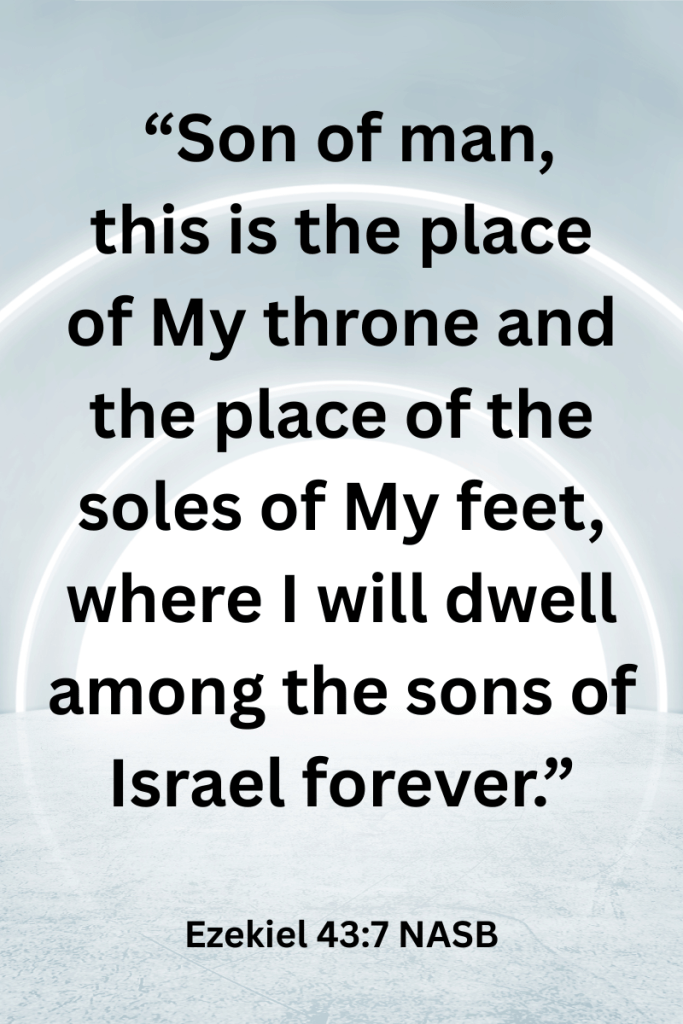
In Ezekiel 43:7 God says: “Son of man, this is the place of My throne and the place of the soles of My feet, where I will dwell among the sons of Israel forever.” This verse offers a shift from how the Temple is normally discussed in the Old Testament. God is not presented as dwelling in the heavens, feet propped on the Ark of the Covenant. Rather throne and soles are together on earth.
It can be difficult to conceptualize God occupying a single location while having a presence everywhere. Even scripture can seem ambiguous on this topic, for example Psalm 139:7-10, which seems to include both concepts, implying that one or the other is metaphorical. In the past when discussing the “throne” and “footstool” texts I have suggested they involve where God’s focus is. While God is aware of all things, God gives special attention to the promised land.
But if language about the Tabernacle and the Temple normally meant to convey that God’s attention is focused on Jerusalem, while God still dwelt apart in heaven, it seems that in the time of this new Temple the opportunity had come to combine the two settings. God (in whatever sense) dwells “among the sons of Israel forever,” with both God’s throne and the “soles” of God’s feet situated at the new Temple (Ezekiel 43:7). “Behold, the tabernacle of God is among men, and He will dwell among them” (Revelation 21:3). Take joy in this!
The change seems to involve more than the location of God’s throne. We are not told that this new Temple’s Holy of Holies has any furniture, such as an Ark of the Covenant for God’s feet to rest on. We are told: “This is the law of the house: its entire area on the top of the mountain all around shall be most holy.” (v. 12). Does this expanded holiness suggest that in the new Temple there is no need for divided courts, and places of greater and lesser sanctity? It implies that only those who may enter God’s presence are allowed near, for the whole area is where God stands.
(This could be overstated. In 44:13-14 God speaks of priests who had not behaved as they should, but who would be allowed to serve. It says: “they shall not come near to Me to serve as a priest to Me, nor come near to any of My holy things, to the things that are most holy; but they will bear their shame and their abominations which they have committed. Yet I will appoint them to keep charge of the house, of all its service and of all that shall be done in it.” So, we again see ambiguity in the text. What is “most holy,” and what is not?)
Ezekiel was told: “As for you, son of man, describe the temple to the house of Israel, that they may be ashamed of their iniquities; and let them measure the plan.” (v. 10). God expected that contemplating these exalted plans for worship would affect Ezekiel’s hearers. God’s prophet had already received the measurements of the building, and now begins to get those for the altar, followed by expectations for the priests.
Recall that for most of its history the Levitical priesthood did not function as it was meant to. Teaching had not gone out as it should, being a priest had not always seemed honorable, nor possessing God as inheritance been greatly valued. But God is saying this will be fixed, it will work. When God dwells with the people, the priests will do as they were meant to. And the name of the Lord will be glorified.
Reflection Questions
How do you think it felt for Ezekiel, a priest so long separated from his worship roles, to see a vision of this pristine Temple, untouched by false worship, and then filled with God’s glory? What do you think Ezekiel made of God’s plans for the future of the Temple and the priesthood?
What is something that helps you strive for the Lord (perhaps a Bible account, event, image, or the comfort of a friend, which you are able to hold to as an example of what you particularly aspire to or hope for)?
What difficulties do you think Ezekiel may have faced in trying to relay his experience of this vision to his fellow exiles? How does that compare with your experiences of trying to express yourself to others?
The Israelites have been in exile for twenty-five years and it has been about fourteen years since the fall of Jerusalem. The prophet Ezekiel is in Babylon when he experiences visions of God. He is taken to a very high mountain in Israel and from the south side he sees buildings that look like a city. He is visited by a man whose appearance was like bronze, an angel. He is holding a measuring tool. He told Ezekiel to closely pay attention to everything he would show him and he was to tell the people of Israel everything he saw.
He was shown a temple complex. It was given with detailed and specific measurements and dimensions including outside walls, gates, alcoves, thresholds, porches, outer courts, rooms, etc. Some say this vision symbolizes an ideal temple where God’s presence resides and God is glorified. Others believe that it is a literal future temple that will exist in the Millennium. There is much discussion on this vision. For instance, if it is a literal temple in the 1,000 year reign of Christ, why are there offerings there? Are these only memorial offerings remembering the ultimate sacrifice that Jesus provided? Though we may not understand everything about the vision, we know that it showed the people of Israel that there would be restoration and reconciliation with the LORD. This vision gave the people hope. They viewed the temple as a place to worship and praise the LORD. They had the same desire that we do. We want to be in the presence of God. We want to experience Him. After all, He is amazing and we love Him. He desires to be with us as well. How blessed we are to know that the LORD is with us. As the apostle Paul states, “Don’t you know that you yourselves are God’s temple and that God’s Spirit dwells in your midst? And God’s temple is sacred, together you are that temple.” (1 Cor. 3:16&17b) How blessed we are to be so connected to the LORD.
(As editor, I had been concerned that we had a few weeks with no one signed up to write devotions – so I sent out several emails and God answered with not just one writer for today – but two! So, with no apologies, but many thanks to God and to both Rebecca and Daniel, here is your second for the day…)
Devotion by Daniel Smead (Minnesota)
Today’s text is the start of another of Ezekiel’s visions, in which he again visits his homeland of Israel. It takes place on a mountain by a city, which is presumably a way of referring to Jerusalem, and Ezekiel observes a new Temple. His guide in that building is a shining figure, who sounds something like the figures that moved God’s throne-chariot back in chapter one. This figure measures the Temple and declares the dimensions for Ezekiel to record, having calculated them using a stick a bit over ten feet long.
Interestingly, this vision is one of only two places where Ezekiel states the exact date an event took place, the tenth of Nisan, near the start of the Hebrew year that went from 573-572 B.C. The vision is twenty-five years after Ezekiel was taken from Jerusalem and Solomon’s Temple, and about thirteen years after the Temple’s destruction.
In its essence this vision allowed the exiles to look forward to a time when God’s people, again in the promised land, would have a renewed opportunity to worship God at a temple. The passage did not take shortcuts to describe this but went into minute detail. Rather than simply refer to the existence of a temple, we are told about its size and decorations as though the importance of fulfilling every detail is being emphasized. Using some effort, readers could put themselves in the scene alongside Ezekiel.
The building described in this text is quite large, and it is not a prophetic description of the Temple built in the time of Zerubbabel, after the Babylonian exile. Nor, apparently, did the returnees of that generation attempt to follow this design even when doing so would simplify their work. For example, 40:28-37 describes having three gates to the inner courts, and a Jewish Midrash says the second Temple had seven gates. In fact, the small number of gates, and the emphasis on large square rooms, raises the issue of the practicality of the design, and whether this was ever intended as a literal image of a building or just as a symbolic representation – the architectural equivalent of a parable, perhaps.
Ezekiel, as a priest who had ministered at Solomon’s Temple, would have a particular interest in the description this passage provides, whether it was symbolic or a future reality. But Ezekiel was not the High Priest, and even in his vision it seems that he does not enter the Holy of Holies, though he reports its dimensions (41:4). We hear nothing about the contents of that area.
I have written before about John’s measuring of the Temple in the book of Revelation, and how simple it can be for us when reading the figures in that passage to miss the time it would have taken to measure those distances. The same issue applies here. The long period when Ezekiel watched the shining figure go about this task, announcing number after number, can only have felt surreal. Obviously, this scene was leading somewhere, though learning what awaits tomorrow’s text. In the meantime, Ezekiel moved through a nearly empty building, large enough to hold thousands of people, simply recording its dimensions.
How often do you find yourself caught in a moment, feeling incomplete, unsure what comes next? At that time the exiles in Babylon were probably wondering what their next steps would be, and this vision was part of how God laid out expectations for them. Ezekiel, in his vision, must have found it obvious that what he saw was building toward a larger point, although he could have been recording measurements for hours. It may not always seem as obvious to us when God is at work in our lives, or how. But it is to be hoped that we can maintain trust that God is working. I don’t know how often we learn quickly or plainly what our next steps need to be. Sometimes Ezekiel waited years between his visions, visions that we can simply turn pages to link together. And the fulfillment of all that he saw in his visions waited far longer than a few years.
Regardless of all that Ezekiel went through, and how long it took, if the Bible revealed that somewhere along the way he decided not to pay attention to what God was doing with him, that it was not all worth it, we would consider him foolish. From our perspective in history such a choice would appear absurd. But sometimes we, and indeed sometimes I, need to be reminded of this same principle for ourselves. My trust, and my attentiveness for what interests God, need firming up. I can’t expect to maintain the same focus always and in every situation; no one can. Humans don’t have that kind of attention span and focus. I, and maybe you, need to be reoriented when necessary. At times we also need to realize that God still cares about us, continuing to be open and accepting despite our failings. The people God was telling about a new temple had their old one destroyed just 13 years earlier. God is open to offering forgiveness and acceptance, but more than being open to that, God strongly desires to provide it to us, in love.
Reflection Questions
What thoughts and feelings might Ezekiel’s original audience have had before Ezekiel’s temple vision – as they have been stuck in a foreign land far from God with no clear way to worship Him and even no temple to try to return to? Have you ever felt similarly?
What thoughts and feelings might Ezekiel have had as he was getting a tour of this temple? As he was sharing his vision? How might the people have responded?
In what ways might God be asking you to pay attention to what He has done, is doing and will do? Is there anything in your past that you didn’t understand at the time but you can see now how God was using it in preparation for your future?
When do you find yourself needing hope? What gives you hope?
Why do bad people seem to succeed in this life? Why do the righteous suffer while the wicked seem to get away with everything? And if God sees it, why doesn’t He step in right away?
That’s exactly where the book of Habakkuk begins. The prophet cries out to the LORD, confused and hurting, asking why injustice is allowed to go on. It’s a reminder that God isn’t afraid of our concerns. He wants us to bring our pain, our doubts, and even our “why” straight to Him.
God answers Habakkuk in a way he doesn’t expect. He says He will use the Chaldeans (a powerful and wicked people) to bring judgment on Judah (a less powerful and less wicked people). But He also makes it clear that their strength is nothing compared to His, and their own judgment is coming.
Habakkuk learns that affliction is part of living in a broken world. God’s justice is not absent just because it isn’t immediate. His plans are bigger than what we can see, and even while Habakkuk was praying, God’s answers and plans were already in motion, just not in a way he could yet understand.
In the middle of this, God gives Habakkuk a promise. “The righteous shall live by his faith” (Habakkuk 2:4). Paul quotes this later in Romans 1:17, reminding believers that faith is the foundation of a right relationship with God.
By the end of the book, Habakkuk’s tone shifts. His questions turn into worship. Chapter 3, written as a song, closes with
“Yet I will rejoice in the LORD; I will take joy in the God of my salvation.” (Habakkuk 3:18)
That’s the kind of faith we’re called to, not just praising God for what He’s done, but trusting in Him even when the outcome is still unseen.
Reflection Questions:
What does Habakkuk’s honesty in prayer teach you about how to approach God in hard times?
How does “the righteous shall live by his faith” (Habakkuk 2:4) challenge your response to unanswered prayers?
What would it look like for you to rejoice in the LORD this week, even in uncertainty?





 Seek Grow Love