Psalm 50 cuts through the noise of empty ritual and gets to the core of what God truly wants from us- genuine worship.
God doesn’t need us to sacrifice animals to him- he already owns all the beasts of the forest and all the cattle of the hills and all the birds of the sky. God doesn’t need anything that we can give him, there is nothing we can offer him that he doesn’t already have.
Verses 14-15 say, “Offer to God a sacrifice of thanksgiving, and perform your vows to the Most High, and call upon me in the day of trouble; I will deliver you, and you shall glorify me.“ God’s desire is for our hearts to be turned towards him. He asks for thanksgiving and for us to call on him when we’re in trouble, to remember that we depend on him so that He can help us.
This Psalm is a great reminder that there is no use in just going through the motions. Our spiritual practices shouldn’t be a show to look good in front of others, nor is our faith a series of boxes to check to make sure we’re being Christian enough. Our faith is a relationship with a real and true God who loves us and wants us to come to him.
-Hope Fletcher
Reflection Questions
What does God desire from you?
How would you describe your relationship with God right now? Are there changes you think God would like to see? Describe. Are you wanting to make any changes? Describe.
What will you give thanks to God for today? And tomorrow? And next week?
My husband used to be in sales and sometimes the leads he had were in the evening and a fair distance from home. To stay awake while driving, in addition to opening his windows and turning the radio way up, he sometimes made up songs. He’s quite clever and I thought some were pretty good. Creativity can be fun.
Psalms are poems. Songs are poems put to music. They are often used to help the Israelites remember their content. Only one of these Psalms is directly attributed to David. We don’t know who wrote the others, but they are all titled A Song of Ascents and were sung by travelers, likely on their way to Jerusalem for one of the yearly feasts. These musical poems prompted the Israelites to look at God from many perspectives.
121 – God is their helper and creator. He doesn’t sleep, so He is always watching out for them.
123 – They recognize God is in heaven and they look to Him for mercy.
124 – They acknowledge God as their protector.
125 – They see that God surrounds them – he sees everything, all the time. He brings peace to Israel.
128 – They understand that they need to fear the Lord, and that blessings come from His hand.
129 – They speak of God’s righteousness. They speak of those who hate Zion (are against Israel) that they will be put to shame.
130 – They talk of His forgiveness and the hope Israel has through God’s love. They know He will redeem them.
As they traveled, their focus was on God, whom they were going to worship. These songs would have prepared their hearts, minds and attitudes to come before God.
Get creative, and consider making up your own poem, set to music or not, to tell of what God means to you. Which of His characteristics do you want to tell about? Here’s an easy way to start – borrowing some of what we read today.
To you I lift up my eyes, O you who __________. As __________ surrounds my home, so the Lord surrounds me. Blessed is everyone who fears the Lord. Lord, bless me with __________ and __________. The Lord is righteous. May all who harm your people, Lord, be __________. O Lord, hear my voice; listen to my pleas for __________. I wait for the Lord; I wait for _________. My hope is in you, Lord!
Amy Blanchard
Reflection Questions
Before you head off to church, take some time to prepare your heart, mind and attitude to come before your amazing God. What will it look like for you to do that? Spend some time in God’s word, or in prayer? Sing some praise songs?
Which of God’s traits are you clinging to right now? Is there someone you can reach out to who can offer support?
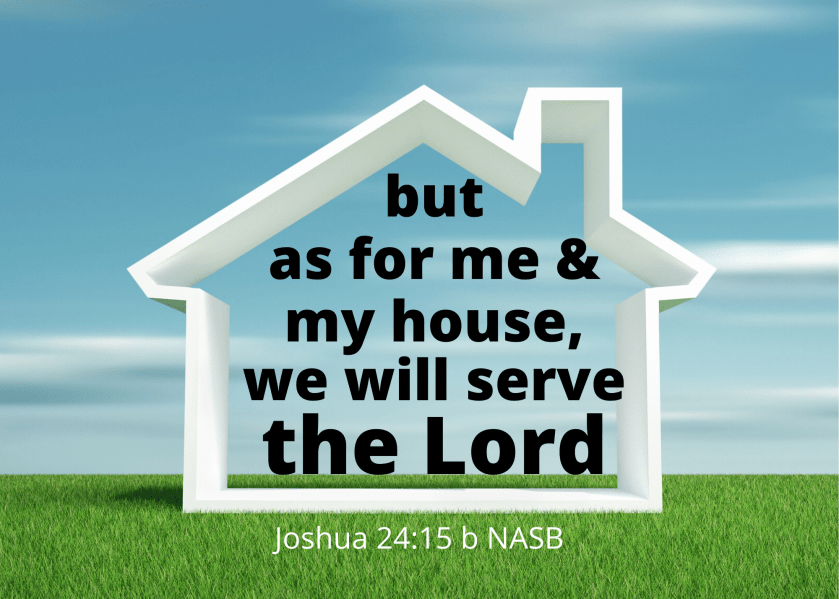
In these final chapters of Joshua, we read his deathbed advice to his people. Filled with nuggets of wisdom, Joshua calls the people to remember their history and God’s faithfulness, and he encourages them to continue following God. Joshua reminds the people that there is only One True God, YHWH, and that the household idols and the gods of the people around them are not truly going to save them. Yet still Joshua asks them to make a conscious decision, to declare their devotion one way or the other: “Choose this day whom you will serve… but as for me and my house, we will serve the LORD!” What a powerful charge to the people! If anyone had been unclear about Joshua’s position, there was no doubt after this profound declaration. Of course, the people agree that they will follow God, and of course, it wouldn’t be long before they would turn away yet again.
Joshua, famous among his people as a devoted follower of the One True God, knew humanity’s tendency to have idolatrous hearts. As he closed out his life, he wanted to remind the people to focus on what – WHO – is truly the most important. If you’re anything like me, you probably scoff at the ways in which the Israelites kept turning from God in spite of all His miraculous provisions, but in reality, all of humanity worships something; the idols are just different for each of us. We have an innate desire to worship, and that should be directed toward our Creator. However, our flesh can often lead us to worship the things of this world – money, entertainment, sex, identity, work, comfort, power, nature, and self – more than we worship our God. We must be alert to the things of this world that are vying for our devotion, keeping our eyes attuned and faithful to our God above all else.
Don’t let Joshua’s words be just an empty platitude on your dining room wall, but really take it to heart. Whom will you serve? Will you follow the empty gods of this age, or will you wake up every day willing to follow the One True God?
-Rachel Cain
Reflections:
What does it mean to really serve the Lord? What idols do you need to cast aside to really seek and serve Him?
Research the ways in which Joshua is a foreshadowing of Jesus. There are many interesting parallels!
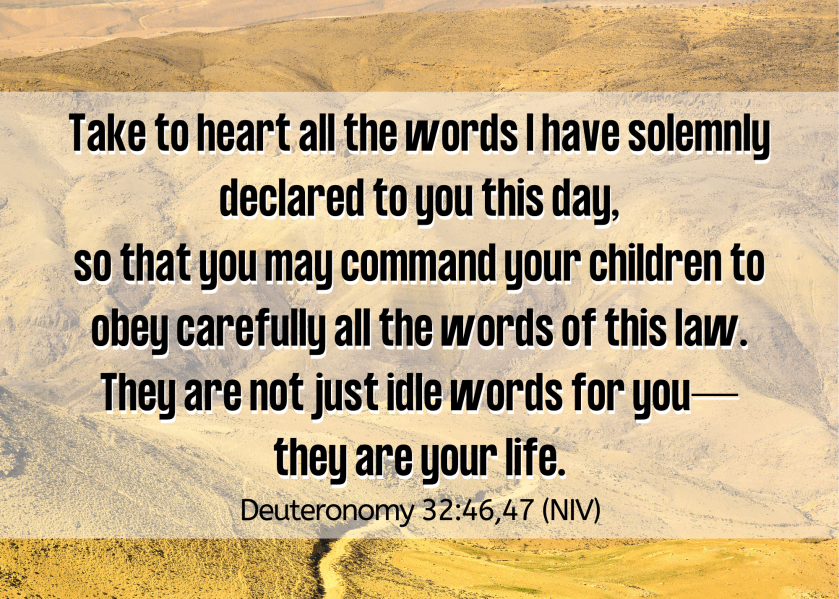
When Moses had finished reciting all these words to all Israel, he said to them: “Take to heart all the words that I am giving in witness against you today; give them as a command to your children, so that they may diligently observe all the words of this law”. Deuteronomy 32:45-46 (NRSV)
I’m a music lover. My memory of “contemporary” music goes back about 30 years. 1995-1996 is when I first remember getting into music on the radio. It’s not just the music of my era… I grew up listening to the classic rock format as well as ‘90s rock and pop. If I were to anonymously give you a top 20 list of my favorite albums or songs (which I’d probably never be able to narrow down), you might be left scratching your head, wondering who this person is and when they were born. Powerful is the art of song and music. I love music for the notation, the way that notes and chords are put together to create melody and harmony, even dissonance, but also for the lyrics… The way that someone can convey emotion or conviction in a way that hits hard, that makes you think and feel.
Great songs come in many forms. There is much to be gleaned from a simple lyric – Jesus loves me, this I know, for the Bible tells me so; and there is much to contemplate from an imaginative and thoughtfully written gem that paints an image in the mind: “Could we with ink the ocean fill, and were the skies of parchment made; were every stalk on earth a quill, and everyone a scribe by trade; to write the love of God above would drain the ocean dry; nor could the scroll contain the whole, though stretched from sky to sky”.
The Beatles were a smash with their early simplistic songs, but also with more thought-provoking tunes toward the end of their run. Leonard Cohen’s “Hallelujah” (Jeff Buckley did it better) is one of the most gut-wrenching (in a good way) songs that I can think of. It carries the listener through peaks and valleys of emotion as it describes tensions in the human experience of love. Perhaps I have digressed too much, but I can get distracted when I get into the minutiae of music.
In Deuteronomy 32, we have recorded a song that Moses recited to the Israelites shortly before he went up to Mount Nebo to get a distant view of the promised land and then die. In this song, we see a variety of things addressed. Moses glorifies Yahweh, his God, but takes the people on a journey to envision their future failure and rejection of God’s ways that they are on a path toward. Challenges, encouragement, and perspective.
While Moses covers some pretty negative territory regarding the Israelites in his words, he also gives assurance that Yahweh is a God of mercy and redemption and that his people will be cleansed. Despite impending failure, there is forgiveness and mercy on the docket, and there will ultimately be protection for the people of God against their adversaries.
I find it a little curious that Moses addresses the people in song, diverging from the status quo of God’s revelation to his people up to this point, but song can be a powerful way to commit things to memory. In contrast to the ten commandments and the subsequent revelation of the full law, this presentation perhaps was remembered and recited in a way that was engaging and complementary.
-JJ Fletcher
Reflection Questions:
How has music impacted your relationship with God and Jesus?
Do you find it easier to remember lyrics and scripture put to song than simply memorizing bible verses?
How do we balance the desire that we might have for catchy and relatable tunes with the directive to glorify and worship God with music?
What impact do you think Moses’s addressing the people in this manner had on them? (might be helpful to look back at Deuteronomy 31:19-22)
And behold, now I bring the first of the fruit of the ground, which you, O LORD, have given me.’ And you shall set it down before the LORD your God and worship before the LORD your God. Deuteronomy 26:10 (ESV)
It is Sunday morning. What are you going to do this morning (or, depending on when you read this, what did you do this morning)? It is the first day of the week; did you spend it on yourself, or did you give some of your time in worship of Yahweh our God and in remembrance of his son, Jesus, our savior? Most of those reading this likely attended a local church this morning, but some of you may have needed to work, or perhaps there was another reason for not being in church today.
Why am I asking these questions? Deuteronomy 26 speaks of the act of giving the first fruits of the harvest as an offering to God. Looking forward to the entrance into the land of milk and honey, the promised land, the Israelites are instructed to take a portion of their first fruits and bring it to the priest to set before the altar. Taking a portion of what God has blessed them with and giving it back as a sacrifice or offering. Things are different now. We are not under the ceremonial law, but are we exempt from sacrifices?
Through him then, let us offer up a sacrifice of praise to God continually, that is, the fruit of lips that make confession to his name. Do not neglect to do good and to share what you have, for such sacrifices are pleasing to God. Hebrews 13:15-16 (REV)
Worship is something God desires of us, and while it is not for us, it does us good, for it puts God into our focus and puts him in his exalted place. Jesus told his disciples to break bread and partake of the cup whenever they got together “in remembrance of me”. We need to remember Jesus’ sacrifice as we try to live sacrificial lives.
Gathering for worship and fellowship is important, but it is a sacrifice. Many people don’t work on Sunday, a day to sleep in and relax! We may see the value of setting this time aside for worship, but sometimes we may struggle with it. Churches are filled with imperfect people (sorry if this comes as a surprise to you), and sometimes those people are a source of pain in our lives. We hurt one another and sometimes struggle to confess our sins against one another, and sometimes we fail to forgive those who sin against us (that seems backwards from how Jesus instructed us to pray). Maybe we see this sacrifice of our time as a duty, and we lose some of the wonder that we experienced toward Christ’s church.
There can be reconciliation through our sacrifices of praise and obedience, just as Christ’s sacrifice reconciles us to God, as we spend time in community and in fellowship through the spirit of God, we should be transformed to be like Jesus, who was able to forgive the betrayal and brutality that was directed to him. Jesus had to slog through difficulties and disappointments like we do; he had his times of questioning, and maybe he even struggled at seeing the wonder of it all at times. Through obedience, sacrifice, and confession, we can be conformed to his image of Jesus and also glorify God as we recognize him as our provider and source of our hope.
-J.J. Fletcher
Reflection Questions:
What do we have for first fruits that can be brought before God?
I see time as being our most valuable resource. When we give time to God, what does this do to and for us?
Do you give money to your church or other ministries? How does financial offering correlate to first fruits?
When you give the first fruits of your day or week to God in devotion or worship, does it differ from giving him whatever you have left at the end of a long day or week?
Celebrate the Festival of Tabernacles for seven days after you have gathered the produce of your threshing floor and your winepress. Be joyful at your festival—you, your sons and daughters, your male and female servants, and the Levites, the foreigners, the fatherless and the widows who live in your towns.” – Deuteronomy 16:13-14
Today we read God’s commands to begin observing three major feasts: Passover, the Feast of Weeks, and the Feast of Tabernacles. Each of these festivals was meant to be an intentional time set aside for remembrance (a recurring theme in Deuteronomy). The Israelites had witnessed God’s power and provision in so many ways… like so many. They were delivered from Egypt, provided for in the wilderness, and were finally being brought into the Promised Land—all of which included various miracles and supernatural occurrences. These celebrations were more than legalistic rituals—they were acts of worship and gratitude intended to continually remind God’s children of His unending goodness.
While most Christians today don’t keep these feasts in their traditional form, their purpose no doubt remains deeply relevant. We are still called to remember God’s goodness, rejoice in His provision, and keep His Kingdom promise forefront in our minds. Jesus, our Passover Lamb, has secured our ultimate deliverance, and we live in the hope of the final harvest when God will gather His people into His eternal presence. Not only must we live in hope, but in daily remembrance. Our hope is not a baseless one. We have a book full of stories and people and places that display our Father’s faithfulness. We live in a world uniquely and precisely designed for human life in ways that defy mere chance. We see glimpses of the Kingdom in small moments every day. These are the things that we must recognize and reflect upon on a daily basis.
Whether through communion, worship, prayer, or perhaps even partaking in some feasts or holidays, we are called to consistantly honor the God who has redeemed us, sustains us, and promises us a future. I pray today that we cultivate hearts of gratitude and remembrance, celebrating our Father’s steadfast love and infinite goodness in every season of our lives.
-Isabella Osborn
Reflection Questions:
God established specific times for Israel to remember His faithfulness. How can setting aside time for remembrance strengthen our faith? How might neglecting remembrance weaken faith?
How can you intentionally set aside time to remember and celebrate God’s goodness?
What are some specific ways God has delivered you in your life? Have you taken time to truly reflect on and thank Him for those moments?
Chapter 12 is the beginning of a new set of comprehensive laws that take up the bulk of the book of Deuteronomy. Today we read about the specific ways in which God desired His people to worship. He called them to worship in His good and perfect way, not in the ways of the surrounding nations. The Israelites were instructed to destroy any false altars and worship only where God had chosen. This was about doing what was right in God’s eyes, rather than every man acting on his own whims or false morals.
You shall not worship the Lord your God in that way. But you shall seek the place that the Lord your God will choose out of all your tribes to put his name and make his habitation there. There you shall go. – Deut 12:4-5
You shall not do according to all that we are doing here today, everyone doing whatever is right in his own eyes, for you have not as yet come to the rest and to the inheritance that the Lord your God is giving you. – Deut 12:8
Chapter 13 issues a strong warning against abandoning their commitment to the one true God for a false god. It is warned that there will be false prophets and dreamers who can perform signs or wonders, but that they must not fall for such tricks and deception. It is even warned that if your family member whispers to you suggesting that you serve other gods, you must not listen to them. In fact they were instructed to kill them. Fortunately for us, such violence is no longer expected in these cases, however, discernment and steadfast loyalty to our Creator are expected of us. In today’s age, we are instructed to be aware of false prophets, and even false messiahs, as Jesus warns in Matthew,
Then if anyone says to you, “Look, here is the Christ!” or “There he is!” do not believe it. For false christs and false prophets will arise and perform great signs and wonders, so as to lead astray, if possible, even the elect. – Matt 24:24
Today, we may not have physical altars to tear down or false priests to execute, but our hearts can easily become divided. We are tempted to blend worldly influences with our worship, allowing distractions, personal desires, or cultural norms to shape our devotion rather than the truth of God’s word. In a world full of voices claiming to speak truth, it is imperative that we remain anchored in scripture. Even generally positive things, such as success, relationships, or even religious experiences, can become idols if they pull our hearts away from God. True devotion means prioritizing Him above all else, not in the ways we see fit, but in the ways He has commanded us.
-Isabella Osborn
Reflection Questions:
Are there any influences in your life—cultural, personal, or societal—that may be shaping your faith or outlook in ways that are not aligned with God’s Word?
How can you actively practice discernment in recognizing false teachings or influences that lead you away from total devotion to God?
In what ways can you ensure that your worship and daily life reflect God’s truth, rather than personal preferences or societal norms?
This week my husband is attending a four day technology conference where attendees are being introduced to the absolute newest innovations in the world of technology. They get to hear keynote speakers who are the experts in their field. He is loving exploring all the new and improved gadgets and gizmos. He also made sure he left a little extra wiggle room in his suitcase to bring home some conference souvenirs from the show floor exhibits.
As we’ve been reading in Exodus these last few days, it struck me that Moses was experiencing a somewhat similar event. With a few important differences of course. Moses’ conference wasn’t 4 days but 40. His wasn’t in Spain or Florida, but on Mount Sinai. His conference souvenir was much more impressive (and heavy) than anything Jason has come home with. And, the topic of Moses’ conference wasn’t technology but worship.
I think if you asked most people what Moses was doing on Mount Sinai, if they had any idea at all, they might say God was giving him the Ten Commandments on stone tablets. And they wouldn’t be wrong, as we see that did occur in the final verse of Exodus 31, which is part of our Bible reading today. However, there is much much more to the story. First of all, one should have asked – which visit to Mount Sinai – because it appears there could have been up to 7 or 8 trips up and down the mountain for Moses. (Similarly, if you asked me how many times Jason has been to technology conferences, I lost count a long time ago.) But, this was definitely a special place and Moses and God spent some special time together on this mountain.
It is interesting that this particular 40 day worship conference began way back at the tail end of Exodus 24 “Moses entered the cloud and went up on the mountain. And Moses was on the mountain forty days and forty nights.” (Ex 24:18 ESV) Thus begins 7 detailed chapters (Exodus 25-31) in which Moses tells us exactly what was really going on on Mount Sinai for 40 days and nights. And it really wasn’t about the law and the Ten Commandments, this time. In fact, these were given back in Exodus 20-23 (just 4 chapters for the giving of the law, though we will get to some more soon in Leviticus). Also, in Exodus 24 Moses had written down God’s rules for living. He read them to the people and they agreed that they would obey.
Next, God was moving on to the next BIG thing – How will you WORSHIP me? If you’ve been following along this week in Exodus you’ve read over and over again, “The Lord said to Moses…”, and “You shall make…”. And then you’ve read many, many detailed directions on how God wanted the people to make a tabernacle where they would meet and worship God. Contributions, curtains, ark of the covenant, bread table, golden lampstand, bronze altar, outer court, lamp oil, the priests’ clothing and consecration, incense altar, census tax, bronze basin, anointing oil, incense…no wonder it took 40 days! I wonder if Moses had to pass a written test at the end so God was sure He remembered the perfect incense recipe and the dimensions of the curtains. Maybe Moses took notes and made sketches which would become the rough draft of Exodus 25-31.
It’s important to remember these were not just suggestions given for one possible way they could create a space for God to dwell with them. These were precise directions from the Creative Maker of the Universe. The All-Knowing Keynote Speaker at this Worship Conference knew what He wanted and why. There was only one right way to do it God’s way. Perhaps He was giving them valuable experience in doing things God’s way. Thankfully, He was making it known, every detail, so they wouldn’t have to guess and get it wrong over and over again. Also, as we see if Exodus 31 He was not only giving this information to Moses, but He was also giving His Spirit and ability, intelligence and knowledge to others who would lead the work of crafting. They didn’t have to figure it out on their own! They could follow the God-given directions and God would provide the skills and abilities and knowledge and Spirit they needed! But, what if Moses or Bezalel or Oholiab (the gifted craftsmen) or the people decided green and yellow yarn would be much brighter and cheerier than blue, purple and scarlet? What happens when we disregard God’s directions and decide to do it our own way instead?
One example is given in Exodus 32. Just as I have my biggest technology emergencies when my tech expert is at the technology conference, when Moses is at the worship conference, the Israelites experience a very big worship emergency. They not only try changing the color of the yarn, they change their god. Fearing what has happened to Moses (apparently they didn’t get the advertisement that this worship conference would last 40 days), they take matters into their own hands and decide it’s time to make a new god to lead them. It sounds so ridiculous – but perhaps if we are honest we have sometime also gotten tired of waiting on God, and fearing the worst, took action in the wrong direction. Unfortunately, Aaron followed along with their ideas, maybe scared of the people, maybe eager to get his chance to be in charge?
At Moses’ 40 day Worship Conference he got to receive first hand from the Lord the unveiling of all the latest and greatest features of how God wanted the Israelites to prepare to worship the Almighty. How can you attend a worship conference with God today? What does He want to reveal to you about how to worship Him?
-Marcia Railton
Reflection Questions
Why do you think God gave Moses so many specific directions for how the Israelites were to worship Him? Do you think there is a connection between His rules for how we live and how we worship?
I don’t think there is just one type of music God wants to be worshiped with, or just one color of carpet God wants to see in every church, but what are some worship rules you think God wants us to remember when we worship Him today?
What can we learn from Moses about Christian leadership? And from Bezalel and Oholiab? And from Aaron?
Have you ever created a new god to worship and follow when you became fearful or impatient. How do we guard against falling into the golden calf trap?
Places of worship come in all different shapes and sizes. I have worshipped God in huge cathedrals with impressive pipe organs and altars overlaid with gold and stained glass windows. I have also worshipped God in open-air tabernacles with sawdust floors. I have worshipped God in a deer stand, at the beach, on a mountaintop and on a table undergoing radiation. I have worshipped God in loud and energetic services with guitars, drums, and electronic keyboards and I have worshipped him in places with no sound at all except the flickering flame of a single candle.
I believe God loves to be worshipped in lots of ways and in lots of places. Even in the Biblical stories God was worshipped on simple stone altars, in burning bushes, on mountain tops and down in valleys.
Israel was at a critical time in their formation and it was important for them to have a steady reminder of God’s presence. God made his presence visible to them as they journeyed with both a pillar of cloud in the day and a pillar of fire at night. As they continued their journey across the wilderness, God chose to make his visible presence known to them in a portable house of worship. This place would provide structure in the midst of their community wherever they stopped to make camp. The tent of meeting or tabernacle would be an ongoing visible sign that God’s glory was in their midst. And God taught them how to be a holy nation. He used various symbols and rituals of sacrifice and worship as a way to drill home to them his holiness and the consequences of sin.
How God chose to do this is quite interesting. He could have simply built a temple Himself in the heavens and dropped it down fully formed on earth. However, God chose instead to invite His people to become active participants in creating this place of worship.
First, God began with their willing desire to give. “Tell the Israelites to bring me an offering. You are to receive the offering for me from everyone whose heart prompts them to give. These are the offerings you are to receive from them: gold, silver and bronze; blue, purple and scarlet yarn and fine linen; goat hair; ram skins dyed red and another type of durable leather. acacia wood; olive oil for the light; spices for the anointing oil and for the fragrant incense; and onyx stones and other gems to be mounted on the ephod and breast piece” (Exodus 25:2-7). This was not a mandatory tithe that was required; this was an offering to be willingly given and received.
Where did the people get all of these valuable commodities? If you will recall, as they were leaving Egypt they were given many valuable items by the Egyptian peoples – one might say this was payment to help compensate for years of slavery. They had these items in their possession already. Those who were willing could give them to help create the tent of meeting and the prescribed worship items inside of the temple, which included the Ark of the Covenant, the table, the lampstand as well as the material for the tabernacle itself, and the altar, courtyard and the oil to keep the lamps burning. All of the materials were freely donated. The people of God used their own skill to build the items from these donated materials – carpenters, weavers, stonemasons, goldsmiths and others each made their own contributions to the creation of this place of worship. In this way, everyone in the community that wished to participate had buy in to the tabernacle. It truly was a communal place of worship.
Once the nation finished their journey through the wilderness and took possession of the Promised Land, they would eventually transition from a portable tent of meeting to a permanent temple under the leadership of King Solomon. However, this tent of meeting served them well for 40 years in the wilderness and many more during the times of the judges, and kings Saul and David.
For Christians, we do not worship God in a tabernacle or physical temple and we do not bring sacrifices of sheep or goats or bulls for an offering to God. For us, the Church itself is the temple of God. I am not talking about the building where the Church gathers to worship, I am talking about the actual people who gather to worship, and we are the Church. Jesus said whenever 2-3 gather in his name that he is there in their midst. There is no one single right way or place to worship God. It is wherever God’s people come together. Christian Worship does not have to follow a strict pattern. Worship is where we gather to read the word of God, pray, worship, encourage each other and exhort one another to good works, break bread and proclaim the resurrection of Jesus. Blood sacrifices are not necessary because Jesus is the Lamb of God who takes away the sins of the world and he entered into the holy of holies once and for all and gave his own body as the final sacrifice for all of our sins.
One thing remains unchanged from the time of Israel in the wilderness tent of meeting and the Church today. God still welcomes us to bring our offerings from the heart as a way to say thank you. We can still bring tangible offerings, and we can still offer our gifts and talents as ways of showing God our deep gratitude for all of his blessings to us. It is not all that important how we worship or where we worship, but it is very important that we worship and we bring our offerings freely to worship God.
Jeff Fletcher
(originally posted February 7, 2020 for SeekGrowLove)
Reflection Questions
Why do you think God wanted the Israelites to have a tabernacle? What are some benefits today to having a place to go to worship God together with God’s people? What are the additional benefits to being able to worship God anywhere?
Why do you think God gave Moses so many details for how to make the tabernacle and its furnishings?
Where do you find a sanctuary where God dwells with you? What offerings do you freely bring to God as part of your worship?
“Each of us shoulder an invisible backpack,” I recently heard this statement during a professional development session about trauma-informed practices for students. While the idea of carrying emotional baggage is not new, the thought that this load is often imperceptible to others—visible only to the one who bears it—has lingered with me. As we consider our own baggage, the persisting heaviness of personal sin, trauma, and fear becomes clear, especially when these burdens are held within. If we choose to bear this weight alone, it can become a crushing load. In a prayer, a plea, and the prompting of a promise, I encourage each of us to begin unpacking the deepest and darkest longings and aches of our hearts, asking for release from our fears and sins.
In the second chapter of Malachi the Lord continues to call out Israel’s priests for persistently violating His law and covenant with the tribe of Levi. Two important takeaways emerge from this passage. First, no one is above submitting to Christ – or in their case, the law- and leaning on Him to carry their burdens. Second, choosing the perpetual path of personal sin wearies the ears of God. An unrepentant heart leads to the removal of protection and blessing, leaving us despised, humiliated, and metaphorically (or even literally) covered in our own filth. While we may not feel ready to announce our shortcomings to the world, we can no longer justify our sin or allow ourselves to call what is evil, good.
Psalm 150 reminds us (and speaking to myself here, mostly) that picking up an instrument means momentarily setting down the fears we carry. As stated yesterday, when we offer worship to the Lord, we reconnect with Almighty God. Praise is not merely a response to blessings but a declaration of trust in His sovereignty and goodness. I think of Joseph, Paul, and Silas, all of whom used worship to transform their injustices into testimonies (Gen 40; Acts 16). What we carry may be truly terrible and meant for evil, but with praise to our Heavenly Father, our overwhelming emotions can become a weaponized testimony that God uses to free others from similar circumstances.
Finally, in our New Testament reading, we see Jesus transform fear and failure into fruitfulness. After a night of empty nets in the Sea of Galilee, Jesus directs His disciples to cast their nets on the other side of the boat, resulting in an abundant catch. Onshore, Jesus awaits them with a prepared meal, inviting them into His provision and rest. When our doubts and frustrations run high—when we find ourselves spinning our wheels without results—we must seek the voice of the greatest Fisher of men. Only He can tell us where to cast our nets. Without His guidance, we labor in vain. Moreover, Jesus not only encourages but nourishes, reminding us that if He calls us to a task, He will also provide for it.
Carrying the weight of fear and sin is paralyzing. We will never feel adequate, and we will remain distant from God if we leave these burdens unaddressed. Ironically, when we unpack and expose these things to the Light, we receive freedom and restoration through Jesus Christ. As we reflect on the year that has passed, this is the invitation: begin digging through your invisible backpack, identifying the objects that hold you captive. Turn your failures and frailty over to Jesus, allowing Him to shoulder your burdens with the payment of His blood. Trust that His Father is faithful and forgiving, ready to release you from the weight you carry and restore you to the lightness of His yoke.
-Aaron Winner
Reflection Quesions
What do you carry in your backpack? What has been the result of carrying it? What would it look like to start unpacking it?
Pray for direction on where and how to cast your nets. Where and when have you previously had the most success fishing for men? What might the Greatest Fisher of Men be asking you to do next?
How has worship brought you closer to God? How can you worship Him better today? What will you worship Him for?