The Error of Innovation

1 Kings 12-14

If you’re like me, you’ve purchased an “assembly required” item and unpacked the contents without thumbing through the instructions. “How hard could it be to turn a few screws and boards into a bookshelf?” Halfway through the build, you realize you used the wrong board in one section, another is fitted upside down, and in your haste, you’re now down at least one screw. Necessity may be the mother of invention, but sometimes innovation comes from darker places—with consequences far greater than a shoddy IKEA build. Pride and fear can quickly lead us into folly as we try to adjust and adapt without seeking counsel. Likewise, our spiritual life was never meant to be self-driven, self-led, or self-defined. To build our relationship with God, we are called to be faithful to His instructions and selfless in their pursuit.

In today’s reading, King Jeroboam is appointed as the new leader of Israel. As he takes the reins, he surveys the political pieces of a recently split kingdom. His people had long worshiped in Jerusalem, which remained part of the rival kingdom of Judah. Jeroboam feared that his people’s loyalty would ultimately shift back to Rehoboam, king of Judah, from the anointed house of David. Instead of consulting the God of Abraham, Isaac, and Jacob or one of His prophets, Jeroboam devises his own solution to keep the people close to home.

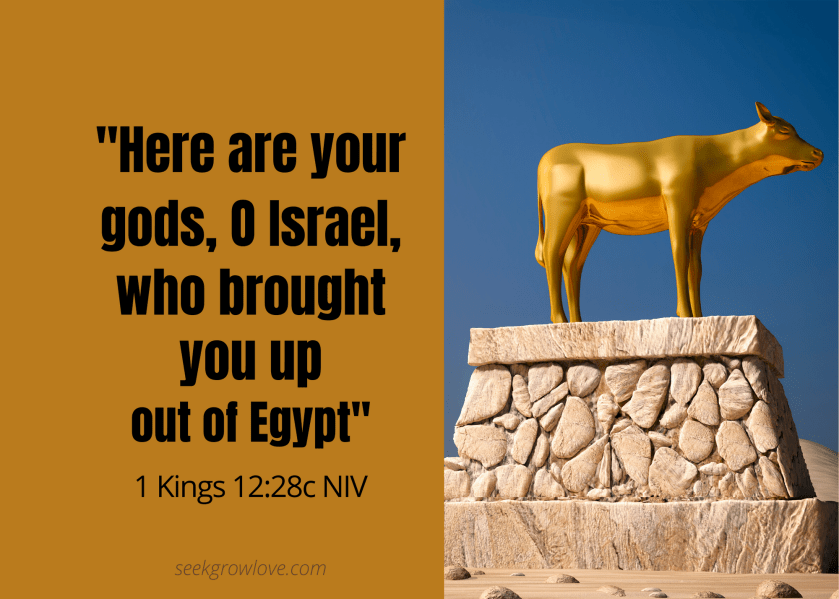
“Jeroboam thought to himself, ‘The kingdom will now likely revert to the house of David…'” So the king made two golden calves. He said to the people, ‘It is too much for you to go up to Jerusalem. Here are your gods, Israel, who brought you up out of Egypt.'” (1 Kings 12:26, 28)

Jeroboam took up his place as both the political and spiritual leader of Israel, but motivated by fear and a desire for control, he led God’s people astray. He created false idols, counterfeit altars, and bogus festivals—all in an attempt to keep his people from returning to the holy city of Jerusalem. Leaving behind the moral clarity of God’s commands, it became easier and more accessible to engage in a made-up religion that appeared similar on the surface to what they knew to be true. They were working with the same pieces, but some were flipped upside down, some placed in the wrong spot, and others lost along the way. As their worship moved farther from Jerusalem, the distance between Israel and God grew greater.

There is a stark warning here for the adjustments and innovations we see in the Church today. We must be careful that our worship, ministry, and evangelism do not favor convenience over obedience or comfort over conviction. If we fail to heed this warning, we may end up with well-developed systems that contain many of the same pieces—but are no longer building the Kingdom of God. Instead, we risk creating idols and events that offer no eternal hope. Granted, we may not be fashioning golden calves, but when we prioritize comfort over truth, we risk building spiritual lives rooted in fear, insecurity, and pride—lives that are void of God’s instruction.

It has never been about innovating what works for us or embracing a “you do you” mentality. God demands surrender and faithfulness in our daily worship, which means we will likely find ourselves worshiping in the city of our enemies from time to time. Resist the urge to craft a god who fits us. Instead, let us be molded to fit His purpose and to build His Kingdom according to His Gospel instructions.

-Aaron Winner

Reflection Questions

  1. What problems do you think God saw in Jeroboam? Do you think God ever sees these same problems in you?
  2. What does God desire from us – in our worship and in the way we live our lives?
  3. What are your thoughts about the following: “If we fail to heed this warning, we may end up with well-developed systems that contain many of the same pieces—but are no longer building the Kingdom of God” ? Have you seen this occur? How can we better heed this warning for our lives and for our church and for the Kingdom of God?

Gifts, God and Glory

1 Kings 10-11
2 Chronicles 9

There are simply some things you have to see with your own eyes to understand what all the hype is about. To stand at the edge of the Grand Canyon or to gaze from the helm of a ship in the middle of the ocean are images that have been perpetuated as pinnacle experiences through pop culture. While it’s possible to be in awe while reading a description or gazing at a photo, the real deal—being present in these places—has left me in wonder at the work of the Almighty.

In a similar manner, the stories of Solomon’s wisdom had spread like wildfire, reaching as far as the Horn of Africa—which, in ancient historical terms, was viral. The tale of a singularly wise leader whose work had led Israel into a time of ultimate prosperity made all the hype seem too good to be true. The Queen of Sheba, having received these reports, had to hear and see for herself. What she found was that the blessings were abundant and beyond even what was reported. The sights and sounds of Israel were breathtaking, but none more than the wisdom of King Solomon. After taking it all in, the Queen acknowledged that the sovereign God of Israel had placed Solomon on the throne to rule at such a time.

“Praise be to the Lord your God, who has delighted in you and placed you on the throne of Israel. Because of the Lord’s eternal love for Israel, he has made you king to maintain justice and righteousness.”
—1 Kings 10:9

In contrast, in the very next chapter of 1 Kings, we watch the eyes of Solomon shift—from service of the Most High to service of his own flesh. From my own speculations, taken from the perspective in Ecclesiastes, it seems that for a season Solomon focused more on the gifts of God than on his relationship with Him. Israel began looking more like the king and less like its God under Solomon’s direction. He established altars for the gods of his wives and concubines, reshaping not only the physical locations but also the worship of the people. The evidence was in: the splendor of this kingdom, which once pointed to the protection of an undefeated Most High God, was now showing signs of the waning wisdom of a compromised king calling his own shots.

As we read these contrasting moments in Solomon’s life, we should turn and reflect on our own. We may not have the accolade of being the “-est” of anything, but there are tales that could be reaching far and wide about us. When we are visited, our “place settings inspected,” and people look at our sacrifice, what does all our effort and show point to? Are we encouraged—or offended—by those who look at the catalogue of our life’s work and give God the credit?

When God has His hand upon us, it can be recognized and sought by strangers from a distant land who hunger or thirst for answers to their questions. The truth is, sometimes from the outside looking in, the beauty of God’s hand in our lives is more clearly seen. Conversely, from the inside looking out, we may gaze upon the gifts of the Lord and mistakenly see them as our own handiwork, when it is by God’s glory that we are richly blessed. The warning given to us by Job is that the One who gives and multiplies can also take away and divide.

The hype of God has been—and will continue to be—acknowledged by those who look at it from afar in awe. However, the goodness of God is best experienced firsthand, through encountering Him with every thought and action. Let us not forget that He is the provider of grace and the bestower of the fruits of His Spirit; we could never attain these through our own effort. Don’t be so entangled in the blessing that you forget the intention with which it was given: to demonstrate the glory of our Heavenly Father.

-Aaron Winner

Reflection Questions

  1. What thoughts, feelings, desires, or motives do you think led Solomon astray? Which of these same thoughts, feelings, desires, or motives do you see in yourself?
  2. In what ways would you like to be like Solomon? In what ways will you work at not being like Solomon?
  3. Are there gifts God has given you that you have mistakenly viewed as your own handiwork? What happens when we focus on the gifts rather than the Gifter? How can we better see what God has given and in return give to Him the credit, thanks and glory for all His wonderful gifts.

Let the Nations be Glad

Psalm 65-67, 69-70

So many of the psalms focus on directly worshipping and declaring the goodness of God, which is good, but this psalm takes that knowledge of God and comes in with a missional view: Let God be known and praised by all the people. All the nations. Not just Israel, his covenant people, but by everyone.

The psalmist recognizes the goodness of God and what he has done for his people. In light of this fact, they want the goodness of God to be experienced by all people and for there to be abounding joy for all.

God provides sustenance for all people, the earth yields its produce. It does so because God designed it that way, so may the nations recognize that Yahweh created life and sustains it through his order.

Verse 4 talks about the nations being judged with equity. Equity here is the Hebrew word mishor, which literally means levelness or uprightness. God will not play favorites with his judgment, he will judge with prejudice, but he will judge fairly and give the same outcomes to the faithful of all tongues and tribes. In the same way, destruction comes from rejecting God, regardless of the background of the individual.

We can look at this through the lens of Jesus, but even without a clear picture, the psalmist saw a future where there was no Jew nor Greek, nor slave nor free, but a world where all could bask in and enjoy the glory of God and worship him in spirit and in truth.

Let the nations be glad.

-JJ Fletcher

Reflection Questions

  1. Where does your joy come from?
  2. Do you view your role as a believer to be missional? To bring others into a saving relationship with Jesus and his Father?
  3. Do you have trouble with being equitable in your sharing? Can it be difficult to share with people from different backgrounds?
  4. If you find great hope and strength in the gospel, shouldn’t you share it? Why are we worried about “offending people” with the gospel?

God’s Desire

Psalm 50, 53, 60, & 75

Psalm 50 cuts through the noise of empty ritual and gets to the core of what God truly wants from us- genuine worship. 

God doesn’t need us to sacrifice animals to him- he already owns all the beasts of the forest and all the cattle of the hills and all the birds of the sky.  God doesn’t need anything that we can give him, there is nothing we can offer him that he doesn’t already have.  

Verses 14-15 say, “Offer to God a sacrifice of thanksgiving, and  perform your vows to the Most High, and call upon me in the day of trouble; I will deliver you, and you shall glorify me.“  God’s desire is for our hearts to be turned towards him. He asks for thanksgiving and for us to call on him when we’re in trouble, to remember that we depend on him so that He can help us.

This Psalm is a great reminder that there is no use in just going through the motions.  Our spiritual practices shouldn’t be a show to look good in front of others, nor is our faith a series of boxes to check to make sure we’re being Christian enough.  Our faith is a relationship with a real and true God who loves us and wants us to come to him.

-Hope Fletcher

Reflection Questions

  1. What does God desire from you?
  2. How would you describe your relationship with God right now? Are there changes you think God would like to see? Describe. Are you wanting to make any changes? Describe.
  3. What will you give thanks to God for today? And tomorrow? And next week?

Poems Put to Music

Psalm 121, 123-125, 128-130

My husband used to be in sales and sometimes the leads he had were in the evening and a fair distance from home.  To stay awake while driving, in addition to opening his windows and turning the radio way up, he sometimes made up songs.  He’s quite clever and I thought some were pretty good.  Creativity can be fun.

Psalms are poems.  Songs are poems put to music.  They are often used to help the Israelites remember their content.  Only one of these Psalms is directly attributed to David.  We don’t know who wrote the others, but they are all titled A Song of Ascents and were sung by travelers, likely on their way to Jerusalem for one of the yearly feasts.  These musical poems prompted the Israelites to look at God from many perspectives.

121 – God is their helper and creator.  He doesn’t sleep, so He is always watching out for them.

123 – They recognize God is in heaven and they look to Him for mercy.

124 – They acknowledge God as their protector.

125 – They see that God surrounds them – he sees everything, all the time.  He brings peace to Israel.

128 – They understand that they need to fear the Lord, and that blessings come from His hand.

129 – They speak of God’s righteousness.  They speak of those who hate Zion (are against Israel) that they will be put to shame.

130 – They talk of His forgiveness and the hope Israel has through God’s love.  They know He will redeem them.

As they traveled, their focus was on God, whom they were going to worship.  These songs would have prepared their hearts, minds and attitudes to come before God.    

Get creative, and consider making up your own poem, set to music or not, to tell of what God means to you.  Which of His characteristics do you want to tell about?  Here’s an easy way to start – borrowing some of what we read today.

To you I lift up my eyes, O you who __________.  As __________ surrounds my home, so the Lord surrounds me.  Blessed is everyone who fears the Lord.  Lord, bless me with __________ and __________.  The Lord is righteous.  May all who harm your people, Lord, be __________.  O Lord, hear my voice; listen to my pleas for __________.  I wait for the Lord; I wait for _________.   My hope is in you, Lord!

Amy Blanchard

Reflection Questions

  1. Before you head off to church, take some time to prepare your heart, mind and attitude to come before your amazing God.  What will it look like for you to do that?  Spend some time in God’s word, or in prayer?  Sing some praise songs? 
  2. Which of God’s traits are you clinging to right now?  Is there someone you can reach out to who can offer support?

Praise or Platitudes

Joshua 22-24

In these final chapters of Joshua, we read his deathbed advice to his people. Filled with nuggets of wisdom, Joshua calls the people to remember their history and God’s faithfulness, and he encourages them to continue following God. Joshua reminds the people that there is only One True God, YHWH, and that the household idols and the gods of the people around them are not truly going to save them. Yet still Joshua asks them to make a conscious decision, to declare their devotion one way or the other: “Choose this day whom you will serve… but as for me and my house, we will serve the LORD!” What a powerful charge to the people! If anyone had been unclear about Joshua’s position, there was no doubt after this profound declaration. Of course, the people agree that they will follow God, and of course, it wouldn’t be long before they would turn away yet again.

Joshua, famous among his people as a devoted follower of the One True God, knew humanity’s tendency to have idolatrous hearts. As he closed out his life, he wanted to remind the people to focus on what – WHO – is truly the most important. If you’re anything like me, you probably scoff at the ways in which the Israelites kept turning from God in spite of all His miraculous provisions, but in reality, all of humanity worships something; the idols are just different for each of us. We have an innate desire to worship, and that should be directed toward our Creator. However, our flesh can often lead us to worship the things of this world – money, entertainment, sex, identity, work, comfort, power, nature, and self – more than we worship our God. We must be alert to the things of this world that are vying for our devotion, keeping our eyes attuned and faithful to our God above all else. 

Don’t let Joshua’s words be just an empty platitude on your dining room wall, but really take it to heart. Whom will you serve? Will you follow the empty gods of this age, or will you wake up every day willing to follow the One True God? 

-Rachel Cain

Reflections:


What does it mean to really serve the Lord? What idols do you need to cast aside to really seek and serve Him? 

Research the ways in which Joshua is a foreshadowing of Jesus. There are many interesting parallels! 

Power in Song

Deuteronomy 32-34 & Psalm 91

When Moses had finished reciting all these words to all Israel, he said to them: “Take to heart all the words that I am giving in witness against you today; give them as a command to your children, so that they may diligently observe all the words of this law”. Deuteronomy 32:45-46 (NRSV)

I’m a music lover.  My memory of “contemporary” music goes back about 30 years. 1995-1996 is when I first remember getting into music on the radio. It’s not just the music of my era… I grew up listening to the classic rock format as well as ‘90s rock and pop. If I were to anonymously give you a top 20 list of my favorite albums or songs (which I’d probably never be able to narrow down), you might be left scratching your head, wondering who this person is and when they were born. Powerful is the art of song and music. I love music for the notation, the way that notes and chords are put together to create melody and harmony, even dissonance, but also for the lyrics… The way that someone can convey emotion or conviction in a way that hits hard, that makes you think and feel.

Great songs come in many forms. There is much to be gleaned from a simple lyric – Jesus loves me, this I know, for the Bible tells me so; and there is much to contemplate from an imaginative and thoughtfully written gem that paints an image in the mind: “Could we with ink the ocean fill, and were the skies of parchment made; were every stalk on earth a quill, and everyone a scribe by trade; to write the love of God above would drain the ocean dry; nor could the scroll contain the whole, though stretched from sky to sky”.

The Beatles were a smash with their early simplistic songs, but also with more thought-provoking tunes toward the end of their run. Leonard Cohen’s “Hallelujah” (Jeff Buckley did it better) is one of the most gut-wrenching (in a good way) songs that I can think of. It carries the listener through peaks and valleys of emotion as it describes tensions in the human experience of love. Perhaps I have digressed too much, but I can get distracted when I get into the minutiae of music.

In Deuteronomy 32, we have recorded a song that Moses recited to the Israelites shortly before he went up to Mount Nebo to get a distant view of the promised land and then die. In this song, we see a variety of things addressed. Moses glorifies Yahweh, his God, but takes the people on a journey to envision their future failure and rejection of God’s ways that they are on a path toward. Challenges, encouragement, and perspective.

While Moses covers some pretty negative territory regarding the Israelites in his words, he also gives assurance that Yahweh is a God of mercy and redemption and that his people will be cleansed. Despite impending failure, there is forgiveness and mercy on the docket, and there will ultimately be protection for the people of God against their adversaries.

I find it a little curious that Moses addresses the people in song, diverging from the status quo of God’s revelation to his people up to this point, but song can be a powerful way to commit things to memory. In contrast to the ten commandments and the subsequent revelation of the full law, this presentation perhaps was remembered and recited in a way that was engaging and complementary. 

-JJ Fletcher

Reflection Questions:

  1. How has music impacted your relationship with God and Jesus?
  2. Do you find it easier to remember lyrics and scripture put to song than simply memorizing bible verses?
  3. How do we balance the desire that we might have for catchy and relatable tunes with the directive to glorify and worship God with music?
  4. What impact do you think Moses’s addressing the people in this manner had on them? (might be helpful to look back at Deuteronomy 31:19-22)

A First Fruit Sacrifice

Deuteronomy 24-27

And behold, now I bring the first of the fruit of the ground, which you, O LORD, have given me.’ And you shall set it down before the LORD your God and worship before the LORD your God. Deuteronomy 26:10 (ESV)

It is Sunday morning. What are you going to do this morning (or, depending on when you read this, what did you do this morning)? It is the first day of the week; did you spend it on yourself, or did you give some of your time in worship of Yahweh our God and in remembrance of his son, Jesus, our savior? Most of those reading this likely attended a local church this morning, but some of you may have needed to work, or perhaps there was another reason for not being in church today.

Why am I asking these questions? Deuteronomy 26 speaks of the act of giving the first fruits of the harvest as an offering to God. Looking forward to the entrance into the land of milk and honey, the promised land, the Israelites are instructed to take a portion of their first fruits and bring it to the priest to set before the altar. Taking a portion of what God has blessed them with and giving it back as a sacrifice or offering. Things are different now. We are not under the ceremonial law, but are we exempt from sacrifices?

Through him then, let us offer up a sacrifice of praise to God continually, that is, the fruit of lips that make confession to his name. Do not neglect to do good and to share what you have, for such sacrifices are pleasing to God. Hebrews 13:15-16 (REV)

Worship is something God desires of us, and while it is not for us, it does us good, for it puts God into our focus and puts him in his exalted place. Jesus told his disciples to break bread and partake of the cup whenever they got together “in remembrance of me”. We need to remember Jesus’ sacrifice as we try to live sacrificial lives.

Gathering for worship and fellowship is important, but it is a sacrifice. Many people don’t work on Sunday, a day to sleep in and relax! We may see the value of setting this time aside for worship, but sometimes we may struggle with it. Churches are filled with imperfect people (sorry if this comes as a surprise to you), and sometimes those people are a source of pain in our lives. We hurt one another and sometimes struggle to confess our sins against one another, and sometimes we fail to forgive those who sin against us (that seems backwards from how Jesus instructed us to pray). Maybe we see this sacrifice of our time as a duty, and we lose some of the wonder that we experienced toward Christ’s church.

There can be reconciliation through our sacrifices of praise and obedience, just as Christ’s sacrifice reconciles us to God, as we spend time in community and in fellowship through the spirit of God, we should be transformed to be like Jesus, who was able to forgive the betrayal and brutality that was directed to him. Jesus had to slog through difficulties and disappointments like we do; he had his times of questioning, and maybe he even struggled at seeing the wonder of it all at times. Through obedience, sacrifice, and confession, we can be conformed to his image of Jesus and also glorify God as we recognize him as our provider and source of our hope.

-J.J. Fletcher

Reflection Questions:

  1. What do we have for first fruits that can be brought before God?
  2. I see time as being our most valuable resource. When we give time to God, what does this do to and for us?
  3. Do you give money to your church or other ministries? How does financial offering correlate to first fruits?
  4. When you give the first fruits of your day or week to God in devotion or worship, does it differ from giving him whatever you have left at the end of a long day or week?

Remember His Faithfulness

Deuteronomy 14-16

Celebrate the Festival of Tabernacles for seven days after you have gathered the produce of your threshing floor and your winepress. Be joyful at your festival—you, your sons and daughters, your male and female servants, and the Levites, the foreigners, the fatherless and the widows who live in your towns.” – Deuteronomy 16:13-14

Today we read God’s commands to begin observing three major feasts: Passover, the Feast of Weeks, and the Feast of Tabernacles. Each of these festivals was meant to be an intentional time set aside for remembrance (a recurring theme in Deuteronomy). The Israelites had witnessed God’s power and provision in so many ways… like so many. They were delivered from Egypt, provided for in the wilderness, and were finally being brought into the Promised Land—all of which included various miracles and supernatural occurrences. These celebrations were more than legalistic rituals—they were acts of worship and gratitude intended to continually remind God’s children of His unending goodness.

While most Christians today don’t keep these feasts in their traditional form, their purpose no doubt remains deeply relevant. We are still called to remember God’s goodness, rejoice in His provision, and keep His Kingdom promise forefront in our minds. Jesus, our Passover Lamb, has secured our ultimate deliverance, and we live in the hope of the final harvest when God will gather His people into His eternal presence. Not only must we live in hope, but in daily remembrance. Our hope is not a baseless one. We have a book full of stories and people and places that display our Father’s faithfulness. We live in a world uniquely and precisely designed for human life in ways that defy mere chance. We see glimpses of the Kingdom in small moments every day. These are the things that we must recognize and reflect upon on a daily basis. 

Whether through communion, worship, prayer, or perhaps even partaking in some feasts or holidays, we are called to consistantly honor the God who has redeemed us, sustains us, and promises us a future. I pray today that we cultivate hearts of gratitude and remembrance, celebrating our Father’s steadfast love and infinite goodness in every season of our lives. 

-Isabella Osborn

Reflection Questions:

  1. God established specific times for Israel to remember His faithfulness. How can setting aside time for remembrance strengthen our faith? How might neglecting remembrance weaken faith?
  2. How can you intentionally set aside time to remember and celebrate God’s goodness?
  3. What are some specific ways God has delivered you in your life? Have you taken time to truly reflect on and thank Him for those moments?

God’s Truth and Way – Not Ours

Deuteronomy 11-13

Chapter 12 is the beginning of a new set of comprehensive laws that take up the bulk of the book of Deuteronomy.  Today we read about the specific ways in which God desired His people to worship. He called them to worship in His good and perfect way, not in the ways of the surrounding nations. The Israelites were instructed to destroy any false altars and worship only where God had chosen. This was about doing what was right in God’s eyes, rather than every man acting on his own whims or false morals.

You shall not worship the Lord your God in that way. But you shall seek the place that the Lord your God will choose out of all your tribes to put his name and make his habitation there. There you shall go. – Deut 12:4-5

You shall not do according to all that we are doing here today, everyone doing whatever is right in his own eyes, for you have not as yet come to the rest and to the inheritance that the Lord your God is giving you. – Deut 12:8

Chapter 13 issues a strong warning against abandoning their commitment to the one true God for a false god. It is warned that there will be false prophets and dreamers who can perform signs or wonders, but that they must not fall for such tricks and deception. It is even warned that if your family member whispers to you suggesting that you serve other gods, you must not listen to them. In fact they were instructed to kill them. Fortunately for us, such violence is no longer expected in these cases, however, discernment and steadfast loyalty to our Creator are expected of us. In today’s age, we are instructed to be aware of false prophets, and even false messiahs, as Jesus warns in Matthew,

Then if anyone says to you, “Look, here is the Christ!” or “There he is!” do not believe it. For false christs and false prophets will arise and perform great signs and wonders, so as to lead astray, if possible, even the elect. – Matt 24:24

Today, we may not have physical altars to tear down or false priests to execute, but our hearts can easily become divided. We are tempted to blend worldly influences with our worship, allowing distractions, personal desires, or cultural norms to shape our devotion rather than the truth of God’s word. In a world full of voices claiming to speak truth, it is imperative that we remain anchored in scripture. Even generally positive things, such as success, relationships, or even religious experiences, can become idols if they pull our hearts away from God. True devotion means prioritizing Him above all else, not in the ways we see fit, but in the ways He has commanded us.

-Isabella Osborn

Reflection Questions:

  1. Are there any influences in your life—cultural, personal, or societal—that may be shaping your faith or outlook in ways that are not aligned with God’s Word?
  2. How can you actively practice discernment in recognizing false teachings or influences that lead you away from total devotion to God?
  3. In what ways can you ensure that your worship and daily life reflect God’s truth, rather than personal preferences or societal norms?