On Your Journey

Psalms

Psalm 121 1 2


We’re discussing seven different types of psalms and how to make them a regular part of our worship.  Today we consider pilgrimage psalms.  A pilgrimage is a journey to a place that holds special spiritual value to the person making the pilgrimage.  In ancient Israel those who lived outside of Jerusalem would make several pilgrimages each year to come to Jerusalem to worship at the temple and celebrate various feasts which commemorated important elements of Israel’s sacred story.  We know that Jesus was arrested and crucified at the beginning of the Passover celebration.

As people made their pilgrimage to Jerusalem they would sing joyful and festive psalms that would help them recall God’s goodness.  If you’ve ever travelled to a special place and event like Fuel, or General Conference, Christian Worker’s Seminar, or summer youth camp, you know that the excitement builds as you journey and get closer to the event.  Sometimes people sing some of the songs that gave meaning and joy to their previous times at those places.

Imagine as the pilgrims get closer to Jerusalem.  As Jerusalem is on a mountain they can see it from a distance.  As they climb Mt. Zion to get closer to the city and the temple of God their excitement grows and they begin enjoying an attitude of worship by singing and recalling God’s blessings.

Psalm 121 is a great example of a pilgrimage psalm:

Psalm 121

A song of ascents.

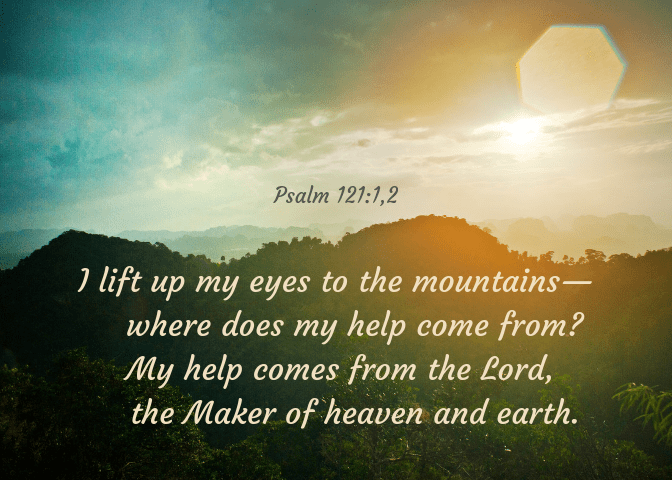
I lift up my eyes to the mountains—
where does my help come from?
My help comes from the Lord,
the Maker of heaven and earth.

He will not let your foot slip—
he who watches over you will not slumber;
indeed, he who watches over Israel
will neither slumber nor sleep.

The Lord watches over you—
the Lord is your shade at your right hand;
the sun will not harm you by day,
nor the moon by night.

The Lord will keep you from all harm—
he will watch over your life;
the Lord will watch over your coming and going
both now and forevermore.

This serves as a reminder that as you journey on your way, God is with you.  God is your helper who watches over you wherever you go.  How comforting and assuring to know that God is with you on your journey through life.  Even during those times where you might not know what’s waiting for you around the next corner or over the next hill, God is there, and he doesn’t go to sleep on the job.

-Jeff Fletcher

Don’t Forget – Give Thanks

FREE THEME WEEK – Psalms!

Psalm 150 6

This week we’ve been looking at seven different types of psalms, musical prayers that have been used for thousands of years first by the people of Israel and then by the Church as part of our worship and devotional life.  The first two types of psalms we looked at were wisdom and royal psalms.  The second two types of psalms were lament and imprecatory, these were a bit more challenging- not all of the psalms are about happy themes.

Today we are going to look at much happier psalms, the psalms of thanksgiving.  These are, perhaps, some of the better known psalms as they speak joyfully in praise of God.

The very last psalm, ends the psalms in a resounding crescendo of praise and thanksgiving”:

Psalm 150

Praise the Lord.

Praise God in his sanctuary;
praise him in his mighty heavens.
Praise him for his acts of power;
praise him for his surpassing greatness.
Praise him with the sounding of the trumpet,
praise him with the harp and lyre,
praise him with timbrel and dancing,
praise him with the strings and pipe,
praise him with the clash of cymbals,
praise him with resounding cymbals.

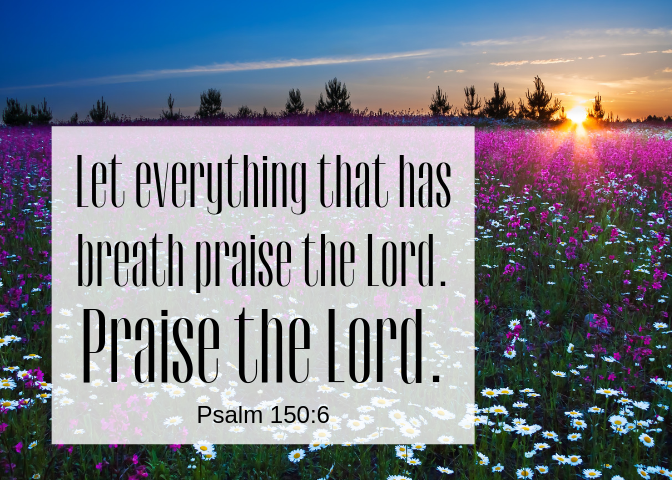
Let everything that has breath praise the Lord.

Praise the Lord.


Let everything that has breath praise the Lord.  These psalms speak for themselves about the joy of worshipping our great and powerful God.  God is worthy of our praise and thanksgiving.

Romans 1:21 gives the consequences of one who fails to offer to God the thanksgiving God deserves: “ For although they knew God, they neither glorified him as God nor gave thanks to him, but their thinking became futile and their foolish hearts were darkened.”  How tragic to fail to give to God the glory and thanks he so richly deserves.  A number of Biblical theologians see in this passage Paul’s reference to the rebellion of Adam and Eve in the garden, who failed to show thanks to God for the good gifts of creation and chose instead to listen to the voice of the serpent calling them to aspire to be like god.  Failure to give thanks to God is the original sin of humanity.  It may also be referencing Israel’s original story of the Exodus.  After God frees Israel from slavery in Egypt, they enter the wilderness, and while God is giving his instructions to Moses on Mt. Sinai, his people are down below making a golden calf to worship.  They trade the worship of God for idols made by human hands.  When we choose to worship anything in place of the one true God we are guilty of idolatry.

Throughout the psalms we are called to reject the original sin of not giving thanks to God and to worship God alone.  Worship is one reason that the Church gathers regularly.  We are not to forsake gathering as the Church for the purpose of worshiping God (Hebrews 10:24-25).  The psalms provide a rich and extensive songbook for us to use in our worship, both as a Church when we gather and in our times of private worship.  I read the psalms everyday as it helps me to join that several thousand year old congregation that joins together to worship and give thanks to God.

-Jeff Fletcher


Mercy & Grace – OR – a Cosmic Butt-Kicking

FREE THEME WEEK – Psalms!

Psalm 69 24

This week we are looking at seven different types of psalms.  So far we’ve seen wisdom, royal and lament.  Today we are looking at, perhaps, the most difficult of all, imprecatory.  Imprecatory means, quite simply, to call down a curse upon another.

Now, this is kind of tricky for Christians.  After all, Jesus taught us that we are supposed to forgive as we want to be forgiven.  We are supposed to love our enemies, right?  So how exactly can we justify praying imprecatory psalms as Christians?

Let’s look at an example of an imprecatory Psalm 69.

Save me, O God,
for the waters have come up to my neck.
I sink in the miry depths,
where there is no foothold.
I have come into the deep waters;
the floods engulf me.
I am worn out calling for help;
my throat is parched.
My eyes fail,
looking for my God.
Those who hate me without reason
outnumber the hairs of my head;
many are my enemies without cause,
those who seek to destroy me.
I am forced to restore
what I did not steal.


It starts out quite similar to a psalm of lament, as we discussed on Tuesday.  “Help God! Things are going badly.  I’m sinking.  Everyone is out to get me!  I’m all alone!”

He goes on to appeal to God for help.

19 You know how I am scorned, disgraced and shamed;
all my enemies are before you.
20 Scorn has broken my heart
and has left me helpless;
I looked for sympathy, but there was none,
for comforters, but I found none.
21 They put gall in my food
and gave me vinegar for my thirst.

Again, this has a familiar ring to it.  The gospel writers used this scripture to point to Jesus on the cross- remember when he said he was thirsty and they gave him vinegar to drink?

So far, we are still lamenting.  It’s dark, but it’s about to turn darker:

22 May the table set before them become a snare;
may it become retribution and a trap.
23 May their eyes be darkened so they cannot see,
and their backs be bent forever.
24 Pour out your wrath on them;
let your fierce anger overtake them.
25 May their place be deserted;
let there be no one to dwell in their tents.
26 For they persecute those you wound
and talk about the pain of those you hurt.
27 Charge them with crime upon crime;
do not let them share in your salvation.
28 May they be blotted out of the book of life
and not be listed with the righteous.


Yikes! It just got real!  The person doesn’t just want God to save him, he wants God to crush his enemies.

“Pour out your wrath on them!”  “May they be blotted out of the book of life.”  Wow!  That’s pretty intense.

“May their place be deserted.”  Luke quoted that verse in the book of Acts when he talked about the need to replace Judas as one of the 12 Apostles.

How does this kind of call for God to damn your enemies fit within the overall message of the gospel of Jesus’ love and forgiveness?

Time and space doesn’t permit the kind of deep digging we might need to do to really get this, but I’ll take a stab at it.  When people hurt us, I mean really hurt us, our normal reaction is to want to hurt them back.  The desire to get revenge and retaliate when wronged is pretty normal, if we’re being honest.  So what do we do with that hurt, that anger, that pain?

Well, we know that some people take a gun and go shoot people at school or at work.  Some people take to social media and try to destroy another person’s life and reputation.  If you’re Carrie Underwood: “I dug my key into the side
Of his pretty little low Mercedes Benz
Carved my name into his leather seat
I took a Louisville slugger to both head lights
Slashed a hole in all 4 tires
And maybe next time he’ll think before he cheats.”

Sure, who among us hasn’t wanted to do that, and worse?

But as Christians we’re supposed to love our enemies.

Paul says in Romans 12

17 Do not repay anyone evil for evil. Be careful to do what is right in the eyes of everyone. 18 If it is possible, as far as it depends on you, live at peace with everyone. 19 Do not take revenge, my dear friends, but leave room for God’s wrath, for it is written: “It is mine to avenge; I will repay,” says the Lord. 20 On the contrary:

“If your enemy is hungry, feed him;
if he is thirsty, give him something to drink.
In doing this, you will heap burning coals on his head.”

21 Do not be overcome by evil, but overcome evil with good.

Yes, there’s a lot in there about how we are supposed to not pay people back, we’re supposed to love.  Sandwiched in the middle of it all is “leave room for God’s wrath.”  Yes, God is a God of tremendous love, grace, mercy and forgiveness and he offers even the worst of sinners the chance for mercy and forgiveness- but he also knows how to do wrath.  He knows how to punish the unrepentant- and the Bible makes it clear that he will do so.

I don’t know who deserves mercy and grace and who deserves a cosmic butt-kicking, and neither did the Apostle Paul, and neither do you.  So we leave it to God.  Imprecatory prayers are simply ways that we say to God,  “I’m hurting and I want to hurt back, but I’m not going to.  I’m going to trust you to deal with this person the way you choose. (but here’s my pain and rage-fueled suggestion for how I’d like you to do it)”

-Jeff Fletcher

 

Alone?

FREE THEME WEEK – Psalms!

Psalm 22 1

This week we are looking at seven different types of psalms.  The first was a psalm of wisdom and the second was a royal psalm.  The third type of psalm is a lament psalm.

Life is not always easy.  I know that’s a real shocker for most of you but it is true.  Bad things happen.  People fail tests.  Relationships go sour.  People get hurt physically, emotionally, spiritually.  Sometimes people suffer in unimaginable ways and sometimes people die.   Sometimes it’s hard to find the words to express our pain during difficult times.  Sometimes this is true for individuals and sometimes it’s true from communities.

There are musical styles that express pain.  The blues are all about coping with pain.  Taylor Swift has written a song about every breakup she’s ever had.  Play many a country music song backwards and you get your truck back, your dog back and your woman back.

God doesn’t expect us to ignore pain or paint a pretend smile on our face and act like everything’s great when it isn’t.  Fortunately, God provides us a language to help us work through pain.  Psalms of lament.  The Bible is full of psalms of lament both for individuals and for communities.  The book of Lamentations is an entire book of laments after the fall of Jerusalem and their exile into Babylon.

Psalm 22 is an example of a psalm of lament.  I won’t include the whole psalm here but I’ll share enough for you to get the idea:

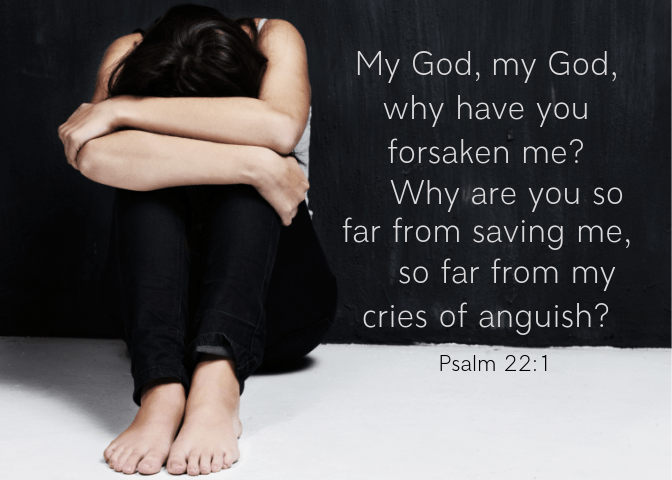
My God, my God, why have you forsaken me?
Why are you so far from saving me,
so far from my cries of anguish?
My God, I cry out by day, but you do not answer,
by night, but I find no rest.

This is a person who is clearly in pain.  Their pain is multiplied by the fact that they feel that God is no-where to be found.  “God, where are you?”  “God I’m hurting.”  “God can’t you see how badly I’m suffering here?”  “God, why aren’t you listening to my cry?”  “God, I need you, O I need you!”

If these words sound familiar to you, it may be because these are the words that Jesus cried out while he was being crucified.  Jesus suffered every way that we suffer and his greatest suffering came when he felt God’s absence.  There are times in our lives when God seems so close and so real and those times are wonderful.  But there are also times when God feels so very far away. Psalms of lament take our feelings of suffering, of abandonment, of God’s absence and help us to give words to them.  It also helps us to know that we are not alone in feeling alone.

9Yet you brought me out of the womb;
you made me trust in you, even at my mother’s breast.
10 From birth I was cast on you;
from my mother’s womb you have been my God.

11 Do not be far from me,
for trouble is near
and there is no one to help.

The one who is suffering here pleads their case before God.  “You’ve been there my whole life”  “I’ve trusted you since I was a baby”  “God, come here… I’m scared, I’m all alone.”  Whether it is physical pain, emotional pain, spiritual pain or often a combination of all three, it hurts when you feel like you’re all alone. The Psalms of lament help us to find the words to cry out to God out of a mixture of faith and fear.

25 From you comes the theme of my praise in the great assembly;
before those who fear you I will fulfill my vows.
26 The poor will eat and be satisfied;
those who seek the Lord will praise him—
may your hearts live forever!

Even though his situation feels hopeless… even though it seems like she is doomed, yet there is hope.  As bad as it feels, as alone as she seems, as desperate and lost and needy and broken, there is hope that one day things will be better, that one day there will be a chance to testify about God’s faithfulness.

Bad thing happen to God’s people too.  We don’t have to pretend that everything’s great when it’s not.  Don’t just read the happy psalms.  Just like Jesus committed Psalm 22 to memory so that when he was at the point of deepest agony he had the words to pray his pain to God, learn to pray the psalms of lament, both for yourself and for those you love who may also feel alone in their suffering.

-Jeff Fletcher


You can read the whole beautiful Psalm of lament here – https://www.biblegateway.com/passage/?search=Psalm+22&version=NIV

The Winning Side

Psalm 110 1

FREE THEME – Psalms

This week we are looking at seven different types of psalms.  Yesterday we looked at a wisdom psalm.  Today we are looking at a royal psalm.

The Psalms were written at a time and in a culture where kings ruled.  Israel was governed by either David or his heir.  David was hand chosen by God to be God’s anointed king.  They literally poured oil over the king’s head and face to symbolize being anointed by God to rule.  This anointed one was literally the Messiah or messianic/anointed king.  When God set David apart as king God promised him that his heir would rule over God’s people forever.  This rule would begin at Jerusalem or Zion but would extend ultimately over all the earth.

Psalm 110 is a promise that the anointed king would rule, that God would give him victory over God’s enemies.

Vs. 4 makes a curious statement- this king will also be a priest, but not the typical priest.  In Israel, to serve as priest in the temple one had to be a descendant of the tribe of Levi.  But David and his family were descendants from the tribe of Judah, which was the ruling tribe.  This descendant of David would be a different kind of priest.  Just as Melchizedek was a priest in the time of Abraham, long before Levi was ever  born, this kind of priesthood was a greater kind of priest than the Levitical priest.

All of this finally makes sense when we understand how Jesus fits into the picture.  Jesus is the fulfillment of this psalm.  He is an heir of David, he will rule as King, he is also a priest but not in the temple of Jerusalem.   As a priest he offers up his own body as a sacrifice to God.  He doesn’t enter the holy of holies in the Temple of Jerusalem, he ascends to the heavens and enters into the immediate presence of God, where he continues to serve as our priest, until the day comes when he returns to the earth to rule over all the earth following the final battle when the kingdoms and kings of the earth will all bow before Christ as King of Kings and Lord of Lords.  This royal psalm points us to Jesus.

Everyone wants to be on the winning side.  This reminds us that if we choose to follow Jesus and give our lives to Jesus, we will be on the winning side at the last battle.

Psalm 110

Of David. A psalm.

The Lord says to my lord:

“Sit at my right hand
until I make your enemies
a footstool for your feet.”

The Lord will extend your mighty scepter from Zion, saying,
“Rule in the midst of your enemies!”
Your troops will be willing
on your day of battle.
Arrayed in holy splendor,
your young men will come to you
like dew from the morning’s womb.

The Lord has sworn
and will not change his mind:
“You are a priest forever,
in the order of Melchizedek.”

The Lord is at your right hand;
he will crush kings on the day of his wrath.
He will judge the nations, heaping up the dead
and crushing the rulers of the whole earth.
He will drink from a brook along the way,
and so he will lift his head high.

Just Two Choices

A Free Theme Week into the Book of Psalms

Psalm 1 6

Greetings!  I’m introducing a week of devotions based on the Psalms.  There are 150 psalms in the Bible. (Note there are Protestant Bible translations and Catholic Bible translations.  The psalm number has a variation in Catholic translations.  I’ll be following the psalm numbering in Protestant versions ie. NIV, KJV, NRSV etc…)

The word psalm comes from the Hebrew word “mizmor” and means melody.  When translated into Greek it is “psalmos” which means song for the harp or the plucking of strings.  The key is that they are musical pieces.  Just as we sing hymns and praise and worship songs in church, the psalms were written to be sung as part of worship.  Most of the Psalms have been used in Jewish and later Christian worship settings for over 3,000 years (and you thought Frank Sinatra or the Beatles was old music).

Not all psalms are alike.  Different commentators call them different things and they are grouped differently.  I like the following 7 groupings:  1.Wisdom, 2. Royal, 3. Lament, 4.Imprecatory, 5.Thanksgiving, 6. Pilgrimage, 7. Enthronement.  During this week I’ll focus on a different type of Psalm and give the description and brief example each day.

Let me also talk to you a bit about how I incorporate psalms into my daily worship.  For hundreds of years men who live in monastic communities or monks have used the psalms as part of their daily worship.  In many communities they sing/pray/chant through the entire Book of Psalms every month.

A few years ago I came across an idea for going through the entire Book of Psalms every month using 5 psalms a day.  On the first day of the month read Psalm 1, 31, 61,91 and 121, the next day read Psalm 2,32,62,92,122.  Whatever day of the month you are on, read that, and then add 30 and keep going up by 30.  That way, in 30 days you will read all 150 psalms.  I break this up during the day: one when I first get up, one mid-morning, one at lunch time, one at supper time and one at the end of the day.  This way I surround my day and fill my day with these prayers and songs to God.  You don’t have to do it that way, but you might want to try it, or whatever way works for you. (On months with 31 days I just pick a few of my favorites for day 31).

The first type of psalm is a wisdom psalm.  It’s a kind of teaching psalm pointing out the way to live a Godly life.  An example of a wisdom Psalm is Psalm 1.

Psalm 1

Blessed is the one
who does not walk in step with the wicked
or stand in the way that sinners take
or sit in the company of mockers,
but whose delight is in the law of the Lord,
and who meditates on his law day and night.
That person is like a tree planted by streams of water,
which yields its fruit in season
and whose leaf does not wither—
whatever they do prospers.

Not so the wicked!
They are like chaff
that the wind blows away.
Therefore the wicked will not stand in the judgment,
nor sinners in the assembly of the righteous.

6 For the Lord watches over the way of the righteous,
but the way of the wicked leads to destruction.


This psalm is a simple but clear message about the choices we have in life.  This theme has been taken up by many through history.  Robert Frost talked about having a choice to take one of two paths and he took “the road less travelled” and that it made all the difference.  Jesus talked about wide gates and narrow gates and the importance of following his path “I am the way, the truth and the life.”  Even the classic rock band Led Zeppelin sang “yes, there are two paths you can go by, but in the long run, there’s still time to change the road you’re on.”

This psalm teaches us that we do have choices.  We can follow the path of the righteous or we can follow the path of the wicked.  The path of the righteous is the “right or correct path.”  This path is the path of one who follows God’s instructions.  The law of the Lord is not so much a law like a legal code as much as an instruction about the way to live.  Jesus showed his disciples/students how to live a life that was faithful to God.  Those who follow this path delight in following God’s instructions for life and spend time meditating upon, praying about, thinking about God’s instructions.  What do you spend your time thinking about, focusing on, absorbing?  The person who is fully absorbed in God’s ways will live a fruitful and prosperous life.  That doesn’t necessarily mean they will be financially wealthy, but they will be successful in the way that God defines success, they will be godly, they will have life.

The other path is the path that leads to destruction.  This is the path that does not end well.  If I told you that there was a fork in the road: if you go right, you’ll end up at Disney World and a lifetime of fun and adventure, if you go to the left, you’ll be at the garbage dump and there’s no turning back.  I’m guessing you’d choose Mickey over a trash heap.  It all boils down to a simple choice.  If you feel like you’re currently heading on the wrong path, there’s good news “there’s still time to change the road you’re on.”

-Jeff Fletcher

The Purpose of the Wilderness

Deep calls to deep in the roar of your waterfalls; All your breakers and your billows have swept over me. Psalm 42_7 (1)If you are not in a wilderness period now, chances are you will probably experience a time like this in the future. It’s the moments where we are spiritually thirsty and hungry for God. It can be puzzling when we are in these moments because we begin to doubt and question God. If there was a word that could be used to define these moments, I would say that it would be “Why.” Why do I feel like this? Why am I in this desert? Why does God seem so far from me? Why won’t he return to me?

Though it can seem presumptuous to ask God these questions, we can find the psalmist asking these questions as well. In Psalm 42, the psalmist says, “Why am I so depressed? Why this turmoil within me?” (v. 5, 11) Later on, he writes, “I will say to God, my rock, Why have You forgotten me? Why must I go about in sorrow because of the enemy’s oppression?” (v. 9) It’s natural to question God during these moments, and even Jesus on the cross asked God, “Why have you forsaken me?” (Matt. 27:46). Sometimes, we know the purpose of the wilderness, as Jesus did when he asked God that question. Other times, we may not know in this life why we have to experience the things that we do.

In these times, it’s incredibly important to remind ourselves of two things: (1) we can trust that there is a purpose for the wilderness, and (2) in the wilderness, we can rely on the goodness of God to carry us through. As we think about the ‘why’ behind our wilderness wanderings, it’s first important to ask ourselves how we got to this point. Sometimes, our wilderness comes from forces outside of us, whether that’s circumstances, conflicts with others, or the adversary like we discussed yesterday. We can look at the examples of Elijah and Jesus to see wilderness experiences that were due to the fallenness of the world, not their own failings. Yet, at other times, the wilderness can be caused by our own actions, like in the case of the Israelites.

During these times, we have two options: We can turn toward God or away from him. It’s this choice that will determine whether or not the wilderness experience will help us to grow or to be destroyed. In this devotion, we won’t be able to come to a definitive answer of why bad things happen to good people. But, we can answer the real ‘why’ behind our wilderness experiences. During this time, we have the option to lean on God and learn what it means to walk hand in hand with him. To experience complete dependence on God. The wilderness may be difficult, but it’s also in these moments that we experience more deeply the salvation of God. Going back to the Psalmist words in Psalm 42, we see that our wilderness experiences can make our recognition of God’s love more real and vivid when, after asking why, he says:

mthermon1
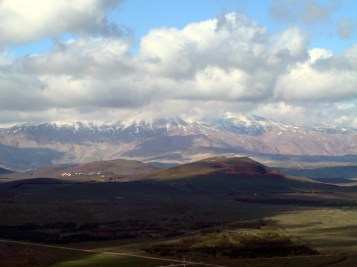
Mt. Hermon (2,814 m – 9,232 ft) on the northern border of Israel

“Put your hope in God, for I will still praise Him, my Savior and my God. I am deeply depressed, therefore I remember You from the land of Jordan and the peaks of Hermon, from Mount Mizar. Deep calls to deep in the roar of Your waterfalls; all Your breaks and Your billows have swept over me. The Lord will send His faithful love by day; His song will be with me in the night – a prayer to the God of my life” (v. 5-8).

We can pray to the God of our life. In these times in the wilderness, trust in your creator, and he will send his faithful love to you.

~ Cayce Fletcher

The Earth is the Lord’s

Psalm 24

versepsalm24

I absolutely love to see God’s creation. I love the snow falling on the bare, winter trees, covering them perfectly. I love to see the sun beams shining through a forest. I love the ocean and beaches with the seemingly never-ending water and countless (for me, not God) grains of sand. I also love rocks and mountains and caves. It’s amazing how different each nature scene can be, yet, each created by God.

Not only did God make these beautiful landscapes for us to see, but He also made YOU! Psalm 24 is one of my favorite chapters because of the first verse.

“The earth is the Lord’s, and everything in it, the world, and all who live in it;”

 I love how this verse is a great reminder of how God made the earth and breath-taking landscapes along with all the people in it. In fact, we’re created in the image of God (Genesis 1:27). Each of us are created in the image of God, which shows how we should treat others with kindness and love, because they too are made in the image of God, just like yourself.

Going back to the 24th Psalm, verse one, helps me realize that sometimes, I just need to step back and remind myself that this beautiful earth is God’s and the people that live on it, are made by God, too. Next time you get to experience new parts of the world you’ve never seen before or even the next time you look outside your window or step outside your house – see the nature you pass by every day and remember who made it. Remember who the earth belongs to. Remember that you belong to God, too, and that’s pretty special!

-Moriah Railton

GOOD!

Psalm 100

psalm 100 5 (1)

I chose to write about Psalm 100 because of how much we can learn from it despite its shortness. This is a great chapter to read, and it only takes a minute of your whole day. The first thing I would like to point out is that in verse four it says, “Bless his name.” This verse is talking about God and how we should give thanks to him and bless his name. Now if you’re like me you might be thinking, why should we bless God’s name? Well, God blessing us and us blessing God are not the same thing at all. God does not profit from us blessing him. It’s not like he gets stronger or better anytime someone blesses him. On the other hand, when God blesses us, we benefit from it. In this verse, it is talking more about how we should praise him.


Throughout the whole Psalm, it talks about how we should praise God. As a church, I believe we should be more joyful, and excited. This Psalm is a great example of how we should praise God. It tells us we should serve God with gladness, shout joyfully, enter his gates with thanksgiving, and give thanks to God.


Usually when we think of ‘good’ we use it to mean something between ok and great. But in this passage, it is saying that he is righteous and about how great God is. This reminds me of the popular song below:


God is good, all the time

And all the time, God is good.


This Psalm is a great one to meditate on. Here are some points from Psalm 100 that you can meditate on.

God made us

We are the sheep in his pasture

The Lord himself is God

His lovingkindness is everlasting

The Lord is good

His faithfulness continues to all generations

Throughout the whole book of Psalms, it says, “His lovingkindness is everlasting”. In fact, it says it 34 times. Of those 34 times, 26 of them are all in Psalm 136. It even says it in every single verse.

Even in this short Psalm we can take so much from it.

-Makayla Railton

What Do the Stars Tell You?

Psalm 19


I have always been amazed at God’s creation here on earth.  The beauty.  The creativity.  The grandeur. In fact, I have always wondered a little bit about the the new heaven and new earth that Revelation 21 records will herald the new Kingdom of God.  Could God really create something more majestic than what we have already seen?  Is there a chance that the new heaven and earth will be a little bit of a let-down?  I am after all a tad attached to what we have here and now.

And then, I saw pictures of Jupiter!  They are breathtaking!  NASA’s space probe Juno has been on a carefully routed 5 year trip to reach Jupiter – and in August 2017 Juno sent back to Earth stunning pictures of the planet it is now orbiting.  Here are just two pictures … many more can be found at https://www.nasa.gov/mission_pages/juno/images/index.html

jupiter swirling south pole            jupiter south pole from Juno


And all of a sudden, I am again in awe of Him and His creations.  And I know I can trust Him.  I can trust Him to create a spectacular new heaven and earth and I can trust Him today with my life.   There is so much He knows that I do not.  There is so much power that He has that I do not.  He is a great Big God and sometimes I forget how much I need Him because I think for just a few minutes that I have this world figured out.  And then my mind is once again blown away by how many stars there are and the new-found beauty of a planet we are just beginning to really discover.

David says it well in Psalm 19.  “The heavens declare the glory of God; the skies proclaim the work of his hands.  Day after day they pour forth speech; night after night they display knowledge.  There is no speech or language where their voice is not heard.  Their voice goes out into all the earth, their words to the ends of the world.” (Psalm 19:1-4).  God’s masterpiece speaks for Him.  His works of art tell us about the artist.

In the New Testament Paul writes similar words to the believers in Rome.  This city was proud of what they considered their superior culture, amazing architecture and roadways (some of which can still be seen today), and numerous temples to foreign gods (amongst them, Jupiter and Juno).   In many ways it was not too unlike our society today.  Paul writes to the church in Rome: “For since the creation of the world God’s invisible qualities—his eternal power and divine nature—have been clearly seen, being understood from what has been made, so that people are without excuse.” (Romans 1:20).  His artwork proves the power and majesty of the artist.

And yet, as we well know there are those who prefer to be blind and create their own explanations for the intricate and beautiful creation.  Interestingly, not one but two psalms begin with these words: “The fool says in his heart, ‘There is no God.'” (Psalm 14:1 and 53:1).   You get to decide which camp you will set your tent in, but there will be a day when everyone will acknowledge God (Romans 14:10-12).

This brings us back to the rest of Psalm 19 which you can read or listen to here –  (https://www.biblegateway.com/passage/?search=Psalm+19&version=NIV).

The first six verses of Psalm 19 speaks of God’s magnificent creation and how it points to God.  The next 5 verses give us a little foretaste of Psalm 119 which we talked about yesterday: the superiority and importance of God’s Word and commands.  “By them is your servant warned; in keeping them there is great reward.” (Psalm 19:11).  And the final three verses emphasize watching my own actions, attitudes, words, and thoughts to see that they are in line with God’s laws and desires for his children – and seeking forgiveness and change when they are not.  I love the final verse of the Psalm as much as the opening verse: “May the words of my mouth and the meditation of my heart be pleasing in your sight, O Lord, my Rock and my Redeemer.” (Psalm 19:14).

We serve an awesome Creator God who has provided a detailed guidebook for our lives and a brilliant plan for the future  – which will include everyone acknowledging him.  May we always strive to be pleasing in his sight.

Marcia Railton

(Stars photographed by Chris Mattison – thanks for sharing!)