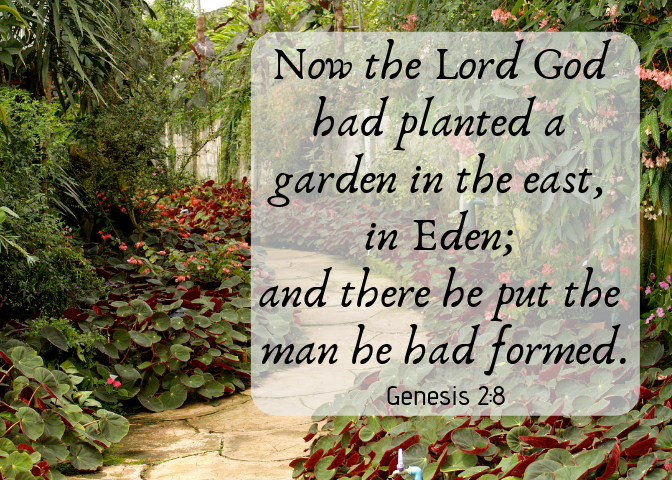
God’s Presence and the Garden

Genesis 2 8

Text: Gen 2:4 – 3:24


Yesterday we began talking about the presence of God, starting with the creation account in Genesis 1:1-2:3. We saw that God not only created the earth as a place for us to live, but also as a place for him to be present with us. The heavens and earth are God’s temple.


As we move on in Genesis, starting with 2:4 and going to the end of chapter 2, we find another creation account, and its focus is different than the first, paying special attention to humans and what seems to be agriculture. We are introduced to a garden, and people to cultivate and rule over it: Adam (which literally means man or mankind) and Eve (which literally means living or life). The garden also includes two special trees, the tree of life, and tree of the knowledge of good and evil. The tree of knowledge could have easily been called the tree of certain death, because God promises they will die if they eat from it. But they can eat from anything else.


This garden is a special place. It seems to be a focal point, almost like a holy of holies for God’s cosmic temple. It is sacred space that he shares with his creation. God walks in the garden and is present there with Adam and Eve. Can you imagine just sharing space with God, doing some gardening, and God just walks by, like it was a normal thing? “Oh, hey God.”


That kind of closeness and intimacy with God in his presence was how it was for Adam and Eve, until something happened. There’s a talking serpent. This mischievous serpent character convinces Eve that she won’t in fact die if she eats from the tree of knowledge, she’ll just have knowledge like God. This is tricky because it has just enough truth in it. Maybe you would call it a white lie, but still a deception. Eve eats from the tree of knowledge, and Adam follows suit.


As Adam and Eve ate from the tree of knowledge, they disobeyed God’s direct command and took matters into their own hands, going down a path to prematurely obtain the knowledge of good and evil. They likely had a childlike innocence about them before, and maybe God would have in time revealed this knowledge of good and evil to them in his way, in his time. Well, now things were going to be different for them. They suddenly realized they had no clothes and hid from God. They were ashamed. God finds out what they did (surely he already knew what they did) and kicks them out of his garden.


The consequences were very serious. God has cherubim (winged creatures sort of like a sphinx, not at all like a baby with wings) and a flaming sword guard the entrance so they can’t enter and eat from the tree of life. They are exiled from the garden, they are effectively sentenced to death by no longer having access to the tree of life and God’s presence. They will have to work much harder to grow food to survive, and some other fun consequences.


Reading an account like this makes you think a lot. What sorts of things are symbolized by the tree of life, and tree of knowledge? What is a serpent doing there? Are we really talking about fruit? I have no definitive answers to these questions. The beauty of this passage is that it forces you to think more every time you read it, and I believe that is why it is there.


The garden account is ripe with symbolism to interpret. While it is an account about real people, it is written in a way that makes it much bigger than that. Adam and Eve can be seen as archetypes for us, meaning the things that are said of them are also true of us. Adam is formed from dust (Gen 3:19), so are we (Ps 103:14). Eve is made from one of Adam’s sides, while we recognize that men and women are each other’s halves in a way. They face temptation and shame, so do we. They do things in defiance against God, and so do we (Rom 3:23), and as a result of that defiance, they exiled themselves from God’s garden, as we frequently exile ourselves from God’s presence when we sin, in a way. Their story is much like ours.


This isn’t the most encouraging chapter in the story of God’s presence. It’s one of the lower places we could go in scripture. The reality is that sin and the presence of God are not compatible things. Sin, separation from God, and death are all connected, if not three heads of the same monster. Of course, God knows this, and still wants to be present with us, so there has to be some kind of remedy for sin. Ultimately, we know that remedy to be Christ, but there was a progression to get there.


Tomorrow we’ll look at Exodus 40 – how God used a man named Moses to renew his presence among his people.


-Jay Laurent
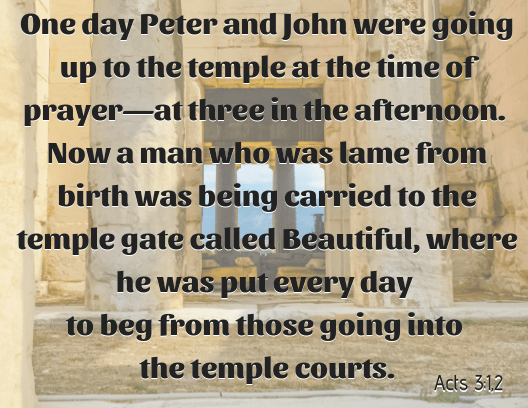
 

Begging for Help

Acts 3 1,2

Happy late Thanksgiving everyone! #thankgivingisthebestholiday Although the day of turkey has passed I hope we can all be thankful for what we have considering many do not have anything at all. Recently in Saint Louis, I encountered a man named Ron who was homeless and had nothing to his name except his torn up bag and the clothes on his back. Ron, like many you may encounter in your lives, asked me for money. There are at least two easy ways to handle this situation. First, we could give them the money they were asking us about. Or second, we lie and walk away feeling like we did that person well by not giving them money that could possibly enable their bad habits.

I would say Peter and John have a more effective way of serving these people. In Acts 3:1-10 Peter and John encounter a man who can’t walk and is begging for money in front of the temple gates (a common practice in that day, which could be compared to those at the stoplights we see). Instead of giving him money, they give him prayer and healing. Something we all can afford and is always at the ready. Next time you encounter someone like this it might be appropriate to pray with them about their situation and see if something big happens.

-Jesse Allen

You Died

Col 3 3

Colossians 3:1-3

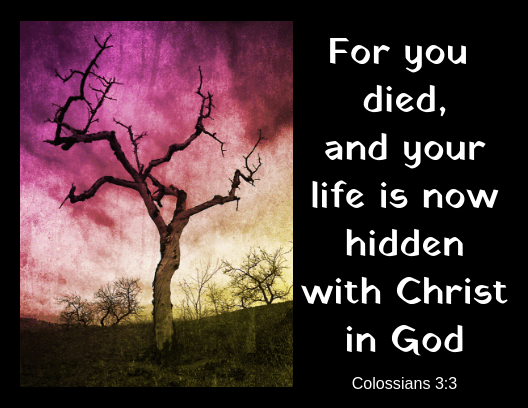
3 Since, then, you have been raised with Christ, set your hearts on things above, where Christ is, seated at the right hand of God. 2 Set your minds on things above, not on earthly things. 3 For you died, and your life is now hidden with Christ in God. 4 When Christ, who is your life, appears, then you also will appear with him in glory.

I wonder how those believers in Jesus understood those words when Paul first penned that letter to them. “you died, and your life is now hidden with Christ in God”. He told them that they died. What would it have meant to them to hear that they had died? Obviously they were still physically alive and breathing. They were not zombies or vampires or other popular dead, but not fully dead creatures. What part of them was dead.

Sometimes today we speak metaphorically about death. “I’m brain dead” means that I did something without thinking it through, it was silly or stupid. “I’m dead tired” means that I need some sleep.

I think that Paul was telling the believers in Christ at Colossi that when they were baptized into Jesus Christ, that part of their nature that was under the control of “the flesh” or their brokenness and alienation from God had died. Apart from Christ, that which drives us or controls us is sin living within us. When we come to Christ, that part that controls us is put to death. Our focus is no longer to satisfy our sinful desires. We live by the spirit of God, our life is now found in God. It has not yet been fully revealed. We are still living under the influence of sin, and the new nature has not yet been fully realized in our daily living. That process, known as sanctification, is ongoing. It requires, as Paul goes on to say, a daily putting to death of things like “immorality, evil desires, greed, rage, malice, slander”.

We’re baptized into Christ, then you died, and rose again. Your new nature has not yet been fully revealed and won’t be until the coming of Jesus, but as you live as a follower of Jesus in this present age, you die to your old self a little more each day as you live by the spirit of God in practical ways.

-Jeff Fletcher

Labor Pains

1 Thess 5 3 (1)

I Thessalonians 5:1-3

Now, brothers and sisters, about times and dates we do not need to write to you, 2 for you know very well that the day of the Lord will come like a thief in the night. 3 While people are saying, “Peace and safety,” destruction will come on them suddenly, as labor pains on a pregnant woman, and they will not escape.

While I’ve never been a pregnant woman, I’ve been married to one who gave birth eleven times… so I’m pretty well acquainted with the whole “sudden labor pains” phenomena. Fun fact… my youngest son, James, came so quickly that I acted as his midwife. We were at home… no midwife in sight…. And she said “I need to push”…and I tried to persuade her to wait. (Don’t ever tell a woman in labor about to push a baby out to wait, if you know what’s good for you). She did NOT wait. She had reached the point of no return.

Paul uses this analogy to help us understand both the suddenness and inevitability of the return of Jesus. His return will happen suddenly.

It’s been a nearly 2000 year long labor… but it’s getting close. Jesus is coming soon. Are you ready?

-Jeff Fletcher

Holy and Honorable and Radically Counter Cultural

1 Thess 4 4.png

I Thessalonians 4:3-8

3 It is God’s will that you should be sanctified: that you should avoid sexual immorality; 4 that each of you should learn to control your own body[a] in a way that is holy and honorable, 5 not in passionate lust like the pagans, who do not know God; 6 and that in this matter no one should wrong or take advantage of a brother or sister. The Lord will punish all those who commit such sins, as we told you and warned you before. 7 For God did not call us to be impure, but to live a holy life. 8 Therefore, anyone who rejects this instruction does not reject a human being but God, the very God who gives you his Holy Spirit.

Paul was writing this to Christians in the first century. He was calling them to live holy lives (set apart for God) in a culture where there was a great deal of immoral behavior that was accepted by society, but which went against God’s standards. Paul contrasts the believers call to live a holy and honorable life that is vastly different from the “passionate lust” that marked the life of the pagan. He warned that God would punish sexual sin and that to reject Paul’s teaching on this was to reject God.

I can’t imagine how difficult it must be for a young person or a new believer to navigate sexual morality in this age today. It’s gotta be tough. It was tough enough for me as I was a child of the 60’s and 70’s and there was plenty of confusion in society then, but at least the Church still gave a clear and for the most part unified message of what right and wrong was all about. But today, young adults are bombarded with images and messages about sexuality that are far different. So much that the Bible clearly speaks of as a departure from God’s path is considered normal by today’s society. To even question such things as premarital sex, homosexual activity, homosexual marriage, serial monogamy etc… is to be considered narrow, judgmental, or even a hate monger. So young people and those who become followers of Jesus Christ later in life face challenges in understanding and adapting to a Biblical world-view regarding sexuality. Exactly the way it was in the first century when Paul wrote this letter.

I note that Paul says that each of us must “learn to control [our] own body”. It’s a process of learning. There are difficult lessons to be learned. As most of us who have had to learn something new realize, learning is a process which takes time and seldom happens without mistakes. Those believers who are more seasoned in their walk with the Lord should remember this, and while teaching faithfulness to God to young and new believers should remember that is it is a process and be patient with those who are still learning. And even be patient with ourselves, for learning something so radically counter cultural is never easy and we are all capable of making mistakes. Truth must always be mixed with grace.

-Pastor Jeff Fletcher

Time for Your Examination

Psalm 139 23 24

Psalm 139: 1, 23-24

“You have searched me, Lord, and you know me.

Search me, God, and know my heart; test me and know my anxious thoughts.

See if there is any offensive way in me, and lead me in the way everlasting.”

I imagine that most of us don’t really enjoy being examined by a doctor. I know I dread it when I go to the doctor’s office and one of the first things they do is ask me to stand on the scale. “Really? I have a sore throat, I’m sure that has nothing to do with how much I weigh.” That’s what I think to myself, but still I dutifully comply. I stand on the scale (why does the doctor’s scale always weigh 5 lb. heavier than the one in my house)?.

Physicians examine us so that they can have an idea of what’s going on inside of us. Is everything functioning properly. Are all the vital organs working the way they are supposed to? Do changes need to be made? Often, at the end of the visit there is a prescription given for some medicine for us to take. Or sometimes a recommendation to make a lifestyle change. Or sometimes, the need for further tests. Sometimes, what is needed is a radical, invasive procedure where they cut into your body… surgery. Most of those things are unpleasant. Sometimes, we avoid going to the doctor all together so that we can avoid hearing his diagnosis. We figure, what I don’t know won’t hurt me.

Spiritually, we sometimes act the same way. We are afraid to go to God and let him give an honest, accurate assessment of our spiritual health. But we need it. We need it more than we need our physical health. We need God to search us… to examine us… to look deep into our hearts and understand our values, our motives, our loves and our hates. We need God to look deep within and discover where our anxious thoughts lie. We need God to call us out on our offensive ways… the ways that hurt others, the ways that hurt ourselves. We need God to prescribe for us the changes that need to be made so that we can experience greater spiritual health.

The hardest prayer, and the most important prayer you can pray, is a prayer of examination to God… “Search me, O God, and know my heart.” Maybe its time you made an appointment with God for an examination. Come to think of it, maybe its time for me to do that too.

-Pastor Jeff Fletcher

Loyalty in the Family of God – Ruth 1

Ruth 1 16
In the first chapter of Ruth we see a beautiful example of Ruth choosing her allegiance wisely. Some may think at the surface level, Ruth stayed with her married family for provision and protection. However, Naomi was a widow—poor, needy and vulnerable in the culture. Especially during the time of a famine in a foreign land. The most advantageous move Ruth could have made would have been to weather the famine, stay in Moab and remarry therein ensuring her safety and security. Naomi even encouraged her to do so in Ruth 1:8-9. However, Ruth remained steadfast in her loyalty to Naomi and the God she had come to know when she became one with her husband and family so many years before. Ruth makes a bold declaration after her sister in law Orpah leaves saying to Naomi,
“But Ruth replied: Do not persuade me to leave you or go back and not follow you. For wherever you go, I will go, and wherever you live, I will live; your people will be my people, and your God will be my God. Where you die, I will die, and there I will be buried. May Yahweh punish me, and do so severely, if anything but death separates you and me.”
‭‭Ruth‬ ‭1:16-17‬ ‭HCSB‬‬
Ruth returned to Bethlehem as a Moabitess. She faced the possibility of being rejected and ostracized in a culture where she is not of the same heritage in Israel. Ruth takes this risk to lay hold to her loyalty to her family and God no matter the outcome as she goes alongside Naomi—who has lost all provision and security. What we can take away from Ruth’s example in this first chapter is the willingness to forsake all else as we follow God. Today it is common that we may have to renounce titles, friendships, status, position etc as we pursue a dynamic relationship with God. We are called to live differently and that is not without sacrifice. What may God be calling you to renounce as we die to self and commit our lives to knowing Him more deeply and allowing Him to love us fully?

Joseph: Loved…and Hated

Genesis 37 3a

One person in the Bible who I find very interesting is Joseph.  During the course of his life, he lived through many troubles and many incredible successes.  Much of the trouble that Joseph faced came from his very difficult family life.  His father, Jacob, had four wives.  Jacob loved Joseph’s mother more than the other three wives.  And then Jacob loved Joseph more than any of the other children.  Genesis 37:4 says “When Joseph’s brothers saw that their father loved him more than any of them, they hated him and could not speak a kind word to him.”  This would lead to big problems for Joseph (more on this later).

Perhaps you have experienced some of this in your own life, in your own family.  Often it is a bad behavior that is passed down from one generation to another.  It creates a lot of resentment within a family.  Imagine how Joseph’s brothers felt knowing their father loved their brother more than them.  Favoritism: don’t pass it on.

-Jason Turner

16 YEARS!


rebecca2

I think I was in my Elementary school cafeteria when I first read the phrase “You Are What You Eat”. Of course, the posters placed in the cafeteria wanted us to realize that it is important to eat nutritious food in order to be healthy and fit.  At the time I probably had tater tots and homemade pizza on my tray. Not sure what I thought about being a Tater Tot.

As we grow up, we understand that what we eat is vital for disease prevention, growth and good health. Because we know this, we try to determine what our every day eating habits should be. In the same way, we need to be discerning about what we feed our minds.

We are constantly taking in what is around us and as Christians, it is important to put only the best into our hearts and minds. In Philippians 4:8 we are told what should occupy our thoughts. “Finally, brothers and sisters, whatever is true, whatever is noble, whatever is right, whatever is pure, whatever is lovely, whatever is admirable—if anything is excellent or praiseworthy—think about such things.” So we need to be intentional about what we are thinking and how we are spending our time. This week I saw that the average American spends 7 years and 8 months of their lives watching TV and 5 years and 4 months on social media (Mediakix). What might seem like an innocent time-killer could actually use 16 years of our lives. So how would the Apostle Paul instruct us to occupy our time? In Colossians 3, we are told, “12 Therefore, as God’s chosen people, holy and dearly loved, clothe yourselves with compassion, kindness, humility, gentleness and patience. 13 Bear with each other and forgive one another if any of you has a grievance against someone. Forgive as the Lord forgave you.14 And over all these virtues put on love, which binds them all together in perfect unity. 15 Let the peace of Christ rule in your hearts, since as members of one body you were called to peace. And be thankful. 16 Let the message of Christ dwell among you richly as you teach and admonish one another with all wisdom through psalms, hymns, and songs from the Spirit, singing to God with gratitude in your hearts. 17 And whatever you do, whether in word or deed, do it all in the name of the Lord Jesus, giving thanks to God the Father through him.”

So there we have it. Everything we say or do should be done in the name of the Lord Jesus, giving thanks to God the Father. Let’s truly rely on God when we pray to “give us today our daily bread” because hopefully we are becoming that daily bread.  We Are What We Eat.

-Rebecca Dauksas

Over 3,000!

Picture1rebecca

I like books. But I find that I like the idea of reading a book, more than I actually like reading the book. Some of you can relate. I have books that I started, but just never finished.  I like the possibility of what the book is promising. Maybe it is becoming more organized, getting better grades, learning another language, do it yourself projects, restoring an old car, …there are countless things that we can learn from books.

The greatest book of course is the one that God has given us.  It is the book that we continue to read through our lives. Why? We have been doing some in depth Bible study during our Grow devotions. What is it that this collection of 66 books is promising to the reader?

The Bible makes some incredible promises. Promises that have happened, that are happening and that will happen. And of course, the importance of these promises rests in the fact that they are offered from God.  He is speaking through the scriptures to us. For instance, the promise that we can know who God is. “Come near to God and He will come near to you”. (James 4:8) Or the promise that we can become God’s children. “See what great love the Father has lavished on us, that we should be called children of God!” (1 John 3:1) We are also offered the promise of forgiveness. “If we confess our sins, he is faithful and just and will forgive us our sins and purify us from all unrighteousness.” (1 John 1:9)

Those promises are amazing because we can be forgiven and we can connect with our Creator. We can grow our relationship with Him so close that we can call Him, “our Father”. And just like a loving Father teaches a child the things they need to know, He teaches us through the scriptures.  We can learn how to make decisions and how to live. And He promises us His Holy Spirit. His Spirit enables us to live lives that show love, joy, peace, patience, kindness, goodness, faithfulness, gentleness and self-control.

I recently read that a Bible scholar states that there are over 3,000 promises from God through the scriptures. That is huge, but we know that those promises will be fulfilled because God is the one making them. We can trust God because He will follow through on His promises. So no matter what, lets continue to study this incredible book with a message of love that is filled with promises written from Our Father.


His divine power has given us everything we need for a godly life through our knowledge of him who called us by his own glory and goodness. Through these he has given us his very great and precious promises, so that through them you may participate in the divine nature, having escaped the corruption in the world caused by evil desires. 2 Peter 1:3-4


-Rebecca Dauksas