1 Samuel 1-3

Raise your hand if you are in the habit of writing out your prayers.

Raise your hand if you are in the habit of writing out your prayers.


Soon after Jesus began his earthly ministry, Jesus went out to find some people who would follow him. One would think that Jesus would choose his followers from among the elite scholars. After all, shouldn’t the king of kings have an elite group of close followers? However, Jesus did not go that route. Instead, we see in Luke chapter five, that Jesus chose the likes of fishermen and tax collectors to be his select, close followers. Fishermen had very little to no education, and they would have been close to no one’s first choice when starting a revolution. Tax collectors, on the other hand, had a poor reputation, as they often tried to cheat people out of their money. Therefore, tax collectors would have been close to no one’s first choice either. For whatever reason, Jesus chose this group to be his followers and to take over when he was to ascend to heaven.
A big part of Jesus’ ministry revolved around healing people of their ailments. In chapter five, Jesus heals both a leper and a paralytic. One would think that after Jesus got done healing people, he would want them to go tell everybody of the great miracle. However, the opposite is true. Often after Jesus would heal somebody, he would tell them to tell no one! We see this in verse 14, as Jesus told the leper to tell no one. Now, why would Jesus not want others to share of the great wonders Jesus had done? The answer is because Jesus’ time to die had not yet come. Jesus still had much to accomplish before his death. If word had spread too much, they would have had him killed sooner.
After Jesus had called Levi, a tax collector, to be one of his disciples, Jesus went to eat with the tax collectors. This caused the Pharisees to grumble and ask Jesus why in the world he would eat with the sinful tax collectors. Jesus replies, “Those who are well have no need of a physician, but those who are sick. I have not come to call the righteous but sinners to repentance,” (Luke 5:31). Here Jesus says that his target audience are the sinners rather than the righteous.
Too often in church, our focus is on the righteous rather than the sinners. We design our services, classes, and events for those that are churched and not unchurched. Perhaps we should consider the words of Jesus in Luke 5:31. Perhaps we should put our focus on the sinners, rather than the righteous. It is those who are lost and sinners that really need the church! Our churches should contain people who are not currently saved but are on the road to salvation. Jesus says it is these kinds of people that he came to call to repentance. Our target audience should reflect that of Jesus’ target audience. At the same time, we do need strong Christians within the church to bring up the unchurched. There is a healthy balance somewhere that we all must find.
Kyle McClain

Reality TV has a certain way of grabbing my attention. Mostly because what happens could be something that happens to us in real life. Whether you watch Survivor, The Bachelor, America’s Got Talent, or Man vs Wild, etc. there is often one thing that they all have as a goal – who will stand victorious?
Jesse Allen

There is a mantra out there these days that says “Work smarter, not harder.” And although the meaning of it is to find more effective ways to do your work (“smarter”), you still have to get the work done. Working more efficiently doesn’t ever mean that you will have to work less hard. It gives the connotation as if working hard is bad. In all reality, there is great value in diligence. It teaches perseverance, persistence, and determination. It teaches us that hard work pays off. It teaches us to push through when times are tough.
When we think about hard work, it paints several different pictures. Some may see someone with sweat on their brow and callused hands, others may see long hours of studying or learning, and others may see someone trying to save their marriage or building relationships…hard work can be physical, intellectual or emotional. Regardless of how you view hard work, it takes time and effort.
The wisdom we glean from Proverbs 20:4 says, “If you’re too lazy to plant seed, it’s too bad when you have no harvest on which to feed (The Passion Translation).” The NIV version uses the word sluggards for lazy. A little name calling there but the point is hammered home. You don’t put in the hard work, there will be no harvest. It is the basic principle of sowing and reaping. What you work for is what you get.
We see this illustrated again in Proverbs 20:13 (The Passion Translation), “If you spend all your time sleeping, you’ll grow poor. So wake up, sleepyhead! Don’t sleep on the job. And then there will be plenty of food on your table.”
Don’t get me wrong, l love a good nap! But too much sleep means that you are missing out. If you put the work in, you’ll get a lot of it. And this is not just applicable in work life; it is also in relationships and intellect/wisdom. For example, if you want to learn how to play the piano, you actually have to spend time learning. You spend time and energy on lessons, and practice and more practice in hopes that someday you will have mastered the song you were working on. Rarely will you find someone who can just sit down to a piano and play Beethoven without putting in the work!
Colossians 3:23-24 says “Whatever you do, work at it with all your heart, as working for the Lord, not for human masters, since you know that you will receive an inheritance from the Lord as a reward. It is the Lord Christ you are serving.” If you think about “your work” through the lens of this verse, then our hard work will eternally pay off! I think it might be wiser to say “work smarter and harder!”
Erin Bormes

The first five verses of this chapter again talk about how important it is to have wisdom.
My son, keep my words
And treasure my commandments within you.
2 Keep my commandments and live,
And my teaching as the apple of your eye.
3 Bind them on your fingers;
Write them on the tablet of your heart.
4 Say to wisdom, “You are my sister,”
And call understanding your intimate friend;
5 That they may keep you from an adulteress,
From the foreigner who flatters with her words
This is re-iterating what a lot of chapter 1 talks about. It is not enough to just know the commands and teachings. You must consider them as some of the most important things you know. Following the commands and having wisdom will allow you to live. This implies that a lack of wisdom will bring death. The rest of the chapter details how this can lead to serious harm, and death.
The rest of the chapter can be a literal case of a man being seduced by a woman, or it can be symbolic of any person being tempted and falling to that temptation. This shows a pattern of falling. The first step is going to a place where the temptation is found. This is in verse 8 where it talks about passing near her corner, and then going all the way to her house. Wisdom would show that we should avoid going around things where we know we will be tempted.
Then, verse 9 says that this is being done in the darkness, or when we don’t think people can see us. In most cases, if we are going to sin, it is going to be when people are not watching, or at least people that we know would be bothered by what we are doing. Again, if we are wise, we will surround ourselves with people who will help us avoid temptation and stay away from those who draw us in to sin.
Then, when we are close to temptation, the sin can look very appealing, and it appears that we won’t get caught – so it is okay. Verses 17-21 are showing this when talking about the couch and bed being adorned, and when it talks about the husband being gone for a long period of time.
With all of this, the man being talked about in this passage falls into temptation and sins. He does not know this will cost him his life according to verse 23. This is not saying that falling into temptation once and sinning means death, but when we fall into a temptation and are not wise enough to run from that in the future, we are going to fall into that same temptation again and again. Then, we will escalate the sin, and get sucked into it until it is a lifestyle.
Wisdom, specifically Godly wisdom, is critical to both avoiding unnecessary problems in this life and in having eternal life in the kingdom. This can only be accomplished by treasuring scriptures and a relationship with God.
Andrew Hamilton

Solomon begins Proverbs 5 again reminding us to seek out God’s wisdom. We must not only hear the wisdom offered, but we must absorb that wisdom and apply it to our lives, so that we can make wise and moral decisions. Then your “lips may preserve knowledge”. In other words, the things we say will be full of knowledge and insight. Solomon knows that we need God’s wisdom to help us make wise choices, because we are constantly facing temptations.
Solomon continues the chapter talking about our temptations, using the example of an adulterous woman. He says, “For the lips of the adulterous woman drip honey, and her speech is smoother than oil.” (Proverbs 5:3) Simply put, this means that this immoral woman may come to you with sweet, flattering words. She will look and sound very tempting. She will tell you whatever it takes to lure you into believing that sexually sinning with her will bring you nothing but joy and happiness.
However, the next few verses go on to say, “But in the end she is bitter as gall, sharp as a double-edged sword. Her feet go down to death; her steps lead straight to the grave. She gives no thought to the way of life; her paths wander aimlessly, but she does not know it.” (Proverbs 5:4-6) In verse 3 it seemed as though the woman was offering bliss, but we find out in these verses that she actually will lead us to suffering and death. You notice it says “her steps lead straight to the grave”. We are all moving on a path. Each day we make countless decisions that are leading us down a path. We need to be using the wisdom God has provided to us in the Bible to make sure we are making choices leading us on the right path.
In verse eight Solomon goes on to offer this advice, “Keep to a path far from her (the adulteress), do not go near the door of her house.” The message here is stay as far away from temptation as possible. Do not put yourself in situations that will tempt you to sin.
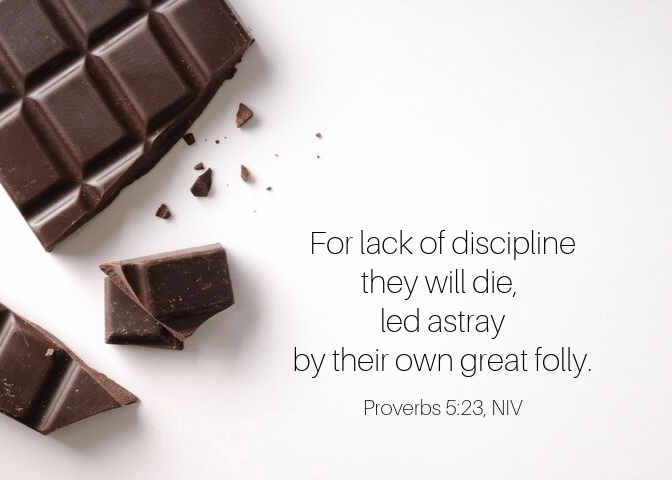
The story of Judy’s chocolate bar is the perfect illustration of the stay-as-far-away-from-temptation-as-possible principle. Judy loves chocolate. In fact, Judy loves chocolate too much, so she decides to not eat chocolate for a month. One day, after deciding to give up chocolate for a month, Judy is at the grocery store buying food for dinner. While at the store, Judy decides to just go down the aisle where the chocolate is. She is not going to buy any, she just wants to look at it. As she gets closer to the chocolate she notices that it is on sale. Judy decides to purchase just one bar of chocolate. She will not eat it now, but it is on such a good sale, she wants to take advantage of the bargain and buy it for later. When she gets home from the store, she keeps thinking of the chocolate bar that is now sitting in her cupboard. Judy believes that just getting to smell the chocolate will be very satisfying and help her to stop craving the chocolate, so she unwraps the chocolate bar and takes a large whiff of the delicious chocolate. It smells incredible. Judy sets a small piece of the chocolate on her tongue, not to eat it, but just to take a little lick. You guessed it, soon the chocolate is gone! Judy devours the entire bar. The question is, when would it have been easiest for Judy to refrain from eating the chocolate? Would it have been easier to not eat the chocolate when it was sitting in the wrapper in the cupboard, or when it was sitting on Judy’s tongue? What if Judy had never gone down the chocolate aisle at the store, but had instead just gone to the fresh produce section?
We need to constantly pursue wisdom, so that we can make God-pleasing choices. We must be vigilant so that we do not believe any of the world’s lies. And finally, when we have identified what our stumbling blocks are, we must stay far away and avoid those temptations.
Jill McClain

“Trust in the LORD with all your heart
And lean not on your own understanding;
in all your ways submit to him,
and he will make your paths straight.”
Proverbs 3:5-6
Proverbs 3:5-6 is an often quoted and memorized Bible verse. However, not surprisingly, it is easier said than done. It is easy to say the words, without really thinking about what living out these words looks like.
Trust in the LORD. When I trust in something I can count on it. The dictionary definition of trust is, “to believe in the reliability, truth, ability, or strength of someone or something; to have confidence in (someone or something); to believe that something is true or correct.” All of these definitions need to apply to my trust in God. I must believe that all his promises are reliable and that what he says is true. I must believe that he had the ability to create the world and that he has the strength to stand against my enemies. I need have confidence that he cares for me and believe that his word, the Bible, is true and correct.
There are so many things in this life that I can put my trust in. I can trust my family, my doctor, the government, my pastor, and the list goes one. But over time, all these people will disappoint and let me down. There is only one that is totally faithful and trustworthy, and that is my Heavenly Father. However, if I don’t take the time to get to know God personally, I will never be able to totally trust him.
Trust in the LORD with all your heart. If I truly trust in God, it must be with ALL my heart. If I only trust God some of the time, or with only some things, then I am not trusting God at all. Trust is an all or nothing kind of proposition.
And lean not on your own understanding. I need to let go of what I think I know, and totally rely on God. I must stop trying to be self-sufficient, but instead depend on my Creator and his infinite wisdom.
In all your ways submit to him. Trusting in the Lord requires that I submit everything that I have, and everything that I do to him, all the time, every day. Some versions say, “in all your ways acknowledge him.” I acknowledge him when I feel his presence with me throughout the day, and turn to him for comfort, companionship and guidance.
And he will make your paths straight. When I fully trust God, then he can lead me down the correct path. So often I want to go my own way and do my own thing. I like to be the boss. However, when I am truly trusting in God then I eagerly follow God’s direction.
When I want to know what God’s will in my life is, I only need to trust in him with all my heart, and lean not on my own understanding, but in all my ways submit to him. If I am trusting, leaning, and submitting, then I can be confident that I am following God’s plan for my life.
Jill McClain
Out in the world today, we see a lot of bold claims made by companies. They promise you weight loss, happiness, wealth, status, and anything else that you can think up. What is their purpose in making these bold claims? They want your money. Many of the times the claims are flat out lies and at best they deliver only a fraction of what was promised. What about Christianity? Does the Bible make big claims like companies do?
Personally, I think the Bible makes a lot of claims about those who put their faith in God. But the logical follow up question to that statement is – are they true? So in this blog post I want to set out to show you four claims the Bible makes about the benefits a Christian receives in this age. The fact that we are talking about this age is important. Obviously a Christian has a major benefit in the age to come with eternal life and the kingdom. However, I want to focus on this life and how being a Christian makes our lives better, now. The four benefits to being a Christian are peace, purpose, perspective, and people.
Peace is a commodity of which the world is in short order. It seems that mental illness is all over the news with illnesses like depression and anxiety sweeping over our nation. Christianity promises to those who put their faith in God that they can find peace. Look at Philippians 4:6-7, “6 Be anxious for nothing, but in everything by prayer and supplication with thanksgiving let your requests be made known to God. 7 And the peace of God, which surpasses all comprehension, will guard your hearts and your minds in Christ Jesus.” Paul, talking to the people of Philippi, is saying that if we hand over our anxiety to God through prayer and thanksgiving in return we will receive peace that surpasses all comprehension. I love how Paul makes the point to say that this peace will guard our hearts and our minds in Christ Jesus. I think Christianity has the best solution for finding peace in this life.
Purpose is an elusive things that some people spend their whole lives searching out. I truly think that people thrive the most when they are living a life after the purpose for which God created them. If you are looking for purpose look at 1 Peter 2:9-10 which says, “9 But you are a chosen race, a royal priesthood, a holy nation, a people for God’s own possession, so that you may proclaim the excellencies of Him who has called you out of darkness into His marvelous light; 10 for you once were not a people, but now you are the people of God; you had not received mercy, but now you have received mercy.” First look at verse 10 where it says, “you once were not a people, but now you are the people of God”. In other words, once you had no identity and no purpose but now you are the people of God and you have a purpose. The purpose statement is at the end of verse 9, “so that you may proclaim the excellencies of Him who called you out of darkness into His marvelous light”. I think when we are giving the good news to people, and that is our driving purpose, we find fulfillment with our lives. What could be better than helping someone change their life forever?
Perspective can be a tricky thing to find, especially perspective that is trustworthy and true. Let’s talk about the world’s perspective on one of the most difficult things we deal with in life, death. To the world, death is crushing, scary, oppressive, breaking, and most of all final. The world has no hope when it comes to death but the Bible offers a better perspective on death. 1 Thessalonians 4:13-18 says, “13 But we do not want you to be uninformed, brethren, about those who are asleep, so that you will not grieve as do the rest who have no hope. 14 For if we believe that Jesus died and rose again, even so God will bring with Him those who have fallen asleep in Jesus. 15 For this we say to you by the word of the Lord, that we who are alive and remain until the coming of the Lord, will not precede those who have fallen asleep. 16 For the Lord Himself will descend from heaven with a shout, with the voice of the archangel and with the trumpet of God, and the dead in Christ will rise first. 17 Then we who are alive and remain will be caught up together with them in the clouds to meet the Lord in the air, and so we shall always be with the Lord. 18 Therefore comfort one another with these words.” If you are a Christian, you are offered a perspective on death that doesn’t include fear but instead centers on hope. Don’t get me wrong, death is still a painful and difficult event but it isn’t crushing for Christians. To me, 1 Thessalonians 4 is a clarifying and liberating passage. Because of the Bible I am freed from the fear of death. Christianity offers us a better perspective on death and a whole multitude of other things.
People, who doesn’t want a people to call their own? Community is an essential part of human flourishing and Christians absolutely crush the competition when it comes to community. Look at what Jesus says in Mark 10:29-30, “29 Jesus said, ‘Truly I say to you, there is no one who has left house or brothers or sisters or mother or father or children or farms, for My sake and for the gospel’s sake, 30 but that he will receive a hundred times as much now in the present age, houses and brothers and sisters and mothers and children and farms, along with persecutions; and in the age to come, eternal life.’” In this present age we will receive 100 times the family that we currently have. This doesn’t mean that all of a sudden our family multiples by 100. What it means is that those who are Christians become our family. You are probably familiar with the term family of God. It is short hand for the community of believers that form one large family all around the world. When I walk into church I know that those people have my back, they love me, they support me, and they are my family.
Maybe now you are asking how can I be sure that these claims actually hold up under pressure? Are these claims made by the Bible like the false claims made by big companies? If you are curious about the validity of the Bible, just ask a long time Christian that you know. They will tell you about the peace they have felt in their lives when there should not have been peace. They will tell you about the purpose they have found. They will tell you about how the Bible has shifted their perspectives for the better. They will tell you about the community that they have in the family of God.
If you are looking for peace, purpose, perspective, or a people I think you should give Christianity a serious look. Maybe you have been on the fence about dedicating your life to Christ or maybe you have fallen away and aren’t where you want to be with God. Either way there is a better life out there, it just takes commitment. You need to commit to following God wherever He leads and you need to put your trust in Jesus. If you are thinking about dedicating or rededicating your life to Christ find a pastor or Christian you trust and talk to them about how following God can change your life for the better.
-Josiah Cain

This week we begin a journey into the Gospel of Mark, reading just one chapter a day. Jesus has much to teach us about being different. Instead of hearing from just one writer this week – we get to hear from 7 young people as they inspire us to follow Jesus.
“At that time Jesus came from Nazareth in Galilee and was baptized by John in the Jordan. Just as Jesus was coming up out of the water, he saw heaven being torn open and the Spirit descending on him like a dove. And a voice came from heaven: “You are my Son, whom I love; with you I am well pleased.”
At once the Spirit sent him out into the wilderness, and he was in the wilderness forty days, being tempted by Satan. He was with the wild animals, and angels attended him.
Mark 1:9-13 (NIV)
In these verses, we see God having favor with Jesus as well as Jesus being tempted. We just came back from Fuel and it’s so easy to go back to life as we know it and to maintain the same habits. We will be tempted both now and throughout the year. However, the theme this year was different and regardless of a Fuel theme, we should strive each year to become a better version of ourselves upon going home.
Let us pray:
“God, we praise you for such a powerful week at Fuel. We’re grateful for the things you’ve laid on our hearts and for the Godly relationships that have been created and strengthened through fellowship. We ask that you would help us act in accordance with your will and help us fulfill the commitment that we made to be different in our personal lives as well as in our communities.”
Until next year, brothers and sisters in Christ.
~Caitie Wood