The Right Friendship

James 4

Wednesday, October 5, 2022

Conflicts and violence are problems we humans have always dealt with. If only there were some insights in the book of James to help us understand why, and how we might be able to help the situation.

“Those conflicts and disputes among you, where do they come from? Do they not come from your cravings that are at war within you? You want something and do not have it; so you commit murder. And you covet something and cannot obtain it; so you engage in disputes and conflicts. You do not have, because you do not ask. You ask and do not receive, because you ask wrongly, in order to spend what you get on your pleasures.” (James 4:1-3 NRSV)

James says the source of conflict is the cravings at war within us. We covet things that we don’t have, and perceive that there isn’t enough to go around, leading us to take what we want by force, many times at the expense of others. We’re wired so deeply for survival that the fear of scarcity often drives us to get what we need in whatever way we can. It’s both a blessing and a curse. 

The passage goes a level deeper into the investigation and explores why we don’t have what we need: It’s because we don’t ask. That’s something I’m not good at. I often feel uncomfortable asking someone else for something, because I think it’s my own responsibility to take care of it. By not asking, I’m underutilizing one of the biggest strengths of being part of family and community. There is more than enough to go around if asking and sharing happen freely.

There’s another layer to this. Sometimes when we ask, we don’t receive because we ask with wrong or selfish motives. By chasing after the wrong things, we are fueling the fire of conflict. James is prompting us to take inventory of our desires and motives. It’s not wrong to need or want things, but the challenge is to seek the right things with a pure heart.

James continues his train of thought by contrasting “friendship with the world” and friendship with God. When we seek things with the wrong motives, we make ourselves friends of the world, and therefore enemies of God. Instead, make yourself a friend of God by humbling yourself and submitting to the leading of his spirit that lives within us. Set aside your selfish desires, as painful as that may be, and ask for truly good things.

James is offering us an antidote to conflicts and violence, advocating for a more peaceful way—partner with God (“draw near” to him) by properly aligning your desires. Seek after and ask for the right things, and have enough as you share in God’s abundance and grace.

-Jay Laurent

Questions to consider:

1. What are some things you need or want, but don’t have?

2. Do you think these needs/wants are because of selfish desires, or are they good things to seek after?

Wildfire

James 3

Tuesday, October 4, 2022

It can be a challenge to control what we say. James describes the tongue like a poisonous and evil beast we can’t tame. He says that it’s a fire that sets the whole cycle of nature ablaze. That’s a lot of power to ascribe to one small part of the body. How can it be so powerful?

James gives us two potent analogies for how this works. You can put a small bit in a horse’s mouth and be able to steer them wherever you want, and you can steer a large ship with a small rudder. It’s the same with the tongue. It’s a small part of the body, but it has great “steering power.”

Have you ever met someone who is just always a positive thinker? It’s equal parts encouraging and annoying how they can always manage to put a positive spin on things. On one side, it seems like they’re not acknowledging the reality of the situation, but on the other, they might have a deeper handle on reality. There is something I can learn from this kind of person. Thinking and saying positive things is like a small investment in those truths. It signals that we are aligned with them and committed to them, and when that is the case, we’ve paved the road for positive actions.

The same could be true for negative thoughts, words, and actions. If you’re putting your chips down on your dismal predictions, you want to be right. Sometimes we want to be right more than we want things to be right, so we can say, “See, I told you so.”

The influence of your tongue goes far beyond just yourself. Imagine you are having a conversation with someone you care about. Somewhere along the line, you start interpreting each other incorrectly (which happens all the time), and one or both of you gets triggered by what the other says. In such a moment, especially when you are angry, it is like all control of the tongue goes out the window. You are suddenly saying hurtful things that you are wishing you didn’t say—even before you finish saying them. The tongue takes over and starts steering the conversation into a fiery disagreement. This is real. You know it’s real because you’ve experienced it. This is the wildfire James is talking about.

For moments like those, it is appropriate to remember to be quick to listen, slow to speak, and slow to get angry (James 1:19). When my pastor, Michael Hoffman, talks about this verse, he says that is why God gave us two ears and only one mouth. If only this was something I could remember more in the moments that count. When you really put effort into hearing people, you take some of the destructive ammunition away from the tongue.

These days, we have quicker and easier ways to cause wildfire than James could ever imagine. I’m pointing at social media. The internet is an amazing innovation and it’s hard to imagine my life without it, but we were clearly not ready for it as a species. Now we are dealing with a beast more ferocious than just the tongue. Now anger, polarization, fear, disillusionment, disinformation, and pure stupidity can be spread across the world in just a short moment with a comment, tweet, post, video, or what-have-you. Those who see or hear it will likely not react or filter themselves as if they are interacting with a real human, and their response will reflect that. It’s a terrible feedback loop. To make it worse, there are algorithms lurking in the background making sure you see the things that are most likely to trigger you. If the tongue is a wildfire, social media is uncontrolled nuclear fission.

Somewhere around 10 years ago now, I realized that social media was not a healthy thing for me, for various reasons. I imagined what would happen if I just quit using it. So one day I quit, and I’ve never missed it. I’m not saying you should do the same, but if you ever find yourself burdened or distracted by it more than you know is healthy, consider it.

The things we say really do affect us. They ripple out and affect our families and friends. They touch our communities and influence our world in ways we don’t even comprehend. This is the reality that James recognizes and wants to warn us about. And given how fast and wide technology allows our communication to spread, that means we have an even higher level of responsibility for what we say.

-Jay Laurent

Questions:

1. When was the last time you started a wildfire with your words?

2. Are there any strategies you could use to help tame the beast that is your tongue?

The Faith/Works Dilemma

James 2

Monday, October 3, 2022

In the second chapter of his letter, James continues with his onslaught of practical but difficult advice.

“What good is it, my brothers and sisters, if you say you have faith but do not have works? Can faith save you? If a brother or sister is naked and lacks daily food, and one of you says to them, ‘Go in peace; keep warm and eat your fill,’ and yet you do not supply their bodily needs, what is the good of that? So faith by itself, if it has no works, is dead. But someone will say, ‘You have faith and I have works.’ Show me your faith apart from your works, and I by my works will show you my faith. You believe that God is one; you do well. Even the demons believe—and shudder.” (James 2:14-19 NRSV)

It would seem from this section that just believing things is no good. If my interpretation of James is correct, that means it’s not enough to go around quoting John 3:16 and telling people they only need to believe in Jesus and they will be saved. There is no checklist of beliefs where you can just tick all the boxes and receive salvation. No single belief will save you, and neither will any magical combination of beliefs.

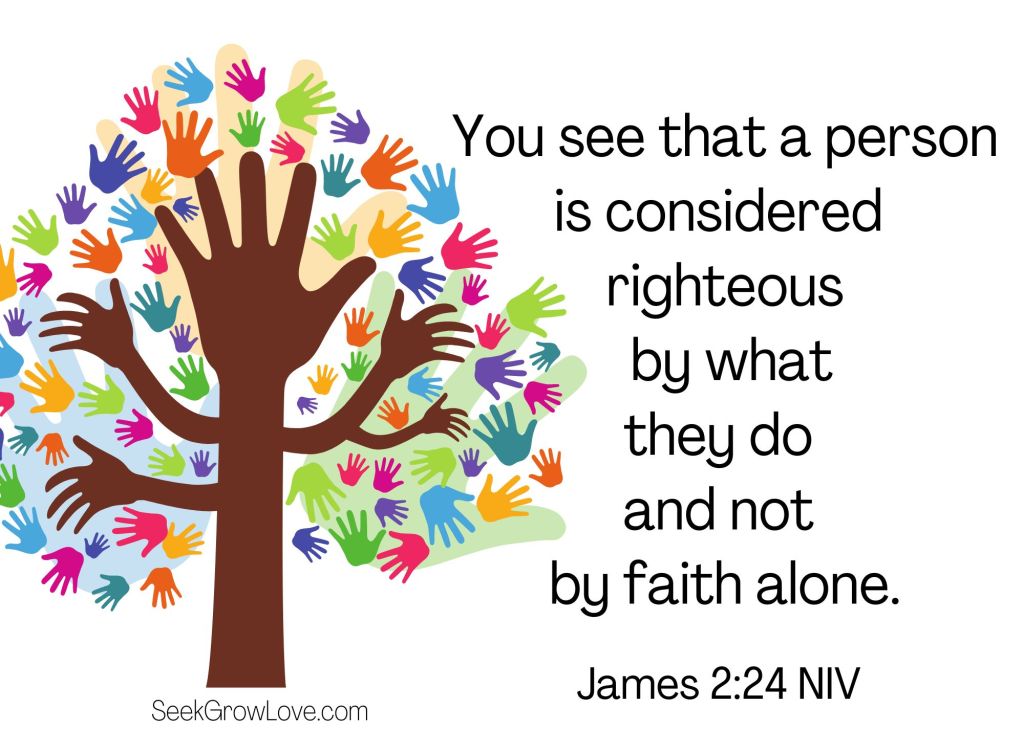
James is asserting that action must accompany faith in order for it to be the real thing. Doing good works is the evidence of your faith. Faith and good works don’t live isolated lives, but are coupled together. To decouple faith and works is to reveal an inconsistency.

Imagine that someone claims to believe in the value of human life as the image of God, yet they go around hurting or killing people. Or maybe they just neglect to help someone else they know is in need. You would notice the inconsistency in that. They must not truly believe in the value of human life since their actions show they don’t value it. James is telling us that actions are louder than words. He cuts right through the nonsense and says, “Hey, don’t just tell me what you believe. Show me.”

When we talk about this passage, it’s likely that we’ll also think of a passage from Ephesians that seems to be in tension with it.

“For by grace you have been saved through faith, and this is not your own doing; it is the gift of God—not the result of works, so that no one may boast. For we are what he has made us, created in Christ Jesus for good works, which God prepared beforehand to be our way of life.” (Ephesians 2:8-10 NRSV)

Paul here is saying that works can’t save you; it’s a gift you accept through faith. James is saying faith alone doesn’t save or justify you; you need works too. Is there a conflict between what James and Paul are saying?

Part of the beauty of this collection of writings we call the Bible is that different authors often have different perspectives on things. We have four different gospel accounts, each with their own angle and emphasis. The general story and message are the same, but some of the finer details differ. This is exactly what you would expect if you asked four different people to describe something they witnessed years ago. This is not a problem at all for the gospels, and in actuality, bolsters the case for their authenticity. It shows that four people didn’t get together in a room for a weekend and collude to produce the exact same fairy tale. Four real people wanted to pass on what they witnessed, and they did so under the inspiration of God.

We see the world with two eyes, each from a slightly different angle. This allows us to perceive depth, in other words, to see things in 3-D. Your brain does some kind of trigonometry with the signals from your eyes to give you an idea of how far away something is. If you had only one eye, it would be much harder to judge depth.

We can regard James and Paul as two eyes looking at the topic of salvation from two different angles, and the result is seeing it in 3-D. It’s the same core truth with different emphases. James sees something Paul doesn’t see, and Paul sees something James doesn’t see. At great risk of oversimplification, I’ll try to bring their viewpoints together. They would agree that faith and works go hand-in-hand. James is saying faith alone is not enough, and Paul is saying works alone are not enough. Neither would say that you can earn salvation by works, but would agree that the works are evidence of a saving faith. Well, I took a stab at it. My only hope is that they can get together sometime to discuss this topic and release it as a long-form podcast.

-Jay Laurent

Question Time

1. Why do you think it is so hard to really live out what you believe?

2. What small steps could you take this week to put your faith in action?

The Long Game

James 1

Sunday, October 2, 2022

The letter of James has some of the most immediately practical wisdom you can find in the Bible. Some have called it the “Proverbs of the New Testament.” If you are looking for guidelines about how a Christian should live, James is a great place to start.

The only problem is that some of James’ advice is hard to take: 

“My brothers and sisters, whenever you face trials of any kind, consider it nothing but joy, because you know that the testing of your faith produces endurance; and let endurance have its full effect, so that you may be mature and complete, lacking in nothing.” (James 1:2-4 NRSV)

I don’t know about you, but when I’m going through difficult things in life, I’m not feeling joy. Isn’t joy supposed to be reserved for things that are… joyful? Isn’t joy for when people get married, or when babies are born, or when a new season of your favorite show is available to stream, or when you are going to have tacos? Yes, joy is for the good things in life.

So why does it sound like James is telling us to enjoy suffering? Is he insane?

Well, no. In order to understand what he is saying, we have to think of the long game. We’re not to be joyful because of the difficult times we are facing, but because of the growth potential they provide for us. Going through things teaches us to endure, and being able to endure makes us more mature and complete. Pressures shape us into stronger people. Recall that if you subject carbon to intense heat and pressure, you get diamonds!

Consider any elite athlete. They didn’t get where they are by accident, but through years of difficult and intense training. Do you think they truly enjoyed all of that training? Of course not, but I bet they did enjoy knowing that through their training, they were going to be the GOAT at their sport.

If you want your muscles to become stronger, you have to progressively challenge them. Likewise, when our faith is challenged, it also becomes stronger. James is asking us to take on the right attitude of joy during our times of discomfort, because we know that through those challenges, we are deepening and growing our faith.

In thinking about all these things, I’m reminded of the time Jesus was in the garden of Gethsemane, under unimaginable distress because he knew he would soon lose his life. Imminent death is the kind of thing that would test anyone’s faith, even Jesus. He didn’t want to go through with it any more than you’d want to drive a stake into your own eye socket. In his situation, I would have been tempted to just run away and wash my hands of the whole thing. I’d say to myself, “This whole messiah business has taken quite a turn and I just want a quiet life somewhere.” I can imagine he had that same temptation. Surely he didn’t enjoy being betrayed, put on trial, scourged, and nailed to a piece of wood to die in total humiliation.

Jesus didn’t have to do what he did, but he was thinking of the long game. Yes, he knew he would face a horrible death, but deep in his heart he had something resembling joy. Not joy because of the circumstances he was enduring, but because of what was just over the horizon. It was this joy and hope that allowed him to muster the strength to say with his dying breath, “It is finished.” He knew that his dying would mean, paradoxically, conquering over the powers of sin and death, and leading us on a mass exodus out of their clutches. He knew that his resurrection would unleash a new reign of God on the earth and again put us at one with God.

Jesus did what he did because he was thinking of us.

-Jay Laurent

A couple questions to reflect on:

1. What are some trials or difficult times that you have had to endure?

2. Can you think of any ways you grew as a result of these times?

Do Good

Hebrews 13

Saturday, October 1, 2022

I get to finish the book of Hebrews today with you, and wow have we covered a lot!  The last chapter is full of little gems like marriage, money, peace, faith, prayer… each are uniquely different, making it hard to write a quick devotional.  So, I’m going to cover the topic that spoke the most to me this week!  You may be drawn to a different aspect of the text, and I encourage you to listen to God’s voice and what He has to tell you versus my own thoughts and ideas.  Hopefully I’ll have something to add though!

I’m going to focus on the relational aspect of this chapter.  Verses 1 and 2 talks about loving others; specifically, strangers.  Now, it may be the “Minnesota-nice” in me, but I seriously love this reminder!  One of my biggest pet peeves is when people are rude to others they don’t even know.  Anytime I encounter someone new who is rude, or even just has a scowl on their face, it automatically turns me off from anything they have to say.

We are told to be examples of Christ, and as Christians, we absolutely are whether or not we think so!  If we are outspoken in our faith, if someone knows you go to church on Sundays, or whatever the situation might be, to anyone we interact with, we are examples of Christianity as a whole.  That is a big responsibility!  These verses are great reminders to love one another and to show hospitality to everyone we meet.  Who knows, maybe you’re loving on an angel!

Skipping ahead just a bit to verse 16, we have another reminder in how to act towards others.  We are told to do good and share with them.  Obviously, this is another way in which we can show the love of God and demonstrate Christianity to new believers.  But, I’ll be completely honest, I’m not always in the best mood to share or do good for other people.  And quite frankly, sometimes people don’t deserve it!  But this verse isn’t telling us to do these things for other people alone.  We are told to offer these things as sacrifices to please God.  Depending on the person, sacrifice might be a good word to describe it!  I think it makes it easier to do good and share if I think of doing it for God versus for man.

Looking at the word sacrifice in verse 16 and the verse directly before that, I am reminded at how the Hebrews originally viewed that word.  Remember, they are still learning that sacrifice no longer has to be the shedding of blood!  That must have been a little confusing to go from sacrifice being blood to being worship and sharing!  This is just another way that shows how drastically Jesus can change our lives.  He took the unclean, messy, death and changed it in to praising God and showing love to others!

We are so incredibly lucky to have a Savior that has changed our world for us.  As a show of gratitude, we can focus on loving one another and spreading the same grace we receive from him to others.  In times like this when our world is hurting from the loss of people to things such as mass shootings, plane crashes, abortions, wars, natural disasters, and so many other horrible things in this life, I encourage you, brothers and sisters, to show a little love.

Grace be with you all!

-Sarah Blanchard Johnson

(originally posted for SeekGrowLove on February 17, 2018)

Application Questions

  1. Reading through Hebrews 13 which of these final instructions is most powerful to you?
  2. How will you share and do good to others this week – remembering that this is your sacrifice which pleases God.

The Secret to Not Growing Weary

Hebrews 12

Friday, September 30, 2022

One of the most powerful sections of this chapter are the opening 3 verses: “Therefore, since we are surrounded by such a great cloud of witnesses, we must get rid of every weight and the sin that clings so closely, and run with endurance the race set out for us, keeping our eyes fixed on Jesus, the pioneer and perfecter. For the joy set out for him he endured the cross, disregarding its shame, and has taken his seat at the right hand of the throne of God. Think of him who endured such opposition against himself by sinners, so that you may not grow weary in your souls and give up.”

The imagery of verse 1 closely resembles that of ancient stadium competitions. Imagine the crowd seated all around you, and you are competing in a race on the stadium floor. You are in the midst of a great multitude of people cheering you on as you strive to win the competition.

While the author of Hebrews likely did not have this exact thought in mind when he wrote that “we are surrounded by such a great cloud of witnesses,” since the word “witnesses” does not refer to spectators but rather individuals who can testify to living by faith, there is something to be said for realizing that we are not living the Christian life merely by ourselves. What the author intends for us to get from these opening verses is that we stand in continuity with the long line of ancient believers despite not ever receiving the promise of “being made perfect” (cf. 11:39-40).

If ancient believers stood firm in their faith despite enduring much affliction and opposition as the author recounted in chapter 11, then that ought to be encouraging to us that we too should stand firm in our faith. To bring his point to a climax, the author then targets the ultimate example—Jesus.

With many historical believers from whom we can draw inspiration and encouragement from, there is none more significant than the example of our Savior. We are told explicitly to “think of him” with regard to his immense suffering at the hands of sinful people and the ultimate shame of crucifixion and to realize that he willingly endured both for the sake of the “joy set out for him.”

What joy was that? What joy could be present in having to experience such awful torment and pain? Jesus’ joy was to do the will of his Father, even if that was to suffer humiliation and an excruciating death upon the cross. Perhaps it is because there is no greater example of perseverance through hardship and an unwavering resolve to live by faith than Jesus the Christ.

This seems to be the reason why the author tells the readers that they are to keep their “eyes fixed on Jesus, the pioneer and perfecter of our faith.” If we understand that Jesus endured all the horrific torture and shame because he trusted in God, then we too can draw strength from him as the greatest witness (i.e., testimony) to standing strong in our faith amidst trials and adversity. Because if we focus our attention on him as the pinnacle of a life lived by faith, then we will “not grow weary in our souls and give up.”

-Jerry Wierwille

Application Questions

  1. When was the last time you felt yourself grow weary? What were you focused on at the time? What would the writer of Hebrews 12:1-3 suggest you remember and stay focused on instead? How might that help?
  2. What helped Jesus endure? How can that help us as well?

Something Better

Hebrews 11

Thursday, September 29, 2022

The opening verse of this chapter sets forth the premise of what is to follow: “Now faith is the reality of what is hoped for, the proof of what is not seen” (v. 1). The author will go through no less than 10 explicit individuals, and mentioning a list of several more, who exhibited faith in their life. And then the chapter concludes by saying “All these were approved through their faith, but they did not receive what was promised, since God had provided something better for us, so that they would not be made perfect without us” (vv. 39-40).

The chapter’s conclusion draws together the litany of exemplary witnesses by tying it to the faith that they share with the audience. And while the exemplars of old had not received the promise, it was by no fault of their own, but it was determined beforehand by God that in his grace, he planned for “something better” to be available to the readers that was not available in the past to all those faithful witnesses that were mentioned. And that “something better” was “to be made perfect” (v. 40).

Now, to modern readers the idea of being made perfect might not be the same as the biblical idea of being made perfect. In Hebrews, the idea of “perfection” entails the definitive forgiveness and putting away of sin, purification and consecration to God, and glorification (i.e., resurrection). And so, to be “made perfect” refers ultimately to eschatological salvation that is bestowed on the worshiper through the high priestly ministry of Christ (cf. 10:14).

But let’s think for a moment, why does the author need to go to such a great length throughout the chapter to simply demonstrate that believers prior to the new covenant did not receive what was promised? Why make the emphasis so extravagant?

One reason for the author’s inclusion of such a long description of exemplars of the faith is to celebrate those who stood with faith looking forward to the promise, but yet not receiving it in their lifetime. The testimony of all these witnesses is that “Faith holds onto the promise, even when the evidence of harsh reality impugns its integrity, because the one who promised is himself faithful” (William Lane, Hebrews [WBC], 395).

I think we have all probably dealt with times when we are holding on to faith, but it doesn’t seem like anything is happening or changing, and we didn’t actually get to see the outcome of our faith. This is what it was like for the believers in the old covenant who looked forward to the coming Messiah and the fulfillment of God’s promise. But we don’t have to look forward since Messiah has already come and has begun to fulfill what God promised.

Therefore, while we have not been “made perfect” yet to the fullest extent of what God has planned for those who trust in him, in Christ we have the definitive sacrifice for sin, the cleansing of our conscience, and a taste of the powers of the age to come. Let us continue to hold fast to our faith in hope of what God has promised that is yet to come: resurrection and final victory over the power of death, so that those who stood by faith before us can also be made perfect with us in God’s coming kingdom.

-Jerry Wierwille

Questions

  1. What encouragement do you gain from reading of the heroes of the faith in Hebrews 11?
  2. Which heroes of the faith are you most looking forward to being with when we together receive God’s promise and reward at the resurrection and coming Kingdom? Why?

When No Sacrifice is Left

Hebrews 10

September 28, 2022

Chapter 10 contains one of the five major warning passages in Hebrews, which makes up the second half of the chapter. It is this section that we will focus on as it functions in a very unique way in this context.

Leading up to verse 26 where the warning begins, the author has now fully explained the perfect sacrifice and the forgiveness that is now possible which was not available under the old covenant. And so, as the author concludes, “where there is forgiveness of these sins, another sacrificial offering for sin is no longer required” (v. 18). This is valid so long as certain conditions are met as the author will go on to describe.

The warning passage begins: “For if we deliberately continue sinning after receiving the knowledge of the truth, there no longer remains a sacrifice for sins, but a terrifying expectation of judgment and the fury of a fire that is about to consume the adversaries” (vv. 26-27).

For those who choose to continue willfully committing sin after coming to know the truth about Christ’s sacrifice, it says “there no longer remains a sacrifice for sins.” What does it mean that there is “no longer” a sacrifice for sins? The author has just gone to great lengths to show the perfect sacrifice of Christ, and such an offering as Christ’s is the only one that is able to “perfect forever those who are sanctified” (v. 14).

If Christ’s sacrifice is the only sacrifice that is sufficient to take away sins forever, and since the author made it clear that the old covenant sacrifices could never “take away sins” (v. 11), then if a person disregards the cleansing and sanctification that is brought about through Christ by willfully continuing to sin, then they have no other recourse to fall back on for forgiveness. Christ’s sacrifice is the only offering that can remove the defilement of sin. Therefore, repudiating Christ and disregarding the knowledge of the truth leaves a person with nowhere else to turn. And that is why the author says that such a person only has to look forward to a “terrifying expectation of judgment and the fury of a fire.”

It is God’s will that we turn away from sin and embrace Christ’s sacrifice on our behalf so that we may be forgiven and cleansed from sin and have “our hearts sprinkled clean from an evil conscience” (v. 22). The means by which we can have this purification in our hearts and minds has already been provided by God through Christ.

And this is why the author warns the reader that they must not fall away and turn aside from the knowledge of the sacrifice of Christ. At the end of the chapter, in one of the final exhortations, the author asserts, “So don’t throw away your confidence, which has a great reward. For you need endurance, so that after you have done God’s will, you may receive what was promised” (vv. 35-36).

In Christ, there is forgiveness from sin now and forevermore. But outside of Christ, we have no hope and no provision for sin. If we will endure in the faith, holding onto the perfect sacrifice of Christ, then we will have done the will of God and will receive the reward of what he promised—everlasting life.

-Jerry Wierwille

Questions

What 4 things are we told to do in Hebrews 10:22-25 (“Let us…” -in NIV – do what 4 things?). Which of these 4 do you think you do most regularly already (though, still with some room for improvement)? Which one would you like to concentrate on doing better this month? How?

Who has spurred you on to love and good deeds? How did they do it?

Who has been an encouragement to you? How did they do it?

Why is Jesus Better?

Hebrews 9

Tuesday, September 27, 2022

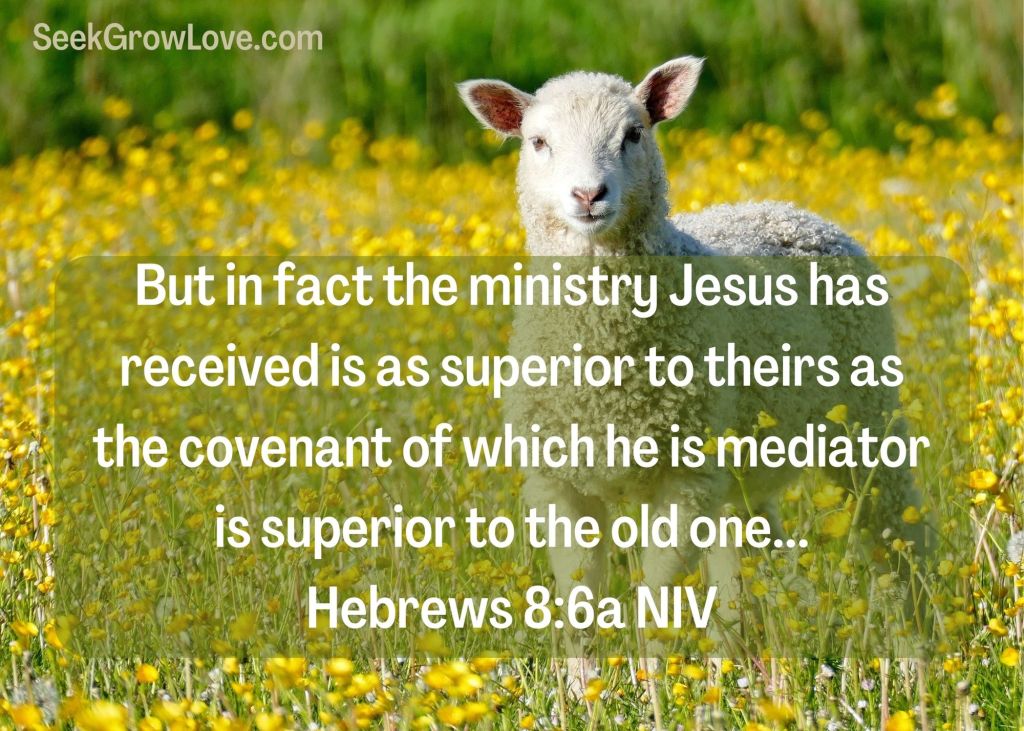
Previously, in chapter 8, the author disclosed that Jesus has now obtained a superior ministry and is the mediator of a better covenant that is enacted on better promises (8:6). While the author has simply made this assertion, it now remains for him to explicate how Jesus’s ministry is “superior.” And it is in chapter 9 that the author takes up this very task.

In the 1st part of the chapter, the author recounts the old covenant ministry under the Mosaic Law. There was a tabernacle and sacred items and a place where atonement was made by priests. Yet, it says that “this is a symbol for the present time…until the time of restoration” (vv. 9-10).

All the institutions of the old covenant were limited because they “cannot perfect the worshiper’s conscience” (v. 9). They mandated various sacrifices and rituals which by their nature were unable to bring the worshiper the true cleansing that was the intended goal of atonement and salvation.

But, in verse 11, the author now turns to present the superior ministry of the Messiah in the new covenant. Throughout the rest of the chapter, the author goes into great detail about how Jesus as our high priest in the new covenant has accomplished everything that the former covenant and regulations could never achieve. Everything from the cleansing of the tabernacle to the sprinkling of the blood of the sacrifice was done by Jesus, not in the earthly tabernacle, which was a copy of the heavenly reality, but in the heavenly tabernacle by offering himself as the “better sacrifice.”

Jesus’ sacrifice was “better” in at least two regards. First, the author says that Jesus did not offer a sacrifice many times as the high priest in the former covenant had to because he entered the tabernacle every year. Jesus entered the sanctuary in the presence of God only once. Second, Jesus did not offer the “blood of another” by bringing an animal sacrifice like the high priest of the previous covenant but rather offered his own blood as the sacrifice for sin.

As verses 13-14 say, “For if the blood of goats and bulls and the ashes of a young cow, sprinkling those who are defiled, sanctify for the purification of the flesh, how much more will the blood of the Messiah, who through the eternal Spirit offered himself without blemish to God, cleanse our consciences from dead works to serve the living God?” What the author is comparing is that if under the old covenant the animal sacrifice was sufficient to sanctify the worshiper for the purification of the flesh, then the blood of Jesus must be able to do more than that.

And this is exactly his point: Jesus’s sacrifice is able to do what the old covenant sacrifices never could, and that is to cleanse our conscience from “dead works,” which are the sinful deeds that lead to death and require forgiveness and healing. The old covenant had no power to cleanse the worshiper’s heart from their sinful deeds.

But praise be to God that through Jesus and his sacrifice our minds and hearts can be washed clean of our sin and that we may with a pure conscience “serve the living God.”

-Jerry Wierwille

Application Questions

  1. Compare the conscience of a sinner under the old covenant to your conscience under the blood of Jesus. What makes the difference?
  2. How will you use your pure conscience to serve the living God today?

The Best Covenant

Hebrews 8

Monday, September 26, 2022

In verse 6 of Hebrews chapter 8, it states that Jesus has now obtained a superior ministry and therefore is the mediator of a “better covenant” with “better promises.” What then follows in verses 8-12 is the longest consecutive Old Testament quotation in the New Testament. The quotation comes from a section in chapter 31 from the Prophet Jeremiah.

Now, when the author of Hebrews says that Jesus is the mediator of a “better covenant,” it doesn’t mean that the covenant is just a little bit better. It is indeed better, but how much better? Is there a way that we could quantify the degree of “betterness” that characterizes the new covenant? I don’t think so.

The new covenant is greater and better than the old covenant to such a degree that a comparison is nearly impossible. Perhaps we might say that the distance between the two covenants is like the difference between the height of the earth’s atmosphere and then the height of the universe. As glorious as the old covenant was, it was still imperfect. But, the new covenant brings the perfection that the old covenant pointed toward and prefigured in a typological way.

And with Jesus mediating a new covenant, this indicates that the old covenant is obsolete and no longer needed since the new covenant has totally eclipsed its purpose and function. Everything that the old covenant stood for and provided—the ways that it conveyed God’s law to his people, revealed the knowledge of him, and made provision for atonement for sin—has been fulfilled and superseded in the new covenant by Christ himself.

The new covenant promises which surpass anything that the old covenant offered was prophesied by Jeremiah when he wrote, “I will put my laws into their minds and write them on their hearts. I will be their God, and they will be my people. And each person will not teach his fellow citizen, and each his brother, saying, ‘Know the Lord,’ because they will all know me, and the least to the greatest of them. For I will be merciful to their wrongdoing, and I will never again remember their sins.”

Therefore, it might help to think about the new covenant as being the “best covenant” because there will not be another covenant. There will be no “new covenant 2.0” or the “new revised covenant.” Nothing that can improve the new covenant any further. God’s law is in the hearts and minds of his people, he instructs them in his ways, all God’s people know him, and he has forgiven their sin completely, never to remember it.

The light of the new covenant is so far greater than the light of the old covenant that the old covenant simply pales in comparison. The well-known colloquial idiom, “It doesn’t even hold a candle to it” seems apt to apply here where if we imagine the new covenant having the glory and radiance of the sun, then what source of light can compete with it. The old covenant is like the moon, when reflecting the sun, the moon provides just enough light to walk around at night and see most objects near you. But it is still dark, and the potential to stumble or trip is very real. However, the light of the new covenant is like noon day where everything is illumined, and we now walk with full vision of what is before us.

The new covenant is better in every way, and we are able to receive and experience all of these better promises it has to offer. Let us count ourselves blessed to have a Savior who mediates this superior covenant that we can enjoy.

-Jerry Wierwille

Application Questions

  1. What are the differences between the old covenant and the new? (You can find several differences in this chapter alone, but
  2. Why do you think the all-knowing God didn’t just start out with the best/new covenant?