Revelation 21

things are gone, the new have come. Cry no more.” God Himself, the creator of all things, will wipe away my tears.

things are gone, the new have come. Cry no more.” God Himself, the creator of all things, will wipe away my tears.


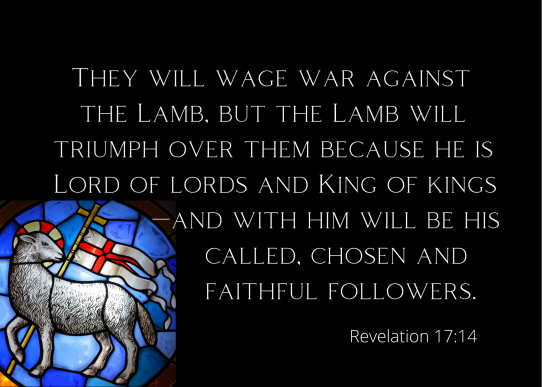
Brothers and sisters, we stand with him. We are called. We are chosen. No matter the persecution of the Dragon, the Beast or the Harlot, let us remain faithful. (v 14)


As we approach chapter fourteen together, John sees four, possibly five, more visions, all depicting the fates of those who are allegiant to the Lamb (Jesus) and those who aren’t. In our world today, people want you to just let people believe what they believe and not challenge their worldview. However, if we trust what Revelation is telling us, it would not be loving for us to allow people to continue living in sin and falsehood. We need to speak up into the lives of our loved ones, because according to chapter fourteen, their fates will not be good if they don’t join the Lamb’s army (the Church). Ultimately, the letter of Revelation is meant to call people to repent and follow the Lamb before time runs out, and we need to do the same.
John sees the same 144,000 from chapter 7 that have the “mark” of God on their foreheads, standing on top of Mount Zion, looking ready for a battle. These are those who have been purchased by the blood of the Lamb; in other words, these are Christians. We learn that their fate is sealed, and their future looks bright! However, John moves forward to describe what awaits everybody else…
An angel is seen, calling people to “fear God and give Him glory”, or repent of their ways (14:7). Another angel warns that “Babylon the great” has fallen, which will be described later on in chapters 17-19. This Babylon, in my interpretation, is a vivid description of Rome once again, as those are the only two nations to ever destroy the Jerusalem Temple. However, those that are within Babylon the great, or those that have worshiped the beast, they will drink the “wine of the wrath of God”, going through torment in fire and brimstone, just like Sodom and Gomorrah (see Genesis 19). These people will eventually be burned up with this fire, but it will be an extremely painful experience.
John then uses the illustration of a grape harvest, in which grapes are thrown into a winepress and squeezed out, causing blood to flow everywhere. It is a graphic image, but a powerful one nonetheless. Those who refuse to worship God and the Lamb will face His wrath, being destroyed completely when Jesus returns. Why would anyone choose to go through this? Unfortunately, many choose to do so.
This message should motivate us to speak up to our friends and family about what Jesus has done. He has saved us from this coming wrath, and now offers that same salvation to anyone who would come follow after him. Of course we love our friends and family and don’t want them to go through the terrifying judgment to come. So speak up! Live out your faith today! Share the good news with whomever you come across! Jesus is coming, and we don’t have much time left.
Talon Paul

666! This number has been special in the minds of believers and nonbelievers alike for thousands of years. What exactly is this number meant to represent? What is the “mark of the beast”? Is the government going to try and put a microchip in my hand? What should I do?
There is much speculation about what the number 666 means, and it all comes from this chapter in Revelation; chapter thirteen. However, before we go wandering off to try and apply this number to our situation in 21st century America, it is important to try and understand what John is trying to communicate to his audience in 1st century Asia Minor. This is an important practice for reading any passage of the Bible, and I encourage you to do your research before applying it to yourself.
John sees a vision of a terrifying beast that has ten horns and seven heads, and was like a leopard, with feet like a bear, and a mouth of a lion. It is likely that John is drawing these images from the Old Testament prophet Daniel, specifically Daniel chapter 7, where the prophet describes four great empires with beast-like imagery. Since Daniel described empires/nations with this imagery, it is likely that John also has a specific empire in mind with his description of this beast. Since we’ve already been told that this beast is responsible for killing the two Witnesses (11:7), John likely has in mind the nation of Rome, who was ruling at the time of his writing and was notorious for killing Christians during the empire’s reign.
John then sees a second beast, which is responsible for making the people worship the first beast. In the first century Roman world that John is writing in, there was a religious movement called “the imperial cult”, that was the fastest growing religion of the time. This religious movement encouraged, and sometimes forced, people to worship the Roman emperors as “gods”. If you do a little historical study on the imperial cult, you may be surprised at how much the whole New Testament addresses this issue.
This second beast forces the people to put a “mark” on their hand or forehead, demanding their allegiance to the first beast. If you don’t have this “mark”, you will be unable to do many things. This number is the number of “a man”, which is 666. This is in stark contrast to the “mark” (or seal) that God had already placed on his own people in 7:3. In other words, you are either with God or against Him.
While I don’t believe we have to worry about microchips in our world today, since that wasn’t the point John was making, we do have a responsibility of giving our allegiance to God in every decision we make. Think about each decision you make today. Is this decision honoring to God, or is it bringing glory to something else? Have you “marked” yourself with God’s grace, or are you seeking something else?
Talon Paul

If the story through Revelation wasn’t strange enough, it gets even stranger in chapter twelve. Here we see a cosmic woman giving birth to a child, who are then attacked by a great, fiery dragon, but then is ultimately defeated by an angel army… What in the world is going on now? Once again, it is important to read the Scriptures for yourself and to discuss with other Christian teachers around you in order to gain deeper insights into the text. Never assume that I know what I’m talking about, or anyone else for that matter; always question and look up the answers for yourself to see if what is being said is true.
I assume that these descriptions are further insights into the contents of the Scroll that was eaten in chapter ten; however, I am not 100% sure on that, but will be going ahead with that interpretation for this discussion. We do gain information about the cosmic battle that is happening around the person of Jesus at his death and resurrection, as Satan (depicted as a dragon) is at war with the angels of heaven during this time. Satan is unable to conquer the cosmic woman that produces Jesus (whoever/whatever that is), Jesus himself, or the angels; Satan doesn’t have as much power as we think he does.
Through frustration, Satan begins to attack the rest of the woman’s children, which are those who “hold to the testimony of Jesus”. In other words, since Satan can’t beat anyone else, he is going to attack the Christians next. We definitely experience this today still, as Satan hasn’t been fully destroyed, although he has already been defeated through the cross. We are weaker than Jesus and the angels, and are susceptible to sin; is there any hope of beating Satan, or are we as doomed as he is?
Perhaps the most practical verse for us in the whole letter of Revelation is found in this chapter. In 12:11, we are given a description about how Christians can conquer Satan. The description is three-fold; we are able to conquer Satan through the blood of Jesus, the preaching of the gospel, and not loving our lives. This should give us great hope and encouragement! We have the power to conquer Satan when he rears his ugly head, if we would only trust in these three things; the blood/sacrifice of Jesus for our sins, the power of our gospel preaching, and the power of looking beyond this life to the eternal life that God has promised us.
I encourage you today to spend some time meditating on these three questions: Do I trust that Jesus’ sacrifice was enough to pay for my sins? Am I faithfully spreading the good news to others around me? Am I truly looking forward to the life that God is bringing me in the future more than this life?
Talon Paul