Other than being selected for jury duty and settling a speeding ticket—both nearly twenty years ago—I have very limited courtroom experience. Most of my perception of trials comes from cinema. Films like To Kill a Mockingbird, Miracle on 34th Street, and A Few Good Men often portray the defense similarly: counsel advises the defendant to remain quiet, not allowing emotion to lead to self-incrimination through testimony or reaction.
In Mark 15, we see Jesus standing trial. Though not advised by earthly counsel, He embodies perfect restraint. Blameless, perfect, and fully justified, He stands before Pontius Pilate, accused for declaring the truth—that He is the Son of the living God. Every defense was at His disposal. He could have commanded, cajoled, or called down divine power. But instead, “Jesus made no further answer, so that Pilate was amazed” (Mark 15:5). The only One who could offer a true testimony chose silence on behalf of our guilt.
This frames the words of Deuteronomy 30 in a different light. “I have set before you life and death, blessings and curses. Now choose life” (Deuteronomy 30:19). Yet before us stands Jesus, choosing the path that lead to crucifixion in order to spare us. He bore our sins, knowing He would be justified by the Father and raised to eternal life. Moses calls God’s people to choose life, but that life is not found in preserving ourselves.
In Psalm 31, we hear the cry that echoes both David and Christ: “Into your hands I commit my spirit; deliver me, Lord, my faithful God” (Psalm 31:5). To live in the Spirit of God is to entrust ourselves fully to His care. It means we do not grasp for every opportunity to justify ourselves or defend our image. When pride rises and we feel compelled to prove our righteousness, we may be stepping away from the cross we are called to bear. After all, it was Barabbas—the guilty—who was released, while Jesus, the innocent, accepted his date.
This is the paradox of the Christian life: “Whoever wants to save their life will lose it, but whoever loses their life for me will find it” (Matthew 16:25). Our heart, soul, mind, and strength are not meant to empower self but to surrender fully. Jesus knew that accepting His sentence would yield eternal glory. Likewise, we stand before our Heavenly Father not with arguments, merits, or credentials, but with a desperate plea for mercy—relying on Jesus Christ, our mediator and counselor
Choosing death is not choosing despair. It is the daily decision to lay down our rights, our pride, and our need to justify ourselves—and instead trust fully in the example of Jesus Christ. We choose conviction. We choose meekness. We choose death.
Reflection Questions
Can you think of a time when you chose to not defend yourself even though you would have been justified to do so? Can you think of a time you did defend yourself but it might have been better if you had not? Why was Jesus silent?
What could it look like to today live out Psalm 31:5 – “Into your hands I commit my spirit; deliver me, Lord, my faithful God”? What do you want God to deliver you from? What does God want to deliver you from? In what ways have you been trying to hold onto your own spirit, your rights, your way of doing things?
How many times do you think you could read Mark 15 today?
Prayer
Dear God, I praise You for Your amazing love for me and the whole human race, a love so deep you gave us the greatest gift, at the cost of the life of Your perfect Son. I thank You for Jesus who teaches us how to life in obedience to You and how to die to self. I thank You for Deuteronomy, Psalms, and Mark 15. Thank you for the written record of Your love and faithfulness and Your plan unfolding. Help me to love You and Your Son Jesus well today. In his precious name I pray.
Today we are pulling up three previously shared devotions on Mark 14, and these are just a few of several posted over the last 9 yearsat SeekGrowLove.com. You may read one, two or three – or even go find some more. Today, may we consider what Jesus did for us, as we also contemplate what we will do for him, this day.
A BEAUTIFUL THING
-Devotion by Andy Cisneros (SC) – (originally posted 3/28/2024 for SGL)
In Mark 14 we see the story of Jesus being anointed with perfume. Jesus takes this beautiful moment and shows us just how great this event truly was. Mary’s actions may signal more than she knows. But, although she may not fully comprehend the messianic significance of her anointing, she appreciates Christ’s worth more than anyone else at the table. But Jesus receives the woman’s gift as a selfless act of love and devotion—an appropriate way to honor the Messiah. Jesus reveals that He will not be with them much longer, which references His soon death and burial.
Jesus says five things about it that mark it as an extremely beautiful act. First, he says, “she has done a beautiful thing to me”. The beauty of it lay in its extravagance. This woman did not spare any of the costly perfume but broke the flask and poured the whole quantity out on him. Judas, with his practical and corrupt mind, counted it up as worth three hundred denarii. A denarius was the day’s wage for a laborer. Three hundred days’ wages would be a tremendous sum. In the eyes of Judas, this woman wasted an enormous amount of money when she poured out the perfume on Jesus. It was such a lavish over the top act, and there lies the beauty of it. When have you done something extravagant and beautiful for Jesus?
Second, He said that it was a timely thing she had done. It was something that could only be done now. Any time you want to do good to the poor you can, because they are always around. And it is right to help the poor. But there are opportunities that come in our life that must be seized at that moment. Mary had sensed this and seized the moment to offer this gift, for such a time would never occur again. It was out of the sensitivity of her heart that she realized that the timing was right, and Jesus recognized this. I’m sure you’ve heard the phrase timing is everything. Mary is preparing Jesus for his death. The timing was now.
Third, she did what she could. She could not fix Him a meal; there was no time for that. She could not make a garment for Him; there was no time for that. There was nothing else she could do to show her love but this. She did what she could. I am sure Jesus has called our attention to that because it is so practical for us. Someone said, “I can’t do everything, but I can do something. And what I can do I ought to do. And what I ought to do, I’m available to do”. Are you doing what you can? Or are you doing what’s easy? Are you doing at least what you are capable of for God and his son?
The fourth element of this act was that it was insightful. Jesus says she has anointed my body beforehand for burying. Many times, Jesus said to these disciples that He was going to die. Not one of them believed or understood him–except maybe Mary of Bethany. She could have understood that he was heading for burial. And since she could not be sure she would ever have the opportunity later to find his body and anoint it for burial, she did it now, as a loving act of service. Of all these friends who were around Him at this time, only this one had the sensitivity of heart to understand what was happening.
Finally, what she did was deserving of being remembered. It was memorable. Jesus said, the story of this beautiful act will be told in memory of her wherever the gospel is preached in the whole world. Here we are today, two thousand years later, fulfilling this very word, telling again of the act of Mary of Bethany when she anointed our Lord’s head and feet.
I hope we can be as understanding and extravagant as Mary was. What can you do today to show your love and appreciation of Jesus? Something extravagant. Something with meaning.
FEAR TAKES OVER
-Devotion by Melissa New (AR) – (originally posted 8/3/2019 for SGL)
Jesus told the disciples that they would all abandon him. It was bad enough that he knew the agony he would endure on the cross, but the emotional sorrow of the betrayal of his closest friends would be gut-wrenching. All of the disciples were saying they would never leave him, no matter what. Peter insisted, “Even if I have to die with You, I will not deny You.” (14:31) Jesus told Peter that not only would Peter abandon him, but that very night he would also deny him three times.
Later, in the Garden of Gethsemane, Jesus asks the disciples to keep watch and pray. They keep falling asleep. I imagine the impending situation has them exhausted from worry and dread. Jesus acknowledged that “the spirit is willing, but the flesh is weak.” (14:38)
When Judas comes to betray Jesus the tension is at an all-time high. The disciples want to fight, but Jesus stops them. Apparently, they immediately realized they were overwhelmed and that’s when fear kicked in. They all ran. One was slow enough that he was seized, but that fear was coursing through his veins so strongly that he left his clothing and ran away naked. That was better than sharing the fate of Jesus. We might see this as utterly shameful. How could they? And how could Peter deny Christ three times especially after Jesus said he would? Did he not remember Jesus’ words after the second denial?
Fear is such a powerful thing. It can be crippling. Fear can shut our mouths, stop us from going and loving others, and keep us from fulfilling God’s will for our lives. More often I see that fear holds God’s people back, but it can also provoke us to act as we shouldn’t just as the disciples did. The naked man and Peter are a clear warning to us. Let’s not let fear have the power to encourage us to expose ourselves shamefully or deny Christ even. In I John 4:18 we are told “perfect love casts out fear.” Let’s pray for perfect love. When we feel fear creeping in, let’s pray for our love to be stronger than the fear.
A DAY TO REMEMBER
-Devotion by Mason Kiel (IN) – (originally posted 8/5/2022 for SGL)
It’s a story we’ve heard a thousand times – Mark chapter 14. Jesus predicts that one of his disciples will betray him, one will deny him, and they feast for one last supper. He’s arrested and, in the face of threat of death, commits to remaining non-violent; even going as far as to heal those who oppose him. The archetype of betrayal, prophecy, and endurance coming together in one of the final chapters of Jesus’s time on earth. So, what more could we take away from these things after hearing it repeated our entire lives? There is always something new to be learned or applied if you’re willing to try to find it.
Starting at the beginning of the passage, a woman approaches Jesus with an exorbitantly expensive container of perfume. She takes this jar of perfume and dumps it all over Jesus, to which she receives backlash. Those in the company ridicule her for not utilizing the perfume for something better, like helping the poor. Admittedly, this would be a very honorable thing to do. But surprisingly, Jesus stands up for her and tells them to not shame her for doing a good thing to him. “The poor you will always have with you, and you can help them any time you want. But you will not always have me.” Mark 14:7.
This is an interesting thing for Jesus to say, as I would imagine him having the mindset of ‘do everything to help those in need,’ but this circumstance seems to be different. There will always be the poor and needy, there will always be the hurt and the wicked. Jesus is the light in darkness, as darkness is the default state, only interrupted by the presence of light, not vice versa. If we spend all of our energy trying to eliminate the darkness, we will lose sight of the light that sustains us incipiently.
Jesus is well aware of this, as the light that sustains and empowers him is God. He cries out “Abba, Father, everything is possible for you. Take this cup from me. Yet not what I will, but what you will.” Mark 14:36. Jesus is crying out in the most passionate and sincerely affectionate way imaginable to his father, begging that his death be made unnecessary, that this burden will be taken from him. However, he takes the proper mindset of being able to accept that what he wants may not be what God wants. When you pray to God for an answer, are you able to accept what He responds with in the same faith Jesus could? It’s no mere feat, but then again Jesus is no mere man.
Not only does he accept what needs to happen, but he also stands firm on what he teaches. If you remember from yesterday, Jesus specifically said to not be afraid when we are brought before the court for our faith, but to answer as the Spirit guides you to, as it is the voice of the Spirit that will talk for you. When they had arrested him and grilled him with questions, “… Jesus remained silent and gave no answer.” Mark 14:61. He needed not respond to their trickery but waited until he knew what he was saying to tell them the truth. For this, they killed him. Could you stand for truth until the end? Could you stand with what you believe and know to be true even if every person would hate you for it? If so, you would be stronger than Peter. He lacked this ability, and defied Jesus 3 times—to which end it destroyed him.
“Immediately the rooster crowed the second time. Then Peter remembered the word Jesus had spoken to him: ‘Before the rooster crows twice you will disown me three times.’ And he broke down and wept.” Mark 14:72. Have you ever gotten to the point in your sin where you don’t even recognize who you are anymore? For Peter, he had been spending the past couple years of his life devoted to following Jesus to the end. And yet, when it mattered most, he denied even knowing him. He had become so distraught by his sin that he had nothing else to do than weep at what he’d done.
Sometimes, when we recognize that we’ve fallen so far from the righteous path laid before us, and become so wrapped up in our sin, all we can do is weep and pray that God can forgive us. In fact, it’s often in these moments that we convince ourselves that there’s no way God could possibly forgive us for what we’ve done… but that would be missing the whole point of the story! Jesus died so that even in the midst of our most egregious pain from sin, we have the opportunity to be forgiven. Even Paul, who was a Christian-slaying murderer found salvation! Do not waste this opportunity that Christ has given to you, but rather repent for your sins and devote your life toward serving his purpose. Amen.
Application Questions
Even if you’ve read Mark 14 many times before – what stands out to you today?
How can you extravagantly love and honor Jesus?
What does it mean to pray, “Not my will but yours be done”? What do you need to surrender and give up to God?
In the past, how have you deserted or denied Jesus? How has fear kept you from doing what God wants you to do?
PRAYER
Dear God,
We thank You for the gift of Your Son. We are not worthy of such a perfect gift. Forgive us of the times we have acted in fear not faith, for the times we have passed up the opportunities to give extravagantly in response to the gift given for us. Help us see Jesus for who he is, and respond with total commitment and devotion today and everyday. I love you, Lord God.
Our Scripture from Deuteronomy chapter 25 is part of a larger section subtitled “Miscellaneous Regulations” in Moses’ goodbye speech. It seems these were pithy statements that didn’t quite fit into his main message and so were added here towards the end of his sermon. To the modern day Christian, some of these statements definitely seem odd or extreme. When looking at Old Testament law, it is always important to examine the heart behind the law. I used to not enjoy the books of the law as they seemed extreme, sexist, and outdated. Since writing devotions for Seek Grow Love and being assigned Old Testament law scripture, I’ve come to have an appreciation for these passages. I approach these scriptures by asking: What can I learn about God’s character? What is important to Him? What does He detest? Often, the heart behind what many of these laws say is later reflected in the teachings of the Early Church. Let’s look at today’s reading as an example.
In Deuteronomy 25:1-3, there is a brief discussion on the rules of flogging. The purpose of these rules is to show that justice should not be cruel or greedy as the punishment is not meant to “publically humiliate” as described in verse 3 (NLT). In 1 Timothy 5:19-21, Paul gives Timothy instructions on how to deal with church conflict. These instructions similarly reflect that justice is not meant to be cruel or greedy, in that accusations are to be confirmed by multiple witnesses to prevent favoritism.
Deuteronomy 25:4 commands respect and fair treatment towards workers. This scripture is even quoted by Paul in 1 Timothy 5:17 to support the idea church leaders should receive pay or compensation for their service. Fair treatment is also encouraged in Ephesians 6:9 and Colossians 4:11 when Paul is instructing Christian masters how to treat their slaves.
I’ll admit, Deuteronomy 25:5-10 is a lot and very weird to us in our culture. Yet, the heart behind the matter was to encourage family responsibility. The whole sandal thing is meant to demonstrate how shame is brought upon those who do not care for their family. This idea is reflected in Paul’s teachings to Timothy in 1 Timothy 5:3-8:
3 Take care of any widow who has no one else to care for her. 4 But if she has children or grandchildren, their first responsibility is to show godliness at home and repay their parents by taking care of them. This is something that pleases God. 5 Now a true widow, a woman who is truly alone in this world, has placed her hope in God. She prays night and day, asking God for his help. 6 But the widow who lives only for pleasure is spiritually dead even while she lives. 7 Give these instructions to the church so that no one will be open to criticism. 8 But those who won’t care for their relatives, especially those in their own household, have denied the true faith. Such people are worse than unbelievers.
God is not wanting us to marry our dead husband’s brothers. He is wanting us to take responsibility for family members in need.
Deuteronomy 25:11 & 12 reminded me of something my cat loving grandmother drilled into our heads growing up. There was often more than one cat living in her house and to protect us grandkids she always warned “Never get in between two fighting cats”. The take away from this law is mind your own business. Stay out of other people’s quarrels. The call to avoid disputes and quarrels is mentioned in many of Paul’s writings to the early church. Paul urges Timothy to avoid “foolish ignorant arguments that only start fights” (2 Timothy 2:23 NLT). Paul tells Titus believers should avoid quarrels and “be gentle and show true humility to everyone” (Titus 3:2 NLT). Later in verses 9-11 Pauls explains how quarrels cause division amongst the body and calls them a useless waste of time. In 1 Thessalonians 4:11 Paul instructs Christians to mind your own business. Sometimes we need to let people work things out on their own. Us getting involved may only make things worse. Obviously, this is not the case in all situations. Christians are certainly called to defend the weak and downtrodden. But let’s say you’re made aware of a feud between two coworkers. It may be best not to pick sides, that by gossiping about it with others you are only adding fuel to the fire. Or maybe you know of two family members on radically different sides of the political spectrum. You getting involved, forcing them to have conversations neither party is ready to have, is not the way to go. Try, as best you can, to live in peace and harmony with everyone, and prayerfully consider when it is time to get involved.
Deuteronomy 25:13-16 is pretty straight forward. Don’t cheat, don’t be dishonest. All throughout the New Testament Christians are called to live truthful, honest lives. This idea could not be made any clearer than in the story of Ananias and Sapphira and the swift punishment they received for stealing from the church.
Finally, the last bit of miscellaneous instruction calls for the destruction of the Amalekites. While this may seem like harsh judgment for a loving and merciful God, it’s worth noting why they are being punished. The Amalekites attacked those who were exhausted, weary, straggling behind the group trying to keep up as the Israelites made their exit from Egypt. Think about who these people were. When you see a large family walking together at the zoo, who is often in the back? It’s the small children with tired legs and grandparents with old legs. That’s who the Amalekites most likely attacked. The vulnerable. That’s why God is so angry with them, for God cares greatly for the downtrodden, the helpless, the victims. This same idea, offering care and protection to the weak, is carried throughout church culture. James specifically writes “Pure and genuine religion in the eyes of the Father means caring for orphans and widows in their distress” (1:27 NLT).
Let’s be real, Old Testament law is weird, confusing, and hard to relate to – at times. We are no longer in the business of offering animal sacrifices. However, when you take a further look behind the reasons for such laws, you begin to see how God remains unchanging throughout both Old and New Testaments. His desires and love for us remains the same.
Questions:
How has conflict within your own church been handled in the past? Was it done in a godly just way? What about within your family? At your place of work? How can you personally ensure justice is served when conflicts do arise?
Do you feel your boss treats you with respect? Are your needs met by your employer? If you are personally in charge of a group of people, do you act fair and just?
Are there members of your family you should be caring for? We love our families, but sometimes things get forgotten in the day to day grind of life. Is there someone in your family who could use your help today, whether that be financially or emotionally?
Why do you think God wants us to avoid petty conflict?
Prayer:
Dear God,
Every part of Your word is precious. Thank You for giving us a way to know You. Teach us to understand Your ways in all parts of scripture.
Today’s reading has a number of gems in it, that not only teach us about God’s character but also the character of His son. In our Deuteronomy readings today we see a number of statutes; take a moment to read them all carefully and consider them as a group (note that we could spend a lot of time here, but there is a huge, critical, overwhelmingly important theological revelation in Mark 14 that we will spend a lot of our time on ). God is holy (Deut 23: 9-14,17-18,21-24), and will be treated as such when in His presence. God will judge each of us individually (Deut 24:16), we won’t be held responsible for the sins of another. God wants us to treat each other with mercy and love (Deut 23:15-16, 25, and chapter 24 in it’s entirety). The equity (or, ultimate fairness) of God is something that always amazes me. God’s will for His people is that they honor and revere God, and treat each other with love and respect.
We humans have a will too, but since we are human beings and not God, we have limited perceptions and because of this we tend to make poor decisions at times. Think of it this way: as human beings walking along the road of time we can see moderately clearly where we are standing, looking backwards we can see a narrow view of where we have been (but even so it grows fainter in the distance), and looking ahead we are essentially just guessing how the path will go based on the path we’ve walked so far. This doesn’t really highlight how limited our perceptions are, so now let’s imagine that this road is almost completely dark, and as we walk we are holding a candle that faintly illumines a tiny area around us as we walk; but there are vast worlds and other paths aside from the one that we walk that we can’t see which others are walking. That’s what it’s like to be human.
My whole point is this: our perceptions are very, very limited. Our tiny human brains can only perceive so much, the limitation of the human eyeball only accepts a very specific very tiny range of light frequencies, the human ear only hears a very specific very small range of sound frequencies, and all of our senses have limitations built into them. God, on the other hand, our Creator, is not limited in this fashion. He sees the thousands upon thousands of potential paths that we all walk on, fully illumined, and from the beginning of the trail of our birth to the end of the trail at our demise. The God who made us does not suffer from our inherent limitations, and as such, has a much clearer macroscopic picture. It is only logical that His will is superior to ours, since He has a much clearer perception of not only us, but our neighbor, and the world (all of which He created). The God who made your heart knows it better than you do yourself.
This is why the wise person submits himself to the will of God, because God has better information and therefore can make better decisions with better outcomes (Hillary Scott has a great song out called “Thy will” which I recommend). We tend to be very limited and narrow in our vision, and tend to make poor decisions with poor outcomes when we rely on our own will because of our inherent limitations. The more you rely upon your own will, the poorer the decisions and the worse the outcomes (and trust me, I’m speaking from painful experience on this one).
When we come to our reading in Mark 14 today, our savior Yeshua (Jesus), our future king, is having a crisis of faith. You see, having been born a man; a nice Jewish boy from the line of David (Matt 1,), even though God both knit (Luke 1:35) and sent Jesus (according to Jesus, 32 times in the book of John), even though he was the prophesied and anointed Messiah (the son of David, the son of God, the king who will rule forever: 2 Sam 7), Jesus still self-identified as a son of man (a human, about 72 times in the gospels). So even though God had knit and sent this man to be the savior of Israel (and the world), and even though Jesus was given a portion of the holy spirit that allowed him to perform signs and wonders in the name of the Most High God, he was in fact (by his own words, John 8:40) still a man.
Every human, when they are faced with their own mortality, has some serious thinking to do, even if you have been given a large portion of the holy spirit. We know that God had revealed to Jesus that he was about to die because we can see from the passage here in Mark 14:32-42 that he is agonizing over his upcoming gruelling death. I believe that one of the main reasons that our God revealed this to Jesus is that our God is, overwhelmingly, fair and equitable. He wanted to allow a choice to His chosen Messiah; a final act of complete trust and obedience (reminiscent of the one he offered Abraham when he was asked to sacrifice his only son from Sarah to determine his faith).
“…Abba! Father! All things are possible for you; remove this cup from me; yet not what I will, but what You will.” ( Mark 14:36 LSB). Jesus knows that God can do all things, and hopes there is another way and asks God to provide it, but he also completes that request with an obedient submission to the will of the Most High God, YHVH. If you have accepted some of the later traditions of men in understanding of the nature of God, this will create some serious questions for you; because we see clearly that Jesus is subordinate to the Father and one of the primary tenets of many groups is to insist on their equality, but that’s just not what the scriptures say.
Jesus has his own will and it’s to not die, just as Abraham’s will was not to sacrifice his son, but he obediently complies and submits to the will of God, just like his ancestor Abraham. This is not the act of an equal, but a loyal subordinate. If you acknowledge this clear scriptural understanding then you are going against a lot of “traditional” requirements in many churches and you might just get kicked out of band camp if you bring it up, because that conflicts with some of the other later ‘developed’ traditions of men that have come to be traditional requirements. Please remember though: you are the one that will stand before God to account for yourself, not your church group or pastor, but you. Trust God.
So what do you do if scripture doesn’t agree with your doctrinal theology? Change your doctrinal theology, of course; we are under the scriptures and not above them. Scripture is our guideline, the word of God transmitted in written form, and if we are going to be obedient children of God, like our Messiah, King Jesus, then we must submit to God’s authority. When God speaks, we listen, period. Is a servant greater than his master? “Verily, verily, I say unto you, The servant is not greater than his lord; neither he that is sent greater than he that sent him.” (John 13:16 KJV). In the book of John alone, Jesus explicitly states that the Father has sent him over 30 times, and also states “As the Father has sent me, I am sending you” (John 20:21 LSB). The Christ is under the authority of God, the Father, and we are under the authority of the Christ. It’s a pretty straightforward corporate organizational chart, if you believe scripture and hold to it as authoritative.
REFLECTION QUESTIONS
Why do we often follow our own will and not God’s?
Have you ever changed something you believed because scripture indicated something different?
God sent Jesus, Jesus sent us: are you being a good representative and can you improve?
PRAYER
Abba! Father! Not my will, but Yours be done. Show me Your will, Father, and grant me the perseverence and humility to submit to it. Help me to be a servant who pleases you, Father. All things belong to You, and all of the blessings that I’ve received have come from You, even my life. Lead me and teach me, please. Thank you, in Jesus name, Amen.
I’m very partial to and fond of the book of Deuteronomy for a couple reasons. First and foremost, Jesus quoted out of this particular book religiously (no pun intended). When Jesus was tempted, every single one of his responses was from the book of Deuteronomy (go ahead and verify that if you like, per temptation: hungry? Deut 8:3, test God? Deut 6:16, worship Satan? Deut 6:13). When Jesus said “It is written…”, this is usually the book that he’s quoting from that it was written in; which tells me it was probably pretty important.
When Jesus was asked what the greatest commandment was, he quoted Deuteronomy 6:4-5, “The Shema”: 4“Hear, O Israel! Yahweh is our God, Yahweh is one! 5You shall love Yahweh your God with all your heart and with all your soul and with all your might” (LSB Translation). If you don’t have that one memorized and know it by heart, you really should, because according to Jesus it’s the greatest commandment; see Mark 12:29-31. It’s one of the primary reasons that many of us understand our God in the manner in which we do, since it was given in such a clear manner. This passage alone should have prevented a number of the innacurate understandings (but clearly didn’t, starting in about the 4th century and persisting to this very day).
When I was younger and read some of the Old Testament statutes given to the Israelites, I thought some were just weird. I didn’t really understand that this is because the statutes were given to an entirely different culture, in an entirely different time and place, and that they make much more sense when read holistically and with a more “macroscopic” lens. When you take a step back most of these laws had to do with respect; respect for your community, respect for your fellow creation, and respect for your God. The thing that I didn’t understand the most at the time was that respect for my fellow creation WAS respect for my God, or at least one aspect of it.
Looking at just a few of these today from our reading, there is one specific point I’d like you to consider, and take away from this reading: (Deut 22:2 LSB ) “And if your brother is not near you, or if you do not know him, then you shall bring it home to your house, and it shall be with you until your brother searches for it; then you shall give it back to him.”. This is the key question I’d like for us to think about today: Who is our brother? We see from the above passage that they don’t need to be near us, and that we don’t even need to know them. I would suggest that based on these two simple criteria that our brother (or sister, or “sibling” if you’d rather) is any other human being (which God created) that is sharing this planet (which God also created) with us (see also Luke 10: 25-37 for a more complete understanding). Your brother is everyone, just as your sister is everyone, just as your neighbor is everyone.
So when Jesus gave us the second greatest commandment in Mark 12:31, “…You shall love your neighbor as yourself.” (quoting Lev 19:18), it sets a pretty high standard for this type of love. I mean, let’s be honest: while most of us like our neighbors plenty, do we really love them as much as we love ourself? Do you regularly think of how much food others have when you’re buying groceries for your family? When you buy new clothes for yourself, are you also concerned about what the guy down the street is wearing? When you get a new car, do you ever stop and consider how the next door neighbor’s vehicle is working? I’d say that (speaking for myself at least) while I try to be a good Christian I tend to think about myself a lot more than I think about other folks, and the further out they are from me the more that is the case. I could say that a lot of this is due to the wealth driven society that I grew up in here in America or the “current evil age” that we’re in, but then Christ came to save us and gave everything he did while we were still in our sin. We should remember that when we consider how we act towards others, even when wronged.
Applying the verse above we see that people that we don’t even know are our brother, our neighbor. So what about their needs? What about that homeless guy, or the addict, or that guy who goes to a different church that doesn’t believe the same thing, or that guy/gal that uses weird pronouns? Can we truly say that we love them as much as we love ourself? If we did, we’d think about all of them every time we thought about doing something for ourself, and we just don’t. It’s an almost impossibly high standard and one in which I personally fail almost constantly, if I’m being honest.
I believe that a very, very important thing to remember is that God created us in His own image so that we would have dominion over the things on the earth (Gen 1:26), which comes with some privilege and some responsibility. We have been placed here on this earth with our fellow creations, and allowed to have the resources and wealth that we currently possess by the grace of God, in order to reflect the character of God. God is the most gracious, the most merciful, and being created in His image means that we should be reflecting that graciousness and mercy as well. Think about how patient God has been with you. Do you show that same patience to others? Think about how generous God has been with you. Do you show that same generosity to others? Think about how forgiving God has been with you. Do you show that same forgiveness to others? Think about it for a moment. Now consider that even with all of the offenses that humanity has committed against God, from the beginning of history, He STILL sent us Jesus. Sober reflection on this will show us that we have a long way to go if we are going to accurately reflect God’s love.
Have you ever been watching TV or listening to the radio and hear a loud alarming series of beeps which are followed by a “This is a test. This is only a test” message? Well, we don’t get that loud annoying sound in life, but I’d like you to consider that this life that you have been given is also just a test. God has strewn seeds all along the road, and the ones that grow and develop fruit in the manner which He desires will be brought into the storehouse and saved (The Kingdom). Those that do not grow in the manner He desires and bear the proper fruits will be discarded. If you are ever so focused on yourself that you do not stop to consider “Am I my brothers’ keeper?”, then please stop for a moment and understand fully that the answer is a resounding YES, because God made you that way, as His representative. So, child of God, represent.
REFLECTION QUESTIONS
How can I better reflect the character of God…
With my interactions with others?
With the wealth and other resources that God has given me?
With my time and attitude?
With my patience?
While bearing the fruits of the spirit?
When was the last time you…
Bought a homeless person a meal?
Offered a stranger a ride?
Stopped and helped a stranger who was broke down?
Offered to do a physically difficult task for an elderly person?
What are some things that you CAN do/WILL do for a “sibling”/neighbor?
PRAYER
Father God, help me to circumcise my heart, and to reflect Your character to all of my brothers and sisters, to each of the other beautiful and unique humans which You have created, to glorify You. Please grant me the ability to show the same patience, mercy, and generosity that You’ve shown to me. Father God, thank you most of all for Jesus. Amen.
There are some landmark buildings and monuments that make you feel small when you’re standing next to them, and give you a sense of wonder and awe when you see them. The Statue of Liberty, the Taj Mahal, the Eiffel Tower, the Great Pyramid of Giza, the Hagia Sophia, etc. The first temple of Israel (built @ 966-959 BC) was one of those types of buildings, only more so, until it was destroyed at the onset of the Babylonian captivity, around 587 BC.
The importance of the Temple structure to the Jewish people can’t be overstated. The entire culture of the ancient Jewish people was centered around this structure. Jeremiah warned the people in Jeremiah 7:4 that just living by the temple (the First Temple) wasn’t going to keep them safe, particularly since the people were living an idolatrous and sinful life, but it had become so ingrained in the cultural psyche that “this was where God was” that it was inconceivable that it, or by extension they, would ever fall…despite clear warning from all of the prophets to turn away from idolatry and wickedness and return to God OR ELSE.
When the first temple fell, the Jewish people were in captive exile for 70 years, it was devastating to the national identity. Daniel 9:2 details the moment when Daniel, in his captivity and exile, discerned that the time of the desolation of Jerusalem, namely 70 years, had been fulfilled (he was reading from the book of Jeremiah 29:30, look it up). Thus began the return to Israel and specifically Jerusalem as detailed in the books of Ezra and Nehemiah after being exiled and captive in a foreign kingdom for 70 years, as spoken by YHVH through the prophets.
The second temple was built in 516 BC, you can see from the timeline that it was one of the first things restored (after the protective walls). This marked the triumphant return, the temple rebuilt, the restoration of the people to God. Keep in mind, the temple was at the very center of the ancient Jewish religious experience. Without the temple you couldn’t offer sacrifice, couldn’t fulfill the Law, couldn’t talk to God in the manner in which they’d become accustomed. For over 70 years, the Jewish people were orphaned from both their land and their God. It truly can’t be overstated; the importance and significance of this structure to the Jewish people. Can you imagine the joy and cultural pride of seeing it rebuilt again, after so long in captivity? The answer is no, you can’t even begin to imagine; unless you were a Jew living in that time and living through those events, you can’t even begin to comprehend how big a deal it was. We can get the glimmer of an idea when reading through the Old Testament, but to actually feel what they felt is beyond our ability, we can only imagine. It was EVERYTHING to the Jewish people.
Now, after the Temple has been rebuilt (called “the second temple”), it stood for over 500 years and is now once again the cultural and religious center of the Jewish people. It’s ingrained in the culture and daily religious life of the people, generationally. “A disciple” pulls Jesus aside to proudly point at the temple, and to marvel at it’s construction and stones.
Jesus tells the disciple that “not one stone will be standing on top of the other“. Can you imagine the sidelong looks? Immediately his inner circle begins to question him privately: what are you talking about? When is this going to happen? Why won’t the temple be standing? The account in Mark 13: 1-2 is paralleled in Matt 24:1-2 and also Luke 21: 5-6. Each account has slightly varying details which is to be expected from different viewpoints (this is actually a “proof of veracity” by detectives when investigating and taking statements from witnesses, by the way, if they are all too closely aligned then collusion has usually occured). I want you to take note that this conversation saved numerous early Christian lives. Because they listened.
The 2nd Temple was destroyed in 70 AD, by Roman forces (led by Titus) that had besieged Jerusalem. This was a particularly brutal event. Before the Roman forces ever arrived Jerusalem had been engaged in what was effectively a 3-way civil war which destroyed most of their food supplies, and then the Romans came. This is an extremely well documented event; and is exceptionally horrifying and morbid. I will spare you some of the gory details of starvation, famine, and cannibalism (such as Maria of Perea), but if you are interested look up “Siege of Jerusalem (70 CE)” on wikipedia. There will be more information there than you can scour from your mind about the horrors of this terrible war that are well documented by Josephus (who was conscripted and spared for this purpose) and others. The Arch of Titus still stands as a testament in stone to this event. It’s truly terrible, and horrific atrocities occurred.
Do you know who didn’t suffer through this horror, though? The early Christian church. The parallel account in Luke 21: 20-22 is the clearest reading of this warning: “But when you see Jerusalem surrounded by armies, then know that it’s desolation is at hand. Then those who are in Judea must flee to the mountains…because these are the days of vengeance…“(LSB). Vengeance for what, you may ask? Well, think about it, Jesus was crucified about 30 years prior. It is well documented by early church historians (including Eusibius of Caesarea, Remigius, and Epiphanius) that the early church fled Judea to Pella (in the Decapolis region east of the Jordan River), around 66-69 AD…as the Romans were coming and began surrounding the city of Jerusalem. To understand the tribulation they avoided by doing so I really recommend you read that article mentioned above, but the thing to note is that they listened to Jesus, and then they acted.
When we read all of Jesus’ words in Mark 13, let’s be honest: it’s pretty ominous. It doesn’t paint a pretty picture. It says that as believers, we will probably have to go through some unpleasantness to put it lightly. Pay special note to Mark 13:13 though, because in this is our promise: “…but the one who endures to the end, he will be saved.” (LSB). We as Christians need to listen, our very lives depend on it. If you want to see the kingdom of God, we must endure to the end. One of my favorite bible verses is Zeph 2:3: “Seek Yahweh, All you humble of the earth who have worked his justice; seek righteousness, seek humility. Perhaps you will be hidden in the day of Yahweh’s anger.” (LSB).
So what can we, as followers of Christ, do to protect ourselves?
Seek Yahweh. Listen to Him, and those whom He sent to instruct us (particularly the Christ).
Pray, fast, work His justice upon the earth. (See that homeless guy? Feed him. See that elderly widow? Go ask if she needs help. Go and visit the jails or the hospitals, offer the orphan hope, turn the other cheek when offended, freely give to those in need, work His justice upon the earth!)
Ask our Mediator, the Christ, to intercede for us.
Seek Righteousness, seek Humility.
REFLECTION QUESTIONS
Do you regularly “work His justice upon the earth”?
How can you improve in that area, in both frequency and implementation?
How can you listen better, to both the written words and spirit of, our God?
What are some ways that we can build up our endurance to prepare?
PRAYER
Father God, thank You for life, breath, and all things. Thank You for sending us Your son to teach us the way to the kingdom. Please help us to humbly acknowledge You in all things, in all of our ways, and to listen when You speak to us. Please instruct us, lead us, and keep us safe. Grant us the endurance that we will need in order to please You. In Jesus name, Amen.
From Tom Siderius from Church of God Blanchard, Michigan – Pastor Masihi is the chairman of the Unitarian Mission of Pakistan and is very active and vigorous in his teaching of One God truth and Unitarian belief there. I have been privileged to help with teaching there via zoom as has Jon Welch, Jerry Wierwille, and others from COG churches. I asked him for a sermon that he has given there in Urdu which could be adapted to a Seek Grow Love devotion for us to read. I have edited it for structure but the content is his. Please read with him and pray for their mission there and the fellowship that we can have with them.
Hello brothers and sisters, very important topic of who our God is. For hundreds of years the teaching of the Trinity that God is three persons in one: the Father, the Son, and the Holy Spirit; has been seen as a core belief within Christianity.
Yet this teaching has been assumed to be taught in the scriptures, not directly taught. What does God’s word show about Himself? Is the teaching of the trinity true? Who is the God of the Bible? I hope to answer these questions today.
Thus says Yahweh, your Redeemer, and the one who formed you from the womb, “I, Yahweh, am the maker of all things, Stretching out the heavens by Myself And spreading out the earth all alone,” — Isaiah 44:24
Whoever God is, he is the only God. There are not multiples. There is only one and He has revealed Himself by a name, this name is Yahweh, and He alone is God.
And God furthermore said to Moses, “Thus you shall say to the sons of Israel, ‘Yahweh, the God of your fathers, the God of Abraham, the God of Isaac, and the God of Jacob, has sent me to you.’ This is My name forever, and this is My memorial-name from generation to generation. Go and gather the elders of Israel together and say to them, ‘Yahweh, the God of your fathers, the God of Abraham, Isaac, and Jacob, has appeared to me, saying, “I indeed care about you and what has been done to you in Egypt.— Exodus 3:15-16
When God revealed Himself to Moses, He identified Himself to be the God that Abraham, Isaac and Jacob believed in. These men were the ancestors of the Israelites. The God of the Bible is the same as their God.
“Hear, O Israel! Yahweh is our God, Yahweh is one! You shall love Yahweh your God with all your heart and with all your soul and with all your might. These words, which I am commanding you today, shall be on your heart. You shall teach them diligently to your sons and shall speak of them when you sit in your house and when you walk by the way and when you lie down and when you rise up. You shall bind them as a sign on your hand, and they shall be as phylacteries between your eyes. You shall write them on the doorposts of your house and on your gates.”— Deuteronomy 6:4-9
This passage is at the core of the Jewish faith. In a world where many people have said there are many gods, Yahweh God revealed himself to all of Israel as the one true God. This is the one God that they taught their children and who is the creator of us all.
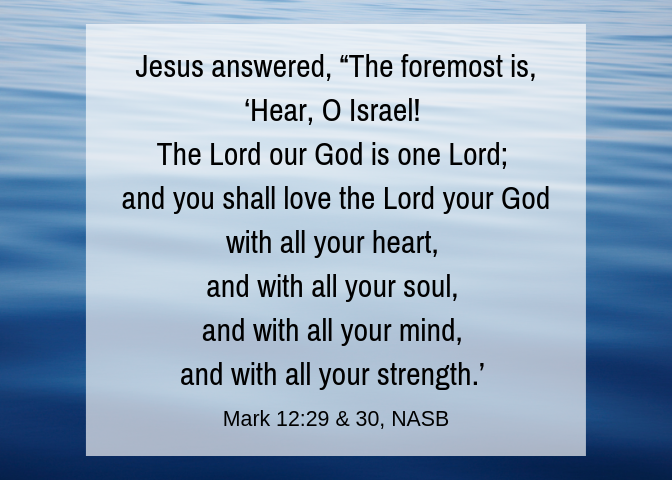
“And when one of the scribes came and heard them arguing, he recognized that He had answered them well and asked Him, “What commandment is the foremost of all?” Jesus answered, “The foremost is, ‘Hear, O Israel! The Lord our God is one Lord; and you shall love the Lord your God with all your heart, and with all your soul, and with all your mind, and with all your strength.’”— Mark 12:28-30
Jesus, who is a Jew, held to the same God as his ancestors. He said this is the most important commandment of all to love this one and only true God. This is the God of Jesus. The Trinity teaches that Jesus is God or a part of God, yet Jesus acknowledges he has a God.
“Jesus said to her, “Woman, believe Me, an hour is coming when neither in this mountain nor in Jerusalem will you worship the Father. You worship what you do not know; we worship what we know, for salvation is from the Jews. But an hour is coming, and now is, when the true worshipers will worship the Father in spirit and truth; for such people the Father seeks to be His worshipers.”— John 4:21-23
There have been claims that Jesus came to reveal and teach the God of the Trinity. That Israel did not fully understand God. But is that true? Jesus here acknowledges that the Jews knew God, and that their God was the true God. Israel did not believe in a trinity. They understood who God was because he had revealed Himself to them.
“For even if there are so-called gods whether in heaven or on earth, as indeed there are many gods and many lords, yet for us there is one God, the Father, from whom are all things and we exist for Him, and one Lord, Jesus Christ, by whom are all things, and we exist through Him.”— 1 Corinthians 8:5-6
Paul confirms his belief in one God, also called the Father. He believes in this one God and in the one Lord, Jesus. If this God of the Trinity was revealed by Jesus then why does Paul not acknowledge that? Paul acknowledges the one true God and the son that God sent, Jesus.
“There is one body and one Spirit, just as also you were called in one hope of your calling; one Lord, one faith, one baptism; one God and Father of all who is over all and through all and in all.”— Ephesians 4:4-6
There is only one faith and this faith is in this one God, the Father. There is no mention of three beings of a trinity God. Only the Father, He alone is God.
Jesus also confirms this is his God and the only true one.
“And this is eternal life, that they may know You, the only true God, and Jesus Christ whom You have sent.” — John 17:3
Jesus says our salvation is dependent on knowing the true God, and to also know His Messiah, Jesus. Jesus does not put himself as that true God, but that we have to believe in his God.
“Jesus said to her, “Stop clinging to Me, for I have not yet ascended to the Father; but go to My brothers and say to them, ‘I ascend to My Father and your Father, and My God and your God.’” — John 20:17
Our God and Father is Jesus’s God and Father. There was not a revealing of a new God or a new understanding of that God. But the same God that Abraham, Isaac, and Jacob believed in is the same God that our Lord Jesus believes in and serves.
“He who overcomes, I will make him a pillar in the sanctuary of My God, and he will never go out from it anymore. And I will write on him the name of My God, and the name of the city of My God, the new Jerusalem, which comes down out of heaven from My God, and My new name.” — Revelation 3:12
Here, Jesus is now in heaven at the right hand of God. And he still speaks of his God. Again, the teaching of the Trinity is not revealed, but only the one God, the same God of Jesus.
This is the God that Jesus pleased when he was a child
And Jesus was advancing in wisdom and stature, and in favor with God and men. — Luke 2:52
This is the God that brought about Jesus through His power upon Mary at the right time according to Gods plan.
The angel answered and said to her, “The Holy Spirit will come upon you, and the power of the Most High will overshadow you; and for that reason the holy Child shall be called the Son of God.— Luke 1:35
But when the fullness of the time came, God sent forth His Son, born of a woman, born under the Law, so that He might redeem those who were under the Law, that we might receive the adoption as sons. — Galatians 4:4-5
God brought about Jesus and it was the same God that Jesus worshipped. God did not come down or become man, He chose a man with a very special job.
“Men of Israel, listen to these words: Jesus the Nazarene, a man attested to you by God with miracles and wonders and signs which God did through Him in your midst, just as you yourselves know— this Man, delivered over by the predetermined plan and foreknowledge of God, you nailed to a cross by the hands of lawless men and put Him to death. But God raised Him up again, putting an end to the agony of death, since it was impossible for Him to be held in its power.” — Acts 2:22-24
Often it is questioned then, who is Jesus? If he is not God or a part of God, then who is he? Peter shows who he is. He is a man chosen by God. God gave great power to and a very special role to this man, Jesus. It was not God who came down to do this mission, but a man like you and me who was chosen for this mission.
“Therefore having overlooked the times of ignorance, God is now commanding men that everyone everywhere should repent, because He has fixed a day in which He will judge the world in righteousness through a Man whom He determined, having furnished proof to all by raising Him from the dead.”— Acts 17:30-31
God is using this man and showed everyone by raising him from the dead. This was not God who died, because God cannot die, or God who raised himself, but a man who was raised by God to eternal life. And it is this man who is in heaven with our God and his God.
“This is good and acceptable in the sight of God our Savior, who desires all men to be saved and to come to the full knowledge of the truth. For there is one God, and one mediator also between God and men, the man Christ Jesus, who gave Himself as a ransom for all, the witness for this proper time. For this I was appointed a preacher and an apostle (I am telling the truth, I am not lying) as a teacher of the Gentiles in faith and truth.” — 1 Timothy 2:3-7
There is only one true God. Jesus is a man who mediates between us and this one true God. Jesus could not meditate between God and men if he himself was God. He represented God to us, and represents us to God.
So what does God’s word show about Himself? Is the teaching of the trinity true?
God has revealed Himself in His word as the only true God. He has given us His name as Yahweh, the God that Abraham and all Israel believed in. The God from the beginning is the same God Jesus worships.
The god of the trinity is not revealed in scripture. The trinity is a teaching that does not hear the words of our savior Jesus who has shown the only true God. So let us all praise and worship the one true God and Father of us all, the God of our Lord Jesus Christ.
Reflection Questions
Whether you are hearing these thoughts for the first time, or you have spent your whole life believing them, or somewhere in the middle – what makes sense to you today about these verses from Scripture? What do you currently have questions about?
What do you love about Jehovah God? What does He reveal about Himself in Scripture?
What do you love about the Son of God, Jesus Christ the Messiah? What do we learn about him in Scripture?
Prayer:
My heartfelt prayer is that Jehovah God will reveal His truth to all Christians. And that all Christians will know the one God Jehovah the Heavenly Father and the Son of the Father, Jesus Christ. In the name of the Lord Jesus Christ, Amen.
Blessings, Your brother in Christ, a servant, Pastor Haroon Yaqoob Masihi
Waiting is hard. We all know this. We have all had things we’ve prayed for, waited on receiving. Patience truly is a virtue.
Waiting is scary. It’s hard to be still. We feel we should be doing something. Sadly we don’t recognize waiting on God as something worth doing. We become anxious in those still moments God is building character. We begin to question, to doubt.
The end of Psalms 27 describes waiting as brave and courageous (v. 14 NLT). Sometimes being still is the bravest thing a person can do. It takes courage to put your trust in something other than what you yourself can produce.
Throughout various points in my life, God has called me to seasons of waiting. It’s hard. I never really thought of it as courageous or brave, just something I sadly had to experience. Had someone plainly told me back then, my decision to wait on God’s revelation was an act of bravery and not defeated surrender, I might have responded to those situations with more joy and hope.
And so, I’m keeping it short and simple, today. For those of you that find themselves in a season of waiting, take heart and hope from the words of David. Your decision to wait on God and trust in His timing is brave. You are not doing nothing. You are taking a courageous step of faith. Do not let the barren wasteland of waiting rob you of the hope and joy we have in our Awesome God.
Reflection Questions:
Think back to a season of your life where you were waiting. What difference would your response have been to that time if you had been told your waiting was an act of bravery and courage? Is there someone in your life today that needs to be told this?
Are you in a season of waiting? How is waiting brave? How is it courageous?
Check out the song “Take Courage” by Kristine DiMarco. I prefer the radio version found here: https://youtu.be/Ehw0FWFGl_A How does this song relate to our topic of waiting, today?
Prayer:
Dear LORD,
It is in You that I put my hope, my trust. Let me stand firm in the security of Your word, even during the uncertain waiting periods of my life. You are the one who delivers me. You will rescue me from my deep waters. Let me be still enough to hear You. Let me be brave enough to wait for You.
In the name of the one who delivers, Your son, Jesus Christ,
The story of Palm Sunday is one of my favorites. Christ’s triumphant entry is a story about how God is greater than our expectations. The people of Jerusalem expected one thing, but God had a better plan in store.
As Jesus rode through the city, the crowds chanted “Hosanna” which means “Save us.” Right then and there, the people of Jerusalem were expecting Jesus to gloriously lead a battle to rescue them from the Romans. Except, that is not at all what Jesus or God had planned. Not long after, some of these same people shouted, “Crucify him!” Sadly, they did not see what was right in front of their noses. That Jesus was saving them. Just not in the way they had wanted or thought. They limited God. They put the Messiah in their own little box of expectations.
We are no different.
So many times do we allow our expectations to limit God. I’ve done it. I’m guilty of telling God how He can fix a problem. Throughout my young adult life, I was constantly giving God suggestions on how to give me a boyfriend. It was ridiculous, I know. The God of the Universe did not need me to offer advice on how to write my love story and thank goodness He did write it! I will be happily married six months come Friday. The man God had chosen for me was certainly worth the wait – even if it all came about in a way I wouldn’t have expected or chosen.
I’ve also found myself limiting God. In college I suffered from hip alignment issues that caused intense nerve damage. Due to this, I wasn’t able to dance like I used to do (I was trained in classical ballet for ten years). During this time, I never really relied on God for healing. Sure, I prayed about it, but I didn’t ever actually believe anything would come of it. Somewhere during the early months of my diagnosis, I had just decided that God wasn’t going to heal me. It was not that I believed he couldn’t, but rather, I thought he had bigger issues to deal with than me. I was not dying of cancer nor was I paralyzed. There were people worse off than me that needed God’s healing. I knew that wasn’t the way God operated, that He is big enough to care about all His children, but, I had allowed my bitterness to blind me of the truth. After about three years of this, a woman from church took me aside to remind me that God can heal me. I started to put in the work, got back into doing my physical therapy. I began dancing again – even if it wasn’t to the same extent as before. The following summer, I took my first dance teaching job. Since then I have worked for three different dance studios, taught countless classes, and helped produce four Nutcracker performances. I nearly lost out on the chance to do any of this because I had put God into a box. I limited His power with my own expectations.
It is amazing what can happen when we open our eyes to the vast power God has. He is an incredibly creative problem solver. Instead of having Jesus vanquish the Romans on the day of his triumphant entry, God had him enter the city on a lowly donkey. Since it wasn’t what people were expecting, they were easily led into believing that Jesus was not the promised one after all. It wasn’t what they wanted at the time they wanted it, and so, they turned away.
This week I encourage you to open your eyes, to look for the ways God is working in your life – outside the box.
Questions:
Are you limiting God?
Is there an area of your life where you’ve allowed your expectations to prevent you from seeing God’s answers?
Prayer
Dear God,
Thank you for being bigger and greater than I can imagine. Thank you for sending your son, not just to save the people of Jerusalem, but all people, including me. Open my eyes and help me see your work in my life. I don’t want to be blinded by expectations that I miss something amazing. In Jesus’ name,
One of the things taught in most of Christianity is that Jesus came into Jerusalem only one time and it was a great celebration of his kingship and carried out by all who were so glad to see him. It is commonly called “Palm Sunday”. The people calling him the “Son of David” is the same as calling him “king” by the people there. They wanted him to come to the capital there and throw out the Romans and Greeks and then set up his kingdom on earth right then and there. This record in Mark 11 is about the first day before Passover that Jesus comes into the city. I took the reading from the Revised English Bible (REV) on the Spirit and Truth’s website.
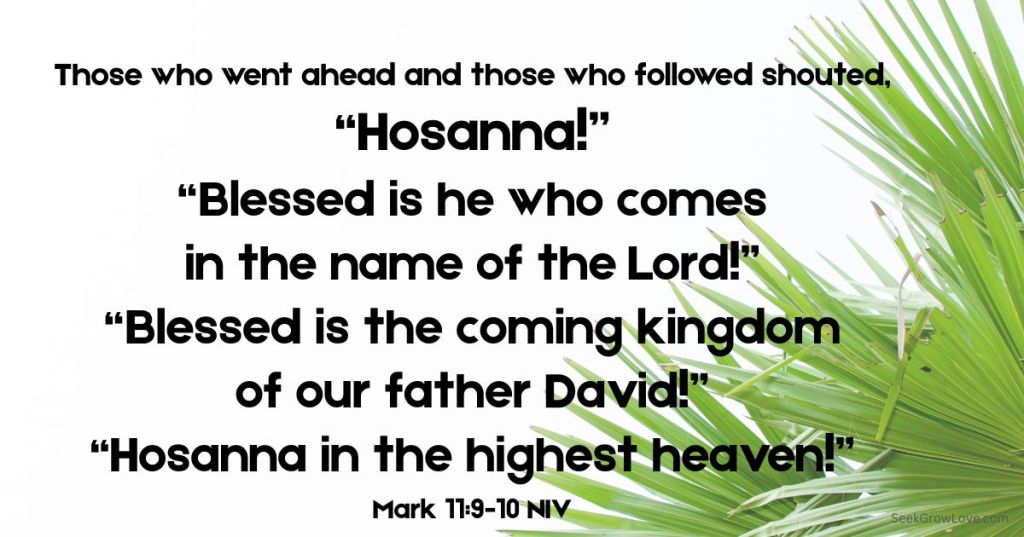
Jesus’ entrance to Jerusalem on this day is one of rejoicing and great celebrations by the people. “Hosanna” is literally “God save us”. They are saying “God save us by the one who comes in the name of Yahweh”. Heady stuff and sure to make both the secular leaders of the Jews (mostly Sadducees) and the Romans soldiers and administrators very unhappy. The Jews didn’t want to upset the cozy formula they had worked out to go along and get along. Also to keep the money train going in the Temple and with the tourists coming there. They had the money-changing tables where whatever money the people had would be exchanged for the official money to be used in the Temple, with a large profit margin going to the changers. The other commerce area set up was to sell sacrificial animals and was also in the outer court. The outer court was called the court of the Gentiles where all nations could come into the Temple area. This is why Jesus says to them that the Temple was designed to be a blessing for all nations, but you have turned it into a den of thieves.
Jesus on this entrance to Jerusalem comes into the Temple and looks around and then leaves and goes back to where he is staying in Bethany (probably at the house of Mary, Martha and Lazurus).
Mark 11:1-26 THE MINISTRY OF JESUS IN JERUSALEM (REV) The Triumphal Entry
The next day he gets up early in morning and for the second time goes on the road going to Jerusalem. On the way he sees a fig tree and because he is hungry goes to the tree expecting to find figs. The record says that when he gets to the tree it has no figs, but Mark also says curiously that the time of figs is not yet. He then curses the tree, and it dries up from the roots, also not the way that trees normally die. This is a picture of how Israel has failed in God’s purpose at this time. See this explanation from the REV commentary attached here.
(REV Commentary ) “seeing a fig tree.” The fig tree was one of the trees in the Bible that symbolized Israel. This particular fig tree was a fitting parable of Israel. It was in full leaf and looked very promising, even ahead of the rest of the trees. It should have been a source of great blessing for those who looked for early sustenance coming out of the winter months. Instead, it was a liar, promising much but delivering little, deceiving weary travelers and giving them false hope. Jesus cursed it, foreshadowing the curse and destruction that would come upon Israel.
“it was not the season for figs.”The question this verse poses to the average reader is, “Why would Jesus curse the fig tree for not having figs if it was not the season for figs?” The answer to that question lies in understanding that, although there were a couple varieties of fig trees in Israel, the common variety produces two crops of figs per year. An early fig grows on the old branch stock that grew the preceding year. This early fig often begins to grow even before there are leaves on the fig tree, although sometimes these early figs and the leaves start to grow at the same time. These early figs usually start developing in March, but may be a little earlier or later depending on the climate, and the circumstances of any given tree (Israel has many different climates, usually somewhat depending on elevation). These early figs mature in June, and the leaves grow and mature along with them. A second crop of figs starts on the new tree growth that sprouts that year, and they generally ripen in August.
Since Mark is recording events around Passover, Jesus would have approached the fig tree in April. Although it was not yet the season for figs, Jesus noticed that this particular tree was in full leaf. If the leaves were fully formed, that meant he could expect the figs of this particular tree to be early too, or at least be far enough along to be somewhat satisfying to eat. This should not surprise us. It often happens in horticulture that a plant is a few weeks earlier than the “regular season.” However, when Jesus got to the tree, the situation was not just that the figs it had were not yet ripe, it did not have any figs at all!
Jesus then cursed this tree and it died overnight. Jesus would ordinarily never curse a tree of any kind for not having fruit or buds. Often, trees go through hardships that keep them from bearing fruit in a given year. Jesus said he did what he heard from his Father, God, and this is an example of that. God gave Jesus the revelation to curse the tree, so Jesus cursed it and it died overnight, which was a miracle. Thus, this tree became a twofold teaching example: it showed that Israel was going to be cursed (which it was for rejecting its Messiah), and it also taught the apostles that when God gave you revelation, no matter how unlikely it seemed, if you trust God and believe and act on what He says, the revelation will come to pass (this is the manifestation of trust, 1 Cor. 12:9). (REV Commentary on Mark 11)
The withering of the fig tree is a symbol of the judgement of Israel and its leadership. The fig tree and olive tree are used in scripture as symbols of the nation of Israel in several places.
What a lesson in believing and faith for us to learn. We need to have “faith” which is our believing in accord with the Word and Will of God. When we confess the Word, believe it and act on it God is able to help us accomplish His purposes in life. What are the important elements of miraculous deliverance and help? We see here God’s will for us to operate as His agents here in the world today. Don’t discount His help and direction that He willingly gives us when we ask by faint heart or disbelief in spiritual help. Have a great day today in Christ.
QUESTIONS:
What do you learn about Jesus in Mark 11?
What does your faith look like today? What have you seen that has increased your faith? What have you heard that has increased your faith?
Where would you like to have more faith?
Prayer:
Father, we look to you today to give us understanding and wisdom in Your Word and intentions. We thank you for being part of the “God Story” you have made each of us. Give us today the bread we need daily and help us in our times of need. Heal our minds, hearts, and bodies in accordance with Your will. We thank you for the sacrifice of Christ that gives us life today and in the future. We pray in the Name above all Names, Jesus Christ.






 Seek Grow Love