Gotcha!

Joshua 9-11

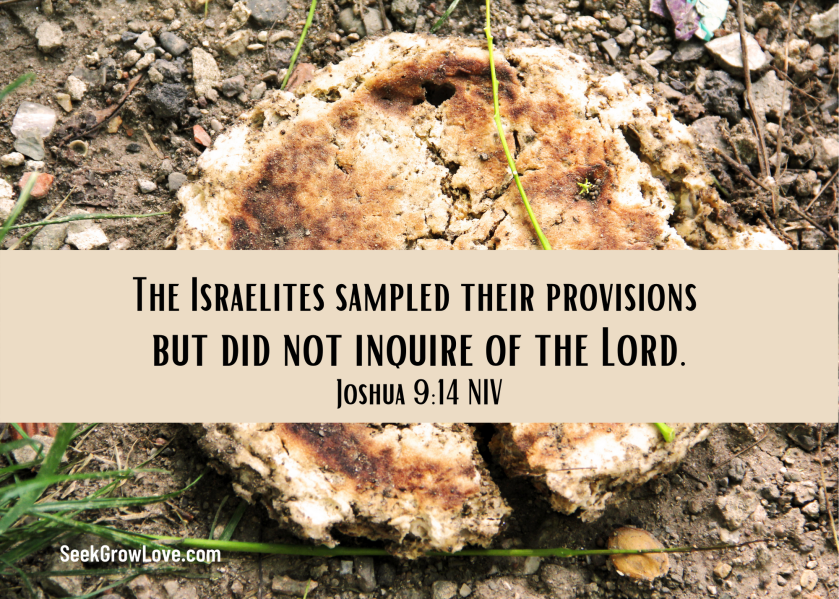
When the inhabitants of Gibeon heard what Joshua had done to Jericho and Ai, they acted deceptively. They gathered provisions and took worn-out sacks on their donkeys and old wineskins, cracked and mended. They wore old, patched sandals on their feet and threadbare clothing on their bodies. Their entire provision of bread was dry and crumbly. They went to Joshua in the camp at Gilgal and said to him and the men of Israel, “We have come from a distant land. Please make a treaty with us… Then the men of Israel took some of their provisions, but did not seek the LORD’s decision. 15 So Joshua established peace with them and made a treaty to let them live, and the leaders of the community swore an oath to them. Joshua 9:3-6;14-15  (CSB)

“Be skeptical of everyone, including the skeptics”. I don’t know where this quote or phrase came from, but I often find myself in that mindset. Why? Because of stories like this. There are those out there who would try to deceive and use this deception to take advantage of others. I used to get calls and emails all the time at the church from people who were looking for money to help with something. There was always a story about why they were in this tough situation. The second half of that quote also resonates because sometimes people just like the status quo or throw cold water on other people’s ideas.

Maybe some of those people were deceptive, and maybe some of them were genuine. I don’t know. What I do know is that there were occasions where I would try to give something, but there were times that I did not. I did my best to discern who was authentic, but I couldn’t really know. What I could do was pray about it and see if God gave me a push in one direction or another, but if he didn’t, I’d need to make a choice. In situations of meeting needs or requests, you can’t help everyone, we have finite resources. I do think it is important not to be dismissive of every request because there are people who genuinely have needs and come to churches as a last resort.

When the Gibeonites came to Joshua and the men of Israel, they did their best to pull one over them, and it worked. The leadership did appear to be skeptical and questioned the Gibeonites, but they neglected to check with something powerful that they had at their disposal: access to Almighty God! Rather than checking on what God wanted them to do, to seek wisdom in this situation that some of them even thought might be a little fishy, they made a knee-jerk decision and swore a treaty to do no harm.

Don’t you think that it would have been wise to consult God when there were treacherous peoples all about the land? The Gibeonites got their protection, but they found themselves indentured to the Israelites because of their shenanigans. I guess that beats death? Some might disagree.

When faced with big decisions, we should come before God and seek wisdom. Especially when we are the leaders of his institutions. Whether leading the Israelites four millennia ago or leading in Christ’s Church today, when we face big decisions (skeptical about what is going on or not), we must always ask what God would have us do. We have scripture to guide us, as well as the Spirit of God that will guide us when we are earnestly seeking after him. When we see leaders fall or make ruinous decisions, we can probably rest assured knowing that they did not honestly seek God’s will and input for that decision. Unless God is intent on making a statement with you like he did with Hosea, he is not going to tell you to make decisions that would be considered dubious by wise observers.

-JJ Fletcher

Reflection Questions

  1. Can you think of a time that not seeking God’s decision burned you? How did you respond or recover after?
  2. Do you find yourself to have a healthy level of skepticism, or do you often find yourself being a bit too Pollyannish? Is there value in both? What are some of the drawbacks of each of these traits?
  3. Do you think Joshua and the leaders learned something from this experience?
  4. How do you think it best to navigate people who are too extreme on the scale of being too trusting or distrusting? What can we do to be a good emissary of Jesus in those situations?

Burned by Sin

Joshua 5-8

But the Israelites broke faith in regard to the devoted things: Achan son of Carmi son of Zabdi son of Zerah, of the tribe of Judah, took some of the devoted things; and the anger of the LORD burned against the Israelites. Joshua 7:1 (NRSV)

As God promised, He led the Israelites to victory over Jericho. It is to be ransacked and destroyed, and there are to be none left alive, aside from Rahab and her family. There were specific items (gold, silver, etc.) that were taken from the rubble that were to be set aside and placed in the treasury of the house of the Lord.

After this great blessing of victory, one would assume that everyone would honor the directives of God and be obedient to him, but alas, we’ve been here before. Despite God proving himself time and time again to be a God of his word, both in blessing and in punishment, this knucklehead named Achan decides to take a heap of these goods for himself, and he buries them underneath his tent.

The stuff is hidden, there was so much of it, no one is going to know. The only one that this affects is him, and he’s going to keep it a secret. Maybe, eventually, it will just seem like this is some of the swag that was received from the Egyptians as they sent their ancestors out of Egypt. I don’t know what exactly was going through Achan’s mind, but I’m sure we’ve all been there, deceiving ourselves, justifying the stupid decisions that we have made to disobey or to take something that we have no business possessing.

As I sit here, I am reminded of an instance where one of my brothers took something that did not belong to him. This would have been sometime in the mid to late 90s and I’m a little fuzzy on some of the peripheral details. But we get home after a trip to the grocery store (Bohning’s in Ponchatoula, LA, I believe), and we discover that my brother has in his possession a whistle pop. After further investigation, it is discovered that he has many of them; in fact, he has a FULL BOX of whistle pops. At some point while we were standing in the check-out line, he grabbed the box off the candy shelf and shoved it under his shirt or down his pants. Now, I’m assuming that my mom took him back to Bohning’s to return it, as had happened when other contraband candy items had “shown up” in our house.

Now, a 5-year-old is not going to get arrested for petty theft and is probably going to get some sort of punishment for their misbehavior, but that action did not just affect him. There is embarrassment when a parent brings their child in to cop to a misdeed, apologize, and return the uneaten contraband. The stakes are low in this situation, but the principle is there: sin and error do not just affect the perpetrator.

Israel is feeling a kind of high as their God has just handed their enemies to them, and they are going to press forward into the land. They go make military advances on Ai, but they are driven back; they do not experience deliverance against their enemies; they are driven back and several dozen of their comrades fall to the enemy.

How? Why? Why would God deliver them a fortress and then allow them to fall to a less powerful fortification?

Because sin doesn’t happen in a vacuum. Sin affects everything. You don’t have to sin against someone for them to be affected; there are plenty of indirect effects of sin. We don’t have to go into a laundry list of sins, but different sins can cause us to behave and think in certain ways that harm others. Sin can lead to anger. Sin can lead to spousal abuse or neglect. Sin can lead to broken relationships. Sin can lead to more and more sins being perpetrated. Sin can break hearts. Sin can put a wedge between a person and God, and I’m not talking about the person that sinned.

Achan’s sin caused God to be furious, and he withheld his blessing and protection from Israel. Achan’s misappropriation of riches, which had nothing to do with the battle against the people at Ai, led to the loss of a battle. The sin affected all of Israel. In this case, Achan lost his life because of his sin.

So, if there is unrepentant sin in our homes, in our churches, in our relationships, and our individual hiding places, we can expect that it is going to affect others in one way or another. Sin cannot be reconciled with good. Jesus died to free you from sin, not to free you to sin. Yes, sin is crouching at our door; your enemy, the devil, is on the prowl like a lion to devour you with temptation that leads to sin (1 Peter 5:8). But when we sin, we are not to try to justify it or explain it away. I’ve cited it already this week, but here it is again:

“If we confess our sins, he is faithful and just and will forgive us our sins and purify us from all unrighteousness” 1 John 1:9 (NIV)

Achan confessed his sin, but the damage had been done. He waited till he had been found out and others had suffered extreme loss due to his actions.

When we fall short, it is best to confess quickly before it becomes a bigger mess in our lives and the lives of those we love (or don’t even know).

-JJ Fletcher

Reflection Questions:

  1. Why is it so easy to overlook God’s commands?
  2. Is it difficult to read about the punishment for sin that is described in scripture? Does it lead you to a greater appreciation for the New Covenant in Christ’s blood?
  3. What thoughts did you have on Achan’s sin as you read through today’s reading in Joshua 5-8?
  4. Why is it easy to be blind to the way that our sin affects others?

Messy Parts

Joshua 1-4

Then Joshua son of Nun sent two men secretly from Shittim as spies, saying, “Go, view the land, especially Jericho.” So they went, and entered the house of a prostitute whose name was Rahab, and spent the night there. Joshua 2:1 (NRSV)

Context is important. Out of context, this verse might convey something completely different from the story that follows. In the same way, when we hear an unsavory detail about an individual, it could easily prejudice our opinion of them. Everyone has messy parts of their lives, but those messy parts don’t tell the whole story.

Descriptors carry weight. Rahab the prostitute… If, in casual conversation, you hear that about someone, what do you think? The modern vernacular is “sex worker” trying to clean up a description about someone who works in a profession that is not lacking in crude descriptors. We won’t go there. You probably don’t think the best of that individual. You ask what happened that they went down that path in their life? So many questions… or maybe none. We write them off as someone who is living outside of God’s will and God’s grace.

The spies are commissioned to go and get a close-up of what Jericho is about. Boots on the ground in an espionage mission to help determine what will need to happen to eliminate a fortress city that is currently situated in the land that has been promised to God’s people.  

The spies get there, they meet a prostitute, and they go lay low in her house. Probably not who they expected to find as a sympathizer. Rahab is knowledgeable about the God of Israel. She offers and provides help to these spies and ensures they remain hidden from the Canaanites, who are wary and fearful of the impending insurgence of Israelites into “their land”.

But a prostitute…

Everyone does not get to choose their lot in life. Millions of people are trafficked or remain in a human sex trafficking situation at any given time. These people do not enter this willingly, it is essentially slavery.

Rahab. A prostitute. By choice? We don’t get much clarity here, but Rahab was likely forced into this situation where she engaged in prostitution. Slavery of this kind would not have been uncommon. Perhaps she was widowed or divorced and had no other recourse? Again, we don’t know. What we do know is that this unlikely ally to the people of Israel changed the course of history. While her profession was unsavory, her heart was made of gold. She had respect for Yahweh, the God of the Israelites, and she was willing to help Israel for a guarantee of safety and liberation. Seems legit. It’s a bad situation Rahab has found herself in, but she has heard of the power of God and wants to be a part of the community that is protected by the almighty God.

The spies promise her safety if she protects them, and they uphold their end of the bargain after she keeps them safe (Josh 6:22).  When Jericho is destroyed, Rahab and her household are spared.

James 2:23-26 says, “And the scripture was fulfilled that says, “Abraham believed God, and it was credited to him as righteousness,” and he was called God’s friend. You see that a person is considered righteous by what they do and not by faith alone. In the same way, was not even Rahab the prostitute considered righteous for what she did when she gave lodging to the spies and sent them off in a different direction? As the body without the spirit is dead, so faith without deeds is dead” (NIV).

Describing Rahab as a prostitute, something that she did in Jericho, does not do her justice. We are, after all, talking about King David’s great-great-great grandmother. She is not just a footnote in history; she is in the genealogy of the savior of the world (Matthew 1:5)! Rahab is, in her actions, a savior for the Israelites, especially the two spies who trusted her, and is an ancestor to Jesus, the most consequential figure in human history. The Son of Man, the Son of God, the anointed king of the coming Kingdom of God.

When I think about Rahab, I think about a talk that Tony Campolo gave about throwing a birthday party for a prostitute at 3 AM. You can watch it here: https://www.youtube.com/watch?v=kWlMV-UmueM&ab_channel=EvanCourtney

Don’t write people off. They may be far from God or living in situations that, for lack of a better descriptor, we would call complex. No one is beyond redemption, and we should strive to extend grace and try to bring the joy that we find in Christ into the lives of everyone we meet, whether they be a pastor, an executive, that elderly woman who sits three rows in front of you every week at church, or the prostitute you bump into at a diner at 3 AM when you are adjusting to being many time zones away from home.

-JJ Fletcher

Reflection Questions:

  1. Why is it so easy to dismiss “unsavory” people?
  2. Do you have “unsavory” parts to your life that you don’t want anyone to know about? What if people knew? How would they treat you? Is there a way you can use the messy parts of your story to help someone else?
  3. What can we glean from the role of Rahab in the victory of the Israelites over Jericho? What can we glean from how the spies treated and trusted her?
  4. Sin is sin. Why does sexual sin have a different gravitas than most other sins?

Power in Song

Deuteronomy 32-34 & Psalm 91

When Moses had finished reciting all these words to all Israel, he said to them: “Take to heart all the words that I am giving in witness against you today; give them as a command to your children, so that they may diligently observe all the words of this law”. Deuteronomy 32:45-46 (NRSV)

I’m a music lover.  My memory of “contemporary” music goes back about 30 years. 1995-1996 is when I first remember getting into music on the radio. It’s not just the music of my era… I grew up listening to the classic rock format as well as ‘90s rock and pop. If I were to anonymously give you a top 20 list of my favorite albums or songs (which I’d probably never be able to narrow down), you might be left scratching your head, wondering who this person is and when they were born. Powerful is the art of song and music. I love music for the notation, the way that notes and chords are put together to create melody and harmony, even dissonance, but also for the lyrics… The way that someone can convey emotion or conviction in a way that hits hard, that makes you think and feel.

Great songs come in many forms. There is much to be gleaned from a simple lyric – Jesus loves me, this I know, for the Bible tells me so; and there is much to contemplate from an imaginative and thoughtfully written gem that paints an image in the mind: “Could we with ink the ocean fill, and were the skies of parchment made; were every stalk on earth a quill, and everyone a scribe by trade; to write the love of God above would drain the ocean dry; nor could the scroll contain the whole, though stretched from sky to sky”.

The Beatles were a smash with their early simplistic songs, but also with more thought-provoking tunes toward the end of their run. Leonard Cohen’s “Hallelujah” (Jeff Buckley did it better) is one of the most gut-wrenching (in a good way) songs that I can think of. It carries the listener through peaks and valleys of emotion as it describes tensions in the human experience of love. Perhaps I have digressed too much, but I can get distracted when I get into the minutiae of music.

In Deuteronomy 32, we have recorded a song that Moses recited to the Israelites shortly before he went up to Mount Nebo to get a distant view of the promised land and then die. In this song, we see a variety of things addressed. Moses glorifies Yahweh, his God, but takes the people on a journey to envision their future failure and rejection of God’s ways that they are on a path toward. Challenges, encouragement, and perspective.

While Moses covers some pretty negative territory regarding the Israelites in his words, he also gives assurance that Yahweh is a God of mercy and redemption and that his people will be cleansed. Despite impending failure, there is forgiveness and mercy on the docket, and there will ultimately be protection for the people of God against their adversaries.

I find it a little curious that Moses addresses the people in song, diverging from the status quo of God’s revelation to his people up to this point, but song can be a powerful way to commit things to memory. In contrast to the ten commandments and the subsequent revelation of the full law, this presentation perhaps was remembered and recited in a way that was engaging and complementary. 

-JJ Fletcher

Reflection Questions:

  1. How has music impacted your relationship with God and Jesus?
  2. Do you find it easier to remember lyrics and scripture put to song than simply memorizing bible verses?
  3. How do we balance the desire that we might have for catchy and relatable tunes with the directive to glorify and worship God with music?
  4. What impact do you think Moses’s addressing the people in this manner had on them? (might be helpful to look back at Deuteronomy 31:19-22)

Succession Plans

Deuteronomy 30-31

Then Moses called Joshua, and said to him in the sight of all Israel, “Be strong and courageous; for you will go with this people into the land that Yahweh has sworn to their fathers to give to them, and you will cause them to inherit it. Yahweh, it is he who goes before you; he will be with you, he will not leave you or forsake you. Do not be afraid, and do not be dismayed.” Deuteronomy 31:7-8 (REV)

In Deuteronomy 31, Moses begins to reflect on the fact that his life is about to come to an end and he will not be leading the Israelites into the promised land. We see Joshua enshrined as Moses’s successor, as God directed Moses (Numbers 27).

Succession plans are important as leadership changes are critical junctures for organizations. When a known change is coming, it is easier to start laying the groundwork for succession, but that can be short-sighted. There is wisdom in succession plans that consider the unknown. No one knows how many days they have left to live in this age. Illness can come on suddenly, and tragic accidents happen frequently. By the grace of God, you reader, will live many more years to serve God faithfully, but what if the unthinkable happens? Have you ordered your house? Have you, in your role as pastor, leader, director, or church volunteer, poured into those around you and prepared individuals to do the necessary ministry of the church if, for some reason, you must vacate your position, voluntary or otherwise?

In my first year at Atlanta Bible College, I took the course Principles of Ministry and Leadership (I think that was the correct class name) with Professor Jon Cheatwood. One of the books that we used was the 21 Irrefutable Laws of Leadership by John Maxwell. While I have not touched that book in nearly twenty years, I remember clearly one of the concepts in the book: Leaders should be training their replacements, figuratively working themselves out of the job. You should ensure that those under you or around you can take over the tasks and responsibilities you are responsible for. This is not to create job insecurity but to ensure stability for an organization or ministry if unexpected departures happen.

Just as Moses was chosen by God to lead his people out of Egypt, Joshua was chosen to lead them into the promised land. Moses publicly enshrines Joshua as leader, making clear the succession plan and avoiding a power vacuum with multiple individuals striving for the top spot or fearful individuals that pick up camp and head back to Egypt.

Several years ago, there was a TV show called Succession that was loosely based on real events from a power struggle within a powerful business. I am not recommending the show, but it showcases the chaos that surrounds an organization that does not have clear protocols and succession plans in place.

About 10 years ago, my church was thrust into unexpected changes in pastoral leadership. While not without bumps in the road, the leadership of the church was equipped enough to manage a very difficult period. Clearer succession plans certainly could have made some things easier and maybe would have created some different dynamics in leadership structures than what was implemented during the transition. While you may not be able to perfectly clone yourself as a leader (and you probably shouldn’t), you can pour into the next wave or generation of leaders and begin preparing them for the joys and difficulties of ministry and leadership. Whether you are a senior pastor, a volunteer coordinator, or somewhere else on the spectrum of ministry roles, we should always be working to ensure that the ministry of the Gospel is primed to continue in our organizations, with or without us.

-JJ Fletcher

Reflection Questions

  1. Have you ever experienced a sudden change in leadership? Either as a member of leadership or someone that looked to leadership, what were some of the takeaways that you had from that experience? What could have been better in that situation?
  2. How important do you think it was that Moses made a public showing of the transition of leadership from himself to Joshua?
  3. What are some of the pitfalls of tight-fisted leadership that does not allow for the incremental growth and training of future leaders?
  4. Does God choose leaders now like he did in the times of Moses and Joshua? What does leadership selection look like now?

Carrot and Stick

Deuteronomy 28-29

“And if you faithfully obey the voice of the LORD your God, being careful to do all his commandments that I command you today, the LORD your God will set you high above all the nations of the earth… But if you will not obey the voice of the LORD your God or be careful to do all his commandments and his statutes that I command you today, then all these curses shall come upon you and overtake you. Deuteronomy 28:1;15 (ESV)

Motivating my four children, ages 4 to 12, requires different strategies. My 12-year-old is motivated by rewards, i.e., if you do all your chores and then some extra work, you can have an extra 30 minutes playing the Switch. Consequences, however, don’t seem to faze her quite as much. The other 3 children are less cut and dry and require a more measured approach with rewards and consequences; however, one great challenge is follow-through. As busy parents with hundreds of things to do each day and limited energy reserves, it can be difficult to be consistent and follow through on our threats and promises.

God is not inconsistent. God is merciful, but he follows through on his promises. In Deuteronomy 28:1, he promises a blessing in return for obedience, but in Deuteronomy 28:15, he promises punishment for disobedience. It’s the same as a carrot and stick. Something tasty to motivate or something that brings pain to correct course. We see through Israel’s history that even though God followed through on his promises of blessing, he still had to break out the stick to use on a hard-headed people.

Over the past couple of weeks, I have been preaching from Romans 7-8. In Romans 7, Paul writes about not understanding his actions. Paul knows what is right, he knows what God desires of him, and he wants to be obedient, but there’s a problem. Despite the faith in and knowledge of God’s ways, Paul succumbs to human desire and does the things he does not want to do, i.e., the things of the flesh. Can you believe it? Paul, the apostle, was a “slave” to sin in the flesh! Is that hard to believe? Paul is human like us, and despite what we know is right, we often don’t do the right thing. Why, why, why? Because sin is ingrained in the flesh.

There are debates on something called original sin, which is not something we’ll get into here, but it is clear we learn how to sin from an early age. We are naturally selfish as children; we need to be self-focused to survive, but as we mature, we should become less self-focused and more focused on the big picture. In the Christian view, we should be imitating Jesus, who humbled himself (Philippians 2). Jesus was a model of selflessness and submission to God’s will. Jesus did not want to die, yet he was obedient to the point of death so that many could be ransomed from the death that comes from sin; he saw the big picture. Though we can see the big picture, we often fall short of the kind of selflessness that Jesus modeled.

Unlike the Israelites under the old covenant, we have Jesus in clear view. We are not holding out hope for a future savior but rather holding onto the promise that the blood of Jesus has covered our sins past, present, and future. While we are called to obedience, God does not hold our salvation in limbo every time we mess up. We are faced with the present consequences of our mishaps with sin, but we have constant forgiveness through the blood of Christ Jesus. If we confess our sins, he is faithful and just and will forgive us our sins and purify us from all unrighteousness” 1 John 1:9 (NIV). We don’t have to go through the carrot and stick metaphor as partakers of the New Covenant in Christ’s blood. We must strive to be obedient, but fess up when we miss the mark, and move forward in each new day as we are redeemed by the blood of the lamb.

-J.J. Fletcher

Reflection Questions:

  1. Why do you think it is so hard to balance the desires of the flesh with the knowledge of the living God and some pretty clear instructions on his will for us?
  2. Is it easy to become discouraged when we fall short? What are some obstacles to confidence in our faith walk?
  3. Does a tendency toward legalism sometimes impede our ability to deal with flaws in ourselves and others?
  4. Is there a place for carrot-and-stick dynamics in church life and discipline?
  5. What would Paul think about the way that some modern churches deal with reconciling the desires of the flesh with faithfulness to the gospel?

A First Fruit Sacrifice

Deuteronomy 24-27

And behold, now I bring the first of the fruit of the ground, which you, O LORD, have given me.’ And you shall set it down before the LORD your God and worship before the LORD your God. Deuteronomy 26:10 (ESV)

It is Sunday morning. What are you going to do this morning (or, depending on when you read this, what did you do this morning)? It is the first day of the week; did you spend it on yourself, or did you give some of your time in worship of Yahweh our God and in remembrance of his son, Jesus, our savior? Most of those reading this likely attended a local church this morning, but some of you may have needed to work, or perhaps there was another reason for not being in church today.

Why am I asking these questions? Deuteronomy 26 speaks of the act of giving the first fruits of the harvest as an offering to God. Looking forward to the entrance into the land of milk and honey, the promised land, the Israelites are instructed to take a portion of their first fruits and bring it to the priest to set before the altar. Taking a portion of what God has blessed them with and giving it back as a sacrifice or offering. Things are different now. We are not under the ceremonial law, but are we exempt from sacrifices?

Through him then, let us offer up a sacrifice of praise to God continually, that is, the fruit of lips that make confession to his name. Do not neglect to do good and to share what you have, for such sacrifices are pleasing to God. Hebrews 13:15-16 (REV)

Worship is something God desires of us, and while it is not for us, it does us good, for it puts God into our focus and puts him in his exalted place. Jesus told his disciples to break bread and partake of the cup whenever they got together “in remembrance of me”. We need to remember Jesus’ sacrifice as we try to live sacrificial lives.

Gathering for worship and fellowship is important, but it is a sacrifice. Many people don’t work on Sunday, a day to sleep in and relax! We may see the value of setting this time aside for worship, but sometimes we may struggle with it. Churches are filled with imperfect people (sorry if this comes as a surprise to you), and sometimes those people are a source of pain in our lives. We hurt one another and sometimes struggle to confess our sins against one another, and sometimes we fail to forgive those who sin against us (that seems backwards from how Jesus instructed us to pray). Maybe we see this sacrifice of our time as a duty, and we lose some of the wonder that we experienced toward Christ’s church.

There can be reconciliation through our sacrifices of praise and obedience, just as Christ’s sacrifice reconciles us to God, as we spend time in community and in fellowship through the spirit of God, we should be transformed to be like Jesus, who was able to forgive the betrayal and brutality that was directed to him. Jesus had to slog through difficulties and disappointments like we do; he had his times of questioning, and maybe he even struggled at seeing the wonder of it all at times. Through obedience, sacrifice, and confession, we can be conformed to his image of Jesus and also glorify God as we recognize him as our provider and source of our hope.

-J.J. Fletcher

Reflection Questions:

  1. What do we have for first fruits that can be brought before God?
  2. I see time as being our most valuable resource. When we give time to God, what does this do to and for us?
  3. Do you give money to your church or other ministries? How does financial offering correlate to first fruits?
  4. When you give the first fruits of your day or week to God in devotion or worship, does it differ from giving him whatever you have left at the end of a long day or week?

True Holiness

Deuteronomy 21-23

When reading chapters such as the ones we read today, I find it’s sometimes easy to just glide through these laws that initially seem irrelevant to us today. Within these ancient statutes, however, two timeless themes particularly stood out to me: God’s call for His people to be set apart in holiness, and His heart for the most vulnerable in society.

1. A Call to Holiness

As we’ve read previously, God set Israel apart from the surrounding nations to be a people that reflected His righteousness. These laws we observed today emphasize moral purity, integrity, and responsibility within the community. For example, laws regarding sexual immorality (Deut. 22:13-30) were meant to protect family structures and promote faithfulness. 

While we no longer live under these specific laws, the principle of holiness remains. Something beautiful happens in the New Testament—though it caused an outrage at the time. Jesus shifted the focus from outward regulations to inward transformation. 

Blessed are the pure in heart, for they will see God. – Matthew 5:8

Holiness today, while still requiring abiding by a list of rules (the handy little updated one provided by Jesus), is ultimately about living in a way that honors God, demonstrating His love and goodness in our daily actions. Even though we don’t face the consequence of being stoned to death if we fall into temptation, these passages point out just how important it is in the eyes of God that we choose to walk in His light. 

2. Justice and Care for the Vulnerable

These chapters also reveal our Father’s deep concern for justice and protection of the weak; many of the laws were designed to guard against exploitation:

  • Captive women were given dignity and rights, rather than being killed or treated as property, as they would if their home had been conquered by other nations at the time (Deut. 21:10-14).
  • Neighbors were expected to care for one another—returning lost property and offering help when needed (Deut. 22:1-4).
  • Fair treatment of runaway slaves—they were not to return an escaped slave to their master but to let them settle freely in their land. (Deuteronomy 23:15-16)

We see Jesus continue this mission throughout his ministry on earth, declaring, “The Spirit of the Lord is on me, because he has anointed me to proclaim good news to the poor… to set the oppressed free” (Luke 4:18-19). He demonstrated through both his life and death that true holiness heeds more than personal purity, but also constantly considers how best we can treat those around us, especially those in need.  

-Isabella Osborn

Reflection Questions:

  • How do we maintain spiritual purity in a world full of distractions? What are some ways you can guard your heart, mind, and actions?
  • Even though we are no longer called to live according to the Old Law, we still are called to holiness in the New Testament. What are some of Jesus’ commandments that you find it difficult to abide by?
  • What are some practical ways we can reflect God’s heart for the weak and vulnerable in our modern world?

A Just God. A Merciful God.

Deuteronomy 17-20

Your eye shall not pity. It shall be life for life, eye for eye, tooth for tooth, hand for hand, foot for foot. – Deut 19:21

We serve a just God. Since the very beginning, He has worked to keep His justice system in place, while still pouring out His love and upholding His commitment to bring humanity back to Him. In Genesis, it was impossible for Adam and Eve to remain in the good and perfect world that God created for them, for they were no longer good and perfect. They were tainted with sin and death. But it broke His heart to lose His children, so He made a way for them to live out full and meaningful lives, and to someday be eternally reunited with Him in a renewed good and perfect world. 

When Abraham’s descendants were established into the nation of Israel, they found themselves tugged toward sin and disorder, godlessness and false-god worship. And so God gave them a nice set of very thorough, very just laws, such as the ones we read about today. Israel served a God of order and righteousness, and was to be a nation of order and righteousness—a beacon among the lawlessness that surrounded them. Some of the laws found within these chapters seem harsh to us today, but this was before Jesus was sent to justify us freely. There had to be a system in place to bring God’s people back to Him when chaos ensued, and to discourage such chaos from coming about in the first place.

The Rock, His work is perfect, for all His ways are justice. A God of faithfulness and without iniquity, just and upright is He. – Deut 32:4

Fortunately, our God of justice and order is also a God of love and mercy. By making His Son Jesus our sacrificial lamb, we are saved. We need not impose justice upon our neighbor by repaying an eye for an eye, a tooth for a tooth, a hand for a hand, or a foot for a foot. We, the guilty, have been justified—our debt paid. Jesus, the innocent, took our full punishment. He is our city of refuge, where even the most stained by sin can find rest and grace. 

In Jesus, justice and mercy collide. The weight of the law, which once demanded life for life, was satisfied on the cross. Because of his sacrifice, we no longer stand condemned, but redeemed. Let us walk in the freedom he purchased for us, extending to others the same mercy we have received, and living as a reflection of God’s righteousness in a chaotic world.

-Isabella Osborn

Reflection Questions:

  1. God’s justice required that sin be dealt with, yet His love moved Him to make a way for redemption. How does understanding both His justice and mercy deepen your relationship with Him?
  2. In what ways can you extend the same grace and forgiveness to others that God has given to you?
  3. Israel was called to be a nation of righteousness and order, standing apart from the lawlessness around them. How can you live as a reflection of God’s righteousness in a world that often rejects His order and truth?

Remember His Faithfulness

Deuteronomy 14-16

Celebrate the Festival of Tabernacles for seven days after you have gathered the produce of your threshing floor and your winepress. Be joyful at your festival—you, your sons and daughters, your male and female servants, and the Levites, the foreigners, the fatherless and the widows who live in your towns.” – Deuteronomy 16:13-14

Today we read God’s commands to begin observing three major feasts: Passover, the Feast of Weeks, and the Feast of Tabernacles. Each of these festivals was meant to be an intentional time set aside for remembrance (a recurring theme in Deuteronomy). The Israelites had witnessed God’s power and provision in so many ways… like so many. They were delivered from Egypt, provided for in the wilderness, and were finally being brought into the Promised Land—all of which included various miracles and supernatural occurrences. These celebrations were more than legalistic rituals—they were acts of worship and gratitude intended to continually remind God’s children of His unending goodness.

While most Christians today don’t keep these feasts in their traditional form, their purpose no doubt remains deeply relevant. We are still called to remember God’s goodness, rejoice in His provision, and keep His Kingdom promise forefront in our minds. Jesus, our Passover Lamb, has secured our ultimate deliverance, and we live in the hope of the final harvest when God will gather His people into His eternal presence. Not only must we live in hope, but in daily remembrance. Our hope is not a baseless one. We have a book full of stories and people and places that display our Father’s faithfulness. We live in a world uniquely and precisely designed for human life in ways that defy mere chance. We see glimpses of the Kingdom in small moments every day. These are the things that we must recognize and reflect upon on a daily basis. 

Whether through communion, worship, prayer, or perhaps even partaking in some feasts or holidays, we are called to consistantly honor the God who has redeemed us, sustains us, and promises us a future. I pray today that we cultivate hearts of gratitude and remembrance, celebrating our Father’s steadfast love and infinite goodness in every season of our lives. 

-Isabella Osborn

Reflection Questions:

  1. God established specific times for Israel to remember His faithfulness. How can setting aside time for remembrance strengthen our faith? How might neglecting remembrance weaken faith?
  2. How can you intentionally set aside time to remember and celebrate God’s goodness?
  3. What are some specific ways God has delivered you in your life? Have you taken time to truly reflect on and thank Him for those moments?