
It was All Oppressive UNTIL…

Old Testament: Amos 3 & 4

Poetry: Psalm 73

New Testament: Luke 13:1-9

(Originally posted, April 25, 2020 when we were doing a chronological Bible reading plan so the reading for the day was 3 psalms, including Psalm 73, and the previous day we had read from 1 Chronicles.)

Yesterday we read the short short story (2 verses) of Jabez (1 Chronicles 4:9, 10).  He prayed.  God granted his request.  Remember, we don’t know the timeline for the life of Jabez.  Since he had requested from God the expansion of his territory (amongst other things) I feel it is most likely that this answer didn’t come with a snap of the fingers  -though God can certainly work that way when He wants to. I wonder if this answer was achieved over a period of time, with some persistence and wisdom and work required from Jabez.  But still – it sounds so simple and sweet. A fairy-tale ending in just two verses. Jabez prayed.  God granted his request.

But, what about the times when the answer isn’t coming.  We may be praying hard – with a good measure of persistence, wisdom and work, too.  But, it’s just not coming together like we thought a good God would do.

I think of Job and the 41 long, difficult, trying chapters of his story – before the final 42nd chapter when we see God finally shower Job once again with double the blessings.  It would be great to read the book of Job today to remember Job’s anguish – and God’s answer.  Or, you can read Psalm 73 – it is like a mini book of Job boiled down into one powerful psalm.

The author of this psalm begins by acknowledging that he knows God is good.  And, yet, he personally had nearly lost his way and his faith because of his own serious struggles while simultaneously watching the wicked prosper.  He saw boastful, callous, violent, evil men succeeding and growing in popularity and wealth, all while denying and even mocking God.  Are we sure this wasn’t written in 2020 (or 2024)?  Haven’t we seen and heard the same things this week and shook our heads and asked, “Where is God?  This isn’t right or just or fair?  The world is too messed up!”  And we sink down deeper in our despair.   As the psalmist said, “When I tried to understand all this, it was oppressive to me…” (Psalm 73:16)

UNTIL…

Yes – keep reading!  The good stuff is coming – just like it came for Jabez and Job and the psalmist,  it is coming for you and for me.  Though it does require a little bit of action on our part.  The psalmist reveals the secret.  He wrote, he was oppressed UNTIL he, “entered the sanctuary of Godthen I understood their final destiny.” (Psalm 73:17).  Look to God.  Put yourself smack dab in His presence.  Intentionally seek Him out.  Change your focus.  Consider the whole timeline, the big picture.  Look into the future.  Consider the consequences and coming judgement.  Rest in knowing God has got this.  And He has got me.  And if you let Him, He has got you.

The rest of this psalm has beautiful passages of God’s strength, guidance, comfort, plan, wisdom, & protection in any and every situation.  Don’t miss the chance to read it for yourself and soak it in.  Which verse is your favorite in Psalm 73?

Also, don’t miss out on the powerful truths in Psalm 77 & 78. (We will officially be reading those next week, but you could look ahead now.)  Psalm 77 begins much the same way Psalm 73 did – in agony and despair.  And maybe you have been there yourself sometime?  Perhaps you have asked yourself, “Has his unfailing love vanished forever?..Has God forgotten to be merciful?” (Psalm 77:8, 9).

And yet – here again we will see a great turn-around.  In a few short verses he will be writing, “Your ways, O God, are holy, What god is so great as our God?” (Psalm 77:13).  What makes the difference?  What happened in-between verse 9 and 13?  Did he win the lottery?  Did he get all his wishes granted in the sudden snap of his fingers?  It had looked so hopeless.  What changed?

10 Then I thought, “To this I will appeal:
    the years when the Most High stretched out his right hand.
11 I will remember the deeds of the Lord;
    yes, I will remember your miracles of long ago.
12 I will consider all your works
    and meditate on all your mighty deeds.”

His situation did NOT change.  His thinking did.

What he was focusing on changed.  He rewired his brain, his thought processes, his attitude, his words, his outlook.  He remembered the good God had done.  He meditated on God’s work.

The anguish and oppressive depression doesn’t have to win, even in a situation that appears so bleak.  You may find yourself in the dark, questioning God.  You are not alone.  But, don’t allow yourself to remain in the dark.  Keep stepping towards the light.  You don’t have to wait until your circumstances change.  Instead, change your view.  Enter His Sanctuary.  Search for the good things He has done – in the past and today.  Seek Him.  Read His Word. Remind yourself of His power, faithfulness and love.

Marcia Railton

Reflection Questions

  1. Psalm 73:2 & 3 says: “But as for me, my feet had almost stumbled, my steps had nearly slipped. For I was envious of the arrogant when I saw the prosperity of the wicked.” How does it affect you when you see the wicked prosper? How have you seen others affected? How can it lead to stumbling? What would be a better response when we see the wicked prosper?
  2. How does your view of things (the wicked, your suffering, the future) change when you enter God’s presence? How do you enter God’s presence?
  3. Which verse is your favorite in Psalm 73?
Your Purpose

Old Testament: Amos 1 & 2

Poetry: Psalm 73

New Testament: Luke 12:22-59

Have you ever wondered what your purpose is? Why are you here? What am I suppose to accomplish in this lifetime? 

I think it’s pretty simple yet we make it so complicated sometimes, or at least I do. 

Luke 12:22-23

Do Not Be Anxious

[22] And he said to his disciples, “Therefore I tell you, do not be anxious about your life, what you will eat, nor about your body, what you will put on. [23] For life is more than food, and the body more than clothing.

I am blessed because I rarely worry about what I am going to eat or what I am going to wear. If Jesus is telling his disciples not to worry about their essential needs, I highly doubt I should be worried about what others may think concerning the kind of car I drive, the shoes I wear, the house I live in, or even if I’m going to have enough money saved so I retire in 30 years, etc.  Don’t get me wrong, I believe there is value in planning ahead and being wise with your money, but if you do it at the expense of being less generous, spending less time with family and friends, and most importantly getting so consumed that you forget about your relationship with God. It’s all in vain and meaningless. 

Luke 12:31

[31] Instead, seek his kingdom, and these things will be added to you.

This sums up how we ought to live and where our priorities should lie. Seeking the Kingdom isn’t always the easiest decision in the moment, but it is always the best decision. Seeking the kingdom isn’t always the best financial decision in the moment, but it’s always the best financial choice in the end. Seeking the kingdom won’t always give you everything you think you need and want now, but it will give you everything you thought you wanted and needed and so much more when the Kingdom is revealed. 

I challenge you and myself to see how we can make a real difference for the coming kingdom now, and how we can store up treasure in heaven where no thief can steal and no moth can destroy! 

Luke 12:33-34

[33] Sell your possessions, and give to the needy. Provide yourselves with moneybags that do not grow old, with a treasure in the heavens that does not fail, where no thief approaches and no moth destroys. [34] For where your treasure is, there will your heart be also.

-Luke Elwell

(originally posted for SeekGrowLove December 19, 2022)

REFLECTION QUESTIONS

  1. Is there a time when you where anxious about something? How else could you have reacted?
  2. What are some ways to seek the Kingdom? How will you personally seek the Kingdom today?

Jonah’s Object Lesson

Old Testament: Jonah 4

Poetry: Psalm 73 (on repeat the rest of this week)

New Testament: Luke 12:13-21

In Jonah chapter 3, the great city Nineveh repented, and they turned towards God. Afterwards, God had mercy on the people and relented on the upcoming disaster that Jonah was warning them of. 

For those who follow God, it should be easy to rejoice when God shows his mercy and love. However, in Jonah chapter 4 we see that Jonah was displeased with the mercy that was afforded to the people of Nineveh. Why was Jonah angry at this? This is possibly due to Nineveh being the capital of the nation of Assyria, an enemy of Israel. Perhaps being on opposite sides, Jonah wanted to see his enemies destroyed, or perhaps his own personal morality guided that the Ninevites deserved destruction. Perhaps the disaster never befalling Nineveh also delegitimized the words that he spoke to them, and made him feel less powerful. Either way, Jonah’s heart was not in the right place, and God saw to it that Jonah saw this too. 

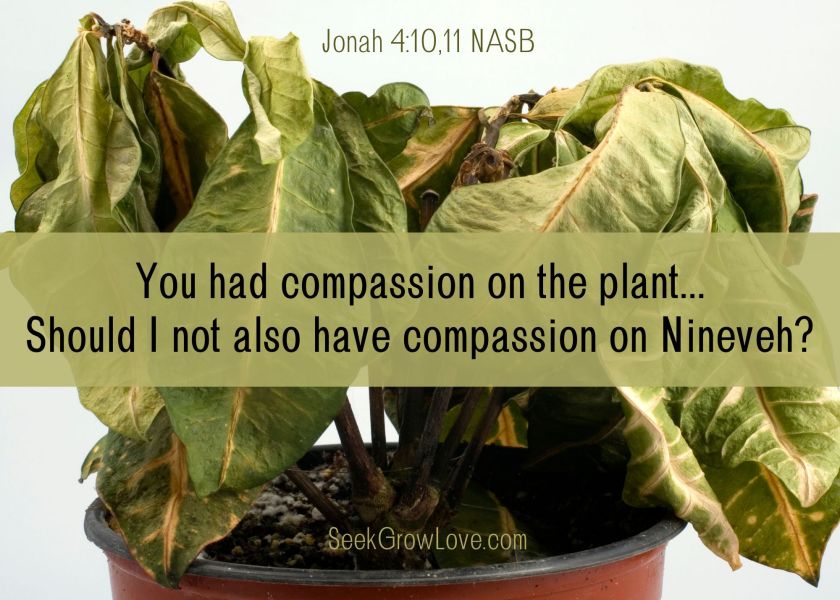
After Jonah complained to God, he rested. There, God allowed a plant to grow. Jonah found joy in this. Then, God caused the plant to die in the morning, and called in a great heat to overcome the area that Jonah was in. Again, Jonah cried out at the demise of the plant that he had. 

God then likened this plant to Nineveh. It gave great joy to Jonah despite him not being the reason it grew, and it was only there overnight. So too Nineveh should also receive mercy even if recently they turned from their wicked ways. 

Although only 11 verses long, Jonah 4 reveals a lot to us about who God is, and how we should interact with him. First off, God used the plant as a metaphor for Nineveh, much like how his son Jesus would use parables to teach spiritual lessons to people in ways that they may understand. 

Secondly, God has love for people, even for those that are not his chosen people. Perhaps Jonah may have disagreed with this at the time, but regardless this goes on to show the legitimacy of the great commission given by Jesus in Matthew 28, and carried out through the rest of the New Testament. The love of God is for everyone. 

Thirdly, we should always want what God wants. Even if we do not understand God, or if we do not agree with the way things may be going for us, we must adopt the viewpoint that aids so many people throughout the Bible: “not my will, but yours be done.” “Yours” referring to God, our father in heaven. 

-Colby Leggitt

Reflection Questions

  1. Even when we feel that we are worthless, how can we remind ourselves of the greater purpose that God has called us to?
  2. Why was Jonah so upset that God relented to the disaster to befall Nineveh? How can we connect this to times in our lives when we are angry that things don’t go our way? 
  3. What does God tell us about the worth of being angry (without very good reason)?
  4. Was God’s lesson on Jonah too harsh? Are such tribulations the kind of tough love that is needed sometimes for us to see things the way God wants us to?

They Believed!

Old Testament: Jonah 3

Poetry: Psalm 73

New Testament: Luke 12:1-12

It is interesting that some of the best positive examples in the book of Jonah come from some of the least likely places.

In Chapter 1 what do we learn from the pagan sailors?

In Chapter 2 what do we learn about prayer from the prophet who was trying to run away from God?

And, in Chapter 3 what do we learn from the king and inhabitants of one of the most wicked cities of their time? Repent! Believe in God (vs 5) and repent! Humble yourself. Mourn because of your sins. Fast – give up your comforts and pursuits so you can focus completely on what God wants to tell you and what He wants from you. Send out a proclamation to let others know and hold them accountable. “Let men call on God earnestly that each may turn from his wicked way and from the violence which is in his hands. Who knows, God may turn and relent and withdraw His burning anger so that we will not perish” (vs 8b & 9). It is a great lesson to learn and imitate! Has your life changed because of a decision to believe and repent?

It’s interesting that Israel and Judah had the benefit of many prophets speaking for many, many years and generations, to the Israelite kings, officials and countrymen, time and time again and sometimes even with miraculous signs. And yet, these countries were still often heading in the wrong direction, away from God. But here in sinful Ninevah, a man of God (who had screwed up a time or two, and wasn’t always the most reliable or faithful, but did know how to pray) takes a one day walk into Ninevah, preaches, and changes the destiny for the whole capital city of Assyria. I wonder if Jonah told of his personal testimony – how God had gotten the attention of this particular runaway prophet? Do you have a story you can tell – even if it doesn’t include a huge fish? What might it mean to your listeners?

-Marcia Railton

Reflection Questions

  1. What does repentance mean to you? When have you repented, of what, what did it look like? Did it last? Where are you without repentance? If the Ninevites didn’t repent what would have happened to them?
  2. What could you say to one on the path to destruction? What part of your testimony could you share? What can you tell them about God? What do you know about the future? How would you feel if they DID listen to you and repent?
  3. What is the difference between God changing and God relenting? Where else do we see Him relenting?
  4. What have you learned from some of the least likely sources, perhaps even from a runaway prophet? Why do you think God chose to send Jonah to Ninevah – twice? Where might God be asking you to go?

He Answered Me

Old Testament: Jonah 2

Poetry: Proverbs 31

New Testament: Luke 11:14-54

What do you find in every one of the four chapters of Jonah?

Not a great fish – but prayers.

And, chapter 2 is just about all a prayer from the prophet Jonah to his great big God – while he waits, inside the belly of a fish sent by God.

What might you pray if you ever were to find yourself in such a predicament, or an equally stuck and potentially stinky one? What predicaments have you found yourself in that shared some characteristics, even though there were several differences, too? What did you pray for in those instances? I am guessing my prayer would include a whole lot of “Get me outta here, God!” If there is one type of prayer that most of us seem to have mastered, perhaps it is the prayer for deliverance. Lord, deliver us from sickness, from unemployment, from stress and anxiety, from dysfunctional families, from bad grades, from disgrace, and yes, from evil, and the list goes on. Turns out there are a lot of places we do not want to be – including inside the belly of a great fish.

But I find the prophet who was trying to run away from God in chapter 1 has a lot to teach me about prayer in Jonah chapter 2.

I am guessing that given 3 whole days and nights Jonah had the perfect opportunity to say a lot of things to God. He might have very well included some prayers for deliverance. But, that is not what is recorded in the 8 verse prayer of Jonah 2. Jonah sees and recognizes and gives God thanks for taking care of him, thus far. He sees the belly of the great fish not as a trap but as one more step of God’s merciful path toward salvation. And he thanks God. It could have been so much worse. He would have been at the bottom of the ocean, lifeless. But God has sent salvation. (Maybe that was the name of the fish?) He delivered from the deep. He provided a spiritual time-out for Jonah. He helped Jonah put his life and his death into perspective to see again God’s greatness and the privilege we have to follow Him, to fulfill our vows to Him, even into the scary land of the Ninevites (but more on that tomorrow.)

-Marcia Railton

Reflection Questions

  1. What conversations could you have with God for three days and three nights if you removed all distractions around you except those that could be found inside the deep dark belly of a great fish? How could you create and take advantage of a spiritual time-out to meet with God for an extended time?
  2. In the midst of your big fish, or when you felt you were sinking, what have you/can you thank God for?
  3. When did you need a reminder that “Salvation is from the Lord.” How did Jonah know that to be true? How do you?

Jonah Ran

Old Testament: Jonah 1

Poetry: Proverbs 30

New Testament: Luke 11:1-13

(You will notice we are not done with 2 Kings yet, but we are taking a pause to add in the book of Jonah at this point. Through the rest of 2nd Kings and 1st and 2nd Chronicles we will be inserting the 17 books of prophecy and the rest of the books of history – Ezra, Nehemiah and Esther – in a chronological fashion. However, when we start a book of prophecy we will read the whole book even though the events might span a good chunk of history throughout Kings/Chronicles. Thank you to Robert Jones of Atlanta Bible College for his help in ordering these books amongst the Kings and Chronicles.)

The story of Jonah is one of the most well-known stories in the Bible. However, the book of Jonah is one of the least read books in the Bible! Let this devotion serve as a challenge to read this book with fresh eyes this week.

Jonah is perhaps the most unique prophet in the Bible. Isaiah, Daniel, Elijah, and so many others serve as intensely righteous men who carry about the Lord’s message with great zeal. Habakkuk shows shocking honesty and transparency in his prayer life. Amos shows us that the most humble people– yes, even the shepherds– are called into ministry of some kind. But what about Jonah?

Jonah shows that rebellious streak that runs within all of us at some time or another. God has called him to preach to the city of Nineveh, the capital of Assyria, and Jonah does not listen. It’s understandable; Nineveh is nearly 700 miles away from Jerusalem. That would take well over a month to travel there in his time! But wait– Jonah doesn’t just say no to God. He actually runs away in the opposite direction!

So Jonah runs away and God lets him know that there’s no running from God. In fact, throughout Jonah’s refusal to minister to the Assyrians, it still brings glory to God. The sailors he’s traveling with tremble with fear when they discover who Jonah’s God is. Notice that, in 1:11, the sailors want to please Jonah’s God, and instead of saying, “Let’s turn this ship around and head to Nineveh,” he says, “Just throw me overboard.”

But God wasn’t done with Jonah. Jonah’s saved. But more importantly, Jonah experiences a spiritual reckoning: (Sneak peak into tomorrow’s reading of Chapter 2…) Jonah has a moment of complete clarity and offers up a remorseful, prayerful praise to God. He recognizes that God is the one in control (2:3). And he recognizes that salvation comes only from the LORD.

So here are a few questions for us to consider in all this:

Do we listen for God’s voice like Jonah does? 

Do we reject God’s call like Jonah did? Probably more than we realize.

Do we expect God to call us to the “Nineveh” of our lives?

Do we learn from our mistakes like Jonah did, and pray about it? 

Will Jonah learn from these events, and change his ways? We’ll have to find out this week.

-Levi Salyers

(originally posted for SeekGrowLove December 15, 2021)

ONE MORE QUESTION to add to those above…

What do we learn from the sailors in Jonah 1?

The One Thing You Need

Old Testament: 2 Kings 13 & 14

Poetry: Proverbs 29

New Testament: Luke 10:38-42

Have you ever had the opportunity to go see, and possibly meet, a celebrity (actor, musician, athlete) in person? Ten years ago, the New York Giants and the New England Patriots were in Arizona to play in Super Bowl XLII. You may be thinking that I tried to get to see either Eli Manning (the Giants quarterback) or Tom Brady (the Patriots quarterback). But my interest wasn’t in either of them. No, I knew that Eli’s brother, Peyton, would be in town to attend some parties before the game. I had a friend of a friend of a friend who had tickets to one of those parties and I daydreamed hard about getting to meet the future NFL Hall of Famer.

A few years before that I was in Monaco and my tour guide had heard that George Clooney, Brad Pitt and Matt Damen were supposed to be filming a scene in the movie Ocean’s 12 at the famous Monte Carlo Casino. The group of students that I was traveling with and I stood with a crowd of people for almost an hour hoping to get a glimpse of the three actors. Well that never happened. But we did get to witness two extras walk down the steps of the casino and that scene is in the movie, so it wasn’t a complete waste of our time. Kinda.

When I read Mark chapter 5 I imagine that the crowds that followed Jesus around were a bit like the superfans of a celebrity. Wherever He went, masses of people would go and seek Him out. Not because He was rich and famous, but because they had heard He could perform some pretty crazy healing miracles. In this chapter we read about three people who were not just highly interested in meeting Jesus, they were desperate to meet Jesus. And so they did what they had to do, to get near Him. The demon-possessed man saw Jesus at a distance and ran and fell on his knees at Jesus’ feet (verse 6). The father of a dying young girl worked his way through the crowd and fell at Jesus’ feet (verse 22). The sick woman reached through the swarm of people to touch his cloak and then fell at His feet (verses 28, 33).

Desperation brings you to a place of complete abandonment of pride and social decorum and a complete surrender to experience an ounce of relief. Imagine being so in need of healing that you fight your way through a crowd of strangers to fall onto your knees at the feet of Jesus. The wonderful thing is that Jesus had compassion on each and every one of those people and He will have compassion on you too.

But Jesus doesn’t want you to humble yourself just when you’re desperate for healing. He wants you to be desperate to spend time with Him every day, even when things are going well for you. His desire is for us to sit at His feet and enjoy His presence no matter what is going on in our lives. Remember Mary, Martha’s sister, who sat at her Lord’s feet and she was praised for doing what was right (Luke 10:38-42)? Mary had the right idea. It’s during these times that we learn how to follow Him and to love Him. It’s during these times that we understand what it means to love others and become a fisher of men.

Psalm 16:11 says, “You have made known to me the path of life; you will fill me with joy in your presence, with eternal pleasures at your right hand.” When we find ourselves at the feet of Jesus, life, in all of its complexities, will begin to make a little bit of sense because we no longer view things at face value, but we get glimpses of how our life experiences fit into God’s eternal plan. Yes, we will still know sorrow and grief, but we will also have an eternal hope, a peace that surpasses understanding, and overflowing joy.

So let’s take a few minutes to fall on our knees at the feet of our Savior and Lord.   

-Bethany Ligon

(originally posted for SeekGrowLove Sept 15, 2017)

Reflection Questions

  1. What is the benefit of coming to the feet of Jesus when you are worried and upset and in need? What is the benefit of coming to Jesus when you just want to be closer to him and learn from him?
  2. What have you received at the feet of Jesus?
  3. What worries and distractions have you allowed to keep you from the One Thing you need? What is that One Thing?

Are you Listening?

Old Testament: 2 Kings 11 & 12

Poetry: Proverbs 28

New Testament: Luke 10:25-37

As Marcia mentioned in yesterday’s devotion, many of us were at Midwest Family Camp last week, where the theme was “Stand Firm”.  In a nutshell, if we don’t have a relationship with the Lord, it is critical that we repent and come into a relationship with Him. If we already have a relationship with the Lord, we need to strengthen that relationship, and stand firm in the faith – no matter what.

In today’s reading in Proverbs 28, there are a few verses that jumped out at me which reinforced that message.  The first is found in Proverbs 28: 9, “If anyone turns a deaf ear to the law, even his prayers are detestable.”  This proverb tells us that if we’re not doing everything to live the life God called us to live, if we’re not following His rules, then He won’t listen to our prayers.  Since many of our prayers are about asking for God’s help with various things, if we selfishly want Him to answer our prayers, then we need to obey His rules, and live for Him.  As we grow in relationship with Him, we come to long for an even deeper relationship with the Lord. Then we learn that prayer is powerful, and we don’t waste it just asking for superfluous things.

Proverbs 28:13 goes on to say, “He who conceals his sins does not prosper, but whoever confesses and renounces them finds mercy.”  This is saying if we pretend to be Christians, we won’t prosper (you can’t fool God).  But if we confess and renounce our sins, and turn completely to God, we will receive God’s mercy.  I don’t know about you, but I would much rather have His mercy than to have Him holding me back from prospering.

As we continue to read through this chapter, we get to verse 20, which says, “A faithful man will be richly blessed, but one eager to get rich will not go unpunished.”  I’ll take a detour here and comment on the health and wealth teachings we often hear from people who don’t know better.  The theory goes sort of like this… “if someone follows God, God will bless every aspect of their life.  They will be rich, healthy, and blessed.”  Many people who call themselves Christians subscribe to this false belief.  Jesus told us in John 16:33, “…In this world, you will have trouble.  But take heart, I have overcome the world.”  We have to remember this life isn’t our reward.  This life is the test to see what reward we will receive when Jesus returns.  If we are faithful to the Lord now, we will enjoy peace with God now, and eternal life when Jesus returns.  If we are just trying to get rich, we are actually worshiping money, not God — our reward is in this life, and we will forfeit eternal life.  

1 Tim 6:9-11 says, “People who want to get rich fall into temptation and a trap and many foolish and harmful desires that plunge men into ruin and destruction.  For the love of money is a root of all kinds of evil.  Some people eager for money have wandered from the faith and have pierced themselves with many griefs.  But you, man of God, flee from all this, and pursue righteousness, godliness, faith, love, endurance, and gentleness.”

Instead of trying to get rich, we need to follow the advice given in Proverbs 28:27, “He who gives to the poor will lack nothing, but he who closes his eyes to them receives many curses.”  Again, I think the idea is that if I’m greedy, wanting to keep all my money for myself, I’m not trying to please God, I’m just greedy for money, and God will curse me for not following Him.  But if I’m generous with the things God has given me by giving them to the poor — this mimics God’s generosity to me.  When I am imitating God, God loves that.  In fact we’re commanded in Ephesians 5:1, “Be imitators of God, therefore, as dearly loved children.”

So the bottom line is this.  We need to do everything we can to reconcile ourselves to God.  We need to confess and renounce our sins, obey His laws, be faithful, and be generous.  All these things are required to live in close relationship with God.  And if we live in a close relationship with God, we will have peace with God in this life, and an amazing reward in the life to come.  In Rev 21:4, we’re told, “He [God] will wipe every tear from their eyes.  There will be no more death or mourning or crying or pain…”   Rev 21:7 goes on to say, “He who overcomes will inherit all this, and I will be his God and he will be my son.”

How well are you imitating Dad?

Stand Firm.

–Steve Mattison

(Originally posted June 28, 2021 – but we did just return from another week of Family Camp, where the theme was “Pray Continually”. You can watch Steve’s Thursday Night sermon and story on Yield to God’s Will here.)

Reflection Questions

  1. What are the prayer lessons to be remembered from Proverbs 28?
  2. How well are you following God’s instruction?
  3. When was the last time you confessed your sins to Him?
  4. What relationship do you have with money? Is it stronger than it ought to be? How would you rate your generosity? Why do you think God values our generosity?

Wounds from a Friend

Old Testament: 2 Kings 9 & 10

Poetry: Proverbs 27

New Testament: Luke 10:1-24

The Proverbs are, in many cases, fairly self explanatory. Don’t be lazy, don’t be a wicked ruler, don’t be foolish but be wise, be a righteous ruler, be diligent in your work. Each Proverb has it’s own meaning but they go along those lines. But some are not so self explanatory. They are counterintuitive.

A short example is found in 28:27. If you want to be prosperous and blessed, to never be in want, then we give our money to the poor. The world, our own sinful heads, and many economists believe that the way to grow our wealth and not be in want is to hoard our money. But that’s not the way God works. It is only in generosity and giving that we will be blessed. This comes from the fact that God will bless and many times he blesses us through the care of others in our time of struggle and hardship.

Also, 27:5-6 doesn’t seem to be true in the moment. I don’t like to be rebuked. I don’t like it when a friend calls me out on the garbage way I am acting. But the Proverb teaches us that we should delight when a friend rebukes us because their correction comes from a place of love and they want our life to be one of wisdom and righteousness. This is especially true for  our brothers and sisters in our local church. Many times, we may feel judged by the people of our church, but more often than not, they are wanting the BEST for us. The “wounds” they give are better than any kisses of those who tell us we have nothing wrong with us. There could be people who act like a friend and hurt you in terrible ways, but here we mean TRUE friendship, TRUE companionship, TRUE love from a brother or sister in Christ. That true love is shown in forgiveness and compassion, especially in our moments of weakness and humility. Many times, when we are sinning and are fearing the rebuke of those people, we hide our sin away, like 28:13 says. But counterintuitively, by hiding our sins, we only hurt ourselves more when they are brought to light in some other way. We need to confess our sins and turn away from them. When we do, compassion and forgiveness are waiting for us from the people of God and from God himself.

Jake Ballard

(originally posted for SeekGrowLove June 17, 2020)

Reflection Questions

  1. What other proverbs have you run across that seem counterintuitive and the opposite of how the world thinks or operates? How is God’s wisdom better than the world’s?
  2. Can you think of a time a true friend gave you correction or a rebuke? Can you think of a time you, as a true friend, gave correction or rebuke? What is the value of correcting a friend? What problems can develop if we don’t correct in love, or if we don’t accept the correction given in true love?

God of Restoration

Old Testament: 2 Kings 7-8

Poetry: Proverbs 26

New Testament: Luke 9


Our God is a God of restoration. There will ultimately be a full restoration, but full restoration can only happen when the world is once again the beautiful, perfect place God created it to be, when His Kingdom is established on earth. Partial restoration, however, has been happening ever since the beginning of time. We read about restoration countless times in the Bible, and if you look, you can see it in our lives today, too. God constantly restores what has been lost to His people, whether it be a physical ability, such as sight, or movement, or a spiritual restoration, such as that of faith, or even the restoration of life.


Today, we read in 2 Kings chapter 8 about a Shunammite woman who lost everything she had during a 7 year famine, but because of her faith in God and willingness to obey, it was restored to her. Now this woman was not new to witnessing God’s ability to restore what was lost. In chapter 4 of 2 Kings, we read about how Elisha rewarded the Shunammite woman’s kindness with fertility, and she bore a son. Sadly, the son later died, but she had faith in God’s power, so she sought out Elisha. Elisha came, and the son was brought back to life; he was restored.


It is clear that this woman had remarkable faith. Perhaps this is why Elisha warned her about the famine that would come on the land for 7 long years, and advised her to leave. So without question, she and her household left their home and stayed in the land of the Philistines for 7 years, until the famine was over. When they returned, she had to appeal to the king to get back her home and all her land. The crazy thing is, right as she was coming to appeal to the king,
Elisha’s servant, Gehazi, (who in chapter 5 was cursed with leprosy, and left Elisha… so perhaps these chapters are not necessarily in chronological order) was telling him the unbelievable story of the miracle Elisha performed in the resurrection of the son of the Shunammite woman. The woman, who just happened to show up during this particular story time, also gave an account of what happened, and the King was so impressed that he instantly granted her the land and all that she left 7 years ago.


This story speaks volumes of God’s perfect timing, and adds to the common theme we see throughout the Bible of God’s willingness to restore what has been lost to those who are faithful. Look closely at the different ways in which God restores things in your life, and let it remind you to live everyday for the ultimate restoration that’s coming.


-Isabella Osborn

(originally posted for SeekGrowLove on June 8, 2021)

Reflection Questions

  1. In 2 Kings 8 what does God do for restoration to take place? What did the Shunammite woman do? What did others do?
  2. Where have you seen restoration? Did faith play a part in the restoration you witnessed? What did God do? What did the recipient of the restoration do? What did others do?
  3. How can you be a part of God’s great restoration project? What restoration can you be praying for? What restoration can you be working towards, with faith in God, that He will act in amazing, restorative ways?