Are you flourishing?

I have come that they may have life, and have it to the full. John 10:10

OLD TESTAMENT: 1 KINGS 15-16

POETRY: PROVERBS 16

NEW TESTAMENT: EPHESIANS 6:18-24

I have spent the last 3 years of my life and academic studies focusing on the subject of human flourishing.  Let me ask you a question this morning…Are you flourishing in your life?  Would you like to?  To flourish is to grow healthy, to thrive.  I believe it is God’s ultimate goal for us to flourish.  If you look at the Bible from beginning to end, it is all about flourishing.  In Genesis God creates the heavens and the earth.  He fills the earth with abundant plant and animal life and that places humans on the earth to act as his stewards.  Humanities first job was to cultivate and enjoy a flourishing garden.  God’s first command to humans was “be fruitful and multiply.”  That is all flourishing language.  At the end of the Bible, in Revelation 22 it shows the culmination of God’s plan to live with humans on a restores and renewed earth where there is flourishing.  There is a picture of a river flowing from God’s throne and along the banks of the river are the tree of life that bears fruit all year long and whose leaves bring healing.  This is, once again, flourishing language.  

Throughout his ministry, Jesus uses the language of flourishing as well.  He says things like “I have come that they might have abundant life.” (John 10:10). That is the language of flourishing.  In John 15 he says that he is the vine and we are the branches.  We must remain connected to him to bear fruit.  This is flourishing language.  Later, the Apostle Paul picks up this same language of flourishing.  In Galatians 5:22-23 he speaks of the “fruit of the spirit” as love, joy, peace, patience, etc…  This is most definitely flourishing language.

God wants His children to flourish.  As we know, in order for a plant to flourish it needs certain conditions.  It needs good soil with good nutrients, it needs the right amounts of sunlight and rain, it needs to be nurtured, weeds to be pulled, pruning, pests and parasites need to be kept away.  In the same way, God’s children need to have conditions that are favorable to our flourishing.  God lays these out throughout the Bible.

The week we are going to focus on Proverbs.  I think it is helpful for us to think of the Proverbs as very simple and clear instructions on how to spiritually, emotionally, relationally and even physically flourish.  To learn how to grow a flourishing garden you might want to talk to a wise and seasoned gardener who can give you insights into how to get the most flourishing.  How to prepare the soil, when to plan the seeds of plants, how deep to plant, how far apart to space them, how much watering is needed, do they need more sun or more shade, when and how to prune.  Proverbs give these kinds of practical wisdom instructions to help God’s people flourish.

Consider one of the short Proverbs in today’s reading: “Gracious words are like a honeycomb, sweetness to the soul and health to the body.” (Proverbs 16:24).  Raw honey has health benefits, it contains antioxidants and other good things, and it tastes sweet.  I remember as a child seeing my very English grandfather put a giant teaspoon of honey into his cup of tea which he drank several times a day.  He lived to be almost 100 (hey maybe I need to start putting honey in my tea?).  So honey tastes good and is good for you, win-win, right?  In that same way, in our spiritual, emotional and relational life, speaking gracious words or words that are full of grace also taste good and are good for you.  Jesus is the ultimate example of what a flourishing human life looks like and it was said of Jesus that he was “full of grace and truth.” (John 1:14).  Colossians 4:6 says: “Let your speech always be gracious, seasoned with salt, so that you may know how you ought to answer each person.”

Maybe I am just getting old, but it seems to me that people are often not very gracious in the ways they speak to each other.  In many ways, social media makes it easier to speak very ungracious words to others behind the safety of anonymity or the filter of a phone or computer screen.  Now, when I hear someone speaking graciously in public or on social media, I am like, “Wow, that was nice to hear for a change.”

God wants us, His children, to experience flourishing lives.  One way toward flourishing is to monitor how we speak and intentionally choose to speak words that convey grace to others.  We do not always have to agree with others and even Jesus spoke truth to his opponents, but even hard truth can be spoken with grace.  That is part of being wise in our speaking and that is one-step towards a fruitful, productive and flourishing life.

~ Jeff Fletcher

Jeff is a pastor and chaplain who lives in the beautiful mountains of Virginia. He has spent his life in ministry and recently earned his doctorate from Vanderbilt University. He has a large, loving family and is very active in all the COG events and ministries.

Questions:
  1. In what ways are you flourishing in your life? Where do you feel like you are not flourishing?
  2. Have you noticed flourishing language in the Bible before? How does the Bible speak about flourishing? What is flourishing according to the Bible?
  3. How does the wisdom of Proverbs help you to flourish in your life?

The Sword of the Spirit

Old Testament: 1 Kings 13-14

Poetry: Proverbs 15

New Testament: Ephesians 6:17b

Ephesians 6:17b – “…and the sword of the Spirit, which is the word of God.”

We have been given the most powerful weapon of all – God’s Word. It’s so powerful that Jesus used the Word of God as he engaged in battle during his forty days in the wilderness. Three times, the devil proposed a tempting offer to the Son of God. And three times, the Son of God used the Word to fight back. After strike three, the devil turned tail and left Jesus alone. 

Have you ever used the Word of God while experiencing a spiritual attack? There have been nights where I have been lying in bed consumed with wonders and worries not able to sleep. I laid my Bible open on the edge of my bed, placed my hand upon the written word and eventually drifted off to a peaceful sleep. 

One particular day, anxiety was getting the better of me and the only thing that kept my mind from spiraling out of control was reading aloud 2 Samuel 22. I must have read that chapter twenty-two times that day. That day wasn’t easy, I was emotionally exhausted by the time the sun went down. But with the help of God’s Word, I managed to fight back and extinguish the flaming arrows that bombarded my mind. 

The author of Hebrews declares that “the word of God is living and active”. This is not just any sword, it is a double-edged sword that does damage going in and coming out of its intended target. It’s not a sword that will go dull or become irrelevant, it’s a sword that has withstood the test of time. It’s not just a sword for the elite warrior, it’s a sword that someone on the front lines of battle would use for both defensive and offensive maneuvers. It’s not a sword that is meant to be a decorative display, it’s a sword that is meant to be used.

An experienced soldier isn’t someone who has just seen a lot of battles. A soldier of high caliber is one who took their “basic training” seriously and continues to practice and hone their skills, even when they are not on “active duty”. 

Any professional athlete knows that their off season is not a multi-month vacation. It’s an opportunity to recover from injuries, cross train in other physical activities, continue with proper nutrition, and work on the finer skills of their game. 

Likewise, when we find ourselves in a period of peace, it is not time to lay aside our swords and eat grapes all day long. We need to be preparing for the next attack. If the Word of God is living and active – then we must also be living and active. Daily engagement with the Word is crucial, but so is being part of a church fellowship. Staying involved in local ministry, putting your spiritual gifts to good use is a way to stay ‘living and active’. 

While I am thrilled that you are reading these words, have you opened up your Bible today? It is a powerful weapon, forged with priceless materials, intended to protect and defend against the enemy’s attacks. Use it in times of battle. Use it in times of peace. Know this weapon inside and out. And may you be victorious as “you stand your ground, and after you have done everything, to stand.”

-Bethany Ligon

Reflection Question

  1. How can you use the Sword of the Spirit during times of war? And in times of peace? What has God’s Word provided for you at different times?
  2. Can you tell of a time that God’s Word was exactly the weapon you needed? What did you find there? What did it provide for you? How did it change the battle? Who can you share this testimony with?
  3. Where do you tend to turn when you don’t turn to the Bible? How do those battles go?

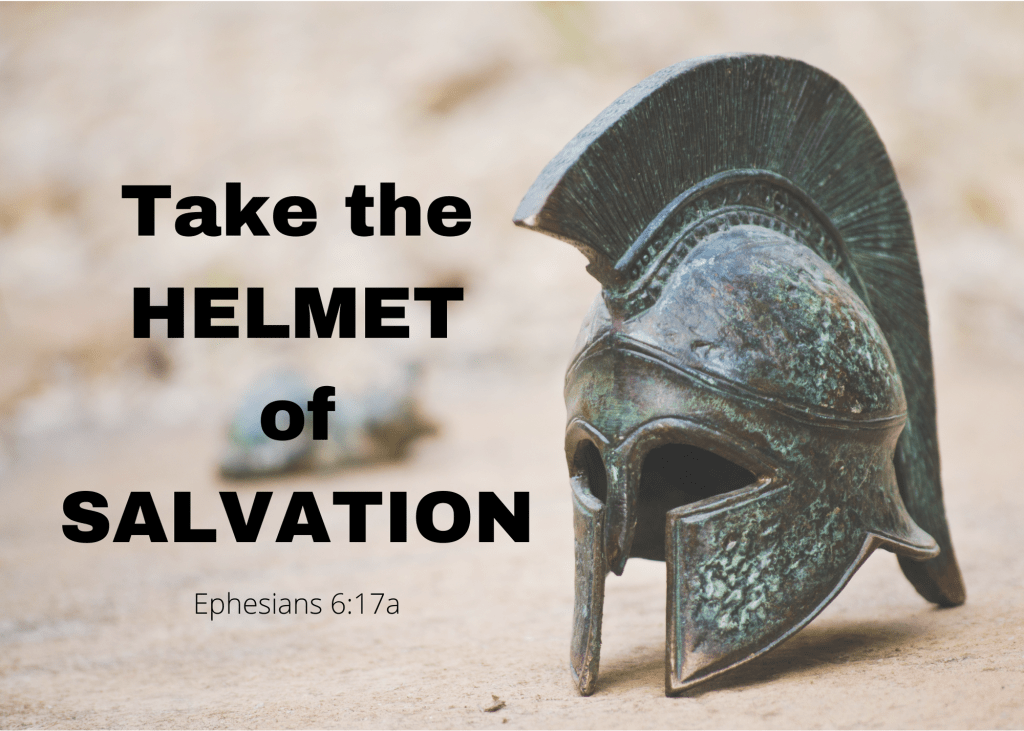
Head Protection

Old Testament: 1 Kings 11-12

Poetry: Proverbs 14

New Testament: Ephesians 6:17a

Ephesians 6:17a – “Take the helmet of salvation…”

Here’s a disquieting fact to start our devotion today: According to the International Brain Injury Association, 5.3 million Americans are living with some kind of disability due to a traumatic brain injury. 5.3 million is the population of South Carolina! Of course there are varying degrees of injury, but most are due to car accidents and sports-related incidents. 

And while 5.3 million is a staggering number, I’m willing to bet that there are so many more people living with spiritual battle scars in their minds. 

Our minds are such a vulnerable space and it’s one of the enemy’s favorite areas to attack. At least, that’s been my experience. Anyone else struggle with random thoughts popping up that obviously aren’t from God? 

But why attack the mind? Why not make the heart the primary target? Because our thoughts turn into words, which turn into actions, which turn into habits, which turn into our character. James, the half brother to Jesus, said it this way, “It is the evil that a person wants that tempts him. This desire causes sin. Then the sin grows and brings death.” (James 1:14-15, ICB) This is why it is imperative to protect this part of our body. 

For the apostle Paul, the author of this Epistle, the helmet was the perfect metaphor; after all, he was under house arrest when he wrote this letter. He probably had a lot of face time with a Roman guard who most likely wore some kind of helmet. Each piece of the helmet added another layer of protection against injury or death.

Paul calls this piece of the armor the helmet of salvation. The Greek form of the word for salvation is used only in this verse in all of the New Testament and it means “peace”. As we don this piece of armor, we can have the “peace of God that transcends all understanding will guard your hearts and your minds in Christ Jesus”. (Philippians 4:7)

Where does this salvation or peace come from? It comes from being in the Word of God daily: reading, studying, meditating, and memorizing it. We need to be intentional about the media that we consume and the conversations that we participate in. We need to be aware of entertaining the thoughts that seem to come out of nowhere. Protecting our minds against the thoughts that flow in and out should be something that is carefully monitored as we go about our daily living.

If you want to be in God’s Shalom peace while you engage in spiritual battle, be sure to wear the helmet of salvation.

-Bethany Ligon

Reflection Questions

  1. How do you think the enemy attacks minds? What about yours in particular?
  2. Describe the progression from thoughts to words to action to habits to character. Give an example that leads to ungodly character. Give an example that leads to godly character. Which type of thoughts do you work at thinking most?
  3. What protection is available to you against the thoughts that lead to ungodliness and death? In what ways can salvation and peace mean the same thing? What can you do (today) to strengthen your protection that God has made available to you?

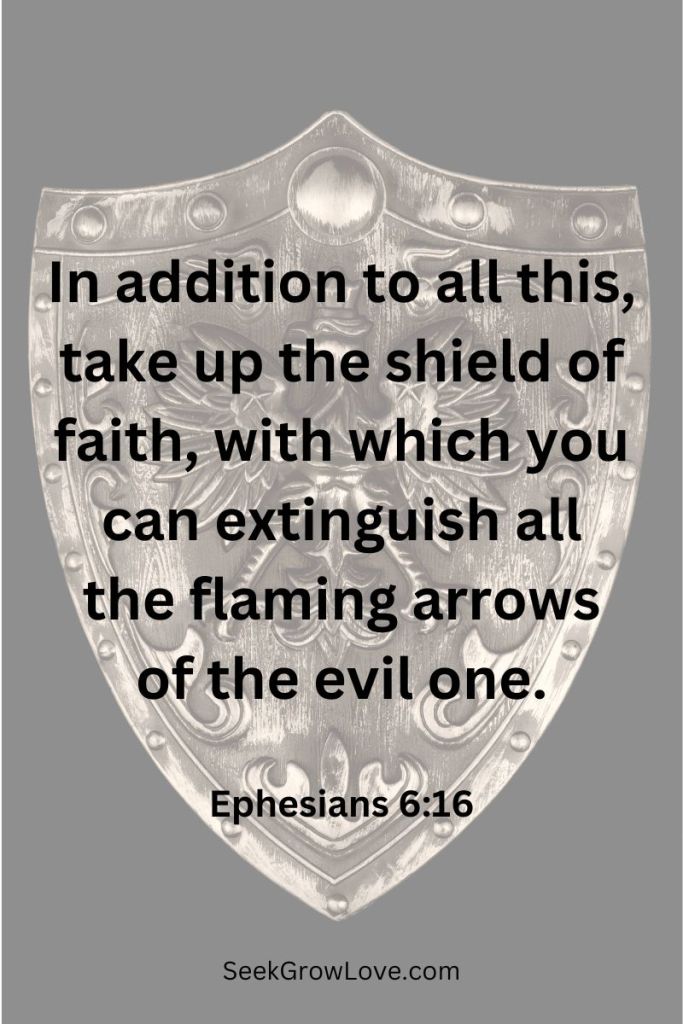
Your Shield of Faith

Old Testament: 1 Kings 9-10

Poetry: Proverbs 13

New Testament: Ephesians 6:16

Do you ever feel like you’re being bombarded with issues, concerns, or worries? Have you ever heard yourself saying, “If it’s not one thing, it’s another”? Maybe you’re just having a typical ‘Monday’ even though it’s Thursday. Or maybe you find yourself clumsy dropping things, forgetting why you walked into a room, or having to deal with “that one person” more often than normal? It’s not so much one big thing, it’s just one little thing after another that really tests your patience. 

My friend, those big things, those small things, those things in quick succession, those repeated things…those very well could be “flaming arrows of the evil one”.

So why does the author of Ephesians, Paul, specifically use the term “flaming” arrows…why not just regular arrows? If a vulnerable soldier were hit by a normal arrow, it would likely only cause damage to himself. But if a flaming arrow hit him, the flame could catch onto nearby flammable material and cause significant damage.  

The comparison leads us to think about how these spiritual attacks affect us and those around us. When we’re experiencing trials and tribulations, how are we treating others? Are we still kind and compassionate or do we take our frustration out on others? When the challenges are mounting up all around us, do we hide out and disengage or do we press on with our commitments and ministries? When the attacks start coming from every angle, are we able to keep our head on straight and make responsible decisions, or are we tempted to act recklessly with our resources and health? 

You see, from the evil one’s perspective, the more damage that can be done with a single flaming arrow, the more successful the attack. It’s not just you and your personal faith; it’s your physical and spiritual health, your relationships and ministries that are under attack.

This is why taking up the shield of faith is so vital when engaging in spiritual warfare. A Roman soldier would have his wooden shield soaked in water so that when a flaming arrow hit its intended target, the flame would be extinguished and not cause collateral damage. 

Likewise, when we are soaked in the Word of God, those attacks become a little less hazardous to how we choose to carry on in the battle. 

In John 7:38, Jesus says, “Whoever believes in me as Scripture has said, rivers of living water will flow from within them.”

The more of the living water that we have flowing through us, the more protected we are from the enemy’s attacks on our faith. We need to stay spiritually hydrated by engaging in the Word of God on a regular and consistent basis. This will build up our faith and protect us from the flaming arrows that are pointed in our direction.

-Bethany Ligon

Reflection Questions

  1. What do you see and recognize as flaming arrows of the evil one? How can recognizing them as flaming arrows of the evil one improve your response to them? Which ones have attacked you or caught you off-guard most recently?
  2. Where/when have you seen a flaming arrow in action – with the potential of injuring or taking down more than just the one it hit? How can we guard against the effect of the flames of these arrows?
  3. How strong is your shield of faith? Does it have weak spots that make you more vulnerable? What can you do to strengthen your shield?

Fitted Feet

Old Testament: 1 Kings 7 & 8

Poetry: Proverbs 12

New Testament: Ephesians 6:15

When was the last time you regretted wearing a pair of shoes? I recently was on the hunt for a pair of gray sandals and I found some that I thought I might like from an online store. I ordered them and at first, they seemed to be very cushy and comfortable. As I wore them throughout the day, I noticed that the straps were rubbing the bottom of my ankle. It never caused a blister, thankfully, but it was just irritating. 

Anyone who is on their feet all day can tell you the value of having comfortable and supportive shoes. Whether it be someone in the medical field, law enforcement, military, food service industry, or in the classroom, having a good pair of shoes is a necessity. 

But what does having supportive footwear have to do with the Armor of God? A soldier’s boots (or sandals as ancient Roman soldiers would wear) are likely the one piece of their attire that they use for hours on end, every single day. They train with their weapons while wearing their boots. They go on marathon-long hikes while wearing their boots. They eat their meals while wearing their boots. And sometimes, they will even sleep while wearing their boots. If a soldier’s feet are sore or tired or have blisters, he or she becomes limited in what they can do – at least without any pain.  

Our verse today talks about being “fitted with readiness”. A soldier must be ready to go at any given moment. Likewise, as believers fighting in a spiritual battle, we must be prepared to take action at any point in time. 

And just what are we to take action with? The Gospel of Peace. This gospel includes the message of salvation and the Kingdom of God. As warriors in a spiritual battle, we need to remember whose army we fight for. When we are laser-focused on what we’re fighting for, we can be empowered and strengthened to fight against anyone or anything that is our opposition. So when temptation or persecution comes our way, we can make sure that we are in the ready position, set to take our Commander’s orders.

But also, the Gospel of Peace is something that we should be comfortable sharing with others who have not yet discovered it for themselves. Being ready to explain to others what we believe and why we believe it is another way to wield this piece of armor. Conversations with our friends, family, work buddies, and even random people you encounter in your day-to-day life can sometimes lead to discussions about our faith. When we are ready to share the Good News, we are showing ourselves to be prepared soldiers in the Lord’s army.

So let’s lace up our boots, and get ready to share the Good News of the Gospel of Peace!

-Bethany Ligon

Reflection Questions

  1. The gospel is only called the “gospel of peace” here in a passage about the spiritual war we are in. How would you describe the gospel of peace and why do you think this wording was chosen for this passage?
  2. Do you feel like you are ready to take action to follow your Commander’s orders today? What do you think could happen if you ARE ready? What could happen if you AREN’T ready for action? What could you do now to be more prepared? Do you think you have ever used an excuse of not being ready when God wanted you to do something?
  3. How can you share the gospel of peace with others this week?

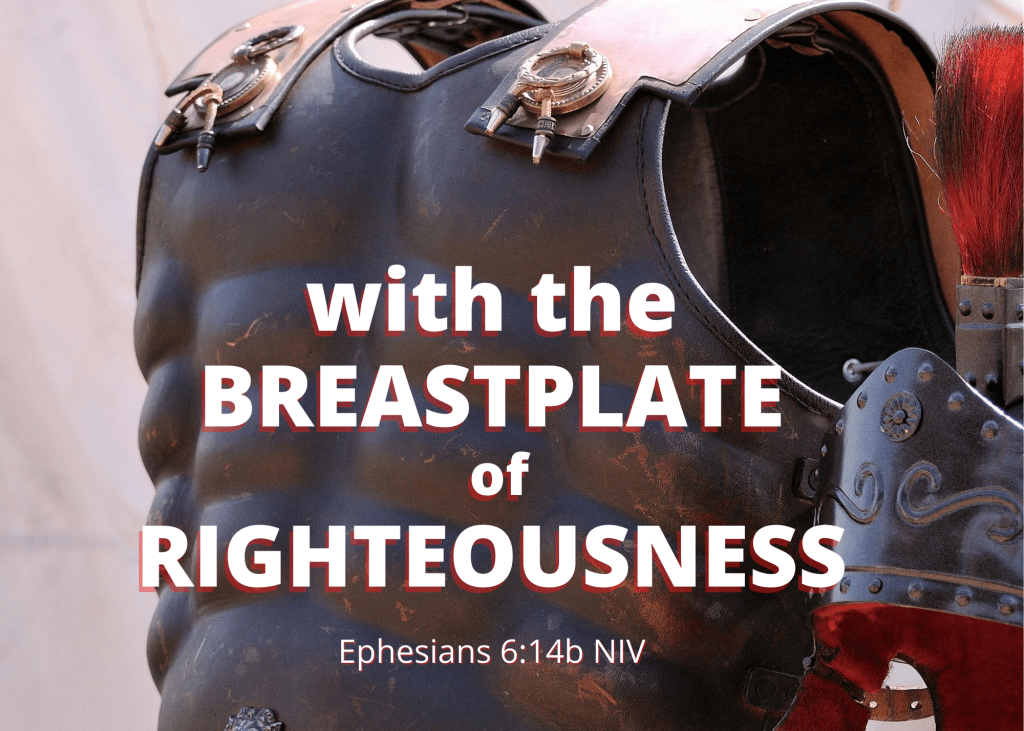
the Breastplate of Righteousness

Old Testament: 1 Kings 5 & 6

Poetry: Proverbs 11

New Testament: Ephesians 6:14b

As we continue our study on the Armor of God, we come across two terms that are not frequently used in our day to day vernacular: breastplate and righteousness. So let’s dig a little deeper in order to come to a better understanding.

The breastplate is the piece of armor that goes directly on top of the chest, protecting the heart, lungs, spleen, liver, and even the stomach. Longer breastplates would also cover and protect the intestines. Without this vitally important piece of the armor, any direct impalement by a sword, spear, or arrow could prove to be fatal. 

In modern warfare protection, soldiers wear vests made of a material called Kevlar. Invented by Stephanie Kwolek in 1965, its usefulness is not limited to body armor, but extends to brake pads, space suits, and drum heads. It’s been tested to be ten times stronger than steel, is capable of absorbing high-velocity impacts, and withstand extreme hot and cold temperatures. (Thanks Google AI for the information!) Today’s warriors don it knowing that their life could depend on it!

Righteousness is a word that is typically limited to “churchy conversations”. (Unless you were in high school in the early 90’s and claimed that something thrilling was “totally righteous”.) But what does this word really mean? Basically, it means to be in right standing before God; morally and ethically sound; to do the right thing with a pure heart. 

So how does a person become righteous? Romans 3:22-24 says, “This righteousness from God comes through faith in Jesus Christ to all who believe. There is no difference for all have sinned and fall short of the glory of God, and are justified freely by his grace through the redemption that came by Christ Jesus.”

Let’s try to tie this together. When we wear the breastplate of righteousness, we are literally layering on spiritual protection upon our hearts. Without this gear, we are vulnerable to the attacks from the enemy that could prove to be fatal. When we wear this armor of righteousness, we are able to stand before God and be seen worthy and faithful. His Holy Spirit will protect us. 

Some may be tempted to try to shortcut the cost and find cheap substitutes for this level of protection. Whether it be trying to buy our own righteousness by being a “good person” or living an inauthentic lifestyle, where your words and actions cover up a deceitful heart, the Bible is clear that there is only ONE source for a legitimate breastplate of righteousness. We must have faith in Jesus. Faith that accepts Jesus as Savior and Lord. Faith that believes the Lord will fight for us. Faith that commits to standing firm when everything around us crumbles. Faith that submits everything, our hopes and dreams, our plans and purposes, our resources and relationships, our past, present and future to the One who is called Jesus, the Christ, the Son of the Living God. 

Yes, it is costly. But the protection and confidence that it provides is invaluable for the fight that we must fight. “For our struggle is not against flesh and blood, but against rulers, against the authorities, against the powers of this dark world and against the spiritual forces of evil in the heavenly realms.” (Eph 6:12)

-Bethany Ligon

Reflection Questions

  1. How would you rate your righteousness: “to be in right standing before God; morally and ethically sound; to do the right thing with a pure heart”?
  2. How would you rate your faith in Jesus? What happens if you try to have righteousness apart from faith in Jesus? What does faith in Jesus lead you to be and do?
  3. How does a breastplate of righteousness protect you from the powers of this dark world? What would Satan want you to believe about the breastplate of righteousness? Where do you see this attitude/belief in the world?

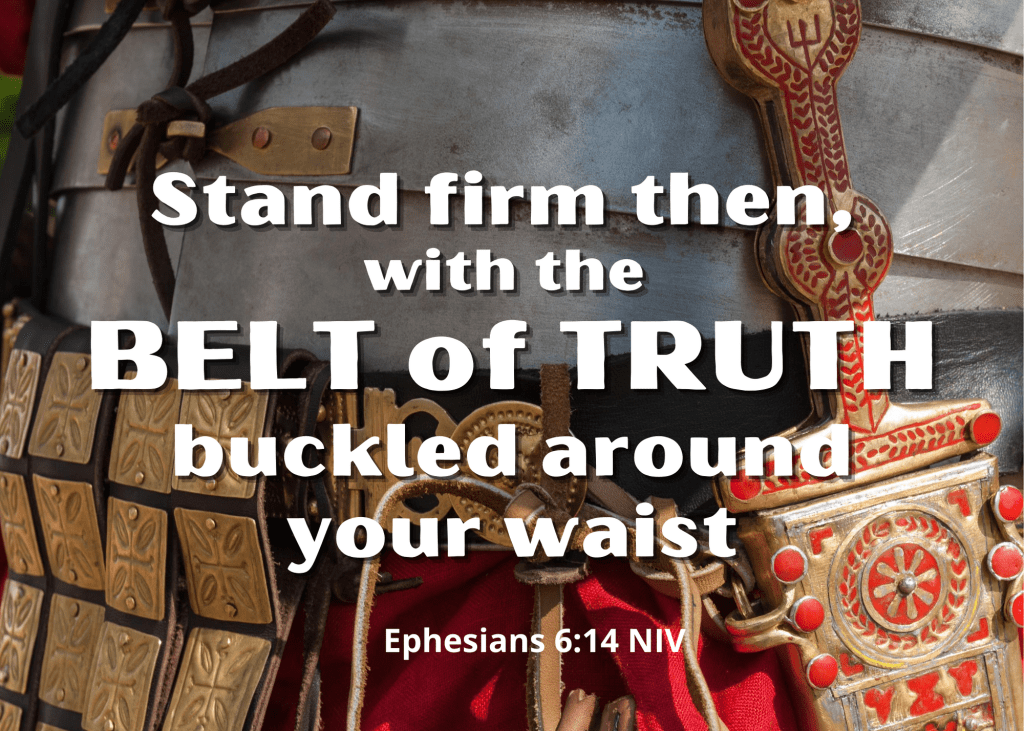
Belt of Truth Buckled

Old Testament: 1 Kings 3 & 4

Poetry: Proverbs 10

New Testament: Ephesians 6:14a

Heads up! This devotion is going to take you in a mini dive into the history of the buckle of all things! But first…

Many of us have read our key verse more than a handful of times in our lives. And we’ve even been taught about the belt of truth in our Sunday School lessons. It’s been explained that in ancient times, before a foot race or prior to battle, runners and warriors would tuck their long garments into their cloth belt, in order to provide free movement for the legs. 

As I considered this first half of this verse, the word buckle stuck out to me. My thoughts went a little something like this:

“Wait a minute…a buckle in ancient Roman times? This doesn’t make sense. The earliest I’ve ever seen buckles in history books is on the Pilgrims. Did Roman soldiers wear buckles?”

A few clicks in my web browser confirms that indeed, buckles were part of the Roman body armor. Depending on the type of armor, there could be one main buckle, or in segmented forms of armor, many mini buckles to hold all the pieces together. What’s more, the more elite soldiers had super fancy buckles, whereas those that served in the infantry had simpler and more practical buckles. 

Who knew???

With this new knowledge, our key verse today starts to take on an expanded meaning. Without the buckled belt of truth, the breastplate won’t stay in place and the protective plates on the shoulders wouldn’t be able to stay attached. Also, the tunic part of the armor which protected the groin wouldn’t have anything to attach to if it weren’t for the buckle. 

It all starts with the buckle on the belt. Just like it all starts with Truth. 

  • John 14:6 – “I am the way, the truth, and the life.”
  • John 8:32 – “Then you will know the truth, and the truth will set you free.”
  • 2 Timothy – “Do your best to present yourself to God as one approved, a worker who does not need to be ashamed and who correctly handles the word of truth.”
  • Psalm 25:5 – “Guide me in your truth and teach me, for you are God my Savior, and my hope is in you all day long.”
  • Ephesians 1:13 – “And you also were included in Christ when you heard the word of truth, the gospel of your salvation…”

The start of our key verse in Ephesians chapter 6 begins with “Stand firm then…”. If we are ignorant of the Truth, there is no way that we can stand firm. We must know the Truth of YAHWEH, and His Son, Jesus. We must know the Truth of salvation and the coming Kingdom. If we fail to know these truths, then our efforts to stand firm against the attacks of our opposition will be for nothing. 

So buckle up and stand firm in Truth.

-Bethany Ligon

Reflection Questions

  1. What would happen if you went into battle but couldn’t keep your pants up, or were restricted by your long garments? How important is truth? How do the other components of the armor rely on truth? What happens if we try to stand firm without truth?
  2. What truths do you believe about YAHWEH, His Son, Jesus, salvation and the coming Kingdom? Are there any that you are unsure about and need to study more? How do these specific truths affect other pieces of your armor: salvation, righteousness, faith, and gospel of peace?
  3. What can you do today to be better buckled into the truth?

Be STRONG in the LORD

Old Testament: 1 Kings 1-2

Poetry: Proverbs 9

New Testament: Ephesians 6:10-13

Ephesians 6:10-13 – “…Finally, be strong in the Lord and in his mighty power…”

If you were to look at the different video playlists I have curated in my Youtube profile, you’d see that a majority of them are workout exercise videos. I have playlists for upper body strength, lower body strength, pilates and barre workouts, HIIT and stretching videos. What can I say, I need variety in my life if I’m going to pursue a lifestyle that includes regular exercise. 

But physical strength and endurance is not what the apostle Paul is talking about in the sixth chapter in his letter to the Ephesian church.

Nor is Paul referring to mental toughness. The kind of fortitude that prisoners of war or persecuted believers must endure when they are held captive in inhumane environments. 

Paul writes the words, “be strong in the Lord and in his mighty power”. These words are almost identical to what we read in Joshua 1, verse 9, “Have I not commanded you? Be strong and courageous. Do not be terrified; do not be discouraged, for the LORD your God will be with you wherever you go.”

Joshua was preparing for a physical battle that had spiritual consequences. We probably are not preparing for a physical battle; however, if we are actively pursuing a life centered on the Gospel message, we are indeed engaging in a battle that has spiritual consequences. 

So what does it mean to be “strong in the Lord and in his mighty power”?   

First, I think it means that we must recognize that if we are going to do anything in the name of Jesus, we are stepping into battle against the devil’s schemes. We become a threat that must be neutralized. A soldier prepares for battle by donning on their tactical gear. We need to do likewise.

Second, “be(ing) strong in the Lord and in his mighty power” means that our own efforts, our intelligence, our will power, our connections, our resources are insufficient protection for what we are up against. If it were up to only us, then our efforts would be whooped before we even really got started.

Once we acknowledge that we are in a battle and we are without adequate protection, what are we left with? We will only be successful in spiritual warfare with our faith. A faith that says:

We believe that God is who He says He is.

We believe that nothing is impossible for God.

We believe that God is faithful to His people.

We believe that God will fight for us. 

We believe that God has already won the ultimate battle.

When we cling to these truths, we are “strong in the Lord and in his mighty power” and we can withstand any kind of opposition that we are tasked to face and endure. And we will be victorious. 

For whatever battle you might be facing today, remember that you are not alone. You serve a God who loves you and has empowered you with His Holy Spirit to stand firm and do great things. Keep the faith and believe.

-Bethany Ligon

Reflection Questions

  1. How strong are you – physically, mentally, and spiritually? Of these three areas in which do you spend more workout time developing? How does one go about strengthening spiritual muscles? Why are spiritual muscles important?
  2. What do you believe about God and His Son Jesus and how does believing each statement help prepare you for spiritual battle?
  3. What do the devil’s schemes look like? When does he win battles? What can you do to stand against him in God’s power?

Seeking God & Standing Firm

Old Testament: 2 Samuel 23-24

Poetry: Proverbs 8

New Testament: Ephesians 6:1-9

The world’s most powerful navigational tool, the compass, has been around in some form for over 2000 years.  Originally used in divination, it found its way to navigation a few centuries before the age of exploration. When blinded by snow, when tossed at sea, when wandering through a dense forest, it works without fail for all who seek direction. When unobstructed by friction or gravity, the magnetized metal responds in the same true way to of the Earth’s gravitational field, aligning with poles of the Earth.  This means that a compass is actually influenced by two directions at once, polar opposites. It seems silly to say, but you cannot travel in the direction of north and south at the same time. All of these elements ring true in our faith.

“To fear the Lord is to hate evil; I [Wisdom] hate pride and arrogance, evil behavior and perverse speech. Counsel and sound judgment are mine;  I have insight, I have power.” – Proverbs 8:13-14

It is equally foolish to say that we can move in the direction of God and evil and be on the same course. They are truly polar opposites.  To love God is to hate evil (Psa 97:10).  To honor God is to give up pride (Jam 4:6). To pursue God makes the pursuit of anything else secondary (Matt 6:24).  We can acknowledge the fact that our journey will not be perfect, but the direction we are pointed is true, faithful, and unchanging.  It doesn’t adjust with time or relativism (Isa 40:8).  Be conscious of the friction and the pull that is in the present evil age that will skew your target.  Chart a course from God’s word and prepare yourself because there is more than one force at work.

“Finally, be strong in the Lord and in his mighty power. Put on the full armor of God, so that you can take your stand against the devil’s schemes. For our struggle is not against flesh and blood, but against the rulers, against the authorities, against the powers of this dark world and against the spiritual forces of evil in the heavenly realms.” Ephesians 6:10-12

The military command of “standing firm” is far from passive (Eph 6:13). In 2 Samuel 23, we see a captivating glimpse of David’s mighty warriors. Many of them, like Eleazar (v. 10), are not commended for their brilliant offensives, but holding their ground to the very end to eliminate enemy forces. Likewise, the grace we accept from God is through faith, not deed (Eph 2:8-9), and by seeking and finding Him, we have already arrived at the destination in some sense (Eph 2:19-20). Therefore, we cannot rest our laurels because there are all-out assaults coming. It is not a battle of mortality, flesh and blood, but a battle against rulers, authorities, powers of darkness, and even spiritual forces for the spoils of eternity. We are to armor ourselves with truth, peace, faith, salvation, righteousness, holding close to the Spirit and ready to wage war until the end.


In conclusion, today’s lesson is two-fold.  First, make sure that you are allowing God’s direction to guide you as you move.  Know that when you are moving towards God, you are fleeing from evil influence, relative morality, and sin and towards a loving God and restored perfection (2 Tim 2:22).  Second, once we arrive in grace, our job is to stand our ground.  We are to set a fortress around our hearts (Pro 4:23), as both a guard and a vigil, petitioning for God to intercede and help us withstand the battle.  Like Paul, our prayer should be for fearlessness (Eph 6:20), eyes-locked on the prize , so we can stand firm in the truth of the Coming Kingdom.

-Aaron Winner

Reflection Questions

  1. Towards God or towards evil? What does each path look like? What is at the end of each path? Which direction are you pointed?
  2. What or who has turned you around before, pointing you in the wrong direction? What are you leaving behind you when you move towards God?
  3. What acts as your compass? How valuable is your compass to you? Have you ever been lost without it?

Photoreceptors

Old Testament: 2 Samuel 22

Poetry: Proverbs 7

New Testament: Ephesians 5

A few weeks back my children were very excited to have me read a new book they checked-out from the library.  Not yet mastering the alphabet, their choices are often from the featured book table, typically the flashiest cover; however, the book they chose did not meet my expectation. Their choice: The Worm.  The title wasn’t a metaphor. Not a how-to on dance moves. Not a fictional story of a kid-turned-wrestler.  It was literally a picture book just about worms, and so we began to learn everything I never wanted to know about these three phylums of the animal kingdom.  Did you know that worms can be over 100 feet long? And there are people around the world who eat worms? Or that worms are hermaphrodites? Probably the most relevant fact to today’s devotion is that most worms, including the earthworm, don’t have eyes. This doesn’t stop them from knowing when they are exposed to light. Built into the skin of earthworms are photoreceptors which work as light detectors. These creatures of darkness cannot exist in the light. Being caught above the surface trying to do your same wormy thing equals starvation, dehydration, or becoming prey.

Looking at today’s Proverb, we can see that the speaker is specifically warning his son about infidelity and adultery.  If we use a broader brush with this wisdom, and extend the metaphors and figures of these proverbs as is often done, we can bring our own struggle with sin into the picture.  “Do not let your heart turn to her ways or stray into her paths.  Many are the victims she has brought down; her slain are a mighty throng. Her house is a highway to the grave, leading down to the chambers of death. (Prov. 7:25-27).” Don’t stray into the path of lust, pride, greed,or being obscene (Eph 5:1-3).  A knock on the door soon becomes a visit. A visit becomes a stay.  When you stay long enough, it is where you live (James 1:14-15). Like a worm, deeper and deeper you dig yourself into the ground, making your bed and lying in the grave.

You may not have heeded the warning up to this point, so here is the wake-up call to all of us worms trying to hide from the light, whether it be for a day or decades,“But everything exposed by the light becomes visible—and everything that is illuminated becomes a light.  This is why it is said, “Wake up, sleeper, rise from the dead, and Christ will shine on you (Eph 5:13-14).’” When we are exposed by the light of God, we shrivel up and die.  This can be tremendous or tragic. Waking up today means we die unto ourselves and become a new creation in Christ.  We are covered, cleansed, and made pure through God’s grace given to us through the blood of the Lamb.  If our dry bones do not rattle and we die in our darkness, there is no rebirth. Only an eternal separation, a scorching from the Light, because, “For of this you can be sure: No immoral, impure or greedy person—such a person is an idolater—has any inheritance in the kingdom of Christ and of God.  Let no one deceive you with empty words, for because of such things God’s wrath comes on those who are disobedient. Therefore do not be partners with them (Eph 5:5-7).” 

You may have fallen victim to a snare, directly disobeying the commands of God. Don’t sleep on this. Restore your relationship with the One True God, and in the midst of the distress, ask for help and He will answer, not letting you become a victim to the grave (2 Sam 22:5-7). God has given us a path to repentance and an amazing grace. It is time to put your photoreceptors to work, find the surface, and enter again into His marvelous light.

-Aaron Winner

Reflection Questions

  1. What sins have seduced you? What was enticing about this sin? Have you gone in for a visit, or a stay, or is that where you live now?
  2. What do you know about God’s wrath? What do you know about God’s grace? How does God decide which worm gets the grace and which worm gets the wrath? Which worm are you right now?
  3. How active have your photoreceptors been? Do you recognize the difference between light and dark? Unlike the worm, do you seek the light? How?