Watch Out for Those Thorns!

Old Testament: Numbers 23 & 24

Poetry: Job 18

New Testament: Mark 4:1-25

It’s getting close to planting time in northern Indiana, so it seems a great time to look again at the Parable of the Sower – one of my favorite parables. And I love how I still find new thoughts and ideas in this teaching from Jesus. I remember how this parable ministered to me when I was a young youth worker experiencing heartache over a youth who had received the word but was going in a different direction. This parable encouraged me. Jesus didn’t expect that every seed we helped to sow would grow into a healthy, whole, fruit-bearing plant. But, he did, and does, expect us to keep sowing the seed. And, we never know which of the seeds we sow will indeed grow, bloom, and produce beautiful, life-giving fruit.

Today I want to zero in on the seed among the thorns, but first a quick review of the other three types of soil and Jesus’ explanation of each to provide contrast.

Seed 1 – fell along the path – birds came and ate it – as soon as they heard the word Satan (the birds) came and ate it

Seed 2 – fell on rocky places – not much soil – not much root – sprang up quickly – when sun comes up plant is scorched and withers – receive the word with joy – but lasts only a short time – trouble and persecution comes and the plant falls away

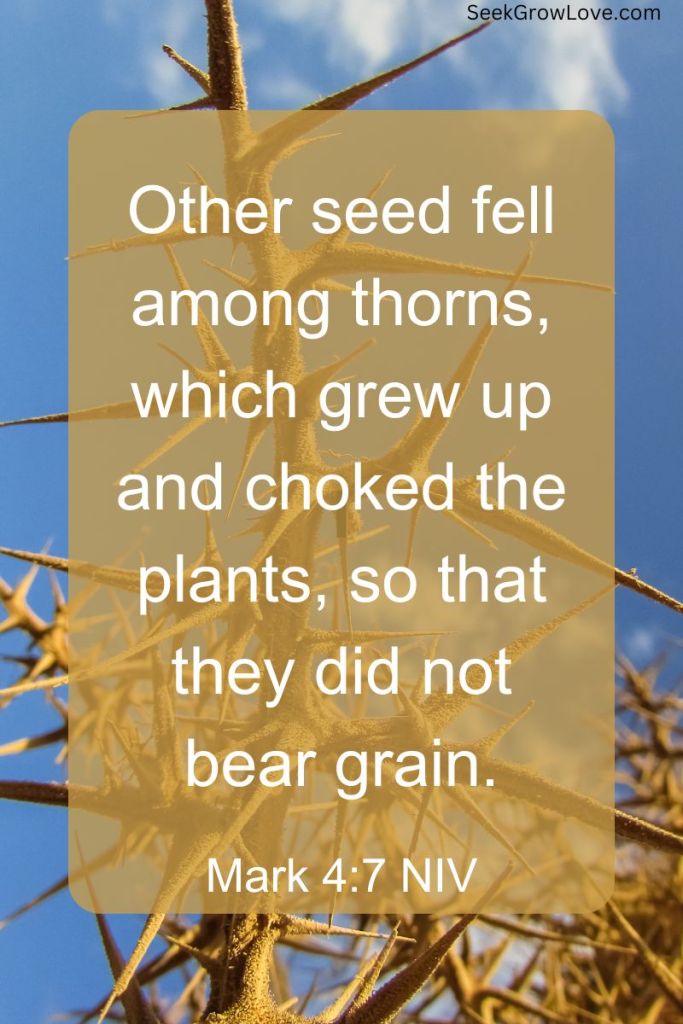
Seed 3 – fell among thorns – thorns grew up and choked the plant – plants did not bear grain – hear the word – but worries of this life, deceitfulness of wealth, and the desires for other things comes in – the plant is choked out, making it unfruitful

Seed 4 – fell on good soil – came up and grew and produced a crop, multiplying 30, 60, or even 100 times – hear the word, accept it and produce a crop

It is important to remember that in each of these scenarios the seed is all the same. There is nothing inferior to seed 1, 2 or 3. It is the same as seed 4. It is the perfect word of God being sown into the world. What creates the difference is where in the world it lands. Some people will accept it and do all that is necessary to make it grow in their lives and even produce fruit to give life to others. Some people will not. But, either way, the seed is still good and perfect.

The new thing I saw when I read the parable this time is that the plant from seed 3 that fell among the thorns did not necessarily die. Seed 1 never had a chance at life. Seed 2 enjoyed life for a short time but withered/fell away. I think in my mind I was giving a death sentence to seed 3 already as well. But, that’s not exactly what the Scriptures actually say. Both in the original parable and Jesus’ explanation it says the plant was choked by the thorns – it does not say killed by the thorns – at least not yet.

It is not down and out, yet. It is still alive – it might be sitting in your pew with you at church or it might be your neighbor across the street. It has a pulse. It might be a family member – it might be you. It is not dead, yet. It is alive – but it is not healthy. A healthy plant doesn’t have thorns wrapped around its neck. Jesus tells us the result of being choked by the thorns was that it did not bear grain – it was unfruitful. It is alive – but it is not experiencing the abundant life that Jesus spoke of. It is not producing and displaying the life-giving fruit of the Spirit. It is not reproducing and giving new life to others. It is alive but it isn’t passing along life. It is a sad place to be – whether you are a plant or a Christian.

Who needs a vegetable garden with no vegetables? Or an orchard with no apples? Or a wheat field with no wheat? Or a Christian with no fruit?

What can be done for such a plant? Is there any hope for the plant choked by thorns? I say yes! Cut off the thorns! Sometimes when I am gardening I am not sure what needs to be pruned and what needs to stay. What would kill the plant and what would help it grow healthy? I love that Jesus tells us exactly what the thorns are so we know what to cut out. He tells us the thorns are “the worries of this life, the deceitfulness of wealth, and the desires for other things” (vs. 19). And if you aren’t cutting them out, be sure that they are choking new life out of you. A worried Christian. A greedy Christian, or a Christian relying on his own bank account. A Christian with other priorities. It is not a healthy place to be. And it certainly doesn’t promote new life.

Examine your plant carefully. Being alive is good. But are you bearing fruit? What does your fruit look like? What does it smell and taste like? Where are you giving new life to others? If you aren’t sure if you are bearing fruit now – what do you want your fruit to look like? What do you need to get rid of first?

What thorns might be creeping up toward your neck? What are you worried about? Do you think your problems are too big for your God? What are you putting your trust in? God or yourself or your job or your paycheck? Do you hoard, are you always striving for the next big toy, is it hard to be generous? Have you bought any of the ‘deceitfulness of wealth’? Is pleasing God the most important thing in your life? Or are there other things you desire more? What have you made the number one priority in your life?

Cut out the thorns so you can have life – and bear fruit – which will in turn give life.

-Marcia Railton

Questions above – and what other questions would you add?

Surviving a Deadly Plague of Snakes

Numbers 21:9 NIV for SGL

Old Testament: Numbers 21 & 22

Poetry: Job 17

New Testament: Mark 3

In today’s reading, the Israelites needed a spiritual “blood transfusion.” Their sinful and rebellious attitude had shown itself in impatience, complaints about hardships, ingratitude for manna, and a lack of faith in God’s leader, Moses. This faithlessness resulted in a deadly plague of snakes that were killing the people.

The Israelites repented and asked Moses to intercede for them. God’s response required them to show their repentance by a simple act of faith. Moses made a bronze serpent and lifted it up on a pole. To be healed, people had to look at the serpent. If they didn’t believe God’s words, they wouldn’t look up and would therefore die. Only through faith could they be saved.

Homeopathic medicine is the practice of curing likes with likes. The patient receives diluted doses of substances that, at full strength, cause the same symptoms the patient already has. This type of medicine is used in many parts of the world, though it remains controversial among medical experts. In this instance, God prescribed a similar remedy for Israel, treating snake bites with a replica of a snake. Going a step further, God undid the effects of the plague through an image of the curse itself.

Today’s story begins with the people grumbling … again. It was the same old story: we’re dying, we’re starving, we don’t like the miraculous food, and we’re sorry we ever left Egypt. But this incident is unique; this time, the people repented.

In past events, Moses had asked God for mercy on behalf of the Israelites, but on this occasion, his prayers were prompted by a recognition of their sin that Israel hadn’t shown before. They realized on their own why the snakes were sent, and they confessed their sin. In that way, this was a spiritual breakthrough for Israel!

If God had followed the formula we’ve seen so far, we might expect Him to demand a sacrifice of some kind, like a lamb without defect. But the Lord told Moses to put a bronze snake, a picture of judgment, on a pole for all to see. He directed the people’s eyes, not to an image of purity, but to a symbol of wrath.

For healing to take place, the people had to close the loop of repentance. They sinned, confessed, and asked for mercy. The last step was to accept God’s remedy by faith and follow His instructions.

We often picture Christ as the perfect sacrifice, and that he is. But He also took upon Himself the shame of sin and the full penalty of wrath. In His conversation with Nicodemus, Jesus compared His upcoming crucifixion to the lifting up of the serpent in the desert. Let’s confess our sins, seek His mercy and turn our eyes to him, who not only gave his life but also received our punishment. Thank Him in word and in deed today.

Andy Cisneros

(Originally posted on March 3, 2020 for SeekGrowLove)

Reflection Questions

  1. What have you most recently complained about? Do you often complain? Is there a problem with complaining and grumbling? How do you think others view your complaining? How do you think God views it?
  2. What role does confession and repentance play in your relationship with God and others? How has God shown His mercy to you when you have repented? Is there anything you need to confess and repent of?
  3. After the Israelites confessed and repented what did they have to do next? What does God expect from us after confession and repentance?

Bring Your Friends to Jesus

Old Testament: Numbers 19 & 20

Poetry: Job 16

New Testament: Mark 2

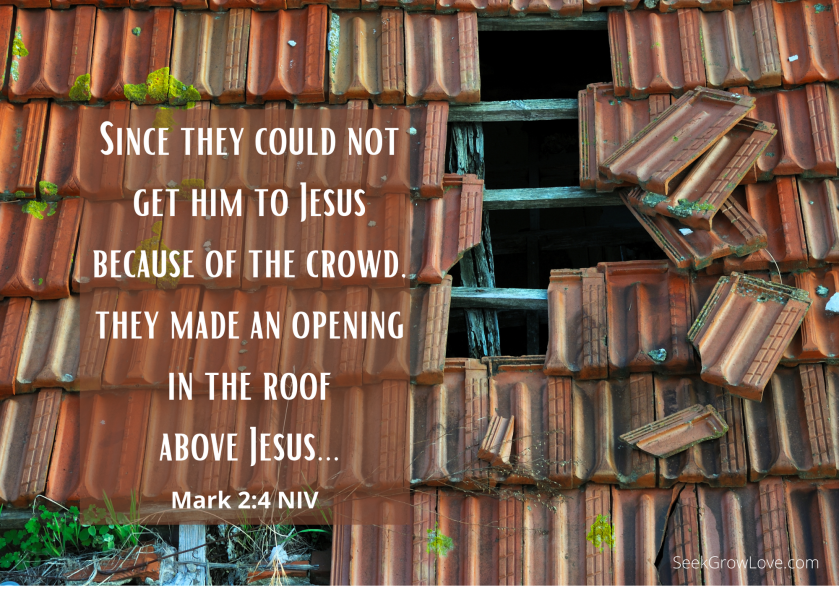
In Mark 2, we find the story of Jesus healing a paralyzed man.  Jesus was becoming more well known, and more popular.  He was inside a house, and some men brought their friend to Jesus so Jesus could heal him.  But because such a big crowd had gathered, there wasn’t room to bring him to Jesus, not even outside the door.  So the friends took the man onto the roof, dug through the roof, and let him down in front of Jesus.

I have to admire these friends.  They were very concerned about their friend, and wanted to see him healed.  They believed Jesus could and would heal him, if they could just get him to Jesus.  They didn’t just “pray about it”, they stepped out on faith and did something about it.  They dug through the roof, and let their friend get close to Jesus – and Jesus rewarded their efforts.

Mark 2:5 tells us, “When Jesus saw their faith, he said to the paralytic, “Son, your sins are forgiven.”  Jesus obviously saw that the man was crippled, but Jesus saw what wouldn’t have been nearly as obvious to us.  The man’s biggest problem was his sin – so Jesus healed him of that first.  This is the greatest miracle Jesus performed (and still performs).  

The teachers of the law said that Jesus was blaspheming, believing only God can forgive sin.  I’m guessing they were thinking, “it’s easy to tell someone their sins are forgiven, since you can’t prove they are really forgiven.”  Jesus then told them, “But that you may know that the Son of Man has authority on earth to forgive sins…”  He said to the paralytic, “I tell you, get up, take up your mat, and go home.”  So the man got up, took his mat, and walked out.

I love this story, not only because I love reading about all of Jesus’ miracles, but specifically because this is the only story I can think of where someone is healed because of the faith of his friends.  We’re not told, maybe the paralyzed man asked to be taken to Jesus.  But any way about it, Jesus saw the faith of the friends, forgave the man’s sins, and ultimately healed him.

This story puts me to shame.  I invite you to ask yourself some questions…

Am I this concerned about my friends?  

Am I willing to be uncomfortable – maybe even make a scene – to bring someone to Jesus?  

Am I willing to not just “pray for” someone, but actually “do something” for someone?  

Would Jesus see my faith and forgive and even heal someone I care deeply about?

Finally, do I need Jesus’ ultimate miracle for myself – to have him forgive me of my sins?  This miracle meets the greatest need.  It costs the most.  It brings the greatest blessing.  It has the longest lasting results.  And Jesus is still doing it daily.

–Steve Mattison

(Originally posted for SeekGrowLove on October 6, 2020)

Questions – See Above

Let’s Go Fish!

Mark 1:17 NIV for SGL

Old Testament: Numbers 17 & 18

Poetry: Job 15

New Testament: Mark 1

I used to own a pair of fish that my best friend gave me. I thought I was a decent fish owner. But then I went off to Australia for three weeks and when I returned, I came home to find that the slow-release food supply that I put into the tank, didn’t dissolve. My poor fish starved to death. Oops.

So your reservation to take seriously any of my mentioning of fish, fishing, or fishermen would totally be understandable.

But I ask that you hear me out, just this once, for this particular topic. After all, I did my due diligence and Googled some information.

Mark 1:17 says, “Come, follow me,” Jesus said, “and I will make you fishers of men.”

Being a fisherman was way back then and continues even today to be a daily job. Likewise, as we follow Jesus daily, our casting of nets should happen every day we are around others. If we are called to be fishers of men, all of our interactions need to be with the purpose of building relationships and showing others, verbally and nonverbally, what life with Jesus as our Lord looks like.

Peter and Andrew knew when the best time to go fishing was. According to www.takemefishing.org (I’m totally serious… ) the best time to fish is usually later on in the day. I know that there are probably a gazillion other variables that should be considered, so don’t go dismissing the bigger picture here. Later in the day, the fish are primed for feeding because their metabolism and digestion are roaring. There is a lesson for us here – in order for people to win others to Christ, they need to be primed. In God’s own timing, a person’s heart will be open to receive the Gospel. As fishers of men, we need to be praying for those opportunities to present themselves so we are able to discern what to say and when to say it.

We know from verse 16, that Simon (later called Peter) and his brother Andrew used nets for fishing. Not a pole, line and lure, but nets. They caught hundreds of fish at a time. When Jesus says that he will make us fishers of men, I think His intention is that we not just teach a few people about Jesus, but that we influence hundreds of people, over our lifetime, to consider what life as a follower of Jesus would look like.

We also know from verse 16, that fishing was not a solo effort. It demanded at least a pair to get the job done. Our faith is meant to be in a community. Yes, Jesus goes off to a solitary place in verse 35 of Chapter 1, but that doesn’t mean we live in a vacuum. Working and serving with other believers is how our faith is supposed to be carried out.

I fully admit that sharing the Gospel is not my strength. But as I read this verse, I became convicted that this is something that I need to take more seriously. That’s partly why I chose it to be the verse to memorize for the week. So even though it is a short verse and easy to commit to memory, it’s potential to change my life and the lives of those around me, is significant.

Wanna go fishin’?

-Bethany Ligon

(Originally posted for SeekGrowLove on September 11, 2017)

Reflection Questions

  1. How have you been helped by your fishing community? How can you help them?
  2. How committed are you to following Jesus and fishing for people? What do you find hardest about these jobs? What gets in the way?
  3. Pray to God about how He would like to see you fishing for men/people. What does it look like? When and where will it be done? Who will your fishing partners be?

With all Boldness

Old Testament: Numbers 15 & 16

Poetry: Job 14

New Testament: Acts 28

At the end of the book of Acts we are following Paul in his ministry as he shares his testimony and all he is learning from God with established groups of believers as well as with those who have not yet heard the good news of Jesus Christ. He is told through a prophet that he will be bound by the Jewish leaders and sent to the Gentiles to share his story.  He is accused by the Jewish leaders in Jerusalem, then arrested and imprisoned while the Roman authorities try to figure out which side of the story to believe.  Over the course of Paul’s imprisonment he is moved to various cities and meets with several governors as well as King Agrippa.  Then finally he is sent to Rome.  During each of these transitions, Paul has an opportunity to share the story of his conversion…who he was…who he is and who he will continue to be through God’s grace.  Every time he is questioned he says something like the following phrase from Acts 23:1 “My brothers, I have fulfilled my duty to God in all good conscience to this day.” 

Paul faced so much opposition during this period of time and yet he continued to stand firm in his belief that God had a purpose for him which would be fulfilled no matter what…arrest, false accusations, storms, shipwrecks, imprisonment, isolation, death threats, nothing was going to stop God’s message from being spread.

As the book of Acts closes we are given a chance to witness Paul as he teaches a group of Jewish leaders in Rome. 

Acts 28:23-30

They arranged to meet Paul on a certain day, and came in even larger numbers
to the place where he was staying. He witnessed to them from morning till evening,
explaining about the kingdom of God, and from the Law of Moses and from the Prophets he tried to persuade them about Jesus. 24 Some were convinced by what he said, but others would not believe. 25 They disagreed among themselves and
began to leave after Paul had made this final statement: “The Holy Spirit spoke the truth to your ancestors when he said through Isaiah the prophet:

26
“‘Go to this people and say,
“You will be ever hearing but never understanding;
you will be ever seeing but never perceiving.”

27
For this people’s heart has become calloused;
they hardly hear with their ears,
and they have closed their eyes.
Otherwise they might see with their eyes,
hear with their ears,
understand with their hearts
and turn, and I would heal them.’[a]

28 “Therefore I want you to know that God’s salvation has been sent to the Gentiles,
and they will listen!” [29] [b]

30 For two whole years Paul stayed there in his own rented house and welcomed all
who came to see him. 31 He proclaimed the kingdom of God and taught about the Lord Jesus Christ—with all boldness and without hindrance!

Some of those who were listening, heard Paul’s message and their lives were changed.  Others found that they couldn’t believe what Paul was preaching and left.  They heard but didn’t understand, they saw but didn’t allow comprehension. Paul kept right on teaching, preaching and sharing his mess so that God’s message could get through.

Oh to have Paul’s boldness and eloquence!  There are many times that we are provided the opportunity to share our own stories of faith with others and we often let them pass us by.  Are we afraid?  Maybe we don’t think they would be interested, or that we’ll be bothering them if we share.  Or maybe we don’t want to offend anyone…but if we are learning from Paul’s example, we need to be sharing our stories of faith regardless of the personal costs.  God’s message will be heard, don’t you want to be a part of that exciting adventure? I promise it’ll be a good one!

-Joyanne Swanson

(Originally posted for SeekGrowLove on November 8, 2018)

Reflection Questions

  1. What do you admire most about Paul? What do you admire most about how God worked in Paul’s life?
  2. How has God worked in your life? When was the last time you told someone one of your stories of faith (it could be a conversion story, or how God provided or guided)?
  3. Does fear keep you from sharing? What is the worst that could happen if you share a story of faith? What is the worst that could happen if you don’t share? What is the best that could happen if you do share?
  4. If you would like to practice writing out a faith story, leave a comment here, we’d love to hear yours!

How will your story end?

Old Testament: Numbers 14

Poetry: Job 13

New Testament: Acts 27

One of our readings today has a very good ending. One of our readings today has a very bad ending. The story with the very good ending could have ended very differently and many lives could have been lost at sea, including Paul’s. The story with the very bad ending could have ended very differently and many lives could have been saved including the ten spies who died in a plague and all those over twenty years of age who died in the wilderness.

I won’t retell the stories here. Make sure you read the account of the grumbling Israelites who listened to the ten scared spies instead of the two faithful ones in Numbers 14, and see what the consequences were for their actions and especially their attitudes. It is a powerful chapter that would have a huge devastating effect on the lives of every single Israelite young and old.

And also read the detailed account of Paul’s voyages towards Rome which included hurricane strength storms that went on for days with no sun or stars. Read of God’s promise to Paul in the midst of the storm.

God could have saved all onboard Paul’s ship by simply stopping the storm. But He didn’t. He let them endure the storm that raged for days. Maybe He was building character and perseverance and teaching the other 275 onboard to listen to Paul and Paul’s faithful God. Perhaps He was preparing the Malta islanders to receive all the castaways who would miraculously survive as well as receiving the good news of the God that saves. Maybe he was giving Paul one more great adventure and answer to prayer before arriving in Rome.

God could have sent earthquakes, fire or plagues to instantaneously wipe out the Amalekites and Canaanites so the Israelites wouldn’t need to face opposition and could just march in and take the land God promised to them. But He didn’t. We don’t always get to hear the mind of God and reasons He has for doing it His way, but in this case we do get one interesting reason I wouldn’t have thought of in Deuteronomy 7:21-24.

Do you believe the promises of God? Do you trust Him enough to not grumble against Him when there are obstacles in the way? Do you believe that safety and rest are on the other side of those storm clouds? When you face storms, trials and opposition it is not because God doesn’t care or He is not powerful or smart enough to have avoided the speed bump. Can we trust God knows more than we do and the troubles we face are not too big for Him? We tend to get into pretty big trouble when we decide we know more than God and we want to do it our way instead or we are too scared to go where He guides. Will we listen to the Joshuas, Calebs and Pauls who remind us of God’s promises and His power to provide, when we obey? Or will we grumble against our God in fear of what is in front of us?

How will your story end?

It depends on your view of God and what you do in the storms. Will you believe Him? When the easy way is enticing, when the opposition is scary, when the storm is big, will you remain faithful to God remembering the promises He has given? Will you remember how big and great your God is?

-Marcia Railton

Reflection Questions:

  1. What promises has God given to you? How do they help you when you are scared or unsure of the future?
  2. What obstacles have you encountered on the way? How have you grumbled against the Lord which leads to rebellion?
  3. How can you build your trust in Him so you aren’t tempted to join the masses when they grumble and rebel and try to jump ship but you stand strong with the Joshuas and Calebs and Pauls.
  4. How do you see your story ending?

What Can Your God Do?

Job 12:13 for SGL

Old Testament: Numbers 13

Poetry: Job 12

New Testament: Acts 26

What can your God do? Is there anything He can not do? In our Bible readings today we get a glimpse into how a few different people might have answered those questions.

Let’s look at Job 12 first. Job is replying to his friend Zophar who just suggested that since God is great and right and true and since Job is suffering, that must mean that Job is deceitful, evil, or witless (or all three) and is being punished. Job is ready with a quick reply. Do his friends think “wisdom will die with you?” (vs. 1). He certainly still has some spirit left in him.

Most of this chapter Job is giving credit to God for what God can and has and will do:

– giving life and breath to every creature and all mankind (vs 10)

– owning wisdom and power, counsel and understanding (vs 12)

– controlling the waters with drought or flood (vs 15)

– holding strength and victory (vs 16)

– overthrowing men long established – even judges, kings and priests (vs 17-19)

– reveals the deep things of darkness (vs 22)

– makes nations great, and destroys them (vs 23)

– deprives the leaders of the earth of their reason (vs 24) – hmm – interesting

Job is agreeing with his friends on the greatness of God! No one can come anywhere close to comparing to what God is and what He can do. No human wisdom, strength, plans, or power can successfully stand against Him. When God wants to bring them down, He can and He has and He will! He can make them rise. He can make them fall.

Oh, if only the 10 scared spies knew that lesson from Job! How might their lives – and the lives of ALL of the Israelites who listened to them – have been different. In Numbers 13 we see Moses following God’s direction to send out 12 men (one from each tribe) to look over Canaan land which God had promised long ago to Abraham’s descendants. The twelve found the land just as wonderful as God had promised – flowing with milk and honey, huge clusters of grapes, bountiful harvests. It must have looked pretty amazing as they had just spent a couple years in the wilderness mostly surviving on God’s manna and quail – which were also true signs of God’s miraculous provision – but ones they had become accustomed to and now took for granted.

But rather than believing God for the promise and remembering how He had bested the powerful Egyptians, they shrunk back in fear. They knew on their own they were no match for the strength and size of all the people who already lived in the land. But they forgot what God could do. They forgot how God had already gotten them this far. They forgot what was most important to remember! They forgot what their God can do!

-Marcia Railton

Reflection Question

  1. What have you seen God do for others? What have you seen God do for you? What promises do you believe God will indeed accomplish?
  2. When you feel like a grasshopper up against a giant, what can you remember about your God? What can He do?
  3. How does your view of what He can do change what you do?
  4. Who have you told what God can and has and will do? Who else can you tell?

Citizen Rights and Privileges

Acts 25 11 NIV for SGL

Old Testament: Numbers 12

Poetry: Job 11

New Testament: Acts 25

In chapter 16, we found out that Paul was a Roman citizen. Being a citizen of this vast empire was a great privilege. There were only two ways to gain Roman citizenship; you could either purchase it (something only the rich could afford to do), or be lucky enough to inherit it from your parents when you were born. Paul was born a Roman citizen.

The reason why you would want to be a Roman citizen in the first century is that they were given rights others were not guaranteed. The rights to marry another Roman citizen, to sue and to be sued, to have a legal trial, and to not be crucified were just some of the benefits offered to those privileged enough to be Roman citizens.

As we saw in chapter 21, Paul had already used his citizenship to get out of being flogged (Romans, legally, could not be tortured or whipped). In chapter 25 Paul exercised another of his rights–the right to appeal to Caesar. Paul knew that if he was brought back to Jerusalem, the men that had pledged to kill him would probably succeed. He also knew that he had to get to Rome to testify there. Thus Paul used his privilege to get to where he needed to go, so he could do what he was required to do (though, as we shall see in the coming chapters, this journey would not be an easy one).

If you were born in the West (especially the United States), you, like Paul, are privileged. You have rights like freedom of speech, freedom of religion, and freedom of the press. But there are many parts of the world today where these rights that are taken for granted here are only the ideals of dreamers. There are Christians throughout the world who have to look over their shoulder as they travel to church (if a public place of worship is even allowed) and others who are worshiping with the knowledge that every gathering may easily be their last.

There is another privilege you share with Paul: you are a citizen of Heaven. This citizenship cannot be purchased or inherited. It is not exclusive. The Kingdom of Heaven (or, Kingdom of God) is open to anyone. The poor and the rich, the weak and the strong, the lost and the found are all welcome. The cost of this privilege was paid for by God with the blood of His Son. It is offered to any who will receive it.

Paul was first and foremost a citizen of Heaven. He lived his life devoted to advancing the Kingdom and the One who will establish it in its fullness. The rights his Roman citizenship granted him were nothing compared to those his Lord did. That being said, Paul exercised his privilege as a Roman in order to promote God’s Kingdom as a Christian. He wanted to make sure as many people as possible would become citizens of the Kingdom. You also can use your rights as a citizen of your country to further the cause of the Kingdom. Exercise your earthly privileges in a way that leads others to receive heavenly ones.

-Joel Fletcher

(originally posted March 6, 2019 for SeekGrowLove)

Reflection Questions

  1. Do you think of yourself first as a citizen of the country you were born in/live in – or a citizen of heaven (where God dwells)? What are the differences?
  2. How can you use your rights and privileges to promote God’s Kingdom?
  3. Who do you know who needs to know more about how to become a citizen of the Kingdom of God? How can you share with them?

Handling Hardship

Numbers 11:23 NIV for SGL

Old Testament: Numbers 11

Poetry: Job 10

New Testament: Acts 24

Ok, we know that things are not going to go well when we read, Now the people complained about their hardships in the hearing of the Lord, … (Numbers 11:1)

Why would they do that? The Israelites grumbled, argued and complained, but this never works out for them. Honestly, if we look at our own lives, are we guilty of this too?  Do we show God that we are thankful for our life and the provisions that He gives us?  If I may quote Madame Blueberry: “A thankful heart is a happy heart.”  But, the Israelites are not thankful, and they are not happy.  In Numbers 11, they complained about their hardships in the hearing of the Lord, and when he heard them his anger was aroused. Then fire from the Lord burned among them and consumed some of the outskirts of the camp.

So, surely they adopted a new way of doing things, a new way to react to the situations that arose. Nope.

“The rabble with them began to crave other food, and again the Israelites started wailing and said, “If only we had meat to eat!  We remember the fish we ate in Egypt at no cost—also the cucumbers, melons, leeks, onions and garlic. But now we have lost our appetite; we never see anything but this manna!” (verses 4-6)

Wow. Yep that slavery, that was the good life. Sure, they lived lives of servitude, but they had cucumbers.

Unfortunately, this complaining spread until Moses heard the people of every family wailing at the entrance to their tents. The LORD became angry and Moses was troubled. This is where I think we can learn from the way Moses responds.  He asked the LORD.  He is troubled because he is in a situation that is impossible for him to handle alone.  He just has an honest conversation with the LORD. We see him react in the same way that he did in chapter 9 when he is asked a question about the Passover feast.  He told the people to wait until he found out what the LORD commanded concerning them. I think that is how all of us should handle hardships.  We should talk with God about what ever is troubling us. If we are in a continual conversation with the LORD, we bring him our praises and requests continually too.

Moses told Him that he could not carry all those people by himself; the burden was too heavy. The LORD had a solution for him. The LORD would take some of the power of the Spirit that was on Moses and put it on seventy of Israel’s elders.  They shared the burden of the people so Moses did not have to carry it alone. As far as the request for meat, the quail arrived when the LORD said it would.  Even Moses did not know how God could do it, but again he talks with God about it. I wonder how things would have gone for the Israelites if they had humbly thanked God for their manna and asked for meat.  The LORD could even have thrown in cucumbers if He wanted to.  From today’s reading lets be encouraged to pray continually sharing our hardships and praises with God.

-Rebecca Dauksas

(first posted for SeekGrowLove on September 3, 2016)

Reflection Questions

  1. When hardships hit do you spend more time complaining or praying?
  2. If you were a pastor/youth leader or spiritual counselor for the Israelites what issues or problems would you address with them? Which of these problems do you have as well? What could they – and what can you – do to work towards fixing these problems?
  3. What do you learn about the Lord God in Numbers 11?

An Exhausting Book

Old Testament: Numbers 10

Poetry: Job 9

New Testament: Acts 23

I don’t know about you, but I find reading the book of Job to be a bit (or downright) exhausting. I’m not saying I don’t like the book, but it takes some work. This year might be the first year I have tried reading just one chapter of Job a day. Perhaps it is not as tiring when taken in small chunks. Though I also am considering finding a chunk of time (estimates say about 3 hours) to read the book as a whole to more clearly see the big picture, including the progression of thought and the conversational back and forth between Job and his friends which takes up so much of the book.

I think I have decided what makes the book of Job more exhausting for me than any of the other 65 books of Scripture. Partly, sorrow is hard, whether it is your own or someone else’s. And Job has a lot of good reasons to be sorrowful. In the first two chapters Job was struck with monstrous trials: the loss of his material goods and livelihood, the death of all of his 10 children at once, a painful disease that affects his entire body with sores from his head to his toes, and a wife who tells him to curse God and die.  We know that these ordeals were not a result of God’s judgment on Job for some large, grievous, hidden sin because in Job 1:8 we heard God’s own description of Job – “he Is blameless and upright, a man who fears God and shuns evil.”

I admire his friends, Eliphaz, Bildad and Zophar, for coming alongside their suffering friend.  Job 2:11-13 says when they heard of Job’s distress they made a plan to meet together to visit Job to sympathize and comfort.  When they saw him they wept – and then they sat with him in silence for seven days and seven nights.  To think, how often do I have trouble making the time to just send a card to a hurting friend?  And here they are starting out with spending 7 days hurting with their grieving friend. These friends had the best intentions and were certainly giving of themselves in a time of crisis.  But, good intentions are not always enough. We will hear many conversations between Job and his friends who came to console him, but then turned to some questionable counseling instead.

Along with their good intentions, they also were armed with some very true and accurate knowledge of God.  Throughout the passages of Job there will be many times when Job’s friends – and Job himself – will share solid truths about God, His majesty, sovereignty, power, love, justice and faithfulness.  In today’s chapter 9 Job is speaking (wisely and correctly) of the truth of God’s majesty and power.  Some of my favorites from this chapter are:

vs 4 – “His wisdom is profound, his power is vast.”

vs. 8-10 – “He alone stretches out the heavens
    and treads on the waves of the sea.
He is the Maker of the Bear and Orion,
    the Pleiades and the constellations of the south.
10 He performs wonders that cannot be fathomed,
    miracles that cannot be counted.”

I can learn a lot from Job and his friends as they relay to one another the awesome qualities of God that we sometimes casually dismiss or even forget. He is the Maker of Heaven and Earth! Nothing compares to His wisdom and power! He is in control of nature, and wonders and miracles. We can not understand all He is and all He can do. Our God is greater than anything. He is the Greatest!

But sometimes, even starting with good intentions and a knowledge of the truth (or some truth), is not enough. Sometimes we can start with a true view of God and still come up with false conclusions.  And I think that is the biggest reason the book of Job is mentally exhausting for me. It’s a little bit like playing a game of two truths and a lie – always questioning where the lie might slip in. As I read beautiful descriptions of God’s power and love I nod, smile and agree. I have the same big God. But then, sometimes in the very next verse or stanza the same speaker continues saying, “He would crush me with a storm and multiply my wounds for no reason” (9:17). Wait. No. I do not agree. I shake my head as my brows furrow. YES, God is powerful, that is true. But NO, God does not use His power to crush and wound for no reason.

As we read through Job let’s look for instances where his friends (and Job) begin with their good intentions and a truth about God and mankind – but come up with false conclusions. One example repeated many times over will be – God is just – so if you are suffering you must have done a terrible sin for which He is paying you back with trouble. 

Also, while we search for those truths that were then twisted in the ancient book of Job, let us also search our society, our community, our church, ourselves. Where do we find true descriptions of God (such as, God is love) leading to false, twisted conclusions (so His love for sinners means He won’t punish sin)? What songs do we sing, books do we read, people we listen to, that we agree with the first verse/page/post/thought, but then find untruth in the next? It can be exhausting keeping our guard up. The lies can be hard to discern when they are buried amongst truth. Stay on your guard. Don’t buy the lies and untrue conclusions the world has accepted about God. Keep seeking Him and the truth of who He is and what He does.

-Marcia Railton

(parts of today’s devotion were originally posted on January 5, 2020 for SeekGrowLove)

Reflection Questions

  1. Sometimes people start with complete untruths about God (He doesn’t exist, He exists but has no power, etc…). Those can be easier to spot as false. Where have you seen a true description of God but then a false conclusion?
  2. One thing that bothers me about the book of Job is the large part Satan plays in chapters 1 & 2, but Job and his friends seem completely unaware of Satan’s presence and power and responsibility. Are we as clueless, too? What role do you think Satan plays today?
  3. Don’t miss out on the wonderful foreshadowing found in Job 9:32 & 33. Who is able to “lay his hand upon us both” (vs 33 original NIV)? What difference could that have made for Job? What difference can it, or has it, made for you?