Faithfulness in Every Season of Life

1 Chronicles 7-9 

Psalm 71

Galatians 3

~ Devotion by Cayce Fletcher (SC)

Cayce Fletcher is a wife and homeschool mom of three. She writes and podcasts at amorebeautifullifecollective.com where she helps women grow in grace, build with purpose, and live beautifully. Read the latest post in the Systematic Theology series here

My family always loved musicals, like Hello Dolly, The Wizard of Oz, and of course, the Disney classics. One special favorite was Fiddler on the Roof, and sometimes, we couldn’t help but jump up and dance around the room when a few of the songs came on. 

One of the most famous songs from that movie came to mind when I was reading through today’s passages. The parents are preparing for their children’s marriages, and while they were watching the processional, they sang the following words: 

“Sunrise, sunset

Sunrise, sunset

Swiftly flow the days

Seedlings turn overnight to sunflowers

Blossoming even as we gaze

Sunrise, sunset

Sunrise, sunset

Swiftly fly the years

One season following another

Laden with happiness and tears”

Psalm 71, an anonymous Psalm (but potentially written by King David during Absalom’s rebellion), speaks of a similar sentiment. Only this writer is not focusing on the fleetingness of life, but on how God is there for us in every stage of our lives. 

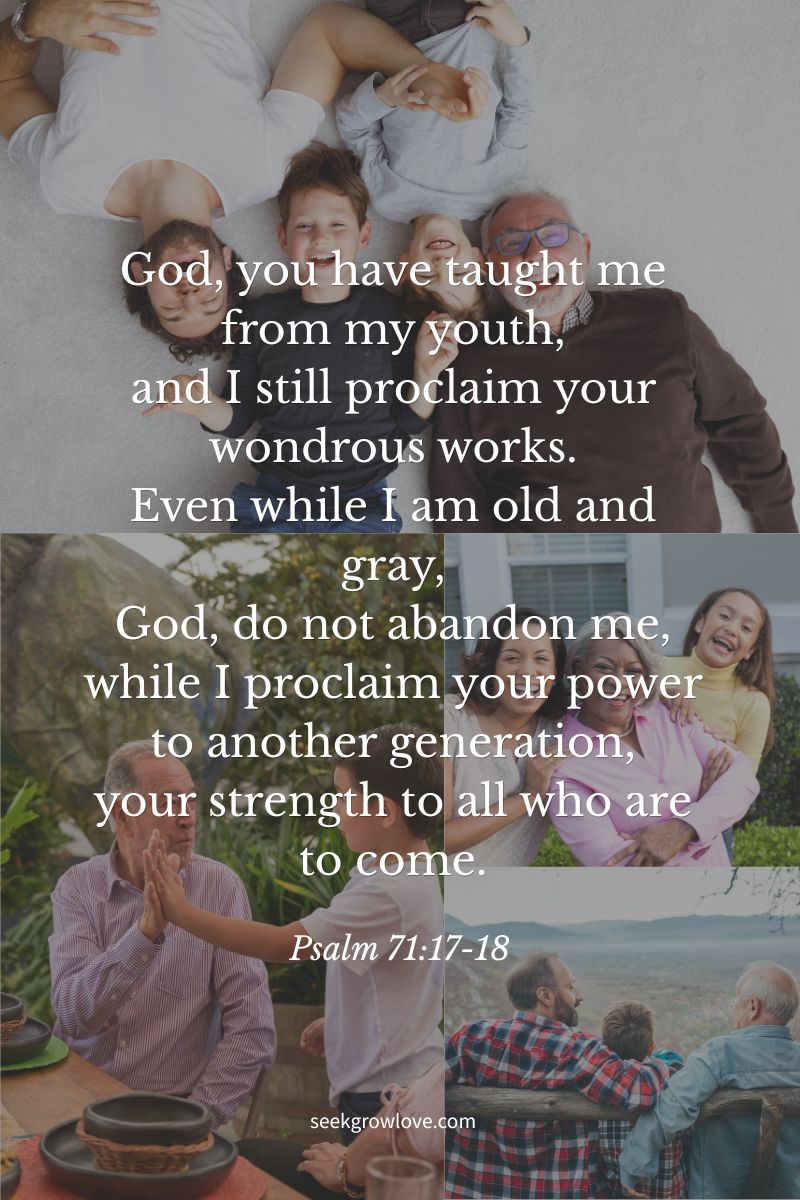
He speaks of his childhood in verse 6 when he says, “I have leaned on you from birth; you took me from my mother’s womb.” About the present, he says in verse 17, “God, you have taught me from my youth, and I still proclaim your wondrous works.”  As he looks forward to the future, he says in verse 18, “Even while I am old and gray, God, do not abandon me, while I proclaim your power to another generation, your strength to all who are to come.

We see the psalmist’s faithfulness to God in the past, present, and future. From ‘sunrise to sunset’, they are leaning on God. Their commitment to God compounds, multiplying as the generations continue to us, who are reading their words today. 

I’ve come to realize that a legacy is made like a chain. When we are strong in our faith and commitment to God, we create a strong link. We are tied to the people that come before us and the future generations that come after us. Time is fleeting, but we can create a lasting impact with our lives when we choose faithfulness in our daily lives. 

What does this look like? We actually see an example nestled in the genealogies we read today. In 1 Chronicles 9, the chronicler notes what happened during the Babylonian exile. When the Israelites returned, one of their primary objectives was to rebuild the temple and begin temple worship – something they had deeply missed during their years in exile. 

In verses 3-21, the priests, Levites, and temple workers were listed. Verse 13 describes them as “capable men employed in the ministry of God’s temple.” According the Enduring Word commentary, “this same phrase is translated mighty men of valor in many other Old Testament passages (Joshua 1:14, Judges 6:12, 1 Samuel 16:18, and many others). It shows that when it came to doing the work of the service of the house of God, it takes a man of strength and courage, the same qualities that are needed in a warrior.” 

Each group was on duty, day and night, guarding the temple, caring for the temple, baking bread, and making music. They all had their own jobs based on gifting and tradition, but they all fulfilled them to the best of their ability, to the glory of God. 

Interestingly, the ‘mighty men of valour’ is not the only callback to the past. Verse 22 references how David and Samuel had instituted the temple worship with these groups, and verse 20 takes it back even further to Phinehas, Aaron’s son. We see how the legacy of the temple workers was created in the past and carried forward for hundreds of years. 

The key to this faithful legacy is found in verse 20. It says that the Lord was with Phinehas. Psalm 71 reiterates this. In his prayers, the psalmist says that God has been with him every step of the way, through trials and through rejoicing. We place our trust in God, we live our lives faithfully, and like the psalmist, God’s great works in our lives brings us to “tell about your righteousness and your salvation all day long, though I cannot sum them up” (Ps. 71:15). 

Reflection Questions

  1. It is a beautiful truth to remember that God will be with us in the past, present, and future. What is one moment that you can point to recently that is evidence of God’s faithfulness? 
  2. Why was the reinstatement of temple worship so important for the returning Jews? 
  3. What can we learn from the description of the temple workers? 

Prayer

Lord, 

Thank you so much for how you have been with me since I was a young girl. Please continue to be with me as I live and work. May all I do bring glory to you. 

In Jesus’ name,

Amen.

SGL.2026.CalendarDownload

Our Hope in the Face of our Enemies

Old Testament: 1 Chron 1-3

Poetry: Ps. 140

New Testament: Colossians Introduction See Below

I love a good adventure story. One of my favorites is The Lord of the Rings (the original series of course). The movies came out when I was young, and I loved the epic battle between good and evil that they portrayed. One of my favorite parts is in the second movie during the Battle of Helm’s Deep. For those of you who aren’t familiar with this scene, let me paint the picture for you. The people were terrified as they were locked away in a fortress that was described as impenetrable. However, the defenses were failing as a massive army of mindless monsters had lined up before the fortress with the sole purpose of annihilating everyone within them. The people inside felt hopeless. They had sent the women and children to hide in caves. The men were putting on armor, knowing that the outcome of the war was a seemingly hopeless situation, that the fight they were putting up was futile, symbolic. They would not back down. 

I imagine that the people in Helm’s deep would empathize with the Psalm we read today. David, who was also on the run from his enemies, faced imminent danger. Because of Saul’s jealousy, he was out to kill David. In Saul’s mind, David was a threat to his throne, and that threat must be taken care of even though David had been nothing but respectful of Saul’s authority throughout his life. David knew what it was like to be in a seemingly hopeless situation. He explains in Psalm 140:1-3, “Deliver me, O LORD, from evil men; preserve me from violent men, who plan evil things in their heart and stir up wars continually. They make their tongue sharp as a serpent’s, and under their lips is the venom of asps.” David was pursued by evil men and felt like he was almost in their clutches. Without God, his situation would have been hopeless. 

In the battle of Helm’s Deep, the people were saved after the third day when Gandalf returned with another army that was able to defeat the army of the enemies. This is an obvious allusion to our ultimate hope that J.R.R. Tolkien, a Christian, included in his book. David also points to this hope in Psalm 140 when he says in verse 12-13, “I know the LORD will maintain the cause of the afflicted and will execute justice for the needy. Surely the righteous shall give thanks to your name; the upright shall dwell in your presence.” Though David’s situation was difficult and dangerous, he knew that there was hope in his situation that seemed hopeless. His hope was God, and he knew that God would come to his aid. 

God has also come to our aid through his son. Jesus is the light at the third day coming to defeat the forces of darkness in the world. The genealogies of 1 Chronicles point to this perfect salvation, the son of David. He is “the true light, which gives light to everyone” (John 1:9). This “light shines in the darkness, and the darkness has not overcome it” (John 1:5). 

When we face down our enemies, when we feel like we are in a seemingly hopeless situation, we can remember of the light, the hope, that we have in Jesus. He has already saved us. 

~ Cayce Fletcher

Reflection Questions: 

  1. Are there areas of your life that feel hopeless? How does this Psalm give encouragement to you?   
  2. Now that we are not fighting physical battles as frequently as in David’s time, some of the Psalms can seem a little archaic. Who are our enemies now? How do we fight against them?  
  3. Why do you think that 1 Chronicles begins with a focus on genealogies? How does knowing your history help you live well today? 

Colossians Introduction

Paul, possibly with the help of Timothy, wrote the book of Colossians to the church at Colossi while in prison in Rome.  He had never been to Colossi when he wrote the letter to them.  

Paul wrote this letter warning the Colossians about doctrinal errors in 2:8, “See to it that no one takes you captive through hollow and deceptive philosophy, which depends on human tradition and the basic principles of this world rather than on Christ.”  This sounds like particularly good advice to us today.

Paul highlighted the importance of living a holy life.  3:1-6 is just a sampling, “Since, then, you have been raised with Christ, set your hearts on things above, where Christ is, seated at the right hand of God.  Set your minds on things above, not on earthly things.  For you died, and your life is now hidden with Christ in God. When Christ, who is your life, appears, then you also will appear with him in glory.  Put to death, therefore, whatever belongs to your earthly nature: sexual immorality, impurity, lust, evil desires and greed, which is idolatry. Because of these, the wrath of God is coming.”

I’ll close with Paul’s advice as recorded in 3:23-25, “Whatever you do, work at it with all your heart, as working for the Lord, not for human masters, since you know that you will receive an inheritance from the Lord as a reward. It is the Lord Christ you are serving.  Anyone who does wrong will be repaid for their wrongs, and there is no favoritism.”

–Steve

sgl23bibleplanDOWNLOAD