Can they Recognize you as God’s Child?

OLD TESTAMENT: Jeremiah 12 & 13

POETRY: Psalm 116

NEW TESTAMENT: 1 John 3

I love looking at my children and seeing which traits of theirs are mine and which are my husband’s. My eldest is my miniature, with her blue eyes and wavy brown hair. She also has all my attitude, but also my creative flair. My second has her father’s eyes and coloring and his gentle spirit. And our son…I’m not sure if either of us were ever that mischievous, but I think we can both claim his cleverness. 

What a beautiful thing to be recognized as God’s child, though. 1 John 3 starts out with this proclamation. “See what great love the Father has lavished on us, that we should be called children of God! And that is what we are!” He claims us as his own, and loves when people recognize us as being children of God. And who can recognize us as such? Only those who know the Father as well. 

Those who know me well, can likely look at my children and see that they belong to me. They recognize characteristics. But those that don’t know me? It’s not so obvious. And that is why the world does not understand us. If the world doesn’t know God, it won’t recognize God’s traits in us. 

This chapter speaks a great deal on sin and how we must turn from it. It speaks on love and hate. But my favorite part of this passage is the promise that it offers, right off the bat. Verse 2 says, “Dear friends, now we are children of God, and what we will be has not yet been made known. But we know that when Christ appears, we shall be like him, for we shall see him as he is.” 

One day, we will be without sin. One day, our relationship to God will be obvious. We will look like his son, Jesus Christ our savior. Everyone will see the resemblance. But until that time, we struggle against sin and imperfection. Verse 9 tells us, “No one who is born of God will continue to sin, because God’s seed remains in them; they cannot go on sinning, because they have been born of God.” 

The world is looking at us, Christians. They are seeing us proclaim to be children of God, followers of Christ, and they are suspicious. If they don’t know God, they won’t recognize our conviction and our faith. But they recognize sin as we all do. And they see when we proclaim to follow God but refuse to turn from our sin. They see when we don’t love. They see when we are spiteful, or petty, or cruel. They see when we say “Love your neighbor” but do not carry out the actions. They see selfishness, pride, and haughtiness. These traits are fully recognizable as worldly traits. 

The world may not always understand true, Godly love, but we are to show it anyway so that others can see glimpses of God’s love for them. It is his great desire that we all be his children, and that one day, at Christ’s return, we are all made pure and fully known as Children of God. 

Reflection Questions: 

What traits do you show that you hope others see as Godly traits? Which areas in your actions and attitude do you feel you need to work on so that others better recognize you as God’s child?

How can you better love those around you? Is there someone in your life right now that frustrates or hurts you that you find difficult to love and be kind towards? Read through verses 21-23 and pray now for some extra strength and grace from God to be more loving toward them, so that they can see God in you.

Praying over you this week, my brothers and sisters. I’m so grateful to be a part of God’s chosen family with you.

– Jenn Haynes

The Implications of Living in God’s Love pt. 2 

Old Testament: Jeremiah 33 & 34

Poetry: Proverbs 20

New Testament: 1 John 3

“For this is the message that you have heard from the beginning, that we should love one another.” 1 John 3:11 

Implication #2: we must love one another 

Children of God 

There is an expression you may have heard that goes something like “the apple doesn’t fall far from the tree”, which is usually used to mean that a son is quite like their father in one or many ways. Sometimes it is used to praise someone who has shown virtue, other times it is used to lament how vices are handed down like heirlooms no one wants. John, similarly, calls those who have virtue from living in the love of God, children of God.  

As we can see from 1 John 3:1 and will see again tomorrow in 4:19, God’s love initiates our ability to be His children. God loves us, calls us to become a part of His family, and leaves it to us to respond positively to this call or to reject it. When we accept this call, we are not immediately transformed into a full-fledged twin of Jesus (the perfect son of God). As John points out in 3:2 what we will look like once God’s love has completed its work in us is not known. We have only seen God through mediators. One day that will change, and we will be like Him–which is an exciting and terrifying notion.  

In the meantime 

While we don’t know what we will be like in the future, John tells us what the love of God means for how we live now. We are to love one another. At the very least this means we must love those who are within the body of Christ. Some would like us to stop there. At times it seems an insurmountable challenge. However, an argument could be made and perhaps should be made that the child of God should love everyone. This is the view I hold. To paraphrase Jesus: “even the wicked take care of their own” (Matthew 5:47). The follower of Christ, however, is to love everyone. After all, God causes the sun to shine on the good and the bad (Matthew 5:45) and Christ died to save those who needed saving—that is to say, EVERYONE.  

The question of how to love 

Once one becomes a Christian and understands the need to love, the necessary question of how to love will follow. John anticipates this question and gives the answer: love how Jesus taught to love (3:23). When we love the way Jesus taught (and how he himself loved), it will show that we are the children of God and will keep us abiding in God.  

The question of how we can possibly love like Jesus 

Knowing that we should love like Jesus will not mean that we will love like Jesus. In fact, simply trying to do so will only lead to the frustrating realization that we can’t. That is to say, the apprentice will never be able to outdo the master so long as they remain an apprentice. Maybe thinking about it this way isn’t helpful since it seems hard to believe we will ever reach the same level of righteousness as Jesus–at least not while the world is still unredeemed. Maybe this is why John mentions the bit about not knowing what we will be. However, John does hint at how we can love in the way Jesus did: by the spirit of God within us. Only when we have the spirit of God working through us can we love as Jesus loved. This is the only way we can love our neighbors, love our enemies, and love our brothers and sisters in Christ.  

There’s one more implication of living in God’s love I want to mention, but it will have to wait until tomorrow.  

-Joel Fletcher

Don’t Love with Words?

1 John 3

Monday, October 17, 2022

If you have never heard of G.T. and the Halo Express, 1) you are missing out on quality kids music/plays and 2) sorry, you won’t be able to sing along with my devotions for the next few days.

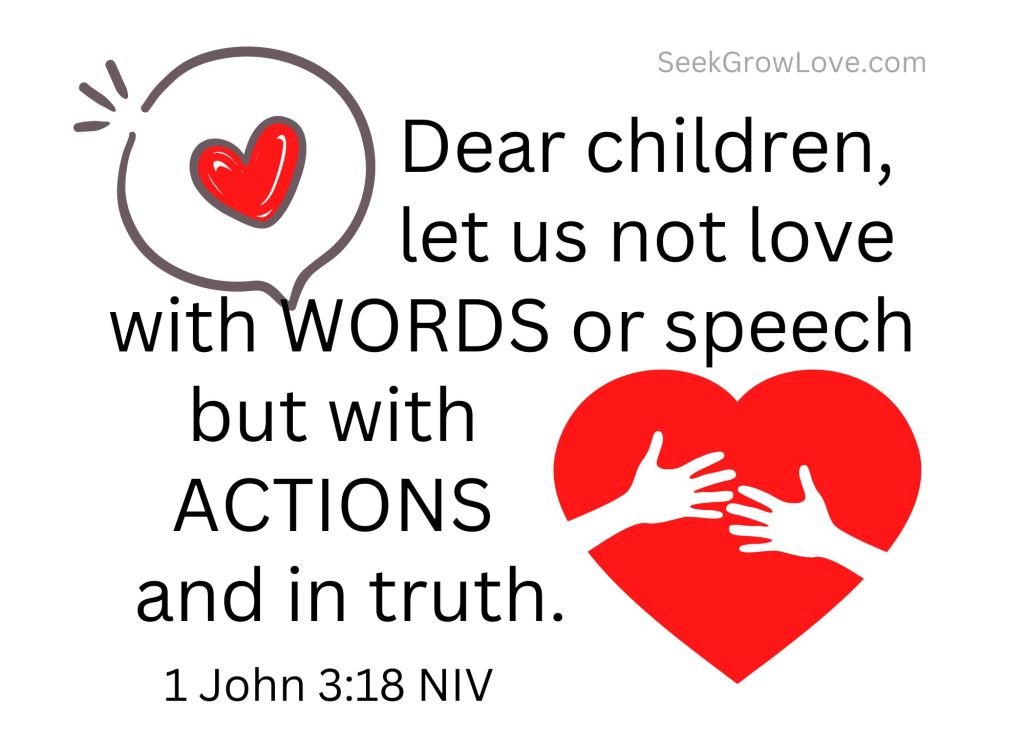
I encourage you to read the whole chapter of 1 John 3, but I am just going to focus on one verse, my favorite – 18, (thanks to memorizing it in this kids play growing up).  The translation I learned was “Dear children, let us not love with words or tongue but with actions and in truth.” 

I have been listening to this one with my daughter, and it has sparked some discussion.  The song breaks it up a little bit, and the line that is sung together is “let us not love with words or tongue.”  When we look at the whole verse, it is easy to know that we shouldn’t stop there.  But for a 4 year old who doesn’t quite understand all the subtleties of language yet, that was confusing.  Why should we not love with words?

This isn’t saying we shouldn’t use our words to be loving, but rather that it shouldn’t stop at that.  If all we do is say that we love someone, it really means nothing.  We need to show people that we love them in how we act, and by being truthful.

It reminds me of James 2:17 “In the same way, faith by itself, if it is not accompanied by action, is dead.”

My dad taught a memorable object lesson to our class when I was growing up.  He took us for a car ride in one of the many winter months (it’s Minnesota – they all blend together) with the windows rolled down.  As he drove, he asked us, “Are you cold?”  When we of course said yes, his response was, “I’m really sorry you’re cold!  I wish you were warm.”  And he kept on driving.  His point was that even if you say the right things, when you can make a difference in the situation (such as putting the windows up) but do nothing, what you say doesn’t matter.

Jesus truly showed his love in action by his sacrifice for us.  We ought to show others that we love them, not just tell them.

It is a good reminder for a 4-year-old to be loving in her actions toward her little brother and a good reminder for everyone to be loving in their actions towards anyone they interact with.

~Stephanie Fletcher

Reflection Questions

  1. When have you found yourself saying the loving thing – but not showing love with your actions? What problem is created here? How can you fix this?
  2. According to the rest of the chapter what else do our actions show?

His Commandment

1 John 3

IMG_0009

The World’s Relation to God’s Children

This chapter mentions two ways in which the non-believing world reacts to the children of God:
1. The world does not know us (that we are God’s children) just as it did not know Jesus, that Jesus is God’s Son (3:1).
2. The world hates us (3:13). The world is like Cain, who hated and even murdered his brother.
Especially in 3:11-18, the author instructs us not to be like the world and hate our brothers, our fellow believers in Messiah Jesus.
Knowing what Love is, I John 3:16, the parallel to John 3:16

“By this we know love, because he laid down his life for us. And we also ought to lay down our lives for the brethren.”
This verse encouraged me (Stephanie), so much during the hardest time of my life, which was just after my husband came to the understanding of the one true God and His Messiah Jesus – and the mistreatment that followed in result of his faith. The verse really helped me to focus on what real love is – to think how Jesus humbled himself to death on a cross. He was mistreated and ill spoken of; they even took his clothes away from him. That is how I know what love is, and I could take courage because of what Jesus went through and lay down my life for the brethren, disregarding the shame.

Jesus didn’t come to give a license to sin, but to remove sin, 2:4-10
At first glance the author may seem to contradict himself. In 1:8-9 he says we sin, but in 3:6 he says “no one who abides in him (Jesus) sins”. I think what the author is saying is that believing in Jesus does not give people a license to sin. Believers may sin (and there is a way to forgiveness, 1:8-9) but a life characterized by continual sin is not one in step with abiding in Jesus. Jesus didn’t come to give a license to sin. On the contrary, the writer gives two reasons why Jesus “appeared”:
1. To take away sin.
2. To destroy the works of the devil
Jesus and a believers life in Jesus does not give license to sin, but rather removes and destroys sin.
Theme Verse
1 John 3:23 could perhaps be considered a good theme for the entire epistle:
“And this is his commandment, that we should believe in the name of his Son Jesus Christ and love one another, just as he has commanded us.”

Bill and Stephanie Schlegel