Hide and Seek

Genesis 3, Proverbs 3, Matthew 2

Devotion by Aaron Winner (SC)

Our two-year-old’s favorite game is probably hide and seek. She is actually pretty remarkable at staying still and quieting her breaths so she will not be found. The only problem with her strategy is that she always chooses the same hiding spot—the curtains in our master bedroom. For her, the game is not about actually remaining hidden. It would lose its appeal quickly if she stayed concealed too long. Her joy is ultimately to be found and to be reunited with family, “Daddy, you found me!”

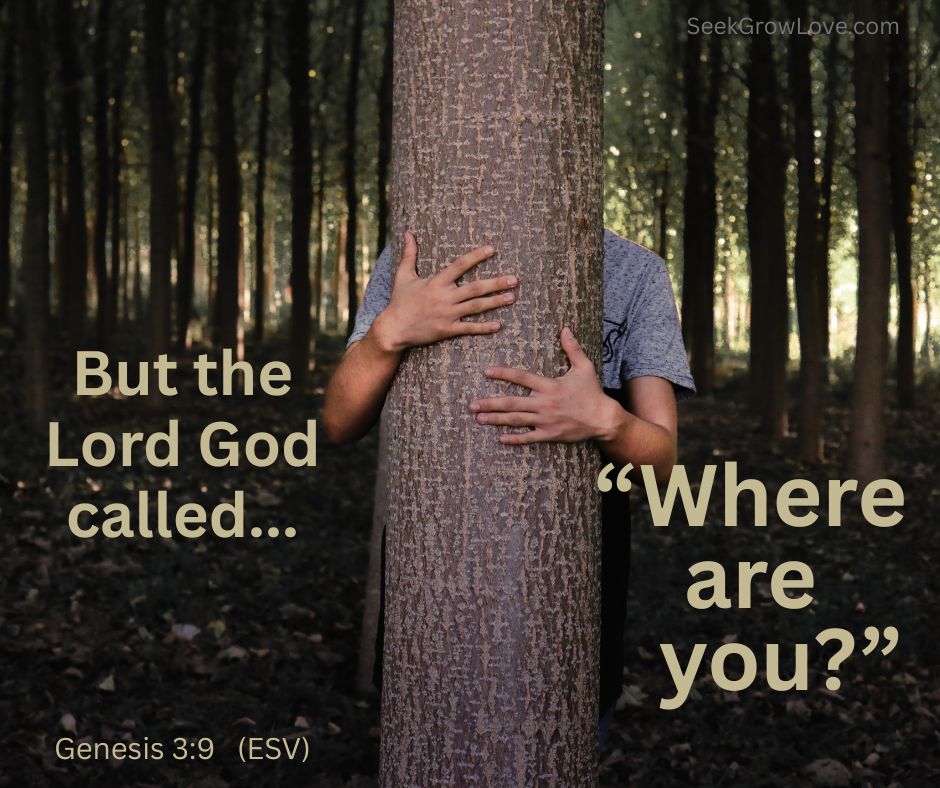
In today’s reading, we see God playing the seeker as He looks for His favored creation in the garden. No matter how still Adam and Eve remain, God knows the hiding place. When He asks, “Where are you?”, it is a loaded question from the one who knows us most intimately, both our physical location and hearts. God is not met by the joyful giggles of a toddler, but by the shameful chagrin of sin (Prov. 3:7). Even though God knew where He would find them and did not withhold discipline (Prov. 3:12), by His infinite grace, He still searched for them.

That same grace carries forward into the arrival of the Son of Man. God hung a star in the east to announce the birth of Jesus Christ. He is the hope first spoken in Genesis, the One who would crush the head of the serpent (Gen 3:15). Though the distance was far, men who were seeking found a child, guided by both the heavens and the Word of God (Matt. 2:6). God makes His mercies known.

And so, when we are searching, we are always led to the same place. If we are looking for rest, we look to Jesus. If we are looking for meaning, we look to Jesus. If we are looking for hope, we look to Jesus. Throughout the Old Testament, again and again, God “hides” His promise of His Son in plain sight some 300 times, all pointing toward the life, death, resurrection, and return of Jesus Christ, who conquers sin once and for all.

So who are we fooling if we think we can remain hidden among the foliage and unseen by God? If we feel distant from him, the heavens and His word are still declaring we need only turn to the same place where our faith begins, Jesus Christ. Unchanged is the place where grace and hope begin.

Let us pray this together:

Abba Father, I have been desperately hoping you would find me. I will trust in You with all of my heart. I won’t lean on my understanding but Yours. Give me correction along with your grace that is greater still. In all Your ways, let me submit to You, for I know You will make my path straight. Lead me to the advent of Christ, to be found among the faithful who seek You. In your name of your Son, whose resurrection gives us hope. Amen

Reflection Questions

  1. It is good for us to remember we do not have the mind of God – but what tone of voice do you imagine God used when asking, “Where are you?” Why might He have started with a question, and this specific question? What tone of voice might He have used when giving correction and consequences?
  2. How are you like Adam? How are you like Eve? How did God show grace and correction with consequences to Adam and Eve? How have you experienced both grace and correction with consequences from God? What is the purpose of each?
  3. Adam and Eve obviously didn’t have Proverbs 3:5-7 on their refrigerator. How might it have helped them to know these verses of wisdom? How can you better live out Proverbs 3:5-7? When do you most need to hear these verses? How can you memorize them and/or plaster them in your life so they will be part of your first line of defense against temptation so you can spend less time hiding from God.
  4. From today’s readings, what are some beautiful things about God’s plan of salvation through His Son Jesus?

Without Shame

Genesis 2, Proverbs 2, Matthew 1

Devotion by Aaron Winner (SC)

Visit any home with young children after bath time, and you’ll quickly understand that it is not uncommon to see a child streaking through the living room with nothing but a grin. Our children still live in a stage of innocence, and while their word “nakey” simply defines a lack of clothing, it carries none of the weight or connotations that often accompany the word naked. While comfort levels with wearing one’s birthday suit vary widely, physical exposure is usually reserved for environments of trust and intimacy.

Adam and Eve stood before one another in the Garden of Eden in such a state. Without shame, they walked fig-leafless as they tended to their calling as caretakers of creation. Their nakedness reinforced intimacy within marriage, but it also revealed something deeper. They stood before their heavenly Father “nakey” as well. As with childhood innocence, the absence of sin allowed exposure without fear. This openness demonstrated not only their relationship with one another, but also their unguarded connection with their Creator.

So, to have meaningful relationships with our brothers and sisters in Christ, should we band together to form a nudist colony? Please, no. But in a far more important spiritual sense, we are invited into this level of intimacy. God forms relationship with us through His presence as He moves alongside us while we tend His world—speaking truth, laboring together, and allowing Him to shape us through shared faith and testimony.

Narrowing our focus further to our nuclear families and closest friends, we are called to be even more personal and exposed, not performative or guarded in appearance. Whether we look at the forming of the first family, the father-to-son instruction in Proverbs, or the genealogy in Matthew, each offers examples (and warnings) of how trust, proximity, and intentional teaching shape the spiritual life of a household. Today is as good a day as any to check in on someone within this circle, or to seek them out, so that we might better know one another and, together, better know our Heavenly Father.

“For the upright will live in the land, and the blameless will remain in it.” Proverbs 2:21

With the propitiation of sin through Jesus Christ, we can now be presented before God without shame. The promise remains the same: the blameless will remain in the land – A perfect, promised one to come, which makes me scratch my head and wonder, “Will our resurrected bodies be ‘nakey’?” I know we will be wearing smiles—and we will have to see about the rest. But even now, we are invited to live and walk with one another in a spiritual closeness that reflects what was once lost and is now being restored. And in that place, we may once again find ourselves standing without shame.

Reflection Questions

  1. What do you imagine life was like for Adam and Eve before sin entered? What do you imagine it was like for God? What changes took place with the first sin?
  2. What do you feel shame about? Why? What does God want for us when we feel shame? How can shame be overcome?
  3. What are your thoughts when you read Proverbs 2:21?

Unpacking the Beginning

Genesis 1, Proverbs 1, Matthew 1

Devotion by Aaron Winner (SC)

Twenty years ago, I moved 1,000 miles with all my possessions loaded into a Buick Skylark, including my goldfish riding shotgun, to share a two-bedroom apartment with my newlywed wife. Now, as we move out of our home of fourteen years, it has taken six trips with a U-Haul, countless carloads, and a dumpster to move just 10 miles away. Granted, our family has grown to five people and a dog, but the math still doesn’t justify an increase of roughly 100 times more stuff. I can’t help but wonder: When did we get all of this? And why? Does it make us better equipped? Not necessarily. Does it bring us joy? Not really—especially not over the last month. Does it move us closer to God? Rarely.

This is not the rant of a minimalist millennial, nor a critique of your cherished possessions. There is still quite a plank in my own eye here. Rather, it is simply an acknowledgment that while we stand at the beginning of a calendar year, the beginning of a new reading plan, and the beginning of both the Old and New Testaments, we are not at the beginning of our lives. We carry things with us as we move from one year to the next. Our trailers in tow may look different, but they are often filled with trophies and affirmations, expectations and disappointment, habits and vices, grief and trauma. There can be a quiet vanity, trending toward insanity, in everything we accumulate along the way. However, in all of this, we can still look to “In the beginning…”

In Genesis 1, we are reminded that beginnings matter because our sovereign God is a God of purpose. Creation is not a random display of infinite power, but an act that makes all things matter (excuse the science pun). God purposely names, separates, and shapes what was formless, repeatedly calling it “good.” From the very first verse, we learn that clarity and meaning do not come from compiling, but from God’s intentional and intelligent design.

“The fear of the LORD is the beginning of knowledge; fools despise wisdom and instruction.” —Proverbs 1:7

Accumulation can be a trap —more plans, better systems, or tighter control—will somehow translate into the power and wisdom of our Creator. However, Proverbs’ opening provides a clear contrast. It is a pursuit in fear and reverence that makes God’s wisdom accessible. As we begin to examine what fills our moving truck from one year to the next, it is through God’s understanding that we prioritize what matters, process the hurt, and chunk into the bin the things that no longer serve His purpose for us. A good start might simply be to pause your reading long enough to tell your Heavenly Father you are ready to revere Him in the coming year.

Finally, our last beginning comes from the Gospel of Matthew, where Mary is foretold of the birth of Jesus. Gabriel says He will be called Emmanuel—“God with us”—the ultimate title given to God’s greatest gift of great joy to creation. He entered a crowded, cluttered world, as He still does today, not asking us to take on baggage on His behalf, but instead inviting us to bear only the burden of His cross.It is the one thing that should be clear and conspicuous as we wander, move, and rove; it is Christ who shoulders the majority of the burden, carrying it alongside us.

As I consider this moment —and the truckloads of stuff waiting in storage—perhaps the question is not what can I add to make this year memorable, but instead, where can I begin to let go in reverent surrender. As we begin to unpack what the next year might hold, let us first make room for God’s presence, preparing only to keep only what can be called good by our Heavenly Father in the beginning.

Reflection Questions

  1. What are you carrying with you into the New Year? What positive things? What has been put into your moving truck that is not beneficial to you? What might God like to see you surrender this year?
  2. What do you love about the creation account? What do you learn about God from His creation?
  3. How do you/could you prioritize the fear of the Lord? Pray for God to give you wisdom, insight and dedication to living this new start in a way that is pleasing to Him.

The Only One Worthy and Able

Revelation 4-6

Devotion by Aaron Winner (originally posted for SGL on Dec 28, 2020)

There is much to take in with today’s reading as John describes the throne room of heaven and the events that unfold, marking the Kingdom of God being set into motion.  There are angels, horsemen, and elders, each executing and exacting the will of God.  If you are a bit overwhelmed by today’s reading, you are not alone. John, who spent more time with Jesus than most, is still awestruck by the worship of God happening before him, and he is doing his best to describe heavenly things for which there is no earthly vocabulary (something important to keep in mind as we examine the remainder of this book and prophecy).  With a resounding question, John’s attention is drawn to the hand of God:

“And I saw a mighty angel proclaiming in a loud voice, “Who is worthy to break the seals and open the scroll?” But no one in heaven or on earth or under the earth could open the scroll or even look inside it. I wept and wept because no one was found who was worthy to open the scroll or look inside.” Rev 5:2-4

John weeps, for the content of the scroll could very well never be known.  Salvation’s plan locked inside this scroll with no one on heaven or earth who is worthy of removing the seven seals that keep it shut.  This is seemingly the end of the road.  Without a Savior, life on earth has no redemption.  This is most definitely worth a weep, knowing that for some, their story stops here.  They have put everything in what they alone can achieve, yet they are like every other creature in heaven and on earth.  Without the hope delivered in the next verses, all that would remain is remorse and regret (Luke 13:27,28).

Then one of the elders said to me, “Do not weep! See, the Lion of the tribe of Judah, the Root of David, has triumphed. He is able to open the scroll and its seven seals.” Rev 5:5

Salvation is a gift of God, paid for by the blood of Jesus Christ (Eph 2:8,9).  In the moments when we are overcome with great grief, sense the defeating drift of sin, are lost or lonely, feel pressed or persecuted, let Jesus Christ step forward. Do not reach deeper into empty stores, pour out of a broken vessel, or pick up the shattered pieces; let him do what we cannot.  We need only lift our heads – to pray, to seek, to take heart – as we listen to the words of the elder that Jesus Christ, the Lamb of God, has triumphed.  He will step forward and unfurl a new banner, renewing and restoring the purpose of our life. He alone is worthy to open the scroll, yet we are indeed the beneficiaries of the prize of his propitiation.

And they sang a new song, saying:  “You are worthy to take the scroll and to open its seals, because you were slain, and with your blood you purchased for God persons from every tribe and language and people and nation.” Rev 5:9

Reflection Questions

  1. What do you find especially memorable, powerful or awe-inspiring in John’s description of God’s heavenly throne room in Revelation 4? How is God described? What is he praised for?
  2. What makes Jesus worthy and able to do what no one else could or can do? What has he triumphed over? What will he triumph over? How is Jesus described? What is he praised for?
  3. What is the problem if no one could be found to open the scroll? When was the last time you really considered or even wept over the fate of those without salvation? You can not unseal the scroll. But you can introduce the one who can and will to those who do not know the Savior.

It’s Personal

1 Kings 17-19

I have appreciated the opportunity to read and share my thoughts with you across these seven days. We’ve traced the unfolding drama of the divided kings and kingdoms of Israel. We’ve watched the culture shift, the crowd move to and fro, and the pressure rise and fall, but through their stories, one truth rings clear: the faithful know that wisdom comes from God alone.

“How long will you waver between two opinions? If the Lord is God, follow him; but if Baal is God, follow him.” (1 Kings 18:21)

Looking momentarily at my own nation, America is a nation with deep Judeo-Christian roots, as many of our founding documents demonstrate a commitment to God as the architect of the law that governs us. Our motto makes mention of our trust in God, we proclaim His work in our patriotic songs, open government functions with prayer, and swear in our presidents with their hand on His Word. I am one of many who believe the blessings we enjoy as a nation—even in today’s troubling times—can be attributed to the enduring declaration that the God of Israel and the Father of Jesus Christ reigns here.  Sadly, more and more are living on borrowed blessings as the altars of moral revision, self-importance, and political convenience are being fashioned and raised.

Today, we look to the prophet Elijah, who lived as a lone voice for the Lord in a nation God had once richly blessed. Elijah wasn’t trendy or tribal. His conversations with God were authentic and intimate, and he took action as one who was swiftly obedient. His faith was so personal that he was often fully dependent on the Lord even for his next meal—fed by ravens and sustained by a jar of oil and flour that never ran dry. How ready would we be to fight off the enemies of God, to recite and rely on His promises, and even to expect miracles in His name, if we lived with this kind of faithfulness?

Each of us is called to that kind of personal, committed, lived-out faith. It may seem like faith is inherited—passed down through our nation’s heritage or through family and friends—but true faith is never proximal. Hanging with a spiritual crowd, attending high-energy worship services, or serving on a ministry team are not guarantors of a relationship with the Lord.  Personal faith is born in the discomfort of repentance, in the surrendering of fear, and in the offering up of our possessions. These are the intimate things God desires from us. In the abandonment of self, we begin to hear God’s call clearly—and are emboldened because we know our Creator personally.

“At the time of sacrifice, the prophet Elijah stepped forward and prayed: ‘Lord, the God of Abraham, Isaac and Israel, let it be known today that you are God in Israel and that I am your servant and have done all these things at your command. Answer me, Lord, answer me, so these people will know that you, Lord, are God, and that you are turning their hearts back again.” – 1 Kings 18:36–37

In this week’s reading, we’ve seen that change in a nation is inevitable. I pray that “In God We Trust” will continue to stand as a reminder of our nation’s steadfastness for the Lord. But however long it endures, let it always point us to something greater—our personal relationship with God, built through surrender, obedience, and faith. If the Lord is God, stand for Him—even if you stand alone. Because at the end of the day, it’s personal.

-Aaron Winner

Reflection Questions

  1. What character traits do you find in Elijah? Is there one you would like to have more of in your life? How would you go about adding more?
  2. What choices are before you today?
  3. Which one will you choose? Why?

The Weight of Waiting

2 Chronicles 17
1 Kings 15:25-16:34

I was rushed out of the room, carrying a kid in each arm, and taken to the recovery room to wait for the return of my wife. The twins were here, and I had no idea what to do. There was a bassinet nearby, but I honestly couldn’t figure out the logistics of laying down one newborn without compromising my grip on the other. “That’s okay,” I thought. “My wife will be here soon, and she’ll help me sort it all out.”  So I waited. I nervously held onto them in a football hold as the minutes crept by. But then the minutes became longer than expected, and my confidence started to fray. I waited with my little ones—without information, without control, and without a clue. In that intermission, I did the only thing I could think to do: I sang. Out of praise, to stave off fear, and to quiet the echoing newborn cries, I sang:

“From my mother’s womb, you have chosen me, love has called my name,”

and “You’re perfect in all of your ways… perfect in all of your ways to us.”

Waiting isn’t for the faint of heart. To be patient is to fight our innate desire for safety and certainty. It reminds us that we are not in control—that our desires are only a small variable in any given situation. If we’re looking for holy ground—a place where our striving ends and God’s sovereignty begins—look no further than the weight of waiting.

As the northern kingdom of Israel spiraled under a succession of corrupt kings, Jehoshaphat began his reign in Judah. He watched the pendulum swing wildly in the wrong direction. But instead of rushing to react, Jehoshaphat paused. He sought the Lord. He devoted his heart to God’s way first, building his faith and fortifying the kingdom—not through conquest or alliances, but by spreading the Word and Law of the Lord and strengthening what already belonged to Judah.

There were no flashy political plays. No dramatic battles or self-promoting power grabs—all of which might have benefited a new king eager for approval. In contrast to war-beaten, idol-chasing, anxious Israel, Judah found peace—politically and spiritually—by halting, reflecting, focusing, and waiting on the Lord to move.

“The fear of the Lord fell on all the kingdoms of the lands surrounding Judah…”

(2 Chronicles 17:10)

Waiting made Israel restless. But it made Judah rooted.  Israel scrambled. Judah stood still.

So how do we wait in a manner that is pleasing to the Lord when life is beyond our control—when answers are delayed or the enemy seems to be advancing?  We fortify what’s already been entrusted to us. We hold our families, will continue using our gifts in ministry, and give consistently with our tithes. We don’t chase what we don’t yet have—we deepen what God has already given.  We also choose worship over worry. Worry imagines every possible outcome.

Worship reminds us who holds them all.  Even if God is silent, He is moving.  Commit to the wait.  Trust in the Lord.  He will act.

– Aaron Winner

Reflection Questions

  1. How well do you wait? How much do you worry? Can you think of a time where your waiting increased your peace?
  2. What is wise to do while waiting? What is foolish to do while waiting?
  3. What do you appreciate from Aaron’s list of waiting activity – halting, reflecting, focusing, and waiting on the Lord to move?

Too Much Experience

1 Kings 15:1-24
2 Chronicles 13-16

I will be celebrating my 40th birthday in just a few short weeks. To be candid, I’m not exactly thrilled about this milestone—but one thing I am looking forward to is being able to say, “That was half a lifetime ago.” There’s something satisfying in acknowledging that with age has come experience.

One of the longest experiences I’ve had is playing guitar. For the last 1,352 weeks, I have averaged a few hours of play and have become masterful at my style. That’s not a gloat or a flex—just an illustration that I’m familiar with my craft. Much of what I do now is second nature, developed through repetition and refined over time. The same could be said of anyone who’s practiced a craft or trade for a significant portion of their life.

But experience is a double-edged sword. It gives us the ability to say things like, “I’ve seen this before,” or “We’ve already tried that,” or “We’ve made it through worse.” That can build confidence as we develop our approach. But when we rely solely on experience or live under the illusion there is nothing to learn, we may fail to consult the Word of the Lord. We make ourselves the master of our own fate, and in time, we are doomed to fail.

King Asa was a dependable leader. After the division of the kingdom, his reign represented a season of peace and prosperity.  These blessings came upon the whole of Judah because he “did what was good and right in the eyes of the Lord.” Asa tore down idols, repaired the temple, and called the people to return to God. He didn’t trust in his half-million soldiers alone.  He petitioned the Lord for help:

“Lord, there is no one like you to help the powerless against the mighty. Help us, Lord our God, for we rely on you, and in your name we have come against this vast army. Lord, you are our God; do not let mere mortals prevail against you.” – 2 Chronicles 14:11

As a result God delivered Asa and the people of Judah.  In gratitude and commitment, Asa responded in worship.  His people offered a tremendous sacrifice as a wholehearted oath to their Deliverer. Again, the Lord gave them a season of rest.

But in Asa’s 36th year—after decades of faithfulness—something changed. Faced with conflict, he no longer sought the Lord. Instead, he relied on his own strategy, forming a treaty with a foreign power. The prophet Hanani rebuked him:

“Were not the Cushites and Libyans a mighty army with great numbers of chariots and horsemen? Yet when you relied on the Lord, he delivered them into your hand. For the eyes of the Lord range throughout the earth to strengthen those whose hearts are fully committed to him. You have done a foolish thing, and from now on you will be at war.” – 2 Chronicles 16:8–9

The temptation to take matters into our own hands often comes not in times of scarcity, but in times of prosperity.  Our experience, knowledge, notoriety, or wealth can make us feel capable, but no matter our breadth or depth, we each have  blind spots and limitations that fall far short of the omniscience of our Heavenly Father.  This is the great irony: the more experienced we become in serving the Lord, the more we should rely on His voice. If anything, maturity should deepen our dependence, not diminish it.

God is ready to win battles for those who are whole-hearted committed to Him. May we be found among them—not only in our youth or our desperation, but even more in our decades of experience. Let us not confuse our  familiarity with faithfulness. And when we hear His voice—whether in instruction, correction, or comfort—may we respond with the same dependence that brought us to Him in the first place.

-Aaron Winner

Reflection Questions

  1. What did Asa do right? What did Asa do wrong? What might his thought process or motives been when he was doing right? And when he did wrong?
  2. Consider your own life – when did you seek the Lord and He blessed you for it? When did you NOT seek the Lord, but relied on your own strength, decision making skills, and human knowledge? What was the outcome?
  3. What does it look like to seek the Lord and rely on Him?
  4. In what areas are you currently relying on the Lord? Where are you in danger of falling into the “too experienced”, can-do-this-on-my-own trap?

Affirming Voices

2 Chronicles 10-12

You may be familiar with the book The 5 Love Languages by Dr. Gary Chapman, which gained some notoriety around the turn of the millennium. The premise is that each of us feels and expresses love primarily through one of five ways, and it benefits us not only to understand ourselves but also to learn how our spouse, family, and coworkers prefer to receive love and encouragement.

My love language happens to be “words of affirmation,” meaning I feel loved when people offer praise, encouragement, or a thoughtful compliment. While offering this kind of edification should be part of how we love others at some level, our attraction to affirmation can sometimes replace truth with feeling. When that happens, we may reject godly wisdom in favor of voices that echo our pride.

In 2 Chronicles 10–12, we revisit the story of the rhyming rulers: Jeroboam and Rehoboam. In yesterday’s account from Kings, we focused on Jeroboam’s role in rebelling against Solomon’s successor. Today, we focus on the critical crossroads of the kingdom, seen in Rehoboam’s response to the people’s request: “Please, lighten the load” (10:4).

At first, it appeared Rehoboam had inherited his father Solomon’s wisdom—he asked for time and consulted seasoned advisers. These elders urged compassion and mercy, suggesting he serve the people in order to win their loyalty. But Rehoboam rejected their counsel (10:8), choosing instead to listen to his inexperienced peers—yes-men and blowhards who flattered him for their own gain. He sought affirming voices, not truthful ones, and chose pride over prudence.

Let’s take a moment to reflect on the voices we allow into our ears.  When we struggle in our Christian walk, do we welcome critique from a brother or sister in Christ who lovingly holds us accountable? Or do we prefer the reassuring voice of a coworker who says, “You’re doing fine—no one can live like that all the time”? When God’s Word convicts us, are we willing to change? Or do we search for justifications that let us edit the commands of our Heavenly Father? Are we allowing ourselves to be sharpened by iron, or do we dull the blade with confirmation bias?

Spiritual maturity means knowing the voice of the Shepherd and following only Him. His voice convicts us through the Living Word, speaks to us through the faithful message of a pastor or prophet, and often appears in a candid conversation with a friend. Ready yourself to listen to the voices that challenge your sin, confront your plans, and redirect you toward obedience. God will be there in the battle to meet you, as he did a humbled Jeroboam, with a greater grace and divine deliverance.

“In the end, when Rehoboam and the leaders of Israel humbled themselves, they declared, ‘The Lord is just’ And the Lord, seeing their humility, relented: ‘Since they have humbled themselves, I will not destroy them but will soon give them deliverance’” 2 Chronicles 12:6, 7

-Aaron Winner

Reflection Questions

  1. From above “…do we welcome critique from a brother or sister in Christ who lovingly holds us accountable?”
  2. “When God’s Word convicts us, are we willing to change? Or do we search for justifications that let us edit the commands of our Heavenly Father?”
  3. “Are we allowing ourselves to be sharpened by iron, or do we dull the blade with confirmation bias?”
  4. What roles do pride and humility play in today’s passage? What roles do they play in your life today? What will it look like and sound like and feel like for you to humble yourself before God today?

The Error of Innovation

1 Kings 12-14

If you’re like me, you’ve purchased an “assembly required” item and unpacked the contents without thumbing through the instructions. “How hard could it be to turn a few screws and boards into a bookshelf?” Halfway through the build, you realize you used the wrong board in one section, another is fitted upside down, and in your haste, you’re now down at least one screw. Necessity may be the mother of invention, but sometimes innovation comes from darker places—with consequences far greater than a shoddy IKEA build. Pride and fear can quickly lead us into folly as we try to adjust and adapt without seeking counsel. Likewise, our spiritual life was never meant to be self-driven, self-led, or self-defined. To build our relationship with God, we are called to be faithful to His instructions and selfless in their pursuit.

In today’s reading, King Jeroboam is appointed as the new leader of Israel. As he takes the reins, he surveys the political pieces of a recently split kingdom. His people had long worshiped in Jerusalem, which remained part of the rival kingdom of Judah. Jeroboam feared that his people’s loyalty would ultimately shift back to Rehoboam, king of Judah, from the anointed house of David. Instead of consulting the God of Abraham, Isaac, and Jacob or one of His prophets, Jeroboam devises his own solution to keep the people close to home.

“Jeroboam thought to himself, ‘The kingdom will now likely revert to the house of David…'” So the king made two golden calves. He said to the people, ‘It is too much for you to go up to Jerusalem. Here are your gods, Israel, who brought you up out of Egypt.'” (1 Kings 12:26, 28)

Jeroboam took up his place as both the political and spiritual leader of Israel, but motivated by fear and a desire for control, he led God’s people astray. He created false idols, counterfeit altars, and bogus festivals—all in an attempt to keep his people from returning to the holy city of Jerusalem. Leaving behind the moral clarity of God’s commands, it became easier and more accessible to engage in a made-up religion that appeared similar on the surface to what they knew to be true. They were working with the same pieces, but some were flipped upside down, some placed in the wrong spot, and others lost along the way. As their worship moved farther from Jerusalem, the distance between Israel and God grew greater.

There is a stark warning here for the adjustments and innovations we see in the Church today. We must be careful that our worship, ministry, and evangelism do not favor convenience over obedience or comfort over conviction. If we fail to heed this warning, we may end up with well-developed systems that contain many of the same pieces—but are no longer building the Kingdom of God. Instead, we risk creating idols and events that offer no eternal hope. Granted, we may not be fashioning golden calves, but when we prioritize comfort over truth, we risk building spiritual lives rooted in fear, insecurity, and pride—lives that are void of God’s instruction.

It has never been about innovating what works for us or embracing a “you do you” mentality. God demands surrender and faithfulness in our daily worship, which means we will likely find ourselves worshiping in the city of our enemies from time to time. Resist the urge to craft a god who fits us. Instead, let us be molded to fit His purpose and to build His Kingdom according to His Gospel instructions.

-Aaron Winner

Reflection Questions

  1. What problems do you think God saw in Jeroboam? Do you think God ever sees these same problems in you?
  2. What does God desire from us – in our worship and in the way we live our lives?
  3. What are your thoughts about the following: “If we fail to heed this warning, we may end up with well-developed systems that contain many of the same pieces—but are no longer building the Kingdom of God” ? Have you seen this occur? How can we better heed this warning for our lives and for our church and for the Kingdom of God?

Living Beyond Contentment

Proverbs 30-31

When eating, it takes our bodies roughly twenty minutes to register that we are full. During this window, it’s still easy to overindulge—residual hunger hormones convince our brains that we aren’t yet satisfied. Giving in to a few extra bites can become a few extra pounds, and even small overindulgences, even in the short-term, can harm our well-being.

In many ways, we are wired to live beyond contentment. We accumulate extra clothes, extra cars, and extra rooms. While I have certainly faced seasons where I have battled with “not enough,” more often, I’ve wrestled with “too much.” And the more I feed desire, the more ravenous it becomes. When indulgence becomes a habit, our appetite grows louder while our awareness of God’s provision grows quieter under the noise of stuff-shifting.

To be content at the dinner table is to put the silverware down and wait. It requires restraint—a virtue that feels increasingly radical in every facet of living. As we saw with Solomon’s story yesterday, prosperity can easily deceive us into thinking we are self-sufficient. In today’s reading, Agur’s prayer in Proverbs 30 echoes a more familiar prayer taught by Jesus to His disciples. Daily bread is the quiet miracle of enough. [1 Kings 17:13-16; Matt 6:9,10]

“Two things I ask of you, Lord; do not refuse me before I die:
Keep falsehood and lies far from me;
give me neither poverty nor riches,
but give me only my daily bread.
Otherwise, I may have too much and disown you
and say, ‘Who is the Lord?’
Or I may become poor and steal,
and so dishonor the name of my God.” (Proverbs 30:7–9)

Wisdom is a gift that Solomon received, and God still gives generously to those who expectantly ask (Jam 1:5-8). Contentment, too, is a gift from the Heavenly Father—who provided manna in the wilderness, the Bread of Life in Christ, and continues to meet our daily needs. Contentment stretches far beyond finances or hunger. It reaches into our identity, our roles, our relationships, even our location and life stage. Paul’s famous declaration—“I can do all things through Christ who strengthens me (Phil 4:11:13)”—wasn’t about achievement , but learning contentment even within prison walls, fully surrendering the perks of his previous identity.

We do not live to satisfy our cravings. To live beyond contentment is to collect moldy manna, an untrusting load that serves no purpose. Instead, we are invited to live as shrewd and savvy worshipers: disciplined with our efforts, generous with our resources, and joyful in simplicity (Proverbs 31). In this way, we show ourselves devoted and dependent—not on what we can store up, but on the One who supplies.  If we are to live in excess, let it be in the goodness of a Father who meets every need and has satisfied our debt with the death of His Son and whose grace is sufficient for every demand.

-Aaron Winner

Reflection Questions

  1. Are there instances/areas when you have lived, or are living, beyond contentment? Do you have a collection of moldy manna?
  2. What do you think the secret of contentment is?
  3. How does Proverbs 30:7-9 differ from “worldly wisdom”?