Meeting the Mission

john 10 27

Throughout this week,  we have laid the groundwork that leads us from the call to the kingdom.  We considered how Jesus sought those who were seeking something better, and how those men recognized the call, the voice of their master (John 10:27).  Next, we considered how the heavens declare our salvation, and the continuing metaphor we have in the heavens declaring the glory of God (Psalm 19) and His salvation plan for mankind.  Knowing this, we applied this knowledge to God’s presence even in the darkest points in our lives – in the highest heavens he is there, but also in the deepest chasm (Psalm 139:8). His Spirit is promised and available to those who ask to receive it.  When we accept Jesus into our lives, we not only receive the Spirit of God, but also the weight of the cross – not our sin, which Jesus has paid for once and for all – but the daily responsibility to carry the name of the Lord with us wherever we go. Finally, we looked at how faith should be our great motivator.  It assures us when we don’t see God working the way we desire that he is working all things together for those who love him (Rom 8:28). The culmination of this hope comes when we arrive home. We will not be returning, but experiencing for the first time the place we have been called, where the light has been leading, where the Presence of God is close and real, where the cross paved a way for us, and the plan, having all who have believed and waited, rewarded together (Heb 11:39-40).

It is a beautiful story unfolding before us, but right now, we’re in the middle.  The part in between being called and being home. So where does our mission begin?  It begins with prayer. Prayer is our conversation with God, admonishing him, asking for repentance, lifting up concerns, and seeking his will.  Paul tells us that we should pray repetitively or without ceasing (2 Thes 5:17) constantly thanking Him, seeking His word, and listening for His voice.  It is the best way to align ourselves with his will for our lives. These are everyday acts of spiritual warriors, the same as someone who runs or lifts every day in preparation for a marathon.  In Acts 9, Saul is blinded when He sees Jesus Christ standing before him on the Road to Damascus, but it is Ananias, a man most likely practicing his faith in his hometown, that is called to a great mission.  Risking his life to go before the Christian persecutor, he speaks to him, ““Brother Saul, the Lord—Jesus, who appeared to you on the road as you were coming here—has sent me so that you may see again and be filled with the Holy Spirit.” With these words, the course of Paul’s life and Christianity are forever changed.

For some of us, our mission will lead us to a foreign country, a great stage, or into a dramatic change of circumstance; however, we are all called to be faithful, seeking opportunities for God to use us as a vessel to speak peace and hope into the lives of those around us in the present; Many lives are lived, fearing God and keeping his commandments, in hometowns before neighbors, coworkers, or fellow students, a task that is can be ironically harder. We continually pray for those who are within our reach and influence, attuning ourselves to the will of God.  When we are faithful, we most assuredly will be ready for the harder things God calls us to as we will reach out and unabashedly share His Kingdom, leaving behind our ego, leaving behind our reputation, and even leaving behind our lives – in a moment or daily, knowing our mission is met.

-Aaron Winner

Thank you, Aaron for writing this week!  We did miss you at FUEL, but we are thankful for your continued commitment to God’s mission in your life.  Aaron recently shared his newest recorded song: How Great You Are.  Thank you for pointing us to the One who is Great!

Coming Home

john 14_3

One of the most bittersweet moments after a long, fulfilling journey is coming home.   Over the course of the past several years, I have been to a handful of different countries and have had some of the most wonderful, unforgettable experiences.  I usually spend my flight home scrolling through pictures, journaling, retelling that trip’s running joke, and planning a return journey to the destination I’m leaving behind.  Nevertheless, no matter how far I stray away, I find a soothing pleasure in seeing that final turn that will steer me into my driveway, opening the door to take a breath of the familiar smell, and laying down on my bed with my head perfectly placed on my pillow.  As I close my eyes, I do not think how much I wish to be where I was, I only think that I am so happy to be home.

I know many of you reading this have the exact same experience with the place you call home; however, I know for others, your current home is far from a place you wish to return.  Returning home to you means refacing an unpleasant past, examining poor relationships, having greater opportunity to sin, dealing with loneliness, hiding from abuse, or a customized mixture of some/all of these things.  The contrast between where you were and where you are going back to is so remarkably different that you see no hope in returning. There is always hope in returning home.

“Do not let your hearts be troubled. You believe in God; believe also in me. My Father’s house has many rooms; if that were not so, would I have told you that I am going there to prepare a place for you. And if I go and prepare a place for you, I will come back and take you to be with me that you also may be where I am. You know the way to the place where I am going.”  John 14:1-4

The reality is that all of us who believe are on a journey home, but it is possible none of us will make it there in this lifetime.  God is preparing a place for all of his children, those who believe in the Father and the Lord Jesus Christ and know and live by saving grace that comes through faith.  Jesus Christ is preparing a place for us to lay our heads for eternity, and he will one day come back for us, fulfilling his promise. We do not look for a physical direction, or a spiritual ascent in the heavens, but look for the way, the truth, and the life Jesus speaks of as the restoration to the Father. Our desire is to be here on this earth, but it is not in its present state (1 John 2:15-17), but the fulfillment of the Kingdom of God.

No matter where we lay our heads or what situations befalls us, we have been given a way to where Jesus is calling.  One place is not more powerful than another. One experience is not higher than the other. By placing Jesus Christ as our heart, our hope stays with us, and is never in a location or circumstance.  Still, even our spiritual highs pale in comparison to what is promised for us in the place that is being prepared for us. In the Kingdom we will be in the presence of our Savior and our God. Where we arrived at the place prepared for and rest in the assurance of eternal life, none of us will desire to be where we were; we will only think we are happy to be home.

-Aaron Winner

Seeing Isn’t Believing

john 20 29

One of the simplest examples of an optical illusion is the Hermann grid.  Black squares closely placed side by side with white space in between. Our brain, forever processing the input of our eyes, darkens the spaces around where our eyes are focused, creating dots between the corners of the squares that do not exist.  Even though I know the truth, my eyes are trying to tell me something different. There is an ongoing battle in my nervous system between what I know is the truth, and what I sense. Such is the ongoing battle with our faith — the confidence and assurance in things we know to be true, yet our senses may tell us otherwise.  With each next step that comes our way, we must give control to our senses or our heart. Faith or sight.

In the final chapter of Matthew, the culmination of our hope is made complete: Jesus arises from the grave.  Amen. Our example in life shows us the physical transformation that will occur when we are raised from the dead alongside all those who patiently await in the grave (Heb 11:39-40).  However, we are told that when the high priests hear the news of the resurrection, they quickly bribed the soldiers overseeing the grave and told them to spread the lie that Jesus had not really risen from the grave but was stolen in the middle of night.  Jesus sends word to his disciples to meet him in Galilee to see with their own eyes that he was indeed raised as he had promised. Yet at the moment they had Jesus Christ, the risen one, standing in front of them, some doubted (Matt 28:17). They had heard Jesus preach the gospel.  They heard him predict his resurrection. They watched him perform miracle after miracle. They even watched him raise people from the dead. Still, some of them were not convinced it was Jesus Christ. In this moment, seeing was not believing to them. Surely Jesus Christ was just some form of an optical illusion.


Like the disciples in this moment, I often wonder if the people I know who have reservations about faith would change their minds if they saw Jesus?  If they saw him heal, cast out demons, or calm the sea, would this be enough to change their tune? The conclusion I come to is, no, it didn’t and it won’t.  It did not change the hearts of the Pharisees who rebuked Jesus for healing on a sabbath. It did not change the hearts of nine lepers who walked away with the promise in hand of being healed.  It did not change the rich, young ruler heart to turn all his possession over for the promise of greater Kingdomly treasure. Even among the apostles, John’s account of the events after the resurrection of Jesus makes Thomas as the scapegoat disciple who doubted. It took literal touching the scars of Jesus to truly restore his faith.  Blessed are those who believe in their heart, not give in to their senses (John 20:29).


Then Jesus came to them and said, “All authority in heaven and on earth has been given to me. Therefore go and make disciples of all nations, baptizing them in the name of the Father and of the Son and of the Holy Spirit, and teaching them to obey everything I have commanded you. And surely I am with you always, to the very end of the age.” – Matthew 28:18-20


Finally, in that moment, believing or not, Jesus gives the commision to his apostles, and I believe, each one of us.  Whether or not we believe, we are still held to the standard of preaching, baptizing, and teaching the world the Good News. Jesus Christ forever changes the course of their lives because he is a risen Lord and Savior actively working within them and for them until their demise or he returned.  Something changed in the heart of the disciples who doubted from then to Pentecost. They did not believe the gospel because they saw Jesus; they believed because He was the Lord of their life and the gospel was true, speaking to each one in the words of God, His Son, and in all of creation. Each of these men traveled a different part of the world to share this hope, and most found a gruesome end to their life far from home as a martyr.


We don’t need to see Jesus to share this same zeal and spirit. We need only to nurture the seed that has been planted in our hearts, to carry his gospel wherever we go.  We must declare with our mouths that Jesus Christ is our Lord from whatever stage is set before us and to ask others to make a commitment to declare the same. There will be a day when faith is made sight; they will be one in the same.  Every tongue will confess what I already know is true. No optical illusions — trumpets will sound, the clouds will roll back to reveal the King of Kings and the Lord of Lords, and life as we knew it will be no more. Until that day comes, we desperately seek His will, we urgently share His news, and we excitedly await for the assured thing we do not yet see.

-Aaron Winner

The Weight of the Cross

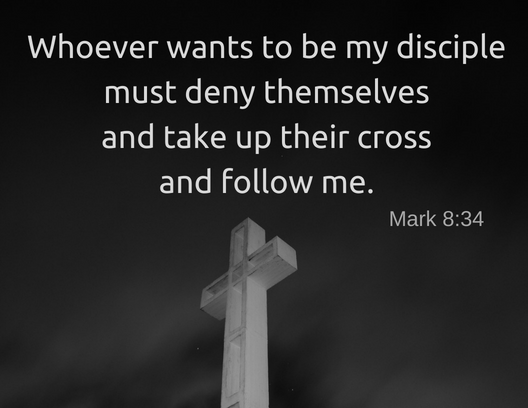
Mark 8 34

The Via Dolorosa, or the “way of suffering”, is the path, according to tradition, that Jesus took to the cross on the day of his crucifixion.  His literal carrying of his cross most likely involved moving 100-300 pounds across a half mile stretch after being beaten to within an inch of his life.  This was an impossible journey that had Jesus incapable of bearing the burden, and his cross was (forcibly) taken up by Simon, the Cyrene (Matthew 27:32). Jesus carried the weight of the cross until there was nothing left in him; however, his path to Golgotha, to pay for the sins of all mankind, did not start at the Lion’s Gate on the day of his death, but it was an everyday consideration that was revealed to him by God.


Then he called the crowd to him along with his disciples and said: “Whoever wants to be my disciple must deny themselves and take up their cross and follow me. For whoever wants to save their life will lose it, but whoever loses their life for me and for the gospel will save it. – Mark 8:34-35


Jesus predicts his death moments/verses before, and knowing how his story would play out, he most likely thought of His own literal cross he would bear on a daily basis.  He uses it as our example for the daily battle to call ourselves his disciples. We must deny our hopes, our will, our thoughts, our opportunities, our deepest desires, and stand alongside him on the Via Dolorosa – the way of suffering – and follow him.  It is a hard, burdensome journey to put ourselves to death (1 Cor 15:31) and be crucified alongside him (Gal 2:20).


BUT the difference is Jesus no longer carries his cross.  He died once and for all and now lives so you can count yourself as one who will receive the same promise (Rom 6:10-11).  Just as Simon, the Cyrene, helped Jesus bear the burden of the physical cross, Jesus stands waiting to help us bear the things we cannot.  He makes our yoke easy, and our burdens light (Matt 11:30); he constantly is inching our cross towards the place he has prepared, not the Place of the Skull, when it seems we cannot journey no further. Without Him or God’s grace, it would be a crushing weight, and we would be doomed to fail.


We count our momentary sufferings as loss, because even in suffering we have Christ, and access to God, our Father.  Those who do not have him suffer alone, are crushed alone, and die alone. There is no hope from the crosses they choose to bear. They lead to a death without hope, eternal destruction and separation from the God who desperately loves them and allowed His son to suffer so that we might live.  Today, tomorrow, and every day that we have an inch of life or more, we must take up the cross and follow him, knowing He has and will bear the weight when we cannot.

-Aaron Winner

The God Hug

2 chron 7_14b

Hugs convey so many emotions – there’s the “hey, I haven’t seen you in a while” hug, the “wish you well on your journey” hug, the “so sorry for your loss” hug, the “I’m so happy for you” hug, the “I can’t believe we just did that” hug, the “I love you anyways” hug, the “it’s great to be alive” hug, the “you must be having a bad day” hug, and “you look like you haven’t been hugged in a while” hug.  Putting your arms around another human being brings about some sort of connection we simply cannot attain on our own – I mean, have you ever tried to hug yourself (or are you trying now that you read that)? It just doesn’t work. Your mind knows that you cannot fulfill this need for embrace, connection, and sense of belonging on your own. The great irony of hugs is we often need them in the midst of the the most lonely and terrible things.  When we feel no one can know. When we feel no one understands. When we feel we are not worthy of love. When we are ashamed of what we become. When we are running away.


“When I shut up the heavens so that there is no rain, or command locusts to devour the land or send a plague among my people, if my people, who are called by my name, will humble themselves and pray and seek my face and turn from their wicked ways, then I will hear from heaven, and I will forgive their sin and will heal their land. Now my eyes will be open and my ears attentive to the prayers offered in this place. I have chosen and consecrated this temple so that my Name may be there forever. My eyes and my heart will always be there.” – I Chronicles 7:13-16


These words were spoken by God to Solomon concerning Israel after the consecration of the temple.  These people have a condition and a promise not unlike our own. When things get bad, where are we going to turn?  When we are lonely, scared, hurt, or struggling to understand, who will we seek? The thing is, we have someone who understands.  We have someone who calls us worthy. We have a proud Father. We have someone to run to in the middle of the deepest, darkest storms of our life. He is God Almighty, and his arms have been reaching towards you and I since the beginning of our existence, ready, waiting, watching, and listening.  Once He hugs, he does not let go because His name is forever written on our hearts, his newly establish temple.


There are two conditions to God’s hug.  The first is submission. The actual physical posture of a hug is one of the most vulnerable positions you can put yourself in.  Your arms and hands are no longer protecting your body. You are giving up the rationally safe position to experience greater joy. This same predicament comes with turning to God.  Giving up safety means airing out your junk to him and others. It means putting trust in His hands. We do not seek to know why the rain falls on the just, but we seek to know Him, that He is a Good Father, who is for us, not against us – this is what brings us joy when we don’t understand.  I know – IT IS SO HARD in the midst of famine, frustrations, and fury, but God is faithful to us, so we must seek and trust.

Additionally, the second condition is invitation.  God was invited into Solomon’s temple and He shows up big time (2 Chronicles 5:14).  That same invitation and power is available to us. Submitting to God’s will begins the removal of junk that crowds the space where His Spirit is to dwell, and His Spirit is our Comforter, our spiritual hugger, constantly filling and surrounding us with the presence of God.  It is available to us when the clouds are shut and when we celebrate the rain. Try this – actually physically verbalize this invitation and outstretch your arms – I know sounds weird. Submit. Invite. As you worship, as you pray, as you walk throughout your day. God presence is what follows, telling us that we are His children and we can cry out “Abba, Father, I need a hug!” because we are never left or forsaken by our Father.

-Aaron Winner

the Light wins

light

Sitting in Sunday School, hearing the story of creation over and over again, I never wondered why light was the first creation of God.  While we might need a lamp to work through the evening, God certainly doesn’t (Psalm 139:12). What is even more curious is the Sun and stars are not created until Day 4.  Hmm. Before we quickly call this a contradiction, I think skipping ahead to the end of our story tells more about the beginning – “There will be no more night in the city, and they will have no need for the light of a lamp or of the sun. For the Lord God will shine on them, and they will reign forever and ever. – Revelation 22:5  What does this scripture tell us?  1. That light can exist without the stars, moon, or sun, and 2. God himself is the source of that light.


God, in his infinite wisdom and beautiful scripted metaphor, begins our story with darkness being turned into light and a distinction created between the two (Gen 1:5).  God’s physical light was created to overtake the darkness – just as Jesus, our Light, was created to over take our darkness, our sin. This metaphor runs even deeper. God’s light is His presence in the life of men, Jesus is called the Light because he is God’s fulfillment of that presence, we are called light because God can now live in us, and there will be no more darkness is His kingdom because there will be nothing to separate us from the light of God.  It still goes deeper. Even now the physical lights God has ordained, the sun (Psalm 50:1), stars (Genesis 26), and moon (prophecy), are constantly testifying who He is and the calling on our lives. Are these universal symbols we see repeated in storytelling in all people and ages inspired by religion, or did God in his infinite wisdom inspire in us all a calling and connection much higher than we often acknowledge?


These thoughts are enough to contemplate for the rest of our lives, but light’s contrast, darkness, is a daily competing force in our lives.  We live in an imperfect age where darkness separates us from the fullness of relationship with God, on a global and personal level. The possibility of war, famine, poverty, persecution, abandonment,  and destruction are the present realities, along with the many terrible things sin and its consequence brings into our lives. It does not take too long dwelling on these things to feel like be have been abandoned or forsaken by God, but the rising of the sun is the constant, every day reminder, that He has called us out of the darkness and into His marvelous light (2 Peter 2:9-10).  God’s Spirit does no longer hovers of the deep, dark waters of our soul, but now lives in us, constantly reminding of his love, mercy, and plan. We have a personal relationship with Jesus Christ, our Word, than is bringing a light that leads the way back to God.


Crack open your blinds or curtain a little before you go to bed this week and let the sun’s piecing light wake you the following morning.  Let this physical awakening be a reminder of your calling, and be challenged on a daily basis to overtake the darkness. God is perfectly planning and restoring those who seek Him for something beyond this world.  It is true that darkness currently lingers, the Light wins.

-Aaron Winner

Leave the Boat Behind

matt 4 20

Many of you who subscribe to this blog are currently on voyage towards your “Mission” or FUEL 2018.  Sadly, I have been left behind (electively) for the first time in almost 20 years, which gives me a wonderful opportunity to man the deck and steer the course for your inspiration from the scriptures.  My hope for those attending FUEL 2018 is to place a mark on your map, so you can begin navigating your day. Those of us not attending or those who don’t even know what FUEL is, I hope to remind you of the called Christian’s day-in-day-out commissioning that sets us on a life-saving and life-giving course, not only for ourselves, but for all who have set sail seeking the truth.


To provide some context for our key text today, Matthew 2-4 shows us the preparation of Jesus for His ministry and purpose.  He was born with distinction, baptized to be righteous, and tempted to be proven. He is now ready and worthy for his calling to share a game-changing gospel to both Jews and Gentiles (Isaiah 9:1-2).   He begins sharing this good news, specifically, looking for disciples to come follow Him. The events that unfold in Matthew 4:18-22 are shocking to most of us. Jesus calls a set of brothers to follow him, and they actually do it.  And then it immediately happens again. WHAT!? Now to be fair, we are not given a lot of context. It is possible the conversation with these fishermen was longer than “Come, and follow me and I will send you out to fish for people,” but keep in mind, this is before the miracles of Jesus — when he was baptized, tempted, and sharing the gospel like us.  If Jesus spoke any other words or had a reputation, it was regarding two things: repentance and the Kingdom of God (v.17).


Now, it has been said the two best days of a boat owner’s life are the day they buy their boat and day they get rid of it.  It would be disingenuous to say all boat owners feel this sentiment, but the majority do. Why? The infatuations and pleasures brought by owning a boat quickly are outweighed by the unforeseen investments, burdens, and maintenance.  Andrew, Peter, James, and John could very well have been content, but were undoubtedly ready to disembark because they were looking for something better. These four men left their nets, boats, and fathers and immediately followed Jesus. I know. You are scratching your head — “It doesn’t happen like this; people today don’t actually leave their stuff, work, or family behind to follow Jesus.” It actually does.  Quite a bit in the Bible, but as I have seen with my own eyes, quite a bit today WHEN there isn’t contentment with leaving people on sinking vessels.


We do not have to perform miracles to create this type of rapid response to the gospel, only share the message that removes the burdening responsibilities “owning” a boat. What is that message?  “Come, follow Him, ” in this many words or more, not merely left to a cryptic metaphor with our actions. Additionally, we must be ready to verbalize our answer to the hope we have, the faith that makes us live differently (1 Peter 3:15).  These words are our net, our bait, our way of setting the hook for conversation; otherwise, we are just fishermen, waiting for a fish to hop onto the shore (which is pretty ineffective). No matter what we catch, those who share our message and praise it, those who hate our message and curse it, or those who are seeking our message and find it, we are His fishers of men who continually cast our message of the Kingdom of God, seeking and searching for those who are ready to leave the boat behind.

-Aaron Winner

One Thank You

Luke 17

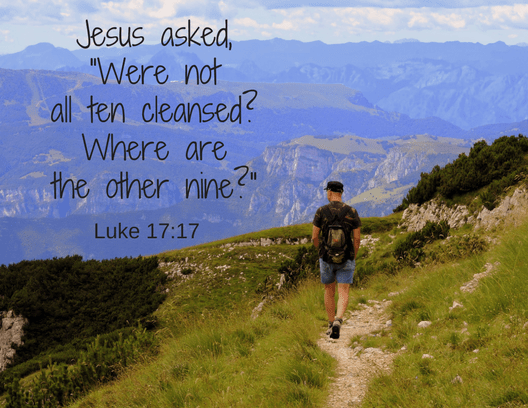
Luke 17 17 edit

A simple, but important rule in my sixth-grade classroom is students must say “thank you” anytime they receive something from me.  It doesn’t matter if that something is homework, a reward, a present, or even a consequence, the expectation is always that I am thanked.  Why?  There are a few reasons.  First, when you thank someone you acknowledge you are receiving something.  Second, when you thank someone you acknowledge they are the giver of that something.  Finally, when you thank someone you are showing that you have considered and accepted that something.  Conversely, if I am not thanked, I must assume my students do not value the item, the giver, or its intention.  Now, I am not naive enough to believe every eleven-year-old that says “thank you” has gone through this thought process.  They may simply be well-mannered (or well-rehearsed).  Maybe they know it is a rule and do it to avoid a negative consequence (which they would have to say “thank you” for anyways).  They simply may do it because everyone else is doing it.

It can be hard to tell the authenticity of a thank you, but one pattern I have noticed is when someone is truly thankful, they will seek you out to tell you.  Such was the case of a student of mine who delivered a letter to me on Teacher Appreciation Week last year.  While the standard fare is a box of chocolates, a coffee mug, or a cleverly-punned present, she crafted an honest-to-goodness thank you card.  There were no generic references to how awesome I was, how my class was the best, or how funny I am (which all are true), but she acknowledged specific words I had written in her yearbook at the close of the prior school year. She stated those simple words had changed her attitude, and she wanted to let me know that she greatly appreciated the time I took to consider them, write them, and live them.  Favorite “appreciation” received to date.

In today’s reading, Luke 17, Jesus amid traveling from Galilee to Samaria is met by a lot of lepers.  They each want the same thing: to be healed.  Jesus obliges, and without much reference to how he did it, he simply states in verse 14, “Go and show yourself to the priest,” meaning they would now be known as the men who formerly had leprosy.  They were cleansed, restored, no more peril or pain. They could now enter the city gate, walk the street, and be with all those they had left behind.  In their excitement, nine men rush to show everyone how they had been healed.  A single soul stops; he turns to praise God and give thanks to Jesus for this wonderful blessing beyond measure.  Jesus is curious about the other nine, but tells the lone returner he was “healed because of his faith.”

So many times I have read this story and am left wondering, “Why did Jesus say this man was healed ‘because of his faith’? Were they not all healed?” The more I read over this passage, place it preceding Jesus’ next topic, the Kingdom of God, it begins to resonate what Jesus may be alluding to.  While this thankful leper was cured in the very same way as the other nine, he alone received the lasting healing and life that comes through the acknowledgement of Jesus Christ.  This thankful man’s healing was not physical transformation but an allegoric alignment of his spiritual salvation.

So where does this leave us?  Often, we are the nine.  We joyously jog back to the place we came – complacency or repetitive sin — because we know we are restored, we can enter the city gate, we can walk the streets, and we can be with those we have loved because Jesus has already paid the price for us to do so.  We may thank him because we are well-rehearsed to do so in prayer.  We may thank him because we fear what might happen if we don’t.  We may thank him because that is what everyone else is doing; however, the minute everyone else turns and runs, we are there following them instead of running to our Lord and Savior.  Take a moment to stop. STOP!  Turn around.  Run to Jesus (repent).  Praise God (for your blessing)!  Tell him what he has given to you, what He means to you, and how that is changing your life, not because that is something you do, but because that is something YOU do!  When we offer thanks to him in this way, we will know the eternal healing that comes through a thankful faith.

-Aaron Winner

The Master and Manager

Luke 16

Luke 16 13

God and money?  Can a Christian have both? No. Yes. No? Yes? Hmm.

I am to sell all my worldly possession (Luke 18:22), but I am responsible for making sure the physical needs of widows and orphans are met (James 1:27).  It is easier for a camel to go through the eye of a needle enter the Kingdom of God (Matt 19:24), but God richly blesses men with wealth who follow him (Prov. 10:22).  I am to store up my treasure in heaven (Matt 6:19), but I am told the wise man saves his riches for a rainy day (1 Cor. 16:12. Prov. 21:20).  On the surface of this topic, it would seem we have contradiction, but thankfully today’s reading might help us come to a clearer conclusion when we consider two powerful, but unequal masters: God and money.

In Luke 16 we are presented with a peculiar parable that shows the strength of the almighty dollar.  As the story opens, we are introduced to a dishonest manager who is in charge of accounting (a running theme) of debts for his master. He learns that his master soon will dismiss him, so as each debtor approaches the manager with their contracted commitment, he forgives a portion of their debt.  Being shrewd, he knows he will be the receiver of their thanks, although it was neither his debt to forgive nor his portion to take.  Jesus makes no misgiving that he was speaking specific directly to the Pharisees, who were fundamentally dealing in the same way.  These “managers” of God put literal prices on forgiveness and offerings, ensuring their comfort, but cheating God of glory, praise, adoration, honor, or extending grace himself.  They, like the shrewd manager, traded their merciful Master for passing provision.

In Dale Carnegie’s famous work, How to Win Friends and Influence People, he states “It isn’t what you have or who you are or where you are or what you are doing that makes you happy or unhappy. It is what you think about it.” This is a challenging thought that calls us to contentment, but also in context of this specific parable, helps us increase our focus.  Are you the master or the manager of your wealth? time? health? will? Are they yours to divide, take, or utilize as you please? Who receives honor, praise, and recognition when you offer these things freely to others?  Sometimes we are as shrewd as the Pharisees, thinking a possession, a place, or a position is the source of a joyful life.  They make us feel momentarily like the master, but really, they take us away from our true purpose.

Jesus concludes this parable by saying if we cannot be trusted with the small things, why would God ever give us the BIG things. If we cannot rely upon him for our own daily bread why would he ever ensure we are the steward for the needs of others?  If we are faithful to Him, we are entrusted with more of His bidding, not in direct correlation, but determined by the master (See: “Parable of the Talents”).  Yes, this can include money.  Yes, this can include more time on earth.  BUT GLORY, HALLELUJAH, YES, he is talking about the KINGDOM.

So, can you have God and money? Yes. Can you serve two masters? No.  Will God give you more if you are faithful? Yes.  Is it money? Not necessarily, but IT IS the Master’s wealth beyond measure for His faithful managers.

-Aaron Winner

The Parable of the Lost Ring

Luke 15

Luke 15_10

It was the beginning of a Louisiana winter when I lost my wedding ring just a couple years into my marriage.  It was a beautiful white gold ring with an inscription of our anniversary on the inside of the band.  It was a perfect reminder of my covenant in every way; however, its faults were it was a little loose when my hands were cold, and of course, it had me for an owner.  My friends and I were readying to play a football game on a Sunday afternoon and I was warming up by tossing the ball with a friend.  In a bit of foreshadowing for the events of the day, my ring slipped off as I caught the ball.  I picked it up off the ground, remarked how cold it was that afternoon, thought about placing my ring inside my pocket but thought it might fall out if it was there.  I put the ring back on my finger, only to lose it at some point in the next couple of hours of our pick-up game.

As we finished playing, my heart immediately sank when I realized it was gone.  I felt a cold sweat build on my forehead, my gut churned, and I held back tears, disappointed that I had lost something so precious.  My friends helped me look for almost an hour without success.  In the muddy, mushy, marshy Louisiana ground, I could see the imprints of our shoes and feet, I could see heaps of crawdad holes, but none of us saw the silvery reflection of my ring buried within the mire and muck.

In Luke Chapter 15, Jesus tells a series of three parables with a similar subject of a possession that has gone missing. In “The Parable of the Lost Sheep”, the master realizes that one of his flock is missing, and leaves behind 99 others to search for the lost one.  In the “Parable of the Lost Coin”, a woman takes account (to tie to our theme from yesterday) to realize she has misplaced a day’s earnings and does the equivalent of turning up couch cushion, investigating under the bed, and sweeping every nook and cranny to uncover it.  In “The Parable of the Lost Son” a father turns his son loose with an inheritance, but is actively looking for his return.  In addition to the same topic, each story ends in a similar resolution: what has been lost has become found and there is great rejoicing.

For me, there are two great takeaways as I ponder the collective meaning of these parables.  The first: to be lost, you have already belonged.  It is true that we each must find the Master in order to be saved, but He is the one who never stops searching.  Our Lord desires that not even a single sheep goes astray and is left without the safety of the shepherd (2 Peter 3:9).  Additionally, my thoughts turn to the Book of Life.  In Revelation 3, we are presented an image that our names are not written into the Book at the transition from “lost” to “saved”, but have already received a place there and are blotted out at the end of a life that is not found in Christ.  We are always His, but like the lost son, we make the decision to be found.

The second takeaway is the wonderful rejoicing that occurs when we turn our lives over and are indeed found.  There is a literal fiesta in the firmament to celebrate our Savior’s joy that we are alive again. No longer do we share the fleeting moments of a mortal life with our Father, but have the hope of an eternity of His presence, living with Him in His kingdom, our intended inheritance instead of passing pleasures. We, too, should echo the heavens and revel in each return.

Unfortunately, the resolution to my own parable of the ring isn’t as joyous as our Jesus’.  I searched for the ring for weeks, beseeched friends I know with metal detectors, offered rewards, but none of these measures ensured the retrieval of my wedding band.  I resigned my search, and my ring is forever lost in the loose Louisiana earth.  Maybe, as I like to imagine, it is the crowning jewel at the bottom at some crawdad family’s hole. With this being said, I can’t help but be thankful that my God has called me his treasure and that he never stops searching for me.  He finds me in my wandering, revealing and moving His will and His way through His words, waiting for my silhouette to again darken the horizon when I have gone astray – a Father who never fails finding those who desire to be found in Him.

-Aaron Winner