Resolution 6: Finish What You Have Started

Malachi 3-4 and Revelation 22

If you are reading this, you have officially made it to the end of 2021, like it or not.  For many, whether they have faced greater hardships or substantial joy, they are ready to see what God has in store for their next year of life.  For me, the calendar is one of the few things that I can say each year that I saw through to completion.  I have successfully completed the calendar 36 or so times; however, one year, if the Lord tarries, I simply won’t.  Poof.  My dusty remains will most likely rest in some sentimental location in the earth’s crust to wait for the return of Jesus Christ, awaiting to receive his promise alongside all those who faithful have served Him (Hebrews 11:39-40).

Conversely, with about every other element in my life, I am a terrible finisher.  Currently, I have several projects going on at my home: a mostly finished deck, one mostly finished fence, one mostly unfinished fence, and a horseshoe pit that I decided to begin work on a couple of days ago. I present this as evidence that I am a terrible finisher, and this is just a single outlet of my life.  This is true in pretty much every aspect, from professional work to text messages, there is always something left undone.  Thank you, God for not making the Christian walk a checklist that has to be completed before I bite the big one. No matter how many “tasks” I have performed, how many prophecies I have spoken, or how much love I have shown, if I wake up the next day still sucking air, I am not finished, and that is a feeling very familiar to me.

Then he told me, “Do not seal up the words of the prophecy of this scroll, because the time is near. Let the one who does wrong continue to do wrong; let the vile person continue to be vile; let the one who does right continue to do right; and let the holy person continue to be holy.” – Revelation 22:10-11

For I am already being poured out like a drink offering, and the time for my departure is near. I have fought the good fight, I have finished the race, I have kept the faith. Now there is in store for me the crown of righteousness, which the Lord, the righteous Judge, will award to me on that day—and not only to me, but also to all who have longed for his appearing.” 2 Timothy 4: 6-8

God has us covered with grace.  If He cared, like Kingdom of God-cared, about my fences, deck, or horseshoe pit, then they would already be made complete, and I could move onto the next project at hand.  But we have an eternal God whose mind is set on eternal things.  He doesn’t care about my home projects.  Only my heart in pursuing them. He doesn’t care about my career, only my heart in pursuing it.  He doesn’t care about my resolutions, text messages, or what I am leaving undone, only my heart when pursuing each of those things.  His grace is already complete, so the thing He and I work on are the hearts that will find their way to the Kingdom of God, including, and most importantly to me, my own.

If 2021 is my last calendar year, I will leave behind much undone, which may resound with you because many of us are in the same boat. However, my heart is the one project that I have assuredly been working on and hope and pray that it is finished and made God complete through Christ Jesus (Col 2:10). Everything can be (and really will be) left undone, unfinished, and incomplete. I encourage us all to close out this year being finishers. Not by checking off the last couple of boxes of projects, resolutions, or bucket list items that remain, but by considering matters of the heart: your faith, your actions, and your pursuit of eternal things, so you can end this day, this year, and this life, strong.

“On the day when I act,” says the Lord Almighty, “they will be my treasured possession. I will spare them, just as a father has compassion and spares his son who serves him. And you will again see the distinction between the righteous and the wicked, between those who serve God and those who do not. – Malachi 3:17-18

In all my prayers for all of you, I always pray with joy because of your partnership in the gospel from the first day until now, being confident of this, that he who began a good work in you will carry it on to completion until the day of Christ Jesus. – Philippians 1:4-6

-Aaron Winner

As we finish off our 2021 Reading plan…we are excited about beginning a new plan for SeekGrowLove for 2022. Watch for more information coming today! Sneak peak – tomorrow’s reading will be Matthew 1. We are glad to have you on this journey working on our hearts as we Seek Him, Grow Our Faith and Love Him and Others through another calendar year!

Read or listen to today’s Bible reading plan passages at BibleGateway.com here – Malachi 3-4 and Revelation 22


Resolution 5: Make Healthy Choices

Malachi 1-2 and Revelation 21

I think we all have flirted with the “best by” dates on food products.  Some of us have done it out of necessity, others maybe more out of laziness, but there is no doubt that some are more sensitive to these subjective guidelines .  I personally give it a sniff and stir test.  Looking for foul odors or curious textures before giving it a taste.   The level of craving or hunger often determines how much flexibility I will give.  At work, I still haven’t lived down a tub full of moldy hummus I ate because I didn’t want to waste it.  I should have just kept my mouth shut (well open really, I was eating), but alas, here I am telling another audience. Surely, the carrots, celery, and apple I was enjoying with the hummus offset any of the negative consequences.  I am willing to eat leftovers, perform sniff tests, down some soft grapes, because when I do this, I give my family an opportunity to buy healthy fresh foods, and treat them to a pleasing sit-down meal from time to time.  This Outback Dinner was brought to you by the goat cheese that sat on the bottom of the meat drawer for weeks and the awful cauliflower-something dish that no one else would eat. Nevertheless, it would seem a bit more detestable if I only treated myself alone and made my family eat the stuff growing hair in the back of the fridge.

 When you offer blind animals for sacrifice, is that not wrong? When you sacrifice lame or diseased animals, is that not wrong? Try offering them to your governor! Would he be pleased with you? Would he accept you?” says the Lord Almighty. – Malachi 1:8

Now to frame these choices into a different context.  Is this the way we are treating our relationship with God?  Are we giving him the leftovers, the surplus of our pantry, or the rejects of our storehouse?  Is there an allotted time that you are giving God each day for prayer?  Or do you pray when you have time.  Or if you get up early.  Or when you’re in the car alone.  Are you only tithing what you have left after you pay your bills?  And that is only if there is anything left.  Or maybe not this month because things are tight.  Are you filling the church with single-ply toilet paper when you have triple-ply at your house?  Or bringing your recipe-gone-wrong to the potluck?  Or going to church only when it’s convenient to your and your kids schedule?  Or donating things because you didn’t like the style anyways? If you answered yes to any of these, what you are giving God is going to require a sniff and stir test; your offering may be lame. Your discipleship is growing mold and diseased.  When we are talking about God, we give him the firstfruits.  The unblemished.  Simply the best we have (which still is the equivalent to nothing) but it is fragrant to God and His desires.  He acknowledges the sacrifice when we bring it with a merciful heart. He sees the effort we are making to have a relationship with Him. Our offering is not animals or crops, it is our time, our effort, or energy, our money, and our stuff.

“Therefore, I urge you, brothers and sisters, in view of God’s mercy, to offer your bodies as a living sacrifice, holy and pleasing to God—this is your true and proper worship.” Romans 12:1

He who did not spare his own Son, but gave him up for us all—how will he not also, along with him, graciously give us all things? – Romans 8:32

God didn’t skimp on salvation.  He didn’t provide someone who was expendable.  He didn’t choose someone who was already terminally ill. He didn’t choose a criminal.  He picked the firstfruits, or as Colossians 1 says the firstborn of all creation, meaning before it all, God had already set aside the sacrifice of His son for our sins.  He picked the best.  The only man unblemished by the disease of sin.  This is our example of what sacrifice should look like.  Even though we don’t live in the age of sacrifice, giving first, going without, but most importantly showcasing with our very best effort our desire for God is still a beautiful way to show our love for Him and our request to receive the magnificence of his mercies.  He doesn’t require our sacrifice, but he desires our worship.

“I did not see a temple in the city, because the Lord God Almighty and the Lamb are its temple. The city does not need the sun or the moon to shine on it, for the glory of God gives it light, and the Lamb is its lamp. The nations will walk by its light, and the kings of the earth will bring their splendor into it. On no day will its gates ever be shut, for there will be no night there. The glory and honor of the nations will be brought into it.  Nothing impure will ever enter it, nor will anyone who does what is shameful or deceitful, but only those whose names are written in the Lamb’s book of life.”

On a final note, the best of God’s plan is yet to come.  The richness in store for us is beyond anything we would do without now.  Again and again, as you read the blueprints of the Kingdom in Revelation 21, you will be blown away by the preparations God has made.  The God outside of time has taken all of His time to make something beyond all fathom, wealth, and existence.  Wow!  Consequently, when your sacrifice is from the healthiest choice, you are going to miss some fun.  You will have to wake up early or stay up late.  You will have to do without some luxuries, or even believed necessities.  There is still a greater inherent blessing from knowing, serving, and honoring God in the reheated stuff that this life is made of in a corrupt, sinful world.  But God…Oh, how God! He is pouring His very best into what is to come.

-Aaron Winner

Read or listen to the Bible reading plan passages at BibleGateway.com here – Malachi 1-2 and Revelation 21

Resolution 3: Save Less

As someone in their mid 30’s who still lives the vast majority of their life like their 13, it’s kind of weird to think my wife and I have assets and savings. Banking. Bonds. Portfolios. Pensions. That’s all stuff for adults. I can’t even match my socks. Yet, here I am, meeting with a retirement counselor and occasionally checking in on the stock market.  As much as both my wife and I love our work, we realize that we don’t want to do it forever.  Each month, a chunk of pay goes into a couple different accounts meant for use a quarter century from now. Lord willing, if we both make it.  Check with us in 25 years.

We are reminded in Proverbs that it is a fool who doesn’t think about the future (Prov: 6:6-8).  Yay. Point for me. But should I, as a Christian, have money in my savings account when I could be giving it charitably?  Do I really need to put aside money for the future if God is going to take care of me? Hmm. God gives all, and tells you to save for rainy days, so He will give you something to save for a rainy day. Honestly, I’m not sure. What I do know is saving is an important discipline, especially with the consideration of tithing, but we are reminded by Jesus that we can get carried away with accumulating things, hoarding our wealth, our assets, and collections (Matt 6:19-24; Mark 10:17-27) and be led down not only a distracting path, but a divisive contrast to the life that pursues God that leads to destruction. If you must err on a side as you pursue God’s answer for this, it would be to give more, and save less.  See the sparrows and the rich young ruler.

Unfortunately, or honestly, more fortunately, you will not receive any long term financial advice from me because I can’t even be counted on to keep cash in my pocket without losing it.  The virtuous woman in my house is responsible for all of our rainy day savings. Although still not fully qualified, I would like to take a moment to focus on the savings that occur in today’s reading.  As we all know, weddings can be very expensive affairs and often are the culmination of many years worth of saving.  Keep this in mind when you begin to read about the marriage supper of the Lamb.  God has been “saving” for the wedding of Jesus and the Church since the foundations of the world.  Imagine how elaborate this celebration will be, when God begins to tap into his reserves for sons and daughters. This is a nest egg far beyond our imagination.

“Then I heard what sounded like a great multitude, like the roar of rushing waters and like loud peals of thunder, shouting:  Hallelujah! For our Lord God Almighty reigns! Let us rejoice and be glad and give him glory! For the wedding of the Lamb has come, and his bride has made herself ready. – Revelation 19:6b-7

Investing in a single company, bond, or stock is a foolish idea, that’s Finance 101 and some wisdom for earthly investments. However, for treasures that await in heaven to become sight on earth, you can’t diversify.  You must be sold out in your devotion to the Savior (Matt 16:24-26).  That means you must begin reducing and selling off your other investments of your time, your mind, your energy, and your heart.  If you must bank, first, bank of the hope of Jesus Christ. If you must save, first, let it be for others in the telling of the Gospel message.  If you retire, first, let it be in the peace that comes from this saving knowledge.  The pension that comes from a lifetime of devotion to God is far greater than we could ever imagine and earned through our faith in a single truth: Jesus Christ is the Son of the Living God and Father, given as propitiation for our sin, and He is coming again to establish God’s kingdom.  Wholly invest in this.

The Lord their God will save his people on that day as a shepherd saves his flock.  They will sparkle in his land like jewels in a crown. – Zechariah 9:16

-Aaron Winner

Read or listen to today’s Bible reading plan passages at BibleGateway.com here – Zechariah 9-11 and Revelation 19

Resolution 2: Exercise Less

Zechariah 7-8

It was roughly two and a half years ago when I sat down at a Walmart because I wasn’t feeling particularly well. My seat – the automated blood pressure cuff, because I felt like I needed to get a reading. I felt tense, short of breath, and was sweating for no particular reason.  My suspicions were confirmed when my blood pressure came up 160-something, over 100-something.  Yikes!  My wife was pregnant with twins at this point, and as a soon-to-be-dad, the mental, physical, and emotional stress hadn’t even really started.  With a history of heart issues running through my family tree, I thought, if my blood pressure is this high now, how am I going to be able to play with my kids?  I knew something had to change.  I made a few changes to my diet, but mostly, I began to exercise to get rid of extra poundage that was contributing to the toll I was placing on my body.

The super-short version of the story is YAY! My blood pressure is normal, I play with my kids, and I’m down about 50 pounds.  Running (a lot) is now part of my weekly routine.  But now that I’m where I want to be with my health, I am finding that exercise can simply be exercise. A repeated motion, causing a bit of sweat, but sometimes to no real purpose. If I run 40 laps around the track, I will start and end in the same place. Nothing achieved. I can celebrate the fact that I can snag an extra donut on Teacher Appreciation Day, or score,  a McDonalds breakfast (I didn’t say my blood pressure was great, just normal) without the guilt, or eat eight desserts at Thanksgiving (sad, but true), but I’m not really going anywhere.  I am in maintenance mode, like those awaiting a second temple here in Zechariah. 

“Ask all the people of the land and the priests, ‘When you fasted and mourned in the fifth and seventh months for the past seventy years, was it really for me that you fasted? And when you were eating and drinking, were you not just feasting for yourselves? – Zechariah 7:5-6

Now, before I move any further, it needs to be said I am healthier because I run. Spiritual disciplines are not unlike this. These routines are important, and even more, necessary. Prayer, worship, and reading God’s Word should be part of your to-dos every. single. day. BUT what those items shouldn’t be are chores sandwiched between taking the trash out to the curb and picking up the milk.  Are you doing these things because you want to draw into a closer relationship with God? OR are you doing these things because you are doing these things.  I mean, how did you get here to read this blog today?  Is it part of your exercise or your routine?  If so, is it because you desire more about your loving God and his calling on your life? Or do you use it as a means to build credit in the God bank so you can have the extra donut, or eighth desserts? It’s tough. Right? Live for a moment outside of the routine.  Today, start exercising less and engaging more. Throw out the score card because God already has you beat. Enter into the purpose of what you are doing, seek Him, and draw nearer to His Spirit.  Find a way to share His justice, His mercy, and His many compassions because you are compelled to show the love of God, not simply run to the next item on your list.

This is what the Lord Almighty said: ‘Administer true justice; show mercy and compassion to one another. Do not oppress the widow or the fatherless, the foreigner or the poor. Do not plot evil against each other.’ – Zechariah 7:9-10

-Aaron Winner

Read or listen to today’s Bible reading plan passages at BibleGateway.com here – Zechariah 7-8 and Revelation 18

Resolution 1: Drink More Water and Less Kool-Aid

Revelation 17

The eternal feasting from Thanksgiving to Christmas has begun to catch up with me (it’s not just you, promise).  This pre-New Year’s week (and it’s bloating) is often cited by many as their week of revelation and insight into the preparations of what they might change in the upcoming year. While any time – month, day, or hour – is welcome to change, this week I will be focusing on some resolutions presented to us in the continued reading in the prophecy of Zecheriah, the Revelation of John, and the beginnings of Matthew.  While many of the passages are filled with prophetic, symbolic, end-time images, I will try to remain focused on the big picture: the message or warning presented in the passages.  Our eyes should be open, our ears listening, and our spirit attune to the world around us, not only because we become reflective as our year draws to an end, but because the drum roll quickens towards the end of this present evil age.  We should hasten our efforts, not to simply shed a few holiday pounds, start a new hobby, or get organized, but to make changes and to carry on efforts that will make lasting impacts in the Kingdom of God.

Speaking of eternal things, did you know, Kool-Aid, when stored properly, really doesn’t expire?  It is a seemingly innocent drink, yet there is a crushing idiom out there beckoning people not to partake in the consumption of this perpetual potion: You might hear an older generation say, “Don’t drink the Kool-Aid ”.  This expression actually means don’t believe everything you hear, especially because it presents a very real threat.  It might seem that the origins of this phrase refer to the high sugar content, the unnatural color, or the artificial flavor of the name brand fruit drink of childhood and beyond.  It is true, there isn’t much wholesome about this drink (sorry, grape. I still love you tho❤️); however, this isn’t where our figurative turn of phrase is born.  Instead, the origin is far more tragic than the attack on our blood-sugar.  The notorious event is referred to as the 1978 Jonestown Massacre, where hundreds of innocent men, women, and children died by drinking, or being forcibly injected, with a combination of Flavor-Aid and poison.  This presents a more tragic history behind the coinage, but draws a parallel to today’s reading in both Zechariah and Revelation.  The words below remind me that there is a great coming (or even present) evil, or a more perilous and poisoned Kool-aid that is brewing and being passed as legitimate name-brand Gospel.

“I saw that the woman was drunk with the blood of God’s holy people, the blood of those who bore testimony to Jesus.” – Revelation 17:6

The prostitute on the beast paints an ironically sobering picture, becoming intoxicated on the blood of saints and lying with the kings of the earth.  Those who take part in this great debauchery against God, may do so willingly, but it seems many do so unwittingly, astonished and deceived by the spectacles of ungodly power (v.8) . There will be those who are not in the Lamb’s Book of Life who attend churches, have ministries, and even blog about Christ, but give-in to tinted truths, sweet lies, and god-like power, because it is a more “palatable” gospel, requiring less real change and more gratification.  The love, justice, mercy that take root in another source other than our Heavenly Father, may look pretty, taste sweet, and have some of the same notes, but it is filled with poison.  It will never quench your thirst.  It is just empty calories leading you closer to death.  Stop the endless following, swiping, and double-tapping – look up.  Turn off the continuous bombardment of the news cycle – look up.  Quit chasing after causes that don’t lead to the saving Gospel message of Christ – look up. Don’t drink the Kool-Aid.

Now, this begs the question, what then should we drink?  Coffee!  Wrong. Tea? Still wrong.  Soda?  Getting colder.  Simply, water.  No beans, no leaves, no syrup, no colors, no nonsense straight-from-the-tap water.  It is what your body is craving, essential to every major function in your body, beginning at the cellular level.  Among many other things, water aids in digestion, stabilizes the heart, regulates blood pressure, flushes away the toxins, and provides protection to the day-to-day function of our organs and joints.  Such is true for our Living Water, the Gospel message and the Spirit of God present in our daily walk.

Jesus answered, “Everyone who drinks this water will be thirsty again, but whoever drinks the water I give them will never thirst. Indeed, the water I give them will become in them a spring of water welling up to eternal life.” – John 4:13-14

“On the last and greatest day of the festival, Jesus stood and said in a loud voice, “Let anyone who is thirsty come to me and drink. Whoever believes in me, as Scripture has said, rivers of living water will flow from within them.  By this he meant the Spirit, whom those who believed in him were later to receive. Up to that time the Spirit had not been given, since Jesus had not yet been glorified.” – John 7:37-39

While there is a metaphor to be drawn for each of these literal benefits, there is an inherent advantage, understood or not, from consuming water.  Yes, we are trying to flush away perpetuated falsehoods, but drinking living water in and of itself is simply refreshing.  Make time for God’s Word.  Worship Him in your car.  Honor Him with your time. Live out the Gospel through actions and bear the testimony of Jesus Christ. Resolve to fill your tumbler and carry it wherever you go because there are so many ready to make the switch from the Kool-Aid to the quenching Living Water.

-Aaron Winner

Read or listen to today’s Bible reading plan passages at Bible Gateway here – Zechariah 5-6 and Revelation 17

Right Place. Right Time. Right Action.

Esther 3-4

Yesterday, we began to read the book of Esther. Let’s quickly summarize what happened in the first couple of chapters to bring us up to speed for today’s reading:

Chapter 1: King Xerxes, King of Persia, is having a pretty awesome party.  He is serving up an endless buffet with unlimited refills.  He has a few too many refills and calls for his wife, Vashti, because he wants to look at her. She refuses.  He consults with his friends (who might have had a few too many as well),and they decide to execute her as an example to prevent disrespect throughout the kingdom.  Buzzkill. Proclamation in Caveman Voice: Men Strong. Women Weak.  

Chapter 2:  King Xerxes decides it is time for a new queen.  Hmm. What’s a good way to pick my next wife? Personality. No. Virtuous qualities? No. Oh! Beauty contest.  Proclamation in Caveman Voice: Send Pretty Women. Enter Esther – fits the bill. Also, she’s Jewish, although Xerxes doesn’t know, doesn’t care because that doesn’t affect her looks.  Another party.  Mordecai, Esther’s uncle, uncovers a plot to assassinate Xerxes. Mordecai tells Esther who tells Xerxes. Esther trusted. Mordecai trusted. Conspirators impaled.

Have your plot uncovered and being impaled? Unfortunate. But having the car ahead of me pay for my weekly McDonalds run?  Being seated in the section at the ballpark that receives a free loaf of bread? Sitting down at a restaurant and having a meal served on the house? All of this, and more, has happened to me.  I’m a pretty lucky guy.  It seems that I find myself at the right place, the right time.  It’s either that or people just really think that I need food. Being in the correct location at a critical moment is important.  Ask anyone who has ever been late for an interview, or ended up at the wrong Starbucks. But in many circumstances, those two factors are simply not enough.   An equally important prerequisite that isn’t always taken into account (and makes the expression way too long like in the title) is the right action.  Many times you must DO something in order to take advantage of the golden opportunity that is being presented.  Just existing in a place or a moment isn’t enough.

When Esther’s words were reported to Mordecai, he sent back this answer: “Do not think that because you are in the king’s house you alone of all the Jews will escape.  For if you remain silent at this time, relief and deliverance for the Jews will arise from another place, but you and your father’s family will perish. And who knows but that you have come to your royal position for such a time as this?” – Esther 4:12-14

Christians are already in some of the prime real estate for evangelizing.  Christians are in schools. Christians are in workplaces.  Christians are on TV and radio. They make TikToks and podcasts.  I would say that for most of us, we err on the side of being in the world a little more than not.  Having a presence in each of these locations, at this time in history, is not in itself a bad thing.  In a caveman voice: School good. Work good. TikTok, umn, me no say.  But when you sit on your hands and let the world continue to spin in the same way it always has, then you are in the midst of the right location, the right time, but the wrong action.  Simply being an elevated, passive Jew in the kingdom of Persia was not going to save her people from being put to death.  Xerxes, didn’t even know. Being a passive Christian in the same manner is equally reckless. They may not even know. THEY. MAY. NOT. EVEN. KNOW. This is most definitely the correct time. Heed Mordecai’s warning. You MUST become an influencer, not in a manner that will get you more clout or draw attention to yourself, but in a manner that draws attention to God.  You most definitely were made for a time such as this.

But you are a chosen people, a royal priesthood, a holy nation, God’s special possession, that you may declare the praises of him who called you out of darkness into his wonderful light…Live such good lives among the pagans that, though they accuse you of doing wrong, they may see your good deeds and glorify God on the day he visits us. – 1 Peter 2: 9,12

–Aaron Winner

Today’s Bible reading passages can be read or listened to at BibleGateway here – Esther 3-4 and 1 Corinthians 14

Tough Love

1 Corinthians 13

The simplest truth about human relationships is that if we just loved one another a bit more, we would have fewer problems.  I know, it is a bit cliche, but it doesn’t make it any less true. Our focus would be consistently outward.  We would be ready to listen and meet the needs of others. God has made it pretty clear that the most hardened heart can soften by showing the quality that embodies who He is, yet it is a weapon we often leave unwelded.  We often list our harshness or judgements under the guise of “tough love”, and this may or may not be true on a case-by-case basis. However, we must stick closely to the prescribed path in 1 Corinthians 13.  It actually might be simpler to love “toughly”, but if you simply write people off, or find a way to punish them, or speak your mind without backing it up with the many other qualities listed here, you are a hollow box and a lot of noise.  What’s tough love, really tough love, is to love someone who isn’t concerned in the slightest with being like God at the moment, or even ever. Love never fails. So you must love. You absolutely must.  And your love must be like God’s love.  Below I reworded one of the most famous passages of scriptures (v.4-7) that coincides with our reading and, most likely, one of the last handful of weddings you attended.  My goal isn’t to add to the list, only to reword it to give it novelty in hopes to make it challenging or convicting instead of a rehearsal of familiar words.  If it helps tune your mind to God’s love, wonderful.  If it is a confusing mess, don’t read it.  My concern is that you know loving is tough, especially those whose actions betray your love.  That shouldn’t stop you.  But THAT is tough love.  And THAT is what God shows to each one of us on the daily.

For God to come in and change the “unlovable” (mind you, this can be and has been you), you must sit and listen. Listen to their problems and hear them say what they think, even if you don’t agree. You have to include them, share with them, and treat them with dignity, even if they are not concerned in the slightest about having any.  To love, you have to let others be great and cheer them on.  Sometimes this means the spotlight will come off of you, or you are treated as less important.  If you are loving, you’re not concerned with that, because in love, others come first.  Love holds back the insults, name-calling, and doesn’t attack a person made in the image of God.  True love can be shown without expecting anything in return and can be left unreciprocated.  On rare occasions, you can have angry love.  You can be mad at someone because they are doing some serious sin damage to others or even him/herself.  But you don’t start there.  You don’t live there.  You are truthful with someone, because lying is not loving.  But you retreat quickly from the fight, and fill the space with mercy, more patience, and more kindness.  That means love is forgiveness, and not holding grudges.  We can love those who have wronged us.  We can love those who have besmirched our reputation, injured our family through carelessness, or hate us because of our beliefs. We may know their wrong to us as a historical account, but not as an emotional one, and we thank God we have an opportunity to show love to them in such a way.  In fact, loving like God means that you would actually stand-up for this person who has done you the greatest harm.  Loving someone means that you are trusting without “but.” And that can be so hard. But trusting in God first and foremost allows you to do that.  Believe in people.  Never give up on people.  Much easier said than done. It’s tough. So tough. But don’t let it stop you from trying. Your efforts are to help others see God, and they will know His love because it has been extended to and shown through you.

-Aaron Winner

Today’s Bible reading passages can be read or listened to at BibleGateway here – Esther 1-2 and 1 Corinthians 13

A Seemingly Small Part

of God’s work,

1 Corinthians 12

When we think of the ear, we most likely are thinking about those lumpy, peculiar bits of cartilage just on the outside of our head.  While their shape helps us to ping the location of the sound, the majority of the work is being done on the inside.  The eardrum is vibrating, creating the analog beating that is then turned to electronic impulses that our brain interprets.  But even just beyond the eardrum, there is great work happening that is equally important to the overall function and health of the body, although this is assuming you are not hearing alarming noises at the present. Enter the eustachian tube.  It is the gravity-driven country road between the other side of your ear and the top of your throat.  This little pathway is responsible for a couple of very key functions, which you may never be aware of if all is going according to plan.  It sends any junk the ear makes down and out.  It prevents bacteria and any other intruders from creeping up.  But finally, its primary function might just sweep you off your feet, literally.  The regulation of gas and pressure behind our eardrum is important to hearing, but even more important to balance.  If this is the slightest bit off, we may be experiencing a case of vertigo, an internal roller coaster that never leaves the station. The room will spin.  Sweat forms on our brow.  Our eyes jitter.  Our head pounds.  Nausea fills our belly until our body cannot take it any longer and we “blow chunks” as one might put it more indelicately. Oh, and yes, you may lose your hearing too.  All because a space less than a quarter of a square inch doesn’t have the right amount of pressurized gas.

In Chapter 12 of 1 Corinthians, Paul speaks of the ear, but also hands, feet, and eyes.  The metaphors for the functions of each part of our body are endless.  Physically, we can “survive” without some parts, but we recognize that functioning as a whole is disabled because something, or to Paul’s analogy, someone, is missing.  While it may be more obvious when a man or woman is missing an eye or a digit, it is equally important to recognize when we are missing the kidneys and a liver which are removing the poison, or the amygdala which is controlling our rage and lashing out, and yes, the eustachian tube which is providing a steady balance.  These parts are easily overlooked, and many times, the people fulfilling these roles are not only disregarded, but are themselves unaware they are doing them.  These aren’t the folks performing miracles, preaching in the street, or speaking in tongues.  These are the ones who watchfully discern, the ones who are unflinchingly faithful, who make and show perfect peace, and those who have an infinite amount of helping hands to extend.  These are of special modesty, but of equal concern (v.25).

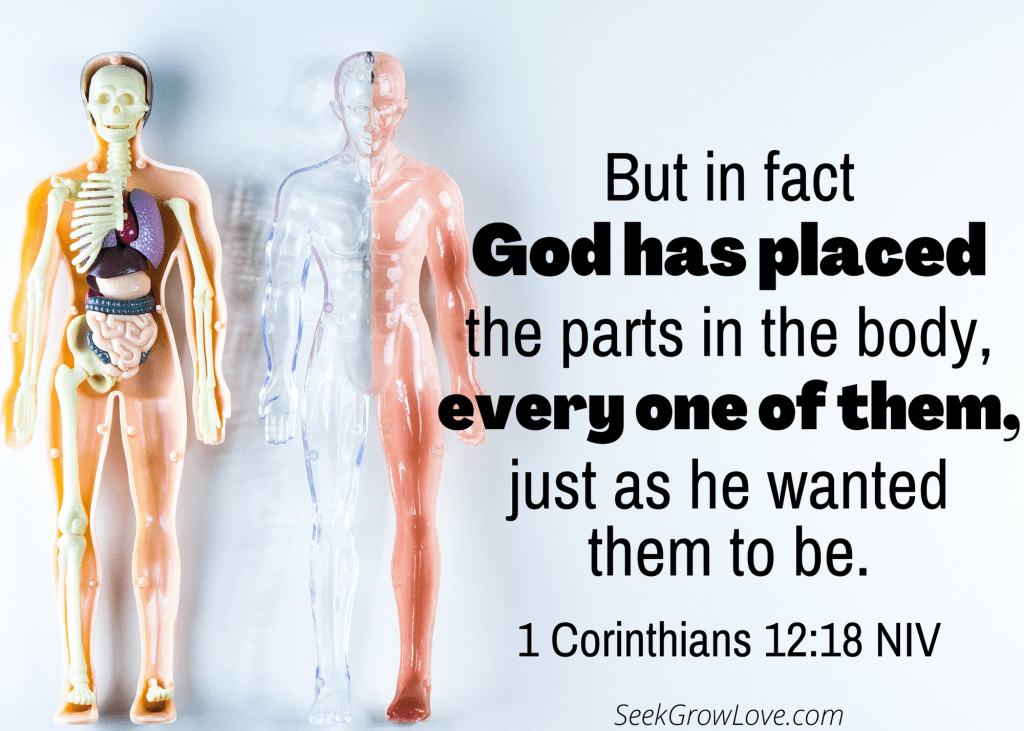
“But in fact God has placed the parts in the body, every one of them, just as he wanted them to be.” – 1 Corinthians 12:18

Now, for the bit with application.  We often give much love to the “showier” bits.  Those who take on a responsibility during a worship service or teach a class, but for a moment, think about the hidden parts among your church body.  Who stands watch (physically or emotionally) at the door of your church?  Who finds a way to create harmony between a foot and a hand vying for the same attention? Who shares their faith when doubt is beginning to spread among the believers?  It is time to take notice.  To recognize. Find a way to show this part of the body some love today. A call, a text, a card, a small token, or a chore done.  It is a very important bit of “self” care. Chances are they will be modest.  They will say they aren’t really doing anything important.  The truth is, they might be the very part keeping the church on their feet, preventing potential headaches, heading off a building rejection of the stomach, or simply lending a listening ear.  If they suffer, so do we, BUT if they rejoice, so do we.  We absolutely need all the parts to be the church we are called to be.

“On the contrary, those parts of the body that seem to be weaker are indispensable, and the parts that we think are less honorable we treat with special honor. And the parts that are unpresentable are treated with special modesty, while our presentable parts need no special treatment.” – 1 Corinthians 12:22-24a

–Aaron Winner

Today’s Bible reading passages can be read or listened to at BibleGateway here – Nehemiah 11-13 and 1 Corinthians 12

The Overwhelming Compassions of God

Nehemiah 9-10

Everyone needs compassion. Our gracious God, the ultimate source of love and mercy, readily extends compassion to us when we face the great challenges in our life.  But it doesn’t stop there.  God is not “deservingly” showing compassion to us because we have made sacrifices for his namesake.  He overwhelms us with compassion when we deserve it the least.  When our ears have been deaf to his calling, when our back has been turned, when our eyes are glistening with selfish pride, that is when he is most compassionate.  It is pretty simple:  life is best lived in and by the design of God.  Anything else is to be pitied.  But we do not serve a God of overwhelming pity.  He doesn’t stop at, “man, that stinks, wish you would have made some better choices there, bud.” He picks us up in our filth, gives us the full concentration of his blessings, and turns our feet back on the path that leads to him.  Over and over again. Undeservedly. In today’s reading, we get a quick lesson in the history of compassion of Israel from Abraham to Nehemiah.  Draw some (rather easy) parallels to your own life as your study this account of the rich mercies of God.

“But they, our ancestors, were arrogant;  bullheaded, they wouldn’t obey your commands. They turned a deaf ear, they refused to remember the miracles you had done for them;…And you, a forgiving God, gracious and compassionate, Incredibly patient, with tons of love – you didn’t dump them.” – Nehemiah 9:16 MSG

  1. God still has compassion for you, even after you have been arrogant.  You can attempt to go it alone.  God doesn’t give up that easily.  When the miracles no longer come, when the blessing subside, and you decide to turn back, he doesn’t merely say, “told you so.” He says “turn around, I’m still here.”

“Yes, even when they cast a sculpted calf and said, “This is your god Who brought you out of Egypt,” and continued from bad to worse,  You in your amazing compassion didn’t walk off and leave them in the desert.”  – Nehemiah 9:18 MSG

  1. God still has compassion for you, even when you don’t give him credit.  Oh, how we like to take credit. How scorned are we when we don’t get the little credit due to us?  And we haven’t really done anything.  It would be simple enough to say, “Good luck in the desert by yourself,” yet God hears the cries of his people and comes rushing in to, again, fight the battles.

But then they mutinied, rebelled against you, threw out your laws and killed your prophets, the very prophets who tried to get them back on your side— and then things went from bad to worse.  And in keeping with your bottomless compassion you gave them saviors: saviors who saved them from the cruel abuse of their enemies.  – Nehemiah 9:27

  1. God still has compassion for you, even when you stab him in the back.  That’s right, literal stabbing of prophets delivering the word of God.  Maybe you are not guilty of such a crime, but openly denying the word of God delivered to you in your life is an equal abuse of the Word of God.  That’s pretty much what sin is.  But guess what?  Those who openly and defiantly deny the gospel, receive sanctification and redemption through Jesus Christ if they make him the Lord and Savior of their life.  Your confession is never rejected, if done so from the heart.

But as soon as they had it easy again they were right back at it—more evil. So you turned away and left them again to their fate, to the enemies who came right back. They cried out to you again; in your great compassion you heard and helped them again.

This went on over and over and over. They turned their backs on you and didn’t listen. – Nehemiah 9: 28, 29 MSG

  1. God still has compassion for you when you return right back to your sin.  That’s right, we are almost cartoonish in our behavior sometimes.  Do the sin.  Ask for forgiveness. <5 min later> Do the sin.  Ask forgiveness.  Thankfully, we have a God of infinite mercies, BUT as Paul says our goal is not to exhaust the grace of God.  If you haven’t figured it out, somewhere in our sinful nature is the habit to turn back to sin, but we must try to actively stop or flee from it.  God is unfatigued with extending his compassions if we truly seek him through repentance.

You put up with them year after year and warned them by your spirit through your prophets; But when they refused to listen you abandoned them to foreigners. Still, because of your great compassion, you didn’t make a total end to them. You didn’t walk out and leave them for good; yes, you are a God of grace and compassion.  – Nehemiah 9:30,31 MSG

  1. If you’re reading this, God still has compassion for you.  You are not abandoned.  It may feel foreign because you have pitched a tent outside the wall, but there is NOTHING that can separate us from the love of God in Christ Jesus.  Maybe you’re seemingly satisfied to be out there for now.  Man, that’s awful.  You will not receive even the pity of men if this is where you stand.  But God looks compassionately upon you, and leaves the gate open, giving every opportunity to be a part of his grace, love, forgiveness and hope.  There is a time limit though, an end game. Once you stop breathing, it’s over.  There are no guarantees when this will be.  An even more compelling argument than “no guarantees” is every moment you are not living in the presence of God, you walk around heavily burdened with sin, guilt, doubt, and shame because you don’t know His compassion.  He will take it all from you and cast it as far as the east is from the west.  Stop. Turn. Cry. Listen. Let go. It is time to let His compassion overwhelm you.

–Aaron Winner

Today’s Bible reading passages can be read or listened to at Bible Gateway – Nehemiah 9-10 NIV or – from The Message Nehemiah 9-10 and 1 Corinthians 11

The Shack of Your Choice

Nehemiah 7-8

Nehemiah’s vision is complete.  The wall of Jerusalem has been repaired and the Jews reestablished their home, yet there is much to contemplate.  It would be easy to focus on what isn’t present at this moment.  Generations have passed away in captivity and exile, to close their eyes in death as slaves.  The present state of a skeletal city is a reminder that there is still so much work left to do to bring Israel to its former glory.  There are fears of the future and the foes taking camp around a city that is trying to put itself back on the map.  Instead of being driven by doubt, regret, or worry, Nehemiah and the priest of Israel establish the completion of the wall as a time to celebrate the return of God’s people.

Nehemiah said, “Go and enjoy choice food and sweet drinks, and send some to those who have nothing prepared. This day is holy to our Lord. Do not grieve, for the joy of the Lord is your strength.” – Nehemiah 8:10

As God’s timing would have it, the completion of the wall shared a seam with the Festival of Tabernacles of the Feast of Booths and the words shared from the Laws of Moses.  You may be familiar with this week-long celebration from your earlier reading this year, but this might be a good time to summarize the origin and purpose of this festival.  God had redeemed his people, the Hebrews, out of enslavement in Egypt.  He did this through sending a series of plagues to Egypt, parting the Red Sea, and giving his commandments.  There were a few bumps in the road.  The Jews spent a great deal of time wandering in the desert because of their lack of faith and disobedience, yet he remained with them wherever they were, and he still blessed them with receiving the Promised Land, the very place where Nehemiah and those who followed him out of exile had returned.

We don’t serve a God who is solely responsible for the harvest.  We don’t serve a God who is solely responsible for the rain. We serve a God who works in the harvest, and works in the rain, but also works on the days that are in between. We may endure a great deal of prosperity or adversity, but ultimately, we take count of the blessings and realize that compared to eternity and the Kingdom of God, we are just living in booths, moving, temporary structures built from our feeble attempts to gather a few sticks or a few bricks.  After a long journey, we may seek to call it home, but it won’t be, right?  It is only a place to eat a few meals and get some rest until we no longer want it, it is destroyed by the elements, or someone else is enjoying it because we are pushing up daisies. 

The whole company that had returned from exile built temporary shelters and lived in them. From the days of Joshua son of Nun until that day, the Israelites had not celebrated it like this. And their joy was very great. Day after day, from the first day to the last, Ezra read from the Book of the Law of God. – Nehemiah 8:17,18a

Therefore our home as we wait is not established in a certain location, but is rooted in the Word of God – in our Savior Christ Jesus, The Word and Cornerstone. Additionally, His Word, is the saving knowledge of the Gospel testified to by the Living Word, that is meant to be shared with all, especially those who have not prepared (v.10).  The harvest has not yet come, so we could be freshly stepping out of captivity, like the Hebrew or those returning from Babylon.  If this be the case, there is a lot to do to ensure our initial success – like create some solid boundaries.  Maybe we feel as though we are in exile, we are a far cry from the person who was once called Christian. Listen to God’s calling.  Recognize his blessings.  There is a promised land, even for those who wander (and truly, only for those who wander).  No matter the season, God is there, and the greatest of harvest is coming soon.  Enjoy this spectacular vista from the shack of your (but really, God’s) choice.

-Aaron Winner


Today’s Bible reading passages can be read or listened to at BibleGateway here – Nehemiah 7-8 and 1 Corinthians 10