I’m certain that there were many times in my childhood that I cried about things that I have no memory of anymore. Perhaps I lost a hot-wheel that I really liked? Maybe I got vanilla ice cream when I was really hoping for chocolate? I am sure that in the moment, they felt like the worst things ever – but they really weren’t. Eventually I grew up enough to realize that those things that threatened to break my heart were trivial and not worth prioritizing as highly as I once had. However, for the rest of my life I will certainly remember the heart break, sadness, and grief I felt from my grandfather, Rex Cain, passing several years ago. My heartbreak over his loss, and the lasting memory of him, reveal that my heart highly honors and loved my relationship and memories I had with him
Sometimes the most tangible and revealing way to discern what you truly love is to observe what breaks your heart. If you mourn over the loss or corruption of things that are holy, honorable, good, and live-giving – it shows what your heart loves to see and help sustain. If you mourn over the loss or corruption of things that are profane, dishonorable, evil, and exclusively self-serving – it shows what your heart loves to see and help sustain. We should want our hearts to break over that which breaks God’s heart because it reveals that our hearts are aligned with His. This is what Jesus teaches us in his famous sermon on the mount, “Blessed are those who mourn, for they shall be comforted.” (Matthew 5:4 ESV).
In these chapters of Revelation, John is taught about the rebellious and great city Babylon, depicted as a prostitute riding the wicked beast (read chapters 13-16). We also learn how Babylon’s judgment will come swiftly and full of irony, the very methods of prosperity and rulership with the beast will be its own ruin. The angel speaking to John also touches on all the various kings and merchants who built up their life of luxury by communing with Babylon and its wickedness. Naturally, all of the kings and merchants who benefited from Babylon wail and mourn over the loss of their beloved city:
All the kings of the earth…will stand far off, in fear of her [Babylon’s] torment, and say ‘Alas! Alas! You great city, you mighty city, Babylon! For in a single hour your judgment has come.” (Revelation 18:9a & 10 ESV)
Their own heartbreak is a song of condemnation. The fact that their heartbreak is due to losing the epitome of human wickedness and evil illustrates what their hearts truly loved – and it was certainly not God or His salvation. So in the end, God will let them have what they claimed to want, and allow them to experience the self-destructive ends it brings. Their mourning will prove fruitless as God will not comfort them.
Meanwhile, chapter 19 contains the praises and redeeming joy of all of God’s people whose hearts were breaking all throughout the tyrannical and wicked reign of Babylon. Their mourning will prove fruitful as God will comfort them.
These chapters serve as an opportunity to see the cosmos and our place in it at a lofty height and decide what our hearts truly love and care about. Whatever we choose to love, inherently means we also choose what to mourn. I urge you, as do these chapters, to not be like the kid who’s so fixated on the momentary and shallow pleasures of this life only to mourn over them when they are gone. Instead, make the presently painful and eternally blessed choice of having our hearts break over the corruption of this age. Our momentary heartbreak will turn into eternal joy one day.
Reflection Questions
Is there anything that you are mourning the loss of, or perhaps the lack of, that God does not mourn?
What are things you can do to help “rewire” your heart to love what God loves?
(if you read that yesterday you could re-read it – and then also get a start on Jeremiah’s next book, Lamentations – Lamentations 1-2)
Devotion by Dustin Farr (South Carolina)
All week, we have seen God speak against nations. We have read about judgment on neighbors, warnings to the proud, and promises of restoration for His people. Again and again, the theme has been clear, God humbles the exalted and lifts up those who seek Him. Today’s passage brings that story to a close with the final word on Babylon.
Babylon was not just another nation on the list. It was the empire that crushed Jerusalem, burned the temple, and carried God’s people into exile. To Judah, Babylon’s power must have felt like an unmovable wall. Yet in today’s reading, that wall crumbles. God declares that Babylon’s destruction will be complete and final. “When you finish reading this scroll, tie a stone to it and throw it into the Euphrates. Then say, ‘So will Babylon sink to rise no more because of the disaster I will bring on her. And her people will fall.” This is what will happen to the city that once seemed untouchable.
But this isn’t just about Babylon. It’s about the God who keeps His word. The God who, decades earlier, through the prophet Habakkuk, promised that Babylon’s reign would end. The same God who disciplined His people was also the one who defended and redeemed them.
So when we are in the places where we feel stuck, powerless, or forgotten, we know that we can rest assured in the justice and redemption of God. There may be “Babylons” in our lives. Health struggles that weigh us down, broken relationships that leave us hurting, financial pressures that keep us up at night, or just the struggles of life. Things that feel too strong to ever fall, and It can be easy to believe that nothing will change. But our God has the final word. His justice may take time, but it is certain. His restoration may not come when or how we want it, but it will come, and we can rest assured in that.
If we can trust Him with the big stories of nations and empires, then surely we can trust Him with the smaller but deeply personal battles we face. The same God who threw down Babylon is the one who lifts up His people, heals what is broken, and keeps every promise He makes. Our call is to remain faithful, not letting what we see in the moment shake our confidence in the One who rules over it all.
Reflection Questions:
Where have you experienced a “Babylon” in your life that God eventually brought down?
Looking back over this week’s readings, what is the biggest truth about God’s character or His promises that you want to carry with you?
If you have been following along this week, today’s chapters may feel familiar. Once again, God speaks judgment over the nations. But this time there is a shift. In chapters 46–48, the focus was on nearby nations. In today’s reading, in chapter 50, the scope widens, and the spotlight turns to Babylon, the strongest empire of the day and the very nation God had used to discipline Judah.
Babylon’s fall was not just another victory in history. It was the fulfillment of what God had told Habakkuk earlier in our readings: the oppressor would not go unpunished. Their idols, walls, and armies would crumble, and their pride would be exposed. What made this moment unique was that the fall of Babylon also marked the beginning of Israel and Judah’s restoration. God promised they would return together, seeking Him with repentant hearts, and He would renew the covenant they had broken.
For us, the lesson is clear. Pride and worldly security can feel unshakable, but they cannot stand when God moves. True safety is found in humility before Him. As Jesus said, “For whoever exalts himself will be humbled, and whoever humbles himself will be exalted” (Matthew 23:12). The same God who brought down Babylon can rebuild what is broken in our lives if we turn to Him in humility and trust.
Reflection Questions:
When God promised the fall of Babylon, it seemed impossible to those living under its power. How does this challenge your view of what is “too big” for God to change today?
Israel and Judah’s restoration was tied to turning back to God with weeping and seeking. What would it look like for you to return to Him in a season where you feel far away?
Babylon’s downfall shows that no one is beyond God’s reach. How can this truth shape the way you pray for people or situations that seem unchangeable?
After Jerusalem fell to Babylon, a small remnant remained in Judah under the leadership of a man named Gedaliah, who was appointed governor by Babylon. During this time there was stability but it was short-lived due to a man named Ishmael. Ishmael was a royal descendant of the line of David and desiring power created a plot to assassinate Gedaliah and his council. He didn’t stop there but then also killed the Babylonian guards, and even murdered Judeans who were with him. His violence went further when seventy men from Shechem, Shiloh, and Samaria came to bring grain and incense to the temple. Ishmael lured them in and slaughtered them, sparing only ten who bribed him with hidden supplies. These were not acts of justice. They were fueled by pride, ambition, and a willingness to kill the innocent to secure power.
In the aftermath, fear spread through the remnant of the Judean people. Johanan and the other leaders gathered and the survivors approached Jeremiah the prophet, asking him to pray to the LORD for direction. They promised to obey whatever God revealed. For ten days, Jeremiah waited for God’s answer while the people appeared willing to hear it. In reality, they had already decided on their course…fleeing to Egypt for safety.
When God’s answer came, it was direct. Stay in the land, and He would protect them; go to Egypt, and judgment would follow. The message was a test of trust. Would they believe God could preserve them under Babylon’s rule, or would they seek security on their own terms? Their response revealed their hearts. They accused Jeremiah of lying and acting under Babylonian influence, then forced him and Baruch to go with them to Egypt.
Once in Egypt, they returned to idol worship. They knew God’s commands and yet chose to break them. But their disobedience would have consequences. They knew God’s commands and yet chose to break them. Their disobedience would not go unanswered. God made it clear that the very place they sought for safety would be the place of their destruction. The sword, famine, and plague they feared in Judah would meet them in Egypt.
In the middle of this message of judgment, God also spoke to Baruch, Jeremiah’s scribe. While others were seizing power or chasing their own plans, Baruch was called to remain faithful in the work God had given him. God told him not to pursue “great things” for himself during this time, and in return promised to preserve his life. It was a reminder that in seasons of uncertainty, real security comes from God’s hand, not from self-promotion or human strategy. This passage highlights how meaningless it is to ask the LORD for guidance, if you don’t plan on adhering to it. True obedience means submitting to His direction even when it opposes our plans. Faithfulness matters more than personal ambition, and security apart from God is an illusion.
Reflection Questions:
Have you ever sought God’s direction but deep down hoped it would match what you already wanted?
How does this account challenge you to submit to God’s will even when it conflicts with your plans?
What would faithfulness look like for you in your current situation?
In Jeremiah 51-52, we continue to read about the rise and fall of one of Israel and Judah’s greatest adversaries – Babylon. Most would think they had it coming; after the ruthless destruction of Judah and years of the children of God being held in captivity, how else would Yahweh react? One might even wonder why it took so long for Him to free His people from these evil, power-hungry conquerors. As we’ve seen throughout the Old Testament, (particularly Judges, 1st and 2nd Kings, and Isaiah) the Israelites had their own series of mishaps and repeated sin. As a result, God – in His perfect timing – used Babylon to bring retribution to His people. However, He did not let Babylon’s wickedness go unpunished. Eventually, their arrogance and sin led to their ruin. Through Jeremiah, God declared that Babylon would be punished for its pride and cruelty. This was not just a political event, but a fulfillment of God’s divine justice and plan.
Our God’s ways are not to be challenged, nor is His wrath to be evoked. Vivid imagery is painted throughout the 64 verses of chapter 51, which follows the previous 46 verses in chapter 50 (in which the proclamation of Babylon’s grim downfall was only getting started). The LORD our God has a fierce vengeance, one that nobody should desire to face. Our God is a God of love, but as seen in these chapters, He does indeed declare enemies. And to be an enemy of the one true God is pretty much the worst place you could possibly find yourself in. These scriptures serve as a powerful reminder of God’s complex and perfect character. He is surely abounding in love, kindness, and mercy, but He is also a God of justice, holiness, and righteous wrath. This understanding brings to mind two important truths:
1. We can rest assured that justice is ultimately in the hands of God, and punishment will be bestowed upon His enemies on the day of judgment. We don’t carry the burden of deciding who is worthy of God’s love, and instead have freedom in Christ to love everyone God places in our lives – choosing to love the person and not the sin. In a world filled with brokenness and division, we can be a light of grace, knowing that God’s justice will prevail.
2. I do not want to be an enemy of God, and I know you don’t either. These chapters challenge us to examine our own hearts and lives. Live each day knowing fully that you are fearfully and wonderfully made, you are a servant of Christ, you are the beating heart of the church, you are the hands and feet of God, and you are His beloved child. In a fervent endeavor to avoid ever being known as an enemy of God, anchor your identity instead in these things, and place your trust in the unshakable Kingdom of God. For the empires of this world will fall, but His is everlasting.
To be a part of God’s everlasting kingdom means surrendering our own desires and aligning ourselves with His greater purposes. It means that we are called to walk in obedience, trusting that His plans are far beyond our comprehension. Babylon fell because it was built on the shaky ground of pride, greed, and corruption. But as followers of Christ, we stand firm on the solid foundation of God’s eternal kingdom—a kingdom defined by love, justice, mercy, and truth.
-Isabella Osborn
Reflection Questions
Are there areas in my life where I am relying on my own strength or worldly systems instead of trusting in God’s good and perfect ways?
How can I actively align my daily choices and actions with God’s kingdom values?
In what ways can I guard my heart against pride and self-reliance, ensuring that my foundation is rooted in Christ rather than the fleeting things of this world?
Revelation 18 pictures the shock of those who supported and gained from the success of Babylon the great, and then see it destroyed. As others have said, true wealth is found only in Christ, so those who tried to gain from corrupting themselves with Babylon did so at the cost of their lives (Matthew 16:26). When the voice from heaven warns to come out of Babylon it isn’t just about leaving before the city falls if you happen to be there, but to avoid contamination with its practices lest we fall as well (compare 2 Corinthians 6:17).
It is again difficult to decide whether some details in the chapter were meant literally. Does Babylon engage in sorcery, or does that express its evil influence on those caught up with it? Which of the trade goods listed are we to think Babylon truly receives – the list wasn’t going to include modern luxury items, but is it just trying to give the feel of wealth based on first century items? Is it in the slave trade, or does it wreck people’s characters? Some will ask if Babylon is a port city at all, or a system with a global reach. Is Babylon destroyed and burned in a single hour, or does it just suffer a rapid fall? (In Revelation 17:12 we were told that the ten kings shared their power with the Beast for one hour, so we may have a reason to see this time reference as metaphorical. Contrast for example the effort taken in the text to show that three and a half years / 42 months / 1260 days is a precise figure.) That last point would be simple to explain in our modern society, however, as a collapse after a single hour which leaves fire behind could refer to a nuclear attack.
You might hear part of this chapter and think you were in the Old Testament (for example you could compare Ezekiel 27). There is that feel to it. You could imagine Jonah saying these things about Nineveh. It’s all from the same God. Sometimes God gets to show mercy, but when judgment is called for God does not hold back. In fact, after recounting the despair of the kings and merchants and sailors who sinned with Babylon, the chapter calls on God’s servants to rejoice in what has come about. In Revelation 18:21 a strong angel announces Babylon’s permanent fall and punctuates the point by throwing “a stone like a great millstone” into the sea. Jeremiah never went to Babylon, but he sent a scroll there with Seraiah describing the fate of the city and told him to read it aloud, and then tie a stone to it and throw it into the middle of the Euphrates (Jeremiah 51:63). The judgment of God was being left to sink to the bottom, like the city would sink. As I said, we are reading words in a familiar style.
I’ve long been struck by cases where God set up instructions that don’t seem to have end conditions. How long was the Garden of Eden guarded by an angel with a flaming sword (Genesis 3:24)? Perhaps it was until the flood of Noah’s day destroyed it, or it could have all withered away first. And while the millennium brings grace across the world, will the former site of Babylon the great sit as a blighted patch reminding people of old evils? That may be its fate. As the angel said, no more will the sounds of music, work or happiness be found in her. But then “in her was found the blood of prophets and of saints and of all who have been slain on the earth.” It seems like Babylon the great is worthy of the treatment it receives. We would do well to learn its lesson in advance and turn our backs on all its ways and put our hearts fully toward that other city (the one with foundations; Hebrews 11:10).
Lord, thank you for sanctifying us by the Spirit and faith in the truth. Thank you for teaching us to take pleasure in righteousness. Thank you for disciplining us for our good, so that we may share in your holiness. Thank you for giving us sound words through your servants. Please help us to listen, and to reflect on what you have said. Help us to grow in your will. And in everything we do, in word or deed, may we do all in the name of the Lord Jesus. Through him we give thanks to you, dear God. Amen.
-Daniel Smead
Reflection Questions
1. When you envision God, do you see God as preferring to show mercy or to give judgment?
2. What do you find yourself most valuing about your life as a Christian?
3. What do you most look forward to in your future as a Christian?
4. What do you most appreciate being able to share with others as a Christian?
I want to use this devotion today as a part confession, part devotion to share. At multiple times in my faith I have doubted God. The most common question I ask is “Why does so much bad happen in the world if we have a powerful God?”
And that’s the question Habakkuk asks when communicating with God. The minor prophets before him continuously condemned the corrupted Israelites, but all Habakkuk does is ask God that same question.
The main reason I share that about my life is so that even if one reader out there has asked that question, they know they’re not alone. The cool thing about it? It’s not a new or unusual question! Luckily the answer to the question, that eventually brought me peace, lies within this book.
To really focus on what Habakkuk three is all about we have to look at the set up of the previous two chapters. In the first chapter, he’s complaining to God about the corrupt Israelites. God then responds by saying that’s why he is raising Babylon. Habakkuk then flips to backtracking and telling God to slow down, Babylon is WAY worse than Israel. God teaches Habakkuk that all of the nations will have to answer eventually and that he’s not with Babylon, simply God’s not bringing them down just yet. These sins of Babylon aren’t exclusive to Babylon, there will always be a Babylon. Will God let this cycle continue?
So this back and forth is developed through the first two chapters to lead us to the third and final chapter. Habakkuk implores God to renew them in their days, not wanting to wait any longer. In verses three through fifteen Habakkuk then goes on in prayer, starting with God’s mighty appearance to the world, “radiance Like the sunlight”, a lot like the appearance of God to the Israelites way back in Exodus. He then produces in this prayer/poem that God will indeed crush evil.
“In indignation You marched through the earth; In anger You trampled the nations. You went forth for the salvation of Your people, For the salvation of Your anointed.
You struck the head of the house of the evil To lay him open from thigh to neck.” (Habakkuk 3:12-13)
This is Habakkuk eventually coming to realize the truth. God will come around to having evil vanquished from our world and our lives, and he will do it by our side.
In the last three verses of the chapter, Habakkuk choses faith. He chooses that whether in war or peace, or famine or harvest, he will choose triumph in the Lord. To rejoice in the God of his salvation.
Understanding what went on in the whole book of Habakkuk draws very clear parallels to the lives of any and all who, at one time or currently, have doubted God. Take extra time to pray today but structure it differently. Pray to have your faith increased, and to be strengthened in submitting yourself to the timing of our God.
-John Evans
As a new writer for SeekGrowLove, I was asked to include a short bio about myself, so here goes...Currently attending McGintytown Church of God of Abrahamic faith, and serving as a youth leader, deacon, and assisting with worship. At Twenty-One years of age I have a lot to learn, but was once told I don’t have to know everything to be a great teacher, I just have to know something you don’t. Thanks for reading, have a blessed day.
Application
Have you ever doubted God? What can you learn from Habakkuk?
If you were to write a personal version of Habakkuk 3:17-19 what are some “Even if..” statements you would include? Consider hardships God has already seen you through, hardships you are currently in, as well as what the future may hold. How would you describe God’s strength and benefits for you (verses 18 & 19). Share your new poem with God as you pray for your faith to be increased.
The book of Daniel is a fun and strange ride, and there is kind of a lot going on. But it’s totally worth it. I’m glad you’re here. Today we are reading chapters 1-3.
Babylon has been around since its debut as the Tower of Babel, and all along has maintained its poor reputation for being the quintessential oppressive and arrogant empire. It is such a powerful symbol that it is recycled to apply to pretty much any oppressive empire in the Bible. Big, bad Egypt is not actual Babylon, but it’s Babylon. Much later in the book of Revelation, those references to Babylon are about Rome, but they are meant to point you back at all the other Babylons and trigger your imagination.
The symbol of Babylon is flexible enough it has a way of representing basically any human governed kingdom, which possess varying degrees of terribleness. I have to admit I don’t mind my Babylon much. All things considered, the U.S.A. isn’t a bad place to be. I can’t think of any place I would rather be. Sure, this place, like all other places, provides me with plenty of things to gripe about if I want to, but I’ll keep my greener grass wishes in check, because somewhere else could be truly terrible. I wish my Babylon well, and I’ll work toward making it a better place how I can. I’ll enjoy relative peace and security while it’s a reality.
As great as my Babylon is, it’s still Babylon. It’s often claimed that we live in a Christian nation, but I don’t buy that. If it was ever true, it is certainly not now. My best case scenario is if Babylon allows me to practice my faith without interfering, meddling, or controlling. My hope rests in God and in Christ, not in party politics, culture wars, economic growth, particular governmental systems, or military strength. If the state of all those other things happens to be firing on all cylinders, that is just icing on the cake, but I’m not counting on it.
In the book of Daniel, things get rolling very quickly with Babylon living up to its name by besieging Jerusalem. The temple vessels are looted and placed in a treasury of a Babylonian god, and Daniel is among the royalty and nobility carted off to Babylon.
Daniel and his friends are integrated into the culture, receiving Babylonian names, learning the language, wearing the clothes, being trained in all the knowledge and wisdom, and eventually receiving government jobs. All of this is okay, but what they are facing is the challenge of deciding where to draw lines. How can they maintain their identity as Israelites while in many ways embracing this new Babylonian culture?
The first place Daniel decides to draw a line is that he doesn’t want to be defiled by eating the royal rations. After Daniel voices his concern, the palace master is terrified he’ll lose his head if he doesn’t feed them the rations and they start looking unhealthy as a result. Daniel’s wise strategy is to suggest a trial period of 10 days with a diet of vegetables (or seeds) and water. The result is that their new diet has caused them to look better than the other guys who were getting the king’s rations. So they are allowed to continue with their special diet, and claim back a small part of their identity. The best part is that nobody had to lose their head in the process.
Now Daniel is set apart in another way: He has earned the reputation of being able to interpret dreams. The king calls upon his magicians and enchanters and sorcerers because he has been having terrible dreams. Being the reasonable man that he is, what he requires of them is that they tell him not only the interpretation of the dream, but also tell him what his dream was. The penalty for not being able to do this is death. They reasoned with the king that this is too hard and “no one can reveal it to the king except the gods,” but he just raged and ordered that they all be dead.
Enter Daniel, who says that he’ll be able to figure it out if he has some time. Have you ever over-promised? If I were him, I would be plotting my escape from Babylon right about now. But since Daniel is wiser than I am, he tells his friends about the problem and they all ask God to reveal the dream and interpretation to them. God reveals it to Daniel in a vision, and he prays a beautiful prayer acknowledging God as the source of all wisdom, knowledge, and power.
It’s time for Daniel to report back to Nebuchadnezzar, and the stakes are high on this one. If Nebuchadnezzar is not satisfied, a lot of people could die, including Daniel and his friends. This is another characteristic of Babylon: Human life is expendable in the hands of the powerful.
Daniel recounts the dream to Nebuchadnezzar. There is a giant statue with a head of gold, chest and arms of silver, belly and thighs of bronze, legs of iron, and feet partly of iron and partly of clay. Then a stone is cut out, strikes the feet, and causes the whole statue to disintegrate and blow away in the wind. Then the stone becomes a mountain that fills the earth.
The dream with the statue is revealing a pattern of the transfer of power from one king or kingdom to the next ones in line, in a degrading fashion, and lastly to the final one that lasts forever. Usually the kingdoms represented by the body parts going down are thought to be Babylonia, Media, Persia, and Greece (consisting of the Ptolemaic and Seleucid dynasties), but the specific kingdoms are less important than recognizing the big picture pattern. It can be observed in the original historical context of Daniel, but I think it is able to describe a recurring reality throughout history. It is just the way things work. Babylons get taken over by other Babylons, and earthly kingdoms are temporary. The transfer of power is presented as being more in the hands of God and less in the hands of earthly kings.
The stone, or the last kingdom, could be said to be like the rulership of God manifested through a restored Israel. This is the hope and expectation of God’s people who are in exile. This idea of the reign of God is as central to believers now as it was in the distant past, but like other themes and patterns, it has taken up new, rich meanings as the story of God has progressed.
When Nebuchadnezzar heard the dream and its interpretation, it might have hit him like a little love letter from God, going something like this:
Dear Nebuchadnezzar,
Yeah, that terrible dream came from me, and I revealed it to Daniel. By the wisdom I gave him, he interpreted it. No need to kill your wise men or anyone. They were right, nobody can do what you asked.
The only reason you were able to take over my people and destroy my temple is because I let you. Yes, you are powerful, but the power you have really comes from me. There will be a day when others will come along and all your power will be given to them. And they will also have their day when their power will be taken from them. You see, I am the one who has power over the patterns of history, not you. And from me will come a kingdom that will crush all other kingdoms. It will never end and will never be taken over. It would be best if you accept this. I will contend with you for as long as it takes for it to sink in. There are things worse than bad dreams.
Best Wishes,
Revealer of Mysteries
It was never really a showdown between Daniel and the king. The real fun is watching the shoving match God and Nebuchadnezzar are having behind the scenes. Make no mistake about who is schooling who. God is trying to give Nebuchadnezzar a chance to understand the big picture. For now, the tyrannical Nebuchadnezzar is truly amazed and at least acknowledging God as “the God of gods and Lord of kings and revealer of mysteries,“ but don’t hold your breath. He still doesn’t get it.
The next thing we know, Nebuchadnezzar has built a giant golden statue as an image of his god and has commanded everyone to worship it. Really? Just a second ago you were calling Daniel’s God the “God of gods.” Worshiping Nebuchadnezzar’s god isn’t something our old pals, Shadrach, Meshach, and Abednego are willing to do. Being Jews, they will not worship a Babylonian god, or any other god, but only YHWH.
But there is a smear. We’re not sure if the giant statue is an image facilitating worship of a Babylonian god, Nebuchadnezzar, or Babylon itself. They seem to be blended together in some ambiguous combination. So there may be another kind of idolatry in play that Shadrach, Meshach, and Abednego are not on board with: nationalism. This isn’t simply respecting your country or deriving part of your identity from it, it is a level above where the country or leaders are gods. Sometimes it is hard to tell the difference. The kingdoms of this world will come and go. It’s important to tie our identity to the one that lasts forever.
They knowingly risk their lives to draw a line and remain faithful to and hopeful in God rather than Babylon. I love what they say to the king:
“If our God whom we serve is able to deliver us from the furnace of blazing fire and out of your hand, O king, let him deliver us. But if not, be it known to you, O king, that we will not serve your gods and we will not worship the golden statue that you have set up.” (Daniel 3:16-18)
Whether God could or would save them is irrelevant to them. It would be easy to always do the right thing if we knew God would always protect us, but that just isn’t how it works. For every story of amazing deliverance like this one, it seems like there are several others of pain or martyrdom. Our hope doesn’t hinge on safety! God be praised when he delivers us, and when he doesn’t.
Luckily for our friends in this story, God does deliver them in a mindblowingly impossible way. And now Nebuchadnezzar is convinced not just that God reveals mysteries, but also that he delivers in ways no god can. He is convinced of this so powerfully that he declares that anyone who blasphemes against this God will be torn to pieces.
It’s at least a step. Maybe there is hope for this king after all… we’ll see what happens.
-Jay Laurent
Today’s Bible reading passage can be read or listened to at BibleGateway here – Daniel 1-3
Tomorrow let’s read Daniel 4-6 as we continue Daniel’s story and our
I love God’s optimism. Sometimes God reminds me of a Jewish mother, always looking for the best in her son.
“Three Jewish mothers are sitting on a bench, arguing over which one’s son loves her the most. The first one says, “You know, my son sends me flowers every Sabbath.
“You call that love?” says the second mother. “My son calls me every day!”
“That’s nothing,” says the third woman. “My son is in therapy five days a week. And the whole time, he talks about me!”
God is optimistic like that: “Tell them everything I command you; do not omit a word. Perhaps they will listen and each will turn from their evil ways. Then I will relent and not inflict on them the disaster I was planning because of the evil they have done.” (Jeremiah 26:2-3).
God was more than ready to forgive them. God had no desire to punish His people. He gave them every opportunity to repent. But instead of heeding the warnings of Jeremiah and changing direction, they wanted to kill the prophet. Jeremiah was eventually spared, but the people still failed to listen to his warning and repent. Babylon ultimately did conquer them and carry them back to Babylon in Exile.
Jeremiah warned that the exile would last 70 years. Another “prophet” named Hananiah came back and said that in just 2 years they would all be back and everything would be okay. Hananiah flat out lied. He was spreading fake news (see yesterday’s devotion). It ended up that Hananiah is the one who died and his prophecy did not come true.
Once the exile began there was no turning back. But God had a plan for that time in exile. It was actually to protect his people. Just as their years of captivity in Egypt enabled Israel to grow from just a few people into a great nation capable of taking possession of the promised land, this time of exile was intended to be a time for God to both cleanse the land from idolatry and cleanse God’s people from their idolatrous ways. While the exile might have felt like a punishment and a judgement, and it was, it was actually intended by God to help bring his people back to righteous living.
When a parent punishes a child, the healthy parent is not getting any joy from seeing their child suffer. The old expression “this is going to hurt me a lot more than it hurts you” has a real basis in truth. A loving parent punishes, or better – disciplines, their child out of love. The child has been acting in ways that are ultimately harmful to themselves and they need correction. After numerous warnings and Israel’s failure to heed those warnings and repent, God had to take bold corrective action. But the intent and purpose is love. They needed to be purged of their idolatrous practices which included sacrificing their children to the gods of the age.
The exile was intended by God to purge them of their idolatry and purify them as a people. As they were living in Babylon they were to live as good citizens. They were to “seek the peace and prosperity” of the place in which God had brought them (Jeremiah 29:7). Babylon was certainly not a perfect place and had its own share of godlessness and evil, but God’s people were to live peacefully and seek the good of Babylon while they were there.
I would encourage you to read carefully the letter that God had Jeremiah send to the exiles in Babylon found in chapter 29. This is instructive for Christians today. As Christians in the world today, we are ultimately children of God, citizens of God’s coming Kingdom. Our King is Jesus and he is currently in heaven, waiting for the day when he will return to earth and establish God’s kingdom. So our citizenship is currently in heaven. When our king comes and the earth is transformed, our citizenship will be here on the renewed earth. Until that time, as we live here we are resident aliens. I may be a US citizen in the United States in name, but ultimately, I am a citizen of God’s Kingdom living here as a stranger and foreigner. Peter calls us exiles. You and I are exiles living here just as the Jewish people were exiles living in Babylon in Jeremiah’s time.
As exiles here we should practice the same things that Jeremiah told the Jews in Babylon to do as exiles there. We should get married, have families, increase in number and pray for the place we are living. We are to continue the creation mandate given in Genesis 1- “be fruitful and multiply, fill the earth and subdue it etc…” As Christians living here in exile we use our gifts to make the place in which we are living a better place. Babylon was not perfect, but the people of God living there were to contribute to it being a better place to live. America or Canada or wherever you happen to live is not a perfect place, but you as a Christian should live in a way and use your gifts and energy to make it a better place, until Jesus comes again and we are no longer in exile but enter into the fulness of the Kingdom of God.
Note that eventually, God brought judgment against Babylon. That empire fell to the Medes and the Persians, and it was the Persians that made it possible for the people of God to return from exile to the promised land. Let us seek the best for wherever we live, but when God decides to bring judgment against that place, it is all part of his plan, and he will watch over His people who remain faithful to him wherever we are. And in the end, all will be well.
“Fallen, fallen is Babylon the great!” Great political power, great military might, great wealth, great corruption and resistance to God and to his ways in the world. Babylon represents all the great powers of the world who have used their power and wealth in service of self and in opposition to God’s Kingdom. In John’s time, Babylon would have been the Roman Empire as they persecuted God’s people. In every time and place there have been Babylons. Who or what is the Babylon of our age? Who or what is using it’s wealth and power in service of satanic goals in opposition to God’s Kingdom? Whoever or whatever it is, those powers are doomed to fall. All the power and military might of this present age pales in comparison to the armies of Jesus Christ who will bring about their utter defeat at his return.
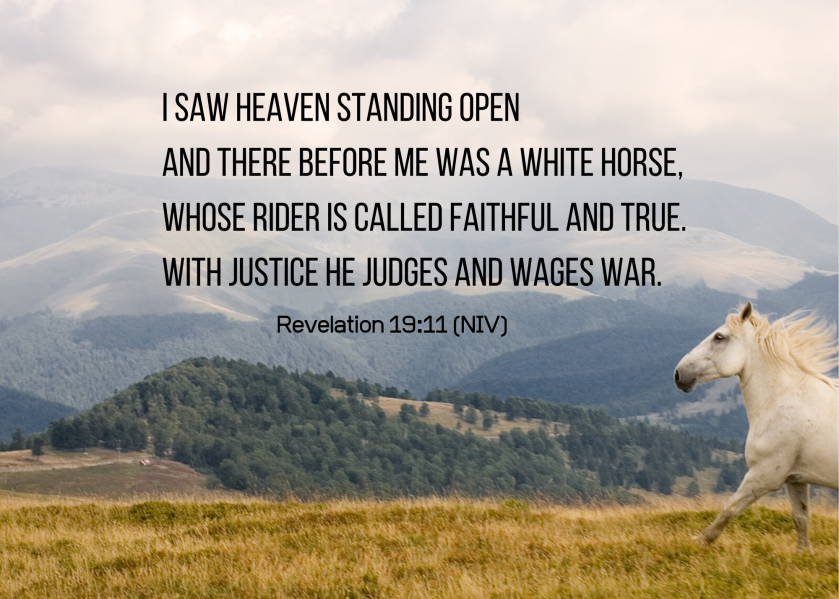
Jesus came to Jerusalem the first time gentle, riding on a donkey. When he comes again it will be as a warrior on a white horse leading the angelic hosts to victory over the forces of darkness.
Once again, for John’s original audience in Rome, these images of the conquering Christ returning to defeat the broken powers of this earth who had been persecuting God’s people must have filled their hearts with hope and expectation. It would have given them courage to continue following Jesus Christ, even in the face of suffering and death.
How often are today’s Christians tempted to give in to the lure of worldly power? How often are we tempted to join forces with Babylon? Where are we willing to compromise our faith in order to receive short term, temporary benefits?
Revelation reminds us that, as powerful and appealing Babylon might seem, it’s fate is certain, Babylon will fall. It makes no sense to give our support to an enterprise that is destined for destruction. Instead, it makes sense to support the one whose ultimate victory is guaranteed. Jesus Christ will prevail, the Kingdoms of this world will become the kingdoms of our God and of his Christ! Hallelujah!




 Seek Grow Love