Purpose in the Waiting

Genesis 27-30

Today, I’d like to zero in on just one verse: Genesis 30:22, “Then God remembered Rachel; he listened to her and opened her womb.”

Let’s break this down.

Then God – When I read these two words together, I think that other events had to take place first, before God took action on Rachel’s behalf. The ten sons born to Leah and the two maidservants had to be before Joseph and later Benjamin were born to Rachel. There was a purpose to the waiting. If Joseph had been born before his brothers, he would have had more clout in the family and probably wouldn’t have been sold off as a slave by his brothers and ended up working in the house of Pharaoh.

Remembered Rachel – According to my Bible notes, “remember” doesn’t imply that God forgot. It implies that God expresses concern and He acts with loving care; He shows favor.

He listened to her – Apparently, Rachel never stopped asking God for a son. She believed that it was possible for God to grant her this request, even though many years had gone by.

So what does this mean to us?

  1. God’s timing is perfect. More than likely something needs to take place before our heart’s desire becomes a reality. Maybe it’s a sequence of events or maybe it’s a change in attitude. Whatever it is, we have to trust that God knows what He’s doing.
  2. God hasn’t forgotten about you. “The LORD your God is with you, he is mighty to save. He will take great delight in you, he will quiet you with his love, he will rejoice over you with singing.” Zephaniah 3:17
  3. Have Big Faith and keep talking to God. Keep seeking after Him. “You will seek me and find me when you seek me with all of your heart.” Jeremiah 29:13

Many Blessings,

-Bethany Ligon

(Originally posted for SeekGrowLove August 1, 2016)

Reflection Questions

  1. Looking back on your life can you think of a time when you discovered purpose in the waiting?
  2. When have you experienced God’s perfect timing?
  3. In what area are you working on having Big Faith?
Remember & Celebrate

OLD TESTAMENT: Esther 8-10

POETRY: Psalm 141

NEW TESTAMENT: John 14:15-31

Esther 9:22 – “as the time when the Jews got relief from their enemies, and as the month when their sorrow was turned into joy and their mourning into a day of celebration. He wrote them to observe the days as days of feasting and joy and giving presents of food to one another and gifts to the poor.”

How often do you remember and celebrate the mercies God has shown you?

In this last section of the book of Esther we read about the establishment of the celebration of Purim which commemorates when the Jews saw their fear and sorrow turn into relief and joy as the edict of annihilation was overturned.

All throughout the Old Testament, God calls His people to set aside specific days to remember and celebrate all that was done on their behalf. From Passover to Purim and Rosh Hashanah to Chanukah, these Jewish holidays are full of traditions that have been passed down through the generations.

As New Testament believers we take time to celebrate Christmas and Easter. He is our Messiah, and our salvation and hope are only available to us because of his perfect life, atoning death, and miraculous resurrection.  

Additionally, many of us regularly partake in communion, once again recognizing the sacrifice of Jesus on the cross and the promise of eternal life in the Kingdom of God. 

But doesn’t God show us His grace and mercy daily? Shouldn’t we set aside time each day to pause, reflect, and give glory and honor for all that has been accomplished on our behalf? Like the Jews in the time of Esther, we too have been saved from the threat of annihilation from our enemies. We have been given the power of the Holy Spirit to do battle and conquer fear and so much more. 

Every day we have reason to celebrate. Abundant living is ours today! God has given us so much. Let us never take it for granted.

-Bethany Ligon

Reflection Questions

  1. Why do you think God gave directions for days of celebration? What benefits do they have?
  2. What has God given you that He wants you to remember?
  3. What was to be included in the celebration of Purim? What ingredients can you include in your holy days and in your every day?

Humility that Leads to Life

Pride that Leads to Death

OLD TESTAMENT: Esther 5-7

POETRY: Psalm 141

NEW TESTAMENT: John 14:1-14

Esther 6:6 – “When Haman entered, the king asked, ‘What should be done for the man the king delights to honor?’”

Today’s Old Testament reading includes some of the most dramatic events! In the end, the bad guy loses and the good guy wins. And through it all we see how humility comes before honor and pride comes before a fall.

At the end of Esther chapter four we see Esther demonstrating humility as she recognizes that the only hope she has to save the Jews from destruction is to fast and pray to God.

Esther is also humble as she risks her life to approach the king uninvited. She knows that the only hope that she has of saving her people is if she shows proper honor to the king.

Mordecai showed humility as he continued to show up to the king’s gate day after day. The king had failed to acknowledge Mordecai’s part in uncovering the conspiracy to kill him. But that didn’t stop Mordecai from doing what he was called to do. What I find especially intriguing is that even in the light of impending destruction of all the Jews, Mordecai remained faithful and humble; he resisted becoming bitter and resentful.

Have you ever been overlooked? Ignored or dismissed after putting forth effort on behalf of someone else or to complete a task. Have you ever taken initiative only to have someone else receive the credit? 

If so, it can be disappointing, frustrating, and disheartening, which can then lead to apathy or even bitterness and resentment. 

But as believers, we are called to a higher standard. We are instructed multiple times that we do not work for anyone other than God. It is Him who we aim to please. He sees us, He knows how hard we work, He is aware of the self-discipline that is required to practice excellence. And even if our efforts are never acknowledged by others around us, we can count on God being fair and just. 

In due time, Mordecai was honored in the king’s court, Esther kept her status as queen, and the Jews were saved from destruction. And as for Haman, his pride led to his death. 

God saw and made what was wrong, right. He will do the same for you as you live in humility and honor Him in all that you think, say, and do.

-Bethany Ligon

Reflection Questions

  1. How is fasting (as seen at the end of chapter 4) an act of humility? What is your experience with fasting? How do you think God views fasting? Do you think there was benefit in the 3 day fast of Esther, her maids, Mordecai and the Jewish people?
  2. Where would you rate yourself on the humility – pride scale? What do you tend towards?
  3. What are the dangers that come with pride? When have you seen the pride fall?

When You are Bewildered

OLD TESTAMENT: Esther 3 & 4

POETRY: Psalm 140

NEW TESTAMENT: John 13:18-38

Esther 3:15 – “Spurred on by the king’s command, the couriers went out, and the edict was issued in the citadel of Susa. The king and Haman sat down to drink, but the city of Susa was bewildered.”

The third chapter of Esther opens up with yet another character of the narrative being introduced, Haman. We don’t know where he came from or what he did to deserve such a high rank among the king’s court, but we quickly learn that he comes from a lineage that is known for being at odds with Israel, the Agagites. We also learn that he thinks of himself as someone who deserves to be honored by those who are lower in status. And when Mordecai refuses to bow down to Haman, that’s when life as the Hebrews knew it, would change almost over night.

Chapter four has some of the most famous sentences recorded. As Mordecai is imploring Esther to take action to save her people from annihilation, he says to her, “And who knows but that you have come to a royal position for such a time as this?” (verse 14) And two verses later, Esther replies, “I will go to the king, even though it is against the law. And if I perish, I perish.”

Talk about resolve in a time of tribulation! Esther’s character in this time is certainly one to take notice and imitate.

Which brings me to the phrase that jumped out at me in preparation for today and it’s found back in chapter 3, verse 15. Haman is thrilled that his plot will be carried out, even if he has to wait months for it to come to fruition. But just in case the king starts to really think about what he’s agreed to, Haman takes him out for drinks to keep him distracted. Meanwhile, the city of Susa is left wondering why would an edict for the complete destruction of a people group be made? What happened? Why the Jews, what did they do? What if Jews were intermarried, would some family members be killed while others be left alone? What if I did business with some Jews? What if my closest friends were Jews? Was I just expected to stand aside and let the authorities carry out a nonsensical edict? Who am I to stand against the government?

Does this sound like another time as described in modern day world history books? 

As an ordinary citizen in my town, in my state, in my country, there are plenty of times when governing authorities make decisions that don’t quite make sense. I admit that while I do participate in elections, I’m otherwise not politically active or especially knowledgeable beyond the headlines that pop up in my notifications. And so I can relate to the citizens of Susa who were left bewildered. Would I take action to try to stop the impending atrocities or would I remain in my confused state and watch events play out?

There are plenty of causes that anyone could choose to become involved in to make a difference for the vulnerable. How and when is between the individual and God. But that’s not exactly where I’m going with this.

I do want to remind you, dear friend, that even when this world leaves us bewildered, confused, or even indignite over injustices, as believers in the faith, we are also citizens of the Kingdom of God. And as God is eternal and true, we do not have to wonder or worry about some other authority coming in and stripping us of our spiritual citizenship. God is Almighty, He is holy, He is just, He is compassionate, He reigns over all creation, nothing is beyond His notice or His control. His care is over each and every one of us; He is trustworthy and faithful to His people. We can remain confident through prosperous times and turbulent trials that not only are we citizens, but we are children and even co-heirs with Christ in a Kingdom that will never end.

-Bethany Ligon

Reflection Questions

  1. What do we learn of Esther’s character? Mordecai’s? Haman’s? The kings? Of those characteristics you listed which ones can you see in yourself this past month? Which would you like to work on eliminating in your life? Which would you like to work on growing in your life?
  2. When have you been bewildered – perhaps by a government decision?
  3. What do you know from your own experiences and from Esther’s life about God’s character?

“Now there was…”

OLD TESTAMENT: Esther 1-2

POETRY: Psalm 140

NEW TESTAMENT: John 13:1-17

Esther 2:5 – “Now there was in the citadel of Susa a Jew of the tribe of Benjamin, named Mordecai son of Jair, the son of Shimei, the son of Kish,”

The book of Esther opens up with introducing the reader to the reign of King Xerxes of Persia. His kingdom was vast and wide. His wealth was beyond measure. His wife, Queen Vashti, was one of the most beautiful women in all of the land. He seemed to have it all. Except King Xerxes didn’t have it all. He hadn’t yet conquered Greece. And his wife, well, she wasn’t keen on being paraded around objectified by men in drunken states. And for this, she was punished, dethroned, and for all intents and purposes, exiled. Now, King Xerxes didn’t have a queen.

Chapter two of Esther opens up with the phrase, “Now there was…” introducing us to a new set of characters in the story, Mordecai and Esther, who are the individuals that we should really turn our attention to. These two new characters are Hebrew exiles living in Persia under the reign of King Xerxes. And as we read through the book of Esther, we see that their presence in this kingdom is vital to the survival of Xerxes, but more significantly, the Hebrew population in Persia.

This phrase “Now there was…” has gotten me thinking about the other times it is used in Scripture. Within the NIV translation, it is used eight additional times. (Gen 12:10; 26:1; Nu 20:2; 2 Sam 9:2; 1 Kings 13:11; Luke 2:25; 23:50; and John 3:1) It’s an author’s way of transitioning to something new, maybe even something unexpected. 

As we find ourselves in the middle of Advent season, I’m going to take my devotional-writer prerogative and divert slightly and transition to another, but related, idea. (We’ll come back to Esther tomorrow, I promise.)

I am thinking of key people in the narrative of Jesus’ birth that also deserve a “Now there was” introduction.

Now there was…Mary, the betrothed of Joseph, chosen by God to be the mother of the long awaited Messiah.

Now there was…Joseph, the man selected to raise the Messiah as his own.

Now there was…Gabriel, the angel who was sent to share the news of parenthood with Mary and Joseph.

Now there were…the shepherds who witnessed a great company of the heavenly hosts praising God upon the birth of Jesus.

Now there were…the Wise Men who traveled from afar to present gifts of frankincense, gold, and myrrh to the new born child. 

All of these people had a role in introducing Jesus to the world, just as he was born. There are many prophets who foretold Jesus in the Old Testament. There are many apostles and disciples who continued to tell the world about Jesus through the Gospels and Epistles of the New Testament. 

Who is telling the world today about Jesus?

Now there was…YOU.

We each have the privilege and responsibility to continue to share the Gospel message to those who do not know it yet. 

As we celebrate the birth of Jesus with family and friends, let us not forget that there might be someone we know who needs to be introduced to the Lord and Savior of the world. They need to hear the message that they are loved, that they can be healed, that there is hope beyond what they experience today. YOU can be the difference for someone else today and give them the greatest gift of all, the Gospel message. 

May God bless you and keep you as you go about your day.

-Bethany Ligon

Reflection Questions

  1. In the first two chapters of Esther what have we learned so far about the main characters: the King of Persia, Mordecai, and Esther? How would you describe each one?
  2. Choose a character from the events of the birth of Jesus. How would you describe him/her?
  3. How would you like to introduce someone to Jesus? Pray about the opportunity, the words, the hearts (yours and theirs) that can make the difference.

The One Thing You Need

Old Testament: 2 Kings 13 & 14

Poetry: Proverbs 29

New Testament: Luke 10:38-42

Have you ever had the opportunity to go see, and possibly meet, a celebrity (actor, musician, athlete) in person? Ten years ago, the New York Giants and the New England Patriots were in Arizona to play in Super Bowl XLII. You may be thinking that I tried to get to see either Eli Manning (the Giants quarterback) or Tom Brady (the Patriots quarterback). But my interest wasn’t in either of them. No, I knew that Eli’s brother, Peyton, would be in town to attend some parties before the game. I had a friend of a friend of a friend who had tickets to one of those parties and I daydreamed hard about getting to meet the future NFL Hall of Famer.

A few years before that I was in Monaco and my tour guide had heard that George Clooney, Brad Pitt and Matt Damen were supposed to be filming a scene in the movie Ocean’s 12 at the famous Monte Carlo Casino. The group of students that I was traveling with and I stood with a crowd of people for almost an hour hoping to get a glimpse of the three actors. Well that never happened. But we did get to witness two extras walk down the steps of the casino and that scene is in the movie, so it wasn’t a complete waste of our time. Kinda.

When I read Mark chapter 5 I imagine that the crowds that followed Jesus around were a bit like the superfans of a celebrity. Wherever He went, masses of people would go and seek Him out. Not because He was rich and famous, but because they had heard He could perform some pretty crazy healing miracles. In this chapter we read about three people who were not just highly interested in meeting Jesus, they were desperate to meet Jesus. And so they did what they had to do, to get near Him. The demon-possessed man saw Jesus at a distance and ran and fell on his knees at Jesus’ feet (verse 6). The father of a dying young girl worked his way through the crowd and fell at Jesus’ feet (verse 22). The sick woman reached through the swarm of people to touch his cloak and then fell at His feet (verses 28, 33).

Desperation brings you to a place of complete abandonment of pride and social decorum and a complete surrender to experience an ounce of relief. Imagine being so in need of healing that you fight your way through a crowd of strangers to fall onto your knees at the feet of Jesus. The wonderful thing is that Jesus had compassion on each and every one of those people and He will have compassion on you too.

But Jesus doesn’t want you to humble yourself just when you’re desperate for healing. He wants you to be desperate to spend time with Him every day, even when things are going well for you. His desire is for us to sit at His feet and enjoy His presence no matter what is going on in our lives. Remember Mary, Martha’s sister, who sat at her Lord’s feet and she was praised for doing what was right (Luke 10:38-42)? Mary had the right idea. It’s during these times that we learn how to follow Him and to love Him. It’s during these times that we understand what it means to love others and become a fisher of men.

Psalm 16:11 says, “You have made known to me the path of life; you will fill me with joy in your presence, with eternal pleasures at your right hand.” When we find ourselves at the feet of Jesus, life, in all of its complexities, will begin to make a little bit of sense because we no longer view things at face value, but we get glimpses of how our life experiences fit into God’s eternal plan. Yes, we will still know sorrow and grief, but we will also have an eternal hope, a peace that surpasses understanding, and overflowing joy.

So let’s take a few minutes to fall on our knees at the feet of our Savior and Lord.   

-Bethany Ligon

(originally posted for SeekGrowLove Sept 15, 2017)

Reflection Questions

  1. What is the benefit of coming to the feet of Jesus when you are worried and upset and in need? What is the benefit of coming to Jesus when you just want to be closer to him and learn from him?
  2. What have you received at the feet of Jesus?
  3. What worries and distractions have you allowed to keep you from the One Thing you need? What is that One Thing?

The Sword of the Spirit

Old Testament: 1 Kings 13-14

Poetry: Proverbs 15

New Testament: Ephesians 6:17b

Ephesians 6:17b – “…and the sword of the Spirit, which is the word of God.”

We have been given the most powerful weapon of all – God’s Word. It’s so powerful that Jesus used the Word of God as he engaged in battle during his forty days in the wilderness. Three times, the devil proposed a tempting offer to the Son of God. And three times, the Son of God used the Word to fight back. After strike three, the devil turned tail and left Jesus alone. 

Have you ever used the Word of God while experiencing a spiritual attack? There have been nights where I have been lying in bed consumed with wonders and worries not able to sleep. I laid my Bible open on the edge of my bed, placed my hand upon the written word and eventually drifted off to a peaceful sleep. 

One particular day, anxiety was getting the better of me and the only thing that kept my mind from spiraling out of control was reading aloud 2 Samuel 22. I must have read that chapter twenty-two times that day. That day wasn’t easy, I was emotionally exhausted by the time the sun went down. But with the help of God’s Word, I managed to fight back and extinguish the flaming arrows that bombarded my mind. 

The author of Hebrews declares that “the word of God is living and active”. This is not just any sword, it is a double-edged sword that does damage going in and coming out of its intended target. It’s not a sword that will go dull or become irrelevant, it’s a sword that has withstood the test of time. It’s not just a sword for the elite warrior, it’s a sword that someone on the front lines of battle would use for both defensive and offensive maneuvers. It’s not a sword that is meant to be a decorative display, it’s a sword that is meant to be used.

An experienced soldier isn’t someone who has just seen a lot of battles. A soldier of high caliber is one who took their “basic training” seriously and continues to practice and hone their skills, even when they are not on “active duty”. 

Any professional athlete knows that their off season is not a multi-month vacation. It’s an opportunity to recover from injuries, cross train in other physical activities, continue with proper nutrition, and work on the finer skills of their game. 

Likewise, when we find ourselves in a period of peace, it is not time to lay aside our swords and eat grapes all day long. We need to be preparing for the next attack. If the Word of God is living and active – then we must also be living and active. Daily engagement with the Word is crucial, but so is being part of a church fellowship. Staying involved in local ministry, putting your spiritual gifts to good use is a way to stay ‘living and active’. 

While I am thrilled that you are reading these words, have you opened up your Bible today? It is a powerful weapon, forged with priceless materials, intended to protect and defend against the enemy’s attacks. Use it in times of battle. Use it in times of peace. Know this weapon inside and out. And may you be victorious as “you stand your ground, and after you have done everything, to stand.”

-Bethany Ligon

Reflection Question

  1. How can you use the Sword of the Spirit during times of war? And in times of peace? What has God’s Word provided for you at different times?
  2. Can you tell of a time that God’s Word was exactly the weapon you needed? What did you find there? What did it provide for you? How did it change the battle? Who can you share this testimony with?
  3. Where do you tend to turn when you don’t turn to the Bible? How do those battles go?

Head Protection

Old Testament: 1 Kings 11-12

Poetry: Proverbs 14

New Testament: Ephesians 6:17a

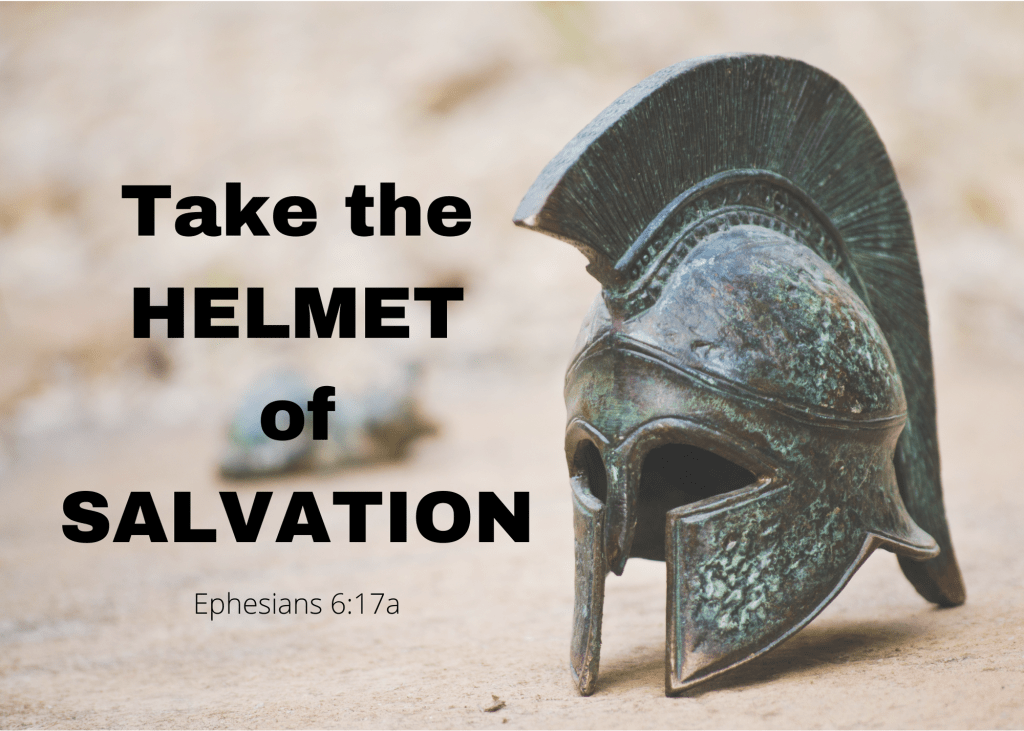
Ephesians 6:17a – “Take the helmet of salvation…”

Here’s a disquieting fact to start our devotion today: According to the International Brain Injury Association, 5.3 million Americans are living with some kind of disability due to a traumatic brain injury. 5.3 million is the population of South Carolina! Of course there are varying degrees of injury, but most are due to car accidents and sports-related incidents. 

And while 5.3 million is a staggering number, I’m willing to bet that there are so many more people living with spiritual battle scars in their minds. 

Our minds are such a vulnerable space and it’s one of the enemy’s favorite areas to attack. At least, that’s been my experience. Anyone else struggle with random thoughts popping up that obviously aren’t from God? 

But why attack the mind? Why not make the heart the primary target? Because our thoughts turn into words, which turn into actions, which turn into habits, which turn into our character. James, the half brother to Jesus, said it this way, “It is the evil that a person wants that tempts him. This desire causes sin. Then the sin grows and brings death.” (James 1:14-15, ICB) This is why it is imperative to protect this part of our body. 

For the apostle Paul, the author of this Epistle, the helmet was the perfect metaphor; after all, he was under house arrest when he wrote this letter. He probably had a lot of face time with a Roman guard who most likely wore some kind of helmet. Each piece of the helmet added another layer of protection against injury or death.

Paul calls this piece of the armor the helmet of salvation. The Greek form of the word for salvation is used only in this verse in all of the New Testament and it means “peace”. As we don this piece of armor, we can have the “peace of God that transcends all understanding will guard your hearts and your minds in Christ Jesus”. (Philippians 4:7)

Where does this salvation or peace come from? It comes from being in the Word of God daily: reading, studying, meditating, and memorizing it. We need to be intentional about the media that we consume and the conversations that we participate in. We need to be aware of entertaining the thoughts that seem to come out of nowhere. Protecting our minds against the thoughts that flow in and out should be something that is carefully monitored as we go about our daily living.

If you want to be in God’s Shalom peace while you engage in spiritual battle, be sure to wear the helmet of salvation.

-Bethany Ligon

Reflection Questions

  1. How do you think the enemy attacks minds? What about yours in particular?
  2. Describe the progression from thoughts to words to action to habits to character. Give an example that leads to ungodly character. Give an example that leads to godly character. Which type of thoughts do you work at thinking most?
  3. What protection is available to you against the thoughts that lead to ungodliness and death? In what ways can salvation and peace mean the same thing? What can you do (today) to strengthen your protection that God has made available to you?

Your Shield of Faith

Old Testament: 1 Kings 9-10

Poetry: Proverbs 13

New Testament: Ephesians 6:16

Do you ever feel like you’re being bombarded with issues, concerns, or worries? Have you ever heard yourself saying, “If it’s not one thing, it’s another”? Maybe you’re just having a typical ‘Monday’ even though it’s Thursday. Or maybe you find yourself clumsy dropping things, forgetting why you walked into a room, or having to deal with “that one person” more often than normal? It’s not so much one big thing, it’s just one little thing after another that really tests your patience. 

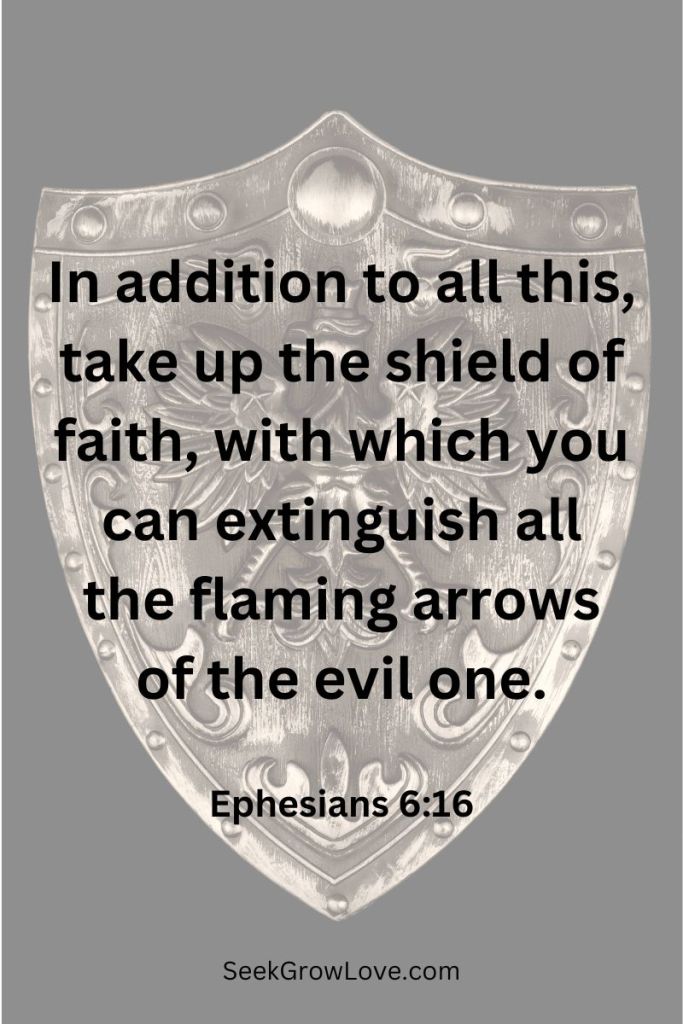
My friend, those big things, those small things, those things in quick succession, those repeated things…those very well could be “flaming arrows of the evil one”.

So why does the author of Ephesians, Paul, specifically use the term “flaming” arrows…why not just regular arrows? If a vulnerable soldier were hit by a normal arrow, it would likely only cause damage to himself. But if a flaming arrow hit him, the flame could catch onto nearby flammable material and cause significant damage.  

The comparison leads us to think about how these spiritual attacks affect us and those around us. When we’re experiencing trials and tribulations, how are we treating others? Are we still kind and compassionate or do we take our frustration out on others? When the challenges are mounting up all around us, do we hide out and disengage or do we press on with our commitments and ministries? When the attacks start coming from every angle, are we able to keep our head on straight and make responsible decisions, or are we tempted to act recklessly with our resources and health? 

You see, from the evil one’s perspective, the more damage that can be done with a single flaming arrow, the more successful the attack. It’s not just you and your personal faith; it’s your physical and spiritual health, your relationships and ministries that are under attack.

This is why taking up the shield of faith is so vital when engaging in spiritual warfare. A Roman soldier would have his wooden shield soaked in water so that when a flaming arrow hit its intended target, the flame would be extinguished and not cause collateral damage. 

Likewise, when we are soaked in the Word of God, those attacks become a little less hazardous to how we choose to carry on in the battle. 

In John 7:38, Jesus says, “Whoever believes in me as Scripture has said, rivers of living water will flow from within them.”

The more of the living water that we have flowing through us, the more protected we are from the enemy’s attacks on our faith. We need to stay spiritually hydrated by engaging in the Word of God on a regular and consistent basis. This will build up our faith and protect us from the flaming arrows that are pointed in our direction.

-Bethany Ligon

Reflection Questions

  1. What do you see and recognize as flaming arrows of the evil one? How can recognizing them as flaming arrows of the evil one improve your response to them? Which ones have attacked you or caught you off-guard most recently?
  2. Where/when have you seen a flaming arrow in action – with the potential of injuring or taking down more than just the one it hit? How can we guard against the effect of the flames of these arrows?
  3. How strong is your shield of faith? Does it have weak spots that make you more vulnerable? What can you do to strengthen your shield?

Fitted Feet

Old Testament: 1 Kings 7 & 8

Poetry: Proverbs 12

New Testament: Ephesians 6:15

When was the last time you regretted wearing a pair of shoes? I recently was on the hunt for a pair of gray sandals and I found some that I thought I might like from an online store. I ordered them and at first, they seemed to be very cushy and comfortable. As I wore them throughout the day, I noticed that the straps were rubbing the bottom of my ankle. It never caused a blister, thankfully, but it was just irritating. 

Anyone who is on their feet all day can tell you the value of having comfortable and supportive shoes. Whether it be someone in the medical field, law enforcement, military, food service industry, or in the classroom, having a good pair of shoes is a necessity. 

But what does having supportive footwear have to do with the Armor of God? A soldier’s boots (or sandals as ancient Roman soldiers would wear) are likely the one piece of their attire that they use for hours on end, every single day. They train with their weapons while wearing their boots. They go on marathon-long hikes while wearing their boots. They eat their meals while wearing their boots. And sometimes, they will even sleep while wearing their boots. If a soldier’s feet are sore or tired or have blisters, he or she becomes limited in what they can do – at least without any pain.  

Our verse today talks about being “fitted with readiness”. A soldier must be ready to go at any given moment. Likewise, as believers fighting in a spiritual battle, we must be prepared to take action at any point in time. 

And just what are we to take action with? The Gospel of Peace. This gospel includes the message of salvation and the Kingdom of God. As warriors in a spiritual battle, we need to remember whose army we fight for. When we are laser-focused on what we’re fighting for, we can be empowered and strengthened to fight against anyone or anything that is our opposition. So when temptation or persecution comes our way, we can make sure that we are in the ready position, set to take our Commander’s orders.

But also, the Gospel of Peace is something that we should be comfortable sharing with others who have not yet discovered it for themselves. Being ready to explain to others what we believe and why we believe it is another way to wield this piece of armor. Conversations with our friends, family, work buddies, and even random people you encounter in your day-to-day life can sometimes lead to discussions about our faith. When we are ready to share the Good News, we are showing ourselves to be prepared soldiers in the Lord’s army.

So let’s lace up our boots, and get ready to share the Good News of the Gospel of Peace!

-Bethany Ligon

Reflection Questions

  1. The gospel is only called the “gospel of peace” here in a passage about the spiritual war we are in. How would you describe the gospel of peace and why do you think this wording was chosen for this passage?
  2. Do you feel like you are ready to take action to follow your Commander’s orders today? What do you think could happen if you ARE ready? What could happen if you AREN’T ready for action? What could you do now to be more prepared? Do you think you have ever used an excuse of not being ready when God wanted you to do something?
  3. How can you share the gospel of peace with others this week?