What to Do with Doubt

Mark 9:14-32 (Monday)
Mark 9 24

None of Scripture was intended to be read.  Although that may seem strange to us today, the ability to read was incredibly rare.  For today, it’d be like having a doctorate.  There are a number of professor’s out there, but you don’t run into them every day.  Reading just wasn’t something most people needed to be able to do to get through their day.  The agricultural and craftsman lifestyles didn’t need to keep many notes themselves.  As a result, the writings, when they were used, were usually read aloud in a collective setting – and this is key.  Because Scripture is meant to be heard – not read!  All those with EARS, let them HEAR.

Because of this, there weren’t any of the nifty little headings that we find in our Bibles today.  It was just one long story without breaks or chapters.  So, the nice breaks that we often get around stories didn’t exist except for the past few hundred years.  For today’s reading, both of these things are really important.

These two vignettes in Mark 9:14-32 (the healing of the child and the misunderstanding of the disciples) come back to back and would have been heard that way by Mark’s original audience.  So, what I’d like you to do is try it.  Take just a second to read these verses out loud. If you’re somewhere public, just try whispering if you want.  But read it out loud and see what sticks out to you.  I’ll wait here and I’ll do it too…

[waiting]

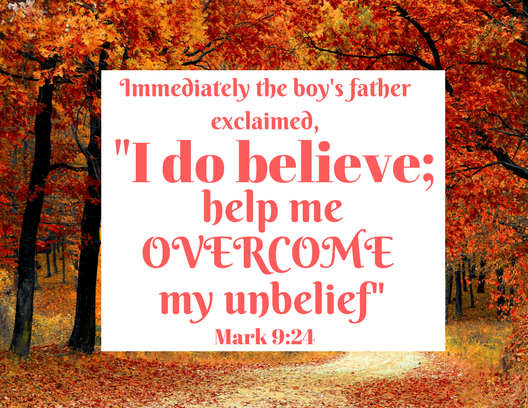
So, how was it?  Awkward? Weird?  Probably a little.  But when I did it something new really stood out to me about this passage.  In the first story, a man comes to Jesus asking for healing for his son. Jesus responds ‘oh you faithless people…how much longer do I have to put up with you.  Bring me the boy.’  The father, distraught over Jesus’ seemingly kinda cruel response, cries out – ‘I want to believe! Please help my unbelief!’  He wants to save his son and will do whatever it takes to save him.

The next story is between Jesus and his disciples.  He’s teaching them about what’s going to happen to him when he reaches Jerusalem.  But they don’t get it.  They don’t have belief/faith, just like the dad in the previous story.  However, instead of putting aside their pride and asking for Jesus to help their unbelief (lack of understanding), they stay silent.

Here, in these few verses, a man from “this faithless generation” reaches out, pleads, and finds Jesus meeting him in his unbelief while the ones who are part of Jesus’ own inner-circle remain unmoved in their faithlessness.  And this at a time when Jesus’s time with them was literally drawing short.

The problem with this is never unbelief.  The problem is how we respond to it.  We won’t have all the answers.  We will doubt and question.  Jesus doesn’t lament our struggle – it is one that he himself walked through (for he shared in all things but without sin).  Embrace the places where you are unsure.  Lean into the spots where the struggle is the most real and you are shaken like the son in the story.  Push forward and call out for a help, a grace that will fill us in our uncertainty and bring healing.

-Graysen Pack
Keep Reading!

Proverbs 1-5a
SATURDAY Weekly Re-cap with Megan Bryant
This week, we read through the last few chapters of Proverbs.  As I said at the beginning of the week, Proverbs is a collection of timeless wisdom.  We looked at pieces of this wisdom ranging from true friendship to confessing our transgressions to being satisfied with our daily bread.  And since these posts didn’t focus on every verse, I would encourage everyone to read back over Proverbs as a whole and analyze the verses not discussed on this blog.  Every time we read the Bible, we have the opportunity to grow in a new way.  We may see a verse in a new light or notice something that we may have missed before.
Let’s continue to learn and grow as we continue to read through the Bible, but also look back over what has already been read to gain new insights.
-Megan Bryant

What a Powerful Tongue You Have!

Tuesday

prov 18 21

Today’s reading is Proverbs 18.

The tongue has the power of life and death, and those who love it will eat its fruit. Proverbs 18:21

Have you ever thought about your words bringing life to someone else? Yet, we see this throughout the scriptures. God uses human beings to communicate who He is. God used human beings to speak and record His commandments and instructions. The Jews were entrusted with the very words of God (Romans 3:2).

Sometimes we may not realize how important our words can be. We certainly don’t want our conversations to make us gossips, quarrelsome, and fools (We don’t want our mouths to invite a beating.) But, as the children of God, it goes beyond avoiding bad conversations and sharing God’s message. God has entrusted us with the Gospel Message.  Good News of who He is, Good News of His Son Christ Jesus and Good News of the Coming Kingdom. We are given the opportunity to communicate that message so we can connect others to God through His Son.  God entrusted Jesus with the message that everyone needs to hear.

Christ said to his disciples in John 6:67-68, “You do not want to leave too, do you?” Jesus asked the Twelve. Simon Peter answered him, “Lord, to whom shall we go? You have the words of eternal life.”

We sometimes forget that our study of the scriptures is important because we are receiving a message from God, a message that we can share with others.  I want to make sure that I get the message straight and the story right because this message “has the power of life”.

By Rebecca Dauksas

(Photo Credit: http://puttingonthenew.com/2013/11/10/proverbs-1821/)

Who is God in Your Life?

Monday

By Rebecca Dauksas

Today North America will be in the direct path of a total solar eclipse, which happens when the Moon completely covers the Sun. In the U.S., the path of the total eclipse will extend from Oregon to South Carolina.  The scriptures are filled with illustrations of the contrast between darkness and light. Proverbs chapter 4 verses 18 & 19 states, “The path of the righteous is like the morning sun, shining ever brighter till the full light of day. But the way of the wicked is like deep darkness; they do not know what makes them stumble.”

How blessed we are to have God’s scriptures to train us in righteousness! They light our way by giving us insight and understanding. For instance, Proverbs 17 is filled with advice on how our conduct can help us manage healthy relationships.  Notice that verse one states, “Better a dry crust with peace and quiet than a house full of feasting, with strife.” We might say, “We would rather enjoy a dry piece of toast with peace and quiet than a delicious 7-course meal with anger, arguments and conflict.”  This statement made me think about how good it is when we can enjoy being a part of a peaceful household.  It might also help us consider how we treat our family members. Do we try to get along with our family? Do we stir up conflict and start arguments?  Making our relationship with God our first priority can help us see God’s wisdom in every relationship.

prov 17 9

Proverbs 17:9 states, “Whoever would foster love covers over an offense, but whoever repeats the matter separates close friends.” When we apply this verse to existing healthy relationships, we see that if we want to foster love, when we are sometimes offended, we should forgive and move on. Which agrees with what we are told about love in the New Testament book of 1 Corinthians 13, the Love Chapter.  “Love keeps no record of wrongs.”  Of course, there are offenses that have to be brought into the open and dealt with, but in this case imagine that a friend or loved one says something that is unkind.  Our tendency may be to tell others, “You won’t believe what she said to me!”  Instead, we can choose to foster love by not gossiping about those unkind words. We can decide that we will not continue to bring it up when our tempers flare. We can choose to overlook it and let it go.

Notice the relationships mentioned in Chapter 17-parent, child, friend, brother, etc.

The way we relate to others gives us the opportunity to show who God is in our lives.

Bible Study Crash Course: Part 2 – Psalm 1

bible

This week, we’ve been focusing on the importance of God’s word for our lives. Yesterday, we focused on the nitty gritty aspects of Bible Study. Today, we’re going to look at the bigger picture as we wrap up the week!

So, when we think about Bible Study, we should have four phrases in the back of our minds:

Read it

Meditate on it

Memorize it

Live it

Yesterday, we talked about our daily quiet time that normally involves reading the scripture. It’s important to remember that we can study the Bible in different ways! Last year, we looked at the Big Picture of the Bible. We read through it quickly and tried to see how each part of the Bible related to God’s epic plan. We can also study the Bible by studying specific books of the Bible, which we will do beginning this Sunday as we study the book of Proverbs. Another type of study that we can do is a topical study, where we look at specific topics like love or marriage and study what the Bible says about it whenever that topic comes up. Each of these ways of studying the Bible really helps us to have a complete picture of what we’re studying, and so we should try to do them at some point in our study of the Bible.

Once we read the Bible, we should meditate on it. If we look at verse 1-3 of Psalm 1, our key passage for today, we see that the man who meditates on the law of the LORD day and night is blessed! What is the law of the LORD? The Bible! But, what does meditating mean? Generally, it means to “think deeply or carefully about something” or to “consider.” It can be tempting to treat our daily reading of God’s word as a chore that we have to check off our to-do lists. We skim through a chapter or two a day and then close our Bibles without ever thinking about it again. The danger in this is that we never let God’s word sink into our hearts! That’s why it’s so important to meditate on it, to think carefully and deeply about what the Bible says. Yesterday, I mentioned that you could journal after reading to help you think. This is a great option! Prayer also helps us to do this. If you’re artsy, Bible Journaling Art can be a great way to meditate on scripture as you make artwork that relates to what you’ve read.

Another aspect of Bible study that’s important and can help us to meditate on the scripture is memorization. Growing up, I never really saw the value in memorizing scripture. My family is Christian so we had about 15 Bibles to choose from if I really wanted to look up a verse. On top of this, my brothers and I got a laptop to share when I was about 7 or 8 years old. By the time I really cared to look up verses, I always had Google or Bible Gateway at my fingertips. This is even truer now when I constantly carry around my phone. All this being said, even when I know that I have the capability of looking up scripture to help me work through a situation or strengthen my faith, I, unfortunately, don’t choose to do this first thing. A worrier by nature, I immediately start analyzing my situation from my viewpoint, and if it’s a problem that stresses me out too much, I’ll enlist the help up my friends to sort it out. If I don’t have scripture ready at the forefront of my mind that I’ve thought about and hidden in my heart (Ps. 119:11), I’m afraid I won’t turn to it until I’ve already done something that I probably shouldn’t have.

For instance, if I am worried about a situation that’s making me anxious and keeping me up at night, I can (1) journal about it, maybe cry about it, and maybe even call a friend if I’m real upset. OR I can remember Philippians 4:6, which says, “Do not be anxious about anything, but in every situation, by prayer and petition, with thanksgiving, present your requests to God.” That’s a pretty profound truth that totally changes the way that I think about how to handle the problems that I face!

Memorization is important. It can help you in situations like this. (Because we both know that even if you have a smartphone AND a Bible sitting at your bedside table if scripture isn’t the first thing on your mind, you’ll probably be picking option one in the scenario above.) And, it can help you as you defend your faith (1 Peter 3:15). Look at Jesus’ temptation in the desert in Matthew 4 if you need some more evidence for the importance and benefits of memorizing scripture. This year, you’ll have some great verses picked out for you to help you memorize Scripture each week with these devotions!

Lastly, we should remember our fundamental purpose for why we study the Bible. We want it to change our hearts. We want to know and live for God. If you do the first three phrases consistently in your life, this, in addition to the power of the Holy Spirit, will really begin to make a big change in your life. And, if we check ourselves with this purpose each day, it will be harder to fall into the trap of viewing the reading of God’s word as a stale chore to be tackled each day.

Let’s dedicate ourselves to reading, meditating on, memorizing, and living out the truths we find in God’s word!

Bible Study Crash Course: Part 1


Bible-Reading-2-3-John
Shar’s Bible Journal from http://www.womenlivingwell.org 


This week, we’ve been talking a lot about the Bible and its importance in our lives. Even if we know how big a difference daily reading the Bible can make in our lives and we desire to know God’s word more, it can seem a bit overwhelming to actually dive into reading the Bible daily. Luckily, these devotions, regardless of whether you have spent the past year with us, have helped to give you some direction as to how to study the Bible. Still, it can be daunting to really dive in to creating this habit that can literally change your life. So, today, we’re going to be talking a little bit about how to study the Bible. For some of you, this will be old stuff that you already know. For others, some of this might be a little new. But, that’s okay! Wherever you are at in your walk with Christ, it’s always important to be intentional about your time with God. So, let’s dive in!


Today, we will talk about one aspect of studying the Bible: What should our daily time with God look like? Before we begin studying the Bible each day, it’s a great idea to pray. Why? During this time, we want to make sure we are coming to our studies with the right attitude to get the most out of it, and we should be sensitive to the Holy Spirit while we are studying. Prayer helps us to keep those things in mind.

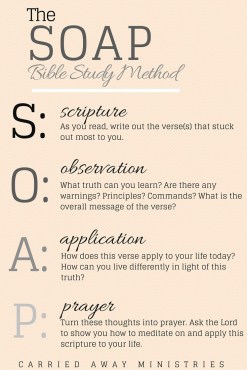
SOAP-Method-of-Bible-study-1

Then, we dive into our actual studies. If this is your first time reading the Bible, it may be helpful to you to just mark some interesting passages with a pen or highlighter as you read. If you’ve been doing this for a while, you may ‘code’ your Bible, marking topics that are similar across texts. Even if you don’t do this every time you read the Bible, once you begin reading regularly, you’ll start to see the ways that the different books of the Bible interact with one another. If you see something, it’s a great idea to write it down in your Bible! This is called cross-referencing and can be a great way to go deeper in your Bible study. Plus, think of all the notes and ideas that your Bible can hold if you keep doing this over a long amount of time! Another way to go deeper in your study is to look up the meaning of words using a dictionary. If you are unsure why an author used a certain word, look it up! You may find something really cool about the original Hebrew or Greek words.

After this, it’s a great idea to write down some of what you found in your study in a journal. Writing things down (1) helps you to work through problems in your mind and (2) will help you remember it later on. If you skim through something, it will be hard for you to really write about it. Or if you read something, but are confused with what the author is trying to say, you may be able to work it out in a journal. Then, like you did in the beginning of your study, it’s great to pray again. Remember, you don’t read your Bible just to know more of what it says. That’s important. But, the main reason why we do it is to get closer to God! Bible study without real heart-changing conversations with God can lead us down the same road as the Pharisees.

Whew! That sounds like a lot, doesn’t it? Once you’ve done all this, it’s awesome if you can find a group of friends or a mentor to help you work through what you are studying. Have questions? You can ask them about it! Sometimes, it may be hard to find times to sit down and read for 30 minutes, or you may be thinking that you would never journal your insights and prayers. That’s okay too! Listening to your Bible in the car or online can be a great way to learn more about what God is trying to say even if you don’t enjoy reading.


Tomorrow, we are going to look at another aspect of studying the Bible. In the mean time, take a moment to put some of these Bible study tips into practice as we read the context around a verse (2 Tim. 3:16) I mentioned yesterday in 2 Timothy. Read through 2 Timothy 2-4. While you do this, think about the importance of learning what God’s word has to say. Like 2 Tim. 3:15 says, the Bible is “able to give you wisdom for salvation through faith in Christ Jesus.” Let’s get in the Word! And, if you still feel a little overwhelmed, you can be reminded of what Richard J. Foster writes in his book Celebration of Discipline:

“Study produces joy. Like any novice, we will find it hard work in the beginning. But the greater our proficiency, the greater our joy. Study [of the Bible] is well worth our most serious effort.”


Does your Bible study look different than this? Do you have any other Bible study tips you would like to share? You can share them in the comments below!


(Check out more about Shar’s Bible Journal at http://womenlivingwell.org/2014/09/good-morning-girls-bible-study-journal-amazing/)

Word Power – Psalm 119:57-120

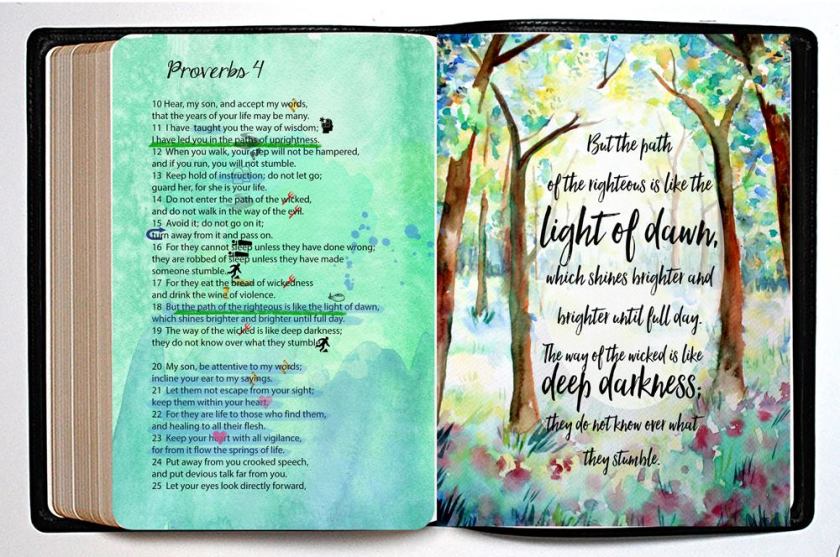
path-of-dawn-bible-journaling

This week, we’ve been talking about the importance of choosing life. How do we choose life? By gaining godly wisdom and following God’s commandments, we can choose the path of life for our lives that our memory verse for this week talks about (Duet. 30:19-20). Though discipline and commitment are good for creating and sustaining a good relationship with God, it’s also incredibly important to long for that relationship, to desire it. Yesterday, we talked about what it means to desire God and his word and how that can transform our lives. Like Psalm 119:107b says, “LORD, give me life through your word.” When we choose to invest in God’s word, we are choosing life.

Today, we are going to continue talking about the Bible and its importance for our lives. Specifically, we are going to talk about what the Bible can do in our lives, according to what it says. In our reading passage for today, verse 105 says, “Your word is a lamp for my feet and a light on my path.” One important way that the Bible gives us life is by shining a light for us to find our way through this dark world. Matthew 5:14-16 describes the Christian believer as a light shining on a hill for the world. If we don’t know God’s way of light through prayer and his word, then we are still living in darkness. How then can we be the light that Jesus describes? Paul describes us as the children of light, who do not belong in darkness (1 Thess. 5:5). Because of this, we need to dedicate ourselves to seeking that path of light, and we do this by pursuing God’s word.

Why does the word of God have this power? We can think back to the beginning in Genesis 1 where God spoke and the world came into being! His word is just as powerful now. We have been given his inspired word. This means that though people wrote it who were not God, the message that it says comes from God. This message now is just as important as it was 2,000 or 3,000 years ago. 2 Timothy 3:16-17 says, “All scripture is inspired by God and is profitable for teaching, for rebuking, for correcting, for training in righteousness, so that the man of God may be complete, equipped for every good work.” If we want to train in righteousness, we need to commit ourselves to learning and internalizing God’s word!

When we do this, we have to be prepared for a major heart change. If you remember what we talked about on Monday, we can see how the heart is fickle and doesn’t always follow the right paths of righteousness. We need something to test our ways against those of God (Isaiah 55:8-9). That is what the Bible can do! Hebrews 4:12 says, “For the word of God is living and effective and sharper than any double-edged sword, penetrating as far as the separation of soul and spirit, joints and marrow. It is able to judge the ideas and thoughts of the heart.” When we test our thoughts and actions against God’s word, we can begin to discern if we are following God’s ways of light or the world’s ways of darkness. The Bible can truly be a light to our path towards living a righteous life that mirrors Christ!

Tomorrow, we will talk more about some practical ways to study God’s word. But, today, let’s rest in the power that comes from God’s word. God’s word accomplishes what it sets out to do in our lives. If we can speak his truth over our lives, we will begin to see him working in them in mighty ways.

“For just as rain and snow fall from heaven and do not return there without saturating the earth and making it germinate and sprout, and providing see to sow and food to eat, so My word that comes from My mouth will not return to Me empty, but it will accomplish what I please and will prosper in what I sent it to do.”                -Isaiah 55:10-11

Rest

Picture2

Hebrews 1-4

One of my favorite things to do on a dark stormy day is to curl up with a good book, relax, and ultimately take a nap.  It’s one of the best times for me to forget all the things to do that swirl around my mind and just rest. After that period of rest, I feel refreshed, renewed, and better able to work through what needs to be done.  Rest is not just something we enjoy but we are actually commanded to rest in both the Old and New Testament but since today’s reading is Hebrews 1-4 that is what we will stick with.

Hebrews 4:11 says, “Therefore let us be diligent to enter that rest, so that no one will fall, through following the same example of disobedience.” We NEED to rest.  It doesn’t say rest if you have the time or only rest when you are tired but instead it says to be “diligent.”  I am diligent to eat dinner every night and I am diligent to read my Bible each day but am I diligent to rest every day?

We are reminded in 4:13 that nothing that we do is hidden from our creator.  We might be able to hide our lack of rest from our friends and family but we cannot hide the truth from God. One day we will enter God’s rest in God’s Kingdom but until then let us rest from the turmoil of each day and focus on the one who promises us peace.

If you haven’t tried it already for the remainder of the time that you are reading through the Bible, before you jump into reading take a few minutes to rest.  Turn off your phone, go to a quiet place, breathe deep, and be still.  When you feel as though your mind is no longer racing then spend time in prayer and begin your study.

-Lacey Dunn

Who Do You Do It For?

Isaiah 58-60

isa-60-1-ww-mf-9x

Thursday, February 23

Overall today’s chapters really focus on being genuine as a follower of Christ. This is sometimes really difficult for a lot of people to recognize and to truly understand. If you grew up in a church, or if you have been to church often, or you’re a “New Christian” you might feel like there are rules to follow, whether written or unwritten. Rules like, read your Bible every day, pray before every meal, go to church every single Sunday, go to church camp, talk to all your friends about God all the time, invite a friend to youth group, or Bible study. Some people fast, there are certain rules about when to be baptized, etc. I hope you get the gist, that sometimes it feels like in order to be a “perfect” or even a “good Christian” you have to do these things all the time. All of those things are awesome and great, if you remember to do all those things, I think you are amazing, and you inspire me, because I will be completely honest; I don’t read my Bible every day- I do most days, but sometimes I don’t. I don’t pray before every meal, again, I pray before most meals, but sometimes I am eating while I am walking to class and I forget. Sometimes I miss going to church on Sunday because I slept in, or the snow was really deep (although that would be a pretty poor excuse right now, as there is so snow in February in central Indiana) or I was sick. We are not perfect and these chapters recognize this, but especially in chapter 58. Doing “all the right things” can be important, but not if we are seeking the approval of people. Reading your Bible often is important, and praying often is important, going to church and fellowshipping with other believers is important, but it is not right if we are doing it to “fit in” or to look like a “good christian” to other believers. These chapters call us out- if we choose to fast, it needs to be to focus on our relationship with God, if we choose to read our Bible every single day, it needs to be to deepen our understanding and trust of God. I challenge you today to think about your heart and your attitude. Why are you reading your bible? Is it because you want to please people? Or because you want to please God. -If you do read your Bible every day as you might be if you are following the 2016 FUEL Bible reading plan, I hope you check your “attitude at the door” before you read and really focus on growing closer to God, because that is the point of spending time in his word. Praying is awesome, but again check your heart and do it to talk with our heavenly Father who is amazing and all powerful. Do all good things for God and only for him. Do not do them to gain favor from people, only do them to focus on God and your relationship with him, because we are blessed to be able to have an individual relationship with him. I hope you enjoyed reading today, and I hope you come back tomorrow. Thanks!

-Jana Swanson

Some songs for today:

Beautiful Things by: Gungor https://www.youtube.com/watch?v=Is6weMrenls

Come As You Are by: Crowder https://www.youtube.com/watch?v=r2zhf2mqEMI


(Photo Credit: http://www.alittleperspective.com/isaiah-59-and-60/)