Wise Enough to Know We are Not Wise Enough on Our Own

1 Kings 3 9

Yesterday, we looked at the relationship between King David and Bathsheba that led to the birth of Solomon.  When King David died, Solomon became king.  “Solomon son of David established himself firmly over his kingdom, for the LORD his God was with him and made him exceedingly great.” (2 Chronicles 1:1)

God appeared to King Solomon in a dream and asked Solomon what he would most like to receive.  Solomon could have asked for remarkable good looks, great bravery in battle, a large loving family, or great riches.  However, Solomon instead asked for wisdom and knowledge.  God replied to Solomon, “Since this is your heart’s desire and you have not asked for wealth, possessions or honor, nor for the death of your enemies, and since you have not asked for a long life but for wisdom and knowledge to govern my people over whom I have made you king, therefore wisdom and knowledge will be given you.”  God was very pleased that Solomon chose wisdom as the gift he most wanted to receive from God.  So, He not only agreed to give Solomon wisdom, but He also said, “I will also give you wealth, possessions and honor, such as no king who was before you ever had and none after you will have.”  (2 Chronicles 1:11-12)   Later in that same chapter we read that Solomon had 1,400 chariots and 12,000 horses and that “he made silver and gold as common in Jerusalem as stones”. God blessed Solomon not only with wisdom, but also with fame, riches and prestige.

Especially during the beginning of King Solomon’s reign, he used his great wisdom and discernment to help govern his people.  One such instance is recorded in 2 Kings 3:16-28.  Two prostitutes came before Solomon asking him to solve a dispute.  Both women claimed to be the mother of the same baby boy.  Solomon said he would cut the baby in two and give each woman half of the baby.  One woman quickly offered that the baby should be given to the other woman.  Solomon determined that the woman who was willing to give the baby up, rather than have him cut in half, must be the true mother for she loved the son too much to have him harmed.

Today you may be contemplating important plans for your future.  Maybe you are struggling with how to deal with a difficult person in your life.  Or possibly you are dealing with a family crisis. When you are faced with difficult choices in your life, how reassuring to know that the Creator of the universe can grant you the wisdom and discernment needed to make sound decisions.  Will you ask Him to? Will you search out the wisdom He has already shared with you in the Bible?

Jill McClain

Never Too Messy for God

INTRODUCTION to PROVERBS

1 Chronicles 22 9

Solomon, who is he and why should I know that name?  First, let’s review the salacious story that led up to the birth of Solomon.  It was Spring, a time when most of the kings in the land would go to battle, due to favorable weather conditions and plentiful food.  However, King David, decided for whatever reason to send his soldiers out to battle, but he himself stayed back in Jerusalem, which certainly went against the warrior king’s typical protocol.  On one of these fine Spring evenings, King David took a walk out on his roof top. As he was strolling around he gazed upon a beautiful woman bathing.  David inquired who the gorgeous bathing beauty was, and was told she was Bathsheba, the wife of Uriah.  King David invited Bathsheba to join him in his bedroom….which lead to…..can you guess?  I’ll give you a hint.  A short time later Bathsheba sent word to David that she was pregnant, with his child.

Upon hearing that Bathsheba was pregnant with his child, King David twice tried to convince Uriah, one of his fiercest warriors, to come home to be with his wife, hoping it would appear that Bathsheba had gotten pregnant by Uriah.  When both of those initial plans failed, David concocted an even more sinister scheme, this time to have Uriah killed.  King David ordered that Uriah be sent to the front line of the fiercest battle, and then instructed that the rest of the soldiers fall back, leaving Uriah alone to face the enemy.  Just as planned, Uriah met his untimely death in the battle that ensued. Following Uriah’s death, Bathsheba moved into David’s home and became his wife.

Not surprisingly, God was very displeased with David for taking Uriah’s wife and then sending him out to die.  David had to face the consequences of his sins.

“This is what the LORD, the God of Israel, says: ‘I anointed you (David) king over Israel, and I delivered you from the hand of Saul.  I gave your master’s house to you, and your master’s wives into your arms.  I gave you all Israel and Judah.  And if all this had been too little, I would have given you even more.  Why did you despise the word of the LORD by doing what is evil in his eyes?  You struck down Uriah the Hittite with the sword and took his wife to be your own.  You killed him with the sword of the Ammonites.  Now, there, the sword will never depart from your house, because you despised me and took the wife of Uriah the Hittite to be your own.’  This is what the LORD says: ‘Out of your own household I am going to bring calamity on you.  Before your very eyes I will take your wives and give them to one who is close to you, and he will sleep with your wives in broad daylight.  You did it in secret, but I will do this thing in broad daylight before all Israel.’” (2 Samuel 12:7-12)

After God delivered this message to David the child born to David and Bathsheba became ill.  David was full of remorse and pleaded with God for forgiveness and for his son’s life.  God forgave David, but his first son with Bathsheba died.

David and Bathsheba had a second son, and they named him Solomon.  Solomon means peaceful.  Solomon went on to become King and his reign was one of peace as foretold in I Chronicles 22:9, “But you will have a son who will be a man of peace and rest, and I will give him rest from all his enemies on every side.  His name will be Solomon, and I will grant Israel peace and quiet during his reign.  He is the one who will build a house for my Name. He will be my son, and I will be his father.  And I will establish the throne of his kingdom over Israel forever.” God loved Solomon and told the prophet Nathan to name him Jedidiah, which means beloved of Jehovah.

There may be consequences to pay for your sins, but if you seek forgiveness God can still work through your “mess” to accomplish great things. After all, from David and Bathsheba came Solomon.

-Jill McClain


(If you’ve been reading with us all year you know we have been working on reading and discussing one chapter of the New Testament everyday – with some FREE THEME days added in to round out the 365 days.  For the month of October we will be reading one chapter of Proverbs a day – the 1st chapter on the 1st of October, 2nd chapter on the 2nd, etc…  It’s a great book to help us all gain a lot of wisdom.  Then, in November we will cover the book of Revelation, and finish off the year with the last gospel we saved for December: Luke.  Keep reading His Word!)

Growing Love

FREE THEME – Loving through Service

Matthew 22 39

This past week I went to Love Grows, a weekend youth retreat focused on growing your love for others through service. Throughout the weekend we were striving to follow Jesus’ teachings when he told us the two greatest commandments: Love the LORD your God with all your heart, soul, mind, and strength, and love your neighbor as yourself (Matthew 22:37-39).  This is so important to live by daily. If we love God then we will love others. We need to express unconditional love to everyone, always. By doing this we can train ourselves to see God’s work that needs to be done. Ask God for courage to step out of your comfort zone to do His work. Thankfully, God has given us spiritual gifts, talents, and passions to serve those around us. So use them.  


One easy way to show love to others is to serve them. As Christians it’s our responsibility to be the hands and feet of Jesus.  Thankfully we can look to the best example of a servant’s heart. Jesus. The most exciting part is that there are so many different ways to shine and serve.  It could be as simple as giving someone a hug or a high five. Or even easier, smiling. Whatever it may be, take a minute of your time to invest in someone else’s life. Compliment. Listen. Encourage. It’s amazing how big of an impact a little kindness can have. We just have to keep our eyes open for opportunities. 


 I want strangers to be able to know that I am different. I want people to see God in me. And I hope you all have similar goals. The only hitch is that it has to be more than just a goal. We need to act in order to make it reality. We should make it a priority. Jesus called us to be different. Be the change. We have a higher calling. Higher standards. Higher expectations. Jesus is calling you to love. 


Makayla Railton


Don’t Just Save Yourself

Deut 6 7

FREE THEME – The rest of the story in Deuteronomy 6

Yesterday we looked at the beginning of Deuteronomy 6 and saw God’s blueprint and purpose for spiritual education: God makes the rules and sends Moses to teach the people so that they will obey and receive God’s blessings.  God’s people need to be learners who study what is right and do it – not just once or twice – but continually.  Are they really God’s people if they don’t believe and act like it?  And how can they believe and act like it if they haven’t truly learned what God requires?  And, not just what others say God requires, for there are many who distort God’s Words and have not learned from Him.  God’s word needs to be a vital part of us – “These commandments that I give you today are to be upon your hearts.” (Deuteronomy 6:6).   It is our connection to God Almighty.

But, it is not enough for you to be connected and learning.  Your next job – is to be a teacher.  For Moses continues, “Impress them on your children.  Talk about them when you sit at home and when you walk along the road, when you lie down and when you get up. ” (Deuteronomy 6:7).  It’s not enough for me, or for you, to be full of God’s Word – just for our own health and benefit and blessing.  It must be shared.  It must be passed on to others – and specifically to the next generation.  They need to know about the One true God.  They need to know about His love and faithfulness and also His requirements and even His anger.  They need to know about the blessings and curses He laid out for His children – so they can choose wisely.

Further along in Deuteronomy 6 Moses reiterates – be sure to follow God’s laws for your life so you will “do what is right and good in the LORD’s sight, so that it may go well with you.” (6:18).  But, it’s not enough to save yourself.  In 6:20 we are to have an answer for our son (perhaps a teenager – or a college student) questioning why we live the way we do.  We are to tell about God’s goodness and faithfulness and the promises we have seen Him keep.

We see this over and over again in Scripture.  Learn – and teach.  Listen – and speak.  Live it – and Give it.  In Psalm 78 we read:

Listen, O my people, to my instruction;
Incline your ears to the words of my mouth.
I will open my mouth in a parable;
I will utter dark sayings of old,
Which we have heard and known,
And our fathers have told us.
We will not conceal them from their children,
But tell to the generation to come the praises of the Lord,
And His strength and His wondrous works that He has done.

For He established a testimony in Jacob
And appointed a law in Israel,
Which He commanded our fathers
That they should teach them to their children,
That the generation to come might know, even the children yet to be born,
That they may arise and tell them to their children,
That they should put their confidence in God
And not forget the works of God,
But keep His commandments,
And not be like their fathers,
A stubborn and rebellious generation,
A generation that did not prepare its heart
And whose spirit was not faithful to God.


The battle is real – and it is for the lives of our neighbors, our children, even the children yet to be born.

If your excuse is that you don’t know enough – see part 1 from yesterday – be a learner.  Get into God’s Word and then pass it on.  But don’t wait until you think you know everything (never) – start with what God teaches you today – and share it.  And don’t be surprised when you learn even more as you seek to share it with others.


Keep Growing – and Helping Others Grow

Marcia Railton


A Lifelong Learner

FREE THEME – Deuteronomy 6

Deut 6 6

Go ahead give it a read – even if you are pretty familiar with the chapter of Deuteronomy 6 already.  It is the well-known home of the Shema – a declaration of the oneness of God.  “Hear, O Israel: The LORD our God, the LORD is one.”  (Deuteronomy 6:4).  But, it doesn’t start or end there.  Let’s look at the rest of the chapter, too.

First off, the word Deuteronomy means “repetition of the law”.  Moses had already written down the events of his own life and the commands of God in Exodus, Leviticus, and Numbers.  Now, close to his own death and the time for the Israelites to enter the Promised Land led by Joshua, Moses uses the book of Deuteronomy to retell what is MOST important for God’s people to remember and live by to receive His blessings.  It’s a great book for God’s people today as well.

Deuteronomy 6 begins with Moses telling the people that these are the laws and commands that 1.) were God given,  2.) which Moses was to teach,  3.) so the people and their descendants would fear and follow God and 4.) thus experience blessing from God.  The blessings come to obedient people who listen to the teachers who teach what God requires.  This sounds like a great description of Christian Education – as designed by God.  But, sometimes we don’t do such a great job of following what God designed.

God’s people were – and are – to be learners.   They need to be hearing God’s Word (daily Bible reading, sermons, Sunday School classes, youth group, small group Bible studies, email devotions, etc…).  I am so thankful for those who have taught and are still teaching me God’s Word and the importance of knowing who the one true God is and how to follow Him and His Son.  I immediately think of my parents, pastors and Sunday School teachers as those who have poured God’s Word into me faithfully and consistently.  I am certainly still learning and correcting and learning some more.  It is a lifelong task to be a learner of God’s Word and His way.

Verse 18 says, “Do what is right and good in the LORD’s sight, so that it may go well with you…”  God’s people can only do right when they know what is right.  And, unfortunately there is a whole lot of confusion and mixed messages in the world about what IS right.    We need to be wise enough to know who to listen to – who is speaking the words of the one true God and what He requires – and who is a false teacher.

Sometimes the false teachers look pretty smooth and appealing and gain a popular following, all while twisting and perverting God’s Word.  They quote Scripture and try to make it say all sorts of ungodly things – even that abortion and homosexuality is approved by God (Does that sound familiar from any presidential candidates you know? Or, maybe a college professor, or a friend?)   And Satan smirks and cheers.  And God, I can only try to imagine, perhaps the sadness, anger, jealousy, patience and love mingled together as He watches and waits.  His judgment will be coming.

So, God’s People – will we be ready for His judgment?  Is it perhaps time to wake up?  Look in God’s Word and read the whole thing!   See who God really is – and isn’t.  Don’t be led astray.  What does He require?  What does He love?  What does He hate?  What is God waiting to teach you today?  Look in His Book.  Seek out wise teachers.

What is on your heart today?  How about some more of God’s Word.  It brings blessings.

Marcia Railton

(Tomorrow let’s continue in Deuteronomy 6 – there’s a lot more there.  Give it a read and I will see you tomorrow.)


Opening My Eyes and His Book

psalm 119 18

FREE THEME WEEK –

Today I do not have an amazing, earth-shattering verse to tell you about that will change your world.

Rather, I want to tell you that when you faithfully seek God, and His wisdom, truth, and love in His Scriptures, He responds in what may feel like earth-shattering ways that will change your world.

Let me give an example from just a few weeks ago, with a little background information first . . .

I have been working on reading 5 Psalms a day (as suggested by Pastor Jeff Fletcher in the Grow16BibleReading devotion a few months ago – https://grow16biblereading.wordpress.com/2019/06/02/just-two-choices/).  I have always been impressed with Pastor Jeff’s spiritual wisdom and figured if this was one of his techniques for growing, then I wanted to try it, too.  He explained, “Whatever day of the month you are on, read that (numbered Psalm), and then add 30 and keep going up by 30.  That way, in 30 days you will read all 150 psalms. On the first day of the month read Psalm 1, 31, 61,91 and 121, the next day read Psalm 2,32,62,92,122.”   Jeff spreads his Psalms out through the day so that his whole day is immersed in Psalms.  I like that idea, but am currently just working on being faithful with all 5 in the morning, along with the Proverb of the day and the Grow16 devotion chapter.

But, this particular morning I was already into the nitty-gritty of my day – my cute daycare kids had been dropped off in my home daycare, my husband and kids were off to their scheduled activities, and I was . . . clipping coupons and finding the best grocery shopping deals.  If you’ve ever tried it – you know it takes some time.  While I have always been frugal with my finances, my couponing goes in spurts – because of the time it takes.  Currently, I am trying to make a dream trip to Israel a reality so I am in super-saver mode which for me includes getting out the scissors and Sunday ads and digital coupons.    As I was snipping and clipping I was wondering if it was all worth it – should I actually be spending my time doing other (probably, more valuable) things?

WAIT – STOP!   All of a sudden I remembered – what about my morning Bible reading – how did that get missed?  Of course there was more valuable things to be doing than saving $1 on 2 boxes of General Mills cereal!  I put my scissors down and curled up in my favorite Bible reading corner of the couch.  I love having digital versions of God’s Word readily available at my fingertips and able to quickly do online searches to find just what verse or topic I am seeking out.  But, for daily Bible reading I am a huge fan of the comfortable, marked-up, leathery Word of God in my lap.

So, with a bit of guilt for not doing it sooner, I was flipping pages to begin with my Psalms of the day. I can not explain why my eyes FIRST took in one single verse from Proverbs 13 – it wasn’t even the 13th of the month.  Besides, I always start with the Psalms first.  The verse was not highlighted or at the top of the page.  There was nothing that should have pulled my attention to this Proverb.  Nothing – But God.  My eyes read: “Dishonest money dwindles away, but he who gathers money little by little makes it grow.” Proverbs 13:11  WHAT!   I read it again and again -now with tears in my eyes.  I had JUST been questioning if my time couponing was of any value at all – and God sends me “accidentally” to this verse.  God sure got my attention – because He deserves it – so much more often than I willingly give it.   God told me – “Make sure you don’t steal your coupons – but go ahead and save your money little by little – it’s okay if it takes some time.”  Little by Little.

That morning I received God’s reassurance and promise – FIRST – keep FIRST things FIRST.  Come to Him and His Word FIRST – with every little need and worry and question.  And He is Big Enough to provide all we need.  Faithfully seek Him daily.

This was written thousands of years ago – for me at that moment in time.  I wonder how many others through the ages have found THAT specific verse at just the right time for them.  And then, to consider, that is just ONE tiny snippet of the truths stored up for each of us that seeks Him.

That verse – Proverbs 13:11 – probably isn’t THE verse you just needed to hear this morning.  I don’t know what your questions and needs are today.  But God does.  God directed me to the answer I was seeking that morning.  And, he has – and will – do it again and again.  The answer may not always come quite so immediately – but remain faithful – it will come – because He is faithful.

Our God is Big and Mighty and He lives and breathes in His Word.  Open it up and take in God.  He is not a foreign, distant God.  He has the answers and He wants to share them when His children come humbly and faithfully before Him.   He is waiting for me and you to draw near to Him.

Sit down and open up His Book – so He can reveal Himself in marvelous ways.

Marcia Railton


Who are Your Children?

3rd Epistle of John

3 John 4

The letter was written by “the elder”, the same author as 2 John. It is a personal letter to Gaius, who must have been a leader in a congregation. It is not possible to know if this Gaius was the same “Gaius” mentioned in other places in the New Testament (Act. 19:29, 20:4, Rom. 16:23, 1 Cor. 1:14).


No greater joy, 1:4


The author states: “No greater joy can I have than this, than to hear that my children follow the truth”. While it is a great joy for biological parents to know that their children follow the truth concerning God the Father and Jesus the Messiah (John 17:3), here the author is using the world “children” metaphorically to mean those who believe that Jesus is the Messiah (1 John 2:1, 5:1). The author most likely had a personal influence in these “children” coming to and then growing in their faith.  Like a parent who cares for their child, the author expressed his desire to be present with them (3 John 1:10, 13, cf. 2 John 1:12).


Support such men, practice hospitality, 1:5-8


The main purpose for the writing of the letter was to encourage Gaius and the congregation to support traveling Christian teachers. The author knew that these teachers of true doctrine were doing “God’s service”, and as much as Gaius and others could support these men, they would be “fellow workers in truth”. Practicing hospitality is a theme emphasized by other writers of Scripture:


Paul: “Share what you have with God’s people, and practice hospitality” (Romans 12:13).


Author of Hebrews: “Do not neglect to show hospitality to strangers, for thereby some have entertained angels unawares” (Hebrews 13:2).


Peter: “Welcome one another into your homes without grumbling” (1 Peter 4:9).


As believers in the One True God and His Messiah, Jesus, we should be ready to open our homes to others of like-minded faith, especially to those who are ministering “for His sake”.


Diotrephes upbraided, 1:9-10


A certain man named Diotrephes was called out because he refused to practice hospitality to the traveling truth teachers. Diotrephes not only refused to give hospitality, but “stops those who would welcome them and puts them out of the church”. Diotrephes must have been a proud, selfish man.


Bill & Stephanie Schlegel


(Editor’s Note: I am so glad I met Bill and Stephanie Schlegel at FUEL this past summer and had the opportunity to share a meal with them, during which time they agreed to write for this week.  I greatly value their love for and dedication to God’s truth.  The Schlegels lived in Israel for 34 years.  He is the author of the Satellite Bible Atlas: https://www.bibleplaces.com/satellite-bible-atlas-schlegel/ . This spring he will be leading an incredible trip to Israel: https://maranathatours.com/wp-content/uploads/brochure-website.pdf

For more great writing, podcasts, videos and testimonies about the truth in God’s scriptures, we welcome you to check out the website that Bill edits – One God Report: http://www.onegodreport.com/

The Love Chapter

1 John 4

i John 4 11

This chapter starts out with an admonition to “test the spirits to see whether they are of God.” Not every teaching or spirit is true. There is a very important test which can be used to know if a spirit is from God, or not. “By this you know the spirit of God: Every spirit that confesses that Jesus Christ has come in the flesh is of God” (4:2).  The test does NOT say:

  • that Jesus Christ has come in the flesh and yet is fully God
  • that God has come in the flesh as Jesus Christ, taking on a human nature
  • that Jesus Christ came from some pre-existent state into the flesh.

We must be very careful to read the text for what it says and not read into it what it doesn’t say! The phrase “come in the flesh” means that Jesus the Christ (Messiah) is a real human being, not just dressed up like one.

1 John 4 is actually the “love chapter” in the Bible as love is mentioned 26 times, almost three times as many times as in 1 Corinthians 13 (9 times). A friend once read this chapter as a devotional thought on Valentine’s Day, and it stuck with me as the “love chapter.” So much so that when I read it last February 14th, I thought that maybe the children’s song could also go “Yes, God loves me, yes, God loves me… the Bible tells me so.”  Ultimately, it’s God’s love that ignites our love for others through His Son, Jesus the Messiah. A key verse that summarizes this chapter of love showing how love is of God is verse 9.  “In this is love, not that we loved God, but that He loved us and sent His Son to be the propitiation for our sins.”

God took the initiative, motivated by love, to remedy our sin problem.

Knowing that “God is love” (4:8,16) should motivate us to love others. But the author is not calling for a hippie kind of “All you need is love, love”. He is admonishing us to a love of other “brothers” who believe that Jesus, the human Jesus, is the Messiah/Christ (5:1). This admonition to love is a call for unity among like-minded believers, because they are family as the children of God. The way we love other like-minded believers whom we can see demonstrates how much we love God, whom we can’t see. And this commandment we have from Him, that the one who loves God should love his brother also (4:21).

Beloved, let us love one another, for love is from God, and whoever loves has been born of God and knows God. (4:7)


Bill & Stephanie Schlegel

His Commandment

1 John 3

IMG_0009

The World’s Relation to God’s Children

This chapter mentions two ways in which the non-believing world reacts to the children of God:
1. The world does not know us (that we are God’s children) just as it did not know Jesus, that Jesus is God’s Son (3:1).
2. The world hates us (3:13). The world is like Cain, who hated and even murdered his brother.
Especially in 3:11-18, the author instructs us not to be like the world and hate our brothers, our fellow believers in Messiah Jesus.
Knowing what Love is, I John 3:16, the parallel to John 3:16

“By this we know love, because he laid down his life for us. And we also ought to lay down our lives for the brethren.”
This verse encouraged me (Stephanie), so much during the hardest time of my life, which was just after my husband came to the understanding of the one true God and His Messiah Jesus – and the mistreatment that followed in result of his faith. The verse really helped me to focus on what real love is – to think how Jesus humbled himself to death on a cross. He was mistreated and ill spoken of; they even took his clothes away from him. That is how I know what love is, and I could take courage because of what Jesus went through and lay down my life for the brethren, disregarding the shame.

Jesus didn’t come to give a license to sin, but to remove sin, 2:4-10
At first glance the author may seem to contradict himself. In 1:8-9 he says we sin, but in 3:6 he says “no one who abides in him (Jesus) sins”. I think what the author is saying is that believing in Jesus does not give people a license to sin. Believers may sin (and there is a way to forgiveness, 1:8-9) but a life characterized by continual sin is not one in step with abiding in Jesus. Jesus didn’t come to give a license to sin. On the contrary, the writer gives two reasons why Jesus “appeared”:
1. To take away sin.
2. To destroy the works of the devil
Jesus and a believers life in Jesus does not give license to sin, but rather removes and destroys sin.
Theme Verse
1 John 3:23 could perhaps be considered a good theme for the entire epistle:
“And this is his commandment, that we should believe in the name of his Son Jesus Christ and love one another, just as he has commanded us.”

Bill and Stephanie Schlegel

Some observations from 1 John, chapter 2

1 John 2 1

“From the beginning…”


The phrase “from the beginning” which was used in the first verse of the book (1 John 1:1), is used 5 more times in chapter 2. In John 1:1 “that which was from the beginning” was that which they had heard, seen and touched, “the word of life”. This “beginning” refers to Jesus the Messiah and his ministry on earth communicating God’s word, not to the beginning at creation. The occurrences of “from the beginning” in chapter 2 are verses 7, 13, 14, and 24 (two times). It is important to keep in mind that “from/in the beginning” in the Scriptures does not always refer to the Genesis creation.


Context must help determine which “beginning” is meant. For instance, in the Gospel of John, the phrase “from the beginning” does not usually refer to the creation, but to Jesus ministry on earth. Note these references:

  • “For Jesus knew from the beginning who those were who did not believe, and who it was who would betray him” (John 6:65)
  • “So they said to him, ‘Who are you?’ Jesus said to them, ‘Just what I have been telling you from the beginning’” (John 8:25).
  • “I did not say these things to you from the beginning, because I was with you” (John 16:24).
  • “And you also will bear witness, because you have been with me from the beginning” (15:27).

In each case mentioned above, from the beginning means the beginning of Jesus’ ministry.

With only two exceptions (John 8:44 and 1 John 3:8 which refer to the devil) “from the beginning” in the Gospel of John and in the Epistles of John (1 John 1:1; 2:7, 13, 14, 24; 3:11 and 2 John 1:5-6) refers to the beginning of Jesus’s ministry. This may help us understand “In the beginning…” of John 1:1. Some One God believers see John 1:1 as a reference to the beginning of Jesus’ ministry. Similarly, Luke mentioned “those who from the beginning were eyewitnesses and ministers of the word” (Luke 1:2). Mark 1:1 mentions “the beginning of the Gospel of Jesus the Messiah.”


“My little children”


Several times the writer refers to those whom he writes as “my little children” or “children” (2:1, 12, 18, 28). This should not be understood as if the writer is derogatorily chastising his listeners for being immature. Rather, these references should be understood as a terms of endearment and care, just as when he calls his listeners “beloved” (1 John 2:7, 3:2, 21, 4:1, 7, 11). As children of God (3:1-2), those that believe that Jesus is the Christ are a family, brothers and sisters, who must love one another (5:1).


An Advocate with the Father


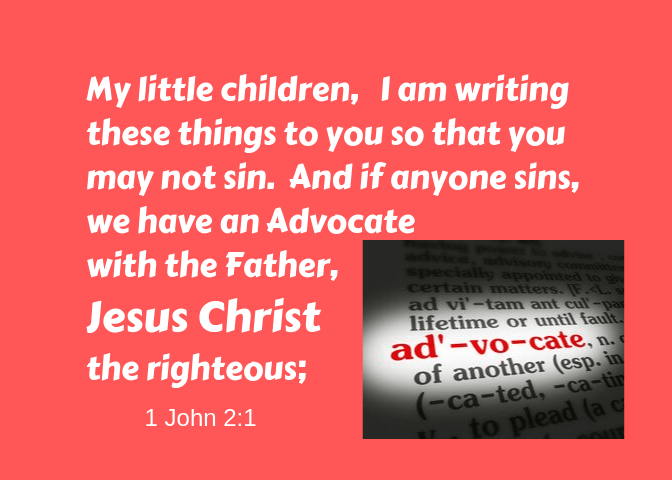
The writer explains that we do sin, but there is a path to forgiveness (1 John 1:8-10). He writes to us “so that we may not sin, but if anyone does sin, we have an advocate with the Father, Jesus Christ the righteous.” Jesus is our advocate, like a lawyer on our side. This should give us great encouragement. Jesus is the honest, righteous lawyer on our side. He is for us. As an expert lawyer, Jesus knows the rules. He knows how to take our case before the Father. He has access to the Father and successfully intercedes for us (cf. 1 Tim. 2:5 and Hebrews 8:1).


We lived in Israel and all our children were born there. Most countries do not grant citizenship to foreign children by virtue of being born in the country. Two of our young adult children applied to become citizens in Israel. They were denied several times over three years. However, not long ago a lawyer, an advocate, took up their case and presto, my children received their citizenship. The lawyer knew the rules, had the connections, authority and knowledge on how to present my children’s case, and succeeded. Jesus is our expert, righteous, successful advocate before the Father.


“Do not love the world…”


The author’s admonition to “not love the world or things of the world” are perhaps the best known verses of chapter 2 (vs. 15-17). He defines what “loving the world” is: the lust of the flesh, the lust of the eyes, the pride of life. It is a love of the way of the world, or of this world’s system. This doesn’t mean that we shouldn’t have an appreciation for the beauty and grandeur of God’s creation, the work of God’s hands, which is “very good” (Gen. 1:31). After all we wait for the regeneration of this world, and indeed the regeneration of this world’s system (Matt. 19:28, Heb. 2:5).


“The last hour”  and “anti-christs”

The author says it is the last hour. What a long hour it has been! He knows that it is the last hour since many anti-christs had already come. Specifically, here he says that the anti-Christ (anti-Messiah) is anyone who denies that Jesus is the Christ (the Messiah). The text does not say, as many traditional trinitarian Christians say, that the anti-Messiah is anyone who denies that God is the Messiah, or that the Messiah pre-existed as God. Rather, the text says that the anti-Messiah is anyone who denies that Jesus, the man Jesus, is the Messiah. “Christ” (Messiah) is never a title for God himself.


Of these anti-christs, the author says: “They went out from us, but they were not of us; for if they had been of us, they would have continued with us…” (1 John 2:19). It is easy to see how a text like this could be mis-interpreted and mis-applied. Especially as centuries passed, anyone could use the text to condemn any kind of a reformer. For instance, Catholics could apply it against Protestants.  Today it is leveled against anyone who denies that Jesus is God. But in its original context it was directed against anyone who denied that the man Jesus is the Christ (Messiah).


The promise of God – eternal life

1 John 2:25 says that God has promised us eternal life (immortal life in the age to come). We can take comfort and joy that God is pretty good at keeping His promises.


Having confidence, and not shrinking back in shame


1 John 2:28 says that if we abide in Jesus, that is, live according to knowledge of who he is, we can have confidence so that when he appears, at his coming, we won’t shrink back in shame. Since we know who Jesus is — the Messiah of God the Father, risen from the dead, exalted to God’s right hand, appointed to rule the world, we can look forward to his return. There is a similar admonition in Hebrews 10:39: “But we are not of those who shrink back and are destroyed, but of those who have faith and keep their souls.”

-Bill Schlegel