Looking For and Following the Star!

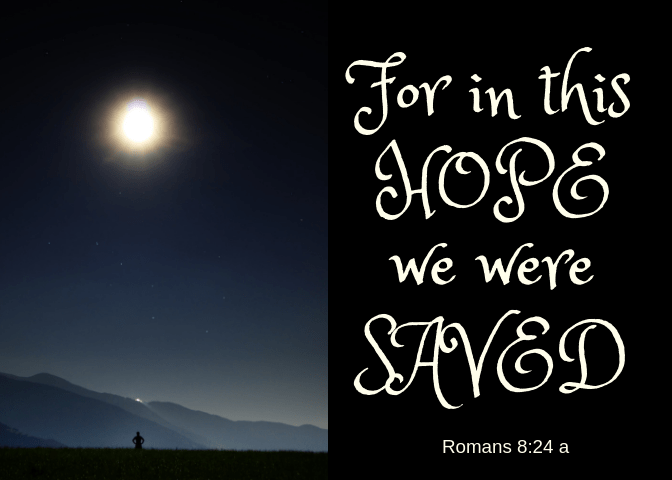
Romans 8 24 a

This week, as we look forward to Christmas and celebrating the birth of our Lord and Savior Jesus, we will look at his birth and what that means going forward for us. Just as the wise men looked for and followed the star to find Jesus, we also have a “Star”, Jesus, to look for and to follow.


As Christmas draws near I, like so many others, am filled with anticipation. Christmas is truly the most wonderful time of the year. I remember growing up as a kid and being filled with so much excitement and anticipation counting down the days and looking forward to Christmas Day! When I think back to the anticipation I felt, it reminds me of the anticipation that the wise men must have felt. No one really knows for sure where the wise men came from, but it is believed that they could have come from the Babylon area, a journey of 800 miles.  If that’s true, they must have really been waiting for and anticipating the sign of the star that would show them the way to the “King of the Jews” –Matthew 2:2. They must have been watching and waiting for the day when that star would appear so they could honor and worship the King.  Once they saw that star, they followed and never looked backed, but followed that star until they found him.


If I were to relate this story of the wise men to myself and the time we live in now, following the first advent of Jesus, I am reminded of the anticipation I have for the second advent of Jesus when he will come back and when God himself comes back and “makes all things new”- Revelation 21:5.


Romans 8:23-25 beautifully states how we should be anticipating the return and coming of our King!


“23 Not only so, but we ourselves, who have the firstfruits of the Spirit, groan inwardly as we wait eagerly for our adoption to sonship, the redemption of our bodies.

24 For in this hope we were saved. But hope that is seen is no hope at all. Who hopes for what they already have? 25 But if we hope for what we do not yet have, we wait for it patiently.”


The prayer that I have for myself and for everyone who reads this is that we anticipate and long for the coming of the King as much as the wise men did.  May we “groan inwardly as we wait eagerly”, may we turn our eyes to the risen “Star”, Jesus, and follow him and never look back, until God sends him back to this earth at his second advent.


-Luke Elwell


Lessons from the Wilderness: Jesus

Wilderness Wandering Lesson #4: God’s word sustains us when we are depleted by the trials of the wilderness.

god's word does.

This week, as we’ve been thinking about our wilderness wanderings, we’ve primarily looked through the lessons from the Old Testament. Today though, we’re going to turn to the New Testament to see an example of a wilderness experience that can teach us a lot about how to make sure this experience makes us and doesn’t break us.

In Matthew 4, Jesus is tempted in the desert by the Devil for 40 days and 40 nights before he begins his ministry. This is a familiar story that shows the humanity of Jesus and how he can relate to us, but today, I want to focus on where Jesus was tempted. It says in verse 1 that “Jesus was led up by the Spirit into the wilderness to be tempted by the Devil.” In our time thinking about the wilderness, we’ve focused on the types of wilderness experiences we may have and how God’s faithful love can sustain us. As we look at Jesus’ experience, we can see how to survive and thrive in the wilderness.  

The first lesson we can glean from this passage is that sometimes, as is the case with the Israelites and Elijah, we are led into the wilderness by God. Jesus was led into the wilderness by the Spirit where he fasted 40 days and 40 nights. At this point, Jesus had not begun his ministry, so this time could have been for testing and strengthening Jesus’ faith and dependence on God so that we could learn from it. By asking ourselves during each wilderness experience “What can I learn from this? How can I grow?”, we can better face the times in wilderness with palms held open instead of allowing bitterness to grow in us.

The second lesson we can learn from Jesus’ time in the wilderness is that God’s word is crucial for surviving in the wilderness. In the wilderness, Jesus had to face physical hunger, thirst, and exhaustion. He also was probably emotionally drained in this time as well. This may sound like a description of ourselves when we go through times in the wilderness. How often in these times where we are sad, lonely, depressed and drained – how often do we pause in these moments and stop the spiral of depression and wandering by saturating ourselves in God’s word? By looking at Jesus’ example, we can see how we can stop temptations in their tracks by responding with God’s word, more specifically by aligning our actions with God’s word.

The last lesson that I want us to focus on today is looking at when this wilderness experience took place. Though Jesus had not begun his ministry yet, in the previous chapter, he had just gotten baptized. All too often, we think that if we have committed our life to God that things will go well, that we’ll never have to experience trials or periods of suffering. But, we can look at Jesus’ life to see that this is simply not that case. Aside from Jesus’ experience on the cross, we can look at the beginning of his ministry as well to see that as these periods will happened to him, they will happen to us.

Jesus survived in the wilderness, and he thrived in the wilderness. I’m not sure what Jesus gained spiritually or emotionally in the wilderness, but I know what I can learn from his experience there. In the wilderness, Jesus was able to overcome temptation and suffering, including not only physical trials – but also spiritual trials – through God’s word. God’s word sustained Jesus and allowed this time to be a springboard into Jesus’ ministry instead of something that would have crippled his ministry. Now, we can look at this story and lessen the impact of what Jesus was able to do because Jesus was the son of God. But, Jesus was capable of growth and change, as seen in Luke 2:52. This is what makes him the perfect mediator for us. So, as we close this lesson today, I want to leave you with the words of Jesus as he readied his disciples for the trials they would face during the days leading up to the crucifixion: “I have told you these things so that in Me you may have peace. You will have suffering in this world. Be courageous! I have conquered the world” (John 16:33). With Jesus, we can conquer the world, including all our days of wilderness wanderings.

~ Cayce Fletcher

spurgeon quote

“Go, Tell It on the Mountain”

Go, tell it on the mountain


“Go, Tell It on the Mountain” was first sung by slaves on American plantations during the 19th century.  The slaves could identify with a Messiah that was born in a lowly manger and lived a humble life.  They embraced the Savior’s promise of a better life for all who would follow him.  And so the slaves eagerly sang the Good News for all to hear.


Go, tell it on the mountain, over the hills and everywhere;

Go, tell it on the mountain that Jesus Christ is born.

While shepherds kept their watching o’er silent flock by night,

Behold throughout the heavens there shone a holy light.


Go, tell it on the mountain, over the hills and everywhere;

Go, tell it on the mountain that Jesus Christ is born.

The shepherds feared and trembled when, lo above the earth-

Rang out the angel chorus that hailed our Savior’s birth.


Go, tell it on the mountain, over the hills and everywhere;

Go, tell it on the mountain that Jesus Christ is born.

Down in a lowly manger our humble Christ was born,

And God sent us salvation that blessed Christmas morn.


The song tells the story of shepherds watching their sheep on the night Jesus was born.  A bright light startled the shepherds and an angel told the frightened shepherds the news of Jesus’ birth.  As soon as the angels left, the shepherds excitedly decided to go find Jesus.  “So they hurried off and found Mary and Joseph, and the baby, who was lying in the manger. When they had seen him, they spread the word concerning what had been told them about this child, and all who heard it were amazed at what the shepherds said to them. The shepherds returned, glorifying and praising God for all the things they had heard and seen, which was just as they had been told” (Luke 2:16-18, 20).

The shepherds were excited to see Jesus and they were eager to tell everyone they met about all they had heard and seen!  They were thrilled that the promised Messiah had finally come and they couldn’t contain their enthusiasm.  They were motivated and anxious to spread the Good News!  Consequently, others in turn learned of the Savior’s birth.

The angel’s announcement to the shepherds was not just good news for the shepherds, but “great joy for all the people” (Luke 2:10).  Are you doing your part to spread the good news to all people?  You must go and tell the gospel on your mountain, in your neighborhood, at your school, where you work and everywhere you go.

-Jill McClain

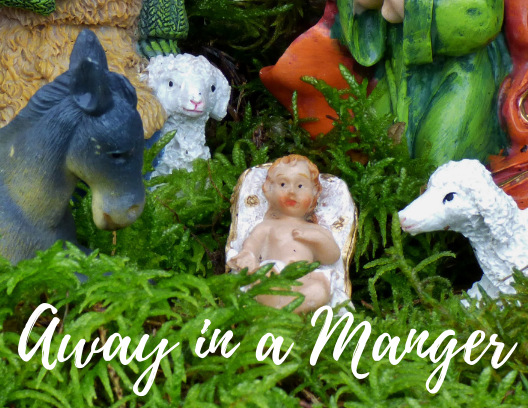
“Away in a Manger”

Away in a Manger


Away in a manger, no crib for a bed,
The little Lord Jesus laid down his sweet head.
The stars in the sky looked down where he lay,
The little Lord Jesus, asleep on the hay.

The cattle are lowing, the baby awakes,
But little Lord Jesus, no crying he makes.
I love thee, Lord Jesus! Look down from the sky,
And stay by my cradle till morning is nigh.

Be near me, Lord Jesus; I ask thee to stay
Close by me forever, and love me, I pray.
Bless all the dear children in thy tender care,
And help me with others Thy mercies to share.


When Jesus was born he did not come with the splendor and pageantry that would be expected of a king; instead, Jesus was laid in a manger.  A manger is a feeding trough for hungry animals, such as cattle, horses and donkeys.  It is no place for any sleeping baby to lay, much less a king.  Although Mary and Joseph probably tried to clean the manger up before they laid Jesus down, it was still undoubtedly a dirty and rough place for a baby to sleep.

Baby Jesus was laid in a manger because there was no other place for him to lay.  “She [Mary] gave birth to her firstborn son and wrapped him in swaddling cloths and laid him in a manger, because there was no place for them in the inn” (Luke 2:7).  At first it may seem that it was just a series of misfortunate, unforeseen circumstances that resulted in the baby Jesus being laid in the manger.  However, that simply can’t be the case. God had centuries to prepare for the birth of his son.  Since the first sin in the garden, God had foretold of Jesus’ coming (Genesis 3:15). 700 years before Jesus was born Micah prophesied that Jesus would be born in Bethlehem (Micah 5:2).  So, God had plenty of time to plan every detail of his son’s birth.  God could have easily arranged to have Jesus born in a castle with an ornately decorated cradle as a bed; after all, He is God, and He can do anything.

So, why would God choose that Jesus’ first bed should be a manger? Jesus was laid in a manger as an infant king because he came to teach mankind that God’s expectations are often opposite of the world’s.  Jesus taught his followers that the last would be first and the least would be the greatest (Matthew 19:30).  He humbled himself and became a servant, washing his disciples’ feet.  Jesus’ entire life was an example of humility.  Based on Christ’s life-long example, Paul instructs us to, “Do nothing out of selfish ambition or vain conceit.  Rather, in humility value others above yourselves, not looking to your own interests but each of you to the interests of others” (Philippians 2:3-4).  In verse 8 of the same chapter Paul goes on to say, “he [Jesus] humbled himself by becoming obedient to death – even death on a cross!”  The manger was just a foreshadowing of the humility that that would lead to the cross.

What about you?  Are you ready to live humbly to follow Jesus?

“As they were walking along the road, a man said to him [Jesus], ‘I will follow you wherever you go.’

Jesus replied, ‘Foxes have dens and birds have nests, but the Son of Man has no place to lay his head’” (Luke 9:57-58).

Jesus’ first bed was a manger, because there was no other place for him to lay his head.  Later, as an adult he still had no place to lay his head.  We have been called to follow Jesus.  What are you willing to leave behind to humbly follow your Savior?  Are you ready to give up your comfy cradle for a manger?

-Jill McClain


“Joy to the World! The Lord is Come”

joy to the world


Isaac Watts published the words for “Joy to the World” in 1719.  A century after Watts wrote the words, Dr. Lowell Mason, heavily influenced by Handel’s “Messiah”, set the words to music. Watts wrote the famous carol after meditating on Psalm 98.  Psalm 98:4 reads, “Shout for joy to the Lord, all the earth, burst into jubilant song with music.”  This is precisely what Watts was trying to do by writing the hymn.

 
Joy to the world, the Lord is come;
Let earth receive her King
;
Let every heart prepare Him room
And heaven and nature sing, and heaven and nature sing,
And heaven, and heaven and nature sing.

Joy to the earth, the Savior reigns;
Let men their songs employ
While fields and floods, rocks, hills, and plains
Repeat the sounding joy, repeat the sounding joy,
Repeat, repeat the sounding joy.

No more let sins and sorrows grow,
Nor thorns infest the ground;
He comes to make His blessings flow
Far as the curse is found, far as the curse is found,
Far as, far as the curse is found.

He’ll rule the world with truth and grace,
And makes the nations prove
The glories of His righteousness
And wonders of His love, and wonders of His love
And wonders, and wonders of His love.


The first verse of the carol talks of Jesus coming to earth.  It does not talk about Jesus’ coming as a special baby, but more importantly his coming as King. There is no mention in the entire carol of Bethlehem, a manger, shepherds, or a special star.   In fact, much of the carol has more to do with Jesus’ future, second coming, than with his birth as a baby.


The third verse of the carol mentions “thorns infesting the ground” and “the curse”, both references to God telling Adam that the ground would be cursed as a consequence of his sin (Genesis 3:17-18). Because Adam and Eve had disobeyed God, mankind would have to work to produce food, and instead of abundant crops growing effortlessly, now weeds and thorns would be plentiful.  However, the carol is looking forward to a day when there will be no more sin, sorrow or thorns.  We know all too well, that that day has not yet come, but we look forward with confidence to the day Jesus will return to earth again and all the consequences of sin will be defeated.

Although much of “Joy to the World” tells the story of Jesus second coming, it is still a wonderful song for us to sing at Christmastime.  As we celebrate Christmas, it is important for us to remember that Jesus did not stay a baby in a manger.  His story does not end with his death on the cross, or even his resurrection. We sing of “Joy to the World” because we know that one day Jesus is coming back to set up his Father’s perfect, never-ending, kingdom here on earth!

-Jill McClain

“Hark! The Herald Angels Sing”


Hark! the herald angels sing

Hark! the herald angels sing,
“Glory to the newborn King!”
Peace on earth, and mercy mild,
God and sinners reconciled!”
Joyful, all ye nations, rise,
Join the triumph of the skies;
With th’ angelic host proclaim,
“Christ is born in Bethlehem.”
Hark! the herald angels sing,
“Glory to the newborn King!”

Hail! the heav’n born Prince of Peace!
Hail! the Son of Righteousness!
Light and life to all he brings,
Risen with healing in his wings
Let us then with angels sing,

“Glory to the newborn King!

Peace on earth and mercy mild;

God and sinners reconciled!”
Hark! the herald angels sing,
“Glory to the newborn King!”

As is common at Christmastime, “Hark the Herald Angels Sing” proclaims peace on earth.  In Isaiah’s prophecy about the coming of the Messiah he states that Jesus will be called the Prince of Peace (Isaiah 9:6).  Jesus certainly came to bring peace.  The most important way that he brings peace, is that he enables us to have peace with God, as is referenced in the hymn when it says, “God and sinners reconciled.”  We have all sinned, and as such we are enemies with God (Romans 5:10).  Enemies cannot become friends until their differences are dealt with.  For reconciliation to occur there is often a price that first has to be paid.  In the case of our sinning against God, the price that needs to be paid is death.  “For the wages of sin is death” (Romans 6:23).  When Jesus died on the cross he paid the price for us to have a relationship of peace with God.  “Therefore, since we have been justified through faith, we have peace with God through our Lord Jesus Christ” (Romans 5:1).

Jesus also gives us peace in the midst of difficult and painful situations.  Hours before Jesus was crucified he promised to give his disciples peace.  On what should have been one of Jesus’ worst nights, on a night he might have been consumed with his own anxiety and despair, he tells his disciples he wants them to have peace.  “Peace I leave with you; my peace I give you. I do not give to you as the world gives. Do not let your hearts be troubled and do not be afraid” (John 14:27).  The peace Jesus is offering is not the world’s peace, which is usually just based on good circumstances.  On the contrary, we are told to expect trial and pain, but that Jesus’ peace can prevail.   Jesus says, “I have told you these things, so that in me you may have peace. In this world you will have trouble. But take heart! I have overcome the world” (John 16:33).

We have no reason to fear the present or the future.  We can rest assured that God is in control of every situation.  When we are faced with difficult conditions do not give into worry, but rather turn to God in prayer, asking for our requests, and thanking Him for all that He has already done.  Then rest in peace, knowing that He loves us and is in control. “Do not be anxious about anything, but in every situation, by prayer and petition, with thanksgiving, present your requests to God. And the peace of God, which transcends all understanding, will guard your hearts and your minds in Christ Jesus” (Philippians 4:6-7).

-Jill McClain


“While Shepherds Watched Their Flocks”

While shepherds watched

The theme for each of our devotions this week is based on a different Christmas carol.  Today, I would like for us to examine, “While Shepherds Watched Their Flocks”.


While shepherds watched their flocks by night,
All seated on the ground,
The angel of the Lord came down,
And glory shone around,

And glory shone around.

“Fear not!” said he; for mighty dread
Had seized their troubled minds,
“Glad tidings of great joy I bring
To you and all mankind,

To you and all mankind.

“To you, in David’s town this day,
Is born of David’s line,
The Savior who is Christ the Lord,
And this shall be the sign:

And this shall be the sign:

“The heavenly Babe you there shall find
To human view displayed,
All meanly wrapped in swathing bands,
And in a manger laid;
And in a manger laid.
“All glory be to God on high,
And to the earth be peace:
Good will henceforth from heav’n to men,
Begin and never cease,

Begin and never cease.”


“While Shepherds Watched Their Flocks” tells the story of the shepherds found in Luke 2:8-20.  At the time of Jesus’ birth shepherds were at the bottom of the social ladder.  They often lived for long periods of time, right in the same fields where they took care of the sheep; so most people looked down on them.  God could have announced the birth of his son to the most influential, rich and successful leaders of the time.  However, instead God chose to first tell the lowly shepherds. “But the angel said to them, ‘Do not be afraid. I bring you good news that will cause great joy for all the people.  Today in the town of David a Savior has been born to you; he is the Messiah, the Lord’” (Luke 2:10-11).  God sent his son for all people – for the rich and the poor, the leaders and the abandoned, the educated and the uneducated, the popular and the friendless.  God had his good news first delivered to the shepherds to demonstrate that the gospel is for all people.

The angels told the shepherds that baby Jesus was “born to you” (Luke 2:11).  Typically, we think that a baby is born to his parents.  But Jesus was a gift given to the shepherds, and each of us.  Jesus was born for us, to save us from our sins so that we may one day have eternal life.  Jesus is the ultimate Christmas gift, given to each of us.

When the angels left, the shepherds said, “’Let’s go to Bethlehem and see this thing that has happened, which the Lord has told us about.’ So they hurried off and found Mary and Joseph, and the baby, who was lying in the manger.  When they had seen him, they spread the word concerning what had been told them about this child.  The shepherds returned, glorifying and praising God for all the things they had heard and seen, which were just as they had been told” (Luke 2:15-17,20).  The shepherds heard the good news, they believed it, they told others the good news and they worshiped God. What about you?  Do you believe the gospel?  If so, are you telling others the good news?  And are you spending time worshiping and praising God for the wonderful gift that has been given to you?


-Jill McClain

“O Holy Night”

O Holy Night


The Christmas carol, “O Holy Night” has a fascinating history.  It was first written as a French poem in 1847 by Placide de Roquemaure, and was set to music by Adolphe Charles Adams that same year.  In 1855, the Unitarian minister, John Sullivan Dwight translated the song into English.  The song was made popular in the United States by abolitionist during the American Civil War.  According to tradition, “O Holy Night” played a significant role in causing a Christmas day cease fire during the Franco-Prussian War.  And in 1906 it was the first song ever played over the radio.  You can read more details about the history of the song here, https://www.beliefnet.com/entertainment/movies/the-nativity-story/the-amazing-story-of-o-holy-night.aspx, a reprint from “Stories Behind the Best-Loved Songs of Christmas” by Zondervan.

O Holy Night!

The stars are brightly shining.
It is the night of our dear Savior’s birth!
Long lay the world in sin and error pining
Till He appeared and the soul felt its worth.

A thrill of hope the weary world rejoices
For yonder breaks a new and glorious morn!
Fall on your knees!

O hear the angels’ voices!
O night divine,

Oh night when Christ was born,
O night divine
O night divine.

            One of my favorite lines in the carol is, “A thrill of hope the weary world rejoices.”  Jesus came to bring us hope. Paul, in I Timothy 1:1, states that Christ Jesus is our hope.  Peter explains that hope further in I Peter.  “Praise be to the God and Father of our Lord Jesus Christ! In his great mercy he has given us new birth into a living hope through the resurrection of Jesus Christ from the dead, and into an inheritance that can never perish, spoil or fade” (I Peter 1:3-4). “Therefore, with minds that are alert and fully sober, set your hope on the grace to be brought to you when Jesus Christ is revealed at his coming” (I Peter 1:13).  Our hope is in the fact that Jesus died for our sins, was raised back to life, and is coming back to Earth to live with us eternally.

Today, we are accustomed to talking about hope as wishful thinking.  I hope for a large, year-end bonus.  I hope one day the Lions will win the Super Bowl.  I hope to win a new car.  Each of these statements are just my desires or my wishes; they do not foretell the future. However, Jesus came to bring us an entirely certain hope.  A definite hope that cannot change.  The hope talked of in the Bible is not wishful thinking, but rather an absolutely true promise of things to come.  A hope that will never fail us, never disappoint.  We can choose to put our hope in our church, our job, our spouse, or other earthly things.  However, over the course of time all of those options will bring disappointment. On the other hand, living for the promise of the kingdom will bring us perfect, eternal life.

Everyone puts their hope in something.  Kyle Idleman suggests you can tell what you have put your hope in, by observing what you spend your time and money on, or what makes you worried or mad.  So what about you?  What are you putting your hope in?


-Jill McClain

“Come, Thou Long Expected Jesus”

come thou long expected

I thoroughly enjoy celebrating the Christmas season.  I like the bright lights and decorations, the baking and yummy treats, the crowded shopping and wrapping presents, the parties and corny Hallmark movies (that make my husband cry), and the extra time spent with friends and family.  I also really enjoy Christmas music. I like new contemporary songs and the old classic carols.  For this week of devotions I will be sharing with you some thoughts on a different carol each day.

The Carol, “Come, Thou Long Expected Jesus” was written in 1744 by Charles Wesley.  Although, not as popular as some other Christmas Carols, it does have a wonderful message.

Come, Thou long-expected Jesus,
Born to set Thy people free;
From our fears and sins release us,
Let us find our rest in Thee.
Israel’s Strength and Consolation,
Hope of all the earth Thou art;
Dear Desire of every nation,
Joy of every longing heart.

The central theme of the song is that Jesus’ birth fulfilled Israel’s longing for a Savior.  God’s chosen people were waiting for the Messiah, who was promised to them by God.  Throughout the Old Testament, written hundreds of years before Jesus’ birth, God’s prophets repeatedly told the Jewish people of a coming Messiah.  Jesus’ birth fulfilled many prophecies, such as the following:

“Therefore the Lord himself will give you a sign: The virgin will conceive and give birth to a son, and will call him Immanuel.” Isaiah 7:14

“For to us a child is born, to us a son is given, and the government will be on his shoulders.  And he will be called Wonderful Counselor, Mighty God, Everlasting Father, Prince of Peace.” Isaiah 9:6

“But you, Bethlehem Ephrathah, though you are small among the clans of Judah, out of you will come for me one who will be ruler over Israel, whose origins are from of old, from ancient times.” Micah 5:2.


The long expected Jesus came not only to fulfill Israel’s prophecies, but also to save the entire world.  “For God so loved the world that he gave his one and only Son, that whoever believes in him shall not perish but have eternal life.”  (John 3:16) Jesus is God’s plan for salvation for each of us.  As Wesley states, Jesus is the “hope of all the earth,” the “dear desire of every nation” and the “joy of every longing heart.”

-Jill McClain

Keep Running His Race

Hebrews 12 1 (1)

Therefore, since we are surrounded by such a great cloud of witnesses, let us throw off everything that hinders and the sin that so easily entangles. And let us run with perseverance the race marked out for us, fixing our eyes on Jesus, the pioneer and perfecter of faith. For the joy set before him he endured the cross, scorning its shame, and sat down at the right hand of the throne of God. Consider him who endured such opposition from sinners, so that you will not grow weary and lose heart.
Hebrews 12:1‭-‬3 NIV
https://bible.com/bible/111/heb.12.1-3.NIV

Yesterday evening I was out for a run.  It was my second run of the day as I did a 3 mile run in the morning.  I was feeling pretty good early in the run so I made a decision to run for 10 miles. I have only ran that far one other time in my life, it was 10 years ago when I ran a half marathon.  I knew this was a big undertaking so I settled into a manageable pace and went for it.  This scripture immediately came to mind, as well as my grandmother.   Sadly, she is in hospice care and very close to the end of her life.  She is surrounded by family, but not her whole family.  We are 800 miles away, and as I was running it gave me the time to reflect on her life, and draw strength from it.
She is someone I would put in that cloud of great witnesses.  She has lived her life in a way that I know God is proud of.  She has faithfully served Him and his people since she was able. And it makes me want to do better.  During my run, I stumbled between 3 and 4 miles. I fell to the sidewalk like a ton of bricks.  At first I laughed because I thought it must have been funny to the passer by’s in cars.  Then I assessed the damage, a few scrapes and a really scuffed up corner on my phone. I decided to push on, but was considering calling it quits and heading home at that point.   But that scripture says to throw off everything that hinders us, and the sin (sidewalk) that so easily entangles us.  Yes my leg hurt, yes my hand hurt, but I wasn’t giving up.  I had made a commitment to go 10 miles. Fast forward to about 8 miles in, and I notice my left hamstring is feeling a little weird with every step. I slow my pace but it gets worse, at 8.5 it starts cramping up. I stop, stretch, walk a bit, then start again. Yet it only lets me go a few steps before it gives up.  My body has had enough, but I still have a mile to go.  I ended up walking that last mile, but I finished the 10.
In many ways I see a correlation between that 10 mile journey and the faith journey we take throughout life.  There are going to be setbacks, there are going to be times we stumble, or get hurt, and want to quit. There are going to be times we can’t or don’t move as fast as we planned.  But the important thing is to remember our commitment, to draw on the strength of others, to eliminate the things holding us back.
The race is already laid out before us, first set out by Jesus, then followed by so many others.  Let’s make sure to include ourselves in that faith list shall we?
Jerry Briggs