The End of the Christmas Story

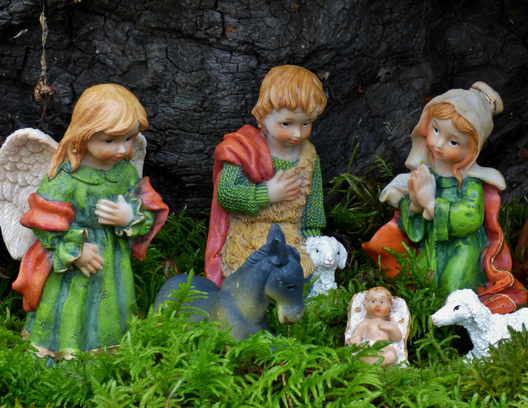
nativity

What is the end of the Christmas Story?

Perhaps when Mary was treasuring these things in her heart and the shepherds were  returning and praising God? (Luke 2:19,20)

Or maybe when the magi were worshiping and presenting their treasures? (Matthew 2:11)

Too often, that is where we stop celebrating in December.  A sweet baby (the Son of God) is born in humble surroundings and certain segments of the population respond with fitting praise and wonder.  The end.  But, as we have seen in our devotions this week, that is far from the end of the story.  I have enjoyed reading through Luke especially at this time of year to see once again what we are REALLY celebrating.

Jesus came as a baby – and what a great opening act that was (you, know the opening act that followed thousands of years of God setting the stage)!!  And 30 years later all sorts of people (fishermen, tax-collectors, sinners, chief priests, foreigners, the sick and diseased, teachers of the law, governors and kings and politicians, rich and poor, Jew and Gentile, men, women and children)  all prepare to meet this traveling preacher, teacher, healer, miracle maker, story-teller, leader, servant.  His favorite topic is always the good news of the kingdom of God (Luke 8:1).  Through his teaching, his parables, and his miracles, the world sees a clearer picture of God than they have ever seen before.  The son truly has his Father’s resemblance.

And, he also is committed to doing his Father’s will – even when that means death on the cross, crucified as a criminal, to take away the sins of the world.  His followers are crushed as they were sure this Jesus was going to set up the Kingdom on earth and begin his reign right then.  How could they have been so wrong?

Thankfully, that is still not the end.  Three days later…the tomb is empty!  Joy to the World!!  Jesus appears to his disciples and uses Scripture to explain to them again how the Old Testament foretold what must take place.

44 He said to them, “This is what I told you while I was still with you: Everything must be fulfilled that is written about me in the Law of Moses, the Prophets and the Psalms.”  45 Then he opened their minds so they could understand the Scriptures. 46 He told them, “This is what is written: The Messiah will suffer and rise from the dead on the third day, 47 and repentance for the forgiveness of sins will be preached in his name to all nations, beginning at Jerusalem. 48 You are witnesses of these things.   Luke 24:22-28

A way was needed for both Jews and Gentiles to be washed clean before they could be full citizens of God’s Kingdom.  And Jesus’ death made the way.  And his resurrection gives the hope for a future resurrection.  For there is one more key element that must take place before Jesus will begin his reign over all the world and the Kingdom of God will fully begin.  This is hinted above in Luke 24:47 and spelled out in Matthew 24:14 “And this gospel of the kingdom will be preached in the whole world as a testimony to all nations, and then the end will come.”

There have been many godly men and women who have died while preaching the gospel – but still the good news has not reached all people in all nations.  The Church of God mourned the death of a very special and faithful pastor, Rex Cain, just this week.  But the mourning was not without hope because the Christmas story isn’t over yet.

In the final verses of Luke (24:51), Jesus ascends into heaven.  When the same event is recorded in the book of Acts (Luke’s sequel) the disciples are told, “This same Jesus, who has been taken from you into heaven, will come back in the same way you have seen him go into heaven.” (Acts 1:11).  The best is yet to come!

The end of the Christmas story is a new beginning.  A beginning that is still to come.  When Jesus breaks through the clouds at his Second Coming this will be the start of his reign on Earth over all who have been faithful.  The dead in Christ will rise and we will see Jesus coming – not as a babe but as a triumphant warrior and king.  A new heaven and a new earth will worship him and his Father.

I pray I will be found ready.  And I pray you will be found ready.  Let’s get to work and tell the nations!

“Come, Lord Jesus!”(Revelation 22:20 b)

-Marcia Railton


Joy to the World – Up From the Grave He AROSE!

Luke 24

JOY to the WORLD!

In yesterday’s devotion, Jesus died.  And the world –  the centurion, the sky, the women, the crowd – took notice and responded.  Even the crowd that had not been Jesus’ followers, some of whom may have earlier shouted, “Crucify Him!”, now, “beat their breasts and went away” (Luke 23:48).  There was something very different about this man Jesus and the way he died.  Though they did not understand at the time that he had died for their sins – and not only theirs – but the sins of the world.

If Luke’s gospel story had ended there, we could still be forgiven people today – able to have a relationship with God because of the sacrifice of Jesus carrying our sins to his death because the wages of sin is death (Romans 6:23).  BUT – there is even MORE good news to come in Luke 24!  A great gift of God is set before us – eternal life in Christ Jesus our RISEN Lord.  Without a risen Lord there would be no future hope for a resurrection for his followers.

When the women brought news to the disciples that Jesus was no longer in the tomb, “they did not believe the women, because their words seemed to them like nonsense.  Peter, however, got up and ran to the tomb.” (Luke 24:11,12).   He was going to search it out and find the truth.  Likewise, the two on the road to Emmaus had many questions and were confused about what they had seen and heard.  Jesus walked with them, “And beginning with Moses and all the Prophets, he explained to them what was said in all the Scriptures concerning himself.” (Luke 24:27).

Today, news of his resurrection and the resurrection to come still brings great joy to his followers.  There are those who say it sounds like nonsense.  There are those who are questioning.  Be like Peter and seek out answers.  Like Jesus, dig into the Scriptures and reveal them to others.  Declare the good news of Jesus’ birth – but then so much more – his death and resurrection.  Share the Joy!

-Marcia Railton

The Christmas Story Continues

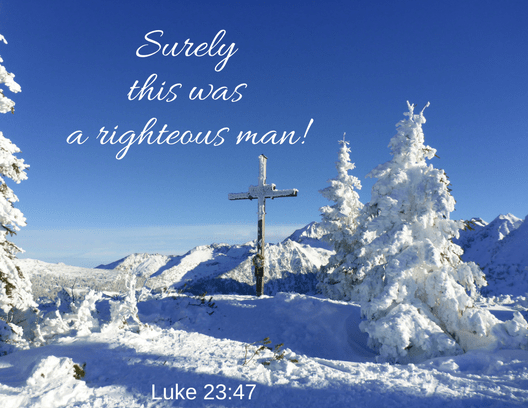
Luke 23 47

Luke 23

Questioning Pilate

Curious Herod

Accusing chief priests

Mocking soldiers

Appealing Pilate

Shouting crowd

Desperate Pilate

Mad mob

Defeated Pilate

Fortunate Barabbas

Condemned Jesus

Cross-carrying Simon

Mourning women

Guilty criminals

Crucified three-some

Forgiving Messiah

Sneering rulers

Informative sign: THIS IS THE KING OF THE JEWS

Insulting felon

Compassionate criminal

Welcoming Jesus

Saved criminal

Darkened sky

Torn curtain

Committed spirit

Last breath

Amazed centurion

Dead righteous man

Seeing crowd

Generous Joseph

So much could be said and written about any one of these elements of Luke 23.  Much of Luke and the gospels – and even the Old Testament – point to this moment in history: the Crucifixion of the Son of God.  Which character do you identify with most today?  Which adjective describes you this year?  What do you find the most amazing?  How does this chapter of Jesus’ history add to the Christmas story of Luke 20 we discussed earlier this week?  In an effort to become more Christ-like, what characteristics do you see in this chapter that you want to work on this week?

Keep Reading and Growing

-Marcia Railton

Who is the Son of God?


Luke 22

luke 22_46

Yesterday, in Luke 21 Jesus was warning the disciples (and those who would follow) of persecution while encouraging them to stand up under it.  And today, in Luke 22 Jesus himself is cast into a fierce storm of persecution.  He will now be showing – not just telling – the disciples, his contemporaries, and all those who would come after him how to stand up under persecution.

But first, a private dinner with his closest disciples to commemorate the Passover – when God saved his people from slavery by the blood of the lamb.  And very soon a new lamb would be sacrificed to save God’s people from slavery to sin.  Jesus tells his disciples that he will not eat the Passover meal, or drink of the cup again, until the Kingdom of God comes.  Communion services are a great reminder of this promise.  At the dinner, he uses the opportunity to remind them once again the secret to great leadership – be a servant.  Stop fighting over who is best…just serve.

I love how even though Jesus knew ahead of time that Peter would fail him, he had still prayed that Peter’s faith would not fail.  And even though Satan would have the opportunity to “sift all of you as wheat,”  Jesus saw a future for Peter in which Peter would be using those painful experiences to help strengthen his brothers.
And then, in the garden while Jesus is pouring his heart out in prayer – his disciples are sleeping.  I wonder how many times he would prod me and say, “Get up and pray so that you will not fall into temptation.”  How much better would Peter – or I – stand Satan’s arrows if he – or I – were fully filled up with prayer rather than whatever feels good or most urgent at the moment?

Enter, Judas – and the chief priests and the guards and the great betrayal!  And even in the midst of the hurt and personal persecution – Jesus gives healing as he restores the servant’s ear.

Early the next morning, Jesus is brought before the chief priests and elders and is questioned about who he is. Is he the Messiah?

Jesus answered, “If I tell you, you will not believe me, 68 and if I asked you, you would not answer. 69 But from now on, the Son of Man will be seated at the right hand of the mighty God.”

70 They all asked, “Are you then the Son of God?”

He replied, “You say that I am.”

They didn’t expect the Son of God to have appeared as a baby in a manger.  They didn’t expect the Son of God to have a rag-tag group of followers in the countryside.  They didn’t expect the Son of God to be persecuted at their own hands.  Beware of what you expect from the Son of God.  Keep reading the gospels – and all of God’s Word to see who God really is, and who the Son of God is!

-Marcia Railton


Still Giving – and Standing Firm

Luke 21

Luke 21_28

Yesterday our devotion centered on the Christmas story – as presented in Luke chapter 20.  Today takes us into Luke 21 which begins with a few verses concerning giving gifts. How fitting.  But here it is a slightly different type of gift which Jesus is referring to.   “As Jesus looked up, he saw the rich putting their gifts into the temple treasury. He also saw a poor widow put in two very small copper coins. “Truly I tell you,” he said, “this poor widow has put in more than all the others. All these people gave their gifts out of their wealth; but she out of her poverty put in all she had to live on.” (Luke 21:1-4).   Giving to God’s work is indeed a great place to give your gifts – whether you are blessed with a lot to give or very little to give.  God sees the heart and is delighted in the heart that joyfully gives all to Him.

The rest of this chapter is devoted to the future – including some rather troubling events: earthquakes, wars, famine, and hatred, prison and persecution as a result of believing and  testifying about Jesus.  But hope is given.  Jesus says he is telling us these things so that we will know what must take place before the end will come.  A hard day of dirty work is always made easier by knowing it will not continue forever.  At the end there will be a time to enjoy the rewards of working hard.   So too, those who are faithful through the end times can look forward to reaping the reward when the Son of Man comes again.

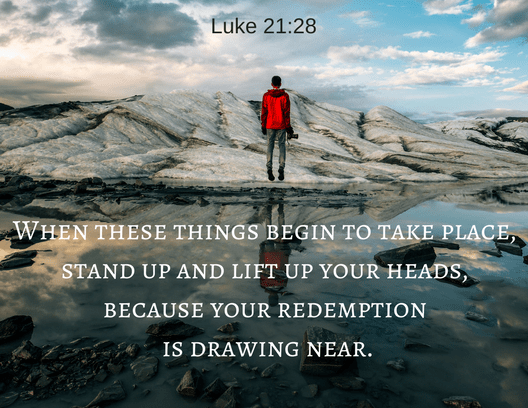
Jesus says do not be afraid; rather, “Stand firm, and you will win life.” (Luke 21:19).  Even while our neighbors are fainting from terror at the surrounding events, Jesus tells us to stand tall.  He says, “At that time they will see the Son of Man coming in a cloud with power and great glory. 28 When these things begin to take place, stand up and lift up your heads, because your redemption is drawing near.” (Luke 21:27,28). 

Keep Giving – and Stand Firm!

Marcia Railton

What Shall I Do? I Will Send My Son.

Luke 20

Luke 20 13

Merry Christmas!

May your day be full of sweet reminders of God’s love.  And may you pass along that love to others.

It is easy to lose sight of the whole picture of Jesus when we gather to feast and exchange presents amid the tinsel, lights, tree, and nativity scene.  A pregnant virgin, a faithful fiancé, a holy night, an angel assembly, a crew of shepherds, traveling wise men, pass the ham, and unwrap the presents.  But wait . . . why??? And then what????

It appears Jesus didn’t spend time preaching about his miraculous and incredibly true birth.  In fact, only two of the four gospels record bits and pieces of his birth story.  But here in Luke 20 Jesus taught the Parable of the Tenants.  And while it isn’t likely used in very many Christmas sermons or devotions, it actually paints a very fitting picture of why Jesus was sent – and what was “the rest of the story” – beyond the shepherds and wise men.

In this parable God plays the role of the vineyard owner.  He entrusts his vineyard (earth) to mankind as farm tenants to care for his vineyard.  The owner sends back several servants (Old Testament prophets) to the vineyard to retrieve some fruit for the owner.  Instead the selfish, greedy tenants mistreat the servants and send them back with nothing for the master.   

“Then the owner of the vineyard said, ‘What shall I do? I will send my son, whom I love; perhaps they will respect him.’ (Luke 20:13).  And so, the Son of God is given a mission for his Father: go to the vineyard to represent his Father to attain what belongs to his Father – the fruit of the vineyard.  God could have done this in so many ways.  He could have sent a violent and powerful son to use force to swiftly get the Father’s work done and repay the tenants for their selfish, greedy wickedness.  But instead the Son was given – a baby – as the Son of Man and Son of God.  And the angels rejoiced.   And the shepherds were in awe as they found things just as they had been told and then joyfully shared the news.

And the Son of God “grew in wisdom and stature, and in favor with God and man” – the tenants of the vineyard. (Luke 2:52).   And the son of the vineyard owner teaches and preaches and performs miracles to display and prove the goodness and sovereignty and master plan of the vineyard owner.  But, they still don’t get it.  Forsaking the master’s plan, as well as his very son, they conspire together and the tenants kill the son.  Now, they figure, the vineyard will be theirs.  There is no longer an heir.  And so, the tenants triumph for a time and seem to have free reign of the vineyard.

But, that is not the end of the story.   In his parable Jesus now switches from past tense to future tense as he says, “What then will the owner of the vineyard do to them?  He will come and kill those tenants and give the vineyard to others.”  So, too, there is a future in our Christmas story today.  And, there is a price that will be paid for all tenants who have chosen to forsake the son.  

In your celebrating today, and in your work tomorrow, in your heart and mind and actions, in your time, in your giving, in your whole living – do not forsake the son.

-Marcia Railton

Jesus is Coming! Jesus is Coming!

Luke 19

luke 19 38

Jesus is Coming!  What preparations do we need to make before Jesus comes?  Climb a tree to get a good vantage point?  Put his money to work?  Spread your cloak on the road?  These were all mentioned in Luke 19 as ways people prepared for Jesus’ coming.

The wealthy, though short, tax collector Zacchaeus was curious about this Jesus who was coming into town.  Not wanting to miss out he climbed a tree to make sure he could see Jesus.

In the Parable of the Ten Minas, during the master’s absence most of the servants took what had been entrusted to them (a mina – about three months wages) and put it to work to earn more – and were rewarded for their work.

When the crowd heard that Jesus was coming to Jerusalem they gathered to pay him honor as they spread their cloaks in the road in front of the colt carrying Jesus.  And with loud voices they joyfully praised God for the miracles they had witnessed Jesus perform: “Blessed is the king who comes in the name of the Lord!  Peace in heaven and glory in the highest”. (Luke 19:38)

This greeting reminds me of the words spoken by the great company of the heavenly host about 33 years earlier when the angels were telling the shepherds of the birth of Christ.  “Glory to God in the highest, and on earth peace to men on whom his favor rests.” (Luke 2:14).

No doubt, today, Christmas Eve, many many preparations will be made – supposedly in preparation to celebrate the birth of a King.  In the midst of our busyness how will we actually prepare for Jesus?   What will we do and say and give and pray TODAY to celebrate his FIRST Coming in a way that will honor him?  Perhaps there will be some things that we decide we will NOT do, in order to better celebrate Jesus’ coming.

And, EVERY day – how will we prepare for his SECOND coming?

Will we take the time and effort to seek out Jesus as Zacchaeus did?  Will we joyfully accept his invitation to meet together and then find ourselves changed – repentant and obedient – because of the time we spend in his presence?

Will we take the talents, time, possessions and minas/money  we have been given and diligently be trustworthy in using them to prepare for the coming return of our Savior – spreading the word, growing the church, and caring for the lost?  Or will we be like the scared servant who just hid away the treasure that he was responsible for – and even what he had was taken from him?

Will we work at honoring Jesus, the Son of God who is indeed coming to be crowned king in a kingdom like no other.   Will we give of ourselves, not afraid to get our clothes a little dirty, not ashamed to speak boldly, not persuaded to keep quiet by the Pharisees in our midst?  For if we don’t speak – even the stones will tell of his greatness (Luke 19:40).

I pray we celebrate his first coming well while we wisely and diligently prepare for his even greater second coming!

Jesus is Coming!

Marcia Railton


One Thank You

Luke 17

Luke 17 17 edit

A simple, but important rule in my sixth-grade classroom is students must say “thank you” anytime they receive something from me.  It doesn’t matter if that something is homework, a reward, a present, or even a consequence, the expectation is always that I am thanked.  Why?  There are a few reasons.  First, when you thank someone you acknowledge you are receiving something.  Second, when you thank someone you acknowledge they are the giver of that something.  Finally, when you thank someone you are showing that you have considered and accepted that something.  Conversely, if I am not thanked, I must assume my students do not value the item, the giver, or its intention.  Now, I am not naive enough to believe every eleven-year-old that says “thank you” has gone through this thought process.  They may simply be well-mannered (or well-rehearsed).  Maybe they know it is a rule and do it to avoid a negative consequence (which they would have to say “thank you” for anyways).  They simply may do it because everyone else is doing it.

It can be hard to tell the authenticity of a thank you, but one pattern I have noticed is when someone is truly thankful, they will seek you out to tell you.  Such was the case of a student of mine who delivered a letter to me on Teacher Appreciation Week last year.  While the standard fare is a box of chocolates, a coffee mug, or a cleverly-punned present, she crafted an honest-to-goodness thank you card.  There were no generic references to how awesome I was, how my class was the best, or how funny I am (which all are true), but she acknowledged specific words I had written in her yearbook at the close of the prior school year. She stated those simple words had changed her attitude, and she wanted to let me know that she greatly appreciated the time I took to consider them, write them, and live them.  Favorite “appreciation” received to date.

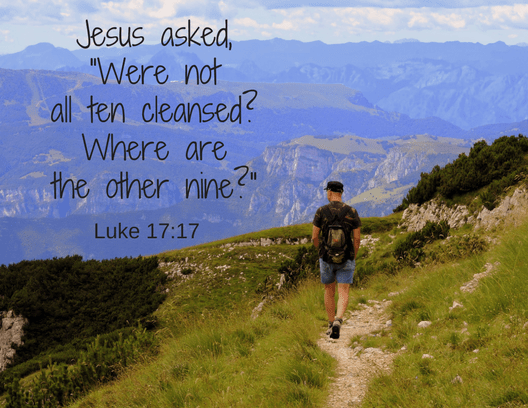
In today’s reading, Luke 17, Jesus amid traveling from Galilee to Samaria is met by a lot of lepers.  They each want the same thing: to be healed.  Jesus obliges, and without much reference to how he did it, he simply states in verse 14, “Go and show yourself to the priest,” meaning they would now be known as the men who formerly had leprosy.  They were cleansed, restored, no more peril or pain. They could now enter the city gate, walk the street, and be with all those they had left behind.  In their excitement, nine men rush to show everyone how they had been healed.  A single soul stops; he turns to praise God and give thanks to Jesus for this wonderful blessing beyond measure.  Jesus is curious about the other nine, but tells the lone returner he was “healed because of his faith.”

So many times I have read this story and am left wondering, “Why did Jesus say this man was healed ‘because of his faith’? Were they not all healed?” The more I read over this passage, place it preceding Jesus’ next topic, the Kingdom of God, it begins to resonate what Jesus may be alluding to.  While this thankful leper was cured in the very same way as the other nine, he alone received the lasting healing and life that comes through the acknowledgement of Jesus Christ.  This thankful man’s healing was not physical transformation but an allegoric alignment of his spiritual salvation.

So where does this leave us?  Often, we are the nine.  We joyously jog back to the place we came – complacency or repetitive sin — because we know we are restored, we can enter the city gate, we can walk the streets, and we can be with those we have loved because Jesus has already paid the price for us to do so.  We may thank him because we are well-rehearsed to do so in prayer.  We may thank him because we fear what might happen if we don’t.  We may thank him because that is what everyone else is doing; however, the minute everyone else turns and runs, we are there following them instead of running to our Lord and Savior.  Take a moment to stop. STOP!  Turn around.  Run to Jesus (repent).  Praise God (for your blessing)!  Tell him what he has given to you, what He means to you, and how that is changing your life, not because that is something you do, but because that is something YOU do!  When we offer thanks to him in this way, we will know the eternal healing that comes through a thankful faith.

-Aaron Winner

The Master and Manager

Luke 16

Luke 16 13

God and money?  Can a Christian have both? No. Yes. No? Yes? Hmm.

I am to sell all my worldly possession (Luke 18:22), but I am responsible for making sure the physical needs of widows and orphans are met (James 1:27).  It is easier for a camel to go through the eye of a needle enter the Kingdom of God (Matt 19:24), but God richly blesses men with wealth who follow him (Prov. 10:22).  I am to store up my treasure in heaven (Matt 6:19), but I am told the wise man saves his riches for a rainy day (1 Cor. 16:12. Prov. 21:20).  On the surface of this topic, it would seem we have contradiction, but thankfully today’s reading might help us come to a clearer conclusion when we consider two powerful, but unequal masters: God and money.

In Luke 16 we are presented with a peculiar parable that shows the strength of the almighty dollar.  As the story opens, we are introduced to a dishonest manager who is in charge of accounting (a running theme) of debts for his master. He learns that his master soon will dismiss him, so as each debtor approaches the manager with their contracted commitment, he forgives a portion of their debt.  Being shrewd, he knows he will be the receiver of their thanks, although it was neither his debt to forgive nor his portion to take.  Jesus makes no misgiving that he was speaking specific directly to the Pharisees, who were fundamentally dealing in the same way.  These “managers” of God put literal prices on forgiveness and offerings, ensuring their comfort, but cheating God of glory, praise, adoration, honor, or extending grace himself.  They, like the shrewd manager, traded their merciful Master for passing provision.

In Dale Carnegie’s famous work, How to Win Friends and Influence People, he states “It isn’t what you have or who you are or where you are or what you are doing that makes you happy or unhappy. It is what you think about it.” This is a challenging thought that calls us to contentment, but also in context of this specific parable, helps us increase our focus.  Are you the master or the manager of your wealth? time? health? will? Are they yours to divide, take, or utilize as you please? Who receives honor, praise, and recognition when you offer these things freely to others?  Sometimes we are as shrewd as the Pharisees, thinking a possession, a place, or a position is the source of a joyful life.  They make us feel momentarily like the master, but really, they take us away from our true purpose.

Jesus concludes this parable by saying if we cannot be trusted with the small things, why would God ever give us the BIG things. If we cannot rely upon him for our own daily bread why would he ever ensure we are the steward for the needs of others?  If we are faithful to Him, we are entrusted with more of His bidding, not in direct correlation, but determined by the master (See: “Parable of the Talents”).  Yes, this can include money.  Yes, this can include more time on earth.  BUT GLORY, HALLELUJAH, YES, he is talking about the KINGDOM.

So, can you have God and money? Yes. Can you serve two masters? No.  Will God give you more if you are faithful? Yes.  Is it money? Not necessarily, but IT IS the Master’s wealth beyond measure for His faithful managers.

-Aaron Winner

The Parable of the Lost Ring

Luke 15

Luke 15_10

It was the beginning of a Louisiana winter when I lost my wedding ring just a couple years into my marriage.  It was a beautiful white gold ring with an inscription of our anniversary on the inside of the band.  It was a perfect reminder of my covenant in every way; however, its faults were it was a little loose when my hands were cold, and of course, it had me for an owner.  My friends and I were readying to play a football game on a Sunday afternoon and I was warming up by tossing the ball with a friend.  In a bit of foreshadowing for the events of the day, my ring slipped off as I caught the ball.  I picked it up off the ground, remarked how cold it was that afternoon, thought about placing my ring inside my pocket but thought it might fall out if it was there.  I put the ring back on my finger, only to lose it at some point in the next couple of hours of our pick-up game.

As we finished playing, my heart immediately sank when I realized it was gone.  I felt a cold sweat build on my forehead, my gut churned, and I held back tears, disappointed that I had lost something so precious.  My friends helped me look for almost an hour without success.  In the muddy, mushy, marshy Louisiana ground, I could see the imprints of our shoes and feet, I could see heaps of crawdad holes, but none of us saw the silvery reflection of my ring buried within the mire and muck.

In Luke Chapter 15, Jesus tells a series of three parables with a similar subject of a possession that has gone missing. In “The Parable of the Lost Sheep”, the master realizes that one of his flock is missing, and leaves behind 99 others to search for the lost one.  In the “Parable of the Lost Coin”, a woman takes account (to tie to our theme from yesterday) to realize she has misplaced a day’s earnings and does the equivalent of turning up couch cushion, investigating under the bed, and sweeping every nook and cranny to uncover it.  In “The Parable of the Lost Son” a father turns his son loose with an inheritance, but is actively looking for his return.  In addition to the same topic, each story ends in a similar resolution: what has been lost has become found and there is great rejoicing.

For me, there are two great takeaways as I ponder the collective meaning of these parables.  The first: to be lost, you have already belonged.  It is true that we each must find the Master in order to be saved, but He is the one who never stops searching.  Our Lord desires that not even a single sheep goes astray and is left without the safety of the shepherd (2 Peter 3:9).  Additionally, my thoughts turn to the Book of Life.  In Revelation 3, we are presented an image that our names are not written into the Book at the transition from “lost” to “saved”, but have already received a place there and are blotted out at the end of a life that is not found in Christ.  We are always His, but like the lost son, we make the decision to be found.

The second takeaway is the wonderful rejoicing that occurs when we turn our lives over and are indeed found.  There is a literal fiesta in the firmament to celebrate our Savior’s joy that we are alive again. No longer do we share the fleeting moments of a mortal life with our Father, but have the hope of an eternity of His presence, living with Him in His kingdom, our intended inheritance instead of passing pleasures. We, too, should echo the heavens and revel in each return.

Unfortunately, the resolution to my own parable of the ring isn’t as joyous as our Jesus’.  I searched for the ring for weeks, beseeched friends I know with metal detectors, offered rewards, but none of these measures ensured the retrieval of my wedding band.  I resigned my search, and my ring is forever lost in the loose Louisiana earth.  Maybe, as I like to imagine, it is the crowning jewel at the bottom at some crawdad family’s hole. With this being said, I can’t help but be thankful that my God has called me his treasure and that he never stops searching for me.  He finds me in my wandering, revealing and moving His will and His way through His words, waiting for my silhouette to again darken the horizon when I have gone astray – a Father who never fails finding those who desire to be found in Him.

-Aaron Winner