What spiritual food are you eating?

OLD TESTAMENT: Isaiah 13-15

POETRY: Psalm 106

NEW TESTAMENT: Hebrews 5

Growing up, I was one of the youngest out of both my family and all my cousins. I changed my first diaper when I was in college when my oldest niece was born. To say I was inexperienced around kids is probably an understatement. Because of this, parenthood has also meant lots of research about what it to actually do. Sleep routines, bathtimes, mealtimes, and independent play. There’s a lot that you need to learn even if it seems like it would be common sense. 

As you read through the Bible, it can be easy to gloss over passages that reference parenthood when you are a teen and young adult. It’s not until you are a parenthood constantly trying to keep your two-year-old out of harm’s way that the significance of the passage “an infant will put its hand in a cobra’s den” really makes sense (Is. 11:8).

Today, we read a passage that also really only starts to show its true significance when you’ve been around children during their baby years. Every child is born helpless, needing constant love, care, and literal physical support. When they are born, they can only eat milk. In fact, if you tried to give your newborn an apple or even a banana they may very well choke. Their baby tummies may not be able to digest it, and they may end up having poor nutrition because they get more calories without the rich nutrients delivered by milk. 

You only start feeding solids after several months of development so that babies can grow bit by bit into the food that they eat. There’s lots of different (and conflicting) advice about the methods and timing for introducing solids, but to keep it simple if you’ve never been around young kids going through this transition, the move from milk to solids is momentous and requires thought and care. Some parents I’ve talked to have even put it off into the child’s seventh or eighth month because of the lifestyle change it requires. However, it is a very necessary step towards a mature adult. 

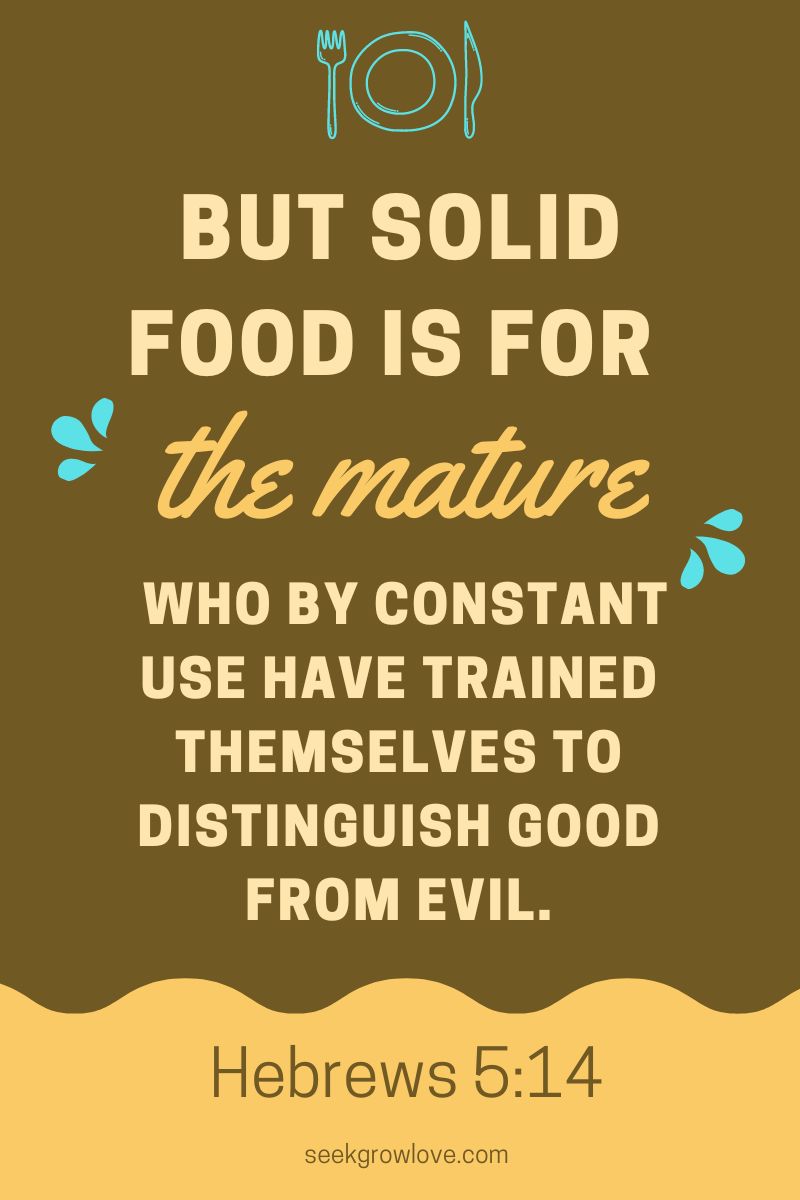
Today, we read in Hebrews 5:11-14, “We have much to say about this, but it is hard to make it clear to you because you no longer try to understand. In fact, though by this time you ought to be teachers, you need someone to teach you the elementary truths of God’s word all over again. You need milk, not solid food! Anyone who lives on milk, being still an infant, is not acquainted with the teaching about righteousness. But solid food is for the mature, who by constant use have trained themselves to distinguish good from evil.” 

In our Christian walk, we want to strive for holiness and righteousness. We want to be mature in our faith. In James 1:4, we read that we want to be ‘mature and complete’ in our faith, not lacking anything. 

The writer of Hebrews was pretty critical of the letter’s recipients. Instead of calling them mature, they were called newborns in the faith who lived on milk, not solid food. What is the milk of the faith? 

The beginning of Hebrews 6 tells us: “Therefore let us move beyond the elementary teachings about Christ and be taken forward to maturity, not laying again the foundation of repentance from acts that lead to death, and of faith in God, instruction about cleansing rites, the laying on of hands, the resurrection of the dead, and eternal judgment. And God permitting, we will do so.”

When we read the judgments in the books of prophecy of the Old Testament, we can often feel a little overwhelmed. But, we want to grow and become mature in faith. This only happens if we are consistent and diligent in our study of God’s word and live out the things that we read. We have to move beyond the basics and move towards solid food. This means dealing with difficult passages, theological concepts, and ethical questions. 

This solid food will help us to become wise. It will help us to have discernment as we deal with an increasingly difficult, complex, and uncertain cultural moment. It will help us to be able to distinguish good from evil and choose the right paths for our lives. 

-Cayce Fletcher

Cayce Fletcher is a teacher-turned-SAHM mom of two. She blogs and podcasts at A More Beautiful Life Collective where she focuses on how you can create a life you love and cultivate your heart for God. Currently, she is working through a systematic theology series on her podcast. You can find her latest post on Bibliology here

REFLECTION QUESTIONS

  1. Read through the list of teachings that is the milk of the Christian faith. Does this list surprise you? Would you add anything to this list? 
  2. Do you think you are currently needing spiritual milk or solid food? 
  3. What steps can you take to grow and mature in your faith? 

Feasting on a Dish of Hope

OLD TESTAMENT: Isaiah 10-12

POETRY: Psalm 106

NEW TESTAMENT: Hebrews 4

A skill that I picked up from my teaching days was the complement sandwich. Whenever you needed to email a parent or correct a student, you nestled your criticism between two things that were good. It was a way of taking ‘a spoonful of sugar to help the medicine go down.’ There have been studies that it takes 5 positive interactions to overcome 1 negative interaction. From marriage to parenting to work relationships, we have to fight to notice the good so that we don’t become too negative with our words. 

Interestingly, as I read through the first few chapters of Isaiah, I noticed that God does the same thing with his prophecies. The people of Israel and Judah were told in no uncertain terms that they needed to repent and turn back to God, or they would face destruction. As we’ve read, this is a pretty bleak picture. 

Isaiah 10:16-18 says, “The Light of Israel will become a fire, their Holy One a flame; in a single day it will burn and consume his thorns and his briers. The splendor of his forests and fertile fields, it will completely destroyed, as when a sick person wastes away. And the remaining trees of his forests will be so few that a child could write them down.”

When we read this, it’s easy to think of God just as the vengeful and wrathful God that sometimes culture depicts him as. And, it’s true that God is a just God; this destruction happened in the past and will happen again in the last days. 

But, to just describe God in this way misses the full picture of who he is. With all of our readings this week, we haven’t been left with destruction. In the midst of these prophecies, there is always hope. God may not give his criticisms in a compliment sandwich, but he does serve up a solid dish of hope. 

Right after God describes the destruction coming in Isaiah 10:18, he then describes how a remnant will be left that will be led by the shoot from the stump of Jesse (Is. 11). We then have this beautiful picture of what the coming kingdom looks like. 

Some of the descriptions of the kingdom that we get: 

  • A king who is righteous, faithful, and good
  • Characterized by peace and nonviolence, not just between the nations but also between predator and prey
  • An Earth that is full of the knowledge of the Lord 
  • Nations that have left between jealousy and strife and are full of brotherly love towards each other 

As we read through Isaiah, we should feel convicted to look deeply at our lives and be sure that we are living them righteously. But, we should also be reminded of the ever-lasting faithfulness and love of our Father. Yes, God is a holy, just God, but he also is a loving God who has good things in store for us. 

With each picture of hope, we are moved to praise just like Isaiah. We say along with him, “Surely God is my salvation; I will trust and not be afraid. The Lord, the Lord himself, is my strength and my defense; he has become my salvation. With joy you will draw water from the wells of salvation” (Is. 12:2-3).

-Cayce Fletcher

Cayce Fletcher is a teacher-turned-SAHM mom of two. She blogs and podcasts at A More Beautiful Life Collective where she focuses on how you can create a life you love and cultivate your heart for God. Currently, she is working through a systematic theology series on her podcast. You can find her latest post on Bibliology here

REFLECTION QUESTIONS

  1. A common theme throughout Isaiah is the tendency of the people to oppress the poor, widow, and fatherless. James 1:27 says that pure religion is to take care of these people. Describe God’s heart for those who are oppressed. How are you serving them in your life? 
  2. Do you view God as a wrathful judge or a loving Father (or a little of both)? How do you think the world views God? What is the correct view of God? 
  3. How do the prophecies of the kingdom that we read in Isaiah move you to praise? 

Walk Worthy

OLD TESTAMENT: Isaiah 6-7

POETRY: Psalm 106

NEW TESTAMENT: Hebrews 2

Have you ever been the bearer of bad news? Or had to confront someone for a wrong that they did – either to you or to someone else? 

It never feels good to deal with confrontation, though some of us handle it better than others. Your hands may get clammy, your stomach may be tied up in knots, and your heart may be racing. The worst is when you’ve said what you’ve wanted to say, but instead of the other person accepting it, they try to respond with a retort or an argument telling you why you’re wrong. 

At that point, what do you do? Turn your tail and run? Forget about it? Give up on the conversation? 

Isaiah had his fair share of confrontations over the years he spent prophesying to Judah. Already we’ve read some pretty harsh words that he had for the people. Today, we got a glimpse of the Lord’s calling of Isaiah. 

Some people you should know: 

  • Isaiah: Prophet to Judah for 40 years, who may have also been a priest. 
  • King Uzziah (also called Azariah): A good king of Judah who was prideful in his final years. After attempting to offer incense in the temple, he got leprosy and died in disgrace.
  • King Jotham: The son of Uzziah. Another good king who led battles and won with the help of God. However, during his reign, the people acted corruptly. 
  • King Ahaz: The son of Jotham. A wicked king of Judah. He destroyed the temple bit by bit and acted sacrilegiously. 

After King Uzziah died, Isaiah saw a vision of the Lord while he was working in the temple. God calls him to go and tell the people this message in Isaiah 6:9-10: “‘Be ever hearing, but never understanding; be ever seeing, but never perceiving.’ 10 Make the heart of this people calloused; make their ears dull and close their eyes. Otherwise, they might see with their eyes, hear with their ears, understand with their hearts, and turn and be healed.”

Talk about a message of confrontation! Isaiah has the response that most of us would have: “But, how long do I need to keep saying this?” To which, God responds, ‘Until destruction is brought upon Judah.’

Isaiah had a hard mission. Not only did he have to communicate a difficult message, but he was also often called to a difficult lifestyle (at one point he had to walk around naked and barefoot as a sign to the people). He had to bear the weight of the message of destruction that he was called to. Still, Isaiah walked ready and willing to the calling that he had received. 

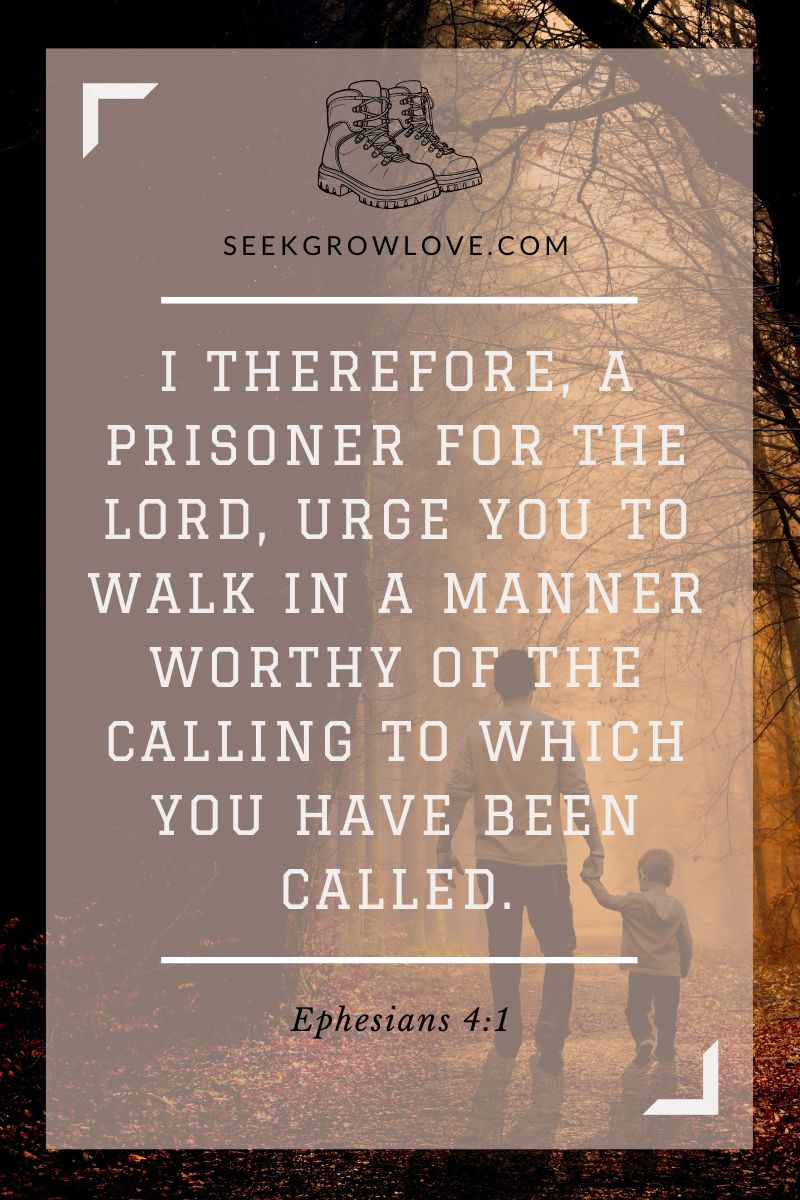
We also have been commanded to live on mission. Ephesians 4:1 says, “​​I therefore, a prisoner for the Lord, urge you to walk in a manner worthy of the calling to which you have been called.” Our calling may not have not been through visions of grandeur like Isaiah, but we have been called to Christ for a purpose. 

Sometimes, living on mission will require us to get a little uncomfortable. We may have to live differently than those around us. We may have to speak about the truth that we have received. We may also have to fight against temptations and stumbling blocks that appear in our paths. 

Our goal should be to walk worthy. What does a worthy life look like? It is a life that is committed. A life that is holy and set apart. A life that is bold and confident. A life that recognizes the great gift we have been given. 

The next time you face some confrontation because of your faith just remember, God is with you. We can stand firm in the calling that we have received. 

-Cayce Fletcher

Cayce Fletcher is a teacher-turned-SAHM mom of two. She blogs and podcasts at A More Beautiful Life Collective where she focuses on how you can create a life you love and cultivate your heart for God. Currently, she is working through a systematic theology series on her podcast. You can find her latest post on Bibliology here

REFLECTION QUESTIONS

  1. How is God described in Isaiah 6? This is one of the most descriptive pictures of him sitting on his throne. How does this picture change the way you view God? 
  2. How would you describe your calling? What is your purpose or mission? 
  3. How would you describe ‘walking in a manner worthy of the calling you received?’ Do you walk worthy now? What might you need to change about your life to make it more worthy? 

What should we do in this backward world? 

OLD TESTAMENT: Isaiah 3-5

POETRY: Psalm 106

NEW TESTAMENT: Hebrews 1

How many of you feel like we are living in a backward world today? What we think should be happening doesn’t happen. We see injustices abound. Regardless of your political party or worldview, there is something clearly not right about our current world, something broken. 

Think in your mind of one instance that shows this backwardness, this brokenness. It may have to do with the upcoming presidential election, health scares, social problems, or wars and rumors of wars. But, the thing in your mind is indicative to you that the world isn’t as it should be. And, it’s a reason why we wait for the kingdom when everything that is wrong will be made right. 

Isaiah is doing something similar in this section of his prophecy. Isaiah 3 details several instances where someone who should be paying honor to someone more deserving instead is receiving honor. This happens in three different ways: 

  • Isaiah 3:4-5 – “I will make mere youths their officials; children will rule over them. The young will rise up against the old”
  • Isaiah 3:6 – “The nobody against the honored.”
  • Isaiah 3:12 – “ Women rule over them.”

Now, before these verses start to offend anyone, let’s just think about what they are saying (and be sure to read the full chapter for context). In this time of destruction, there is a genuine lack of leadership. It gets so bad that anyone with a cloak is being grabbed and made the leader of the people (an honor to which that cloak-wearing brother says ‘No thanks’). 

As the people bicker and fight with one another and inept leaders try to make something out of the ‘heap of ruins,’ God sits on his throne. The true sovereign leader of the people still reigns, and the destruction is coming because he is issuing judgments from his throne.  

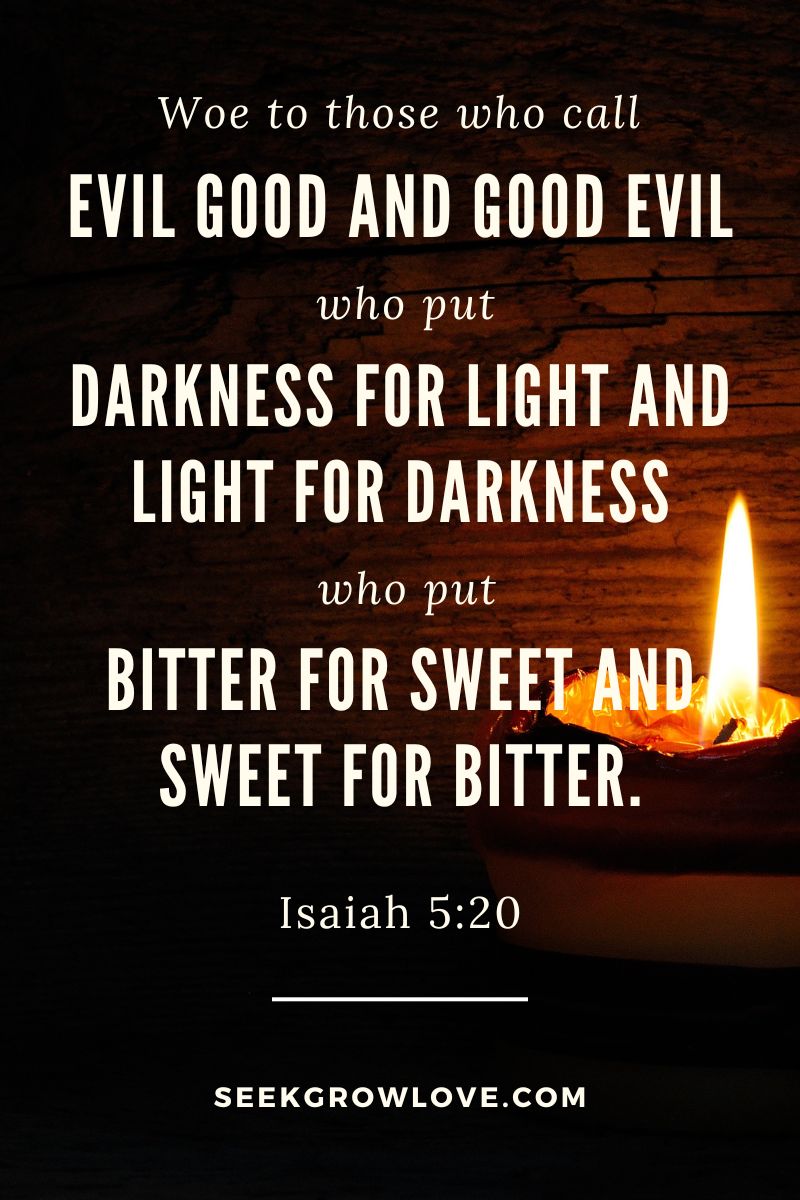
He says in Isaiah 5:20, “Woe to those who call evil good and good evil, who put darkness for light and light for darkness, who put bitter for sweet and sweet for bitter.”

God makes proclamations against the people who oppress his people, those who harm the poor, and the proud. After his judgments are passed, he gives a hopeful picture of the ‘branch that will be beautiful and glorious’ that will be left for those who are still faithful to him. The sins are washed away and fortunes are restored. Israel is brought back to life. 

We often look to our earthly leaders to make this current world right. We know that there is brokenness in the world, so we are quick to grab anyone who seems like a remotely good fit for a leader and put them in power. Meanwhile, there are plenty of power-hungry leaders around, who pass laws and oppress people. Who perpetuates injustice. People who should not be in charge and yet they are. 

What should we do in this backward world? 

Well, we can rest in the truth that the true leader of the world is not one that we elect or put in charge. The true leader of the world is God. He is reigning now, and he will also put everything that is wrong to right in the future age when the kingdom is brought to Earth. 

So the next time you feel afraid or lost, you can trust in God. He is the one who is really in charge, and he is the perfect leader.

-Cayce Fletcher

Cayce Fletcher is a teacher-turned-SAHM mom of two. She blogs and podcasts at A More Beautiful Life Collective where she focuses on how you can create a life you love and cultivate your heart for God. Currently, she is working through a systematic theology series on her podcast. You can find her latest post on Bibliology here

REFLECTION QUESTIONS

  1. What is the significance of the child being the leader? Do you think the child is the leader of our current society? 
  2. What is the danger of being haughty or prideful? Why would this be something God would punish? 
  3. Reread Isaiah 5:20. How have you seen people call evil good and good evil? How can you guard against doing this yourself?

Remembering Your Testimony

OLD TESTAMENT: Isaiah 1-2

POETRY: Psalm 106

NEW TESTAMENT: Philemon 1

I absolutely love to read. When I get a night alone – which doesn’t happen often with two littles running around, my favorite way to spend it is reading snuggled up on my couch under a blanket with a nice cup of coffee by my side. As an English major, I had to read pretty voraciously in college and that habit didn’t stop when I graduated. 

Though I love a good mystery novel and there is no better book for the beach than a sappy chick-lit romance, I also love to learn about the history of things. Currently, I’m on a Classical Education kick. I’m reading everything that I can get my hands on about what classical education is. Before that, I read about the history of the doctrine of the Trinity, homesteading, and Irish history. It’s really just whatever hits my fancy at the moment (which is probably why I have a pile of unfinished books towering by my bedside). 

As I read about all of these topics, the authors do similar things. Before they ever jump to any conclusions, they always begin with the history of a topic. Starting wherever it makes sense, they detail step-by-step why something is the way it is based on how it was formed over the slow marching of years. 

As a writer myself, I can sense why someone feels the need to do this. You don’t really understand something unless you know and understand its past. 

Reading through Psalm 106, we get a clear picture of Israel’s story. It begins with how Israel was rescued out of Egypt and brought through the wilderness. They faced their fair share of trials, but still, some Israelites remained faithful and made the right decisions. 

After entering Canaan, the Israelites ‘mingled with the nations and adopted their customs’ (Ps. 106:35). God had commanded them to be a set-apart people, but they refused to follow his instructions. The ending of Psalm 106 describes how the Israelites were exiled to the nations (whether during David’s wandering as he fled from Saul as some commentators think or during the Babylonian captivity). The author pleads with God to save them. 

Knowing Israel’s history helps us to make sense of the context of Isaiah 1-2. God had shown his everlasting faithfulness to Israel, making them into a mighty nation. Still, the people chose something else. They always followed after idols and rejected God in the process.

Isaiah 1 describes this bleak picture: “7 Your country is desolate, your cities burned with fire; your fields are being stripped by foreigners right before you, laid waste as when overthrown by strangers. 8 Daughter Zion is left like a shelter in a vineyard, like a hut in a cucumber field, like a city under siege. 9 Unless the Lord Almighty had left us some survivors, we would have become like Sodom, we would have been like Gomorrah.”

The Israelites always had a choice about how they were going to live. They could follow God, or they could follow their sinful hearts. When they rejected God, they ended up destroying their lives. 

We have the same choice today. We can choose to follow God or choose to follow the world. I believe the best way to remind ourselves that following God is the best option is to look at God’s past episodes of faithfulness in our lives. We tell the story of his ‘mighty acts’ (Ps. 106:1), and in doing so, we remind ourselves why God is just so good. 

What has God done in your past that helps inspire you to faithfulness to him today? Write your own Psalm of praise, and recommit to your love, praise, and loyalty to God today.  

-Cayce Fletcher

Cayce Fletcher is a teacher-turned-SAHM mom of two. She blogs and podcasts at A More Beautiful Life Collective where she focuses on how you can create a life you love and cultivate your heart for God. Currently, she is working through a systematic theology series on her podcast. You can find her latest post on Bibliology here

REFLECTION QUESTIONS

  1. Read through Psalm 106 today and count the different historical stories referenced throughout the psalm. If you have the time, find the reference for each of the stories, and write those references down beside the Psalm in your Bible. 
  2. Take some time today to answer the last question in this post. What is your testimony of God’s faithfulness in your life? Writing it down can clarify it in your mind.
  3. Isaiah 1:16-17 are popular verses for good reason. The people of Judah had begun to go through the motions of sacrifices and traditions, but their hearts were far from God. Read through these verses, and journal about how you can learn to ‘stop doing wrong and learn to do’ the right that God loves. 

The Hope of the Passover Fulfilled

OLD TESTAMENT: EXODUS 11-12

POETRY: PSALM 23

NEW TESTAMENT: MATTHEW 21:28-32

One of my favorite movies growing up was Dreamwork’s The Prince of Egypt. I loved the music and the story, though it was slightly embellished for dramatic effect. In the movie, Moses and Rameses are the best of friends in addition to being brothers. As plagues ravage Egypt, Moses and Rameses face off against each other, asking each other “Is this what you wanted?” The Bible never talks about Moses and Rameses being close or caring for one another. But, I do think the movie captures what happened to Egypt. 

Egypt destroyed by the plagues in Dreamwork’s Prince of Egypt

As the Israelites gathered up their belongings after the Passover, they walked through a city in complete ruins, statues falling over and temples broken. God had triumphed over Pharoah and the Egyptian gods, and now the Israelites were on their way to freedom. 

The Passover lamb (another sheep reference) is a preview of both the law and the sacrifices that would be required for our sins and the ultimate fulfillment of the law in the sacrifice of Jesus on the cross. Our Matthew readings for the week show Jesus as he grows nearer to the time of the cross. In fact, Jesus enters Jerusalem in Matthew 20 to celebrate the Passover. 

In Matthew 26:17-30, Jesus celebrates the Passover with his celebrates. He breaks bread with them and then tells them that he will not have the Passover banquet again until the kingdom of heaven (Luke 22:14-18). The wedding banquet of the lamb is the hope that we have in the Kingdom (Revelation 19, Matthew 22) – that are sins are passed over forever, as we are raised up incorruptible in a new heavens and a new earth (1 Cor. 15:52). The Passover was a sign of salvation to the Israelites, a testament that they were to observe for generations to come. We can read about the Passover today and be reminded of what is to come in the kingdom. 

We should want to shout in jubilee, believing in the miracle of God rescuing us from the bondage of sin and shame. 

Matthew 21:28-32 leaves us with a caution. As we look forward to this coming kingdom, we want to be the ones who are faithful to the end. The parable draws a distinction between the brother who said he was going to work and the brother who actually worked. In the grand scheme of things, it doesn’t matter how much you talk about Jesus if you don’t actually follow him. You have to leave your life in bondage to sin and go forward to your new life in Freedom. Your life must change. The new focus of your life should be to work for the good of the kingdom of God. 

Psalm 23 ends in this way, 

“You prepare a table before me

    in the presence of my enemies.

You anoint my head with oil;

    my cup overflows.

Surely your goodness and love will follow me

    all the days of my life,

and I will dwell in the house of the Lord

    Forever.”

We see another table set, another banquet, a foreshadowing of the Passover fulfilled, the marriage feast. David trusts completely in God, even in the midst of his enemies. The final words – the sweet hope of David – is to dwell in the house of the Lord forever. The desire of David’s heart is not those green pastures, those quiet waters. The true desire is to be in the presence of God, and the beautiful thing is that being in the presence of God leads to places of beauty and comfort – maybe in this life but definitely in the kingdom. 

May that be the desire of our hearts: To long for the marriage supper of the Lamb. 

~ Cayce Fletcher

Cayce writes about discipleship, productivity, and homemaking at her blog https://amorebeautifullifecollective. You can find her latest post on creating a theme of the year here. You can also listen to A More Beautiful Life Collective Podcast on Apple Podcasts, Spotify, YouTube, or wherever you listen to podcasts. 

REFLECTION QUESTIONS

  1. How do you think the Israelites felt as they left Egypt? How do you think the Egyptians felt? 
  2. Which brother are you in the parable of the two sons? The worker or the talker? 
  3. What do you hope for most in the coming kingdom? What are you most excited about? 

SGLCalendar2024DOWNLOAD

Who are you following? 

OLD TESTAMENT: EXODUS 9-10

POETRY: PSALM 23

NEW TESTAMENT: MATTHEW 21:1-27

The showdown between Moses, God, and Pharaoh’s hard heart escalated in our reading today. What God said would come to pass did: Pharaoh continued to harden his heart again and again despite the plagues that came upon Egypt. At one point, the officials said, “How long will this man be a snare to us? Let the people go, so that they may worship the Lord their God. Do you not yet realize that Egypt is ruined?” (Exodus 10:7). We see the same cycle repeated. At first, Pharaoh was completely unyielding. But, as harsher and harsher plagues were brought upon the people, Pharaoh began to consider letting the Israelites go. 

Exodus 9:15-17 says, “For by now I could have stretched out my hand and struck you and your people with a plague that would have wiped you off the earth. But I have raised you up for this very purpose, that I might show you my power and that my name might be proclaimed in all the earth. You still set yourself against my people and will not let them go.”

Hail rained down and wiped out everything in the fields. Pharaoh finally said, “This time I have sinned. The Lord is right and my people are wrong” (v. 27). It would seem like the plagues could finally stop right? Pharaoh finally humbled himself and was willing to let the people go. After the plague stopped, Pharaoh changed his tune. His heart was hardened, and he refused to let the people go. 

He followed this same cycle of refusing, repenting, hardening his heart, and refusing again with the plague of locusts and darkness. Reading through this story, you might wonder why Pharaoh didn’t see that by hardening his heart, he didn’t gain anything. In fact, he led his nation into ruin with his pride. If he had just let the people go, he would have saved everyone from a lot of pain and suffering. 

It’s interesting to consider that the pharaoh was considered a god by the Egyptian people. Pharaoh is so rash, foolish, and fickle, compared to the God of the Israelites. Pharaoh kept deciding to do something and changed his mind once his feelings changed. Would that be a god you want to follow? 

In Psalm 23, we read about how God, as our shepherd, leads us on right paths. Lysa TerKeurst describes this scene: 

“We might imagine lush green hills like you’d find in Ireland, but David’s reality was the steep, rocky, dry Judean hills. Hills that had to be carefully traveled in order to get to the water and vegetation waiting in the valleys below.

Shepherds leading their flocks also had to be cautious about the timing of their trips. Hard rains could quickly lead to flash floods in a gorge. When a shepherd knew a storm was coming, he wouldn’t allow the sheep to be down in the gorge because they’d drown; instead, he’d wait patiently until the storm passed to lead his flock down to drink. So not only did sheep have to trust where the shepherd was leading them; they had to trust the when of his leading.

The Hebrew word for “paths” in Psalm 23:3 referred to well-worn or deep ruts that were actually good ruts, important because they marked the safest paths. While these paths could be formed by one shepherd over time, it’s more likely they were formed by other shepherds who’d gone before — generations of shepherds wisely walking the same paths. Even today, you can literally look at the hills in Israel and see paths the shepherds have been walking for generations.”

Valley of the Shadow of Death

The showdown in Exodus draws a distinction in leadership, sovereignty, and control between God and the Egyptian gods. The God who proved to be the true God – the one who was the most powerful and in control – was the Israelites’ God. 

The world’s leadership mimics that of Pharaoh’s. Culture is fickle and promotes rash, foolish behavior. If you follow the world’s leading, you will end up being led to destruction. When we follow God, we are walking in the sure and right paths. The paths that don’t lead to danger, but instead lead to life.

Who are you following today? 

~ Cayce Fletcher

Cayce writes about discipleship, productivity, and homemaking at her blog https://amorebeautifullifecollective. You can find her latest post on how to seek the kingdom of God everyday here. You can also listen to A More Beautiful Life Collective Podcast on Apple Podcasts, Spotify, YouTube, or wherever you listen to podcasts. 

REFLECTION QUESTIONS

  1. Describe the differences between Pharaoh and Moses. And, between the Egyptian gods and Yahweh.  
  2. How does it change your understanding of Psalm 23 when you consider the actual terrain of Judah? How does picturing the rocky, steep hillside help you to recognize your need for a shepherd? 
  3. What is the difference between the leadership of God and the leadership of the world? Where does following the leadership of God end? Where does following the leadership of the world end? 

SGLCalendar2024DOWNLOAD

For His Name’s Sake

OLD TESTAMENT: EXODUS 7-8

POETRY: PSALM 23

NEW TESTAMENT: MATTHEW 20:17-34

Yesterday, we focused on trusting in the faithfulness of God despite the challenges, troubles, and obstacles we face. Moses struggled with that trust and confidence that God would be faithful as he saw the increased oppression of the Israelite people. He asked the question, “Why?” Underlying this why was the sentiment: ‘Why – if you could free your people from this oppression – why wouldn’t you, God?’ 

We often ask God the same question. ‘Why – if you could intervene and alleviate the suffering of the world – why wouldn’t you, God?’ The answer to this question that we read in Exodus may ruffle the feathers of our modern sensibilities, but it does not make it any less true. 

We see a pattern through the story of the Israelites that God foretold what the story of the Israelites would be, including even the suffering they would face. Abraham was told about the 400 years the Israelites would spend in Egypt. The suffering of the people as slaves was foretold. And, Moses was told about the hardening of Pharaoh’s heart which would ultimately lead to the Israelites plundering the Egyptians on their way to freedom and the Promised Land. 

This makes us bristle because, in the modern world, our comfort, safety, and happiness are the greatest good. Nothing else is as important as those things. Honor, virtue, courage, and grace are deemed unworthy if they get in the way of our pursuit of these modern ideals. So, when we read that the Israelites would be forced to endure hardship, slavery, death, and injustice, we just can’t believe it. Why would a good God do this? 

God actually tells us why this happened. In Exodus 7:5, God says, “The Egyptians will know that I am the Lord when I stretch out my hand against Egypt and bring the Israelites out of it. The Egyptians will know that I am the Lord when I stretch out my hand against Egypt and bring the Israelites out of it.” God did these things for his name’s sake. The plagues spoke to the glory of God. They demonstrated that ‘God was god, and there is no other’ (Isaiah 45:5). 

The values of comfort, safety, and happiness are not esteemed in the Bible. In fact, the greatest good turns out to be the glory of God, which is exactly what God has brought about with the plagues. His name was made great. 

When we read this emphasis on making God’s name great, we may have some concerns. Some may even say that God is egotistical because he desires for us to glorify him, for us to worship him, and desires to make his name great. 

The basis for greatness and glory can only be found in God. 

When God commands us to worship him foremost in our lives, he is actually establishing boundaries for our worship that will keep us from sin and heartache. When we step outside God’s created order, we fall prey to greed, selfishness, and an endless pursuit of desires and addictions that do not lead to fulfillment or joy. We have a belief in faux modesty in our culture. Though in practice we exalt ourselves daily, we say that don’t. We place that same value of faux modesty on God, and so, we question when God seems to buck against that value. 

John Piper said, “Does my opposition to God’s God-centeredness reveal that my supposed God-centeredness is just a cover for wanting myself at the center, and the use of God to endorse that because he is so centered on me?” 

Who is at the center of your world? Is it God or is it yourself? Is your life’s work to make great the name of God or your own? 

For a more in-depth look at how the plagues depict Yahweh vs. Egyptian gods, read this previous SeekGrowLove post by Sean Finnegan

~ Cayce Fletcher

Cayce writes about discipleship, productivity, and homemaking at her blog https://amorebeautifullifecollective. You can find her latest post on prayer here. You can also listen to A More Beautiful Life Collective Podcast on Apple Podcasts, Spotify, YouTube, or wherever you listen to podcasts. 

REFLECTION QUESTIONS

  1. How did the plagues make God’s name great? 
  2. In Psalm 23, God “guides me along the right paths for his name’s sake” (v. 3). How does guiding us along right paths give glory to God? 
  3. Matthew 20:20-28 tells the story of the mother of Zebedee’s sons coming and asking for Jesus to exalt James and John in the coming kingdom. Jesus responds by stating, “You know that the rulers of the Gentiles lord it over them, and their high officials exercise authority over them. Not so with you. Instead, whoever wants to become great among you must be your servant, and whoever wants to be first must be your slave— just as the Son of Man did not come to be served, but to serve, and to give his life as a ransom for many.” How does becoming a servant bring glory to God and make his name known? 

SGLCalendar2024DOWNLOAD

Choosing to Believe in God’s Faithfulness

OLD TESTAMENT: EXODUS 5-6

POETRY: PSALM 23

NEW TESTAMENT: MATTHEW 20:1-16

Moses overcame the excuses we read about in Exodus 3-4. He traveled to Egypt and met Aaron in the wilderness at the mountain of God. Together, they went and told the people. “The people believed, and when they heard that the LORD had paid attention to them and that he had seen their misery, they knelt low and worshipped” (Exodus 4:31). 

I wonder what Moses thought would happen next. He had spoken to the people, and due to the signs Moses had shown them, they believed that God would deliver his people. Did they think it would happen right away? Did they think that Pharoah would just let them go? What did Moses think? Was he prepared for a resounding no? 

Moses went and told Pharaoh to let God’s people go, but Pharaoh responded, “Who is this God that I should listen to him?” Pharaoh’s response was to make the Israelites labor harder. God had told Moses at the burning bush that “the king of Egypt will not allow to go, even under force from a strong hand” (Exodus 3:19). Even so, it seems like Moses begins to doubt that God will do what he said he will do as he sees Pharaoh make the Israelites’ lives even harder. 

The Israelites begin to complain, saying that it would be better if Moses had never come (Exodus 5:19-21). Moses cries out to God, “Why, Lord, why have you brought trouble on this people? Is this why you sent me? Ever since I went to Pharaoh to speak in your name, he has brought trouble on this people, and you have not rescued your people at all.” (Exodus 5:22-23). Those old insecurities pop up again as Moses repeatedly tells God, “If the Israelites will not listen to me, why would Pharaoh listen to me since I speak with faltering lips?” (Exodus 6:12, 30) 

Moses had the promise of God to fulfill his covenant with Abraham. God said he would deliver the people. But, Moses began to doubt as he looked around at his current circumstances. He tells God, ‘You haven’t even rescued your people at all. You’ve made things worse.” 

We often fall prey to a certain kind of prosperity gospel preaching. We believe that if we work for God and do what he asks, we will see big returns right away. No waiting. No fussing. No pain. No problems. 

This is simply not the way God works. When we act in faith, we know that eventually, we will see a return for what we are working towards. However, that return is not promised to be quick or readily apparent. We work for a lifetime, and with the benefit of time and wisdom, we can look back and see the faithfulness of God. It is a fruit that takes decades not days. A fruit that may not be seen until the Kingdom. 

When Moses didn’t see immediate results, he began to doubt God’s intentions, his power, and his goodness. (Even though he was told that Pharaoh would have a hardened heart!) We have also been told that “in this world, we will have trouble” (John 16:33). How often do we doubt God’s intentions, his power, and his goodness in the face of the trouble of the world? 

We can “take heart” because Jesus has overcome the world!

~ Cayce Fletcher

Cayce writes about discipleship, productivity, and homemaking at her blog https://amorebeautifullifecollective. You can find her latest post on remembering God’s story in our lives here. You can also listen to A More Beautiful Life Collective Podcast on Apple Podcasts, Spotify, YouTube, or wherever you listen to podcasts. 

REFLECTION QUESTIONS

  1. Do you think Moses expected Pharaoh to let the Israelites go right away? Why or why not? 
  2. How do you persevere in your calling in the midst of setbacks and ‘troubles’? What are some practical ways you can stay encouraged to “keep fighting the good fight?”
  3. What is a past example of God’s faithfulness that you can remember when you face troubles in the future? 

SGLCalendar2024DOWNLOAD

Those Dangerous Excuses

OLD TESTAMENT: EXODUS 3-4

POETRY: PSALM 23

NEW TESTAMENT: MATTHEW 19

My son is fully in his threenager stage of life. Our days go something like this: 

“Jonah, go wash your hands. It’s time for dinner.” 

To which he responds, “Mama, I’ve already told you three [pronounced like tree] times. I’ve already washed my hands, and I’ll eat when I’m done playin’.” 

You can imagine my response to this. Let’s just say I have plenty of opportunities for correction and discipline throughout the day. 

Many times, I can recognize my own voice in what he says. What I say, he repeats in his cute toddler-growing-up way. In the conversation I mentioned before, his main goal was to keep playing, so he was just saying whatever he thought would lead to that outcome. He has a tendency to want to keep doing whatever he is currently doing. So if he’s playing, he wants to keep playing. If he’s at church, he wants to stay at church. If he’s at home, he wants to stay at home. This means starting the next activity involves a lot of excuses as to why he can’t quit what he’s doing and move on to the next thing, even if there are good things in store for him when he does. 

In today’s passages, we read about several excuses given as to why someone couldn’t follow through with what they were asked to do. In each case, the excuses were made because the person didn’t want to leave their comfort zone and change their life. 

In Exodus 3-4, Moses was leaving his flock to go find the lost sheep. On the way, he saw a burning bush. The LORD spoke to him there, calling him to go shepherd the Israelite people as they left Egypt and traveled to the Promised Land of Canaan. Moses gives a series of three excuses. He first asked what he should do if the Egyptians didn’t listen to him – probably thinking that it was a lost cause to go and try to ask the Egyptians to give up their unpaid labor. Then, he says that he is not a good speaker, calling himself “slow of speech and tongue.” Finally, he just comes right out and says, “Lord, please send someone else.” 

To each of these excuses, God responds with a resounding, “Go, I will be with you!” God doesn’t point to what Moses was capable of. Instead, he draws Moses’ attention to what he – God – can do through Moses. For the first excuse, God shows how Moses will be able to do wonders through God’s power. In the case of the second excuse, God points to how he is the creator. He will teach Moses what to say. In the last pleading excuse, God gives a helper to Moses in Aaron to be a mouthpiece for him. 

To each of Moses’ excuses, God gives a clear path forward, showing how he in his might and power will make what he has said come to pass. 

Our passage in Matthew 19 repeats this theme of excuses. The rich young ruler had attempted to live righteously, following the law. Jesus told him that he lacked one thing: He needed to sell his wealth and give to the poor. The rich young ruler went away sad, probably full of excuses. He didn’t want his life to change. 

We have been called ourselves. When we hear the gospel, we must change. When we hear God’s leading in our life, we must act. But, all too often, we are filled with excuses. We don’t want to leave our comfort zone, and we think of a million reasons why this is the case. 

Today, don’t focus on why you think you cannot accomplish something for God, or why you think you cannot move forward in faith. Instead, focus on what God has done and will do for you. Trust that he will lead you to “green pastures” and “quiet waters.”

~ Cayce Fletcher

Cayce writes about discipleship, productivity, and homemaking at her blog https://amorebeautifullifecollective. You can find her latest post on biblical ideas creating an ideal schedule here. You can also listen to A More Beautiful Life Collective Podcast on Apple Podcasts, Spotify, YouTube, or wherever you listen to podcasts. 

REFLECTION QUESTIONS

  1. Moses was asked to go down to Egypt, but he didn’t want to go because he felt inadequate. Have you ever felt inadequate when you have been asked to do something for God? How can you overcome those inadequacies and act in faith? 
  2. What excuses have you given when it comes to following Jesus in faith? 
  3. Psalm 23 focuses on how God, as a good shepherd, leads to good things. What are some good things to which God has led you in your life? 

SGLCalendar2024DOWNLOAD