Leadership

1 Timothy 1-3

Devotion by Jenn Haynes (OH)

There was a time when I didn’t think very much of Paul. It was as a teenager reading his instructions to Timothy here in Chapter 2. I had faith, though, that God was speaking through this man, and SURELY there was something here that I just wasn’t understanding correctly. It wouldn’t be the first or last time that I had to look at a scripture passage and throw up my hands, admitting that I just didn’t have an answer. 

I’ve gone back and forth, looking at explanations and trying to get insight on what exactly was happening at this church. I got the impression that the women there were not behaving the way they should be. Admittedly, some scholars use Chapter 2 as absolute reasoning for why women should not be leaders in the church. Obviously, this doesn’t sit well with me, being a female church leader. Many say that it’s specifically addressing a problem within that church, where women were using wealth, fashion, and beauty to loudly and boldly repeat false teachings that they didn’t fully understand, and it was turning others away. Also, some translations point not to Paul refusing to give women authority over men, but rather specifically not giving them authority over their husbands. I heartily agree here, as that would cause disharmony within a balanced marriage that is seeking to honor Christ. 

Looking into the whole of scripture, we actually do see female leaders throughout the Old and New Testaments. Those female leaders had wisdom, were full of grace and mercy, and were servant leaders as we are all called to be. They strove toward truth and righteousness, and they were held up for those qualities. We see many of those qualities listed here in the first chapters of Timothy, giving us a wonderful outline of what a good leader looks like. 

We are to worship and pray together without anger. We are to focus more on our actions than our appearances. We are to be faithful to our spouses and full of self-control, managing our lives, money, and families in a way that honors God. We are all to be worthy of respect. 

That’s a lot to place on an imperfect human being. We hear about scandals with our leaders all the time. They make for sensational news. But this is not what we want to see in anyone, especially in our church leaders who are to be leading others to Christ. 

Stepping up as a leader in our church means greater accountability. James 3:1 warns us about this: “Not many of you should become teachers, my fellow believers, because you know that we who teach will be judged more strictly.”

How many people have turned away from Christ because of the actions of those in his church? Too many. 

Reflection Questions: 

Are you a sort of leader in your church? Even if you don’t have a named role, are there those who would follow your example? Have you ever thought deeply about what kind of responsibility that is? People are looking to you and your example when you proclaim yourself to be a Christ follower. Are you following his example in your words and actions? 

Go through Paul’s list of qualifications of a good leader. Where do you hold up to the standard, and where could you use improvement? How could you do better to be a good example for others, someone others would respect and want to follow. 

Prayer:

My prayer is that we all take to heart the fact that we are representing Christ when we call ourselves Christians. Pray that God opens your eyes to where you can be a better example to others and that you lead those around you closer to a relationship with him. 

Shepherd the Flock & Be Watchful

OLD TESTAMENT: 2 Chronicles 35 & 36

POETRY: Psalm 115 (all week)

NEW TESTAMENT: 1 Peter 5

What is the best way to lead others in the church? What is the best way to follow church leadership?

At the end of 1 Peter, Peter gives some exhortations to leaders in the church and then to the general assembly. His exhortation to leadership, while brief, is powerfully meaningful:

1 Peter 5:2-3 (ESV)

2 shepherd the flock of God that is among you, exercising oversight, not under compulsion, but willingly, as God would have you; not for shameful gain, but eagerly;

3 not domineering over those in your charge, but being examples to the flock.

Leaders in the church are commanded to shepherd the flock not by abusing authority but by being examples. Peter is repeating what Jesus taught him years before (see Matthew 20:25-28). Jesus served others in love, showing everyone how to live a godly life. He did not collect taxes, lead an army, start a big corporation, or run for President (or Caesar, not that it was a democracy!), but even if he held a prominent worldly position, he would not have led through fear or domination.

How many times has this gone wrong in the history of the Christian church? How often are leaders tempted to lead this way? As a pastor, knowing how common this problem is leads me to greater personal reflection and humility. My job is to serve willingly and eagerly and to be a good example to the people in our congregation. That sounds simple and straightforward, but the other way is tempting. Leaders, we must keep the servant’s towel wrapped around our waist at all times!

Peter goes on to admonish the whole assembly to be humble, to cast anxieties to God, and to be watchful. Each of these dispositions is important. First, humility is a foundational Christian attribute. It’s like the key to the door of growth. Humility says, “I don’t know everything yet. I can still learn more.” Everyone in the church should be humble before God and before the Scriptures. There is always more to learn. There is always more to live.

Second, we are to cast our anxieties to God. This world is full of trouble and brokenness. All of us experience anxiety from time to time. We must remember that God cares about every aspect of our lives. What a crazy thing to believe, but it is true — the Creator of the Universe wants a relationship with you! God cares for you!

Finally, we are to be watchful. There are influences of darkness in the world around us (see: anxieties above). The powers of darkness, led by the adversary/devil, have built systems to damage our faith and lead us into temptation. Just as our Lord Jesus taught, we seek God instead. He will deliver us from evil, and the promise is, that as we resist, the devil will flee (see also James 4:7).

-Will Barlow

Reflection Questions:

  1. (Leaders) How do you stay humble and focused on serving the people around you?
  • (Non-leaders) What can you do if you are concerned about your leaders and how they are behaving?
  • Are there things in your life that need more watchfulness or resisting the powers of darkness? What can you do to strengthen your resolve in those categories?

Attention All Shepherds (and Sheep)

1 Peter 5

Tuesday, October, 11, 2022

Chapter 4 ends with verse 19: Therefore, let those who suffer according to God’s will entrust their souls to a faithful Creator while doing good (ESV).

The suffering in the New Testament is related to living a life set apart from worldliness, which is opposed to God’s will. It is not God’s will that we should suffer, but when we follow in the ways that he has prescribed for us we will undoubtedly face opposition and ultimately suffer for the sake of the Gospel. We need to trust that our creator will ultimately use that suffering for good. There’s a popular song that we sing at my church that has the line “you take what the enemy meant for evil, and you turn it for good” (drawing on Genesis 50 for inspiration).

Chapter 5 then begins with Peter addressing the leaders of the church, specifically calling to mind the sufferings of Christ. Pastors/elders are to function in the role of shepherds for the congregations that have been entrusted to them in leadership. The verb that is translated as “shepherd” also can be translated as “feed” – does this directive remind you of any instructions that Peter himself received from Jesus?

In John 21 three times Jesus asks Peter if he loves him (notice a correlation between Peter’s three denials of Jesus and the three affirmations that Jesus receives from him?) and three times tells him to feed his sheep (this is a different Greek word in John, but it means essentially the same thing). As the primary leader of the church Peter was to feed Jesus’ sheep, meaning Christians. The impetus for this spiritual leadership is not to be out of self-importance or in Peter’s case even that Jesus chose him to lead, but out of love for his master and savior (and friend!). When we see Peter lead, he is following in obedience to the one who called him out of the boat and invested in him and entrusted him to feed his sheep. Peter certainly was not doing this for gain or for an easy life, I imagine his life would have been much easier had he simply decided to go back to fishing full time, but he faced many trials and much opposition in his preaching the word and leading the church.

In the same way, those of us who are called to be pastors and elders (who are specifically addressed here, but anyone who holds an office in the church should take heed of this) should be using their love of Jesus as their motivation for leading. Presumably most church leaders start off this way, but it can easily go to one’s head. There are many public instances of pastors who have become controlling, power hungry, and abusive (quite often we see this in large churches with lucrative opportunities for pastors) – but even in small churches the desire to control can infiltrate the hearts of those who are called to lead or “run” the church. Elders (I’ll include pastors in this title from here on out) are to be willing and eager to carry out the work that they have been called to. With a calling to leadership comes responsibility – a significant thing to note is that we who are in authority (and who teach) are held to a higher level of accountability (James 3:1). Those who are in authority are to be an example to those who they oversee spiritually, and humility is one way in which we should be an example. Jesus stated that he was gentle and humble (Matthew 11:29), and we see in Philippians 2 that humility was essential in Jesus salvific work as God’s anointed one.

As Jesus was humble and as we who are elders (overseers) are to be humble (following Christ’s example), so then are the members of the body to exercise humility and submit to those who are in authority over them. If leaders are humble and operating as Jesus would expect them to, then humble Christians submitting to the godly authority that has been placed over them will thrive in their submission. We’re never going to agree on everything and that is why the decisions of local congregations are to be subject to the elders and not left up to the democratic will of a large collective. Elders absolutely can delegate responsibilities and set up clear roles for the body (Acts 6), but the authority over the church should lie with them.

We just added two new elders at my church yesterday. The process was not a short one… Myself and our other elders had many discussions on who we thought would be a good fit to assume these offices and eventually recommended that these two individuals be confirmed as elders. We don’t accept nominations for elders, but rather we look for men who meet the requirements of elders as listed in Titus 1, and then we have a confirmation vote. Other churches do things differently and may have boards structured in different ways or may be more egalitarian in the way that they define elders, I don’t condemn that, but we need to take seriously the guidelines that are listed in scripture and not be too quick to structure things in a way that is more reflective of the nation/society we live in than how the early church did things. Regardless of our views on church leadership one thing we need to be able to do is disagree with grace and love.

We need to make sure that whatever disagreements we have are dealt with in love and we need to not let them distract from what God would have us do and we need to make sure that we keep our minds clear (5:8, reaffirming 4:7), be on the lookout, and refrain from being anxious (cast those anxieties on God, see also Matthew 6), because the enemy prowls like a lion looking for someone to devour. When we allow conflict to take root or we allow anxiety to be prevalent in our churches, bad things will happen. We may often think about the enemy being on the prowl for individuals, but he’d also love to devour a local church and render it ineffective at making disciples or worse, cause it to die out (is that really worse?). I bet we could all think of examples of things we can (or do) divide over, one such argument could be what Peter means by “our enemy the devil”, but we need to take seriously the words of the author of Hebrews when he/she says: “Strive for peace with everyone, and for the holiness without which no one will see the Lord. See to it that no one fails to obtain the grace of God; that no “root of bitterness” springs up and causes trouble, and by it many become defiled;” (Hebrews 12:14–15 ESV).

-J.J. Fletcher

Reflection Questions:

1. For those of you in authority: do you do it willingly? Eagerly? Without being domineering? Sometimes we do have to be forceful and make unpopular decisions, but that can still be done in a graceful and kind way. Do you need to be humbler, or do you think you have that well under control? Do you have an individual in mind that has authority problems with whom you can practice extra grace?

2. For those of you under authority: Do you respect those who have been placed in authority over you? Do you easily submit to that authority? Do you gossip about the leaders of your church and cause problems that way? Do you stop attending church when changes occur, or decisions are made that you disagree with? Do you go church hopping and just stick around till someone ticks you off and move on to the next place (which might just be going back to a former church until the vicious cycle starts over again?

Podcast Recommendation: The Rise and Fall of Mars Hill (from Christianity Today). It can be difficult to listen at times, but it has lots of examples on how to do leadership wrong, which we can benefit from.

Philemon: Leading in Love

Philemon

Sunday, September 18, 2022

The letter to Philemon is one of the shortest of all the epistles and also stands out from many of the others as addressed to an individual rather than to a church. Not only that, but in Paul’s salutation, he identifies himself not as an apostle as he does in his letters to the churches, one with authority over Philemon, but as a prisoner and a coworker of Philemon. This letter is a masterclass in how to lead in love, rather than in authority. If you are in a position of leadership or desire to be a leader, then take to heart the lesson that Paul gives here.

Before we look at how Paul leads Philemon, let’s look at what Paul wants. While Paul is in Rome, he teaches and converts a slave who ran away from his master in Colossae, a man named Onesimus. This man was the slave of Philemon, a disciple at the church in Colossae. Paul becomes very close with Onesimus and considers him to be like a son (Philemon 1:10). After his conversion, Onesimus is willing to return to his master. It’s for this reason that Paul writes to Philemon: to request that Philemon accepts Onesimus back into his service, not just as a slave but also as a brother in the faith (Philemon 1:16).

Now Paul has the authority as an apostle to simply command Philemon to do the right thing here, to receive Onesimus even though Onesimus wronged him by running away. Paul could have written his salutation as he did in the letter to the church, as an apostle of Jesus by the will of God (Colossians 1:1). Instead, Paul humbles himself and approaches Philemon as an equal, as two coworkers in the same mission. This is such an important lesson for leaders. There is a time to exercise authority over people, but there is also a time for a leader to empty himself of his authority so that those you lead can step up and make a free will decision that comes from love rather than coercion (Philemon 1:8-9, 14). 

After his greeting, Paul warms up Philemon with some well-deserved praise. Philemon is praised for his love for the saints, for his faith toward Lord Jesus, for the refreshment of the hearts of the saints (Philemon 1:4-7). Paul tells him how encouraged that even he is just to hear of the works of Philemon. There’s a common teaching these days that for every criticism, you should also give five compliments. Here Paul is demonstrating that principle beautifully. He shares his praise and his personal encouragement in hearing of all that Philemon has done. In doing this, he is able to put forward a request and have it fall on welcoming ears. I have made the mistake before of leading my feedback with criticism and it is never well received. If you learn one thing from this letter, know that your encouragement has more power to make people change than your criticism alone ever will.

Now that Paul has opened with praise, he is ready to put forth his criticism, although to call it a criticism isn’t quite right. Paul knows that Philemon has every right to refuse to receive Onesimus. Philemon was wronged by his slave, and why should he take back an unfaithful servant? If Paul had just sent Onesimus back without sending a letter ahead of him, Paul foresees that Philemon might stumble and fail to receive Onesimus as a brother. If that were to happen, Paul would then have to criticize Philemon for his lack of love for his brother in the faith. So Paul gets ahead of this situation and gives Philemon the chance to make the right decision before he is put in that difficult situation. Paul is so wise. I doubt that I would ever have that insight and foreknowledge to turn a potentially sour encounter into a positive one. 

How can we take this lesson and make it practical? If you are in a position of leadership in your church, your youth group, your school, your job, whatever it may be, try to apply these lessons.

1. Give people the chance to make the right choice before you exercise your authority.

2. Praise people for their good works before you attempt to correct, guide or criticize.

3. Provide guidance before a situation arises. It is easy to recommend a course of action than to correct an error in action. The past is set in stone, but the future is still open.

Even if you aren’t in a position of leadership, I encourage you to heap praise on your leaders and your coworkers.

-Nathaniel Johnson

How Will You Lead?

Isaiah 65-66, Philemon 1

                What is the best way to lead people?  You may be a leader in some area of your life, at school, at work, at Church, among your friends, on a sports team, in your marriage, with your children etc…  Most of us have had some experience being a leader and I’m going to guess that everyone has had the experience of having a leader, probably many, in your life.

                There are a number of leadership styles.  Authoritarian leaders impose expectations and define outcomes.  It’s a very top down approach.  It’s efficient and sometimes required, but doesn’t always create a great experience for those being led.  If you’re the parent of a 2 year old, it’s pretty much the only leadership style.  But what works with a 2 year old doesn’t work as well with a 16 year old, or with your spouse.  It might work okay if you’re the manager of a fast food restaurant with a bunch of first time teen-age employees, but probably not so well if you are managing a medical practice with a group of physicians.

                Participative leadership is more democratic and helps people feel more engaged, but it can be more time-consuming and lead to poor decisions if the employees participating lack necessary information or skills.

                Delegative leaders step back and let the members of the team set their own agendas, which in the right environment can produce a lot of creativity, but can also lead to disunity.

                Transactional leaders use a lot of carrot and stick, reward and punishment.  They give clear expectations and offer clear feedback and immediate rewards and punishments.  It works well getting a 7 year old to clean her room or finish her vegetables, but doesn’t inspire a lot of creativity in capable adults.

                Transformational leaders inspire with a vision and then encourage and empower followers to achieve that vision.  They act as a role model.  This type of leadership is not coercive and leads to high morale.  To learn more check out: https://www.imd.org/imd-reflections/reflection-page/leadership-styles/

                Great leaders adjust their leadership style to the appropriate context and situation.  The little book of Philemon is a wonderful case study on Christian leadership.  The Apostle Paul writes to his disciple, Philemon, about their mutual acquaintance, Onesimus.  Paul and Philemon were brothers in Jesus Christ.  Paul was responsible for Philemon coming to faith in Christ.  Now, Philemon was a leader in the Church and actually had a congregation that met in his home.  When he wrote the letter to Philemon Paul was in jail, probably in Rome awaiting his trial.  While in prison he met Onesimus.  Onesimus was a runaway slave who had been the property of Philemon.  It seems that Onesimus became a follower of Jesus Christ through Paul while they were in prison.  Onesimus had become a supportive helper to Paul.  Paul has a dilemma.  He has two Christian brothers, Philemon, a slave owner and Onesimus, a runaway slave.  Paul wants Philemon to release Onesimus from his enslavement and either welcome him back not as a slave but as a fellow Christian, or allow him to return to Paul and support him while he’s awaiting trial.

                So what leadership style does Paul use?  He could have played the authoritarian card and said “Philemon, I’m an Apostle, I met Jesus personally, I brought you to faith, and now I order you to release Onesimus.”  Under Roman law Philemon had the right to demand Onesimus’ return.  He was not legally obligated to release him.  Legally, under Roman law Paul had no authority to force Philemon to let Onesimus go.  Paul practiced transformational leadership.  He inspired Philemon and gave him a vision of how being a follower of Jesus Christ can transform a person and their values and relationships.  He gave him a vision of Onesimus as more than property or an asset, but as a person, a child of God, as a fellow heir of the kingdom of God bought from slavery to sin and death through the blood of Jesus Christ.

                In using this leadership style Paul creates space for the spirit of God to transform Philemon’s heart, and have a much wider impact on the Church (for nearly 2000 years).  Hopefully, other Christian slave owners saw Philemon’s example and also chose to release their slaves and welcome them as brothers and sisters in Christ.

                Paul uses his personal relationship with Philemon to persuade and inspire him to recognize what Paul had done for him and what Paul was inviting him to do for Onesimus.  This is a great example of persuasive transformational leadership.  In times when God calls you to be a leader either at school, at work, in your family, at Church, in community, or wherever you might be called to lead, remember Paul’s great example of how to be a transformational leader.

                The passage in Isaiah also gives a glimpse of leadership.  In this instance. God is leading his disobedient and rebellious children, Israel.  God’s leadership style here might be interpreted as transactional.  God has punished Israel for their idolatrous and rebellious ways.  God also promises better days ahead for those who faithfully listen to God and walk in the ways of obedience.  Ultimately, God is a transformational leader calling people to look to the vision of a new heaven and a new earth to inspire them to faithfulness now.  God doesn’t enjoy punishing the disobedient.  It’s true that the “fear of the Lord is the beginning of wisdom”(Provers 9:10), but ultimately God wants us to respond to Him out of love- to love him with all our hearts (Deuteronomy 6:5).  God always leads in exactly the way we need, because He is the perfect leader.  Let us follow Him and learn from Him just as Paul (and hopefully Philemon) did.

-Pastor Jeff Fletcher

Today’s Bible reading plan passages can be read or listened to at BibleGateway.com here – Isaiah 65-66 and Philemon

Lead

The Right Way

2 Kings 15-16


As a child, I was always told to be a leader, not a follower. The importance of leading with wisdom and godliness was engrained in my mind; it was repeatedly being taught by parents, teachers, mentors, and of course, leaders. I’m sure most of us grew up with similar advise. We all know the impact a good leader can have, as well as the impact a bad leader can have. That’s why
if we know what it means to be a good leader, we must take it upon ourselves to be one.


The thing is, most of us do know what it means to be a good leader. We all have it within us to lead as God instructs us to lead, because He gave us this whole enormous book full of leaders to read about and learn from. Jesus Christ was obviously the top dog when it comes to leaders…and everything else, but there are so many others we can look at too, including the not so great leaders.


Throughout the Old Testament, the importance of a strong leader is stressed over and over again. We see these amazing, capable, resilient, faithful leaders bringing God’s people into the light, guiding them in the direction God laid out for them, like Jesus someday would. But we also see weak leaders, lacking in faith and abounding in pride. When leaders like that are in charge, they
normally can be observed dragging their followers down with them. The readings of the past week have been absolutely full of leaders who could not leave behind the sins of their predecessors, which “made Israel to sin.” When you have been blessed with the knowledge of the truth, and you know the commands God has given us, it is your duty to be a leader. It is your duty to point others to God in everything you do, not to continually lead others in sin.

When Israel had weak kings who did evil in the eyes of the LORD, the whole nation was brought down as a result. On the other hand, when Israel had strong kings who did what was right in the eyes of the LORD, the entire nation would be lifted up. You can see when God favored Israel and its king, because He would lead them to victory in battle, and bless them with prosperity. When the king and Israel failed, however, they would often be delivered into the hands of their enemies.


It is clear how much of an impact a leader can have in the Bible, and that hasn’t changed at all today. We are so blessed to have the knowledge of the truth, and to know that we are loved by the Almighty. To have this knowledge, and to have a real relationship with God, we also have to accept our responsibility on this earth to be leaders. Not the kind that will lead others into sin, but the kind of leader God can count on to be a light, just as His son was. The kind of leader that has unwavering faith, because they know who holds the future. The kind of leader that obeys the words of the LORD in every circumstance. The kind of leader that shows the unconditional love of God to each and every one of His children, everyday.


Let it be our prayer that we become the leaders God made us to be, to be a bright light that guides others to Him even in this dark world.

-Isabella Osborn

Today’s Bible reading passages can be read or listened to at BibleGateway here – 2 Kings 15-16 and Proverbs 12

Portion Sizes

2 Kings 1-4

Let me inherit a double portion of your spirit

On our occasional visits to Disney World, I often think about the cruel irony of Walt never laying eyes on his biggest dream.  He died just five years before the Magic Kingdom opened, just as they were breaking ground. While Disney was charismatic, passionate, creative, and a visionary, he surrounded himself with an entourage of like-minded people, so consequently, his dream did not die with him. By mentoring and empowering those who worked for him, he allowed their passion, creativity, and vision to fuse with his own, to accomplish even greater things than even he could imagine.  In some manner of speaking, each one of the people around him each received the spirit of Disney, yet retained their own spirit, allowing them to benefit from both. This legacy has been passed down over and over again, and Disney has become one of the most innovative companies in film, television, and travel.  Using a conversion that translates 1966 dollars to 2020, The Walt Disney Company is worth a hundredfold more today than it was 54 years ago, maybe even more than Walt, the greatest of the imagineers, could have ever dreamed.


While the opening today sounds like one of the final chapters of a leadership book, it is akin, albeit less significantly and definitely imperfectly, to the promises of Elijah and Jesus.  Both not only spent a great deal of their time speaking with God, prophesying, and doing miracles, but both these men made specific investments in the people around them for God’s message to increase.  Jesus surrounded himself with the disciples, and Elijah’s legacy is specific to Elisha.  There is no doubt that these men’s examples made a profound impact on those who spent the most time with them (and yes, the example of Jesus is reverberating, impacting us today, but that’s the direction we’re heading).  The momentum of Elijah or Jesus did not stop when they were taken to heaven.  In fact, Elisha, and Peter, often thought of as the disciple Jesus was closest to, were recipients of faith-induced natural phenomena (2 Kings 3:17 ; Acts16:26).  Additionally, both Peter and Elisha raised people from the dead (2 Kings 4:32-35; Acts 9::32-43). Years of watching, listening, and serving led to specific callings for each of these men to do bigger, bolder things than demonstrated by their predecessors (with exception to the propitiation of Christ).  In fact, both Elijah and Jesus prophesied this to be so (2 Kings 2:10; John 14:12-14)


This begs the question: who are we bringing along on our faith journey?  If we are effectively sharing the Gospel message, is there not someone who is receiving an exponential portion of whatever our faith has to offer?  How can we extend our finite time on earth to impact the infinite time we will inherit in the kingdom of God? It may be as simple as sharing our faith with our family.  As my children grow, I am alarmingly realizing the majority of their modeling and information is from my wife and me.  Our ultimate goal is that their faith far exceeds our own, yet if we do not show the devotion, love, and belief we have, they will never receive even a single portion of it, much less build upon the faith we have.  It could be we have served in ministry or occupation where we are now becoming the experienced one (this is also known as “old”).  It is time to take someone under our wing, share our testimony and calling.  By allowing someone to watch, listen, and serve, they can learn from our successes and failures without having to bear the consequences or responsibilities, ultimately placing them in a more successful position when they are on their own, long after our influence has left for one reason or another. Their trajectory is steeper, and at some point will outpace us.


Ultimately, we should be intentional about sharing our faith, vision (God-given), and resources (also, God-given) with our families or small circle of influence. Our greatest calling may be to prepare the way (Eli, Mordecai, and John the Baptist) for someone who will do more than we could possibly imagine because God will use them to exponentially grow his kingdom.  Let’s make some significant investments. Let’s sow and tend the seeds. Let’s watch as God makes the return thirty, sixty, or even a hundredfold because the world is starving for His message. Let us pray and work to serve up bigger portions than ever.

Aaron Winner

Today’s Bible passage can be read or listened to at https://www.biblegateway.com/passage/?search=2+Kings+1-4&version=NIV

Tomorrow’s reading will be 2 Kings 5-8 as we continue on the 2020 Chronological Bible Reading Plan

Making A Different People : Repeated, Enhanced, and Focused

Leviticus 19-21

Leviticus 19 18 NIV
Today, let’s start with a quick rundown of the laws of each section and chapter, and then go back and focus on some important points.
Leviticus 19 has a lot of different laws covering many topics. You may notice some repetition between Leviticus and Exodus (and even other parts of Leviticus). Leviticus 19:3 is very similar in the command about honoring mothers and fathers in Exodus 20:12, for example. Moreover, certain laws are enhanced, like how the peace offering of Leviticus 3 is to be eaten. Leviticus 19 goes through topics like lying, going to psychics and mediums, and being honorable and above board in business.
Leviticus  20 contains laws that are about being faithful : being faithful to God over other Gods, being faithful to God over mediums, being faithful to your spouse over adultery, and being faithful to family over sexual gratification. God warns that being faithful is a prerequisite to possessing the promised land, and if the Jews act unfaithfully, the land will “spew you out!”
Leviticus 21 enhances all the laws so far and talks about how a priest must act and what priesthood requires. The life of a priest was a holy and blessed honor, but not everyone could be a priest, only a select group of people.
I know it’s a lot. But let’s break it down to three key elements:
Repeated : When God repeats something, he wants you to pay attention. For example, he gave us four gospels. Obviously, the story of Jesus was important enough to get four testimonies. So, when we see a law get repeated, we need to take inventory of that law. As noted above, some of the laws in this section are repeated from Exodus in the twelve commandments, some are repeated from Leviticus 18, and some will be repeated again in Deuteronomy. Look for repetition and see if you should follow that command in practice (how to be pure sexually) or if you should follow it in principle (how to sacrifice well).
Enhanced : Be careful that you are paying attention to commands and to whom they are addressed. When we look at the commands of Leviticus 21, we can see that there are additional regulations put on priests, not just any old Tom, Dick or Harry… or even Theophilus, Dan or Hananiah. Today, because of Christ, all believers comprise a royal priesthood.(1 Peter 2:9) But, even in that royal priesthood, those who are leaders, teachers, pastors, elders and deacons are held to stricter standards, and must be above reproach in their leadership. (For more on these requirements, see James 3:1(teacher); 1 Timothy 3(qualifications for overseer and deacon); Titus 1 (qualifications for elders) ; 1 Peter 5:1-4 (elder=pastor=overseer[all words refer to the same office]).)
Focused : Jesus gave many commands, but when asked what is the greatest commandment, he did something both completely expected and completely unexpected. First, he quotes the Shema, the ultimate Creed of Judaism : “Hear O Israel, YHWH is our God! YHWH Alone!” And he follows this quote up with the command that follows, “Love God with all your heart, soul, mind, and strength.” This comes out of Deuteronomy 6:4ff. BUT, then he does something completely not expected. He FOCUSES in on a second answer, a commandment that was so important to Jesus it was LIKE “Love God with everything you have.” That command is found in Leviticus 19:18b: “Love your neighbor as yourself.” Jesus took a small phrase in the middle of Leviticus and said “according to God, this is the second most important commandment in all scripture!” According to Jesus, “Love God, Love People” summarized the whole law and the prophets (Matthew 22:40), which is another way to say the entire Old Testament. Quite a lot of focus given to something in the middle of a bunch of laws, related to not bearing a grudge!
If you ever wonder WHY reading Leviticus is important, remember, Jesus used Leviticus 19:18b to give us the SECOND GREATEST COMMANDMENT. That’s pretty important.
Jake Ballard
Today’s Bible reading passage can be read or listened to at https://www.biblegateway.com/passage/?search=Leviticus+19-21&version=NIV
Tomorrow’s passage will be Leviticus 22-23 as we continue on the 2020 Chronological Bible Reading Plan

1 Timothy 3

“I have written so that you will know how people ought to act in God’s household, which is the church of the living God, the pillar and foundation of the truth.” ~ 1 Timothy 3:15

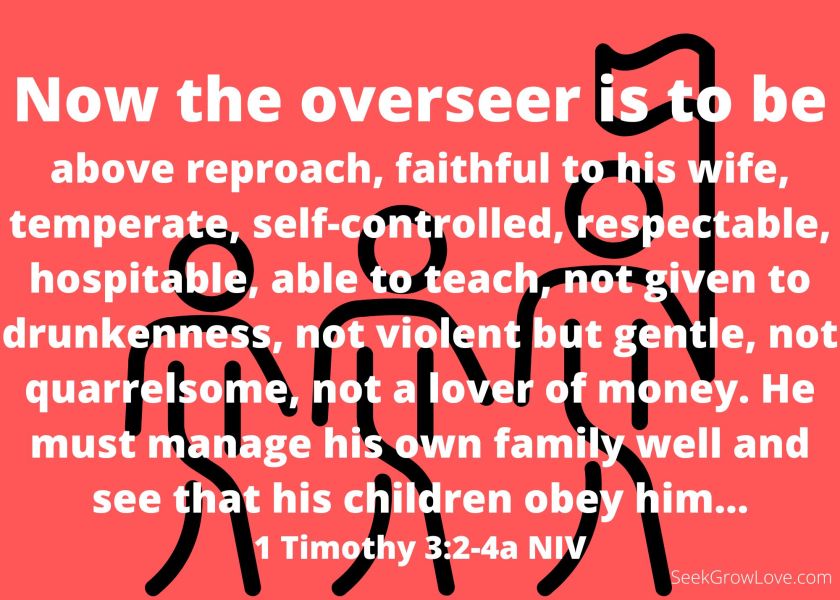
Yesterday, we read about Paul’s instructions to men and women in church during worship services. The common thread throughout the chapter? We all need to pray in humility. As Paul continues his letter, he talks more about what a church should look like, focusing in particular on church leadership. He describes two different leaders: Pastors (or Elder) and Deacons. The job requirements for both of these positions may seem a little bit overwhelming. Instead of being the usual list of requirements that you might find in a job listing (e.g. must be upbeat and engaging, a team player, bachelor’s degree), these requirements shine a light onto the heart of a leader. 

Wednesday Devo

If we are a new believer, the first step we should take in our faith is to grow in our relationship with God. We do this through daily prayer and Bible reading and through meeting with our church family. However, after we have committed ourselves to the faith and have started to mature in the faith, we need to begin to work in ministry. We may not become a pastor or a deacon, but we may lead a Sunday School class for kindergartners, be on staff at an annual church youth camp, or be involved in a visiting ministry for shut-ins. If we are working in ministry, we are leading some group of people. Even if you feel like you are leading no one, you can look at your family, whether that’s children, younger siblings, or cousins, and see the effects of your influence. 

Though the requirements listed for pastors and deacons were written specifically for them, we can look at this list to judge how well we are filling our leadership role. We are not saved by these characteristics and traits, by having them shows evidence of how God is working in our lives. For instance, we should all strive to not be a bully or quarrelsome and instead be gentle (1 Tim. 3:2-3). Why? Gentleness is one of the fruits of the Spirit (Gal. 5:22-23). If God’s spirit is working in our lives, we should be showing evidence of that. So, as you look through the traits listed, think about how you measure up to the job requirements. If you find that you would not be able to fill these requirements, you should take a look at your life and ask God to help you change those areas. Those that are following you are counting on you to lead them down the right path. They are looking at you to see the way they should act. Where are you leading them? 

~ Cayce Fletcher

Generation to Generation

rebecca 6

It brings me so much joy to see youth and young adults pursuing ministry. It is wonderful to see the next generation serving other members of the church and the community in the name of Christ. Young people that “get it”. They want to make a positive difference and make an eternal impact on the world around them.

I am so thankful for the people who were there for our generation. The adults that worked, studied, served, and prayed with us. Our Youth Workers’ commitments to our church and faith were evident in their church involvement.  I was so blessed because I got to serve alongside so many solid servants of Christ. We did the little, insignificant things along with the big stuff. It didn’t matter if it was unclogging a toilet, doing a food collection, visiting a nursing home, rolling coins after a fundraiser, working on a broken down church bus, speaking or singing in a worship service-whatever the task, our Youth Workers were working it out beside us. They spoke with encouraging words of wisdom and instilled confidence as we overcame difficulties that stood in the way to completing our mission. After all, a true follower of Christ is willing to present the gospel, help others, even wash some dirty feet…

The Apostle Paul had the opportunity to bring countless generations of people to Christ. We are still learning from his writings today. Timothy had the chance to learn from him first hand. Paul refers to Timothy as “my true son in the faith”. He had worked alongside Paul for years and had served the churches. Paul made sure that Timothy understood and practiced the essentials of the Christian faith. He also prepared him for leadership.

Paul informed him in 1 Timothy 3:15, “But if I am delayed, I write so that you may know how you ought to conduct yourself in the house of God, which is the church of the living God, the pillar and foundation of the truth.” Paul wanted Timothy to know how to serve the Church, how to deal with problems and encourage the people to grow in Christ.  He warned him about terrible times in the last days because of how evil many people would become (2 Timothy 3:1-5). He also passed along a charge, “But as for you, continue in what you have learned and have become convinced of, because you know those from whom you learned it, and how from infancy you have known the Holy Scriptures, which are able to make you wise for salvation through faith in Christ Jesus. All Scripture is God-breathed and is useful for teaching, rebuking, correcting and training in righteousness, so that the servant of God may be thoroughly equipped for every good work.” (2 Tim. 3:14-17)

What great advice for all generations!

-Rebecca Dauksas