It All Comes Back to His Kingdom

Jesus & Cross

In case you have missed part of this week’s study, here is a quick summary of each of our daily devotions this week:

Sunday –  Luke 13 – The Kingdom of God is Like – Like a virus, a mustard seed, or yeast is the Kingdom of God.  The smallest amount can cause a giant reaction in your life.  You are called to be contagious; constantly build and spread the hope you have in Christ.

Monday –  Luke 14 – Counting the Cost – We are to take account of all we hold valuable.  We may be asked to trade those things in to live within the will of God as we seek his Kingdom.  Entry may cost us everything, but it is a meager price to pay by comparison.

Tuesday – Luke 15 – The Parable of the Lost Ring – God will not stop searching for those who want to be found.  He desires that all men are saved, having a home awaiting in His Kingdom.  The whole of heaven rejoices when the lost sheep are restored to their shepherd.

Wednesday – Luke 16 – The Master and Manager – God is the master of all wealth.  He wants us to be faithful in small ways before we are given more responsibility.  When we acknowledge that we are mere managers, we look at our fortunes differently, as the master’s talents to do his bidding.

Thursday – Luke 17 – One Thank You – Like the lepers, we have been restored; we now can enter the eternal city, The Kingdom of God.  We need to acknowledge God’s restoration through Jesus Christ; no longer are we outcast.  A deliberate and thoughtful thank you is a life that turns to Him.

Friday – Luke 18 – The Power of Persistence –  We should not give up our hope that our Father is listening to our appeal.  Perseverance is the outcome of faith.  Stay the course.  Appeal to the Lord.  He will turn His ear and answer you.

As we have taken a closer look at the six chapters of Luke, we see that it all comes back to the Kingdom of God.  Parables, teaching, healing, reproach – They all point towards the eternal hope that all men can have when they accept Jesus Christ as the Lord and Savior of their life.  Jesus does not dilute the truth of the price of admission.  He says we must be faithful with what we are given; it could cost us everything. Consequently, the reward isn’t necessarily immediately.   The crown of life is not for those who casually follow commands, or openly do good works to receive their inheritance in this present age.  The Kingdom of God is for those who become infected with His love, truth, and message and spread His hope at all cost.  Each of these teachings have been immeasurably challenging and equally thought-provoking.

It has been a great opportunity to write for you this week.  I hope my narratives and notions have resonated in some way to the circumstances and challenges presented in your own life.  I pray you have found connection, truth, and hope in these handful of chapters for the Good News of Luke because these works speak the greatest of truths.  Continue to read, grow your faith, and pray for His Kingdom to come soon.

~With love, your brother in Christ,

Aaron Winner

The Power of Persistence

ask devo

Persistence is like the spraying surf or the whistling wind; it erodes away even the most hardened rock over time.  Battle-hardened generals, the most well-meaning of parents, the most demanding of bosses all will give into persistence.  Why?  Like the irritating gnat buzzing around our head, like an adjacent whistling hearing aid, like the canker sore lingering in our gums, we just want to settle the annoyance so our attention is no longer divided.

Luke 18 begins with Jesus telling a parable about a widow who most desperately was seeking justice, so she would seek out the king of her and tell of her request.  The king wasn’t a God-fearing man, or a man-fearing man for that matter, but he eventually gives into the never-ending nagging just to make it stop.  His exasperation becomes her blessing.  He did not even care about the woman, yet he fulfills her incessant request.  Jesus compares this to the matters of our own heart, and how we might constantly convey needs to our Father in prayer.  Jesus states, “Will he delay long over (our requests)? I tell you, he will give justice to them speedily” because he is a loving Father, who is loftier than any king, but is most desperately desires a relationship with the lowliest of men.

Nearing the end of the chapter, Jesus models his Father’s care for the determined.  A blind beggar recognizes the “King of Kings” is passing by, and recognizes his opportunity to be healed.  He is unrelenting in his pursuit.   He cries out “Jesus, Son of David have mercy on me!”  The crowd tells him to shut up – a nuisance such as this is not worth the time of Jesus.  Instead, the man cries louder, longer, and harder, emphatically declaring the Lord to have mercy on him.  Finally, he has the attention of Jesus, and he declares the desire of his heart: sight.  This time it is not an unkind king who yields to petition, but a truly benevolent one, acting on behalf of the Father, because this blind beggar has believed.

We serve a Father who does not hide in shifting shadows from petitioners, but makes it clear that He is ready, willing, and able to meet our every need if we would so choose to let him.  Not only this, he will also give us the desires of heart if we are attuned to His will and purpose; however, we fail to recognize that we must be faithful and persistent in our request. Now, I don’t think we can annoy God into submission, but there are more than a few faithful followers in the Bible who petition the Lord Almighty, and there is a change of course.  James Chapter 1, which I highly recommend you read alongside your assigned daily devotional, speaks of the great rewards awaiting those who do not surrender in their pursuit.

God is most certainly in control.  He is also a gracious and loving heavenly Father.   He is awaiting your appeal and ready to meet the desires of your heart – yes, even those, that are locked away, wrapped in doubt, and shouted down. Unashamedly shout them and ask in the name of the King, Jesus Christ, and He will hear your cry.

~Aaron Winner

Paul’s Prayer: Strong Holy Hearts

TUESDAY

1 Thessalonians 3-13a

I Thessalonians 3

1Th. 3:1   Therefore when we could bear it no longer, we decided to be left alone in Athens; 2 and we sent Timothy, our brother and co-worker for God in proclaiming the gospel of Christ, to strengthen and encourage you for the sake of your faith, 3 so that no one would be shaken by these persecutions. Indeed, you yourselves know that this is what we are destined for. 4 In fact, when we were with you, we told you beforehand that we were to suffer persecution; so it turned out, as you know. 5 For this reason, when I could bear it no longer, I sent to find out about your faith; I was afraid that somehow the tempter had tempted you and that our labor had been in vain.


1Th. 3:6   But Timothy has just now come to us from you, and has brought us the good news of your faith and love. He has told us also that you always remember us kindly and long to see us—just as we long to see you. 7 For this reason, brothers and sisters, during all our distress and persecution we have been encouraged about you through your faith. 8 For we now live, if you continue to stand firm in the Lord. 9 How can we thank God enough for you in return for all the joy that we feel before our God because of you? 10 Night and day we pray most earnestly that we may see you face to face and restore whatever is lacking in your faith.


1Th. 3:11   Now may our God and Father himself and our Lord Jesus direct our way to you. 12 And may the Lord make you increase and abound in love for one another and for all, just as we abound in love for you. 13 And may he so strengthen your hearts in holiness that you may be blameless before our God and Father at the coming of our Lord Jesus with all his saints.


I highlighted Paul’s prayer at the end of this chapter. In several of Paul’s letters, he offers a prayer in the middle. In these prayers, he often prays about the things which he is about to write. In this prayer, after praying that God will make it possible for him to return to Thessaloniki, he prays three things for the Thessalonians:


  1. May they increase and abound in love for one another,
  2. May God strengthen their hearts in holiness.
  3. May they be blameless before God at the coming of our Lord Jesus.


Paul gives practical teaching on these three things in chapter 4 and we will be looking at his teachings on holiness in the remainder of these devotions this week.

-Greg Demmitt


Not As a Human Word

MONDAY

1 Thessalonians 2-13

Please read 1Thessalonians 2. My perspective in writing these devotions is that you are reading the scriptures. Nothing I write can be as important to you as what God can say to you as you read his word.


1Th. 2:1   You yourselves know, brothers and sisters, that our coming to you was not in vain, 2 but though we had already suffered and been shamefully mistreated at Philippi, as you know, we had courage in our God to declare to you the gospel of God in spite of great opposition. 3 For our appeal does not spring from deceit or impure motives or trickery, 4 but just as we have been approved by God to be entrusted with the message of the gospel, even so we speak, not to please mortals, but to please God who tests our hearts. 5 As you know and as God is our witness, we never came with words of flattery or with a pretext for greed; 6 nor did we seek praise from mortals, whether from you or from others, 7 though we might have made demands as apostles of Christ. But we were gentle among you, like a nurse tenderly caring for her own children. 8 So deeply do we care for you that we are determined to share with you not only the gospel of God but also our own selves, because you have become very dear to us.


1Th. 2:9   You remember our labor and toil, brothers and sisters; we worked night and day, so that we might not burden any of you while we proclaimed to you the gospel of God. 10 You are witnesses, and God also, how pure, upright, and blameless our conduct was toward you believers. 11 As you know, we dealt with each one of you like a father with his children, 12 urging and encouraging you and pleading that you lead a life worthy of God, who calls you into his own kingdom and glory.


1Th. 2:13   We also constantly give thanks to God for this, that when you received the word of God that you heard from us, you accepted it not as a human word but as what it really is, God’s word, which is also at work in you believers. 14 For you, brothers and sisters, became imitators of the churches of God in Christ Jesus that are in Judea, for you suffered the same things from your own compatriots as they did from the Jews, 15 who killed both the Lord Jesus and the prophets, and drove us out; they displease God and oppose everyone 16 by hindering us from speaking to the Gentiles so that they may be saved. Thus they have constantly been filling up the measure of their sins; but God’s wrath has overtaken them at last.


1Th. 2:17   As for us, brothers and sisters, when, for a short time, we were made orphans by being separated from you—in person, not in heart—we longed with great eagerness to see you face to face. 18 For we wanted to come to you—certainly I, Paul, wanted to again and again—but Satan blocked our way. 19 For what is our hope or joy or crown of boasting before our Lord Jesus at his coming? Is it not you? 20 Yes, you are our glory and joy!


I highlighted verse 13. We can ask ourselves, “how do I receive the word of God?” Do we see it from a human perspective, or is God speaking to us.


Let me add one thing right now. It’s likely that most of the people in Thessaloniki heard the word rather than read it. Only about 10 percent of the people could read. That means this letter was written to be read out loud. It also suggests that we might understand it better if we study it as a speech rather than a work of literature. For example, if we focus on the written word, we might spend a lot of time digging into the meaning of each word. If we take a rhetorical approach, meaning understanding it as a speech, we focus more on the impact of the words. Those who study rhetoric think that this letter sounds like a half-time speech given to a football team that is winning but needs to be encouraged to play hard in the second half. Paul doesn’t write as if the Thessaloniki Christians are messing up, but rather as if they need to be encouraged to keep doing the things that they have already been doing well.


Again we ask, “Do you hear this word as the word of the Lord?” What does it look like when someone hears the word of the Lord?


-Greg Demmitt

Reflect His Goodness

psalm 107-22

It’s been a week of thankfulness – recognizing God as the Giver of All Good Gifts, getting to know Him more and more through the gift of His Word, gratefully accepting the gift of His Son, Jesus, and being thankful even in the midst of a difficult time.

Now for the great yearly challenge – how do we continue the thankful thinking all year?

Perhaps the following quote from J.F. Kennedy will provide some help.  “As we express our gratitude, we must never forget that the highest appreciation is not to utter words, but to live by them.”  Show your gratitude, not just by saying, “Thank You” to God and to others, but by living a thankful lifestyle.  If we are deeply thankful for the blessings that have been given we will naturally want to share those blessings with others.  Opening our home to others, tithing to our church, caring for those experiencing difficult trials, and sharing with those who have less material blessings are all ways we can express our gratitude for what has been given.  We can reflect His goodness.  He has given to us.  We will give to others.

And, most importantly, when we are truly grateful for what God has done, for who He is and for His plan of salvation, for the gift of His Son and the forgiveness given, for the Kingdom hope – we will want to share it with others.  Inviting a friend to church, sharing a devotion with the family, praying with someone struggling, telling what God has done for you, giving a Bible, donating to missions (*), posting Scripture on your social media, home, office and locker walls, and the list goes on.

Read over Romans 10.  The world is full of people who do not know the gifts they could be receiving right now – who have not heard the message.  It is our job to, “Sacrifice thank offerings and tell of His works with songs of joy.” (Psalm 107:22).  What thank offerings will you present?  How will you tell of His works?  We are not responsible for other’s reaction to the saving message.  Just as Moses and Isaiah met up with resistance and obstinate people – so will we when we exercise our beautiful feet (Romans 10:15).

Look over your thankful list (go ahead and write it down if you haven’t already this week).  Prayerfully consider how you can show your appreciation for each gift.  How can you pass along the joy you’ve received?  How will you reflect His goodness?

-Marcia Railton


(*) Be watching for the soon-to-be released Lord’s Harvest International Gift Catalog for some great ideas on how to help provide for needs on our missionary fronts (Bibles, church buildings or rent, a pastor’s transportation, an orphan’s or widow’s care, seed & fertilizer, etc….) 

Feeling With People

Monday

Romans 12-15

Romans 12:15  Be happy with those who are happy, and weep with those who weep.

What is empathy?  For me, empathy used to be one of those words that made sense in conversation, but if someone asked me to define it then I’d be hard pressed to give a good definition.  But over the last two years I’ve had the chance to explore empathy in a variety of ways.

One of the best looks at empathy I’ve found comes from a Social Work professor, Brene Brown.  Check out this really amazing and brief video on empathy (https://youtu.be/1Evwgu369Jw).

Brown describes empathy as “feeling with people.”  It’s the ability to understand, reflect, and share someone else’s situation.  Here’s the thing; I believe that empathy sits at the center of the Christian life.  From the life of Jesus to the letters of Paul and the history of the Hebrews, empathy lies at the core of our calling to follow God and live a holy life.

In Romans 12:15, Paul says, “Be happy with those who are happy, and weep with those who weep.”  If this is anything, it is a call to empathy and empathic action.  And what’s the sub-title for the section this verse comes from?  In the NIV, it is “Love in Action.”

This is what it means to put love into our deeds.  It isn’t to fix things, but to share in life with others.

I hope that today and this week, we can begin to see how acting and living empathically will help us bring the love of Christ into the world.

-Graysen Pack

Empathy & Faith

Hello everyone!

Thanks to Graysen Pack for agreeing to write our devotions for this week. Check out the email below to learn a little bit more about the topic.

Our memory verse for this week is Galatians 6:2.

*** For our email followers, follow this link if the above video is inaccessible: https://youtu.be/MZdLKkwCrec.


The Purpose of Unity

 Philippians 1

IMG-0274

One of the main reasons Paul decided to write a letter to the church at Philippi was to encourage unity among them. If they achieved this unity, it would make his joy complete (Phil. 2:2). But for what purpose did Paul want them to be unified? What is the common idea around which their unity was to be based? The answer to this question is found in chapter 1.


Paul had a singular focus in life: to preach the Gospel (good news) to the world. In particular, he wanted to spread it beyond the Jewish people to the Gentiles. In Philippians 1 Paul mentions the persecution he had faced in his life. While he doesn’t go into detail, we know from other sections of the New Testament that Paul suffered greatly. He was thrown into prison multiple times, he was shipwrecked, and, among other things, he was beaten. Despite this suffering, Paul says in verse 12 “…that what has happened to me has actually helped to spread the gospel.” Paul also heard of people who were preaching the gospel out of “envy and rivalry.” Despite these selfish motives, the important thing to Paul was that Christ (the central figure of the Gospel) was being preached. Paul was able to rejoice because his focus was on Christ and the Gospel—even when the situation wasn’t always…pleasant.


And this brings us to Paul’s purpose in imploring the Philippians towards unity.


Verses 27 and 28 say:

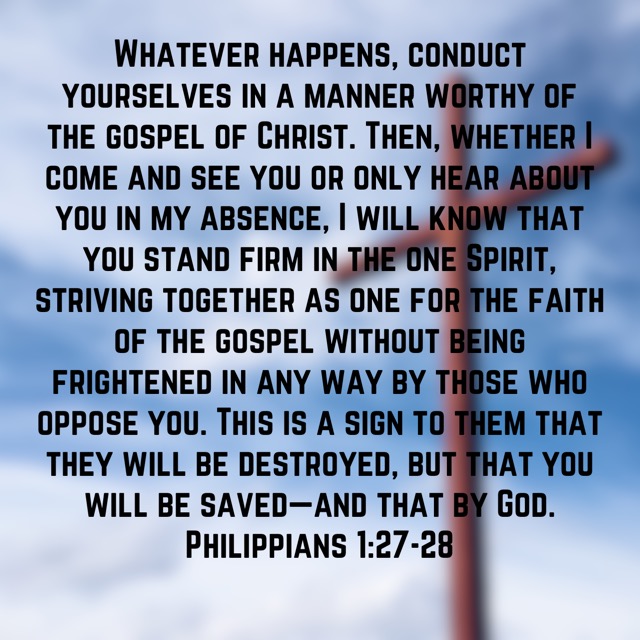
“Whatever happens, conduct yourselves in a manner worthy of the gospel of Christ. Then, whether I come and see you or only hear about you in my absence, I will know that you stand firm in the one Spirit, striving together as one for the faith of the gospel without being frightened in any way by those who oppose you. This is a sign to them that they will be destroyed, but that you will be saved—and that by God.”


Paul wanted the church to be unified in their desire to further the Gospel. This meant conducting themselves in a manner worthy of the Gospel—no matter what happened. If everyone in the Church would start doing this one thing, then they would be striving together as one for the faith of the gospel; they would be unified. No outside force could intimidate them and throw them off course, and no disputes from within could form to distract from their common purpose. This would make Paul’s joy complete.


If we want to bring unity to our churches today, we must make sure that we are unified around the same idea: spreading and living out the Gospel. If it is not for that purpose then it’s pointless. And if we want to bring unity to our churches, each of us as individuals must start living in a manner worthy of the Gospel. If we are committed to the same purpose and to living in the same manner, unity is assured to ensue.


– Joel Fletcher

A Taste of the Kingdom Hope Now

Tuesday

Matthew 24 14

Yesterday we learned about the future hope of the Kingdom of God. A time when God’s just rule and reign will cloak the earth, His son Jesus will reign as king, and you and I will live in a completely restored relationship with God and Jesus on a revitalized earth. But that time has not come yet; still though, God’s presence and rulership can be felt in the present. This is the present aspect of the kingdom of God.

Have you ever wondered what was the point of the miracles Jesus performed? The miracles were great but they were to point to something greater, namely two things: one, they provided evidence that Jesus was who he said he was (John. 5.36), and two, they pointed to the fact that God’s power and rulership were breaking into the present now (Lk. 4.18-19). In the Old Testament there are passages that describe God’s redemptive power and Jesus in his ministry fulfilled those. In Luke 4, Jesus stands in a synagogue and begins to read:

“The spirit of the LORD is upon me, because he anointed me to preach the gospel to the poor. He has sent me to proclaim release to the captives , and recovery of sight to the blind, to set free those who are oppressed, to proclaim the favorable year of the LORD. And he began to say to them, ‘Today, this scripture has been fulfilled in your hearing.’”

The time of God’s healing and restoration, Jesus fulfilled in his ministry. The miracle healings were a taste of the future reality. However, there is another way in which God’s kingdom power and influence can be brought into the present. And that is by obedience to Jesus.

There’s a purpose as to why we should obey Jesus. One purpose in particular is that when we obey Jesus and live as he says to live, we are actually manifesting the kingdom power and influence into the present. When you forgive someone who wronged you, you manifest the kingdom. When you evangelize you bring the kingdom into the present. When you love selflessly, when you obey and honor authority, when you confront sin and wrong doing, when you see people and situations the way God sees them you bring the eternal into the temporal, the kingdom into the present. The life Jesus calls you to live is not a good lifestyle, but a kingdom lifestyle. A life that embodies the ethics and practices of God.

So yes the full realization of God’s kingdom is not here yet, but the effects can be felt and seen in the now through your obedience to Jesus. We looked at the future hope and present reality of the kingdom, and this for Jesus, was the gospel he preached. Here are other verses about Jesus sharing the gospel of the kingdom of God:

Matthew 4.23; 9:35; 24.14 and Luke 16.16

When you share the gospel with someone, sharing the kingdom is essential and yet so many gospels tracks and presentations say nothing about it. Preach and live by the gospel Jesus taught. The gospel of the kingdom of God.

-Jacob Rohrer

Converse with the Almighty

bible

Saturday’s Weekly Recap with Graysen Pack

This week we’ve walked through another six chapters of Proverbs and found words that, although written thousands of years ago, still speak to the persistent struggles of human existence.  Answers to guide us seek the wealth that God promises, to join God’s work as he defends the orphaned and poor, to earnestly engage in honest community, to be aware of the emotional strife of ourselves and others, and to use our words to build a church of sincerity.


It can be easy to forget that even when we read the oldest parts of the Bible, the words are still alive and active.  And we don’t really read Scripture, but instead engage in a conversation with it.  It isn’t a professor lecturing at us from the front of a large classroom.  Instead, it is a dialogue that speaks to who, where, and when we are.  The words of God are both alive in the history of Israel and the church as well as our lives today.


As you continue to read through the Word of God this year, remember that you are entering a conversation that will speak to your life and the life of the world today.