Here’s a disquieting fact to start our devotion today: According to the International Brain Injury Association, 5.3 million Americans are living with some kind of disability due to a traumatic brain injury. 5.3 million is the population of South Carolina! Of course there are varying degrees of injury, but most are due to car accidents and sports-related incidents.
And while 5.3 million is a staggering number, I’m willing to bet that there are so many more people living with spiritual battle scars in their minds.
Our minds are such a vulnerable space and it’s one of the enemy’s favorite areas to attack. At least, that’s been my experience. Anyone else struggle with random thoughts popping up that obviously aren’t from God?
But why attack the mind? Why not make the heart the primary target? Because our thoughts turn into words, which turn into actions, which turn into habits, which turn into our character. James, the half brother to Jesus, said it this way, “It is the evil that a person wants that tempts him. This desire causes sin. Then the sin grows and brings death.” (James 1:14-15, ICB) This is why it is imperative to protect this part of our body.
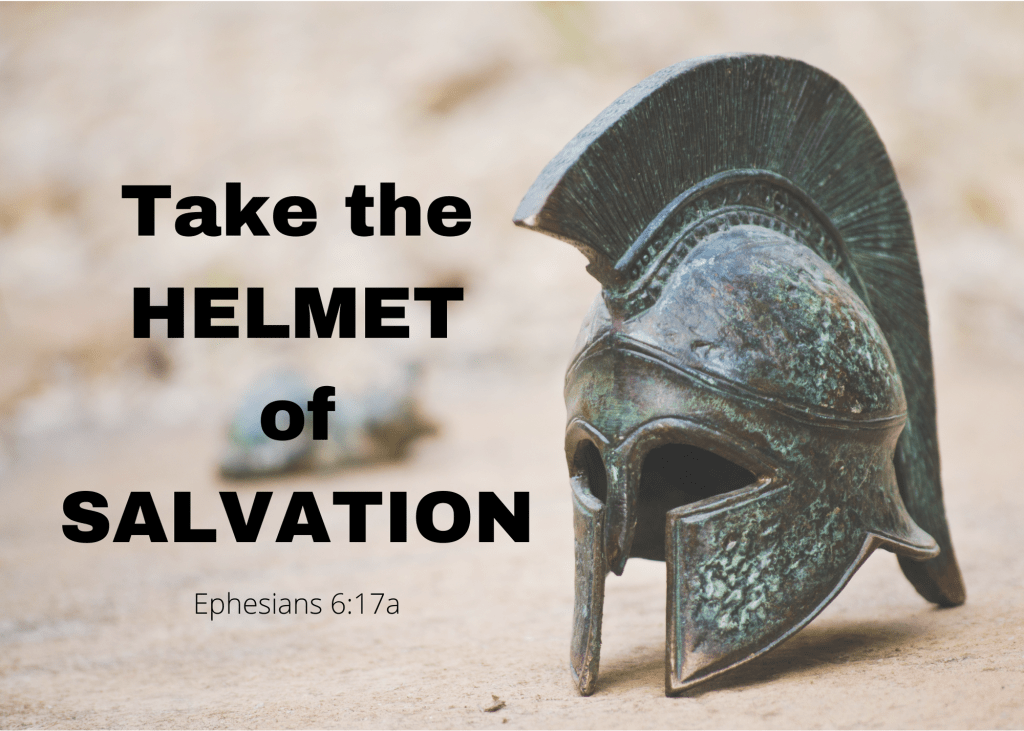
For the apostle Paul, the author of this Epistle, the helmet was the perfect metaphor; after all, he was under house arrest when he wrote this letter. He probably had a lot of face time with a Roman guard who most likely wore some kind of helmet. Each piece of the helmet added another layer of protection against injury or death.
Paul calls this piece of the armor the helmet of salvation. The Greek form of the word for salvation is used only in this verse in all of the New Testament and it means “peace”. As we don this piece of armor, we can have the “peace of God that transcends all understanding will guard your hearts and your minds in Christ Jesus”. (Philippians 4:7)
Where does this salvation or peace come from? It comes from being in the Word of God daily: reading, studying, meditating, and memorizing it. We need to be intentional about the media that we consume and the conversations that we participate in. We need to be aware of entertaining the thoughts that seem to come out of nowhere. Protecting our minds against the thoughts that flow in and out should be something that is carefully monitored as we go about our daily living.
If you want to be in God’s Shalom peace while you engage in spiritual battle, be sure to wear the helmet of salvation.
-Bethany Ligon
Reflection Questions
How do you think the enemy attacks minds? What about yours in particular?
Describe the progression from thoughts to words to action to habits to character. Give an example that leads to ungodly character. Give an example that leads to godly character. Which type of thoughts do you work at thinking most?
What protection is available to you against the thoughts that lead to ungodliness and death? In what ways can salvation and peace mean the same thing? What can you do (today) to strengthen your protection that God has made available to you?
When was the last time you regretted wearing a pair of shoes? I recently was on the hunt for a pair of gray sandals and I found some that I thought I might like from an online store. I ordered them and at first, they seemed to be very cushy and comfortable. As I wore them throughout the day, I noticed that the straps were rubbing the bottom of my ankle. It never caused a blister, thankfully, but it was just irritating.
Anyone who is on their feet all day can tell you the value of having comfortable and supportive shoes. Whether it be someone in the medical field, law enforcement, military, food service industry, or in the classroom, having a good pair of shoes is a necessity.
But what does having supportive footwear have to do with the Armor of God? A soldier’s boots (or sandals as ancient Roman soldiers would wear) are likely the one piece of their attire that they use for hours on end, every single day. They train with their weapons while wearing their boots. They go on marathon-long hikes while wearing their boots. They eat their meals while wearing their boots. And sometimes, they will even sleep while wearing their boots. If a soldier’s feet are sore or tired or have blisters, he or she becomes limited in what they can do – at least without any pain.
Our verse today talks about being “fitted with readiness”. A soldier must be ready to go at any given moment. Likewise, as believers fighting in a spiritual battle, we must be prepared to take action at any point in time.
And just what are we to take action with? The Gospel of Peace. This gospel includes the message of salvation and the Kingdom of God. As warriors in a spiritual battle, we need to remember whose army we fight for. When we are laser-focused on what we’re fighting for, we can be empowered and strengthened to fight against anyone or anything that is our opposition. So when temptation or persecution comes our way, we can make sure that we are in the ready position, set to take our Commander’s orders.
But also, the Gospel of Peace is something that we should be comfortable sharing with others who have not yet discovered it for themselves. Being ready to explain to others what we believe and why we believe it is another way to wield this piece of armor. Conversations with our friends, family, work buddies, and even random people you encounter in your day-to-day life can sometimes lead to discussions about our faith. When we are ready to share the Good News, we are showing ourselves to be prepared soldiers in the Lord’s army.
So let’s lace up our boots, and get ready to share the Good News of the Gospel of Peace!
-Bethany Ligon
Reflection Questions
The gospel is only called the “gospel of peace” here in a passage about the spiritual war we are in. How would you describe the gospel of peace and why do you think this wording was chosen for this passage?
Do you feel like you are ready to take action to follow your Commander’s orders today? What do you think could happen if you ARE ready? What could happen if you AREN’T ready for action? What could you do now to be more prepared? Do you think you have ever used an excuse of not being ready when God wanted you to do something?
How can you share the gospel of peace with others this week?
Ephesians 6:10-13 – “…Finally, be strong in the Lord and in his mighty power…”
If you were to look at the different video playlists I have curated in my Youtube profile, you’d see that a majority of them are workout exercise videos. I have playlists for upper body strength, lower body strength, pilates and barre workouts, HIIT and stretching videos. What can I say, I need variety in my life if I’m going to pursue a lifestyle that includes regular exercise.
But physical strength and endurance is not what the apostle Paul is talking about in the sixth chapter in his letter to the Ephesian church.
Nor is Paul referring to mental toughness. The kind of fortitude that prisoners of war or persecuted believers must endure when they are held captive in inhumane environments.
Paul writes the words, “be strong in the Lord and in his mighty power”. These words are almost identical to what we read in Joshua 1, verse 9, “Have I not commanded you? Be strong and courageous. Do not be terrified; do not be discouraged, for the LORD your God will be with you wherever you go.”
Joshua was preparing for a physical battle that had spiritual consequences. We probably are not preparing for a physical battle; however, if we are actively pursuing a life centered on the Gospel message, we are indeed engaging in a battle that has spiritual consequences.
So what does it mean to be “strong in the Lord and in his mighty power”?
First, I think it means that we must recognize that if we are going to do anything in the name of Jesus, we are stepping into battle against the devil’s schemes. We become a threat that must be neutralized. A soldier prepares for battle by donning on their tactical gear. We need to do likewise.
Second, “be(ing) strong in the Lord and in his mighty power” means that our own efforts, our intelligence, our will power, our connections, our resources are insufficient protection for what we are up against. If it were up to only us, then our efforts would be whooped before we even really got started.
Once we acknowledge that we are in a battle and we are without adequate protection, what are we left with? We will only be successful in spiritual warfare with our faith. A faith that says:
We believe that God is who He says He is.
We believe that nothing is impossible for God.
We believe that God is faithful to His people.
We believe that God will fight for us.
We believe that God has already won the ultimate battle.
When we cling to these truths, we are “strong in the Lord and in his mighty power” and we can withstand any kind of opposition that we are tasked to face and endure. And we will be victorious.
For whatever battle you might be facing today, remember that you are not alone. You serve a God who loves you and has empowered you with His Holy Spirit to stand firm and do great things. Keep the faith and believe.
-Bethany Ligon
Reflection Questions
How strong are you – physically, mentally, and spiritually? Of these three areas in which do you spend more workout time developing? How does one go about strengthening spiritual muscles? Why are spiritual muscles important?
What do you believe about God and His Son Jesus and how does believing each statement help prepare you for spiritual battle?
What do the devil’s schemes look like? When does he win battles? What can you do to stand against him in God’s power?
The world’s most powerful navigational tool, the compass, has been around in some form for over 2000 years. Originally used in divination, it found its way to navigation a few centuries before the age of exploration. When blinded by snow, when tossed at sea, when wandering through a dense forest, it works without fail for all who seek direction. When unobstructed by friction or gravity, the magnetized metal responds in the same true way to of the Earth’s gravitational field, aligning with poles of the Earth. This means that a compass is actually influenced by two directions at once, polar opposites. It seems silly to say, but you cannot travel in the direction of north and south at the same time. All of these elements ring true in our faith.
“To fear the Lord is to hate evil; I [Wisdom] hate pride and arrogance, evil behavior and perverse speech. Counsel and sound judgment are mine; I have insight, I have power.” – Proverbs 8:13-14
It is equally foolish to say that we can move in the direction of God and evil and be on the same course. They are truly polar opposites. To love God is to hate evil (Psa 97:10). To honor God is to give up pride (Jam 4:6). To pursue God makes the pursuit of anything else secondary (Matt 6:24). We can acknowledge the fact that our journey will not be perfect, but the direction we are pointed is true, faithful, and unchanging. It doesn’t adjust with time or relativism (Isa 40:8). Be conscious of the friction and the pull that is in the present evil age that will skew your target. Chart a course from God’s word and prepare yourself because there is more than one force at work.
“Finally, be strong in the Lord and in his mighty power. Put on the full armor of God, so that you can take your stand against the devil’s schemes. For our struggle is not against flesh and blood, but against the rulers, against the authorities, against the powers of this dark world and against the spiritual forces of evil in the heavenly realms.” Ephesians 6:10-12
The military command of “standing firm” is far from passive (Eph 6:13). In 2 Samuel 23, we see a captivating glimpse of David’s mighty warriors. Many of them, like Eleazar (v. 10), are not commended for their brilliant offensives, but holding their ground to the very end to eliminate enemy forces. Likewise, the grace we accept from God is through faith, not deed (Eph 2:8-9), and by seeking and finding Him, we have already arrived at the destination in some sense (Eph 2:19-20). Therefore, we cannot rest our laurels because there are all-out assaults coming. It is not a battle of mortality, flesh and blood, but a battle against rulers, authorities, powers of darkness, and even spiritual forces for the spoils of eternity. We are to armor ourselves with truth, peace, faith, salvation, righteousness, holding close to the Spirit and ready to wage war until the end.
In conclusion, today’s lesson is two-fold. First, make sure that you are allowing God’s direction to guide you as you move. Know that when you are moving towards God, you are fleeing from evil influence, relative morality, and sin and towards a loving God and restored perfection (2 Tim 2:22). Second, once we arrive in grace, our job is to stand our ground. We are to set a fortress around our hearts (Pro 4:23), as both a guard and a vigil, petitioning for God to intercede and help us withstand the battle. Like Paul, our prayer should be for fearlessness (Eph 6:20), eyes-locked on the prize , so we can stand firm in the truth of the Coming Kingdom.
-Aaron Winner
Reflection Questions
Towards God or towards evil? What does each path look like? What is at the end of each path? Which direction are you pointed?
What or who has turned you around before, pointing you in the wrong direction? What are you leaving behind you when you move towards God?
What acts as your compass? How valuable is your compass to you? Have you ever been lost without it?
After the attacks on September 11, 2001, President George W. Bush spoke to the emergency workers in Ground Zero through a megaphone, finding a response that resonated with the entire country and even more, the world, “I can hear you. The rest of the world hears you. And the people who knocked down these buildings will hear all of it soon.” A historical 92% of the country approved of the job he was doing, bringing together a country that was fraying at the seams in the previous election cycle. It is hard to imagine something similar happening today; no matter who is the president-elect in November, half of the country will be instantly dissatisfied with the results. These are typical terms we accept in our government, but also this “majority rules” culture has historically found its way into boardrooms and even churches. Let me quickly lower the tension by stating that today’s devotion is not about politics or presidents. It does not upend or chastise any church form of government. Its sole purpose is to examine the expectation of unity laid out for the church body, as it might be equally unimaginable.
This spirit of unity was on the mind of Jesus before being arrested in the garden of Gethsemane. He prays for his disciples and all believers when he leaves us the following words, “Holy Father, protect them by the power of your name, the name you gave me, so that they may be one as we are one. (John 17:11b)” Jesus knew his departure to the cross would scatter His apostles, create infighting, and feed doubt. Fortunately, with the exception of Judas, each of them found their way back to a unified front. Having seen Jesus Christ raised to life, they each waited for the Holy Spirit at Pentecost. They each dedicated their lives to sharing the Good News of the Kingdom of God. They each shared in martyrdom or exile for the sake of Christ.
In the same manner, I have seen churches unite during revival, when facing tragedy, or during persecution from the outside. It is easy for the dross to fall away when the metal is hot, but what about when the metal starts to cool? What does unity look like in maintenance mode? Within the day-to-day routine of uniting relationships, mulling through ministries, and discerning what is best for a body of believers? In Ephesians 4, Paul describes this as “walk[ing] in a manner worthy of the calling, with all humility and gentleness, with patience, bearing with one another in love, eager to maintain the unity of the Spirit in the bond of peace.”
While there could be a devotion on each of the elements of this verse, let’s quickly unpack the key points given to Ephesus. First, walking implies that it is not a quick process, but instead requires some dedication to go the distance (Eph 2:10). Next, humility is the acknowledgement that self-reflection should be the first step in the process, making adjustments and amendments when necessary (Matt 7:3-5; Phil 2:3), and gentleness is the grace that is extended to my brother and sisters during this same process, as imperfect people try to discern the will of God (Col 4:6). Additionally, we are required to commit to patience and love, easily spoken but in reality, conflict makes us more unbearable to one another (Col 3:12-14; Matt 18:15-20). In the body of believers, this is similar to taking the last rep of weight training, it burns the most, but it is the one that produces the result. Finally, eagerness to maintain unity means we stay focused on what unites us (Rom 14:19), defending against the six things the Lord hates (Prov. 6:16-19), and keep our mission far away from doctrinal nuances or extra-biblical preferences.
Unity takes far more work than building a majority. It isn’t a compromise or consensus because there are no losers. We grow as one together. We move towards one another as we move towards our Heavenly Father. Today, let us be extra mindful in our prayer time to dwell on the topic of unity and ask God to reveal our vision and repair divisions that may exist. May we live out the prayer of Jesus and the petitions of Paul to become one like our God and His Son, Jesus Christ.
-Aaron Winner
Reflection Questions
Where and when have you experienced or seen the beauty of a united church body?
Dedication, humility, gentleness/grace, patience, love, focused on what unites. How can you exhibit these qualities today? How can you use them to increase the unity of your church? What can happen when just one is missing?
As President of the United States, Abraham Lincoln is uniquely positioned in American history as the only leader of a broken country. No matter who he chose to serve in his cabinet, how empathetic his staff was to his role, how much they helped to shoulder the load or strengthened his areas of weakness, no one can truly understand the weight borne by the Commander-in-Chief, whose presidency was the bookends to rebellion. A great example of this can be seen in Vicksburg, a Union siege took out the Confederate stronghold on the Mississippi which was a key route for reinforcement and supplies. While this battle represented a great public triumph for Lincoln’s side, it also held personal tragedy. Lincoln received the report that his brother-in-law, a Confederate general, was killed in battle. It was stated by those surrounding him they never saw the president more moved during the war than when he received this news.
Likewise, David’s emotions in victory are complex. Tens of thousands of men look to their king to champion their victory, no doubt hearing stories of how he famously danced in the streets as the Ark made its way into the city. Instead, they see the lament of a father’s cry. Great leaders, more than anything else, are human; however, the weight of leadership will undoubtedly tip the scales in favor of fostering commitment, vision, and hope for followers, rather than abandonment trials and tragedy. Joab’s words seem insensitive, “You love those who hate you and hate those who love you. You have made it clear today that the commanders and their men mean nothing to you. I see that you would be pleased if Absalom were alive today and all of us were dead. (2 Sam 19:6) ” but they are actually encouragement to a leader who has made a personal sacrifice to acknowledge that tens of thousands of others had done the same.
The words of Jesus could be thought equally cutting and unfeeling, “Let the dead bury their own dead, but you go and proclaim the kingdom of God. (Luke 9:60).” Our ministries do not stop because we face conflict or personal tragedy. Conversely, I would say this is when our ministry and testimony are spotlighted. By the standards of the world, this conflict provides permission to act selfishly, but when we bear our burdens with the Kingdom of God at the forefront, we lean on God and lead others to the Good News. Paul makes mention of this in Ephesians 3. He tells the church at Ephesus not to worry about his suffering, because it is for their sake and to the glory of God. The same circumstance is both a victory yet a personal hardship. Paul instead lifts those he leads in prayer, asking for the strength of the Holy Spirit to guide those for whom the letter was intended, and likewise, encourage us today. No matter what scale Paul used, no matter what was placed in the balance, the weight of the Kingdom of God far outweighed any loss. This sentiment is again echoed from his prison cell to the church at Philippi when he states:
“What is more, I consider everything a loss because of the surpassing worth of knowing Christ Jesus my Lord, for whose sake I have lost all things. I want to know Christ—yes, to know the power of his resurrection and participation in his sufferings, becoming like him in his death, and so, somehow, attaining to the resurrection from the dead.” – Phil. 3:8,10
While we may not be ready to ask for suffering like Paul, tragic circumstances are the nature of this world. It may be an unfamiliar posture, but our grief, our battle, and our dire circumstance is an opportunity to demonstrate the assurances we have, to revel in the joy and love of God. We must look for opportunities to pray for and encourage others who may be participating in the same battle, asking God to give them the strength to see the victory too. Yes, we must bear, and even welcome, hardship for the sake of the Kingdom of God because, with the help of God, we can lead within it, bringing others to the saving knowledge of Christ Jesus.
-Aaron Winner
Reflection Questions
What do you learn about leadership from David? From Paul?
What do you think of the statement: “No matter what scale Paul used, no matter what was placed in the balance, the weight of the Kingdom of God far outweighed any loss.” Do you see this in Paul’s life? Do you see this in your own life?
Who will you pray for strength to see the victory?
In 2 Corinthians 2 Paul teaches us how we should forgive as Christians. Paul expresses the idea that the people who grieved him should not be met with revenge, but instead with reconciliation.
“Now instead, you ought to forgive and comfort him, so that he will not be overwhelmed by excessive sorrow. I urge you, therefore, to reaffirm your love for him.”
Unfortunately, some Christians today have a false definition of forgiveness. We have all heard the saying “I can forgive, but I can’t forget”. When you forgive someone, you don’t keep track of their wrongdoings. This is a way we show love as Christians. 1 Corinthians 13:4-5 states:
“Love is patient, love is kind. It does not envy, it does not boast, it is not proud. It does not dishonor others, it is not self-seeking, it is not easily angered, it keeps no record of wrongs”
Why is Paul so willing to practice forgiveness? It’s because he has been forgiven by God through Jesus. When we feel it’s “too hard” to forgive someone we have to remember how often we are forgiven ourselves.
Forgiveness needs to become part of our new nature. As image bearers of God, we need to become forgiving like God is. We need to recognize that forgiveness is part of God’s nature (Exodus 34:6-7), just as many people in the Bible recognized that God’s nature was forgiving (Numbers 14:17-19). If God is forgiveness we need to be forgiving. Forgiveness was the mission of Jesus Christ, let that be our mission as well.
-Brooke Cisneros
Reflection Questions
When have you forgiven someone else? How did that make you feel?
What is the problem with unforgiveness? What is the connection between unforgiveness and being “outwitted by Satan”? (see verse 11)
Explain how God has forgiven. Have you accepted His forgiveness through accepting His Son? If so, how can you pass forgiveness on to others? If not, why not?
1 Corinthians 15 is a chapter all about resurrection. In 1 Corinthians 15 there were people within the church who don’t believe in the resurrection and feel like it’s not an important belief of being a Christian.
Unfortunately, this is still a belief held by some people today. There are people in the world that teach that the death and resurrection of Christ never really happened, instead it’s just a made up story. Some people even try to water down the gospel and come up with scenarios that are more “plausible” than Jesus dying and being resurrected. This is an incredibly dangerous thought process as the validity of the resurrection gives us purpose as Christians.
In 1 Corinthians 15:3-8, Paul reminds those that don’t believe in the resurrection that there is evidence it happened. There were hundreds of eyewitnesses that saw Jesus alive after being publicly executed by the Romans. Paul then goes on to explain that without the resurrection we are all lost. In 1 Corinthians 15:17-18 Paul says
“And if Christ has not been raised, your faith is futile; you are still in your sins.Then those also who have fallen asleep in Christ are lost.”
Paul is essentially saying that without the resurrection our faith is pointless. We are unable to be saved and our loved ones are unable to be raised from the dead. Paul then goes on to remind us that the resurrection is real! The resurrection of Jesus reminds us of what’s really important in our lives, to glorify God during our lives on Earth.
-Brooke Cisneros
Reflection Questions
Why does it matter if you believe in the resurrection of Jesus Christ or not?
Do you believe in the resurrection of Jesus Christ?
How can you put into action verses 57 & 58, Paul’s concluding words on the resurrection and the difference it should make in our lives?
For the rest of this week, we are going to be looking each day at small sections of one chapter in the Bible- 1 Corinthians 13. When I was a kid I was taught that 1 Corinthians 15 is the Resurrection chapter, Hebrews 11 is the Hope chapter, and 1 Corinthians 13 is the Love chapter. If you’ve ever been to a wedding ceremony there is a good chance that you’ve heard all or at least a portion of this read as part of the ceremony. Today we will look at verses 1-3:
If I speak in the tongues of men and of angels, but have not love, I am a noisy gong or a clanging cymbal. And if I have prophetic powers, and understand all mysteries and all knowledge, and if I have all faith, so as to remove mountains, but have not love, I am nothing. If I give away all I have, and if I deliver up my body to be burned, but have not love, I gain nothing.
This is such a timely reading for me to consider. For the past 3 years, I’ve been working toward receiving my Doctorate of Ministry from Vanderbilt Divinity School in Nashville. It’s been a lot of hard work. For my project I read hundreds of articles and books, conducted interviews, presented ideas to colleagues, tested ideas on various groups, and wrote, edited, re-wrote, and re-edited until I had a project to present to my committee. Then after my committee read it, we met and I had to defend my project thesis orally. Finally, on April 9 I passed. On May 10 I’ll graduate and receive my official title D.Min, Doctor of Ministry in Integrative Mental Health Chaplaincy. The afternoon I passed my wife Karen said “Hello, Dr. Fletcher.” I said, “That’s the only time you’re ever going to call me that, right?” She said, “Absolutely, I hope you enjoyed it.”
So, I’ve been feeling relieved, accomplished, grateful, and good about having achieved this milestone in my academic and professional career.
But God had a lot more to teach me. And Brother Paul put his finger on it. In 1 Corinthians 13:1-3 Paul is saying a lifetime of accomplishments, being a gifted speaker, full of knowledge, or being spiritually gifted with miraculous powers, in the absence of concrete acts of love, is just a bunch of noise. You can get all the degrees and accolades and knowledge, but if you don’t put love into practice, it’s a bunch of noise and worthless.
It reminds me of a story I once heard: There was a child psychologist who was famous and had written many best-selling books on parenting and how to raise children. Recently, he had spent many hours constructing a new driveway at his home. Just after he smoothed the surface of the freshly poured concrete, his neighbors’ small children chased a ball across the driveway, leaving deep footprints. The man yelled after them with a torrent of angry words. His shocked neighbor heard these words and said to him, “You’re a psychologist who’s supposed to love children.” The fuming man shouted, “I love children in the abstract, not in the concrete!”
Paul is saying in I Corinthians 13:1-3 that love in the abstract is worthless.
A few days later, God showed me what love in the concrete looks like. I shared the following story on my Facebook page recently. It resonated with a lot of people because it’s been shared hundreds of times and I’ve heard more responses to it than anything else I’ve ever posted on social media. It illustrates to me what Love in the Concrete looks like:
I met Jesus yesterday. Face to face.
He’s a cashier at a grocery store in Front Royal, Virginia.
I was on my way home from work after a busy Monday visiting sick patients at the hospital, supporting families as their loved ones face the end of life, helping people struggling with addiction and staff cope with the challenges of being full-time caregivers. I’m a chaplain and a pastor, that’s what I do all day. It’s what I’ve trained to do, studied, practiced.
But then, yesterday, out of the blue, with no warning I met Jesus working the register at a grocery store.
First, I saw him patiently help the customer ahead of me. The one who only had 3 items in her cart, was very confused trying to figure out how much she could spend because she needed to have enough left over. He was gentle and patient with her. He couldn’t be more than his late teens, maybe early 20s, but he was attentive and caring. No eye rolls or looks of frustration, just caring for this confused and frustrated woman. (I was the one who was frustrated at how long it was taking).
Then it was finally my turn to check out. He was a thin young man, wearing a cross made of horseshoe nails and wire. He smiled and asked gently, “May I pray for you?”
That was unexpected and caught me completely off guard. I said, “Yes, please.” I was so moved that this young man would take the time to notice me and ask if he could pray for me. This was more than a transactional relationship for him. He was there to do more than simply earn his paycheck and go home. He saw me as more than an object, a thing to help pay his bills, he saw me as a person, a human being made in the image of God, who has a life outside of this 5-minute transaction and has needs that can be helped by God’s intervention. I was deeply moved.
But he wasn’t finished.
“What would you like me to pray for?” What should I say? How specific should I be? Should I say, “I’m currently under treatment for 2 types of advanced cancer and trying my best to keep going?” Should I tell him about my concerns about family members that I love, my desire to help my Church grow, and all the needs of the people I visit and staff I serve in the hospital?
There wasn’t time to go into all of that, so I simply said “My health.”
He stopped and said, “So you are having health problems. I’ll pray for that.”
By then the tears were starting to well up in me and I hurriedly helped him bag my groceries so I could get out of there before I started ugly crying in the grocery store check-out line.
But he wasn’t done yet.
“What’s your name?” That about finished me off. He wasn’t just making conversation or using spiritual cliches like “I’ll pray for you” as well-intentioned people often do, but sometimes forget to actually do. I knew that he really meant it. He was and is praying for me, Jeff, who has health needs. And based on what I saw, he’s already pretty close to God. So I have a feeling God will listen attentively to his prayers.
As I sat in my car afterward waiting for the tears to subside, I had the overwhelming sense that I had just spent time with Jesus.
I met Jesus yesterday.
He works as a cashier at a grocery store in Front Royal, Virginia.
Since I shared this on Facebook I’ve had dozens of people who live locally write to me or tell me in the hospital that this same young man has left others equally in tears when he prayed for them and they, too, equally felt touched by Jesus.
This young man probably doesn’t have a doctorate in spiritual care, but you don’t need one of those to show people concrete love in the name of Jesus. Go and be Jesus wherever you are today.
Pastor Jeff Fletcher
Reflection Questions
Name a time when you were surprised by God’s love revealed to you in unexpected places.
How would you describe the difference between abstract love and concrete love?
The young man showed Jesus’ love while checking people out at the grocery store. Where can you show the love of Jesus today?
As is frequent with God’s word, we see connections, themes, and promises fulfilled which transcend centuries, and today’s readings are an example of this. From our Old Testament reading of Joshua we see a thorough purging and annihilation of pagan people who were not followers of God in the land God wanted inhabited by his chosen people. Terms like “captured”, “struck every person”, “no survivor”, and “utterly destroyed” used more than once paint a pretty clear picture of what Joshua and the Israelites were busy doing. But, why? That is also repeated throughout, and while it could be summed up as “God said so”, it seems more beautifully stated in Joshua 11:15,
“Just as the Lord had commanded His servant Moses, so Moses commanded Joshua, and so Joshua did; he left nothing undone of all that the Lord had commanded Moses.” New American Standard Bible (La Habra, CA: The Lockman Foundation, 2020), Jos 11:15.
Over a thousand years later, our New Testament reading in 1 Corinthians written to the church in Corinth also references instructions on purging out the evil. And just like the pagan people and cultures surrounding and within the promised land in the time of Joshua, Corinth was certainly a place full of evil. A city known for immorality (not immortality as I just accidentally typed!), for all varieties of sexual sins and deviance, statues and idols of lovely false gods like Aphrodite and none other than a thousand prostitutes kept busy at the temple. One could imagine as new converts came out of this culture to Christianity, and for the existing church functioning within that society, there were some things that needed cleaned up. And then there were some things that just straight up needed called out, purged, and done away with. Finding ourselves progressed another couple thousand years from there, I think we can relate.
Tomorrow, the Jewish people and those celebrating Passover will be starting their remembrances and celebrations. I really like that the Jewish holidays have Biblical and spiritual meanings, and Passover is directly mentioned in our New Testament reading today. One instruction the Hebrews were given for the Passover was to remove the yeast/leaven from their homes on the first day. Today, there are all sorts of traditions on how to do this for Passover including varieties of special cutlery and cleaning to remove every speck of potential leaven from cookware to corners of homes and cabinets. Even the kids are apparently often helpful at finding those hard to reach remnants. As Christians according to 1 Corinthians 5, we know Jesus is our Passover lamb, which brought about a huge culture change, and one I am incredibly thankful for because I absolutely do not want to be doing anything with the blood of lambs or goats! But, while Jesus’s sacrificial life and death is a tremendous gift and blessing that reconciles us with God, scripture also tells us we can’t just be thankful for Jesus and leave whatever filth we have in our lives, homes, and churches. Leaven is often correlated to sin in scripture, and today’s reading is very clear. Leaven is not good in this case. It will creep into every corner of the loaf. It contaminates. If we tolerate evil, we will contaminate ourselves and the body of Christ if we are a member of it. If we ignore it and don’t even look for the small hidden pieces of leaven in our lives, the leaven is very efficient at growing, attracting bugs, and all the rest.
We are forgiven and cleansed through our Messiah who took the place of the Old Testament sacrifices. We also know we are human beings living in another Corinth, and it is easy to be deceived when society is screaming “that’s not leaven, that’s just fine”. May we all prayerfully consider the internal, spiritual leaven within ourselves along with any other things we might be cleaning up this spring. While smudges on windows, crumbs under the stove, and dead leaves in landscaping simply do not matter in the big picture, the spiritual stuff is a life and death matter. I love these verses in Psalm 19: 12-14 which talk about intently looking for the hidden pieces of leaven in our hearts.
But who can discern their own errors?
Forgive my hidden faults.
Keep your servant also from willful sins;
may they not rule over me.
Then I will be blameless,
innocent of great transgression.
May these words of my mouth and this meditation of my heart
be pleasing in your sight,
Lord, my Rock and my Redeemer.
-Jennifer Hall
Questions:
1. What similarities do you see between the culture in Joshua’s day, the city of Corinth, and today?
2. Have you ever seen someone’s sin in the body of Christ negatively impact others in the church family?
3. What challenges do you and the church face in identifying sin and right/pure actions from a Biblical worldview in today’s society?