The Priest, Melchizedek, & Jesus

OLD TESTAMENT: ISAIAH 6-7

POETRY: PSALM 62

NEW TESTAMENT: HEBREWS 7

In Hebrews 7 the author of Hebrews (who for simplicity I’ll call “Herb”) describes Jesus’ greatness, particularly as a high priest. Herb is following a pattern we recognize, he has compared Jesus to angels, Moses, Joshua, and now Levitical high priests and says ‘that was good, but he is greater.’ The style of argument he is using was one employed by rabbis, it emphasized moving from a lesser thing (never a thing without value) to a greater thing. In the case of the priesthood connected to the Levites Herb compares it with a priesthood connected to Melchizedek, who has almost no known history (see Genesis 14:18-20, Psalm 110), and ties that to Jesus’ High Priesthood.

When Melchizedek and Abraham met it was several hundred years before the Levitical priesthood began with Aaron’s family, and before the Law which records instructions for those priests. There was no Ark of the Covenant then, and no Tabernacle to house it. It is difficult to imagine what form Melchizedek’s service toward God took, and for whose benefit it was provided. Should we suppose that Melchizedek and Abraham met often, and that the first frequently ministered to the second? We are told that Melchizedek was not only a priest but also the king of Salem (that city seems to have been at or near the site of Jerusalem, Psalm 76:2). Might Salem, under Melchizedek’s leadership, have been faithful to God?

We may find Melchizedek mysterious, rather like Balaam who operated as a prophet separately from the Hebrew people in Moses’ day (and ended up turning away from God). But Herb’s description in Hebrews 7:3 makes Melchizedek’s life sound even less clear, getting into whether we know who this priest-king’s parents were, or when he was born or died, as though Melchizedek had no birth or death. Herb’s point really is that Melchizedek was never stated to have become a priest based on inheriting the position, and that it is never mentioned that anyone took up his role as a priest after him. This is following a second style of reasoning accepted among rabbis, one in which you didn’t need to assume the reality of things which scripture left unstated. This allowed Herb to draw connections to Jesus, as one who did not inherit a priestly role from a parent, and who would never stop serving in his role as high priest. That was in contrast with the carefully kept genealogies of the Levitical system – there were tens of thousands of priests living in the New Testament period, each of whom gained their title through their father, and each of whom was to retire at age 50 (Numbers 8:25) – the order of Melchizedek was not joined based on birth records and was not temporary, but was through the permanent oath of God declaring membership (v. 21, 28; Psalm 110:4). So Herb’s statement “made like the Son of God, he remains a priest perpetually” (3b), paired with him saying that Melchizedek “lives on,” (8) may not just involve the rabbinical argument about an unstated death being assumed not to have occurred – it may refer to Melchizedek retaining his status as priest when he is resurrected. Melchizedek will continue to serve alongside the high priest of his order.

Hebrews repeatedly points to Jesus as the fulfillment of God’s plans and calls believers to follow Jesus to gain perfection / maturity / completion (the Greek term doesn’t translate simply). We are told in 7:19 that “the Law made nothing perfect,” but 7:28 says that “the word of the oath, which came after the Law, appoints a Son, made perfect forever.” Now of course when Herb tells us to join with Jesus he doesn’t mean that believers will stop sinning in this life, after all in 7:25 he describes Jesus as “able also to save forever [completely] those who draw near to God through Him, since He always lives to make intercession for them” (you see the point, people don’t need intercession unless they are still doing wrong; by the way, where 7:25 says “forever” and I note the Greek was more like “completely” that wasn’t the same Greek term as I was mentioning Herb used related to “perfection” and “completion.” I am sort of in the habit by now of noting with translations that say things like “forever” or “eternal” what word they should have said, though, because – say it with me – there was no New Testament word for eternal). As chapter six reminded us, a high priest never took the task on for himself, God made the choice, and when God provided us with Jesus we got the best (and only) high priest possible for the purpose of bringing us fully into contact with God.

I’m not sure if people in the church today think very often about how salvation works, but Herb felt it needed clarification and provided some in his book. We have read about Jews who were concerned over the idea of the Law continuing to be followed in the Church, a meeting was held at Jerusalem with apostles and other leaders to discuss that. At one point Paul addressed the issue by pointing to how God interacted with faithful Abraham, centuries before the Law. Paul showed that obedience to the Law was not required to please God, God was more interested in faith. Herb describes something similar with the priesthood, showing that it existed in Abraham’s time well before Aaron or Levi’s line and so the Levitical priesthood was not required for making connections to God. Herb also showed that Levi effectively tithed to Melchizedek when Abraham gave him a tenth of the spoils of battle, which Herb said meant that the earlier line of priesthood was greater than the later one. 

Such interpretations as Paul and Herb wrote, or the many statements interpreting prophecies in the Bible, do not result from authors ‘putting together the pieces’ for what they wanted to support. I don’t think they could have been so fortunate in locating such details anyway. Rather we are talking about a God who shaped event, prophecy, and interpretation. Just as God chose Abram, by His own will, from whom to make a great nation, God also determined that He would use Abram as the starting point to reach the world. God’s choice involved setting up a whole imperfect system to put the Hebrew people on their path, creating a nation and a history and a culture that prepared the way for Jesus. Jesus then opened the way for people from the world; Jesus also provided for better things than the Hebrew people had been experiencing. It can be mindboggling to think about all the steps of the plan God put in place. I tend to wonder if some of those steps along the way were interchangeable, based upon whether certain people would follow through or fail in what they were called upon to do. What I am certain about is that God’s plan was never going to fail.

Thank you, Lord, for your plan, which you have been preparing for so very long. Thank you that we do not have to depend upon who gave us birth in this world to determine if we may enter your kingdom, but that you allow us to become inheritors of your kingdom through a relationship with your son Jesus. I may come into the relationship fallen, but he can lift me up. However dirty I seemed to myself, he was able to wash me clean. However useless I have felt, he can make me useful. As inheritors with him please help us each to joyfully work in your plan, caring and serving as he does for the will of his Father. And please help me be eager to serve him, let me help in ways I have not yet even been of help. Thank you, Amen.

~ Daniel Smead

Reflection Questions

  1. Do you find it encouraging to think that your future is not based on your past, but on your connection to Jesus?
  2. Hebrews 7:25 says that Jesus is able to save completely “those who draw near to God through” Jesus – do you see this more as part of the cautionary language in the book, saying salvation calls for drawing near to God, or as part of the promissory language of the book, pledging that we are able to draw near to God? How might a difference in outlook on that point affect someone’s life? How have you drawn nearer to God in the last few months?
  3. Perhaps it will seem to be a side issue, but we are told we will be priests in the coming age (Revelation 5:10). If the offer had existed through the Levitical order almost no Christians would be eligible – they are not Levites, they are not male, they are the wrong age, etc. But as members of the Melchizedite order alongside Jesus we are not subject to those restrictions, and we can serve with our High Priest Jesus for centuries. How can you honor God today?

sgl23bibleplanDOWNLOAD

Take Care

Old Testament: Isaiah 5 & 6

Poetry: Psalm 61

New Testament: Hebrews 6

Is it possible to lose your salvation?  The author of Hebrews thinks that this is a real possibility.  It can happen.  In Hebrews 3:12, he wrote, “Take care, brethren, that there not be in any one of you an evil, unbelieving heart that falls away from the living God.”  In Hebrews 6:5, he writes about those who “…. have fallen away, it is impossible to renew them again to repentance…”  Truly, these are very troubling words to read and to contemplate.  We might wonder to ourselves, “I have gone too far?  Have I sinned too much?  Have I ruined my chances with God?”  For each one of us are sinners.  We are imperfect.  We are prone to sin.  We get distracted.  We get discouraged.  We get apathetic.  Each of us can think of people who, at one time, sincerely followed Christ.  They attended church.  They lived good lives.  Their faith seemed genuine.  However, now things are different.  They live as though they had never known the Lord.  In some cases, they have openly embraced evil.  The way of Christ has been rejected by them.  Has their salvation been lost?

      What is it to be saved?  It may be helpful to think of salvation in terms of past, present and future.  In the past tense, you have been saved.  Christ died on the cross for your sins some 2000 years ago.  The work is done.  His blood covers all who come to Him in faith.  Each one of you fondly remembers the day when you came to Christ.  On that day, whether decades ago or only days ago, you were justified before God by the blood of Christ.  So, you have been saved.  In the future tense, you will be saved.  Salvation, life eternal, is not yet in your possession.  You are saved now only in hope and in promise.  The resurrection at the return of Jesus Christ is when salvation will become yours.  You will be saved.  That is the past and future of salvation.  What about the present?  You are now being saved.  You have been saved in the past.  You are being saved in the present. You will be saved in the future.  So, you are being saved.  The present work of salvation in us has been called “sanctification.”  It is a process.  It is to grow into the image of Christ.  God, by His Spirit, is working in you to change you and transform you.  However, the Apostle Paul recognized that there is an ongoing struggle within each Christian.  While we hope in the age to come, we still live in this present evil age.  Paul in Romans 12:2 urged Christians “…do not be conformed to this world, but be transformed by the renewing of your mind…”  Another common theme in the writings of Paul is the encouragement to live by the “Spirit” and not by the “flesh.”  It is no wonder that Paul looked at the Christian life as a contest that must be won, a race that must be completed, a journey that must be finished, and a battle that must be waged.  To be a Christian is to be actively engaged against sin and evil in your life. The book of Hebrews draws from the rich history of Israel to make the point.  The people of Israel were saved from slavery in Egypt by God’s mighty works.  The people of Israel left Egypt with the goal of entering the Promised Land.  However, between the past and the future, between Egypt and the Promised Land was the wilderness.  The wilderness wanderings are what tested the people of Israel for 40 years.  The wilderness tried their faith and challenged their hope.  Then, the people of Israel lived in the shadow of God’s presence.  They had seen the mighty works of God.  God fed them daily with the manna.  He gave them water out of the rock to drink.  However, as incredible as it may seem, many of them remained disobedient.  They grumbled and complained.  They wanted to go back to Egypt!  Hebrews 4:1,2 comments, “Therefore, let us fear if, while a promise remains of entering His rest, any one of you may have come short of it. For indeed we have had the good news preached to us, just as they also; but the word they heard did not profit them, because it was not united by faith in those who heard.”  In the same way, we Christians find ourselves in a “wilderness” of sorts.  Behind us lay our sins and our old way of life.  Before us lay the Promised Land, the kingdom of God, eternal life.  However, you are now walking through the wilderness of this present evil age.  The wilderness is what can make you or break you.  The wilderness experience will reveal who and what you really are.  You have to keep your eyes upon the distant Promised Land.

     Hebrews 6:4,5 observes, “For in the case of those who have once been enlightened and have tasted the heavenly gift and have been made partakers of the Holy Spirit, and have tasted the good word of God and the powers of the age to come and then have fallen away, it is impossible to renew them to repentance, since they again crucify the Son of God and put Him to open shame.”  This verse is not declaring a penalty against those who have fallen away.  Rather, it is simply describing the reality of the human heart.  Some of the Israelites of old were apparently untouched by the wonders that they had seen.  They had short memories.  They were easily discouraged by obstacles.  They didn’t trust the God who had saved them.  They returned to their old ways.  In the same way, some Christians after tasting “the good word of God and the powers of the age to come” have fallen away.  They were unimpressed by what God had done in them.  They were no longer moved by the sacrifice that Jesus made on the cross.  After God had revealed His glory to them, what further could God do to convince them now?  If you have seen miracles and all you can do is yawn, what more can God do with you?  I believe God, in His grace, would allow repentance in these cases.  However, can such a hardened heart be able to repent?  If you have already proven yourself resistant to the Holy Spirit, you have rendered yourself blind and deaf to the saving gospel message.  It is a though God has cooked you a wonderful gourmet meal with the best ingredients.  However, you have no taste for what God is serving.  So, you won’t be back because you have no appetite for what God is serving.  Hebrews reads, “…it is impossible to renew them to repentance….”  You have headed back to Egypt and have forsaken the Promised Land.  What could convince you change your course now?  God had given you his best and you didn’t want it.

      However, it is not the intent of Hebrews to discourage, but to encourage.  Hebrews 6:9 reads, “But, beloved, we are convinced of better things concerning you….”  Hebrews 6:11 adds, “And we desire that each one of you show the same diligence so as to realize the full assurance of hope until the end…”  The book of Hebrews, taken as a whole, is a word of encouragement.  Don’t give up.  Don’t quit.  Don’t be discouraged.  Don’t be overcome by sin.  Have hope.  Have faith in the promise of God.  For God is faithful.  For you will find troubles and challenges in the wilderness.  So, brothers and sisters, if you are reading these words, you have not yet given up. You are not lost.  You are still seeking the Promised Land.  Hebrews 10:35,36,39 sums up this message: “Therefore don’t throw away your confidence which has great reward.  For you have need of endurance, so that when you have done the will of God, you may receive what was promised….but we are not those who shrink back to destruction, but of those who have faith to the preserving of the soul.”  So, the wilderness road may have beaten up a bit.  You may have wandered in the wrong direction at times.  Perhaps you had temporarily lost your way.  You might have encountered obstacles.  However, you are still on the road with your eyes focused on the Promised Land.  Keep going and don’t give up.

-Scott Deane

Reflection Questions

  1. Why is it important to know what you believe about salvation?
  2. Have you accepted Jesus and been baptized? Are you assured of your salvation?
  3. What are some reminders you can put into your everyday routine to point you to living a gospel-centered life so that you don’t forget your primary calling?

Breaking the Sin-Cycle

Old Testament: Isaiah 1-2

Poetry: Psalm 59 

New Testament: Hebrews 4

In yesterday’s devotion, we were reminded of the importance of obedience and the dangers of disobedience. Even though the passages that we read yesterday were years and years removed from our reading today in Isaiah, similar themes run through both. Israel was continuously going through a sin-cycle of disobedience, discipline, and then a decision to return to God. In Isaiah 1, we see the harsh consequences of sin again. Verse 5 says, “Why will you still be struck down? Why will you continue to rebel? The whole head is sick and the whole heart is faint.” Sin has eternal consequences, and it also has consequences in our daily life. Because of the Israelites’ sin, their home was destroyed, and all of the things that they loved were taken away. Even though sin was destroying them from the inside out, they still refused to submit to God. 

In many ways, we can talk about sin with the same language that we use for other negative repetitive behaviors, like addiction. People who are addicted to something keep returning to it even if the actual desire to do the thing isn’t there. They may actually hate the thing that they do, but they can’t seem to stop themselves from returning to it (which sounds a lot like my relationship with social media). Israel continued to return to sin despite the pain that it caused. 

In verses 18-20, we see a promise to the Israelites. It says, “Come now, let us reason together, says the LORD: though your sins are like scarlet, they shall be as white as snow; though they are red like crimson, they shall become like wool. If you are willing and obedient, you shall eat the good of the land; but if you refuse and rebel, you shall be eaten by the sword; for the mouth of the LORD has spoken.” On their own, Israel could never break out of the sin cycle. When they rested on their own power, they fell back into disobedience. 

But, we don’t have to rely on our own power to break our addiction to sin. This promise for the Israelites – the promise to be made clean, to be freed from sin – found its fulfillment in the sacrifice of Jesus on the cross. 2 Corinthians 1:20 says, “For all the promises of God find their Yes in him.” We now have been grafted into the body of Christ. The promise that was given to Israel has been given to us as well. This is why we can break the sin-cycle in our lives. We don’t have to rely on our own works; we find our rest in him. Hebrews 4:9-11 says, “So then, there remains a Sabbath rest for the people of God, for whoever has entered God’s rest has also rested from his works as God did from his. Let us therefore strive to enter that rest, so that no one may fall by the same sort of disobedience.” We can enter into this state of rest because Jesus has done the work for us. He was the sacrifice that made us clean. Just like the Israelites waited for the Promised Land, we wait in hope for the Kingdom, our eternal glorious place of rest. We have to hold fast to the truth and choose to live rightly. 

How then should we live? Isaiah describes a life that is lived rightly: “Wash yourselves; make yourselves clean; remove the evil of your deeds from before my eyes; cease to do evil, learn to do good; seek justice, correct oppression; bring justice to the fatherless, plead the widow’s cause.” (Isaiah 1:16-17). 

Let’s pursue righteousness as we wait for the fulfillment of the promises of God. 

~Cayce Fletcher

***You can find more of Cayce’s writing at www.amorebeautifullifecollective.com.***

REFLECTION QUESTIONS

  1. Why is it so hard to change our behavior on our own power?
  2. In what ways does it comfort you to know that the Holy Spirit can help you break the sin-cycle?
  3. Do you feel as though you are resting in Christ, or are you relying on your own works?

sgl23bibleplanDOWNLOAD

Rebellion, Discipline, and Obedience

Old Testament: Isaiah Introduction (See Below)

Poetry: Psalm 58

New Testament: Hebrews 3

After several years of teaching, I recently had the opportunity to stay home with my two kids. My oldest is three, and he has a mind of his own. Much of my day is spent doing fun things, like playing outside, reading books, and building Lego towers. But, with a toddler, there are always going to be times of correction. Discipline now is necessary for a happy, healthy, well-adjusted human later on. But disciplining through rebellion has its share of tears, tantrums, and yelling of “No.” 

Today, we read about a similar situation of discipline. There are two choices we have in life. We can choose to be obedient to God, submitting to his word, or we can choose to pursue our own desires, rejecting God’s word. One path is the path of righteousness and life. The other is the path of sin and death. In Psalm 58, we read about the harsh judgment reserved for those who are not righteous. In verse 10, “The righteous will rejoice when he sees the vengeance; he will bathe his feet in the blood of the wicked. Mankind will say, “Surely there is a reward for the righteous; surely there is a God who judges on earth.” 

As Hebrews 3:7-8 says, “There as the Holy Spirit says, ‘Today, if you hear his voice, do not harden your hearts as in the rebellion on the day of testing in the wilderness.’ We must take care of the condition of our hearts. If our heart is soft to God’s leading, we will listen in obedience to what he says, and we will do it. However, if our heart is hard, we will be more likely to reject God’s commands. 

How do we know the condition of our heart? It’s important to look at our actions. If what we do is lined up to God’s word, then we have a heart to listen to what he says and follow it. I’ve heard it described as a plumb line that we use to measure up our actions. If we are out of line, God’s word will call us out. 

What does a hard heart look like? If you notice that your actions are consistently not matching up with godly living as described in the Bible, that is a good indication that you have hardened your heart to his teaching. You are living in rebellion. Those words seem harsh, but they line up with the way that Hebrews describe them. If you consistently read that you should do something but you don’t, you are not living righteously. Just like the notifications on your phone, you swipe out of and never look at or the alarm you press snooze on, you are desensitizing yourself to the effects of sin. You’ve become “an evil, unbelieving heart” that is “hardened by the deceitfulness of sin” (v. 12-13). 

We need to encourage each other to pursue a righteous life of obedience. That is what we are called to do. 

~Cayce Fletcher

***You can find more of Cayce’s writing at www.amorebeautifullifecollective.com.***

Isaiah Introduction

The book of Isaiah was written by the prophet Isaiah to the southern tribe of Judah at a time when the Assyrian empire threatened Judah’s destruction.  The name Isaiah means “the Lord saves”.  Isaiah is quoted in the New Testament more than any other Old Testament prophet.

While Isaiah predicted that Judah would eventually be defeated because of their sins; he also predicted a message of hope – the coming messiah (a suffering servant), would come to establish the Kingdom of God on the earth.

Some have suggested that the first 39 chapters of Isaiah focus on doom and gloom, similar to the 39 books of the Old Testament; while the 27 last chapters (40 – 66) of Isaiah focus on hope and restoration, similar to the 27 books of the New Testament.

There are many prophecies in Isaiah about the “last days”, the “Day of the Lord”, the promised messiah (Jesus), God’s suffering servant (also Jesus), conditions in the millennium, and the coming Kingdom of God.

One of my favorite verses is Isaiah 41:10, “So do not fear, for I am with you; do not be dismayed, for I am your God.  I will strengthen you and help you; I will uphold you with my righteous right hand.”

–Steve

REFLECTION QUESTIONS

  1. Have you walked through a season of rebellion? What was the outcome?
  2. What is the importance of obedience?
  3. What is the current status of your heart? How do you know?

sgl23bibleplanDOWNLOAD

Be a Good Guard

*Theme Week: Review of Paul – 2 Timothy 1

Old Testament: Ecclesiastes 10-12

Poetry: Psalm 53

Have you ever been asked to guard something?  If you’ve ever played a team sport it’s likely that you guarded someone or something.  When you play defense in basketball or hockey you guard someone.  In basketball and football, there are positions called guards.  In baseball, the catcher is responsible for guarding home plate.

We encounter lots of guards in life- prison guards,  security guards, the National Guard.  Celebrities and politicians and other rich and powerful people often have bodyguards.  If you’re out with a friend at a busy place and they go to buy food or use the restroom they might ask you to “guard my seat”.  

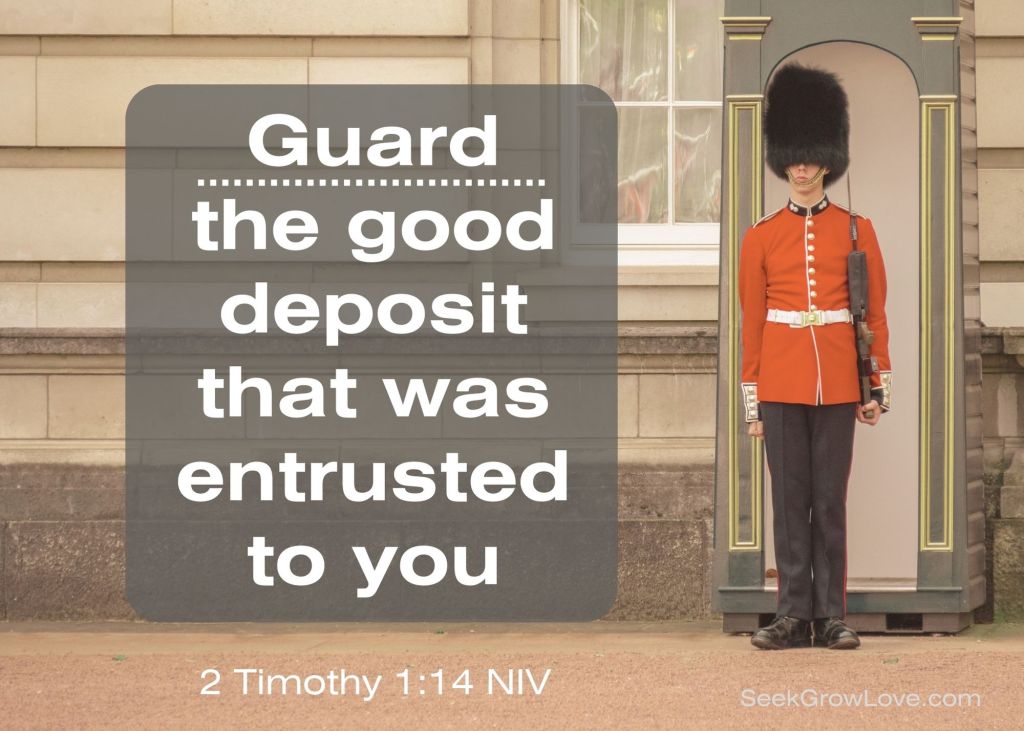
To guard something means that you have been entrusted to protect someone or something that is valued by another.  In today’s reading of 2 Timothy 1, the Apostle Paul has written to Timothy and reminded him about all of the goods that have been entrusted to him in his life.  He speaks about the sincere faith that began in both Timothy’s grandmother and mother now in him.  He describes this faith as something that has been entrusted to Timothy and must be guarded.  I have the image of going to the bank and bringing my paycheck and giving it to the bank officer and asking her to guard my money until I needed it.  I am entrusting my deposit with the bank.  Here, Paul is entrusting his spiritual deposits to Timothy.  Just as Timothy’s grandmother and mother made spiritual deposits in his life, Paul too made spiritual deposits.  Now it’s up to Timothy to both guard those deposits and also put them to good use.  Paul freely changes metaphors to that of fire.  A fire that has started often needs to be fanned, given more air, until it grows enough to really burn.  Protect the deposit and fan the flame.  This is Paul’s counsel to Timothy.

You’ve undoubtedly had many people make faith deposits in your life.  For some, like Timothy, it was a grandparent or parent or other spiritual teacher or mentor.  Maybe it was a Sunday School teacher or youth leader, maybe it was a pastor or a counselor at Church camp.  For many, it was likely a combination of many people who taught by words or actions what it means to know Jesus Christ and follow him as a disciple.  I know in my nearly 60 years of life there have been countless people who have made faith deposits into my life, and who have helped me with my spiritual formation.   These people have shared incredible gifts of faith with me.  I feel a particular responsibility to not allow those gifts to go by the wayside, to be left unvalued,  unused, and unguarded.    I take the deposits of faith that have been entrusted to me and put them to work for Jesus Christ and for the Kingdom of God.  This is an incredibly important responsibility and one that I do not take lightly.  I owe a tremendous debt of gratitude to those who made faith deposits in my life and so I want to “pay it forward” by making faith deposits into the lives of others.  This is why 45 years after I first attended Youth Camp (Now FUEL) I’m still trying to make faith deposits.  I hope and pray that you guard what has been entrusted to you and fan into the flame the gifts that have been given to you so that God’s word will continue to spread like wildfire into a world that needs more faith.

Jeff Fletcher

Reflection Questions:

  1. Take a moment to write down the names of people that you can think of who have made faith deposits into your life.   Say a prayer of thanks for them, or send one of them a note and say “thank you” for the faith deposits they’ve made in your life.
  2. What are some ways that you can fan into flame the gifts that have been given you?  What specific things will you do to help spread the faith in Jesus Christ shared with you?
  3. How can you best guard what has been deposited into your spiritual bank account by others?

God’s Fellow Worker

Old Testament: 1 Chronicles 25-27

Poetry: Psalm 148

* New Testament: 1 Thessalonians 3

Have you even been introduced to someone as God’s fellow worker? It has a nice ring to it, doesn’t it? Paul described Timothy as, “our brother and God’s fellow worker in spreading the gospel of Christ, to strengthen and encourage you (the Thessalonians) in your faith” (1 Thessalonians 3:2). Could you be described as God’s fellow worker?

I am impressed in this chapter (1 Thessalonians 3) with Paul’s obvious heart for his fellow workers (there was a reason they were called brothers even though they had no blood relations) and his heart for the church – some of whom he had not known long and had only spent a short time with. And yet, with the good news Timothy brought of the Thessalonians’ strong faith and love Paul says, “For now we really live, since you are standing firm in the Lord” (1 Thess 3:8). You can hear his heart filled with joy. For now we really live!

Paul had been concerned that when he and his fellow workers moved on to carry the gospel message to other towns the tempter might be successful in tempting the young Thessalonian church away from true faith in God and love for Him and one another. It is a very real and powerful threat that is still active and alive today. It is why the armor of God is so important. Thankfully, the Thessalonians were standing strong.

Another way that Paul shows his heart is through his prayers – night and day – most earnestly – remembering the Thessalonians, praying they might see each other again, and praying that their faith would be strengthened even more. This is an important reminder to keep praying for our brothers and sisters in the church – even if they appear to be doing alright and don’t have any known health problems (often the most common needs on the church prayer list). The tempter is always looking for little cracks in the armor. Prayer is huge. Keep at it. Night and day. Most earnestly. Remember your extended church family in your prayers. Pray for their faith to be strong and growing – with any gaps filled in to present a stronger front against the tempter.

Healthy faith displays action and love. Pray also that love will be increased – love for each other (the church) and also for “everyone else” (vs. 12) including those outside who need to know God and His Son Jesus. Increasing love. Love is a beautiful thing – but increasing love is even so much better. Don’t be content being a loving person – strive and pray to have increasing love. Be a parent, a spouse, a neighbor, a boss, a co-worker, a missionary, one of God’s fellow workers with increasing love. Pray for increasing love for yourself, each other and everyone else.

AND – of course we have to end this devotion as Paul ends every chapter in 1 Thessalonians – REMEMBER – Jesus is coming back!! So live your life preparing for that day! As Paul says so well – “May he strengthen your hearts so that you will be blameless and holy in the presence of our God and Father when our Lord Jesus comes with all his holy ones.” This is my prayer for you – my fellow SeekGrowLove reader. Blameless and holy, I hope to see you there. Come, Lord Jesus, come!

-Marcia Railton

Reflection Questions

  1. Wh0 has been God’s fellow workers with you? What have they done for you and for God? Do they know how much you appreciate them?
  2. How is your faith and love doing – if someone were sent to give Paul a report on you and your church’s faith and love what would Paul hear back? Would he rejoice that you are standing firm? Where can your faith grow, filling in the gaps? How can your love increase?
  3. Pray the prayers of Paul in 1 Thessalonians 3 (for faith filled in, increasing love and blameless/holy people ready to stand/bow before God when Jesus returns) for yourself, and your church family and extended church family. Use specific names God brings to mind. Repeat night and day – most earnestly.

Your Joy

Old Testament: 1 Chronicles 22-24

Poetry: Psalm 147

*New Testament: 1 Thessalonians 2

In the first chapter of First Thessalonians, which we discussed a little yesterday, we see Paul commending the Thessalonians for welcoming the gospel message with joy, even in the face of severe suffering. He is thankful for their work, labor and hope. They had left behind their idols and were serving God and waiting for the return of His Son. Paul notes how they became imitators of him and of the Lord. It is obvious they had first of all listened and believed the message; but then they were also doing, working, sharing the message and actively being a model to others so that “the Lord’s message rang out from you…your faith in God has become known everywhere” (1 Thessalonians 1:8).

I love this picture of Paul’s effective ministry! People have heard the message, they have responded, changed their lives and are serving God. The Lord’s message is now ringing out from the ones Paul shared the Scriptures with! This is a beautiful picture of an effective ministry. This is what I want. Do you want it, too?

Keep in mind, ministry is not just for the licensed pastor. Being a minister of God’s word to God’s creation is for the SS teacher, the elder, the parent, the prayer warrior, the family member, the neighbor, the co-worker who has a heart for God and following his commands and loves people enough to show them the way to be saved through Jesus. Are you a minister? I hope so. Am I a minister? I hope so. If so, let’s do it well. What can we learn from Paul about effective ministry? There’s a lot of wise answers in this short chapter of 1 Thessalonians 2 – here are some of my favorites.

– Know that you don’t do it alone. ONLY do ministry with God’s help. It is HIS gospel message and he will give you the courage and knowledge to share it the way He desires (vs 2).

-Expect some strong opposition. Opposition doesn’t always mean you should stop what you are doing. Sometimes (vs. 2) it means you need God’s help to be bold and carry on because you are doing God’s work and man is opposing you. Other times Paul was stopped from doing what He thought God wanted him to do because God wanted him to do something else. Sometimes, it is Satan opposing us (vs. 18) and we pray and pray some more. In this particular instance Paul found other ways to continue his ministry – can’t go to Thessalonica now but can send Timothy and write letters. Prayerfully consider the source of the opposition before you decide how to proceed.

-Watch yourself so you don’t spread untruths or have impure, selfish motives or use trickery or flattery. Don’t pretend to be someone you are not, don’t be greedy – that’s a huge turn-off (vs. 3 & 5).

-DON’T work to please men. Work to please GOD! (vs. 4) A ministry built to please men will NOT be pleasing to God. It will crumble. Men (and women) are fickle and wrong and selfish and proud and sinners – don’t spend your efforts trying to make them happy and trying to have them like you. God is right and holy and awesome and love and perfect and just. What He says is the One that matters. Live your life and do your ministry to hear His praise and not man’s (vs.6). That doesn’t mean people don’t matter! They matter so much Jesus died for them. But their opinions, wants and view of the truth are always inferior to what God wants and knows to be true. Seek to always please God not men.

-Be gentle – like a mother. And encouraging – like a father. Help them feel valued, important and safe – while urging them to life lives worthy of God who is calling them into his kingdom and glory (vs 7-12). Share your life with them. Be genuinely interested in who they are. Paul wasn’t a street corner evangelist yelling at people as they walked by. He definitely spent a lot of time helping people study and learn the Scriptures – he also spent time working alongside people and having deep discussions – just like a spiritual parent.

So those were some of my favorite pearls of wisdom on how Paul did his effective ministy. Read the chapter to find your own favorites. And then, pray and get to work. We are called to make disciples. What will your ministry look like? How will you imitate Paul and Jesus and the early church which are models for us?

And, as this chapter ends again with a most important theme and reminder, so this devotion ends with the same – Jesus is coming back. Paul was looking forward to the day not only for his sake – but for the joy he would have in standing next to his spiritual brothers and sisters whom he had ministered to in Thessalonica and many other places. They would be his crown, glory and joy as they too were now anxiously anticipating and prepared for the return of Jesus. Look around you today. Prayerfully consider – who is God calling you to minister to? Who is he asking you to prepare for the return of Christ? How is he asking you to do it? Who do you want to be standing next to when Jesus returns, knowing that they are your joy?

-Marcia Railton

Questions for Reflection

  1. Do you have a ministry? What does it look like? How is it similar and different from Paul’s? What do you want it to look like?
  2. What could you do to make your life and ministry more pleasing to God? Pray about it and make a plan with steps to move in this direction.
  3. Prayerfully consider – who is God calling you to minister to? Who is he asking you to prepare for the return of Christ? How is he asking you to do it? Who do you want to be standing next to when Jesus returns, knowing that they are your joy?

Change

Old Testament: 1 Chronicles 10-12
Poetry: Psalm 143
New Testament: Colossians 3

Change, change, change – there is a lot of it in Colossians 3. And it jumps out to me as I read it because my family and 200 of our friends (some we just met, some we’ve known all our lives) just gathered last week at Camp Mack in northern Indiana for Family Camp where the theme of the week was Change.

It is so true that while we were still in our sins God loved us enough to send His one and only Son to die for us that we might be saved from the final and lasting death our sins deserve. God’s grace is huge! Huge enough I need to say it again. God’s grace is huge! It is also true that when we accept this incredible gift God calls on you and I to change. In Colossians 3 this change is referred to as taking off your old self and putting on your new self. Out with the old, in with the new. And not just a little bit less of the old self – but put it to death (vs. 5). No more! No more “sexual immorality, impurity, lust, evil desires and greed, which is idolatry” (vs. 5). Also, “you must rid yourselves of all such things as these: anger, rage, malice, slander, and filthy language from your lips. Do not lie to each other” (vs. 8,9a). Put it to death! Get rid of it! Change!

There are many reasons why we want to change – because God said to, because we want to be more like Jesus, and because we want to set a good example for our Christian brothers and sisters. And yet a powerful reason we NEED to change is stated in verse 6 – the wrath of God is coming because of the acts of the old/earthly nature. God’s wrath is real. Real enough I need to say it again. God’s wrath is real.

So what do we do? Once we see the need to change and we want to change, how do we do it? How do we change? Colossians 3 has some great steps to take.

Clothe yourself with the new (3:12-15)- replace the old with the new. The old has a much harder time trying to creep back in when it’s old place has been filled to overflowing with new, good, godly things: compassion, kindness, humility, gentleness, patience, bearing with one another, forgiving, love, peace of Christ, unity, thankfulness. How can you grow these characteristics?

Set your hearts and your minds on things above (3:1,2) – don’t get caught up in daily, worldly living – focus on Jesus at the right hand of his Father. What will that look like for you? What will it take? Is there a difference between setting your heart on things above and setting your mind on things above? If so, how can you do both?

Your new self you want to grow is “renewed in knowledge in the image of its Creator” (3:10) and we are told to, “Let the word of Christ dwell in you richly” (3:16) – God made you with a brain and the ability to learn and grow and change. Fill your brain with knowledge of the Creator and the words of Christ. Read your Bible regularly! It is important. It is a huge key to lasting change as we discover and do what pleases the Lord.

In perfect unity – be “members of one body” – the body of Christ – the church – “teach and admonish one another with all wisdom” (3:14-16). There is no perfect church, but church is the perfect place to work together for changed lives for the Lord. Stay connected with other imperfect people and together set your minds and hearts on things above, “teaching and admonishing one another with all wisdom.”

Work at it – remember you are serving the Lord and not men (3:23,24). Are you serving men or serving the Lord? How can you tell? How can others tell? It will be work. Work that is rewarding and worth it.

Remember not only the wrath of God which is coming for those who are living in the old nature, but also the reward of God which is the blessed hope of those living in the new nature. If Christ IS your life, then when he appears, you too will appear with him in glory and you will receive an inheritance from the Lord as your reward. (3:4 & 24).

It’s time for a change. Before it’s too late. What will you change today?

-Marcia Railton

Reflection Questions

  1. What “old self” practices and characteristics have you worked at (or are still working on) eliminating? What “new self” practices and characteristics are (or ought to be) taking their place?
  2. Consider the other questions in the devotion. Then pray to God about any changes you feel He wants you to make. Continue being open to other changes God wants to show you.

The Good News

Old Testament: 1 Chron 4-6

Poetry: Ps. 141

New Testament: Colossians 1

Last year, the young adults at my church went through an in-depth study of the gospel. We discussed what the gospel is and why it is so important to be able to “give an answer for the hope that you have” (1 Peter 3:15). What is your understanding of the gospel? Go ahead a pause for a minute and try to sum up what you think the gospel is in a few sentences. 

It’s important to be able to quickly and succinctly sum up what the gospel is. Yes, we can go deeper in our theology. Some things about our Christian walk take a whole life time of wisdom to be able to truly understand. However, when it comes to the basic building blocks of our faith, we need to have an answer for it. We need to understand what we believe. This is the first step towards spiritual maturity. 

In today’s reading, Paul begins his letter to the Colossian church. He give thanks to God for the people in the church and then describes to them why Christ should be so highly esteemed. This passage is a good go-to passage for understanding what the gospel is. Paul begins in Colossians 1:18-20, “And [Jesus] is the head of the body, the church. He is the beginning, the firstborn from the dead, that in everything he might be preeminent. For in him all the fullness of God was please to dwell, and through him to reconcile to himself all things, whether on earth or in heaven, making peace by the blood of his cross.” The gospel, or good news, is the reconciling of us to God through the blood of Jesus. Jesus’ sacrifice made peace between God and man. Not only that, the gospel also points to our hope. Jesus was the firstborn from the dead. His resurrection is proof and assurance of our future resurrection. 

Paul goes on to describe how the gospel changes us in verses 21-22. He says, “And you, who once were alienated and hostile in mind, doing evil deeds, he has now reconciled in his body of flesh by his death, in order to present you holy and blameless and above reproach before him.” When we were not reconciled, we lived doing evil deeds. We were in darkness. Because we have been justified before God, we also can be sanctified. This is the process of being made holy, blameless, and above reproach before God. We are learning how to be made righteous, be made perfect. This is a process that takes a lifetime. The gospel changes everything about us, maybe not right away – but instead through consistently trying to live for God in the best way we can. 

This is why it is so important to understand the gospel and be committed to living for God throughout our life. We will be sanctified “if indeed [we] continue in the fath, stable and steadfast, not shifting from the hope of the gospel that [we] heard” (v. 23). Hold fast to the one who saves! 

~ Cayce Fletcher

You can read more devotions and studies written by Cayce Fletcher at amorebeautifullifecollective.com

Reflection Questions: 

  1. What is your understanding of the gospel? Write down a 1-3 sentence description of what the gospel is.  
  2. Using your understanding of the Old Testament, why was Jesus’ sacrifice necessary to justify us before God?   
  3. What has the gospel changed in your life?   

sgl23bibleplanDOWNLOAD

Our Hope in the Face of our Enemies

Old Testament: 1 Chron 1-3

Poetry: Ps. 140

New Testament: Colossians Introduction See Below

I love a good adventure story. One of my favorites is The Lord of the Rings (the original series of course). The movies came out when I was young, and I loved the epic battle between good and evil that they portrayed. One of my favorite parts is in the second movie during the Battle of Helm’s Deep. For those of you who aren’t familiar with this scene, let me paint the picture for you. The people were terrified as they were locked away in a fortress that was described as impenetrable. However, the defenses were failing as a massive army of mindless monsters had lined up before the fortress with the sole purpose of annihilating everyone within them. The people inside felt hopeless. They had sent the women and children to hide in caves. The men were putting on armor, knowing that the outcome of the war was a seemingly hopeless situation, that the fight they were putting up was futile, symbolic. They would not back down. 

I imagine that the people in Helm’s deep would empathize with the Psalm we read today. David, who was also on the run from his enemies, faced imminent danger. Because of Saul’s jealousy, he was out to kill David. In Saul’s mind, David was a threat to his throne, and that threat must be taken care of even though David had been nothing but respectful of Saul’s authority throughout his life. David knew what it was like to be in a seemingly hopeless situation. He explains in Psalm 140:1-3, “Deliver me, O LORD, from evil men; preserve me from violent men, who plan evil things in their heart and stir up wars continually. They make their tongue sharp as a serpent’s, and under their lips is the venom of asps.” David was pursued by evil men and felt like he was almost in their clutches. Without God, his situation would have been hopeless. 

In the battle of Helm’s Deep, the people were saved after the third day when Gandalf returned with another army that was able to defeat the army of the enemies. This is an obvious allusion to our ultimate hope that J.R.R. Tolkien, a Christian, included in his book. David also points to this hope in Psalm 140 when he says in verse 12-13, “I know the LORD will maintain the cause of the afflicted and will execute justice for the needy. Surely the righteous shall give thanks to your name; the upright shall dwell in your presence.” Though David’s situation was difficult and dangerous, he knew that there was hope in his situation that seemed hopeless. His hope was God, and he knew that God would come to his aid. 

God has also come to our aid through his son. Jesus is the light at the third day coming to defeat the forces of darkness in the world. The genealogies of 1 Chronicles point to this perfect salvation, the son of David. He is “the true light, which gives light to everyone” (John 1:9). This “light shines in the darkness, and the darkness has not overcome it” (John 1:5). 

When we face down our enemies, when we feel like we are in a seemingly hopeless situation, we can remember of the light, the hope, that we have in Jesus. He has already saved us. 

~ Cayce Fletcher

Reflection Questions: 

  1. Are there areas of your life that feel hopeless? How does this Psalm give encouragement to you?   
  2. Now that we are not fighting physical battles as frequently as in David’s time, some of the Psalms can seem a little archaic. Who are our enemies now? How do we fight against them?  
  3. Why do you think that 1 Chronicles begins with a focus on genealogies? How does knowing your history help you live well today? 

Colossians Introduction

Paul, possibly with the help of Timothy, wrote the book of Colossians to the church at Colossi while in prison in Rome.  He had never been to Colossi when he wrote the letter to them.  

Paul wrote this letter warning the Colossians about doctrinal errors in 2:8, “See to it that no one takes you captive through hollow and deceptive philosophy, which depends on human tradition and the basic principles of this world rather than on Christ.”  This sounds like particularly good advice to us today.

Paul highlighted the importance of living a holy life.  3:1-6 is just a sampling, “Since, then, you have been raised with Christ, set your hearts on things above, where Christ is, seated at the right hand of God.  Set your minds on things above, not on earthly things.  For you died, and your life is now hidden with Christ in God. When Christ, who is your life, appears, then you also will appear with him in glory.  Put to death, therefore, whatever belongs to your earthly nature: sexual immorality, impurity, lust, evil desires and greed, which is idolatry. Because of these, the wrath of God is coming.”

I’ll close with Paul’s advice as recorded in 3:23-25, “Whatever you do, work at it with all your heart, as working for the Lord, not for human masters, since you know that you will receive an inheritance from the Lord as a reward. It is the Lord Christ you are serving.  Anyone who does wrong will be repaid for their wrongs, and there is no favoritism.”

–Steve

sgl23bibleplanDOWNLOAD