Be a Good Guard

*Theme Week: Review of Paul – 2 Timothy 1

Old Testament: Ecclesiastes 10-12

Poetry: Psalm 53

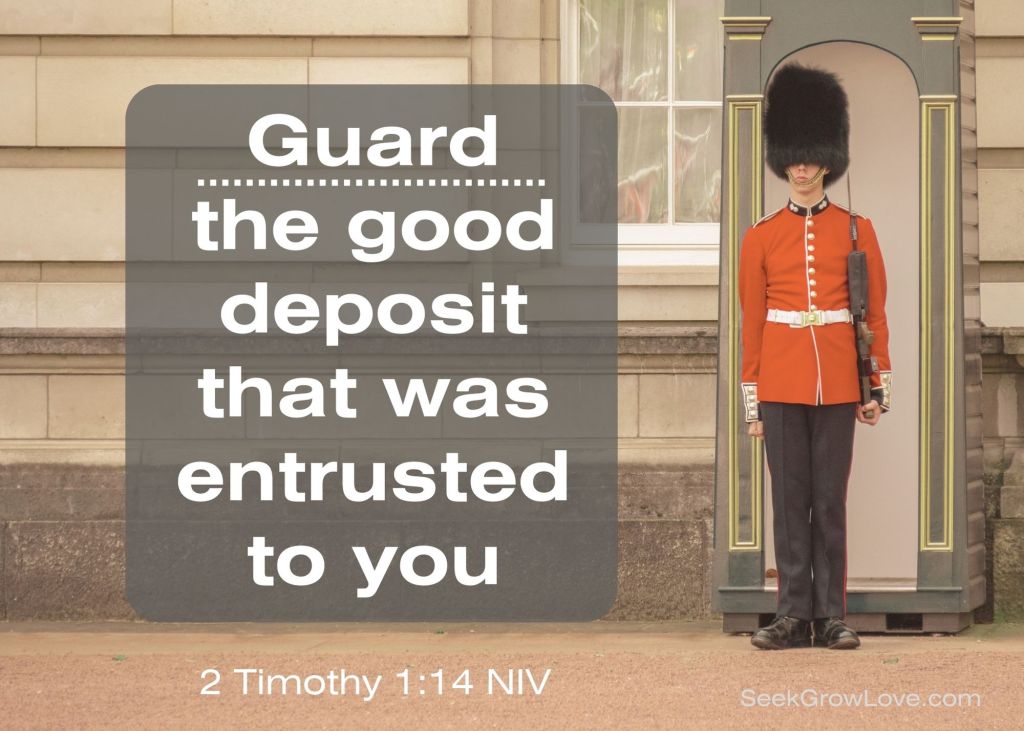
Have you ever been asked to guard something?  If you’ve ever played a team sport it’s likely that you guarded someone or something.  When you play defense in basketball or hockey you guard someone.  In basketball and football, there are positions called guards.  In baseball, the catcher is responsible for guarding home plate.

We encounter lots of guards in life- prison guards,  security guards, the National Guard.  Celebrities and politicians and other rich and powerful people often have bodyguards.  If you’re out with a friend at a busy place and they go to buy food or use the restroom they might ask you to “guard my seat”.  

To guard something means that you have been entrusted to protect someone or something that is valued by another.  In today’s reading of 2 Timothy 1, the Apostle Paul has written to Timothy and reminded him about all of the goods that have been entrusted to him in his life.  He speaks about the sincere faith that began in both Timothy’s grandmother and mother now in him.  He describes this faith as something that has been entrusted to Timothy and must be guarded.  I have the image of going to the bank and bringing my paycheck and giving it to the bank officer and asking her to guard my money until I needed it.  I am entrusting my deposit with the bank.  Here, Paul is entrusting his spiritual deposits to Timothy.  Just as Timothy’s grandmother and mother made spiritual deposits in his life, Paul too made spiritual deposits.  Now it’s up to Timothy to both guard those deposits and also put them to good use.  Paul freely changes metaphors to that of fire.  A fire that has started often needs to be fanned, given more air, until it grows enough to really burn.  Protect the deposit and fan the flame.  This is Paul’s counsel to Timothy.

You’ve undoubtedly had many people make faith deposits in your life.  For some, like Timothy, it was a grandparent or parent or other spiritual teacher or mentor.  Maybe it was a Sunday School teacher or youth leader, maybe it was a pastor or a counselor at Church camp.  For many, it was likely a combination of many people who taught by words or actions what it means to know Jesus Christ and follow him as a disciple.  I know in my nearly 60 years of life there have been countless people who have made faith deposits into my life, and who have helped me with my spiritual formation.   These people have shared incredible gifts of faith with me.  I feel a particular responsibility to not allow those gifts to go by the wayside, to be left unvalued,  unused, and unguarded.    I take the deposits of faith that have been entrusted to me and put them to work for Jesus Christ and for the Kingdom of God.  This is an incredibly important responsibility and one that I do not take lightly.  I owe a tremendous debt of gratitude to those who made faith deposits in my life and so I want to “pay it forward” by making faith deposits into the lives of others.  This is why 45 years after I first attended Youth Camp (Now FUEL) I’m still trying to make faith deposits.  I hope and pray that you guard what has been entrusted to you and fan into the flame the gifts that have been given to you so that God’s word will continue to spread like wildfire into a world that needs more faith.

Jeff Fletcher

Reflection Questions:

  1. Take a moment to write down the names of people that you can think of who have made faith deposits into your life.   Say a prayer of thanks for them, or send one of them a note and say “thank you” for the faith deposits they’ve made in your life.
  2. What are some ways that you can fan into flame the gifts that have been given you?  What specific things will you do to help spread the faith in Jesus Christ shared with you?
  3. How can you best guard what has been deposited into your spiritual bank account by others?

God’s Fellow Worker

Old Testament: 1 Chronicles 25-27

Poetry: Psalm 148

* New Testament: 1 Thessalonians 3

Have you even been introduced to someone as God’s fellow worker? It has a nice ring to it, doesn’t it? Paul described Timothy as, “our brother and God’s fellow worker in spreading the gospel of Christ, to strengthen and encourage you (the Thessalonians) in your faith” (1 Thessalonians 3:2). Could you be described as God’s fellow worker?

I am impressed in this chapter (1 Thessalonians 3) with Paul’s obvious heart for his fellow workers (there was a reason they were called brothers even though they had no blood relations) and his heart for the church – some of whom he had not known long and had only spent a short time with. And yet, with the good news Timothy brought of the Thessalonians’ strong faith and love Paul says, “For now we really live, since you are standing firm in the Lord” (1 Thess 3:8). You can hear his heart filled with joy. For now we really live!

Paul had been concerned that when he and his fellow workers moved on to carry the gospel message to other towns the tempter might be successful in tempting the young Thessalonian church away from true faith in God and love for Him and one another. It is a very real and powerful threat that is still active and alive today. It is why the armor of God is so important. Thankfully, the Thessalonians were standing strong.

Another way that Paul shows his heart is through his prayers – night and day – most earnestly – remembering the Thessalonians, praying they might see each other again, and praying that their faith would be strengthened even more. This is an important reminder to keep praying for our brothers and sisters in the church – even if they appear to be doing alright and don’t have any known health problems (often the most common needs on the church prayer list). The tempter is always looking for little cracks in the armor. Prayer is huge. Keep at it. Night and day. Most earnestly. Remember your extended church family in your prayers. Pray for their faith to be strong and growing – with any gaps filled in to present a stronger front against the tempter.

Healthy faith displays action and love. Pray also that love will be increased – love for each other (the church) and also for “everyone else” (vs. 12) including those outside who need to know God and His Son Jesus. Increasing love. Love is a beautiful thing – but increasing love is even so much better. Don’t be content being a loving person – strive and pray to have increasing love. Be a parent, a spouse, a neighbor, a boss, a co-worker, a missionary, one of God’s fellow workers with increasing love. Pray for increasing love for yourself, each other and everyone else.

AND – of course we have to end this devotion as Paul ends every chapter in 1 Thessalonians – REMEMBER – Jesus is coming back!! So live your life preparing for that day! As Paul says so well – “May he strengthen your hearts so that you will be blameless and holy in the presence of our God and Father when our Lord Jesus comes with all his holy ones.” This is my prayer for you – my fellow SeekGrowLove reader. Blameless and holy, I hope to see you there. Come, Lord Jesus, come!

-Marcia Railton

Reflection Questions

  1. Wh0 has been God’s fellow workers with you? What have they done for you and for God? Do they know how much you appreciate them?
  2. How is your faith and love doing – if someone were sent to give Paul a report on you and your church’s faith and love what would Paul hear back? Would he rejoice that you are standing firm? Where can your faith grow, filling in the gaps? How can your love increase?
  3. Pray the prayers of Paul in 1 Thessalonians 3 (for faith filled in, increasing love and blameless/holy people ready to stand/bow before God when Jesus returns) for yourself, and your church family and extended church family. Use specific names God brings to mind. Repeat night and day – most earnestly.

Your Joy

Old Testament: 1 Chronicles 22-24

Poetry: Psalm 147

*New Testament: 1 Thessalonians 2

In the first chapter of First Thessalonians, which we discussed a little yesterday, we see Paul commending the Thessalonians for welcoming the gospel message with joy, even in the face of severe suffering. He is thankful for their work, labor and hope. They had left behind their idols and were serving God and waiting for the return of His Son. Paul notes how they became imitators of him and of the Lord. It is obvious they had first of all listened and believed the message; but then they were also doing, working, sharing the message and actively being a model to others so that “the Lord’s message rang out from you…your faith in God has become known everywhere” (1 Thessalonians 1:8).

I love this picture of Paul’s effective ministry! People have heard the message, they have responded, changed their lives and are serving God. The Lord’s message is now ringing out from the ones Paul shared the Scriptures with! This is a beautiful picture of an effective ministry. This is what I want. Do you want it, too?

Keep in mind, ministry is not just for the licensed pastor. Being a minister of God’s word to God’s creation is for the SS teacher, the elder, the parent, the prayer warrior, the family member, the neighbor, the co-worker who has a heart for God and following his commands and loves people enough to show them the way to be saved through Jesus. Are you a minister? I hope so. Am I a minister? I hope so. If so, let’s do it well. What can we learn from Paul about effective ministry? There’s a lot of wise answers in this short chapter of 1 Thessalonians 2 – here are some of my favorites.

– Know that you don’t do it alone. ONLY do ministry with God’s help. It is HIS gospel message and he will give you the courage and knowledge to share it the way He desires (vs 2).

-Expect some strong opposition. Opposition doesn’t always mean you should stop what you are doing. Sometimes (vs. 2) it means you need God’s help to be bold and carry on because you are doing God’s work and man is opposing you. Other times Paul was stopped from doing what He thought God wanted him to do because God wanted him to do something else. Sometimes, it is Satan opposing us (vs. 18) and we pray and pray some more. In this particular instance Paul found other ways to continue his ministry – can’t go to Thessalonica now but can send Timothy and write letters. Prayerfully consider the source of the opposition before you decide how to proceed.

-Watch yourself so you don’t spread untruths or have impure, selfish motives or use trickery or flattery. Don’t pretend to be someone you are not, don’t be greedy – that’s a huge turn-off (vs. 3 & 5).

-DON’T work to please men. Work to please GOD! (vs. 4) A ministry built to please men will NOT be pleasing to God. It will crumble. Men (and women) are fickle and wrong and selfish and proud and sinners – don’t spend your efforts trying to make them happy and trying to have them like you. God is right and holy and awesome and love and perfect and just. What He says is the One that matters. Live your life and do your ministry to hear His praise and not man’s (vs.6). That doesn’t mean people don’t matter! They matter so much Jesus died for them. But their opinions, wants and view of the truth are always inferior to what God wants and knows to be true. Seek to always please God not men.

-Be gentle – like a mother. And encouraging – like a father. Help them feel valued, important and safe – while urging them to life lives worthy of God who is calling them into his kingdom and glory (vs 7-12). Share your life with them. Be genuinely interested in who they are. Paul wasn’t a street corner evangelist yelling at people as they walked by. He definitely spent a lot of time helping people study and learn the Scriptures – he also spent time working alongside people and having deep discussions – just like a spiritual parent.

So those were some of my favorite pearls of wisdom on how Paul did his effective ministy. Read the chapter to find your own favorites. And then, pray and get to work. We are called to make disciples. What will your ministry look like? How will you imitate Paul and Jesus and the early church which are models for us?

And, as this chapter ends again with a most important theme and reminder, so this devotion ends with the same – Jesus is coming back. Paul was looking forward to the day not only for his sake – but for the joy he would have in standing next to his spiritual brothers and sisters whom he had ministered to in Thessalonica and many other places. They would be his crown, glory and joy as they too were now anxiously anticipating and prepared for the return of Jesus. Look around you today. Prayerfully consider – who is God calling you to minister to? Who is he asking you to prepare for the return of Christ? How is he asking you to do it? Who do you want to be standing next to when Jesus returns, knowing that they are your joy?

-Marcia Railton

Questions for Reflection

  1. Do you have a ministry? What does it look like? How is it similar and different from Paul’s? What do you want it to look like?
  2. What could you do to make your life and ministry more pleasing to God? Pray about it and make a plan with steps to move in this direction.
  3. Prayerfully consider – who is God calling you to minister to? Who is he asking you to prepare for the return of Christ? How is he asking you to do it? Who do you want to be standing next to when Jesus returns, knowing that they are your joy?

Change

Old Testament: 1 Chronicles 10-12
Poetry: Psalm 143
New Testament: Colossians 3

Change, change, change – there is a lot of it in Colossians 3. And it jumps out to me as I read it because my family and 200 of our friends (some we just met, some we’ve known all our lives) just gathered last week at Camp Mack in northern Indiana for Family Camp where the theme of the week was Change.

It is so true that while we were still in our sins God loved us enough to send His one and only Son to die for us that we might be saved from the final and lasting death our sins deserve. God’s grace is huge! Huge enough I need to say it again. God’s grace is huge! It is also true that when we accept this incredible gift God calls on you and I to change. In Colossians 3 this change is referred to as taking off your old self and putting on your new self. Out with the old, in with the new. And not just a little bit less of the old self – but put it to death (vs. 5). No more! No more “sexual immorality, impurity, lust, evil desires and greed, which is idolatry” (vs. 5). Also, “you must rid yourselves of all such things as these: anger, rage, malice, slander, and filthy language from your lips. Do not lie to each other” (vs. 8,9a). Put it to death! Get rid of it! Change!

There are many reasons why we want to change – because God said to, because we want to be more like Jesus, and because we want to set a good example for our Christian brothers and sisters. And yet a powerful reason we NEED to change is stated in verse 6 – the wrath of God is coming because of the acts of the old/earthly nature. God’s wrath is real. Real enough I need to say it again. God’s wrath is real.

So what do we do? Once we see the need to change and we want to change, how do we do it? How do we change? Colossians 3 has some great steps to take.

Clothe yourself with the new (3:12-15)- replace the old with the new. The old has a much harder time trying to creep back in when it’s old place has been filled to overflowing with new, good, godly things: compassion, kindness, humility, gentleness, patience, bearing with one another, forgiving, love, peace of Christ, unity, thankfulness. How can you grow these characteristics?

Set your hearts and your minds on things above (3:1,2) – don’t get caught up in daily, worldly living – focus on Jesus at the right hand of his Father. What will that look like for you? What will it take? Is there a difference between setting your heart on things above and setting your mind on things above? If so, how can you do both?

Your new self you want to grow is “renewed in knowledge in the image of its Creator” (3:10) and we are told to, “Let the word of Christ dwell in you richly” (3:16) – God made you with a brain and the ability to learn and grow and change. Fill your brain with knowledge of the Creator and the words of Christ. Read your Bible regularly! It is important. It is a huge key to lasting change as we discover and do what pleases the Lord.

In perfect unity – be “members of one body” – the body of Christ – the church – “teach and admonish one another with all wisdom” (3:14-16). There is no perfect church, but church is the perfect place to work together for changed lives for the Lord. Stay connected with other imperfect people and together set your minds and hearts on things above, “teaching and admonishing one another with all wisdom.”

Work at it – remember you are serving the Lord and not men (3:23,24). Are you serving men or serving the Lord? How can you tell? How can others tell? It will be work. Work that is rewarding and worth it.

Remember not only the wrath of God which is coming for those who are living in the old nature, but also the reward of God which is the blessed hope of those living in the new nature. If Christ IS your life, then when he appears, you too will appear with him in glory and you will receive an inheritance from the Lord as your reward. (3:4 & 24).

It’s time for a change. Before it’s too late. What will you change today?

-Marcia Railton

Reflection Questions

  1. What “old self” practices and characteristics have you worked at (or are still working on) eliminating? What “new self” practices and characteristics are (or ought to be) taking their place?
  2. Consider the other questions in the devotion. Then pray to God about any changes you feel He wants you to make. Continue being open to other changes God wants to show you.

The Good News

Old Testament: 1 Chron 4-6

Poetry: Ps. 141

New Testament: Colossians 1

Last year, the young adults at my church went through an in-depth study of the gospel. We discussed what the gospel is and why it is so important to be able to “give an answer for the hope that you have” (1 Peter 3:15). What is your understanding of the gospel? Go ahead a pause for a minute and try to sum up what you think the gospel is in a few sentences. 

It’s important to be able to quickly and succinctly sum up what the gospel is. Yes, we can go deeper in our theology. Some things about our Christian walk take a whole life time of wisdom to be able to truly understand. However, when it comes to the basic building blocks of our faith, we need to have an answer for it. We need to understand what we believe. This is the first step towards spiritual maturity. 

In today’s reading, Paul begins his letter to the Colossian church. He give thanks to God for the people in the church and then describes to them why Christ should be so highly esteemed. This passage is a good go-to passage for understanding what the gospel is. Paul begins in Colossians 1:18-20, “And [Jesus] is the head of the body, the church. He is the beginning, the firstborn from the dead, that in everything he might be preeminent. For in him all the fullness of God was please to dwell, and through him to reconcile to himself all things, whether on earth or in heaven, making peace by the blood of his cross.” The gospel, or good news, is the reconciling of us to God through the blood of Jesus. Jesus’ sacrifice made peace between God and man. Not only that, the gospel also points to our hope. Jesus was the firstborn from the dead. His resurrection is proof and assurance of our future resurrection. 

Paul goes on to describe how the gospel changes us in verses 21-22. He says, “And you, who once were alienated and hostile in mind, doing evil deeds, he has now reconciled in his body of flesh by his death, in order to present you holy and blameless and above reproach before him.” When we were not reconciled, we lived doing evil deeds. We were in darkness. Because we have been justified before God, we also can be sanctified. This is the process of being made holy, blameless, and above reproach before God. We are learning how to be made righteous, be made perfect. This is a process that takes a lifetime. The gospel changes everything about us, maybe not right away – but instead through consistently trying to live for God in the best way we can. 

This is why it is so important to understand the gospel and be committed to living for God throughout our life. We will be sanctified “if indeed [we] continue in the fath, stable and steadfast, not shifting from the hope of the gospel that [we] heard” (v. 23). Hold fast to the one who saves! 

~ Cayce Fletcher

You can read more devotions and studies written by Cayce Fletcher at amorebeautifullifecollective.com

Reflection Questions: 

  1. What is your understanding of the gospel? Write down a 1-3 sentence description of what the gospel is.  
  2. Using your understanding of the Old Testament, why was Jesus’ sacrifice necessary to justify us before God?   
  3. What has the gospel changed in your life?   

sgl23bibleplanDOWNLOAD

Our Hope in the Face of our Enemies

Old Testament: 1 Chron 1-3

Poetry: Ps. 140

New Testament: Colossians Introduction See Below

I love a good adventure story. One of my favorites is The Lord of the Rings (the original series of course). The movies came out when I was young, and I loved the epic battle between good and evil that they portrayed. One of my favorite parts is in the second movie during the Battle of Helm’s Deep. For those of you who aren’t familiar with this scene, let me paint the picture for you. The people were terrified as they were locked away in a fortress that was described as impenetrable. However, the defenses were failing as a massive army of mindless monsters had lined up before the fortress with the sole purpose of annihilating everyone within them. The people inside felt hopeless. They had sent the women and children to hide in caves. The men were putting on armor, knowing that the outcome of the war was a seemingly hopeless situation, that the fight they were putting up was futile, symbolic. They would not back down. 

I imagine that the people in Helm’s deep would empathize with the Psalm we read today. David, who was also on the run from his enemies, faced imminent danger. Because of Saul’s jealousy, he was out to kill David. In Saul’s mind, David was a threat to his throne, and that threat must be taken care of even though David had been nothing but respectful of Saul’s authority throughout his life. David knew what it was like to be in a seemingly hopeless situation. He explains in Psalm 140:1-3, “Deliver me, O LORD, from evil men; preserve me from violent men, who plan evil things in their heart and stir up wars continually. They make their tongue sharp as a serpent’s, and under their lips is the venom of asps.” David was pursued by evil men and felt like he was almost in their clutches. Without God, his situation would have been hopeless. 

In the battle of Helm’s Deep, the people were saved after the third day when Gandalf returned with another army that was able to defeat the army of the enemies. This is an obvious allusion to our ultimate hope that J.R.R. Tolkien, a Christian, included in his book. David also points to this hope in Psalm 140 when he says in verse 12-13, “I know the LORD will maintain the cause of the afflicted and will execute justice for the needy. Surely the righteous shall give thanks to your name; the upright shall dwell in your presence.” Though David’s situation was difficult and dangerous, he knew that there was hope in his situation that seemed hopeless. His hope was God, and he knew that God would come to his aid. 

God has also come to our aid through his son. Jesus is the light at the third day coming to defeat the forces of darkness in the world. The genealogies of 1 Chronicles point to this perfect salvation, the son of David. He is “the true light, which gives light to everyone” (John 1:9). This “light shines in the darkness, and the darkness has not overcome it” (John 1:5). 

When we face down our enemies, when we feel like we are in a seemingly hopeless situation, we can remember of the light, the hope, that we have in Jesus. He has already saved us. 

~ Cayce Fletcher

Reflection Questions: 

  1. Are there areas of your life that feel hopeless? How does this Psalm give encouragement to you?   
  2. Now that we are not fighting physical battles as frequently as in David’s time, some of the Psalms can seem a little archaic. Who are our enemies now? How do we fight against them?  
  3. Why do you think that 1 Chronicles begins with a focus on genealogies? How does knowing your history help you live well today? 

Colossians Introduction

Paul, possibly with the help of Timothy, wrote the book of Colossians to the church at Colossi while in prison in Rome.  He had never been to Colossi when he wrote the letter to them.  

Paul wrote this letter warning the Colossians about doctrinal errors in 2:8, “See to it that no one takes you captive through hollow and deceptive philosophy, which depends on human tradition and the basic principles of this world rather than on Christ.”  This sounds like particularly good advice to us today.

Paul highlighted the importance of living a holy life.  3:1-6 is just a sampling, “Since, then, you have been raised with Christ, set your hearts on things above, where Christ is, seated at the right hand of God.  Set your minds on things above, not on earthly things.  For you died, and your life is now hidden with Christ in God. When Christ, who is your life, appears, then you also will appear with him in glory.  Put to death, therefore, whatever belongs to your earthly nature: sexual immorality, impurity, lust, evil desires and greed, which is idolatry. Because of these, the wrath of God is coming.”

I’ll close with Paul’s advice as recorded in 3:23-25, “Whatever you do, work at it with all your heart, as working for the Lord, not for human masters, since you know that you will receive an inheritance from the Lord as a reward. It is the Lord Christ you are serving.  Anyone who does wrong will be repaid for their wrongs, and there is no favoritism.”

–Steve

sgl23bibleplanDOWNLOAD

The Loving Character of God

Old Testament: 1 & 2 Chron Introduction (See below)

Poetry: Ps. 139

New Testament: Philippians 4

In the midst of all of our discussions of punishment for sin and idolatry, it can paint a picture of a harsh, just God. We know that God is doing the right thing, but it seems like the right thing is also cruel. Today’s scripture brings into focus another aspect of God that proves how loving and truly kind God is. Psalm 139 is a famous scripture and for good reason. Here are some truths we can learn about God from this beautiful and comforting Psalm. 

  1. God knows who we truly are. We cannot hide from God, and we don’t need to feel like we have to. The Psalm begins, “O Lord, you have searched me and known me! […] Even before a word is on my tongue, behold, O LORD, you know it altogether” (v. 1, 4). We can find great comfort in that all the ugly, messed up parts of ourselves is already known to God. We don’t need to try to “flee from [his] presence” (v. 7) because he is already there. This shouldn’t make us feel afraid. Instead, we should feel like we can bring everything we are to God and lay it at his feet. He already knows anyway. 
  2. God’s boundaries are good boundaries. Verse 5 says, “You hem me in, behind and before, and lay your hand upon me.” When we think of God’s law, we can think of it as the rules that keep us safe. It reminds me of the baby gates in my house. My little girl is just starting to crawl. The one place in the house that she always wants to get to is the stairs. She has no idea how to go down them though! The baby gates in my house protect her from the thing that she wants to do. It is a boundary, a law, of protection that turns out to be provision for her. 
  3. God knows our days. We can find great comfort in the sovereignty of God. As we face trials and uncertainties, we know that “Your eyes saw my unformed substance; in your book were written, every one of them, the days that were formed for me, when as yet there was none of them” (v. 16). We believe that God is a good God, and we know that he has good things in store for us. It may not always work out like we hope. But, it will be something that works out for the glory of God. And ultimately, that is the best good. 

As we consider the punishment that God gives, its always important to center that conversation on the never-changing character of God. Exodus 34:6-7 describes the character of God in this way, “The LORD, the LORD, a God merciful and gracious, slow to anger, and abounding in steadfast love and faithfulness, keeping steadfast love for thousandth generation, forgiving iniquity and transgression and sin, but who will by no means clear the guilty, visiting the iniquity of the fathers on the children and the children’s children, to the third and fourth generations.” We see here the story of Israel played out. Yes, God punished a few generations of children because of the iniquity of the Israelites. But, before that, God was faithful and stood by the Israelites. Not only that, after the Israelites were in exile for a few generations, God brought them back. He remembered them and brought them home to the Promised Land. Truly how “Wonderful are your works; my soul knows it very well” (Ps. 139:14). 

~ Cayce Fletcher

Reflection Questions: 

  1. How does reading about the punishment for idolatry make you feel? Does reading about the character of God change those feelings?   
  2. Read Ps. 139:7-12. What does it mean to you that God’s presence is everywhere? How does that change the way you live?   
  3. Pray over verses 23 and 24. Bring to God any of the areas of your life that you feel like a “grevious” to him.   

1 & 2 Chronicles Introduction

The word chronicles means “a factual written account of important or historical events in the order of their occurrence.”  The books of 1 & 2 Chronicles list two such important pieces of information for post-exilic Jews.  

The first is the list of genealogies recorded in the first 9 chapters of 1 Chronicles.  This was important for Jews after the exile to be able to trace their lineage to God’s promised people, and therefore to the promises God made to Abraham.  

The second reason for the name “Chronicles” is that 1 & 2 Chronicles retells the story that was originally told in 1 & 2 Samuel and 1 & 2 Kings.  The difference is that 1 & 2 Chronicles gives only information on the kings of the Southern Kingdon (King David and his descendants).  

These books were written after the fall of the Southern Kingdom to Nebuchadnezzar’s army around 587 BC.  And since the last chapter also includes information about the edict of Cyrus – allowing the Jews to return to Israel –, which took place in 539 BC, these books were likely written in or shortly after 539 BC.

While 1 & 2 Samuel and 1 & 2 Kings share much of the same historical narrative as 1 & 2 Chronicles, Samuel and Kings point out that Israel is being punished for her sins.  Chronicles was written to inspire hope and faith in God.  

Another example of the difference is that Chronicles shows the kings in a more favorable light, including evil king Manasseh, who 2 Chronicles records as repenting of his sins – a fact not recorded in 2 Kings.

Finally, Chronicles shows more cause and effect within a king’s lifetime for his decision to follow or forsake God.  

As you read through 1 & 2 Chronicles, may you too recognize the results of not only the kings’ life choices but also the consequences of your own life choices.  And may you also experience the hope Chronicles tries to convey.  And may you be among those people God is referring to when he said, in 2 Chronicles 7:14, “if my people who are called by my name humble themselves, and pray and seek my face and turn from their wicked ways, then I will hear from heaven and will forgive their sin and heal their land.”

–Steve

sgl23bibleplanDOWNLOAD

Where is your citizenship?

Old Testament: 2 Kings 23-25

Poetry: Ps. 138

New Testament: Philippians 3

The place where we live is so central to who we are as people. It truly is one of the most important parts of our identity. It changes everything: from the foods we like, the music we listen to, the political parties we vote for, our priorities… basically everything. I’m from the south, and I remember going to our national church camp, FUEL, in the summer and being teased for the way we talk, the types of drinks we like (Who doesn’t like sweet tea? Oh right, all you northerners.), and the music we listen to. Before going to these camps, none of those things even struck me as weird. It was just the way everyone around me lived. Where we live can define us. But, we have a more important citizenship – a more important place of belonging – than just our physical address. 

Today, we read about the final demise of the Israelite nation. From the beginning, when God called Abraham out of the future land of Babylon and into the promised land of Canaan – the future land of Israel, there was a beacon of hope and assurance that God was for the Israelite people and would come to their aid. They were his people. 

Even though Josiah instituted reforms to bring his people back to God, the evil the people of Judah had done was so great that God promised, “I will remove Judah also out of my sight, as I have removed Israel, and I will cast off this city that I have chosen, Jerusalem, and the house of which I said, My name shall be there” (2 Kings 23: 27). The devastating consequence of sin is the removal of belonging with God. This meant that the people of Judah – the last remnant of the Israelites who had settled in Canaan – could no longer find their citizenship in the Promised Land. Instead, they were taken captive by the Babylonians and returned to the land that God had called them out of. This is a harsh statement of rejection of the Israelite people. The one whom God had said, ‘I called you out of Egypt to be my chosen possession’ had been returned to the places of captivity. 

Citizenship, rejection. Freedom, captivity. These opposite poles of human existence that the Israelites could choose based on how obedient they were to God’s commands. Because they rejected God’s commands, he rejected them. The freedom they would have in submitting to God and setting boundaries on their freedom based on his law became captivity under other rulers due to their desire to do whatever they pleased.

We have the same promise and warning today. The same choice is set before us. We can choose for our citizenship – our place of belonging – to be in heaven (Phil. 3:20-21) or to be enemies of Christ (v. 18). Phil. 3:19 describes these enemies in the following way: “Their end is destruction, their god is their belly, and they glory in their shame.” This statement could have been written for the people in Judah and Israel. And it could be written to those today who choose to do whatever is right in their eyes rather than follow God’s word. 

To be citizens of heaven, we must follow Paul’s example. I “press on to make it [the resurrection of the dead, aka the Kingdom Life we are promised] my own, because Christ Jesus has made me his own. Brothers, I do not consider that I have made it my own. But one thing I do: forgetting what lies behind and straining forward to what lies ahead. I press on toward the goal for the prize of the upward call of God in Christ Jesus” (v. 12-14). Hold fast to God, and obey his commands! Choose to be a citizen of God’s Kingdom! 

~ Cayce Fletcher

Reflection Questions: 

  1. How does the place where you live affect who you are as a person?   
  2. How would a citizen of the Kingdom act differently than those of the world? Where do you find your citizenship?   
  3. There’s a glimmer of hope in 2 Kings 25:27-30. Jehoiachin is able to “put off his prison garments. Every day of his life he dined regularly at the king’s table.” How do you put off your prison garments of sin and dine at the table of the King in your everyday life?   

sgl23bibleplanDOWNLOAD

Shine like Stars

Old Testament: 2 Kings 21-22

Poetry: Ps. 137

New Testament: Philippians 2

My son, Jonah, is afraid of the dark. For a while, after we would read him a bedtime story and sing “Silent Night” as a lullaby, we would close the door to a dark, quiet room. And, a few moments later, we would hear the pitter-patter of feet as he would get out of his toddler bed, go over to the lamp in his room, and click it on. One day while he was playing, he told me that he had to turn his light on because he doesn’t like the dark because there are monsters in the dark. 

Even though I am grown, I can empathize with his fears. I remember – and I bet you do too – those moments of fear when the lights go out. I remember begging my parents to leave the closet light on because I was unsure what was lurking out there in the dark past my bed. It seems only natural to be a little afraid of the dark, those places you can’t see. It’s a built-in defense mechanism that humans have to navigate nighttime in our world. 

The Bible is full of themes that occur from beginning to end. You could trace the way water is used as a symbol of chaos and cleansing or the way trees represent a strong, godly life. One theme that occurs from beginning to end is the contrast between dark and light. Darkness is always connected with sin and evil, whereas light is connected with righteousness and God himself. 

This is a quick overview of the way this theme is used in scripture. In the beginning, God created the light and called it good (Gen. 1:4). After the fall, the world is described as being in darkness. God is constantly beckoning his people to be a light to the surrounding nations (Gen. 15:5), but Israel repeatedly chose darkness. Jesus is the true light that shines out into the dark world – and his light “gives light to everyone” (John 1:9). We are now the torchbearers that continue to shine a light in the world. We are called to “shine as lights in the world” (Phil. 2:15). We “cast off our works of darkness and put on the armor of light” (Rom. 13:12, see also Eph. 5:7-14). 

We see an example of being a light to the world in Judah’s king Josiah. After two dark, wicked kings of Judah, Josiah repairs the temple. He becomes a light to the nation calling them back to worship God and obey him after over half a century of disobedience. He repairs the temple and shares the law with Judah. The people were in darkness because of the evil kings, but Josiah was being a light pointing them back toward God. Just like the nation of Judah, we also have a tendency to pull toward darkness. In fact, sometimes we seem to like darkness; we prefer it over having our deeds exposed in the light. However, since we are in Christ, we need to put aside those worldly desires and choose to follow God completely. God is light and there is no darkness in him (1 John 1:5). We cannot do the deeds of darkness and follow God at the same time. Let’s be like King Josiah, and be a leader of light to those around us. 

~ Cayce Fletcher

Reflection Questions: 

  1. Why do you think that the Bible uses the imagery of light and darkness to represent good and evil?   
  2. How was King Josiah a light to his country?   
  3. How can you be a light that represents Jesus to others today? What are some actions you could take?   

sgl23bibleplanDOWNLOAD

When You Don’t Know What Else to Do

Old Testament: 2 Kings 19-20

Poetry: Ps. 136

New Testament: Philippians 1

Yesterday, we learned about the exile of the nation of Israel because of the idolatry that they practiced. 2 Kings 17:34 describes the Israelites who lived in Samaria: “To this day they do according to the former manner [fearing God but also serving the gods of the surrounding nations]. They do not fear the LORD, and they do not follow the statutes or the rules or the law of the commandments the LORD commanded the children of Jacob, whom he named Israel.” The nation of Israel had spiraled down the dark, deep hole of sin that ended in exile. 

There is a glimmer of hope in 2 Kings 18, as we read about Hezekiah the good king of the neighboring nation, Judah. “He trusted in the LORD, the God of Israel, so that there was none like him among all the kings of Judah after him, nor among those who were before him. For he held fast to the LORD. He did not depart from following him but kept the commandments that the LORD commanded Moses” (v.5-6). 

A little over halfway through his reign, Hezekiah is faced with a terrible situation. The king of Assyria attacks Judah and forces Judah to pay him tribute. Things even got so bad that Hezekiah stripped the gold off the temple doors and gives it to the Assyrian king. The Assyrians mock God and swear that God has forsaken Judah. This is where chapter 19 picks up. 

When faced with a terrible situation, what does Hezekiah do? Hezekiah humbles himself, goes to God, and listens. Hezekiah sent people to Isaiah to pray in the nation’s behalf (v. 4). This proves to be exactly the right course of action. 

We can learn so much from the reign of Hezekiah, but I think it’s so important to look at how he handled these difficult situations. You can follow the example of Hezekiah in doing the following: 

  1. Humble yourself. Hezekiah tore his clothes and covered himself with sackcloth. He didn’t try to appear to have his life together. He recognized the severity of the situation and knew he could not save himself without God. 
  2. Go to God. Hezekiah went to the house of the Lord immediately. He knew where to turn with the situation got tough. 
  3. Seek counsel and comfort from godly people. Hezekiah gathered up a few trusted servants and priests to go to Isaiah, the prophet for help. 
  4. Recognize that you have a mediator who knows your needs. Hezekiah turned to Isaiah to be a mediator between God and him. He asks Isaiah to pray for him. We don’t have to turn to men to pray for us. Instead, we can go to God ourselves because we have a mediator in Jesus. 

At the end of this chapter, Isaiah gives some reassuring news. The Assyrian king would not destroy Judah. In fact, he would fall by his own sword. Verse 35-37 goes on to say, “That night the angel of the LORD went out and struck down 185,000 in the camp of the Assyrians. And when the people arose early in the morning, behold these were all dead bodies. Then Sennacherib king of Assyria departed and went home and lived at Nineveh. And as he was worshiping in the house of Nisroch his god Adrammelech and Sharezer, his sons, struck him down with the sword.” God’s promises are true. Praise God that we can go to him in all of our sufferings. 

~ Cayce Fletcher

Reflection Questions: 

  1. What difficult situation are you facing today? What strikes fear in your heart? Makes you despair? Bring this situation to God. 
  2. Who are some people you can turn to in difficult situations that can help to point you to Christ?   
  3. How is prayer different from the Old Testament to the New Testament because of Christ?   

sgl23bibleplanDOWNLOAD