Dedicated to Prayer

Mark 1

Saturday, July 23, 2022

As usual, there are many areas we could focus on in today’s devotion.  I’d like to start with a very quick recap of Mark 1.

Mark 1 starts out with John the Baptists preaching a baptism of repentance for the forgiveness of sins (1:4) to prepare the way for Jesus.  Compared with the Old Testament sacrifices, this was revolutionary – introducing a new and better way to reconcile with God.  Confess sins, turn away from those sins, and be baptized for the forgiveness of those sins.

Mark 1 continues with Jesus’ baptism, when God declared, “You are my Son, whom I love; with you, I am well pleased.”  After which Jesus went into the desert to be tempted by Satan for 40 days.

After that, as Jesus performed miracles, “News about him spread quickly over the whole region of Galilee.” (1:28)  After sunset one evening, Mark 1:33 says, “The whole town gathered at the door”, because Jesus was healing many who had various diseases and casting out demons.

Mark 1:35 gives some insight into Jesus’ prayer life, “Very early in the morning, while it was still dark, Jesus got up, left the house and went off to a solitary place where he prayed.”  He was interrupted by his disciples, who said, “Everyone is looking for you.”  But Jesus left to go preach elsewhere because that was why he was sent.

Then, Mark 1:40-42 tells us, “A man with leprosy came to him and begged him on his knees, If you are willing, you can make me clean.  Filled with compassion, Jesus reached out his hand and touched the man.  I am willing, he said.  Be clean!  Immediately the leprosy left him and he was cured.”  As a result of his healing, this man told everyone what Jesus had done.  Mark 1:45 tells us, “As a result, Jesus could no longer enter a town openly but stayed outside in lonely places.  Yet the people still came to him from everywhere.”

The three things that stand out to me in Mark 1 are:

  1. Jesus’ dedication to prayer.
  2. Jesus’ compassion.
  3. Jesus’ popularity – because people couldn’t stop themselves from telling all that Jesus had done.

After staying up very late at night healing people who started to arrive after sunset, Jesus got up very early in the morning while it was still dark to go to a solitary place to pray.  Obviously, prayer was more important to Jesus than sleep.  I think there is a correlation between Jesus’ prayer life and his successful ministry.  How’s your prayer life?

Jesus healed so many people because he had compassion for them, and wanted to relieve their suffering.  I’m especially touched by his reaction to the man with leprosy who came to Jesus, begging to be healed.  Remember that leprosy made a person unclean.  According to the Old Testament law, such a person was an outcast, who had to stay away from people, wear a covering over their mouth, and yell “unclean”.  By coming to Jesus, this guy was breaking the law.  But he knew he likely had a terminal illness, and Jesus was his only possibility of a cure.  

And instead of shrinking back from this man, Jesus reached out his hand and touched the man.  This man had probably not felt another human touch for years.  And Jesus deliberately touched him and healed him.

Do you recognize that your sins are a terminal illness?  Will you come to Jesus, and beg him on your knees, “If you are willing, you can make me clean.”?  If you do, Jesus is still compassionate and will forgive your sins.

Finally, after Jesus healed people, and changed their lives, they couldn’t help but tell everyone what Jesus had done for them.  I can just imagine one of them saying something like, “You know this horrible problem I had?  Well, Jesus completely healed me and gave me a new lease on life.  I know you have some issues too, and I think you should go to Jesus to be healed like I was.  It will change your life too.”  – And as a result, Jesus’ fame and popularity exploded.  Because people couldn’t stop talking about what Jesus had done for them.

What has Jesus done for you?  How are you doing telling everyone you know?

In closing, I’d like to challenge you in a few areas.  First, step up your prayer life.  Give it a test.  Deliberately dedicate time early in the morning to pray, and seek God.  After a week, see what a difference it has made in your life.  If you see a great change, continue the practice.

Second, take all of your problems to Jesus (in prayer).  Your sins, your suffering, your concerns.  Jesus is still compassionate.  Sometimes, he grants physical healing, more often spiritual healing.  Give it a try.

Finally, once Jesus has done something for you, tell everyone you know how He has changed your life.

–Steve Mattison

Application Questions –

Today’s questions came from the devotion – go ahead and give some more time thinking about, and acting on, them.

  1. How’s your prayer life? What could you give up to make more time for prayer? Try the prayer test this week.
  2. Do you recognize that your sins are a terminal illness?  Will you come to Jesus, and beg him on your knees, “If you are willing, you can make me clean.”?  What will spiritual healing look like?
  3. What has Jesus done for you?  How are you doing telling everyone you know?

The Big Reveal on the Meaning of Life

Ecclesiastes 12

Thursday, July 21, 2022

After plodding through Ecclesiastes 1 and 3 over the last two day’s devotions, we are finally at Ecclesiastes 12, where Solomon has his reveal about the meaning of life.  Verse 1 starts out the chapter with, “Remember your Creator in the days of your youth, before the days of trouble come and the years approach when you will say, I find no pleasure in them.”  

The next 7 verses highlight why the elderly may not find pleasure in their old age – because they experience things like fading eyesight, losing hearing, developing tremors, stooping because of osteoporosis, losing teeth, unable to sleep – and then die.

So what does it mean to “remember your Creator?”  Is this like “remember to take out the trash?”  No.  And it entails a lot more than just thinking about Him once in a while. When you’re tempted to enjoy the pleasures of sin, remember your Creator.  When you’re tempted to live your life in rebellion against God, remember your Creator.  When your peers are doing something you know is wrong and you’re tempted to join in, remember your Creator.  It means putting God at the forefront of your thoughts, dedicating your life to Him, and living for Him.

I think there are several practical reasons to start serving the Lord while you are young.   Here is a partial list:

  • Life in a close relationship with God is satisfying and fulfilling, so the earlier you start that relationship with Him, the longer you’ll experience meaning in your life.
  • By accepting God while you are young, you will spare yourself a lot of pain and problems that you would experience in a life of rebellion against God.
  • You may want to live it up while you are young and plan on a “death bed confession” (giving your life to the Lord just before you die).  But we never know when we may die.  Accidents happen.  And you don’t want to suffer the eternal consequences of not devoting your life to the Lord.
  • You may get dementia as you age, and won’t be able to make a decision for the Lord late in life.
  • As people age, they get more set in their ways and find it more difficult to change.

I think Solomon is giving good advice, “remember your Creator in the days of your youth.”  

At the end of Ecclesiastes 12, we finally come to Solomon’s conclusion when seeking the meaning of life.  Ecclesiastes 12: 13-14 read, “Now all has been heard; here is the conclusion of the matter:  Fear God and keep his commandments, for this is the whole duty of man.  For God will bring every deed into judgment, including every hidden thing, whether it is good or evil.”

Fear includes a lot more than being scared of God.  It includes being in awe of Him.  Giving Him reverence.  Giving him glory.  Giving Him your life (living for Him).

To paraphrase Solomon, the bottom line is this:  

You can live your life your own way, and experience a life that is meaningless and unfulfilling, then die.  Or you can live your life God’s way, and experience a life that is meaningful and fulfilling, and then die.

Either way, you will die.  And when Jesus returns, you will face judgment.  If you have lived your life your own way, you will face condemnation and the second death.  If you have lived your life for God, you will receive commendation and will enjoy eternal life.

The only rational choice is to “fear God and keep his commandments.”

You don’t have to be rational.  But you do have to choose.  Choose wisely.

–Steve Mattison

Application Questions

  1. Look again at the list of reasons to start serving the Lord while you are young. Is there anything else you would add to it?
  2. If you have started serving the Lord, when did you start? Why was that a great time to do it? If you haven’t yet, what are you waiting for?

What to do with the Difficult Times

Ecclesiastes 3

Wednesday, July 20, 2022

Whether you know it or not, you’re probably familiar with the first few verses of Ecclesiastes 3:

1 There is a time for everything, and a season for every activity under the heavens:

2  a time to be born and a time to die, a time to plant and a time to uproot,

3  a time to kill and a time to heal, a time to tear down and a time to build,

4  a time to weep and a time to laugh, a time to mourn and a time to dance,

5  a time to scatter stones and a time to gather them, a time to embrace and a time to refrain from embracing,

6  a time to search and a time to give up, a time to keep and a time to throw away,

7  a time to tear and a time to mend, a time to be silent and a time to speak,

8  a time to love and a time to hate, a time for war and a time for peace.

I like about half the things listed, and would rather not have the other half, but life just doesn’t work that way.  We have to take the bad with the good.

I was at a funeral last Saturday when these verses were read.  It seems like this passage is mostly referenced during difficult times – because we don’t need to be reminded about these things during happy times.  When someone is born, we don’t want to be reminded that they will eventually die.  But when someone dies, we need to be reminded that this world has both good and bad, and we can’t just pick and choose what happens in life.

Verse 11 goes on to say, “He has made everything beautiful in its time.  He has also set eternity in the hearts of men…”.  

Does this mean that death is beautiful?; that cancer is beautiful?; that problems are beautiful?  No, not in themselves.  But the rest of the verse goes on to say that God has set eternity in the hearts of men.  I think that means these experiences make us long for the time when these problems will be a thing of the past.  When there will be no more death, or mourning, or crying, or pain – in the Kingdom of God. 

We mentioned Romans 8:22-23 a couple of days ago, which says, “We know that the whole creation has been groaning as in the pains of childbirth right up to the present time. Not only so, but we ourselves, who have the first fruits of the Spirit, groan inwardly as we wait eagerly for our adoption to sonship, the redemption of our bodies.”

In addition to pain and suffering being consequences of the Curse (Genesis 3) as a result of sin, I believe God uses these to help us long for His coming kingdom.  This longing helps us refocus our lives on following Him.  It also helps us not place too much importance on the temporary things this world has to offer.

James 1: 2-4 says, “Consider it pure joy, my brothers and sisters, whenever you face trials of many kinds, because you know that the testing of your faith produces perseverance. Let perseverance finish its work so that you may be mature and complete, not lacking anything.”

I believe this points out that difficulties we face in life can produce perseverance, helping us mature in our Christian walk, and helping us become more persistent in living for the Lord.  And if we finish strong – living our lives for the Lord – we will be in His kingdom, experiencing delight for eternity.  

So because difficulties can draw us closer to God, which will cause us to live more dedicated lives for Him, with the ultimate result of being in His kingdom, in this sense, everything works together for our ultimate good, and is therefore beautiful.  Even though it might seem like something stinks at the time, it can be beautiful – but only if it makes you long for the Kingdom of God and then live your life devoted to following Him.

If difficult times make us resent that God permitted these times, and if we reject God as a result of this, then we can look forward to Ecclesiastes 3:17 which says, “…God will bring to judgment both the righteous and the wicked…”

I’d like to challenge you to let the difficult times draw you closer to God.  But it’s entirely up to you how you respond.

–Steve Mattison

Application Questions

  1. What difficult times have you been through? What good times have you enjoyed?
  2. What can be learned through the good times? What can be learned through the difficult days (and seasons)?
  3. Looking back on your own life (or the example of someone else) can you see times when the trials and hardships have prompted spiritual growth and perseverance and a re-focusing on what truly matters, including of course eternal life with God and Jesus in the coming Kingdom of God?

The 23rd Psalm

Psalm 23

Saturday, July 9, 2022

What comes to your mind when I say “The 23rd Psalm?”  Perhaps you know that it is the most famous of all the Psalms, or even the most well-known chapter of the Bible.  You might think, “Ahhh, the Shepherd Psalm.”  Maybe you remember its author, David, and that he was a shepherd boy.  Or, perhaps you know that Psalm 23 is identified as a Messianic Psalm, picturing Jesus as the Good Shepherd.  These thoughts are all reasonable when considering Psalm 23.  But here are my thoughts when the words “The 23rd Psalm” are said to me. 

I remember a little 4-year-old girl attending the Church of God Illinois State Conference Bible School in Oregon, Illinois in the summer of 1956.  During our lessons that week, the children in attendance were challenged to memorize Psalm 23.  The little girl thought she could memorize it just as well as her older brother, and she was determined to do so.  At the end of the week, each child was asked if he/she wanted to go in front of the gathered students, and recite this beautiful Psalm.  The little girl was shy, but went up in front, by her teacher, and proudly recited the Psalm.  There were a few missed words, but she finished well, and was applauded for her efforts.  She was so proud to receive a ribbon with a “Shepherd and sheep” seal upon it, as an acknowledgement of her accomplishment.  She kept that ribbon for years!

As I (the little girl, as you probably guessed) grew older, I would occasionally recite the psalm to myself.  Years later as an adult, I realized I couldn’t recite it anymore.  I was disappointed in myself.  I made an effort to re-memorize the Psalm, and now it is a part of me.

If you are sad, recite the 23rd Psalm.  Are you stressed, weary, needing direction?  Quote Psalm 23.  Is everything swirling about you, are the burdens weighing too heavily on your shoulders, is hope fast disappearing before you?  Say the 23rd Psalm to yourself.  It offers comfort, strength, and encouragement every time. 

As you say the words, picture yourself as a sheep, lovingly cared for by Jesus, our Good Shepherd.  He leads you to green pastures for grazing, quiet waters for a refreshing drink, and guides you THROUGH dangerous territory, “the valley of the shadow of death.”  He draws you close with his staff, and he rubs oil in any wounds you might have.  What reassurance and love the Shepherd gives his sheep.

As Jesus states in John 10:27, “My sheep hear my voice, and I know them, and they follow me.”

The 23rd Psalm’s words are a treasure to all who read or recite them, providing immeasurable solace in the midst of life’s challenges and troubles. 

The opening sentence actually sums it up.  “The Lord is my shepherd; I shall not want.”

-Paula Kirkpatrick

Questions for Reflection

  1.  When you hear the words, “The 23rd Psalm”, what comes to your mind?
  2. What scriptures provide comfort and peace to you?

A Close Examination

2 Corinthians 13

Thursday, June 30, 2022

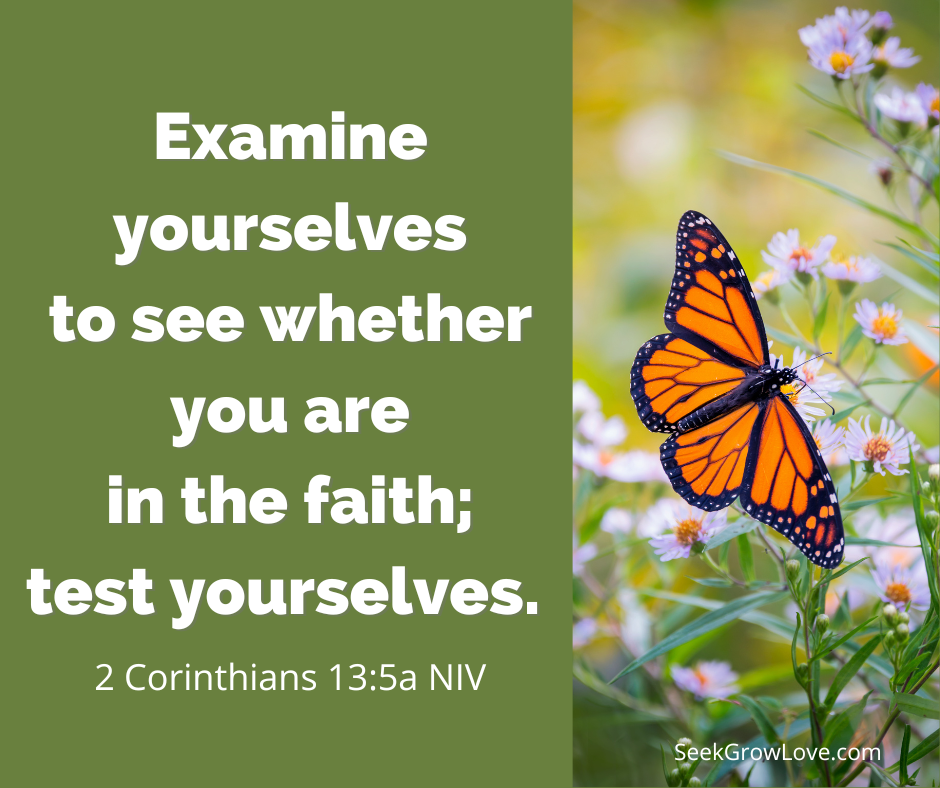
Have you ever heard of the Viceroy butterfly? These winged insects look almost exactly like the beautiful Monarch butterfly. To the untrained eye it would be very difficult to tell the two apart. To tell the two specimens apart, one would have to examine them closely.

In this section of Paul’s letter to the Corinthians, he urges them to examine themselves. He wants them to consider where they are placing their faith and if they are truly living for Christ.

The monarch is poisonous to some predators. By masquerading as the Monarch, the Viceroy can allude and fool its predators. However, underneath the façade, it is not a true Monarch. In fact, it is not potent at all. Within its heart, the Viceroy is nothing like the Monarch

If we listened to Paul and took a step back to examine ourselves, what would we find? Are we masquerading as a follower of Christ or are we the real deal? Are we the Viceroy butterfly or are we the Monarch?

As we examine ourselves and aim for a life where our actions and our heart profess our faith, remember the words in verse 4. “For indeed he was crucified because of his weakness, yet he lives because the power of God. For we also are weak in him, yet we will live with him because of the power of God directed toward you.”

-Hannah Deane

Application Questions

  1. How can you tell if one’s faith is real or phony? What characteristics does real faith have? What characteristics does phony faith have?
  2. What do you see when you examine yourself?
  3. Are there areas where you want your faith to grow deeper and more genuine? What steps will help you grow in that direction? Are you willing to do them?

(Tomorrow we will begin a 3 week look at some of the highlights of the Old Testament books of Poetry: Job, Psalms, Proverbs, Ecclesiastes and Song of Solomon. After that, mid-July to August, we will read Mark, one chapter a day, and then return to Paul’s letters. Lots of good stuff ahead! Keep Seeking God and His Will in His Word! SeekGrowLove)

False Advertising

2 Corinthians 11

Tuesday, June 28, 2022

Have you seen anything advertised lately that you really wanted to try? Keep this in mind. We will revisit it at the end…

     Paul in this section of the letter to the Corinthians is defending his apostleship- not by means of hearsay, but through the proof of his testimony to Christ. Through the actions of his ministry, he has demonstrated his devotion to his faith. In the latter part of the section, Paul lists out the persecutions he has suffered. He does this not for the sake of attention or for puffing up his chest. He does it to demonstrate what the life of a true follower of Christ can look like. He does so to prove through his actions, and not the empty clanging of his voice, that he is an apostle of Christ.

     Paul does make a point to call attention to the “false advertising”, if you will, of others. He even makes the statement in verse 14, “…for even Satan disguises himself as an angel of light.”

Both before and after this powerful statement of warning, Paul also mentions the servants of Satan and the deceitful workers disguising themselves as apostles of Christ and servants of righteousness. Their beautifully spun words are to create an illusion that they are something that they are not. They are to deceive and steal away those who would come to Christ.  

Going back to that product you saw advertised, what about the product appealed to you? Was it the products testability that spoke for its reliability? Or was it the colorful design and exaggerated wording? We are in a world that is saturated in advertising and overrun with so many products trying to steal our attention from the others.

It is the same with who we put our trust in. Sometimes the advertisements of Satan are much more appealing. It can be difficult to choose the beautifully created bowl of fruit over the decadent devil’s food cake. But in the end, one nourishes and sustains us and the other satisfies us for only a moment.

-Hannah Deane

Application Questions

  1. In what ways do you see Satan working to convince the world and Christians that what God said is good is actually bad, and what God said is bad is actually good? How does evil try to look good – masquerading as an angel of light?
  2. What lies of Satan have you believed?
  3. How can we protect ourself from being deceived by Satan as Eve was?
  4. What role does knowing and loving the truth play in fighting temptation? What truths do you find in Scripture that can help you be strong and wise against temptation?

My Show Horse

2 Corinthians 10

Monday, June 27, 2022

I remember back in high school I showed a horse in 4-H at the county fair. The show I was in was all about the looks of the horse and convincing the judge that my horse was the very best in the arena. The goal was to gain the approval of the judge.

So, I got my horse, who had little show experience, all cleaned up. I shined up my dusty saddle. I donned my very best western shirt. I was ready to boast my horse in front of the judge. Even if my horse wasn’t the most experienced or the most expensive, I had to get the judge to believe that he was. I had to get the judge to believe my horse was something that he wasn’t.

However, my horse decided that day that he wasn’t quite willing to cooperate. He was not having it and we very nearly cleared the fence. It is safe to say I did not convince the judge and all my “boasting” was in vain.

I feel like life is often like this. We find ourselves in circumstances where we try to prove our worth based on what we think others want. Like I was trying to convince the judge that my horse was the best show horse, we try to convince others that we are something that we are not.  

In this section of Paul’s letter to the Corinthians, he tells them that what he is in the letters is also who he is in person (v.11). He is not trying to shine up the saddle to convince someone of who he is- his actions speak for who he is in his letters and in person.

He also tells the Corinthians that when we commend ourselves, we are not approved. When I tried to commend myself and the horse I was riding in front of the judge, it did not go so well.

When our goal becomes the approval of humans rather than the approval of God our focus becomes warped, and we lose sight of what truly matters. However, when our goal becomes the approval of God, we become commendable by God. And then rather than boasting in our own power, which always falls short, we can boast in the LORD and His everlasting power.

-Hannah Deane

Application Questions

  1. Can you think of a time when you tried to convince others you were someone you were not? Did it work? What were the consequences?
  2. In what ways (or what areas of your life) do you seek the approval of men rather than the approval of God? What are the dangers of continuing in this pattern? How can you remember to be most concerned with how God is judging you, not what people think of you?
  3. How will you practice boasting in the LORD and His everlasting power, today?

Cheerful Heart Giving

2 Corinthians 9

Sunday, June 26, 2022

Have you ever planted a tomato seed? What was going through your head when you buried it in the dirt? Were you wondering how this small speck of matter could ever turn into an ingredient for the perfect BLT?

What was your attitude when planting this seed? Where you already drooling over the image you had in your head of that BLT? Were you skeptical it would even grow? Or maybe it wasn’t your idea to plant it and you held a grudge that the task fell to you.

While Paul wasn’t writing to the Corinthians about tomatoes or BLTs in this chapter, he did parallel the similarity between tithing and sowing seeds. He wanted the Corinthians to give with a cheerful heart and not out of compulsion or with a heart that was holding a grudge because of giving.

Whether time or financially I feel like this can be a difficulty. There is always something else we could be doing with our time or something else we could be buying with our money. But the importance of giving our time or finances to the LORD is the attitude that we have when doing so.

If we plant that tomato seed with a heart of anger, we may not appreciate the process of watching God grow the seed we planted into a bountiful and beautiful tomato plant. Sure, we can plant it with anger and still enjoy the outcome of the BLT and maybe even that outcome is what will change our perspective next planting season. But the joy of watching God take what has been sown and multiply it into something that we could never even have imagined may be missed with a heart that is misplaced.

When planting a seed, whether time or money, with a cheerful heart we not only receive the opportunity to minister to others, we also are able to enjoy the process of the LORD multiplying it. In the end, when we harbor a cheerful heart for the LORD, the BLT will taste a whole lot better. 

-Hannah Deane

Application Questions

  1. What difference does the attitude make in either cheerful generosity or grudgingly given?
  2. Which attitude do you most often have when giving of your time? Or your finances? If there is a specific area in which you struggle to give cheerfully, how can you work towards improving that attitude?
  3. What do you gain when you give, especially with a good attitude, according to 2 Corinthians verses 6-15?

Saturday – June 25th, 2022

2 Corinthians 8

Tithes. It’s an uncomfortable topic. People get uncomfortable when you talk about money in general, and when you say they should give away their money, sometimes they can get downright feisty. If you are under 18, the idea of tithing is just that moment in church where they play an instrumental song and some people reach in their purse or wallet to discreetly turn in a folded bill. You may even participate with some money that your parents have given you. After 18 though – when you’re in charge of paying bills and then taking care of other living beings (whether that’s a dog, a child, or a plant), that’s when tithing can get overlooked. I know it does in my case. 

2 Corinthians 8, today’s reading, is all about giving which is just another word for tithing. Tithing was a word that originated in England in the Middle Ages to describe the custom of giving 10% of income to the church to support it during that time. Paul talks about this, but he doesn’t focus on the legalistic requirement of giving 10% to ‘do your duty.’ Instead, Paul frames this giving to support the ministry of the apostles, the ministry of spreading the gospel, as an opportunity, a privilege. He says, “For I testify that they gave as much as they were able, and even beyond their ability. Entirely on their own, they urgently pleaded with us for the privilege of sharing in this service to the Lord’s people” (2 Cor. 8:3-4). To participate in the ministry of the gospel whether through actually traveling from place-to-place or supporting via funds was a good thing. It wasn’t a duty that they should begrudgingly do. Later in the letter to Corinthians, Paul goes on to say,  “Each one must give as he has decided in his heart, not reluctantly or under compulsion, for God loves a cheerful giver” (2 Cor. 9:7). Tithing is very much about our attitude. Are we cheerfully giving this offering to support the ministry of God? Or are we doing it only for the appearance of ‘doing the right Christian things’? 

When you think about giving of your time or money, how much should you give? Paul says this: “And here is my judgment about what is best for you in this matter. Last year you were the first not only to give but also to have the desire to do so. Now finish the work, so that your eager willingness to do it may be matched by your completion of it, according to your means.  For if the willingness is there, the gift is acceptable according to what one has, not according to what one does not have.” In this, Paul again is pointing to the importance of attitude when considering how much time or money to give. He wanted the Corinthians to continue with the same desire, regardless of how much they actually gave. He also pointed out that if the desire to give is there, God doesn’t look at how big the gift is. He looks at how much is given in comparison to how much that person has. You can read more about this in the parable of the widow and the two coins in Mark 12:41-44. 

Ultimately, our tithes and offerings are a display of our trust in God. They harken back to the sabbath rest of the ancient Israelites in the desert. By giving God a portion of our time or our money, we trust that God will do great things with it in the world, and we trust that God will make sure that we are taken care of with what we have left. Now, ‘taken care of’ does not mean that we will get rich off of tithing. (That’s the false prosperity gospel.) Taken care of means that we will have clothes on our backs and food in our bellies (Matt. 6:25-34). Our tithes and offerings can also fix our relationship with money. Instead of holding it tightly and greedily, by giving our money away – we are reinforcing that it is not an idol in our lives. Our attitude towards money changes. 

What can you give back to God today? 

~ Cayce Fletcher

Questions for Application: 

  1. Do you normally tithe? How does giving look for you? 
  2. Can tithing be more than just money? (For example, time serving at a church camp or participating in the worship band.)
  3. What is your relationship with money? How do you think that relationship affects your relationship with God?

Friday – June 24th, 2022

2 Corinthians 7

I recently attended a great Young Adult Getaway hosted by the Church of God General Conference. Around 60 (somewhat) young adults got together and had a great time fellowshipping with one another, learning about God, and worshipping God together. The theme for the weekend was “Find Your People” based on a book by Jennie Allen. Especially after living through the social changes brought about by social media and the pandemic, we probably can all relate to feeling both more socially connected and socially isolated than ever before. I can spend hours scrolling to see the engagement and pregnancy announcements from people I went to high school with (that I haven’t seen or spoken to in years), but I don’t feel like I have time to deeply connect with my present-day family and friends. The getaway focused on how we can connect with people – which is an essential yet often overlooked part of the Christian faith. 

While we were there, I spoke about one uncomfortable aspect of connecting with others in a Christian context: holding others accountable. When we first become a Christian, we may think that our fellowship with others is all based on the love we show each other… which is actually true. But, early on in our walk with Christ, our idea of love is based on what we see in movies and TV shows. Love supports each other no matter what. It speaks encouragement (only) and never criticism. It does not judge. Love never makes the other person feel bad. So, we think, based on this understanding of love, that our Christian relationships should follow the same blueprint, but this is not the case. 

Our understanding of what love is changes when we become a Christian. Jesus did say, “By this all people will know that you are my disciples, if you have love for one another” (John 13:35). But, at the same time our idea of love has changed. John later says in 1 John 4: 10-12, “This is love: not that we loved God, but that he loved us and sent his Son as an atoning sacrifice for our sins. Dear friends, since God so loved us, we also ought to love one another. No one has ever seen God; but if we love one another, God lives in us and his love is made complete in us.” Love becomes much more about self sacrifice than mindless tolerance, much more about spurring each other on than accepting where we are currently at. 

Paul recognizes this. As I’ve read through his letters, a common Pauline trait has stood out to me; he is a master at accountability. In his letters, he is constantly calling his fellow brothers and sisters in Christ to higher standards and encouraging them to hold fast to the standard set before them in Christ. This is especially true in his letters to the Corinthians. In today’s reading,  we see Paul continue to do this. He tells them, “Therefore, since we have these promises, dear friends, let us purify ourselves from everything that contaminates body and spirit, perfecting holiness out of reverence for God” (v. 1). But, he doesn’t say this because he dislikes the Corinthians in any way. Instead he tells them later on, “I do not say this to condemn you; I have said before that you have such a place in our hearts that we would live or die with you. I have spoken to you with great frankness; I take great pride in you.” (v. 3-4a). Paul deeply cares about the Corinthian church, which is why it is so important to him that they live right in the eyes of God. 

We also are called to live right and hold others accountable. How are you spurring others on to love and good deeds (Heb. 10:24) today? 

~ Cayce Fletcher

Questions for Application: 

  1. Do you feel more connected or more isolated when you think about your everyday life? Who are ‘your people’ that you live close by that can spur you on in the faith? 
  2. Have you ever experienced accountability (whether it was you holding someone accountable or someone else holding you accountable)? What was that experience like? 
  3. How does accountability strengthen our Christian walk?