To Tithe or Not to Tithe

Our discussion this week about money would not be complete without talking about tithing.  Many believe that we should be giving ten percent of our earnings to the church, which is called tithing.  I must admit that I was very surprised when I researched the topic of money to find that it was not mentioned in the New Testament that we should tithe.  Does that mean we are not required to tithe anymore?

Let’s start with some Old Testament history.  Tithing was a practice back then (Malachi 3:8-12), but if you think you should be following the guidance from the Old Testament, you need to read about all the ways to give money to the church.  I won’t go into great detail, but there were some pretty elaborate rules about giving.  Check out Deuteronomy 14:22-29, Numbers 18:21-32, Numbers 18:8-11, and especially Leviticus 27:1-21.  For example, in Leviticus, if anyone dedicates their house to the Lord, a priest will judge its quality and set a value on it.  If the homeowner wants the house back, they can redeem it by adding a fifth to its value.  You could also dedicate people to the Lord by giving an equivalent value.  A male between the ages of twenty and sixty was valued at fifty shekels of silver, while a female between one month and five years was valued at three shekels of silver.  Of course, we are not under the Old Testament law anymore, so these rules are not in place anymore, including tithing.

Again, the talk of tithing is absent in the New Testament so what should we do about giving money to the church?  I don’t believe there is an exact calculation to follow so I am going to give you my opinion about what should happen.  First, we do not need to follow Old Testament rules anymore, but I think we can learn about God and how he operates by looking at the rules in the Old Testament.  Giving ten percent was a popular theme in the Old Testament.  I think that is probably a good starting point for our giving today.  If God liked using that percentage back then, I think it is likely He still thinks that is a good percentage today.  However, don’t forget that there were other rules for giving that didn’t simply follow the ten percent rule, so it is probably a bit naïve to think that is exactly what we need to do today.

Yesterday we learned that all our money is God’s money, not our own.  I think we need to consider that when deciding on how much to give to the church.  Furthermore, some of God’s money should probably be given to areas outside of the church.  For instance, your neighbor’s house burns down.  God may let you know that it is a great idea to send some money their way to help them get back on their feet.  Should that come out of the ten percent?  That is a trick question.  We should not be concerned about a particular percentage when 100% of the money we have is God’s.  We need to figure out the best way to use that money by listening to God and trying to understand His desires for that money.  I think He may want some to give twenty percent, fifty percent, or maybe even more to the church.  Perhaps, someone is in a tough situation right now and five percent is the right amount.

I do think church is important, and I do think it is important to give money to the church to further God’s work.  I would not want to be selfish in that regard and spend too much on myself and neglect the church.  If you want to know what is important to yourself in life, just look at what you spend your money on and what you do with your time.  If you don’t spend very much money and time on church, then church is not important to you.  If church is important to you, you do not have to tithe to it, but I encourage you to make God’s day by giving an appropriate amount to His work.

-Rick McClain

While this week we are discussing a Christian perspective on money…you can still keep up with your Bible reading plan. Today’s Bible reading passages can be read or listened to at BibleGateway.com here – Isaiah 53-54 and 2 Timothy 2

How Important Is Money?

As a Christian, what am I supposed to think about money?  Do I need to give all my money away to the poor?  Can I take a vacation?  How much should I give to the church?  I know money can buy a lot of useful things, such as food, shelter, Bibles, church buildings, etc., but how hard should I work to earn money?  How much money do I need?  Can I put a steak on the grill when I know there are so many people starving?  These questions were gnawing at me because I wanted to do the right thing, but I wasn’t sure what the proper Christian perspective regarding money was.  Therefore, several years ago I set out to find as many answers as I could in the Bible.  I thought of every money term I could think of and looked up every verse I could find with those words.  I found a lot of answers that I would like to share with you this week.

I think many Christians are ultra-concerned about money.  They want to be good stewards with what God has given them.  They know they can do a lot of good with their money, so it becomes very important to them.  I used to think the same way, but my mindset shifted after I completed my study, and I no longer think money is that important.  Don’t get me wrong, we need money to survive, and we can do God’s work with the money we have, but our focus just shouldn’t be on money.  I find it weird to talk a whole week about something I don’t think is very important, but I think it is very important to get our thoughts about money right.

Money is a salvation issue.  Luke 16:13-15 says we can’t serve both God and money.  You must choose one or the other.  1 Timothy 6:6-10 warns that money is the root of all kinds of evil.  I think we have all seen and probably experienced how money can lead to sin.  Have you ever stolen something?  Have you ever cheated on your taxes by increasing a charitable deduction or not even paying taxes on money you have earned?  Have you ever spent your money foolishly on worldly things?  Are you so driven to make money because there is so much pleasure to buy in this world?  These verses tell us that our salvation is lost if money becomes too important to us.

Proverbs 23:1-8 was very confusing to me at first, but once my eyes were opened, it really helped me form my view about money.  The story is about dining with a ruler who provides all sorts of great food and dining with a stingy man who cuts corners with the meal to save money.  The verses say that both situations should be avoided.  It was easy to understand why eating with the rich man and giving in to gluttony was wrong, but why would it be so wrong to try to be prudent with your money and not overspend on a meal for your guests?  I had to read this several times before it hit me that the problem with the begrudging host was that he thought money was too important, even though he may not have had much of it.  Today we call this person “cheap”.  It might seem like you are being a good steward with your money by buying cheaper things, looking for all the deals, cutting coupons, etc., but it may also be a sign that money is too important to you.  I’m not saying you should never use a coupon or look for a great deal, but the point is that you want to be sure that money is not your master.

Psalm 49:5-20 points out the obvious, you can’t take it with you when you die.  Money is quite meaningless when you consider the big picture, living in a Kingdom for eternity.  You can work hard to make a lot of money and buy a lot of stuff, but it is all quite useless to you when you die.  Jesus was asked in Matthew 22:17-22 about paying taxes to Caesar.  He pointed out that it was Caesar’s image on the coin and told them to give back to Caesar what is his and give to God what is his.  It doesn’t sound like Jesus thought money was very important.

Hopefully you are realizing that money is not important, but you still might be thinking, “Hey, everyone needs some money to live in this world.”  That is true, and I think Proverbs 30:7-9 sums it up very well where our mindset should be.  Agur, son of Jakeh, asked the Lord to neither make him rich or poor, but just to give him his daily bread.  He didn’t want to make so much that he would disown God, and he didn’t want to be too poor and steal.  That seems like a pretty good place to be; you have what you need to live comfortably so your focus is not on money.

-Rick McClain

While our devotions this week will be following the important topic of not focusing on money – and having a proper attitude toward and use of our finances, if you’ve been using the Bible reading plan, keep it up! What important lessons are you finding? Today’s Bible reading plan passages can be read or listened to at BibleGateway.com here – Isaiah 47-48 and 1 Timothy 5

More Opportunities

For God’s Children To Have a Relationship with Him

Isaiah 43-44 and 1 Timothy 3

When you read through Isaiah 43 and 44, what do you see?

I see a God who loves His people, whom He has chosen.  I see a God who shows mercy and patience.  I see a protective God.  I see a jealous God.  I see a God full of power and authority.  I see a world full of broken and lost people.  I also see a Father whose children have ignored Him.  I see a Father who knows there are unrighteous people in the world trying to pull His children off the path of righteousness.  I see a Father longing for a way to have relationships with His children.  I see children who do not understand what they are missing.

All of the great qualities we observe in or read about our God can seem far away when looking at the Old Testament and reading that He set His chosen people aside for destruction and abuse, or when we see large groups of people destroyed, or when the barbaric sacrifices of animals somehow allow for the forgiveness of sins.  I feel at times that the God of the New Testament seems to be much more loving and gracious than the God of the Old Testament.  And yet, since creation, God has had a plan for redemption not just for His chosen people, but for all who called upon His name.  The whole thing can be a bit confusing if I am being honest!  I have to remind myself that God has never changed, He has simply created more opportunities for His children to have a relationship with Him.

The Christian faith is one of just that, faith.  We can scientifically prove many of the events that have happened in the Bible did in fact happen.  However, the idea that an omnipotent God who has created everything in existence chose to create a group of imperfect beings to be made in His image with the purpose of praise, but then those imperfect beings were given free will and ruined it so He had to send them away but He still made a way for them to come back to Him but it still didn’t make them perfect enough so He sent a perfect being as a sacrifice for all the imperfect beings but then the perfect being came back to life to offer hope to the imperfect but the imperfect ones kept making the creation less perfect so one day the perfect one has to come back and fix the imperfect forever so that the omniscient one can live with the imperfect ones who will now be made perfect……Let’s be honest, it doesn’t make sense.  God’s grace requires faith to accept! 

1 Timothy 3:15 – 16 says “…This is the church of the living God, which is the pillar and foundation of the truth.  Without questions, this is the great mystery of our faith: Christ was revealed in a human body and vindicated by the Spirit.  He was seen by angels and announced to the nations.  He was believed in throughout the world and taken into heaven in glory.”  

Our God is a living God.  He has been at work in the nations from day one, and He has had a plan for us to all live in relationship with Him from the start.  Why?  I have no clue.  But faith allows me to know that this is true, and our hope through Jesus Christ allows me to live each day knowing that I have an incredible gift of grace that should be used to praise and glorify the One True God.  Do you accept the completely confusing idea of God’s grace? How do you show that daily? 

(In case you were wondering, I definitely plan on asking God why He gave us free will in the Kingdom…along with many other questions 😊)

-Sarah Johnson

Today’s Bible reading plan passages can be read or listened to at BibleGateway.com here – Isaiah 43-44 and 1 Timothy 3

Bearing Fruit

A few years ago, my friend from church, Terri Tschaenn, gave me a single piece of a cactus that was broken off from her huge cactus plant. I put it in a small pot not knowing what to expect, and I have to say that thing has grown so many shoots and sprouts and whatever new chunks of cactus might be called…..I am now onto a third pot myself and it has been pretty cool to see that thing grow and spread! While I am still learning to be careful with the nasty little prickers, I can tell I am going to have cactus to share! So, if I gave one chunk of cactus to 12 friends, and in a few years they gave one piece to 12 more friends, imagine how fast Terri’s cactus could spread. In fact, she told me that several other people she knows have cacti started from her plant.

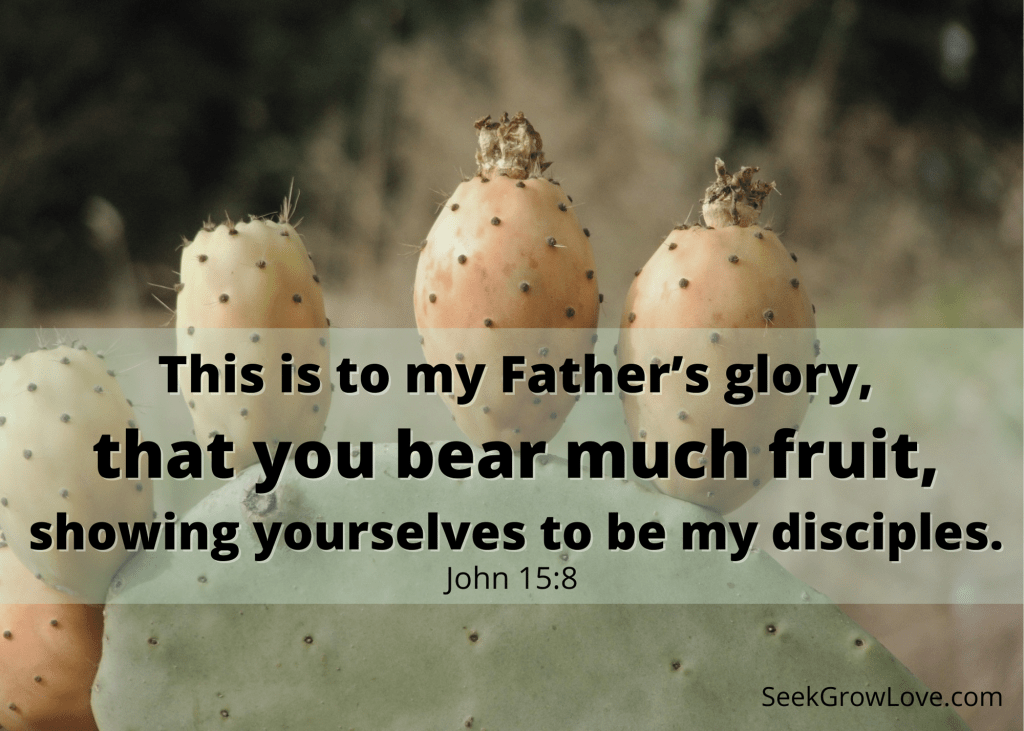
As Christians, we are called to remain in the vine and produce fruit. One way we see the evidence of fruit is in disciples. John 15:8  tells us:

“This is to my Father’s glory, that you bear much fruit, showing yourselves to be my disciples.”

Bearing fruit to God’s glory is not found in the number of likes on a post that happens to have a Bible verse in it, not in the number of people who show up at our “church” event or the people who follow us/like us/or think we are really “nice”. Fruit isn’t measured the way society measures it at all. In fact, probably most numbers society uses for a gauge of success would demonstrate the exact opposite in the sense of bearing fruit that Jesus asks of us.

Jesus had his disciples. Paul had his team. Scripture speaks of a called-out body of people loving one another, teaching, edifying, building up, holding accountable, sharing, confessing sins, forgiving sins. We all have a circle of influence and relationships, and those relationships with followers of Jesus are the ones prioritized above all else in no uncertain terms.

Matthew 12:48-50

New International Version

48 He replied to him, “Who is my mother, and who are my brothers?” 49 Pointing to his disciples, he said, “Here are my mother and my brothers. 50 For whoever does the will of my Father in heaven is my brother and sister and mother.”

If we are to call ourselves a Christian or follower of Christ, we had better seriously consider those we yoke ourselves with and recognize that our church family is our family. We all benefit from being discipled and from discipling and we have a responsibility to seek those with spiritual maturity and a shared relationship with God to grow alongside as brothers/sisters.

-Jennifer Hall

For those following along with the yearly Bible reading plan, you can read or listen to today’s Bible passages at BibleGateway here – Job 19-20 and 2 Corinthians 11

Current Events & Proverbs

When I first started reading my Bible regularly as a teenager, my youth pastor suggested reading a Proverb each day because they were full of wisdom and you can read one for each day of the month. Years later, I heard my pastor at the time, John Railton, suggest the same to his church. I have implemented that strategy intermittently over the years, and while I don’t do it every month,  I have come to learn that the book of Proverbs is a terrific source of reading for wisdom/comfort/practical teachings. I would definitely recommend reading words from “wise King Solomon” to anyone! And, no matter how many times I read them, I still find new lessons and comforts.

Just this week I was reading Proverbs 3, and found a few of them to be very relevant with what I had read a few minutes before in the current events of this world! In fact, if there is one thing that makes me realize how much I need to read the Bible more, it is reading the news these days. So, in case a few words of wisdom that brightened my day brightens yours, here goes. And there are lots more where these came from. Smack dab in the middle of your Bible. Or under “P” in your trusty Bible app.

Proverbs 3:5-7

Trust in the Lord with all your heart
    and lean not on your own understanding;
in all your ways submit to him,
    and he will make your paths straight.[a]

Do not be wise in your own eyes;
    fear the Lord and shun evil.

And a few more wise words of comfort, verses 21-26

21 My son, do not let wisdom and understanding out of your sight,
    preserve sound judgment and discretion;
22 they will be life for you,
    an ornament to grace your neck.
23 Then you will go on your way in safety,
    and your foot will not stumble.
24 When you lie down, you will not be afraid;
    when you lie down, your sleep will be sweet.
25 Have no fear of sudden disaster
    or of the ruin that overtakes the wicked,
26 for the Lord will be at your side
    and will keep your foot from being snared.

-Jennifer Hall

Keep up with that Bible reading plan – read or listen at BibleGateway here – Job 17-18 and 2 Corinthians 10

Set Apart – Together

Earlier this week we read about the importance of being set apart from the world as a follower of Christ. To be called out. Sometimes at work, I get “called out” of a meeting to talk to someone. Sometimes I help patients of mine by intentionally setting him/her apart from other distractions to complete a task. Since I work at a hospital, I frequently go to the waiting room to call out a name, asking that person to stand up and separate from the others to come with me.  Depending on your contexts in life, being called out or set apart might bring that visual of being alone or isolated from others. Maybe sometimes that might sound nice?  For sure at other times, that can sound scary and undesirable.

While we are asked to be set apart from the world in the spiritual sense, we are not created to live, love, worship, and serve in isolation. In fact, 2020 shed some light into the devastations that can be caused by being set apart….alone. That isn’t what Jesus was talking about. The Greek word most frequently translated as church in our Bible is “ekklesia” which means the idea of an assembly of called out people.  The church is called to be set apart from the world. Since our English language often associates the word “church” with building and not the group of people, it is easy to overlook the meaning of the importance of our calling sometimes. In the New Testament we see a group of people called out from the world…..TO GOD. A group asked to be set apart together.

Ephesians 3:16-21: 

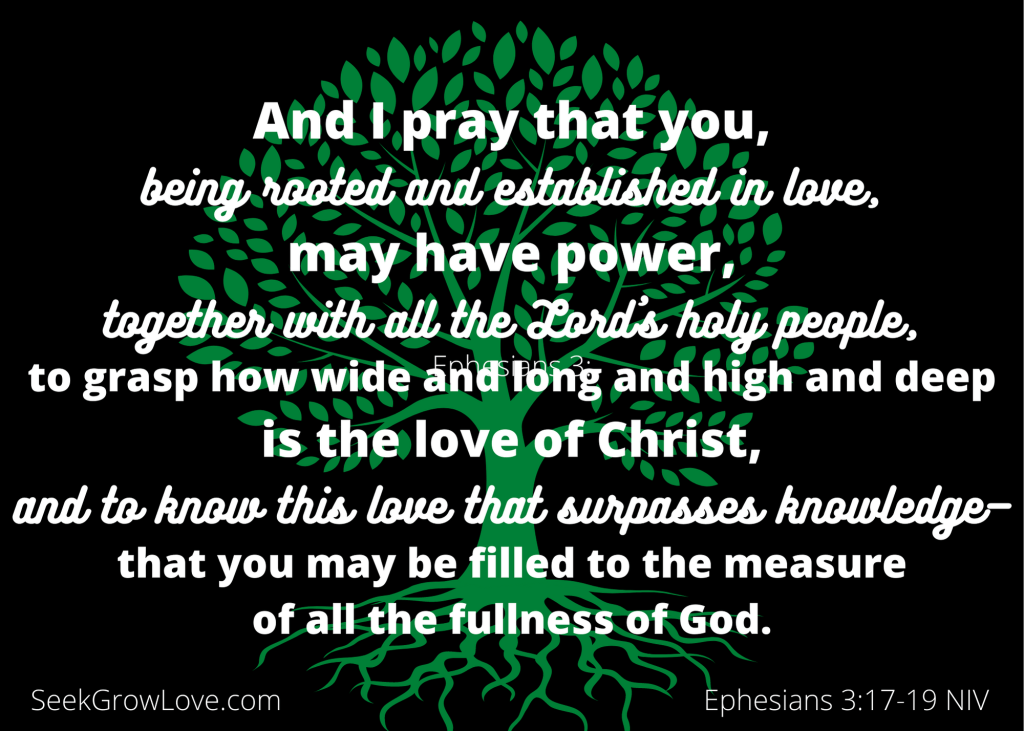
I pray that out of his glorious riches he may strengthen you with power through his Spirit in your inner being, 17 so that Christ may dwell in your hearts through faith. And I pray that you, being rooted and established in love, 18 may have power, together with all the Lord’s holy people, to grasp how wide and long and high and deep is the love of Christ, 19 and to know this love that surpasses knowledge—that you may be filled to the measure of all the fullness of God.

20 Now to him who is able to do immeasurably more than all we ask or imagine, according to his power that is at work within us, 21 to him be glory in the church and in Christ Jesus throughout all generations, for ever and ever! Amen.

He calls us out to love one another. To be mindful of other’s needs and meet them. To edify one another. To be unified. To bring glory to God and Jesus in what we do as an ekklesia. To come together in prayer. To find strength and function as one member of a greater body. 

As we navigate another season of viruses and news stories laden with fear and confusion, let us not do it alone. And let us also not find our church families looking and sounding just like the world. Instead, let us actively seek to be set apart from the world following Jesus in our own individual lives, to find the planks in our own eye, so we can best build up the ekklesia  as we await the return of His son.

We are the church.

“For where two or three gather in my name, there I am with them.”  Matthew 18:20

-Jennifer Hall

This week the devotions are on other passages reminding us of the importance of of being connected to God, Christ and the church, but if you are using the SeekGrowLove Bible reading plan keep enjoying the daily passages. They can be read or listened to here at BibleGateway Job 13-14 and 2 Corinthians 8

What are you living for?

Saturday, August 7th, 2021

Job 7-8, 2 Corinthians 5

We began this week by asking the question ‘Why?’ Why do you do what you do? What motivates your actions? Knowing our why – the purpose behind our actions – can help us align our thoughts and actions with what we really find important. To help us find our why, we need to ask ourselves another question. This will be the question on which we are judged before we enter into the kingdom (or to the lake of fire). This is the defining question of our lives: “What are you living for?” 

The answer to this question will show us what our why is. When we are living for our next paycheck, every action that we do will lead us back to how we are going to make money. When we are living for attention from others, every action we do will lead us to how we are going to get more likes, more glances, or more applause from others. It’s so important to know what we are living for. But, hopefully, it’s not too hard to figure out that the thing we are living for is Christ. 

When we are raised to Christ, everything we do should be to live for him. Paul says this in 2 Corinthians 5:15, “15 And He died for all so that those who live should no longer live for themselves, but for the One who died for them and was raised.” We live for him! 

What does living for him look like? Paul gives us the answer later in 2 Corinthians 5:18-21 “18 Everything is from God, who reconciled us to Himself through Christ and gave us the ministry of reconciliation: 19 That is, in Christ, God was reconciling the world to Himself, not counting their trespasses against them, and He has committed the message of reconciliation to us. 20 Therefore, we are ambassadors for Christ, certain that God is appealing through us. We plead on Christ’s behalf, “Be reconciled to God.” 21 He made the One who did not know sin to be sin for us, so that we might become the righteousness of God in Him.”

Christ began the reconciling work when he died for our sins, and now, we continue his reconciling work as we become more like him and inspire others to do the same. We can have the righteousness of God only because Christ did this reconciling work for us. When we are living for Christ, we become ambassadors. We become the hands and feet of Christ in this world, and at every moment, we should be pointing others back to who God is and what he’s done. 

What are you living for? Be the minister, the ambassador, you were called to be in Christ. Point others to who he is, because you live for him!

~ Cayce Fletcher

Read or listen to today’s Bible reading at Biblegateway.com: Job 7-8 and 2 Corinthians 5 .

Don’t give up!

Friday, August 6th, 2021

Job 5-6, 2 Corinthians 4

I live a short drive from the Blue Ridge mountains. The rolling hills of the piedmont area where I live slowly turn into mountains that tower over everything, rising up in the distance to dominate the landscape. Being so close means that hiking was a favorite pastime of mine growing up. The go-to hike in my area is called Table Rock. Just to the north of Greenville, there is a mountain that overlooks the rest of the upstate. At the very top, there is a bare rock outcropping that provides the perfect spot for a picnic. It can take anywhere from 2-4 hours to get to the top of the mountain and most of that time is spent going straight up. Still, I loved the feeling of anticipation of what the view would look like when we reached the stop and that anticipation kept me going even when I felt like my legs were about to give out. Towards the end of the hike, I was always red faced, gasping for breath, straining towards the next step up. But, that momentary struggle paled in comparison to the views at the top. 

We’ve all probably faced times where it feels like our physical body is just about to give out. If you’re like me, it may be running 5 or 10k, a hard workout, a game of ultimate frisbee (or your favorite sport), a day spent weeding the garden in 100 degree heat, mulching the yard (also in 100 degree heat), or maybe just a really long day at work. These are moments where it seems like you’ll never make it to the end and your main thought is how can you just stop what you are doing and sit down. Each of these things, even if it seems like the difficulty will never end (and I’ve pushed through them all), has a time stamp on it. The struggle will come to an end, and we will arrive at what we’ve been working towards. 

Paul knows about this. In 2 Corinthians 4:7-18, he writes, “7 Now we have this treasure in clay jars, so that this extraordinary power may be from God and not from us. 8 We are pressured in every way but not crushed; we are perplexed but not in despair; 9 we are persecuted but not abandoned; we are struck down but not destroyed. 10 We always carry the death of Jesus in our body, so that the life of Jesus may also be revealed in our body. 11 For we who live are always given over to death because of Jesus, so that Jesus’ life may also be revealed in our mortal flesh. 12 So death works in us, but life in you. 13 And since we have the same spirit of faith in keeping with what is written, I believed, therefore I spoke, we also believe, and therefore speak. 14 We know that the One who raised the Lord Jesus will raise us also with Jesus and present us with you. 15 Indeed, everything is for your benefit, so that grace, extended through more and more people, may cause thanksgiving to increase to God’s glory.”

The clay jars are us! We are fragile. We can be pressured, perplexed, persecuted, and struck down, but through it all, we will overcome. We live knowing that God will save us and raise us with Jesus. So when we feel like we are at the end of our rope, we are reminded that we are overcomers. 

Paul goes on in verses 16-18, “16 Therefore we do not give up. Even though our outer person is being destroyed, our inner person is being renewed day by day. 17 For our momentary light affliction is producing for us an absolutely incomparable eternal weight of glory. 18 So we do not focus on what is seen, but on what is unseen. For what is seen is temporary, but what is unseen is eternal.”

We are renewed day by day for an absolutely incomparable eternal hope in glory with Christ. We will be glorified in the kingdom, so we don’t need to worry about the present sufferings we may face here. Our momentary struggle pales in comparison to what we are promised at the end. Don’t stop striving! Don’t give up! We have an eternal promise that is greater than everything we face now!

~ Cayce Fletcher

Read or listen to today’s Bible reading at Biblegateway.com: Job 5-6 and 2 Corinthians 4 .

The Law of the Letter or of Life

Thursday, August 5th, 2021

Job 3-4, 2 Corinthians 3

The Olympics are going on in full steam with the final days approaching this week. Though I’ve never been one to follow gymnastics, swimming, track, or fencing, when the Olympics comes around, I’m glued to the screen watching people strain towards earthly glory in the form of a gold, silver, or bronze medal. Today, I was watching the morning news, and Caleb Dressel was doing an interview. When asked about how he took care of his mental health, he said that the first thing he did when he got back home from a big event was to not think about swimming for at least two weeks. When he got home, he wasn’t a medal winning athlete; he was just himself. He said if he didn’t do this, the pressure would be too much. He would start to go after an unattainable goal that would ultimately lead him down a dark path. 

Though we can pursue earthly achievements in our careers, finances, homes, sports, hobbies, etc., we are called to live with eternity in mind as Christians. A gold medal, large retirement account, promotion, or degree is not the pinnacle of our life. The way that we live now is working towards that final goal which will come when the trumpet sounds. As I talked about earlier this week, we can rest in assurance that this goal has already been achieved. The victory is won, and we wait for Jesus to come. 

I can say that… but in my heart of hearts, sometimes it’s hard to live like that is actually true. I like to be in control, and for the things that I’m actually good at (which is not sports), I like to be one of the best. I will go all out. And, so in my Christian walk, I can fluctuate from being distracted and worried about the cares of the world and being so legalistic that I stifle the relationship that I’m trying to work towards. When I make it about me, I can go down a wrong path – just like Caleb Dressel. I can’t do anything to add to the accomplishments of Christ, and so all of my actions where I am trying to be the ‘best’ Christian ultimately burn me out and leave me empty – and they can actually leave me further away from Christ (like the Pharisees). 

In 2 Corinthians 3:17-18, Paul writes, “17 Now the Lord is the Spirit, and where the Spirit of the Lord is, there is freedom. 18 We all, with unveiled faces, are looking as in a mirror at the glory of the Lord and are being transformed into the same image from glory to glory; this is from the Lord who is the Spirit.”

We don’t have to live by the law of the letter anymore. We can live in the freedom that comes from living in the Holy Spirit. We are not changing ourselves on our own power; we are relying on the power of God. And, God can do so much more than any man – Olympic medal winning or not. When we rely on him, we have the victory! Whose power are you living in?

~ Cayce Fletcher

Read or listen to today’s Bible reading at Biblegateway.com: Job 3-4 and 2 Corinthians 3 .

What’s That Smell?

Wednesday, August 4th, 2021

Job 1-2, 2 Corinthians 2

My husband is a great cook, but he takes a long time to prepare his meals. On the nights when he is in charge of dinner, I wait patiently for him to chop all of the vegetables, season the meat, and get something sizzling over the stove. After 30 minutes (or a few hours), I finally know that dinner is ready when I get a whiff of something that smells delicious. That smell draws me into the kitchen; it’s enticing and promises a great meal. 

In today’s reading, we read a little bit more about Paul’s testimony. He explains some of the trials that he has faced in his ministry, some of which are difficult and bring him to tears. At the end of 2 Corinthians 2, Paul begins to turn his focus on the way the Corinthians are living. And the question he asks is one that is a little strange, “What do you smell like?” 

At home, I get to smell the delicious smell of my husband’s cooking. But, at work, the smells are not so pleasant. Middle School boys back from PE hang out in a cramped classroom, where Axe Body Spray mixes with some pretty rank BO. Sometimes the students can’t take it anymore and they say, “Mrs. Fletcher, I need some Febreeze in here, because it STINKS!” So, obviously I get to smell the best of smells and some of the worst of smells. Smells that bring me joy and lead to life and smells that make me die a little inside. 

So let’s go back to Paul’s question – “What do you smell like?” He’s not talking about smelling nice like you are about to go on a date to a nice restaurant. Or smelling bad like a middle schooler back from Field Day. He’s talking about the way that our ‘fragrance’ – our way of living – shows Christ to other people. 

In 2 Corinthians 2:14-17, “14 But thanks be to God, who always puts us on display in Christ and through us spreads the aroma of the knowledge of Him in every place. 15 For to God we are the fragrance of Christ among those who are being saved and among those who are perishing. 16 To some we are an aroma of death leading to death, but to others, an aroma of life leading to life. And who is competent for this? 17 For we are not like the many who market God’s message for profit. On the contrary, we speak with sincerity in Christ, as from God and before God.” 
Paul here is saying that we are the fragrance that points people to who Christ is. Through us just being in people’s lives, we should leave behind a scent of Christ. This scent can encourage others to know Christ more – an “aroma of life leading to life” – or it can convict others who refuse to follow Christ – “an aroma of death leading to death.” Our testimony points others to Christ. People are watching, and they are judging the Christian faith based on how you are living. So, I’ll ask you the same question: What do you smell like?

~ Cayce Fletcher

Read or listen to today’s Bible reading at Biblegateway.com: Job 1-2 and 2 Corinthians 2 .