Walls

OLD TESTAMENT: Nehemiah 1-3

POETRY: Psalm 147

NEW TESTAMENT: John 19:1-16

The Berlin Wall. 

The Wailing Wall. 

The Troy Wall (famous for the Trojan horse fiasco in Homer’s mythological “The Odyssey”)

The Wall of Jericho. 

The Great Wall of China. 

Seattle’s Gum Wall. 

These famous walls from history were built primarily to keep enemies out of the territory and protect the residents – with the exception of the touristy Gum Wall, of course. If you live in the USA or are in tune with any of our news, you have probably heard about our Wall, too. The Wall in recent American history refers to a literal wall that was planned to line the entirety of the USA’s southern border with Mexico, and it has been the topic of many a political rant from both political parties. 

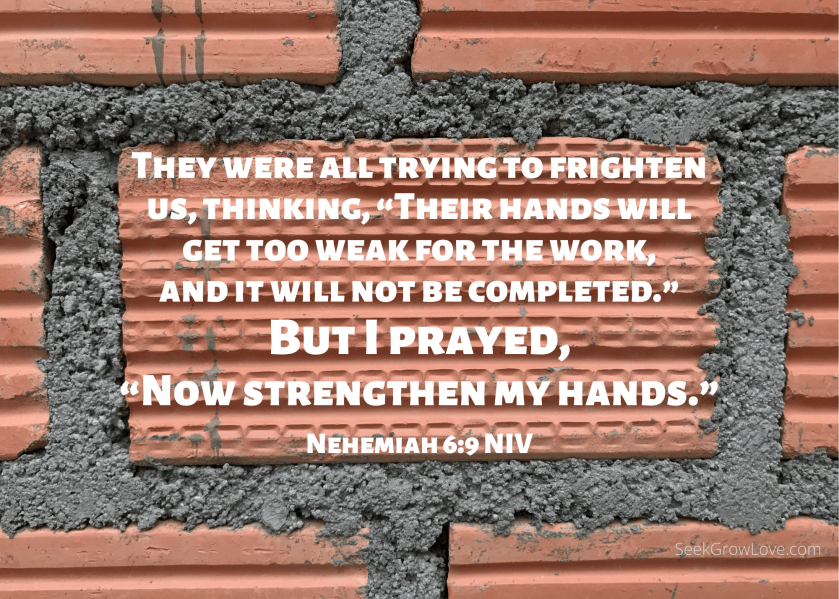
Those of us who are far removed from the concept of once-prevalent city walls and who are not residing near country borders probably don’t comprehend the significance of a wall. Historically, though, city walls were gravely important to the safety of the residents, as they provided a barrier for defense against enemies. The state of the wall often reflected the state of the people who lived within it. In Nehemiah, we read about The Wall of Jerusalem being in shambles, and God’s people were quite broken as well. 

Nehemiah was the cupbearer to the King of Persia, a very important position; the king quite literally trusted Nehemiah with his life! After Nehemiah received word that the walls of Jerusalem were in major disrepair, he committed himself to prayer; still, the sadness was evident on his face as he went to work. Though Nehemiah was fearful that being sad in the presence of the king could cost his head, King Artaxerxes took pity on Nehemiah and allowed him to return to Jerusalem to rebuild the wall. Not only did the king send Nehemiah with his blessing, but he provided Nehemiah with many provisions for the journey.

(Interestingly, the text mentions the queen being with the king when he noticed Nehemiah’s unusually melancholy demeanor. Many scholars believe that this queen is none other than Queen Esther! The book of Esther occurred before the book of Nehemiah; the stories are not in chronological order in our Bible. While God definitely used Esther to save his people in the biblical book bearing her name, she was probably also instrumental in allowing Nehemiah to rebuild the wall.)

I can’t help but think of how comfortable Nehemiah likely had been in his position. He worked in the palace, which allowed for a lifestyle much more posh than the vast majority of the people in the territory of Persia and definitely more comfortable than his relatives in the rubble of Jerusalem. And yet, he was willing to give up everything in order to meet a deep need for God’s people. I just can’t help but wonder if I – if we – would be inclined to do the same? We have an abundance of possessions and time-saving resources: I’ll be the first to admit that I love how my house heats itself on chilly winter days, Walmart grocery pickup is my favorite modern convenience, and Amazon next-day delivery has saved the day on many occasions. Lights, indoor plumbing, DoorDash – we have so much more even than Nehemiah had. Would I be willing to forgo it for a long period of time so I could instead take on a very difficult and dangerous task? 

And yet Nehemiah ventured into the unknown to lead the charge to repair the wall, knowing that he was forgoing so much comfort, yet unable to settle his soul until he completed the assignment to which God had called him. Nehemiah chose to leave everything so he could rebuild the wall, embracing the burden that God had placed on his heart for his people. He accepted the sins of his people and asked God’s forgiveness on behalf of everyone. Nehemiah stayed focused and kept in touch with God despite adversaries trying to distract him and spoil his plans. 

Nehemiah focused on the bigger picture – helping his people for years to come. Similarly, we too must have an eternal perspective. One day, there will be a New Jerusalem which will have a wall with 12 gates that will never be shut. Praise God for the hope of the Kingdom! 

Interesting connections from Nehemiah to the other readings: 

Psalm 147:2, 13 – “The LORD builds up Jerusalem… He has strengthened the bars of your gates.” 

In the John passage, the leaders have turned Jesus over to be crucified, which would lead to the fulfillment of Jesus’ words from John 2:19 in which he called himself the temple. (The temple was in Jerusalem). 

-Rachel Cain

Reflections:

*What burdens has God placed on your heart that might require you to figuratively or literally leave your comfort zone? 

*Are there any “walls” (boundaries) you need to put into place to protect your family or yourself? 

*Pray this prayer (attributed to Sir Francis Drake) to ask God to help to venture out of your comfort zone and be ready to do the work he has called you to do. 

The Branch of the Lord

OLD TESTAMENT: Zechariah 5-6
POETRY: Psalm 144
NEW TESTAMENT: John 17:6-19

Zechariah 6:12-13(NLT) Tell him, ‘This is what the LORD of Heaven’s Armies says: Here is the man called the Branch. He will branch out from where he is and build the Temple of the LORD. 13 Yes, he will build the Temple of the LORD. Then he will receive royal honor and will rule as king from his throne. He will also serve as priest from his throne, and there will be perfect harmony between his two roles.’

Psalms 144:12-13 (NLT) May our sons flourish in their youth
like well-nurtured plants.
May our daughters be like graceful pillars,
carved to beautify a palace.
13 May our barns be filled
with crops of every kind.
May the flocks in our fields multiply by the thousands,
even tens of thousands,

John 17:13-21  (NLT)“Now I am coming to you. I told them many things while I was with them in this world so they would be filled with my joy. 14 I have given them your word. And the world hates them because they do not belong to the world, just as I do not belong to the world. 15 I’m not asking you to take them out of the world, but to keep them safe from the evil one. 16 They do not belong to this world any more than I do. 17 Make them holy by your truth; teach them your word, which is truth. 18 Just as you sent me into the world, I am sending them into the world. 19 And I give myself as a holy sacrifice for them so they can be made holy by your truth. 20 “I am praying not only for these disciples but also for all who will ever believe in me through their message. 21 I pray that they will all be one, just as you and I are one—as you are in me, Father, and I am in you. And may they be in us so that the world will believe you sent me.

This is a wonderful story that we are a part of in the church today.  We are called members of this wonderful church of the body of Christ where God has set us.  We are called out from the world for a purpose and God is building a holy temple for us to be part of where God will dwell.  To be called out from the world is the same as being made holy. When you build a structure out of stone the rocks must be cut or dressed to make them ready to be used in the construction of the structure.  Look at these verses from Ephesians.

Ephesians 2:19-22 (NLT) So now you Gentiles are no longer strangers and foreigners. You are citizens along with all of God’s holy people. You are members of God’s family. 20 Together, we are his house, built on the foundation of the apostles and the prophets. And the cornerstone is Christ Jesus himself. 21 We are carefully joined together in him, becoming a holy temple for the Lord. 22 Through him you Gentiles are also being made part of this dwelling where God lives by his Spirit.

God has chosen you who were rocks with no shape and dressed you to become part of His holy temple.  We have been separated from the world and given a purpose to be part of this great plan.  We are carefully joined together making us part of each other as well as part of God’s dwelling place.  Yesterday we looked at a different figure of the “Branch” who is Jesus Christ.  This word would be better translated as “shoot” or “tree”.  Israel is called the olive tree of God in the OT.  Jesus is the new olive tree growing from the stump and roots of Jesse.

Jeremiah 11:16 16 I, the LORD, once called them a thriving olive tree, beautiful to see and full of good fruit.

This figure has the same meaning as the dressed stone from Ephesians.  Both of the figures of the dressed stone and the grafted branch give us insight into God’s matchless grace and love for mankind.  God is doing everything for His glory and the glory given to Christ Jesus His son.  We are His masterpiece in Christ, another figure of His love for us.  Live today as a wonderful child of God part of a present and future plan of deliverance for all heaven and earth.

-Tom Siderius

Reflection Questions:

Which figure of speech stands out the most in your mind?

How is God dressing (shaping) you for His service today?

A Strong Green Olive Tree

OLD TESTAMENT: Zechariah 3-4
POETRY: Psalm 144
NEW TESTAMENT: John 17:1-5

Zechariah 3:6-10 (NKJV) Then the Angel of the LORD admonished Joshua, saying, 7 “Thus says the LORD of hosts:
‘If you will walk in My ways,
And if you will keep My command,
Then you shall also judge My house,
And likewise have charge of My courts;
I will give you places to walk
Among these who stand here.
8 ‘Hear, O Joshua, the high priest,
You and your companions who sit before you,
  For they are a wondrous sign;
For behold, I am bringing forth My Servant the BRANCH.
9 For behold, the stone
That I have laid before Joshua:
Upon the stone are seven eyes.
Behold, I will engrave its inscription,’
Says the LORD of hosts,
‘And I will remove the iniquity of that land in one day.
10 In that day,’ says the LORD of hosts,
‘Everyone will invite his neighbor
Under his vine and under his fig tree.’ ”

Psalms 144:3-4 (NKJV) O LORD, what are human beings that you should notice them,
mere mortals that you should think about them?
4 For they are like a breath of air;
their days are like a passing shadow

John 17:1-5 ​(NKJV) After saying all these things, Jesus looked up to heaven and said, “Father, the hour has come. Glorify your Son so he can give glory back to you. 2 For you have given him authority over everyone. He gives eternal life to each one you have given him. 3 And this is the way to have eternal life—to know you, the only true God, and Jesus Christ, the one you sent to earth. 4 I brought glory to you here on earth by completing the work you gave me to do. 5 Now, Father, bring me into the glory we shared before the world began.

The greatest message of the kingdom that we need for ourselves, and that we also need to share with others is this wonderful news about Christ and his life and death.  When we read the Bible histories in both OT and NT we are brought to an understanding of who the Father is and what He desires for mankind.  We get this by opening our hearts to His message that He is sending to us.  The Bible is not an encyclopedia where we look up the answers to our questions alphabetically.  God wants us to have faith and trust in Him and He shows us who He is in all these interactions with people who believe.  Especially we see Him in the life of Christ.  Jesus fulfills the law of God by doing the things and saying the things which truly represent God’s love and grace.  We become involved in a lifetime study of trust and faith.  Every day we should see a larger and greater picture of this love God has for us. We also learn of our inability to earn our own salvation but are dependent on His grace.  As we grow, we should come to  appreciate more and more God’s wonderful plan for mankind. 

About 500 years before Christ is born Zechariah prophecies about a man who is called the “Branch”.  This word is better translated as “shoot” or tree.  The stump of the tree of Israel has been cut off and this tree is no longer what it was.  God in the OT compares Israel to a strong olive tree. 

Jeremiah 11:16(NKJV) The LORD called your name,
Green Olive Tree, Lovely and of Good Fruit.
With the noise of a great tumult
He has kindled fire on it,
And its branches are broken.

Jesus becomes a strong tree shoot that grows from the roots of this tree stump and becomes a new tree of life. In Romans 11 God tells us that we are branches from a wild olive tree grafted into this new tree of Christ.  “Romans 11:24 You, by nature, were a branch cut from a wild olive tree. So if God was willing to do something contrary to nature by grafting you into his cultivated tree”.  The words “wild olive” in the Greek is “Oleaster tree”.  If you have noticed in the Midwest we have a terrible plague of invasive Russian olive or autumn olive trees growing everywhere.  These are from the “oleaster” family of trees.  They are very invasive and have no particular value to anyone.  They have small red berries which the birds eat and spread everywhere, but which are very bitter and have no food value.  They look at first like an olive tree especially from a distance.  They have silvery gray leaves and a shape like an olive tree.  But when you get close you see that it is this tree which everyone wishes to get rid of with no value or fruit.  God takes us Gentiles who have no value and aren’t even the right genus of plants and grafts us onto the wonderful tree of Christ.  We become part of this tree of life which God has decided to make us.

 These are branches grafted onto the roots in the humanity of people (which is why it is called the stump of Jesse instead of the stump of David).  But this is a tree chosen and prospered by God and then made even more diverse with the addition of wild olive tree branches to the tree.  What a wonderful picture of the love God has for us.  When we see ourselves in God’s plan then we are trusting Him with our hearts.  This is the desire that God has for us to be in His wonderful family of faith and love. God is always faithful to keep His Word. We have received a wonderful life today and a future with Him.  Have a great day in fellowship with our big brother Jesus Christ and our Father Yahweh God.

Revelation 19:10 (NLT) Then I fell down at his feet to worship him, but he said, “No, don’t worship me. I am a servant of God, just like you and your brothers and sisters who testify about their faith in Jesus. Worship only God. For the essence of prophecy is to give a clear witness for Jesus.”

-Tom Siderius

Reflection Questions:

How do you see yourself in God’s plan?

What ministry does He have for you to do this day?

When They Kill You

OLD TESTAMENT: Ezra 9-10

POETRY: Psalm 142

NEW TESTAMENT: John 15:18 – 16:4

Ominous title, right? In John 15 and 16, Jesus warned his disciples that they would be hated by the world, just as he, himself, was hated by the world. His final warning makes me shudder: 

Indeed, the hour is coming when whoever kills you will think he is offering service to God. (John 16:2b ESV)

Jesus doesn’t say, people might not like you. Instead, he says, when people kill you. Jesus told his disciples they would die. And, they did. 

While many reports of their deaths are extra-biblical, there is a range of sources (from pretty well-verified to pretty random) that enumerate the tragic deaths of the apostles. This list includes executions by the sword (Acts 12:2), upside-down crucifixions, beheadings, stabbings, stonings, burnings, and drownings. 

The point is this: the disciples knew the dangers of following Jesus, but they did it anyway. The holiness of Jesus was worth emulating. The message of Jesus was worth spreading. The splendor of Jesus was worth striving for—even when it meant being spat on, looked down upon, imprisoned, and killed. They knew the terms. And they signed up anyway.

The next time you’re called a heretic, a prude, or a member of a cult, be encouraged by the apostles who came before us. These apostles faced greater persecution but remained steadfast followers of Christ. 

We know why they did it—it’s the same reason we do it. But how did they do it? I think the answer lies in having an eternal perspective, in remembering that a crown of thorns will be exchanged someday for a crown of glory. The pain is temporary, but the glory is eternal. 


So we do not lose heart. Though our outer self is wasting away, our inner self is being renewed day by day. For this light momentary affliction is preparing for us an eternal weight of glory beyond all comparison, as we look not to the things that are seen but to the things that are unseen. For the things that are seen are transient, but the things that are unseen are eternal. (2 Corinthians 4:16-18 ESV)

-Mackenzie McClain

Reflection Questions

  1. Do you feel you have experienced any persecution yet because of your faith?
  2. How does one prepare for persecution?

Set His Heart to Study

OLD TESTAMENT: Ezra 7-8

POETRY: Psalm 142

NEW TESTAMENT: John 15:1-17

About 60 years after the first Babylonian exiles returned to Jerusalem, Ezra, appointed by King Artaxerxes, returned to Jerusalem with a new wave of exiles. His mission was to renew Israel’s commitment to following God’s Law. 

For Ezra had set his heart to study the Law of the Lord, and to do it and to teach his statutes and rules in Israel. (Ezra 7:10)

For Ezra had set his heart…

At the time this passage was written, there was no Hebrew word for brain and no concept of its role in the body. Instead, biblical authors used the word heart (lev or levav) to describe both our emotions and thoughts. Here, when Ezra says he “sets his heart” on studying the Law, he means dedicating his entire being to knowing and following God’s Word.  

You will seek me and find me, when you seek me with all your heart. (Jeremiah 29:13 ESV)

…To study the Law of the LORD…

The Law, or Torah, refers to the first five books of the Old Testament. It contains 613 laws that establish a covenant between Israel and God. God promises that following His way will lead to blessing. 

This Book of the Law shall not depart from your mouth, but you shall meditate on it day and night, so that you may be careful to do according to all that is written in it. For then you will make your way prosperous, and then you will have good success. (Joshua 1:8 ESV)

…And to do it… 

While being able to recite all 613 laws would be impressive, knowledge without application is futile. It’s significant that not only does Ezra know the Law, but he also commits himself to following it. 

But be doers of the word, and not hearers only, deceiving yourselves. For if anyone is a hearer of the word and not a doer, he is like a man who looks intently at his natural face in a mirror. For he looks at himself and goes away and at once forgets what he was like. But the one who looks into the perfect law, the law of liberty, and perseveres, being no hearer who forgets but a doer who acts, he will be blessed in his doing. (James 1:22-25 ESV)

…And to teach his statutes and rules in Israel.

This is where Ezra’s preparation meets his ministry. As a “scribe skilled in the Law of Moses” (Ezra 7:6), his knowledge of the Torah is complete. His mission is to teach the Torah to restore Yahweh’s rule and reign in Jerusalem.

And these words that I command you today shall be on your heart. You shall teach them diligently to your children, and shall talk of them when you sit in your house, and when you walk by the way, and when you lie down, and when you rise. You shall bind them as a sign on your hand, and they shall be as frontlets between your eyes. You shall write them on the doorposts of your house and on your gates. (Deuteronomy 6:6-9 ESV)

May we be like Ezra. May we set our hearts to study God’s Word, to live it out, and to teach its message to a world in need of revival. 

-Mackenzie McClain

Reflection Questions

  1. What have you set your heart on? What is your entire being dedicated to? How is this displayed in your life?
  2. What is the value of setting your heart on studying the law of the Lord (and now the whole word of the Lord made available throughout the 66 books not just the first 5 Ezra had the privilege of knowing)?
  3. Do you find it easier to study God’s law or to do it? Can you have one without the other?
  4. What ministry has God called you to? Who do you know that you can teach what you know about God and His Word?

Remember & Celebrate

OLD TESTAMENT: Esther 8-10

POETRY: Psalm 141

NEW TESTAMENT: John 14:15-31

Esther 9:22 – “as the time when the Jews got relief from their enemies, and as the month when their sorrow was turned into joy and their mourning into a day of celebration. He wrote them to observe the days as days of feasting and joy and giving presents of food to one another and gifts to the poor.”

How often do you remember and celebrate the mercies God has shown you?

In this last section of the book of Esther we read about the establishment of the celebration of Purim which commemorates when the Jews saw their fear and sorrow turn into relief and joy as the edict of annihilation was overturned.

All throughout the Old Testament, God calls His people to set aside specific days to remember and celebrate all that was done on their behalf. From Passover to Purim and Rosh Hashanah to Chanukah, these Jewish holidays are full of traditions that have been passed down through the generations.

As New Testament believers we take time to celebrate Christmas and Easter. He is our Messiah, and our salvation and hope are only available to us because of his perfect life, atoning death, and miraculous resurrection.  

Additionally, many of us regularly partake in communion, once again recognizing the sacrifice of Jesus on the cross and the promise of eternal life in the Kingdom of God. 

But doesn’t God show us His grace and mercy daily? Shouldn’t we set aside time each day to pause, reflect, and give glory and honor for all that has been accomplished on our behalf? Like the Jews in the time of Esther, we too have been saved from the threat of annihilation from our enemies. We have been given the power of the Holy Spirit to do battle and conquer fear and so much more. 

Every day we have reason to celebrate. Abundant living is ours today! God has given us so much. Let us never take it for granted.

-Bethany Ligon

Reflection Questions

  1. Why do you think God gave directions for days of celebration? What benefits do they have?
  2. What has God given you that He wants you to remember?
  3. What was to be included in the celebration of Purim? What ingredients can you include in your holy days and in your every day?

Of Daniel, Diets, and Defilement

OLD TESTAMENT:Daniel 1

POETRY: Psalm 136

NEW TESTAMENT: John 7:1-24

Over the next two weeks, we are going to spend some time in the book of Daniel. Daniel is a book that has generated a lot of discussion: it has been the subject of at least TWO retellings by our favorite cast of talking vegetables and at least one cookbook based on mostly eating those vegetables. However, we might miss the mighty story of this man of the Almighty when we get too hung up on cucumbers, mushrooms, and other morsels. Is the story of the fiery furnace really about chocolate bunnies? (See “note” below.) Are the health benefits of a  “Daniel-Diet” the point of the refusal to eat the King’s food? But, if not, then what is the point of Daniel?

To be clear, this book is one of the most discussed in scholarship from the Old Testament canon. Any statement made about date, authorship and the rest of the book has been discussed ad nauseum by Jewish rabbis and Christian thinkers since the pen was put to paper. The author, Daniel for our devotions, wrote in Hebrew but also in Aramaic; not common for the Old Testament. Moreover, the genre of the book is more similar in style to Revelation than anything else in the Biblical canon. These two books are full of big, bombastic images, metaphors, poetry, talk of beasts, monsters, dreams, the clash of Empires and the Kingdom of God. But, if we are ready to work, to interpret Daniel on his own terms, and to clearly see what he was writing about and what he was prophesying, we will get much more out of Daniel than we have before. 

For example, in chapter one, Daniel, and his buddies Hananiah, Mishael, and Azariah (rather than Shadrach, Meshach and Abednego), who we will call “the boys” today, decide to not eat the king’s food. The boys decide that they are going to eat vegetables and water. They look better after ten days and they prove that this is the diet everyone should eat and life is good… right? Not quite. First, what are the boys giving up? “Meat and wine and choice foods”. In the ancient world, those who worked with the King were expected to be plump (“fat”) because of the wealth and excess of the King. The steward over the boys was *concerned* that they would lose weight, not hoping for it! At the end of ten days, by a miracle of God, though the boys ate only vegetables and water, they look good and FAT. Not a divine diet, not wisdom-based weight loss; it was a miracle of God to keep them healthy and plump! 

But again, the weight and food was never the real point in the first place. Look back at verse 8, “Daniel resolved that he would not defile himself with the king’s food or with the wine that he drank.” Daniel, as a good Jewish boy, knew that the King’s meat was probably slaughtered in the honor of a god of Babylon (much like the meat in the marketplaces in Greece, see 1 Cor. 10:27) and the wine was probably prepared in much the same way. Daniel’s choice to avoid this food was to honor God. YHWH, the God of Abraham, Isaac and Jacob, would be the only God that Daniel would follow; his law the only commands Daniel would obey, food laws as well as moral laws. Daniel’s obedience is blessed by God. The boys were able to understand the administration of state and Daniel was able to understand dreams and visions from God. 

Chapter one is not a weird story about the diet of Jewish kids in a strange land. It is the story of God’s people, God’s Kingdom, clashing against the Kingdom of this world. Daniel and his buddies had a choice to make, to follow the ways of this world’s Empire, to eat the way everyone else ate, to drink what everyone else drank, to *worship* what everyone else worshipped. The choice they made was to follow God even at personal cost and they realized that resulted in blessing they could not have expected. 

That is a story worth working to understand. 

It’s the story Bob and Larry were trying to tell us all along.

Reflection Questions

  1. I’ve been a little harsh on “The Daniel Diet,” but it’s not just one diet or fast or book that makes this mistake. In fact, many have tried to take parts of Daniel to make a diet, or used Ezekiel 4:9 as a recipe for bread, without reading down to Ezekiel 4:12. Are you ready to use the Bible as it was intended? To work to interpret God’s word in a way that impacts you, not a small change but to lead a life of difference?
  2. In light of the first question, are you willing to make the choices that might cost you personally, if it means you remain faithful to God? Are you willing to look different, act different, eat different, vote different, shop different, wear different, **be different** if it means you can be more like Jesus? What strikes you as the first change you can make today that may cost you sounding or appearing cool, just like everyone else, but will make you more like Jesus?
  3. Are there other sections of scripture (beyond Daniel 1 and Ezekiel 4) where you think we may have missed the point? Talk to your mom, dad, grandparent, pastor, youth pastor, or Sunday School teacher about those ideas. What do they think about those harder sections that seem to be about more than surface level ideas?

Note: The author LOVES VeggieTales. In no way should his words be perceived as mocking or belittling the greatest show about talking vegetables ever made. 

-Jake Ballard

Bless the Lord

OLD TESTAMENT: Ezekiel 43-45

POETRY: Psalm 134

NEW TESTAMENT: John 6:1-24

Our psalm for today, Psalm 134,  is one of the fifteen psalms labeled as “Psalm of Ascents” which in the Hebrew Bible are Psalms 120-134, so today’s reading finishes up this section of psalms.  The author of this one is not known, but it is believed that these psalms were written during the 70 years of Judah being exiled in Babylon (same period from Ezekiel’s prophecies we are also reading right now).

Whether or not this was necessarily the intent of these psalms, they were used later by Jewish people who would sing them as they traveled to Jerusalem for the appointed “Pilgrimage festivals” according to the instructions they had been given in Deuteronomy 16.  Looking back on this group of psalms, I can imagine they would be a wonderful source of encouragement on a long journey (heading uphill to Jerusalem!), and could also facilitate a spirit of giving praise and honor to the LORD.

I read some commentators noting how many phrases from these psalms were used in early/traditional hymns as well as how many continue to surface in contemporary worship songs. In fact, when I read today’s psalm, I had a song pop in my head using these words, and imagine others might have had the same happen but with completely different songs based on the many choices out there.  Personally, I also had a scene surface from the Sound of Music when I read Psalm 121! These psalms are certainly jam-packed with lots of beautiful references, lyrics, and thoughts on which to meditate.

We do not have to make the pilgrimage to Jerusalem anymore, and we do not currently live in Babylonian captivity. But, we live in a world whose messages and words are far different than the ones we read in the Psalms of Ascent. Sometimes the messages are blatant screams, and sometimes they are subtle whispers, but as they bombard us, it is easy to forget who deserves our praise, honor, and obedience. It is also easy to mindlessly sing familiar songs, recite familiar psalms, or get caught up in the razzle dazzle displays of “worship music” sometimes.  But, He deserves better.

“Come, bless the Lord, all you servants of the Lord. . .” (Psalm 134)

What does blessing the Lord mean though? Doesn’t He bless me?  Ahh….well, to give us a picture of how we are to be blessing Him here…..this Hebrew word in this context means to “praise and adore”.

This week, I’m guessing many of us could likely amp it up in the praise and adoration of God and Jesus.

-Jennifer Hall

Questions:

  1. How can psalms, hymns, verses, or worship songs encourage you on the difficult life journeys you face?
  2. How did the Psalms of Ascents make you feel as you were reading them?
  3. Consider some reasons God and His son Jesus are worthy of praise and adoration!

Wedding Celebrations

OLD TESTAMENT: Ezekiel 25-26

POETRY: Psalm 125

NEW TESTAMENT: John 2:1-11

Weddings are a lot of fun.  I’ve been blessed to lead wedding ceremonies for 6 of my own children and over 100 other weddings over the last 40 years of ministry.  Of all the weddings I’ve been involved in, the one that affected me most was the wedding of my wife Karen and me.  In 11 days we will celebrate our 40th wedding anniversary- November 24, 1984.

Weddings hold a lot of meaning in the Bible.  Abraham and Sarah’s son Isaac had a special wedding when he married Rebekah.  Their son Jacob had a huge wedding surprise when he thought he was marrying Rachel but her father tricked him into marrying his older daughter Leah.

Jesus’ first miracle came at a wedding when Jesus turned water into wine at a wedding.

John 2:1-11

2 On the third day a wedding took place at Cana in Galilee. Jesus’ mother was there, 2 and Jesus and his disciples had also been invited to the wedding. 3 When the wine was gone, Jesus’ mother said to him, “They have no more wine.”

4 “Woman, why do you involve me?” Jesus replied. “My hour has not yet come.”

5 His mother said to the servants, “Do whatever he tells you.”

6 Nearby stood six stone water jars, the kind used by the Jews for ceremonial washing, each holding from twenty to thirty gallons.

7 Jesus said to the servants, “Fill the jars with water”; so they filled them to the brim.

8 Then he told them, “Now draw some out and take it to the master of the banquet.”

They did so, 9 and the master of the banquet tasted the water that had been turned into wine. He did not realize where it had come from, though the servants who had drawn the water knew. Then he called the bridegroom aside 10 and said, “Everyone brings out the choice wine first and then the cheaper wine after the guests have had too much to drink; but you have saved the best till now.”

11 What Jesus did here in Cana of Galilee was the first of the signs through which he revealed his glory; and his disciples believed in him.

The symbolism of marriage can be seen throughout the New Testament.  It begins in John 2 and makes an appearance in Matthew 22 with a parable of a King who has a wedding banquet for his son.  He hosts a great banquet, but his invited guests refuse to come to the banquet.  Instead, they mistreated and killed the king’s servants. So the king brings his judgment and wrath against the wicked.

Jesus tells a parable about the bridegroom coming to meet his bride for their wedding, but her wedding attendants were not ready and miss out on the wedding banquet (See Matthew 25).

Finally, the book of Revelation reveals the marriage supper of the lamb of God, when Jesus returns to claim his bride and celebrate his own wedding feast. 

 Revelation 19:6-9:

“6 Then I heard what seemed to be the voice of a great multitude, like the roar of many waters and like the sound of mighty peals of thunder, crying out,

“Hallelujah!
For the Lord our God
    the Almighty reigns.

Let us rejoice and exult
    and give him the glory,
for the marriage of the Lamb has come,
    and his Bride has made herself ready;

it was granted her to clothe herself
    with fine linen, bright and pure”—

for the fine linen is the righteous deeds of the saints.

9 And the angel said to me, “Write this: Blessed are those who are invited to the marriage supper of the Lamb.” And he said to me, “These are the true words of God.”

Who is the bride of Messiah Jesus?  It is his Church.  We are the bride of Christ and when Christ comes we will celebrate our union with our savior and king Jesus.  So let us be prepared for this grand and glorious celebration with Jesus.  

Jesus begins his ministry with a miracle at a wedding, and when he returns to earth there will be a great and final wedding feast.  Don’t miss your great celebration.  The greatest banquet in human history.

Pastor Jeff Fletcher

Reflection Questions

  1. What are some of your favorite wedding memories? What makes them so precious?
  2. Imagine what each of the characters at the wedding in Cana were thinking and feeling. Jesus and Mary were disagreeing as to if this was the right time for a first miracle. What do you think God thought?
  3. Why do you think God chose a wedding banquet to compare with the church meeting Jesus at his return? How does a bride prepare for her wedding? How ought the church to be preparing to meet Jesus? Are there any details (or larger issues) that you may have overlooked in your preparations thus far?

John Introduces Jesus

OLD TESTAMENT: Ezekiel 21 & 22

POETRY: Psalm 123

NEW TESTAMENT: John 1:19-34

Last week in the United States we had our election for President.   For months people campaigned on behalf of the candidates.  There were debates, speeches, and interviews.

2000 years ago in Israel, there were questions surrounding potential leaders.  One man who had developed a large following drew interest in from the leaders who sent religious leaders to question who he was.  He made it clear who he was not.

John 1:19-34

19 Now this was John’s testimony when the Jewish leaders in Jerusalem sent priests and Levites to ask him who he was. 20 He did not fail to confess, but confessed freely, “I am not the Messiah.”

21 They asked him, “Then who are you? Are you Elijah?”

He said, “I am not.”

“Are you the Prophet?”

He answered, “No.”

22 Finally they said, “Who are you? Give us an answer to take back to those who sent us. What do you say about yourself?”

23 John replied in the words of Isaiah the prophet, “I am the voice of one calling in the wilderness, ‘Make straight the way for the Lord.’”

24 Now the Pharisees who had been sent 25 questioned him, “Why then do you baptize if you are not the Messiah, nor Elijah, nor the Prophet?”

26 “I baptize with water,” John replied, “but among you stands one you do not know. 27 He is the one who comes after me, the straps of whose sandals I am not worthy to untie.”

28 This all happened at Bethany on the other side of the Jordan, where John was baptizing.

John Testifies About Jesus

29 The next day John saw Jesus coming toward him and said, “Look, the Lamb of God, who takes away the sin of the world! 30 This is the one I meant when I said, ‘A man who comes after me has surpassed me because he was before me.’ 31 I myself did not know him, but the reason I came baptizing with water was that he might be revealed to Israel.”

32 Then John gave this testimony: “I saw the Spirit come down from heaven as a dove and remain on him. 33 And I myself did not know him, but the one who sent me to baptize with water told me, ‘The man on whom you see the Spirit come down and remain is the one who will baptize with the Holy Spirit.’ 34 I have seen and I testify that this is God’s Chosen One.”

John made clear that he was not the one, he was not the Messiah, the King.  John made it clear that Jesus was the true King.  God himself declared that Jesus was revealed to be the savior of the world.  Jesus was God’s chosen.  He was God’s sacrificial lamb who would take away the sins of the world.

John was a man of great humility.  He did not pursue power and glory.  His call was to witness the truth about God’s true savior.

Presidents come and go, but Jesus is the true Messiah and Savior.  Just as John in all humility pointed people to Jesus, let us all point to Jesus as our savior and king.

Pastor Jeff Fletcher 

Reflection Questions

  1. What characteristics of John do you admire? What makes a good Christian leader?
  2. What evidence did John have that Jesus was God’s Chosen One – God’s Messiah?
  3. Like John, how can you prepare people to meet Jesus? How can you introduce Jesus to your friends/co-workers/neighbors?