No Strength Can Stand Against the LORD

Jeremiah 46-48

Devotion by Dustin Farr (South Carolina)

In Jeremiah 46–48 the focus is shifted outward, showing that God’s rule is not limited to Israel alone. He is sovereign over every nation, and His justice reaches far beyond Judah’s borders. In these chapters, God speaks to Egypt, Philistia, and Moab, nations confident in their own strength, secure in their own plans, and certain of their own futures. Yet in each case, the LORD declares that their confidence is an illusion. Egypt’s pride was in its armies and alliances. To human eyes, they seemed unstoppable. But God declares that they will be defeated at Carchemish, their power lost and their strategies useless before Him. Next Philistia’s fate is pictured in chapter 47 as an unstoppable flood, with the Babylonian forces sweeping across the land, leaving cities silenced and grief in their wake. Finally, In chapter 48, God addresses Moab, whose downfall comes not from a lack of defenses, but from a heart of pride. They trusted in their wealth, their fortified cities, and their false gods, but even they could not stand against the living God. However, God ends with a promise that in the latter days, Moab will be restored. This spoke to me as proof that despite his justice being sure, God is always capable of restoration.

What also stood out to me is how easily pride can blind us to the truth. Egypt, Philistia, and Moab all felt secure in what they had built, yet none of it could stand when the LORD came with judgement. Strength apart from God is only just an illusion. I think this calls us to examine what we’re leaning on. Is it our abilities, relationships, resources, or position? If it’s not God Himself, it will eventually fail us. The God who brought nations low is the same God who offers Himself as a stronghold to those who take refuge in Him. Psalm 27:1 “The LORD is my light and my salvation; whom shall I fear? The LORD is the stronghold of my life; of whom shall I be afraid?”

Reflection Questions:

  1. Which false securities do you most see most in our world today?
  2. Where might pride or misplaced confidence be keeping you from full dependence on God?
  3. How does God’s promise of restoration to His people encourage you in a season of uncertainty?

Looking for Solutions in All the Wrong Places?

Isaiah 31-34

Life is full of challenges and problems, and people are always looking for a quick fix to get them by. But a quick fix that the world promises often turns out to be no fix at all, just another problem on top of all of our existing problems. When we leave off trusting in God, and put our trust in ourselves or the quick fixes that the world has to offer, we set ourselves up for disappointment.

In Isaiah 31-32 we see how the Israelites were afraid of the impending Assyrian army and were looking at Egypt as a solution for the protection they needed. But God said, “Woe to those who go down to Egypt for help, and rely on horses, and trust in chariots because they are many, and in horsemen because they are very strong, but they do not look to the Holy One of Israel, nor seek Yahweh!” (Isaiah 31:1, REV) At the time this was written, chariots were a big deal, the latest and greatest military technology. Placing their hopes and trust in these, the Israelites were essentially telling God, “Don’t worry God; we can take care of this; we don’t need you.” And, of course, this is all wrong. God is concerned and invested in his people, he wants to participate in their salvation, and they really do need Him.

The reality is, sometimes we are a lot like the Israelites of Isaiah’s time, we are looking for solutions in all the wrong places instead of trusting in God.  We are not threatened by the threat of an invading army, but we have plenty of challenges and problems that we need solutions for. We don’t look to chariots anymore, but we do depend on modern technology, like cars and cell phones to carry us through. But we should ask ourselves if we are putting our trust in God or in ourselves and the solutions of the world. It is a question about our hearts. Is your cell phone your tool for distraction, connection, and maybe a false sense of safety? Are you running away from something? Have you prayed to God about whatever it is that you are feeling, facing, or going through? Just like Egypt couldn’t provide the security the Israelites were searching for, neither can our devices or distractions fix what’s going on inside us.

God deals with the real problem, not just the symptom. “The Assyrian will fall, but not by the sword of people; and the sword that is not of humankind will devour him. He will flee from the sword, and his young men will become subject to forced labor.” (Isaiah 31:8) With Yahweh our massive problems are no problem at all. It’s not the situation itself, but where we place our trust that makes all the difference.

“The work of righteousness will be peace, and the effect of righteousness will be quietness and confidence forever.” (Isaiah 32:17, REV) Quietness and confidence really stand out to me in this verse. Regarding quietness, I think of how, when a city is quiet, generally nothing bad is going on. And regarding confidence, that’s a kind of safety you feel when you’re not afraid of an impending disaster.

I used to have an old Jeep Cherokee that routinely broke down and on more than one occasion left me stranded on the side of the road, waiting for a tow truck or laboring to fix it under the hot summer sun. Of course, after multiple episodes of this, the Jeep lost my trust and I eventually sold it and purchased a newer Toyota. Since then, I’ve had more confidence that I’ll actually make it to my appointments without breaking down. When I placed my trust in that old, unreliable Jeep, the result was disappointment.

When we choose to follow and obey God, we can experience the quietness and confidence that only he can give. It is fundamentally a heart issue. God wants us, and he is persistent again and again, calling His people back to Him for peace and safety. Just like his promise to the Israelites, when we look to God for salvation, he will be faithful to deliver us.

-Bridger Grable

Reflection Questions

  1. “But we should ask ourselves if we are putting our trust in God or in ourselves and the solutions of the world. It is a question about our hearts. Is your cell phone your tool for distraction, connection, and maybe a false sense of safety? Are you running away from something? Have you prayed to God about whatever it is that you are feeling, facing, or going through?”
  2. What, or who, have you put your trust in, and then were disappointed?
  3. What does it look like to put our trust in God?
  4. What do you think of Bridger’s statement, “God deals with the real problem, not just the symptom”? Where have you seen this to be true?
  5. If you desire to transfer your trust from self, others, things to God what steps could be helpful? What should you avoid? How can you work at this heart change?

Remember & Trust Yahweh our God

Psalm 20

1 Chronicles 19

2 Samuel 10

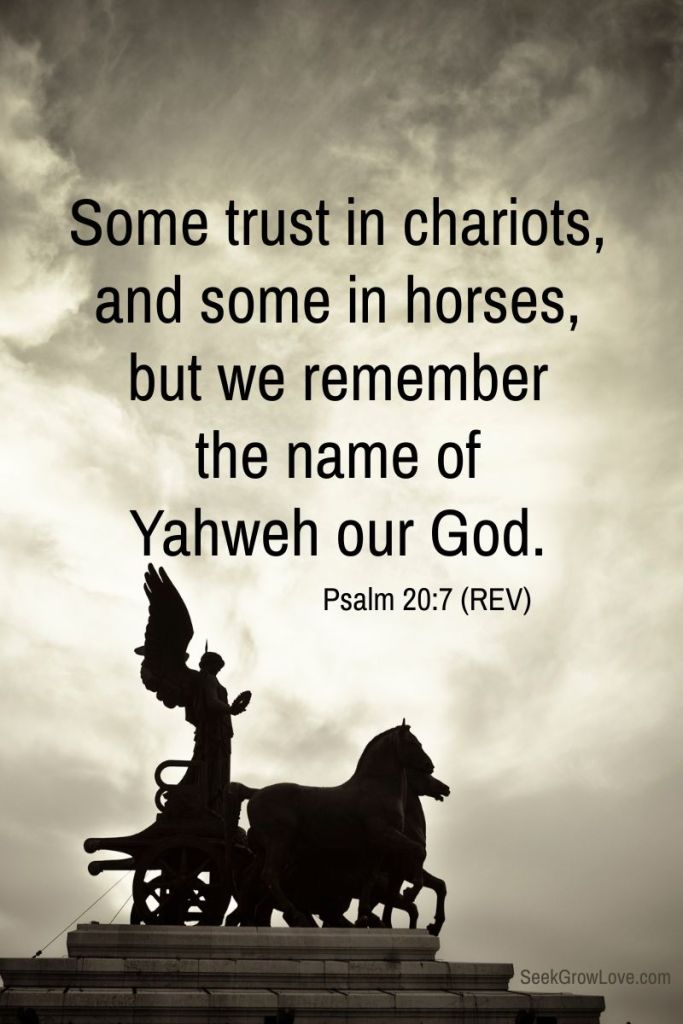
Some trust in chariots, and some in horses, but we remember the name of Yahweh our God.  – Psalm 20:7 (REV)

It is very easy to rely on our modern technologies for help. The United States spent around 1 trillion dollars on defense last year, and it is easy to look at that high spending and have some confidence that the US would have an upper hand in any conflicts that it is engaged in, and that soldiers might enjoy a higher level of safety. We can look at medical technologies and pharmaceuticals and have confidence that something out there can diagnose and treat our potential maladies.

Yet despite these great resources, soldiers still die, and people still get sick and do not receive the diagnosis or treatment that they want or need. Confidence can lead to letdowns when placed in earthly things.

In 1 Chronicles 19, we see King David extend kindness to his potential foes, only for it to be repaid with treachery and opposition. When the Ammonites realize that they have put themselves at odds with David, they amass a significant force of chariots to fend off any attacks. They put confidence in the technology of the day to help deliver them from the potential conflict with Israel.

As Psalm 20:7 says, some people put their trust in chariots and horses, but we remember – or put our trust in – Yahweh. David trusted his God to deliver him and his armies from whatever his enemies devised as a means of attack or defense strategy. David recognized God as sovereign and that God is capable of anything. Historically and personally, David knew that God used underdogs and laughably small forces to conquer the enemies of his chosen people.

We do not have promises from God that we will never suffer or experience pain, death, or illness. God does promise us redemption through the blood of his son Jesus. We have a promise of restoration for the earth, which is something that has never been accomplished by human effort, whether governmental or environmental.

-JJ Fletcher

Reflection Questions

  1. What will you put your trust in?
  2. Who will you put your trust in?
  3. Why is God’s provision so much more powerful than earthly promises?

Let’s Talk About Temptation

1 Corinthians 10-13

verse-of-the-day (1)

Tuesday, June 20

No temptation has overtaken you that is not common to man. God is faithful, and he will not let you be tempted beyond your ability, but with the temptation he will also provide the way of escape, that you may be able to endure it.  1 Corinthians 10:13


Let’s talk about temptation. Everyone is tempted, and everyone has succumbed to temptation at some point in their life, and probably numerous times. I will be the first to admit that fact in my own life. The first thing Paul does is acknowledge the universality of temptation—temptation is ubiquitous. Temptation is a common experience for all humankind. Some people might think that they are experiencing a unique type or degree of temptation, but Paul overwrites that attitude by confirming that no one is alone in experiencing any form of temptation, for every possible sort of temptation has been shared by other individuals.


We all struggle with temptation, that is the common thread that unites the human race. But unlike individuals who do not trust in God, the experience of temptation for believers can be different. Those who believe in God are not in a position of helplessness.


Some people have told me about their experience facing temptation, “I couldn’t help it. It was too appealing. I got tired of resisting. I just couldn’t stop myself.” The idea that there was nothing that could have been done to prevent sin is calling God a LIAR.


Paul says, “God is faithful!” What is God faithful for? He is faithful to: 1) limit the power of the temptation in your life, and 2) provide strength to endure or a possibility to remove the temptation. These are two promises of God when it comes to facing temptation. Either they are true or God is a liar. The problem many people face is that they doubt God is able to actually help them overcome temptation. They feel like it is all a matter of the will to resist temptation, and when their will weakens (as everyone’s does at some point), they feel like they just couldn’t continue to stand against the temptation and decide to just give in.


Satan is constantly battling for our mind and to entice our flesh. Elsewhere, Paul describes this battle in terms of “the schemes of the devil” and the “flaming darts of the evil one” (Eph. 6:11, 16). To combat these threats, Paul encourages believers to equip themselves with the “armor of God” (Eph. 6:11-17) in order to stand firm against the devil and his tactics and influence. While Paul describes a set of defensive armaments to be prepared to engage in spiritual warfare with the devil in Ephesians 6, his point in 1 Corinthians 10:13 is that of trust and reliance upon God to keep one’s foot from slipping and falling into sin.


It takes a resolved heart and mind to build the confidence that God will come through and be there in your time of need. Furthermore, there are two practices that can be of great help in overcoming temptation: 1) knowing Scripture (like verse 13) can turn the tables in the struggle against temptation, and 2) prayer.


If you are able to bring to mind what God has revealed about a particular temptation, it has the power to release the grip of the temptation to the point that you can endure it or eliminate the cause of the temptation altogether. That is the reason Paul calls Scripture the “sword of the spirit” (Eph. 6:17). It has the ability to defeat thoughts, attitudes, and desire that contend against the knowledge and will of God and to free a person from feeling like there is no other way out.


Secondly, prayer is always helpful and necessary when facing temptation. Temptations can come from our own desires or as a spiritual attack from the devil. Whichever it is, we can go to God in prayer asking for strength and wisdom to allow his will to prevail and to help us bring our body into subjection to what is godly and be led by the spirit away from the temptation. James writes in his letter, “If any of you lacks wisdom, let him ask God, who gives generously to all without reproach, and it will be given him” (Jas. 1:5).


If you struggle with a certain temptation, ask God for wisdom, and he will give it to you. And remember that we all have temptations, and nothing is new that we might encounter. God has seen it all before, and he has helped people through it all before. He promises to help you too, if you will but trust him and look to him for deliverance from it.


God is faithful, but do we have the courage to let him prove it?


-Jerry Wierwille


(Photo Credit: https://biblia.com/bible/niv/1%20Corinthians%2010.13)